
Religion
"The religious life of the Pueblos," says Edgar L. Hewett, "is the key to their existence. Their arts, industries, social structure, government, flow in orderly sequence from their beliefs concerning nature and deific power. ... In its essence it is almost what modern science has attained to—the conception of Nature and God as one."[20]
It is readily understood why the Indian felt so dependent upon the sky,
the earth, the sun, and the natural elements. He needed all these for the cultivation of his crops, from which he provided himself with food and clothing, and these things were needed for the growth of game. Everything in his daily existence depends upon them. He considers himself at one with the things about him. The whole world seems animate: each object in space or time exists and has a personality. There is no more concern over personal religious experience than over personal prestige and profit. His own importance in the scheme of existence is no more than that of a tree or a rabbit. "The religion of the Pueblos ... rests on two basic ideas: namely, a belief in the unity of life as manifested in all things, and in a dual principle in all existence, fundamentally, male and female."[21]
Pantheon of supernaturals.
—To this unified belief in nature there is added the belief that certain attributes exist only in particular forces. From this springs a kind of pantheon of supernaturals who embody these forces. Varying little throughout, they may be classed as: cosmic—sun, moon, stars, earth, and wind; animal—beast of prey, water serpent, and spider; ancestral, or the dead in general—the kachina, the skeleton, and the war gods.[22] All these supernaturals exhibit anthropomorphic characteristics and are said in myth to have mingled among men in human form. "Even the spirits conceived of as animals have only to remove their skins and they will become men in shape and appearance, although retaining their supernatural attributes and powers."[23] These supernaturals are graded according to their power and are believed to live in the under regions of the world as well as the four quarters and the heavens above. The importance attributed to them in the different pueblos seems to vary as the sphere of influence or function which they represent is of importance to that group.
Organizations.
—These forces, or beings, may be either friendly or hostile. They require respect and veneration. Gifts and assistance are sought from them by offerings, prayers, or magical practices, carried on by a complicated group of secret societies and fraternities.
These societies are practically unlimited and there is scarcely a limit to the number to which each man may belong. At adolescence every boy is initiated into a kachina cult or kiva society, an esoteric group which approaches the supernatural through ritual and sometimes through impersonation. A youth or man may, through a vow made in sickness, be promised to one of the medicine societies found throughout the pueblos, except in Picuris and Taos, where the kiva societies perform these rites; or, if he 'takes a scalp', he is forced to join the warriors' society to 'save' himself. He may be called upon to join the priesthood or, if he is connected with a sacerdotal household, he may be asked to fill an official position, or he may be appointed or elected to it. There are also innumerable cults. "Most men of advanced age are affiliated with several of these groups."[24]
Each esoteric cult is dedicated to the worship of some special supernatural or group of supernaturals. Each has a priesthood, a pattern of ritual, permanent paraphernalia, a calendric cycle of ceremonies, and a special place for the rehearsals, rites, and performances.
Kiva.
—In each pueblo there are two or more kivas.[25] A kiva[*] is a chamber or room built especially for the meetings of a group and used by its members as a clubhouse for the men, where they come together to talk and work.[26] It is here that many of the semipublic ceremonies take place. At certain times it can be called the theater for religious entertainment.
At Hopi each village has six kivas, in accordance with the cardinal directions. These are subterranean rooms, sometimes built in the mesa side with one exposed wall in which a small hole admits light and air, the roof being kept level with the mesa top. The rooms are rectangular and measure about twenty-five feet long and some fifteen feet wide.[27] About one-third of the floor space is raised a foot above the rest. This may be reserved for spectators of the indoor performances. In the center of
* "Kiva," says Ruth Bunzel, "is a Hopi word which has become the standardized term ... for the ceremonial rooms of peculiar construction which are found in all ancient and modern pueblos."
the roof is the entrance hatchway, through which the long ladder extends. Directly below this opening is the fireplace, a pit which uses the hatchway as a smoke hole. At the lower end a plank with a tightly plugged hole covers a cavity in the floor which represents the place of emergence from the inner worlds, and through which the prayers of the people are supposed to return to the Great Ones. Along one or more side walls is an earthen ledge which serves as a seat and, at the lower end, provides a shelf upon which religious paraphernalia are placed.
The six ceremonial chambers at Zuñi are square buildings incorporated in the house units. There is a hatchway entrance from above, as well as a communicating door to an adjoining house, and a small wall opening on the street side for air. A covered fireplace is found directly below the hatchway and earth ledges are built out from the walls. However, here there is no hole to the underworld.[28]
At Acoma, also, the seven ceremonial chambers are in the house blocks. They are designated as special buildings by the double ladders which lead to their roofs. The poles of these ladders are longer than ordinary, and the crosspieces at the tops are carved with designs suggestive of lightning symbols.[29] Only one of the Acoma chambers has the planked resonance hole in the floor.
One other kiva form is significant. In the Rio Grande region separate circular buildings may be found beside the dance plaza. They are semisubterrane, and sometimes the tops are built to a considerable height. A fine example at San Ildefonso has an outside stairway leading to the top, where a ladder through a hatchway leads one down into the interior. A small opening on the side provides light and air. At one dance I saw there, the more slender and agile dancers climbed in and out through this opening. In some places these round houses appear to be used by different groups and constitute a dressing room or exhibit space for ceremonies;[30] other rooms or kivas in the various Rio Grande pueblos serve as society
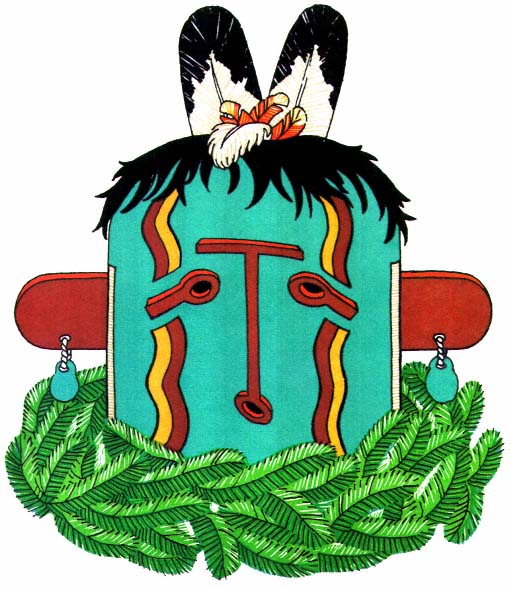
Plate 4.
Hehea, Hopi mask, with collar of evergreen.
and moiety headquarters. There may be several different types of kivas in one village; for example, Isleta has two round houses, two detached rectangular houses, and a separate building for general assemblage.[31]
Ritual.
—"There are definite fixed rituals and prayers for every ceremonial occasion."[32] The general form is a retreat followed by a dance.
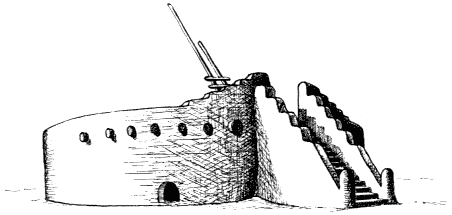
Figure 3.
Round kiva at San Ildefonso.
The retreat is always private, but the dance may be performed publicly in the plaza or semiprivately in the kivas or houses of the cult groups or in the home of the leader.
Along the Rio Grande the retreat lasts from one to four nights; farther west the retreat and subsequent dances may require as many as sixteen days. It is often preceded by a public announcement from the chief or town crier. For the period of retreat an arrangement of sacred objects is made at one end of the kiva. A formal altar of painted wooden slats is erected and decorated with feathers and spruce boughs. On the floor in front of the altar is a painting of special significance. It is made by a priest, and his materials are colored sands or corn meal, which he allows to run through his fingers into compositions delicate and beautiful. Bowls of medicine water and various objects with fetishistic powers are handled and set upon stipulated spots about the altar. Perfect ears of corn, which
sometimes are hollowed out and filled with a variety of native-grown seeds and decorated with beads and feathers, symbolize life tokens and represent the ceremonial chief, the clan head, or the individual society members. Crudely cut stone animal forms, wooden images, masks, and claws and skins of beasts of prey are placed in orderly groups. Altar masks are rarely worn in ceremonies. They are supposed to have come to the earth with the Pueblo people, and since they are so very old, they are regarded with great respect.[33]
Accompanying this altar setup are certain prayers and ritualistic observances. The most stylized as well as the most casual pattern is surrounded by a great background of myth and legend. These are handed down by word of mouth, and it is an important duty of men old in office and in years to instruct the younger men in all ritual forms, at the same time reminding the others of their backgrounds and origins. The form of the ritual is that of a chant which retells the myth centering in this particular rite and thus forms a background for the appearance of certain characters and the final public demonstration. Leslie White says of a religious observance at Santo Domingo: "The retreat as well as the subsequent masked dance is a little play. The medicine men go back to Shipap [the place of their emergence] to see the mother ... to get her to send [the Cloud People]. Hence the chamber into which the society retires is called Shipap. For four days the medicine men are not seen at all, for they are not in the pueblo. They are in Shipap. After the retreat is over the doctors reappear ... and a masked dance is held [they have brought the Shiwanna[*] back with them]."[34]
Those in retreat practice various forms of abstinence. Meat, grease, and salt are abstained from, and at certain times there is absolute fasting. Continence preceding and during any ceremonial action is held to be particularly important. Purification is required in all the pueblos. Bathing, especially washing of the hair, is of great significance. To insure in
* Shiwanna means Rain Makers, anthropomorphic spirits who bring rain.
ternal purification, emetics are taken each morning of the retreat and after the final dance.
The men who take part in the retreat are virtually prisoners. They spend all their time in the kiva or society chamber, where they perform rituals or prepare offerings, costumes, and the paraphernalia for the final performance.
The most common offering is the prayer stick. Its appearance and manufacture will vary with the pueblo in which it is made and the supernatural to whom it is dedicated. It is usually a small stick carefully smoothed and painted, and it has a dressing of various feathers attached with a homespun cotton cord. These are placed before ancient shrines or buried in the fields or at the river's edge. Another form of offering is corn meal or pollen. This may be sprinkled on the dancers, the altars, and the paraphernalia. Every morning those who hold sacerdotal positions make offerings of corn meal to the Sun. Corn meal is significant in every altar ceremony.
Cults.
—The Pueblo Indian early believed that he was dependent upon the Great Ones for his sustenance and well-being. Hence there grew up a cult, the Kachina Cult, for the worship of these Great Ones; and likewise cults of veneration for those beings or forces which regulated other phases of his existence. Inimical beings developed the War Cult; the desire for meat and skins created the Hunt groups; and the mysteries of bodily ills brought about the Medicine societies, the animal patrons of which were supposed to give them insight and power.
"The katcina cult is built upon worship principally through impersonation of a group of supernaturals."[35] Their cult "seems to be the most fundamental aspect of pueblo religion, although the katcina cult itself is probably a later overlay, upon an older weather control organization. The katcina spirits are supernaturals who bring rain and good health. They were created at the time of the first emergence of the people from their underground home or shortly thereafter. Some of the pueblos say
that part of the people fell in the water and were drowned after the emergence, thus becoming katcina."[36]
These supernaturals live in an underground world[37] or beneath the surface of the Sacred Lake, as at Zuñi.[38] The new-born are thought to come from one of these places, and the dead return there. Here the kachinas spend their time in singing and dancing. They possess rich clothing, valuable beads, and beautiful feathers. A very long time ago, the legends tell, the kachinas, whenever the people were lonely and sad, would come to entertain them with singing and dancing in the plazas, or perhaps in specially prepared houses of the pueblo. This would bring gaiety and joy to all the people. When the fields were parched and dry, the kachinas would come bringing the refreshing and revivifying rain. They particularly watched over the Pueblo peoples and provided for them. At Zuñi, it is said that each time the kachinas came they took one of the people back with them into the underground world; thus at Zuñi the joy at the coming of the kachinas was not unmixed with sorrow.[39] At Acoma there was a great fight because the people had mocked and criticized the kachinas.[40] As a result the kachinas decided that it would be better if they no longer visited the village in person. They therefore showed the people how to copy their masks and costumes, taught them their songs and dances, and exhorted them to perform the dances correctly, to live good lives in observation of custom and ritual, and to honor and respect the kachina. In return the supernaturals would come and be with them in spirit and would bring prosperity.
As soon as the impersonator dons the mask of the supernatural, he is believed to become that spirit. As a consequence he is supernatural and must not be approached or touched during the ceremonies, and he must be discharmed after the ceremonies before he again becomes mortal. "Instituted according to tradition, solely as a means of enjoyment, they
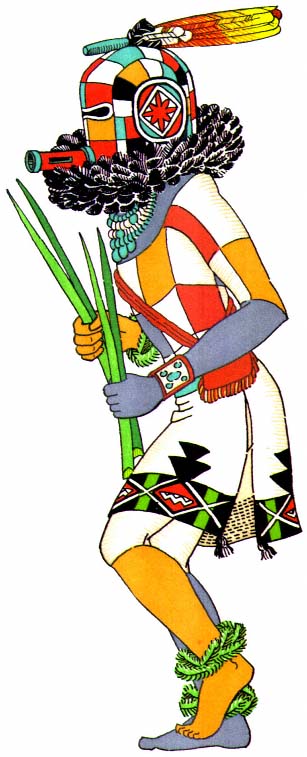
Plate 5.
Many-colored Zuñi Salimapiya of the Zenith, with collar of ravens
feathers,bandoleer pouch, and special feather mask ornament.
[the kachina ceremonies] have become the most potent of rain-making rites, for since the divine ones no longer appear in flesh they come in their other bodies, that is, as rain."[41]
"The katcina or masked figure has been as baffling in pueblo ceremonialism as any of its baffling features. The general concept of the katcina is simple enough. A wearer of the mask represents, in fact embodies, a beneficent supernatural bringer of rain and of abundant crops, but in the katcina conceptual complex in detail there is considerable variation as to particular supernaturals, their origin and their habitats: and as for katcina ceremonial organization or rather association of the katcina with ceremonial organizations, that differs everywhere, from tribe to tribe, even from town to town."[42]
Throughout the span of pueblos all the men belong to one or more tribal units which are associated with the Kachina Cult. In a few villages where the cult is nonexistent the ceremonial organizations center in the moiety, replete with secret rites and ritualistic paraphernalia. In the western pueblos there are six kachina groups, identified with the six directions: south, west, east, north, zenith, and nadir. Each one is lodged in its own kiva. Women, girls, and uninitiated boys are supposed not to know that the supernaturals are being impersonated by their own clansmen.
The dance.
—The climax of each ceremonial period is the prayer drama, a reverential, solemn, ecstatic final dance. It comes at the end of the rigors of retreat and abstinence and concludes the myths and legends the unfolding of which constitutes each ceremonial observance. Originated to give joy and pleasure to the supernaturals, it has been continued as an entertainment for them and as a means of instruction, diversion, and worship for every man, woman, and child in the community. An eminent ethnologist has pointed out that here is "the best round of theatrical entertainment enjoyed by any people in the world, for nearly every ceremony has its diverting side, for religion and drama are here united as in primitive times."[43]
Even the simplest dance has a variety of patterns, and the artistic costuming and stylized action keep the spectators enthralled. A performance may pantomime the story of a certain culture hero, or a legendary figure, or it may exhibit a pageant of numerous and varied characters. The mimetic Animal and Bird dances revert to a belief in an animate world where, in the long ago, man and beast lived together and understood each other. In order to pantomime the hunt, that time must be reinfused with life as when animals gave their lives willingly to aid their human brothers. At the more elaborate dances the clowns are always present. Each village has two groups of very powerful priests who masquerade as grotesque characters symbolic of their mythical origins. The clown-priest phase is universal among all the pueblos, but the grotesquetie varies.
The Mudhead is a well-known Hopi-Zuñi clown with a baglike mask (pl. 40). This mask and the body of the clown are painted earth color with clay from the Sacred Lake. The "Chiffoneti"[*] of the Rio Grande region are unmasked (pl. 39), and their bodies are painted in black and white stripes to represent the spirits of the dead. Although these clowns are the most powerful priests and intermediaries to the gods, they act the buffoon and perform impromptu interludes between the dances. They make sport of individual and group, caricaturing individual eccentricities or satirizing group foibles, and when a direct hit is scored the glee of the nonvictims breaks forth in raucous laughter. They are the censors, the mediators, and the judges for the social life of the village. Sometimes they play games or mimic the performance just ended.
These clowns are always present at kachina dances. Herbert Spinden repeats in part the dialogue with which they drew the Cloud People to a certain ceremony:
"At the appointed time all the villagers go to the underground lodge and seat themselves in readiness for the performance. Soon two clowns appear at the hatchway in the roof and come down the ladder. They
* A present-day Mexican term, commonly used.
make merry with the spectators. Then one says to the other: "My brother, from what lake shall we get our masked dancers tonight?' 'Oh, I don't know. Let's try Dawn Canyon Lake. Maybe some Cloud People are stopping there; Then one clown takes some ashes from the fireplace and blows it out in front of him. 'Look, brother; he says, 'do you see any Cloud People?' They peer across the ash cloud and one says, 'Yes, here they come now. They are walking on the cloud. Now they stop at Cottonwood Leaf Lake'. Then the other clown blows ashes and the questions are repeated. Thus the Cloud People are drawn nearer and nearer until they enter the village. The clowns become more and more excited and finally cry, 'Here they are now!' and the masked dancers stamp on the roof and throw game, fruit and cakes down the hatchway."[44]
Since the Pueblo Indians are fundamentally a peace-loving people, the so-called "war dances" were usually borrowed, sometimes actually purchased, from other tribes which were often their deadliest enemies. These dances then were known by that tribe's name, that is, Navaho, Pawnee, or Apache. The ceremony of the dance is learned in its entirety, even to the chant in a foreign language, and the dress is copied or simulated. Thus the dance can be used as counter-magic against those who originated it, although it is sometimes used merely as picturesque entertainment.
As we have noted, the dance is the event of principal importance in all these ceremonial performances. It is not a dance such as we are familiar with, but a stately movement to a solemn chant—a symbolic and pictorial rhythm which is an outgrowth of prayer just as were the medieval dramas when the Biblical stories were unfolded in action before the high altar. The result is prayer and entertainment, church and theater. Those who perform believe they are benefiting the entire community, even the outside world. Those who watch have also lent their support. During the days of retreat and ceremony the preparation of food for the performers falls upon the women members. Often one society will provide the dance which accompanies the prayers of another society performing the kiva
rites. Each person in the village gives offerings and blessings. For the final performance the people stand silently in solid blocks, looking down from the terraced housetops, or they sit motionless upon the plaza ledges. Between dances there is quiet conversation, gossip, or the subdued hailing of visitors from a far-off pueblo. These are community affairs and everyone must take part at some time during the year. The Zuñi kiva societies are required to present at least three group dances from one winter solstice to the next.[45] Thus those who do not perform are always interested and sympathetic spectators.
At the dances performed in the individual society rooms the audience is composed mainly of the women and children group members, as the men are usually participating. Seated along the sides of the room or at the raised end, they remain quietly attentive, without a change in expression, watching for hours the movement of the dance. Several groups may combine for a presentation in which each performs its own act or dance. These separate numbers are repeated simultaneously in each of the participating kivas.
The dance patterns are very simple. The most common is a long line which moves as a single unit. There may be one row of men working in perfect unison, one foot of each man raised to the same height at the same moment; or there may be two rows facing each other, with steps varied to suit the type of impersonation. Dancers depicting male characters dance more forcefully than those depicting female characters. In the Rain Dance the line of fifty or sixty dancers is squared around three sides of the plaza, but there is no circular action. The dancers themselves turn, and pause, and turn again, the sweep of movement running through the line like a breath of wind through stalks of ripening grain.
A circular pattern is followed in the women's society dances and in
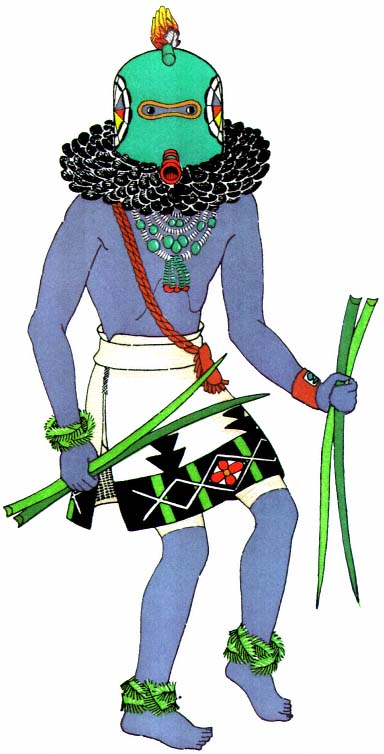
Plate 6.
Zuñi blue Salimapiya of the West, whose body stain is
the fluid from cornhusks. A special kilt bas a wide border
of embroidery. Prophetic yucca leaves are carried.
those performed for curing and for war. The movement is continuous in one direction, with the participants facing the center.
A more elaborate pattern is made up of several movements. In the Rio Grande pueblos, "the public dances in the plaza are more or less processional but the advance is very slow. There are definite spots of stationary dancing and here countermarching is used to make a new quadrille-like formation."[46] Two men are followed by two women, each pair dancing as a single unit. There are no complicated figures or interweaving of dancers.
The dance steps look extremely simple. The usual one consists of a vigorous stamping with the right foot while the heel of the left foot is only slightly raised. In more lively dances both feet leave the ground alternately and give the appearance of sustaining the body in air. About these steps there is a feeling of eternity, as if, since time began, generations, nay, races of dancers had beaten with their feet the surface of the earth to obtain from it strength and power. Women often dance barefoot in order to receive fecundity from the mother of mothers. There are few arm gestures and little posturing. Each dancer has splendid body control. It is enthralling to see the vigorous movement continue without a break for fifteen or twenty minutes at regular intervals throughout the day.
Certain of the Bird dances require great strength and skill for the wheeling and circling movements which give the illusion of winged flight. The footwork is sure and delicate and the precision of each performance is remarkable. These dances as a whole are full of color and imaginative stylization based upon a hypnotic rhythm. The peculiar pulsation is almost impossible to imitate for anyone not born to the sound. The rhythm is regular, but there are skip beats and pauses which occur simultaneously in drumbeat, song, and dance.
Usually, percussion instruments provide the accompaniment for the dance. Drums vary from hollowed logs and pottery jars with skin heads to flat tom-toms. They are beaten with sticks made with a hooped end or wrapped with cotton. Rattles of gourd, turtle shell, and rawhide bags
filled with pebbles or seeds are carried by most of the dancers.[47] Notched sticks may be rasped against each other on a sounding board of wood or gourd. Occasionally, bird-bone whistles are heard—shrill notes above the steady drone of drumbeat and human voice.
All dances are also accompanied by songs or chants sung by a chorus or by the dancers themselves. Some of the songs are so old that the lan-
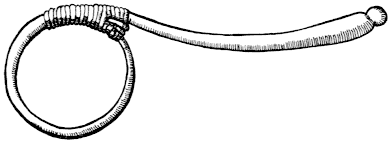
Figure 4.
Hopi drumstick, bent into shape when green and
bound with deerskin thong, forming a looped end.
guage is obsolete and even the singers do not know the meanings of the sounds. On the other hand, some of the old dances have new songs composed for them for each performance.[48]
The masked dances, even those in which female characters appear, are performed exclusively by men. Women take part in most of the other dances. The Corn Dance has an equal number of men and women. The Hunt Pantomimes have one or two maidens who personify the animal mothers. The women's societies perform dances in which only women and girls take part.
The dance leader always takes his position in the center of the line. The priest of the group appears at the head of the line. He does not dance, but stands chanting or praying as he displays a feather badge of office or a banner of ceremonial significance. Whenever a chorus is required, it is grouped around him.