
Missa Pour L'amour D'une
One of the anonymous Masses in SPB80 is almost certainly by Faugues, for reasons structural, mensural, melodic, and contrapuntal. The three-voiced Missa Pour l'amour d'une (fols. 154v-66), copied into the earliest layer, likely dates from the 1450s or the early 1460s. The lone concordance for this Mass is an Italian treatise on proportions that includes a portion of the Crucifixus.[1] The source of the cantus firmus does not survive, but as with all known Masses of Faugues it is a chanson, probably polyphonic. Adhering to another trademark of Faugues, the Missa Pour l'amour repeats the music from one Mass movement for another. In this case the music of the Kyrie II returns for the Osanna, a repetition Faugues also used in the Missa L'homme armé and the Missa La basse danse . Although the same type of duplication happens as well in the anonymous Missa Au chant de l'alouete in SPB80, in Obrecht's Masses on Adieu mes amours and Libenter gloriabor , and others, in none of these Masses can one also find so many other characteristics of Faugues.
Generally the mensural organization in a Mass by Faugues contains few complexities. Tinctoris he is not. The compilation of his mensural signs presented in Table 19 shows the limited range of his mensural successions and combinations at a glance. The Missa La basse danse is
[1] The treatise is preserved in Per1013, fols. 78-123. Most of the numerous examples are by Tinctoris. Aside from many anonymous examples, there are three by Du Fay, one by Busnois, and four by Faugues (not counting this Crucifixus). On the treatise see Bonnie Blackburn, "A Lost Guide to Tinctoris's Teachings Recovered," 31-45.
EXAMPLE 13. Missa Pour l'amour , Benedictus, min. 1-8

the most intricate, with the tenor often in tempus imperfectum prolatio maior while the other parts move in tempus perfectum diminutum . The simplest Mass in this regard and perhaps also one of the latest, the Missa Je suis en la mer , has only two signs used in alternation. Faugues curiously refrains from employing ternpus imperfectum and relies instead exclusively on tempus imperfectum diminutum . This last trait also exists in the anonymous Missa Pour l'amour , but with a telling deviation in the Benedictus.
Twice in the Missa Pour l'amour a proportional relationship between separate voices is indicated not with proportions but by combining unequal mensuration signs. In the Crucifixus duet beginning at "Et iterum," the superius moves in tempus perfectum against tempus imperfectum diminutum in the bass. Notationally this causes a semibreve in the bass to equal a minim in the superius (or, as in Exs. 13-17, a half note in one voice to equal a quarter in the other). In the Benedictus duet the proportional relationship becomes all-pervasive. By means of continually changing mensuration signs and proportions, the speed increases incrementally. Beginning in Example 13 with a proportio dupla —superius in tempus imperfectum diminutum and bass in tempus imperfectum —the duet eventually doubles the tempo to conclude in another proportio dupla. In between the music passes through other proportions: sesquitertia (4: 3) in measures 31-36, dupla again in measures 37-48, and sesquialtera (3:2) in measures 49-52, although the latter effectively disappears when the lower duple voice becomes triple with coloration. Expressed in terms of the numbers of semibreves, the ratios in this remarkable movement progress from 4:2 to 4:3, 6:3, 3:2, and 4:2 (2:1). It is fitting that in the central 6:3 proportio dupla there is a passage of strict imitation at the octave; thus one part follows the other at the Pythagorean interval 2:1.
Faugues achieves the same 2:1 proportional relationship in his La
basse danse and L'homme armé Masses when he writes simultaneously in tempus imperfectum prolatio mairo and in tempus perfectum diminutum . A semibreve under the former sign equals a breve under the latter. Indeed, Tinctoris specifically cites Faugues when he discusses this practice in the following passage of the Proportionale musices :
Others, indeed, place for the sign of the duple proportion only the sign of tempus imperfectum and minor prolation with a tail drawn through it, as that [sign] for the speeding up of the measure mentioned above, a method in which the melody is popularly called 'half time' [ad medium ].... This, as I am satisfied with De Domarto and Faugues in the Masses Spiritus almus and Vinus , so sung [with] this sign, I find tolerable because of a certain equivalence of the former proportion and the latter proportion; for when something is sung in 'half time', two notes are thus measured through the double proportion of one.[2]
Unfortunately, in the one extant source that preserves the Missa Vinnus vina , CS51, there is no such passage.[3] The operative word here is extant , because a scribe who did not approve of this usage, or who found it old fashioned, could easily have transformed the unequal voices into the same note values. Passages combining tempus imperfectum and tempus imperfectum diminutum could have existed in any of several spots in the Missa Vinnus vina . The lengthy maximae in cut-C that stretch out the cantus firmus in the Qui sedes and Et in spiritum would be longae in tempus perfectum . Or as in the Missa Pour l'amour , the Crucifixus has a phrase of strict imitation at "Et iterum venturus est," with a texture easily adaptable to one voice in tempus perfectum . Still closer to the proportional passages found in the Missa Pour l'amour , the Benedictus has not only the same text, but it is also for the most part a duet, the most extensive in the Mass.
Hypothetical as it may be to ponder what this or that portion of the
[2] I have slightly altered the translation of Albert Seay, "The 'Proportionale musices,' of Johannes Tinctoris," 41. The Latin version is in Johannes Tinctoris, Opera theoretica , ed. Albert Seay, 2a:45-46. On Faugues and the Missa Vinnus vina , see below, pp. 188-94.
[3] In his edition of Tinctoris, Proportionale musices (Tinctoris, Opera theoretica , 2a:46, n. 23), Seay wrongly reports that the Sanctus begins with a cut-circle in the superius and a circle in the other voices. He cites as his source not the manuscript but the incipit found in Llorens's catalogue, the Capellae Sixtinae codices musicis notis instructi sire manu scripti sire praelo excussi , 489, where the alleged, but erroneous, combination of mensuration signs appears.
EXAMPLE 14. Comparison of (a) Missa Pour l'amour , Benedictus, mm. 9-17; and (b) Faugues, Missa La basse danse , Benedictus, mm. 21-27
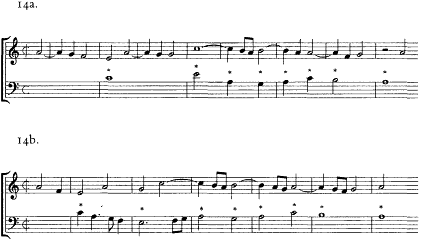
Missa Vinnus vina might have looked like before a mensural transformation, this speculation is not idle. Several phrases found in proportional notation in the Benedictus of the Missa Pour l'amour also exist virtually note for note in Faugues's Missa La basse danse , notated conventionally; even the rhythms are often the same. These segments appear side by side in Examples 14-17. The first instance (Ex. 14) involves a duet within the three-voice Benedictus of the Missa La basse danse (an asterisk marks the bass notes in common).[4] These two phrases include the first important cadence in the respective movements.
For the next two excerpts from the Missa La basse danse , Qui tollis, I have reduced three voices to two. The lower of the two voices in each example takes some notes from both the contra and bass voices. In Example 15 the contra supplies most of the lower voice, except for the last notes from the bass; in Example 16 the first three notes come from the contra, the rest from the bass. The superius parts are virtually identical. Both segments in Example 15 begin with a cadence on a, descend to a cadence an octave lower, and then move ahead. And
[4] A similar passage also exists in the revised Agnus II of the Missa L'homme armé (mm. 46-50).
EXAMPLE 15. Comparison of (a) Missa Pour l'amour , Benedictus, mm. 48-56; and (b) Faugues, Missa La basse danse , Qui sedes, mm. 20-29
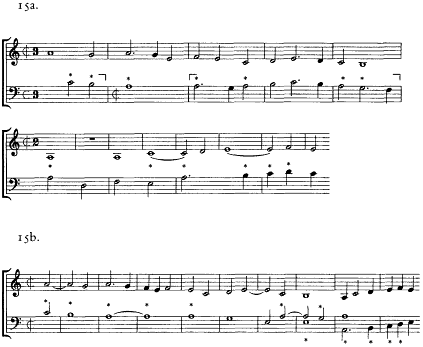
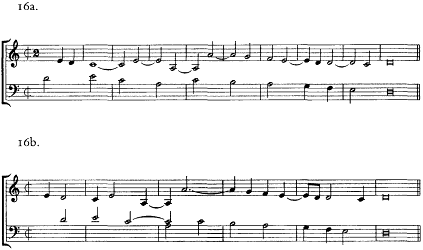
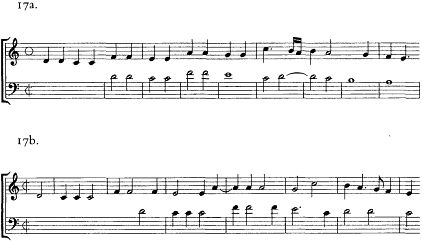
Example 16 shows the final, identical, phrases of each movement. Yet another segment of the Missa Pour l'amour Benedictus exists in the Agnus II trio of Faugues's Missa Le serviteur .[5] Together these examples account for almost half of the Benedictus, twenty-nine measures out of sixty-nine, including most of the free counterpoint unrelated to the cantus firmus. Finally, a proportionally notated phrase of the Crucifixus in the Missa Pour l'amour appears in the Missa La basse danse , both with the same text, "Et iterum" (Ex. 17).
The scope of these similarities provides additional evidence for naming Faugues as the composer of the Missa Pour l'amour . As contrapuntal passages they carry more weight than single-voice correspondences
[5] Missa Pour l'amour , Benedictus, mm. 25-30 corresponds to the Missa Le serviteur , Agnus II, mm. 21-26.
EXAMPLE 16. Comparison of (a) Missa Pour l'amour , Benedictus, mm. 65-69; and (b) Faugues, Missa La basse danse , Qui sedes, mm. 74-79
EXAMPLE . 17. Comparison of imitation in (a) Missa Pour l'amour , Crucifixus (Et iterum); and (b) Faugues, Missa La basse danse , Crucifixus (Et iterum)
(though these exist as well). But aside from this, the discovery of passages notated once proportionately and once uniformly provides new examples of scribes exercising the freedom to renotate music with different mensuration signs. Given the extensive liberties that Nicholaus Ausquier took in SPB80 with the mensuration signs of the Du Fay motet and Missa Ave regina coelorum , this second point is of interest because the alterations could stem from the composer himself.
There are additional melodic similarities between the Missa Pour I' amour and the Missa La basse danse . The Crucifixus of the Pour l'amour and La basse danse Masses begin with the stock-in-trade d-f-e-a' motive. Among the approximately eighty instances of this motive that I am aware of from this period, these are the only two with the Crucifixus text. And the Et in terra of the La basse danse Mass combines two familiar motives, the so-called English 1-3-4-5 motive and a rising octave and descent known in several L'homme armé Masses as the second tune (Ex. 18). These motives also occur together in the Missa Pour l'amour at the start of the Confiteor. Both motives are commonplaces, but in combination they represent yet another link between Faugues's style and this anonymous work. As in the preceding examples, the slower note values in Example 18b do not indicate a slower tempo, only the diminished mensuration sign.
The second of these motives also figures contrapuntally in both the Pour l'amour and La basse danse Masses. In the anonymous Mass this motive opens the Qui sedes imitatively, while in the phrase from Faugues's Et in terra (also seen in Ex. 18) the contra parallels in thirds. What distinguishes each of these movement-opening passages, however, is not the counterpoint but the way in which an abbreviated version of the motive also crops up at the very end of the preceding section, also in imitation. As if in preparation for the next movement beginnings, these concluding motives commence immediately after the penultimate cadences of their respective movements, thirteen imperfect breves from the end of the Qui tollis in the Missa Pour l'amour , and just four perfect breves from the end of the Kyrie II in the Missa La basse danse .
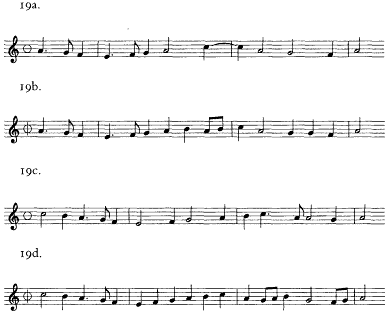
Another motive turns up in almost every movement of these two Masses. The figure usually appears at cadences in tempus perfectum , most often in some form of a triplet rhythm, either dotted, trochaic (long-short), or iambic (short-long). Example 19 has two from each Mass.
EXAMPLE 18. Motivic comparison of (a) Missa Pour l'amour , Confiteor, ram. 1-6; and (b) Faugues, Missa La basse danse , Et in terra, min. 1-12
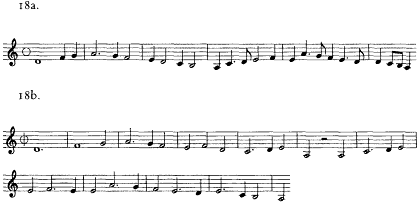
EXAMPLE 19. Comparison of cadential patterns in (a) Missa Pour l'amour , Kyrie I, mm. 6-9; (b) Faugues, Missa La basse danse , Sanctus, mm. 20-23; (c) Missa Pour l'amour , Et in terra, mm. 7-10; and (d) Faugues, Missa La basse danse , Cum Sancto, min. 34-37
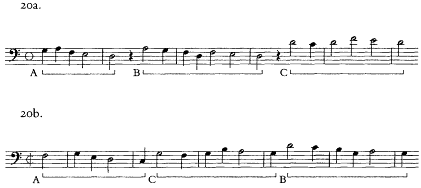
EXAMPLE 20. Comparison of formulaic motives in (a) Missa Pour l'amour , Agnus I, ram. 18-23; and (b) Faugues, Missa Le serviteur , Benedictus, mm. 38-44
While these fit easily enough in a triple meter, Faugues also maintained the motive in this form during movements in tempus imperfectum .
Further contrapuntal and mensural correspondences exist with Faugues's Missa Le serviteur . The motivic techniques shown in Example 20 testify to the formulaic nature of much of Faugues's imitative writing. The three phrases labeled A, B, and C occur in each Mass successively, but in different orders. All three occur often among composers of Busnois's generation. Yet the way in which they appear, not just patched together one after another but also in strict imitation at a distance of one breve (both perfect and imperfect), suggests a composer relying on flexible and familiar improvisational patterns.[6] Supplementing these motivic considerations, the sectional lengths and mensuration signs of individual movements of the Missa Pour l'amour share characteristics
[6] Among several other contrapuntal similarities, a motive related to phrase b of Ex. 20 occurs in both Masses at a variety of imitation intervals: two perfect breves (Missa Pour l'amour , Qui tollis, mm. 41-47), two imperfect breves (Missa Le serviteur , Benedictus, mm. 17-21), one-and-a-half imperfect breves (Missa Pour l'amour , Patrem, mm. 6-9), and one perfect breve (Missa Le serviteur , Christe, mm. 70-76). In each Mass the cadential formula in the bottom voice happens both at the lower octave and at the upper. A loosely imitative passage in the Patrem (mm. 25-30) of the Missa Pour l'amour runs the same course as a passage in the original Agnus II of the Missa L'homme armé (mm. 9-12).
with Faugues's Missa Je suis en la mer . For three of the Mass movements—Kyrie, Sanctus, and Agnus—the lengths of sections are quite close, at times even exact. As shown in Table 20, where these movements are compared, the three opening sections correspond exactly, and the mensuration signs differ only for the Osanna.
The pervasive motivic similarities, together with the characteristic repetition of music between Mass movements and the Faugues-like mensural practices (especially the use of unequal mensuration signs to specify proportions), constitute grounds for attributing the Missa Pour l'amour to Faugues. Aside from increasing the number of Masses by Faugues to six—together with the Missa Vinnus vina —rather than the four published in his "complete works," the attribution of a Mass in SPB80 to Faugues adds another Italian manuscript to the other uniformly Italian sources of his works. The Missa Pour l'amour is not necessarily earlier than the Missa Le serviteur or the Missa La basse danse . All are quite compatible with a dating of circa 1455-65 and the mensuration signs differ only for the Osanna.