
Chapter Seven—
Faugues:
Attribution and Association
Missa Pour L'amour D'une
One of the anonymous Masses in SPB80 is almost certainly by Faugues, for reasons structural, mensural, melodic, and contrapuntal. The three-voiced Missa Pour l'amour d'une (fols. 154v-66), copied into the earliest layer, likely dates from the 1450s or the early 1460s. The lone concordance for this Mass is an Italian treatise on proportions that includes a portion of the Crucifixus.[1] The source of the cantus firmus does not survive, but as with all known Masses of Faugues it is a chanson, probably polyphonic. Adhering to another trademark of Faugues, the Missa Pour l'amour repeats the music from one Mass movement for another. In this case the music of the Kyrie II returns for the Osanna, a repetition Faugues also used in the Missa L'homme armé and the Missa La basse danse . Although the same type of duplication happens as well in the anonymous Missa Au chant de l'alouete in SPB80, in Obrecht's Masses on Adieu mes amours and Libenter gloriabor , and others, in none of these Masses can one also find so many other characteristics of Faugues.
Generally the mensural organization in a Mass by Faugues contains few complexities. Tinctoris he is not. The compilation of his mensural signs presented in Table 19 shows the limited range of his mensural successions and combinations at a glance. The Missa La basse danse is
[1] The treatise is preserved in Per1013, fols. 78-123. Most of the numerous examples are by Tinctoris. Aside from many anonymous examples, there are three by Du Fay, one by Busnois, and four by Faugues (not counting this Crucifixus). On the treatise see Bonnie Blackburn, "A Lost Guide to Tinctoris's Teachings Recovered," 31-45.
EXAMPLE 13. Missa Pour l'amour , Benedictus, min. 1-8

the most intricate, with the tenor often in tempus imperfectum prolatio maior while the other parts move in tempus perfectum diminutum . The simplest Mass in this regard and perhaps also one of the latest, the Missa Je suis en la mer , has only two signs used in alternation. Faugues curiously refrains from employing ternpus imperfectum and relies instead exclusively on tempus imperfectum diminutum . This last trait also exists in the anonymous Missa Pour l'amour , but with a telling deviation in the Benedictus.
Twice in the Missa Pour l'amour a proportional relationship between separate voices is indicated not with proportions but by combining unequal mensuration signs. In the Crucifixus duet beginning at "Et iterum," the superius moves in tempus perfectum against tempus imperfectum diminutum in the bass. Notationally this causes a semibreve in the bass to equal a minim in the superius (or, as in Exs. 13-17, a half note in one voice to equal a quarter in the other). In the Benedictus duet the proportional relationship becomes all-pervasive. By means of continually changing mensuration signs and proportions, the speed increases incrementally. Beginning in Example 13 with a proportio dupla —superius in tempus imperfectum diminutum and bass in tempus imperfectum —the duet eventually doubles the tempo to conclude in another proportio dupla. In between the music passes through other proportions: sesquitertia (4: 3) in measures 31-36, dupla again in measures 37-48, and sesquialtera (3:2) in measures 49-52, although the latter effectively disappears when the lower duple voice becomes triple with coloration. Expressed in terms of the numbers of semibreves, the ratios in this remarkable movement progress from 4:2 to 4:3, 6:3, 3:2, and 4:2 (2:1). It is fitting that in the central 6:3 proportio dupla there is a passage of strict imitation at the octave; thus one part follows the other at the Pythagorean interval 2:1.
Faugues achieves the same 2:1 proportional relationship in his La
basse danse and L'homme armé Masses when he writes simultaneously in tempus imperfectum prolatio mairo and in tempus perfectum diminutum . A semibreve under the former sign equals a breve under the latter. Indeed, Tinctoris specifically cites Faugues when he discusses this practice in the following passage of the Proportionale musices :
Others, indeed, place for the sign of the duple proportion only the sign of tempus imperfectum and minor prolation with a tail drawn through it, as that [sign] for the speeding up of the measure mentioned above, a method in which the melody is popularly called 'half time' [ad medium ].... This, as I am satisfied with De Domarto and Faugues in the Masses Spiritus almus and Vinus , so sung [with] this sign, I find tolerable because of a certain equivalence of the former proportion and the latter proportion; for when something is sung in 'half time', two notes are thus measured through the double proportion of one.[2]
Unfortunately, in the one extant source that preserves the Missa Vinnus vina , CS51, there is no such passage.[3] The operative word here is extant , because a scribe who did not approve of this usage, or who found it old fashioned, could easily have transformed the unequal voices into the same note values. Passages combining tempus imperfectum and tempus imperfectum diminutum could have existed in any of several spots in the Missa Vinnus vina . The lengthy maximae in cut-C that stretch out the cantus firmus in the Qui sedes and Et in spiritum would be longae in tempus perfectum . Or as in the Missa Pour l'amour , the Crucifixus has a phrase of strict imitation at "Et iterum venturus est," with a texture easily adaptable to one voice in tempus perfectum . Still closer to the proportional passages found in the Missa Pour l'amour , the Benedictus has not only the same text, but it is also for the most part a duet, the most extensive in the Mass.
Hypothetical as it may be to ponder what this or that portion of the
[2] I have slightly altered the translation of Albert Seay, "The 'Proportionale musices,' of Johannes Tinctoris," 41. The Latin version is in Johannes Tinctoris, Opera theoretica , ed. Albert Seay, 2a:45-46. On Faugues and the Missa Vinnus vina , see below, pp. 188-94.
[3] In his edition of Tinctoris, Proportionale musices (Tinctoris, Opera theoretica , 2a:46, n. 23), Seay wrongly reports that the Sanctus begins with a cut-circle in the superius and a circle in the other voices. He cites as his source not the manuscript but the incipit found in Llorens's catalogue, the Capellae Sixtinae codices musicis notis instructi sire manu scripti sire praelo excussi , 489, where the alleged, but erroneous, combination of mensuration signs appears.
EXAMPLE 14. Comparison of (a) Missa Pour l'amour , Benedictus, mm. 9-17; and (b) Faugues, Missa La basse danse , Benedictus, mm. 21-27
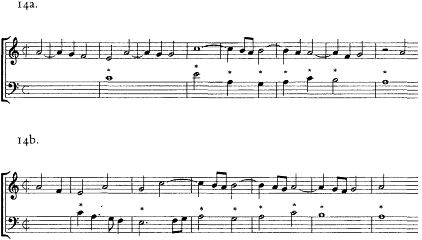
Missa Vinnus vina might have looked like before a mensural transformation, this speculation is not idle. Several phrases found in proportional notation in the Benedictus of the Missa Pour l'amour also exist virtually note for note in Faugues's Missa La basse danse , notated conventionally; even the rhythms are often the same. These segments appear side by side in Examples 14-17. The first instance (Ex. 14) involves a duet within the three-voice Benedictus of the Missa La basse danse (an asterisk marks the bass notes in common).[4] These two phrases include the first important cadence in the respective movements.
For the next two excerpts from the Missa La basse danse , Qui tollis, I have reduced three voices to two. The lower of the two voices in each example takes some notes from both the contra and bass voices. In Example 15 the contra supplies most of the lower voice, except for the last notes from the bass; in Example 16 the first three notes come from the contra, the rest from the bass. The superius parts are virtually identical. Both segments in Example 15 begin with a cadence on a, descend to a cadence an octave lower, and then move ahead. And
[4] A similar passage also exists in the revised Agnus II of the Missa L'homme armé (mm. 46-50).
EXAMPLE 15. Comparison of (a) Missa Pour l'amour , Benedictus, mm. 48-56; and (b) Faugues, Missa La basse danse , Qui sedes, mm. 20-29
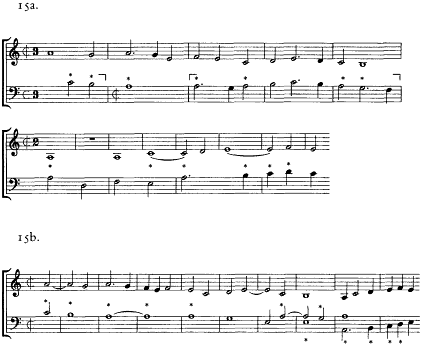
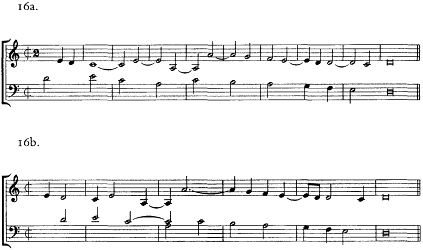
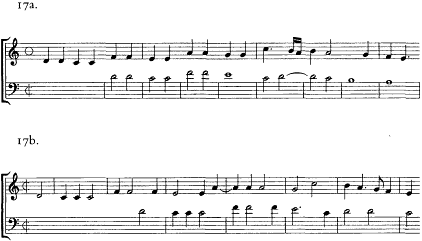
Example 16 shows the final, identical, phrases of each movement. Yet another segment of the Missa Pour l'amour Benedictus exists in the Agnus II trio of Faugues's Missa Le serviteur .[5] Together these examples account for almost half of the Benedictus, twenty-nine measures out of sixty-nine, including most of the free counterpoint unrelated to the cantus firmus. Finally, a proportionally notated phrase of the Crucifixus in the Missa Pour l'amour appears in the Missa La basse danse , both with the same text, "Et iterum" (Ex. 17).
The scope of these similarities provides additional evidence for naming Faugues as the composer of the Missa Pour l'amour . As contrapuntal passages they carry more weight than single-voice correspondences
[5] Missa Pour l'amour , Benedictus, mm. 25-30 corresponds to the Missa Le serviteur , Agnus II, mm. 21-26.
EXAMPLE 16. Comparison of (a) Missa Pour l'amour , Benedictus, mm. 65-69; and (b) Faugues, Missa La basse danse , Qui sedes, mm. 74-79
EXAMPLE . 17. Comparison of imitation in (a) Missa Pour l'amour , Crucifixus (Et iterum); and (b) Faugues, Missa La basse danse , Crucifixus (Et iterum)
(though these exist as well). But aside from this, the discovery of passages notated once proportionately and once uniformly provides new examples of scribes exercising the freedom to renotate music with different mensuration signs. Given the extensive liberties that Nicholaus Ausquier took in SPB80 with the mensuration signs of the Du Fay motet and Missa Ave regina coelorum , this second point is of interest because the alterations could stem from the composer himself.
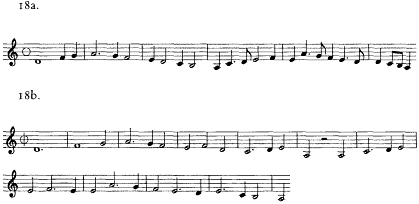
There are additional melodic similarities between the Missa Pour I' amour and the Missa La basse danse . The Crucifixus of the Pour l'amour and La basse danse Masses begin with the stock-in-trade d-f-e-a' motive. Among the approximately eighty instances of this motive that I am aware of from this period, these are the only two with the Crucifixus text. And the Et in terra of the La basse danse Mass combines two familiar motives, the so-called English 1-3-4-5 motive and a rising octave and descent known in several L'homme armé Masses as the second tune (Ex. 18). These motives also occur together in the Missa Pour l'amour at the start of the Confiteor. Both motives are commonplaces, but in combination they represent yet another link between Faugues's style and this anonymous work. As in the preceding examples, the slower note values in Example 18b do not indicate a slower tempo, only the diminished mensuration sign.
The second of these motives also figures contrapuntally in both the Pour l'amour and La basse danse Masses. In the anonymous Mass this motive opens the Qui sedes imitatively, while in the phrase from Faugues's Et in terra (also seen in Ex. 18) the contra parallels in thirds. What distinguishes each of these movement-opening passages, however, is not the counterpoint but the way in which an abbreviated version of the motive also crops up at the very end of the preceding section, also in imitation. As if in preparation for the next movement beginnings, these concluding motives commence immediately after the penultimate cadences of their respective movements, thirteen imperfect breves from the end of the Qui tollis in the Missa Pour l'amour , and just four perfect breves from the end of the Kyrie II in the Missa La basse danse .
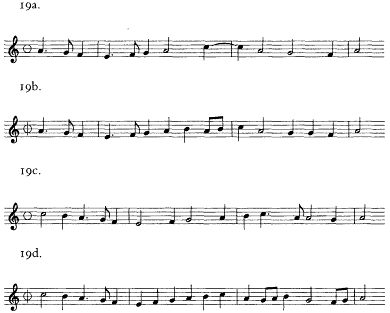
Another motive turns up in almost every movement of these two Masses. The figure usually appears at cadences in tempus perfectum , most often in some form of a triplet rhythm, either dotted, trochaic (long-short), or iambic (short-long). Example 19 has two from each Mass.
EXAMPLE 18. Motivic comparison of (a) Missa Pour l'amour , Confiteor, ram. 1-6; and (b) Faugues, Missa La basse danse , Et in terra, min. 1-12
EXAMPLE 19. Comparison of cadential patterns in (a) Missa Pour l'amour , Kyrie I, mm. 6-9; (b) Faugues, Missa La basse danse , Sanctus, mm. 20-23; (c) Missa Pour l'amour , Et in terra, mm. 7-10; and (d) Faugues, Missa La basse danse , Cum Sancto, min. 34-37
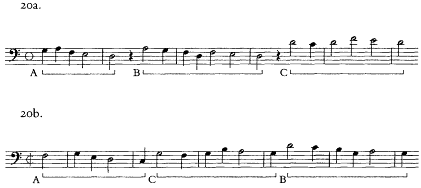
EXAMPLE 20. Comparison of formulaic motives in (a) Missa Pour l'amour , Agnus I, ram. 18-23; and (b) Faugues, Missa Le serviteur , Benedictus, mm. 38-44
While these fit easily enough in a triple meter, Faugues also maintained the motive in this form during movements in tempus imperfectum .
Further contrapuntal and mensural correspondences exist with Faugues's Missa Le serviteur . The motivic techniques shown in Example 20 testify to the formulaic nature of much of Faugues's imitative writing. The three phrases labeled A, B, and C occur in each Mass successively, but in different orders. All three occur often among composers of Busnois's generation. Yet the way in which they appear, not just patched together one after another but also in strict imitation at a distance of one breve (both perfect and imperfect), suggests a composer relying on flexible and familiar improvisational patterns.[6] Supplementing these motivic considerations, the sectional lengths and mensuration signs of individual movements of the Missa Pour l'amour share characteristics
[6] Among several other contrapuntal similarities, a motive related to phrase b of Ex. 20 occurs in both Masses at a variety of imitation intervals: two perfect breves (Missa Pour l'amour , Qui tollis, mm. 41-47), two imperfect breves (Missa Le serviteur , Benedictus, mm. 17-21), one-and-a-half imperfect breves (Missa Pour l'amour , Patrem, mm. 6-9), and one perfect breve (Missa Le serviteur , Christe, mm. 70-76). In each Mass the cadential formula in the bottom voice happens both at the lower octave and at the upper. A loosely imitative passage in the Patrem (mm. 25-30) of the Missa Pour l'amour runs the same course as a passage in the original Agnus II of the Missa L'homme armé (mm. 9-12).
with Faugues's Missa Je suis en la mer . For three of the Mass movements—Kyrie, Sanctus, and Agnus—the lengths of sections are quite close, at times even exact. As shown in Table 20, where these movements are compared, the three opening sections correspond exactly, and the mensuration signs differ only for the Osanna.
The pervasive motivic similarities, together with the characteristic repetition of music between Mass movements and the Faugues-like mensural practices (especially the use of unequal mensuration signs to specify proportions), constitute grounds for attributing the Missa Pour l'amour to Faugues. Aside from increasing the number of Masses by Faugues to six—together with the Missa Vinnus vina —rather than the four published in his "complete works," the attribution of a Mass in SPB80 to Faugues adds another Italian manuscript to the other uniformly Italian sources of his works. The Missa Pour l'amour is not necessarily earlier than the Missa Le serviteur or the Missa La basse danse . All are quite compatible with a dating of circa 1455-65 and the mensuration signs differ only for the Osanna.
Missa, Spb80, Folios 129v-43
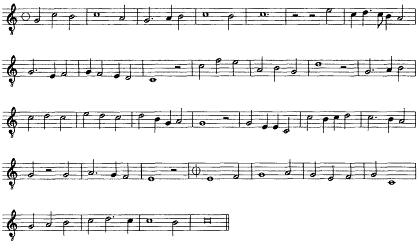
A second anonymous Mass in SPB80 has many of the same Fauguesian traits. But despite its use of structural repetition, its contrapuntal and motivic correspondences with other Masses by Faugues, and its similar mensural and rhythmic organization, the three-voice Mass on folios 129v-43 cannot be attributed to Faugues; rather, it is to Faugues what the Missa on folios 122-29 is to Caron: the product of a close contemporary. Although the cantus firmus is unknown, consistent with Masses by Faugues, it appears to be a chanson tenor (see Ex. 21). The melodic emphasis on the c in upper and lower octaves, the contralike leaps in measures 11-13, and the triadic leaps in measures 19-20 suggest a chanson from before 1450; further, the descents down a tenth to c and the triadic, bass-voice pattern in measures 27-28 are both characteristic of the Le serviteur tenor.
In this Mass every movement has at least one section in common with some other movement. As in Faugues's Le serviteur, La Basse danse , and Je suis en la mer Masses, not one but two sections repeat: The Kyrie II returns as the Osanna, and the Cum sancto comes back twice, as the Agnus III and also as the end of the Credo (see Table 21). In
EXAMPLE 21. Tenor of Missa (SPB80, fols. 129v-43), Agnus I
addition, six measures of the Christe (mm. 23-30) return in the Crucifixus (mm. 28-34), and the brief triple-meter (cut-circle) passage at the end of the Et in terra also closes the Agnus I. Thus the Kyrie and Sanctus conclude with the same music, and the beginning and end of the Agnus take from the beginning and end of the Gloria. Remarkably, since the Credo also ends as the Gloria had, every movement shares its last measures with another. With regard to the conclusion of the Gloria and Credo in the Missa , the lengths and texts of the repeated section are the same as those in the Missa Le serviteur . Starting at the text "Cure Sancto spiritu" in the Gloria, the final section requires thirty-six-and-a-half breves to finish in the Missa Le serviteur and thirty-seven in the three-voice Missa . The identical music then returns in both Credos with the words "Et expecto resurrectionem ... Amen"; however, in the Missa the first seven measures are split from the rest, appearing several measures earlier at "Et unam sancram."
Similarities between this Missa and the Missa Le serviteur extend to motive and counterpoint. In some cases the intervallic patterns matter less than how the patterns are organized. For example, the opening measures of both Masses commence with a descent from g to c in the superius (Ex. 22). The motives are not unusual (and the modal context
EXAMPLE 22. Motivic comparison of (a) Missa (SPB80, fols. 129v-43), Kyrie I, mm. 1-3, 6-10; and (b) Faugues, Missa Le serviteur , Kyrie I, mm. 1-3, 7-11
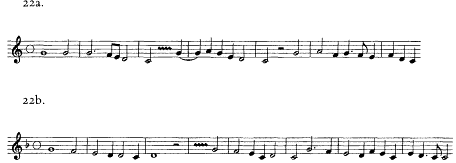
is quite different). But by virtue of being heard three times in the first ten or eleven measures, the motive becomes contextually distinctive. The similarity is aurally enhanced by a deceptive cadence in each.[7]
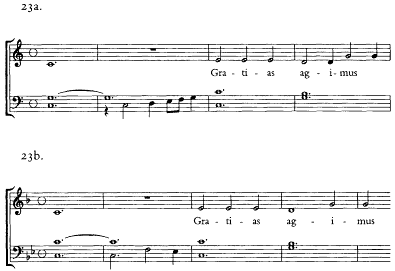
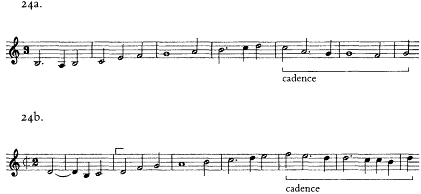
The Et in terra sections of these two Masses also adhere to similar structural plans. Beginning with duets, the contras present the start of the tenor cantus firmus, condensing eight or nine measures from the Kyrie I into five or six, respectively. When the tenors enter at "Gratias agimus," the bass, tenor, and superius voices are clearly related (see Ex. 23, in which the contra is omitted from the Missa Le serviteur ). Variants of the superius motive subsequently return at "Quoniam tu solus Sanctus." Likewise the duets at the beginning of each Patrem correspond, with the contra presenting tenor material for the first ten measures. And the Gloria, Credo, and Sanctus each have a phrase that Faugues used a step higher in the Agnus II of the Missa L'homme armé (Ex. 24).
The mensural organization of this Missa has many features in common with the Missa Vinnus vina . The various sections of the Kyrie and Sanctus movements use identical mensuration signs, the two Agnus conclude in proportio tripla, and the Credos divide internally at the Crucifixus and the Et in spiritum with the same signs. It was Faugues's
[7] Missa , Kyrie I, m. 8; Missa Le serviteur , Kyrie I, m. 7.
EXAMPLE 23. Motivic comparison of (a) Missa (SPB80, fols. 129v-43), Et in terra, mm. 15-18; and (b) Faugues, Missa Le serviteur , Et in terra, ram. 25-29
normal practice to divide the Credo first at the Crucifixus, but later divisions follow no single pattern. Four break at Et in spiritum, and four at Confiteor. In the Sanctus the Missa Pour l'amour is the only Mass to delay the arrival of tempus imperfectum diminutum until the Benedictus.
Even with these extensive structural correspondences, the Missa has too many features not found in Masses by Faugues. Phrase structure tends too often toward the short and disjunct, in the manner of Barbingant. The greater sectionalization stems from simultaneous rests and, in duple meter, phrase-ending fermatas, a chanson device that Faugues is not known to have used. In one especially choppy portion of the Crucifixus, there are three fermatas within the space of forty-six breves, two of them followed by a breve of simultaneous rest. Rhythmically the portions of the Missa in tempus imperfectum diminutum stick to square patterns that are far less syncopated than normal for Faugues. In its use of motives, aside from those resemblances noted above, the
EXAMPLE 24. Comparison of cadential phrase in (a) Missa (SPB80, fols. 129v-43), Cum Sancto, mm. 29-35; and (b) Faugues, Missa L'homme armé , Agnus II, mm. 60-67
extensive similarities to Faugues's counterpoint seen in the Missa Pour l'amour are lacking. Finally, and less obviously, although the Missa has roughly the same amount of imitation as the Missa Je suis en la mer or the Missa La basse danse , imitation in Faugues's Masses usually occurs at a time interval of two to four semibreves, whereas the most frequent distance in the Missa is a single semibreve or less.
For all of these reasons the anonymous Missa is probably not by Faugues but by someone working closely enough to him—a teacher, student, or colleague—to appropriate several structural (and a few motivic) details, particularly from the Missa Le serviteur . Of these the most characteristic of Faugues is the repetition of extended sections of music. Entire submovements such as the Kyrie II repeat, almost invariably, as the Osanna. Since Faugues also routinely repeats the Osanna (in contrast to Caron), the music of the Osanna is heard three times; for example, as Kyrie II, Osanna I, and Osanna II. The extreme case is the CS14 version of the Missa L'homme armé , in which the Kyrie II returns as the Cum sancto, the Confiteor, and the Osanna (and also the Agnus III?), in other words as the conclusion of each movement of the Mass Ordinary.
Whatever the reason for these repetitions, we cannot infer from
them that Faugues lacked invention. He was as capable of varying contrapuntal lines over repeated statements of a cantus firmus as Ockeghem. A rhetorical significance is possible, even probable, although his repetition schemes seem unrelated to textual ideas. Were this so, there would be more instances of Kyrie sections returning in the Agnus. Nor was Faugues the only composer to repeat movements. As listed in Table 21 there are at least nineteen instances during the fifteenth century, including Masses by Du Fay, Josquin, and Obrecht.
Three of the Masses in Table 21 involve a varied repetition of the Agnus I as the Agnus III. In the so-called Missa de Angelis by Binchois, Louis Gottlieb interpreted the double mensuration sign at the beginning of the Agnus I to call for a double-time rendition of the Agnus III, as occurs in the Touront Missa Monyel .[8] This usage of two mensuration signs also happens in the SPB80 Missa by Petrus de Domarto. There the Agnus I has the sign for tempus perfectum copied directly on top of that for tempus perfectum diminutum . After the Agnus II Ausquier copied the familiar directive "tertium Agnus ut supra." While tempus perfectum diminutum was probably not fully twice as fast as O, a faster tempo for the repetition is clearly indicated.
SPB80 has a significant concentration of Masses with structural repetition. When the instances of Agnus repetition are eliminated (because the texts are so close and Agnus I repetitions so common), and the canonic Trent Missa (because it is so brief), and also the Masses by Josquin, Obrecht, Pipelare, Vaqueras, and the anonymous BolQ16 Missa L'homme armé (because they are all later), what remains from circa 1455-75 are the Du Fay Missa Ecce ancilla , the Regis Missa L'homme armé , the five Masses by Faugues (including the Missa Pour l'amour ), and the three that survive only in SPB80: the Missa Pour l'amour , the anonymous Missa with stylistic ties to Faugues, and the Missa Au chant de l'alouete (attributed to Martini in chapter 9). Faugues and musicians at St. Peter's had an inordinate interest in Masses with structural repetition. If Faugues worked in Rome—as I will now argue—Rome looms as the major source of such Masses. Vaqueras and possibly also Josquin would thus be later representatives of a localized tradition.
[8] Louis Gottlieb, "The Cyclic Masses of Trent Codex 89," 1:74-75. Laurence Feininger published the Binchois Missa under this title in DPLSER, I.
Faugues at St. Peter's?
Despite a generation of archival sleuthing, the only solid biographical information about Faugues concerns a short stay in the Sainte-Chapelle at Bourges. There Faugues served briefly as master of the choirboys in the summer and fall of 1462. Documents discovered by Paula Higgins place Faugues in Bourges for indeterminate portions of two three-month quarters: first during the term of St. John the Baptist, beginning on 1 July, and again during the term of St. Michael, commencing on 1 October.[9] His salary for the fall term was small (just 37 sous , 4 deniers ), indicating that he left shortly after it had begun; and his pay for the summer term (9 livres , 6 sous , 6 deniers ) while larger, is still smaller than that given to six other singers, perhaps indicating that he had arrived shortly after that term had begun. Added together his wages amount to slightly more than 11 livres , or virtually the same as the top wage four of his colleagues made in a normal three-month period. He may therefore have served for three months that did not coincide exactly with the standard terms of pay. Several years later the chapter of the Sainte-Chapelle attempted to rehire him, evidently without success, to replace Dns. Johannes Ploton, who had died recently. On 16 July 1471 the chapter agreed to contact Faugues "presbiter" to see if he would return.[10]
Aside from these meager references, our knowledge of him comes from the distribution of his compositions, from contemporaneous citations by theorists, and from mention of him among the fourteen musicians named in Compère's motet Omnium bonorum plena . The earliest of the written accounts is Compère's motet, variously dated between 1468 and 1474.[11] Tinctoris is the first theorist to mention Faugues and probably also the source of the later theoretical references. In his Proportionale (1472-73) and Liber de arte contrapuncti (1477), written in Naples, Tinctoris both compliments Faugues and chastises him for
[9] Paula Higgins, "Tracing the Careers of Late Medieval Composers: The Case of Philippe Basiron of Bourges," 12-14; and idem, "Antoine Busnois and Musical Culture in Late Fifteenth-Century France and Burgundy," 257-58.
[10] Higgins, "Tracing the Careers of Late Medieval Composers," 26; and idem, "Antoine Busnois and Musical Culture," 258.
[11] David Fallows, Dufay , 77-78; and Charles Hamm, "The Manuscript San Pietro B 80," 48-49.
mixing proportional signs and for contrapuntal slips. His praise is effusive, his blame temperate. In the foreword to the counterpoint treatise, Tinctoris places Faugues in select company with Ockeghem, Regis, Busnois, and Caron, as followers of Dunstable, Binchois, and Du Fay, and so as one of the composers who "exhale such sweetness that in my opinion they are to be considered most suitable, not only for men and heroes, but for the immortal gods."[12] Even his criticism of Faugues's occasional diminished fifths is couched as praise: such mi contra fa errors are found "in the works of numerous composers, including the most distinguished , ..." and then he provides examples from Faugues, Busnois, and Caron.[13]
Faugues is also the composer of the anonymous Missa Vinnus vina preserved in CS51.[14] A surprising and biographically significant indication of Faugues's involvement with this Mass exists in the manuscript itself. The least reliable paleographic evidence is the point most often cited, that in CS51 the Missa Vinnus vina follows Faugues's Missa La basse danse . Indeed the Vinnus vina begins on the verso side of the folio that concludes the La basse danse Agnus III. But since the other composers represented by more than one Mass in CS14 and 51 usually do not have their Masses copied contiguously—Du Fay (with four Masses), Caron (three), and Regis (two) do not, Martini (two) does. it is questionable how much this really means.
Scribal hands reveal more than composition order. The copies of the Vinnus vina and L'Homme armé Masses by Faugues in CS14 and 51 have an extraordinary number of corrections in the manuscripts, apparently written by the same hand. Although most works in these sources have corrections, these two Masses by Faugues have many more than found in Masses by other composers. Exceeding all changes in CS14 in length and compositional effort is the revised Agnus II of the L'homme armé Mass (Figure 10). The later scribe was particularly zeal-
[12] Tinctoris, Liber de arte contrapuncti , 2:6, quoted from Oliver Strunk, ed., Source Readings in Music History from Classical Antiquity through the Romantic Era , 199.
[13] My emphasis. Tinctoris, Liber de arte contrapuncti , 2:155-56. The translation, by Gustave Reese and T. McNally, is from George C. Schuetze, An Introduction to Faugues , 3-4.
[14] Rob Wegman has conclusively shown the Missa Vinnus vina to be by Faugues in "Guillaume Faugues and the Anonymous Masses Au chant de l'alouete and Vinnus vina ," 27-64.
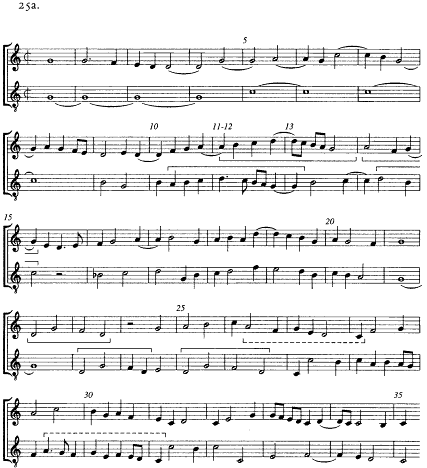
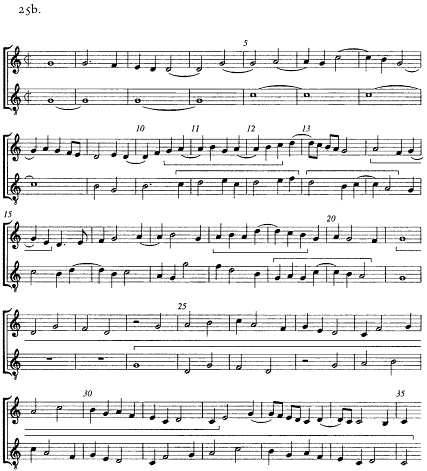
ous. He rewrote the entire contra part and, not previously detected, also added to the superius three or four notes that together comprise a single breve. Example 25a is the first half of the Agnus II as the original copyist wrote it; the measure to which the correcting scribe added notes is numbered 11-12. A comparison of the revised version in Example 25b shows that few measures of the contra part went unchanged. It is substantially this second version later copied into ModD, Ver761, and SMM JJ.III.4.
Since nothing was contrapuntally "wrong" with the old contra part, or for that matter even slightly awkward, the impulse to rewrite is significant—all the more so given the Faugues-like nature of the revisions. Strict imitation plays a much greater role in the later version, as one can see from the imitative passages marked with brackets in Example 25. At the center of the new Agnus the scribe inserted a two-voice canon that stretches over fifteen breves (mm. 21-35). Leaving the old superius part intact, he replaced nonimitative (or loosely imitative) counterpoint in the contra with a strict imitation of the upper voice at an interval of three breves. The counterpoint is completely characteristic of the extended imitations found in many duets by Faugues. One has the impression that the canonic passage, more than the missing measure, motivated the revisions and that, while he was at it, the musician decided to revise the whole part. Some of the other alterations are as remarkable for their insignificance as is this brief canon for its post facto conception and realization. Why, for instance, bother with removing the contra a and b in the middle of measure 10?[15]
The new part for the Agnus may be more dramatic than any single correction in the Missa Vinnus vina , but this Mass received equal care. There is hardly a folio without at least one emendation. Usually the revisions are only a matter of erasing a stem to change a minim into a semibreve, erasing an extraneous note, or changing a note. At the most
[15] This question applies to the contrapuntal differences between the "Rome" version of his Missa L'homme armé and that from Ferrara, which extend beyond the new Osanna, the shorter Sanctus and Credo, and the other large-scale changes. The ModD version has the same type of picayune contrapuntal revisions seen in the Agnus II. Many passing tones have been removed, and in the Pleni the cantus has four modified measures. Moreover, the removal of ornamental neighboring tones observed in m. 10 of the revised Agnus also happens in the Pleni in mm. 13-14 of the cantus, and in the Crucifixus, mm. 56-57.
EXAMPLE 25. Comparison of two versions of Faugues, Missa L'homme armé , Agnus II:. (a) original version in CS14, fols. 148v-49; and (b) corrected version
(continued )
the secondary scribe changed or added a few notes and ledger lines, as in Figure 11 (end of line 1 and middle of line 2, fol. 79v), or a clef (fols. 80v, 81). In all, they add up to forty-seven corrections, three times as many as the next most-corrected Mass in CS51, Gaspar van Weerbecke's Missa O Venus bant . I have tabulated the corrections made
EXAMPLE 25. (continued )
to Masses in this manuscript in Table 22. My count does not distinguish between the number of notes changed, so that what comprises a single correction varies anywhere from an erased stem to several added notes. A separate column accounts for notes actually added or changed by someone other than the main scribe, since it is not possible to determine who erased a note, the main scribe or some later hand. In this column the special attention accorded the Missa Vinnus vina stands out even more noticeably.
Comparatively few of the alterations can actually be called corrections. The scribe changed the clefs when necessary in the middle of a line (fol. 80), supplied several missing notes at the beginning of the Agnus, and shifted a c up a step to avoid a dissonance (fol. 75, line 2). He may also have been the scribe that erased a few notes inadvertently copied both at the end of one line and the beginning of the next (fol. 79, line 1). But if this sort of change were in the majority, one could attribute the disproportionately large number of alterations found in this Mass to a particularly bad exemplar used by the principal scribe. However, the scribe made too many changes for aesthetic reasons for this to be the case. Several times he eliminated a semiminim or fusa passing tone (Patrem, m. 53; Pleni, m. 18; Benedictus, m. 25). Once he smoothed the line by removing an échapée figure (Benedictus, m. 77), a change also found in the revised L'homme armé Agnus II. One alteration improved the imitation (Agnus II, m. 64), another obscured it, evidently in order to strengthen a cadence (Patrem, m. 24).
Not only are the corrections to both Masses substantially in the nature of compositional refinements, they appear to be the work of the same individual. A comparison of scribal hands reveals extensive similarities (Figure 12): notes—semibreves and minims are usually triangular and tear-shaped rather than diamonds, and the top line of breves often sinks down to the right (fol. 69, end of line 3); clefs—as with the breves, the C clefs both tilt down to the right, and the lower rectangle extends beyond the upper; ligatures—the right side of COP ligatures is prone to sag (fol. 70, line 8); and custos—the scribe dips down just before beginning the tail without thickening the pen stroke, and the tail itself curves (compare the custos at the end of line 1 in Figure 11 with those in Figure 10).[16] Whoever took it upon himself to correct these two Masses was interested in them exclusively. His hand does not appear elsewhere in the manuscripts. Other hands made additions to other works.[17]
[16] There is not enough text to make any but the most basic comparisons. The only words this scribe added to the Missa Vinnus vina , "verte cibo" (fol. 80, end of line 5), are in a French bâtarde script, as is the text of the new Agnus.
[17] See, for example, the corrections in the Missa Dixerunt discipuli of Eloy d'Amerval (CS14, fols. 57, 57v, and 63).
The second scribe in the Masses by Faugues probably made his revisions in Rome after the manuscript had been completed.[18] These numerous corrections have a parallel in the careful attention shown the works of Gaspar van Weerbecke in CS14 and 51. Other than the Masses by Faugues, the works most heavily corrected are the Du Fay Missa Ecce ancilla Domini in CS14 with seventeen corrections, the Missa O Venus bant by Gaspar in CS51 with sixteen, and Gaspar's Missa Ave regina coelorum in CS14 with fourteen. In the Roman source from the 1480s, CS35, the most-corrected composition is also by Gaspar, his Missa Princesses d'amourettes with thirteen changes. They also appear to be the work of one particularly interested scribe. Not surprisingly, as a longtime member of the papal chapel, Gaspar was well poised to do his own proofreading. Finally, as described in chapter 4, the alterations to create a pause before the Et incarnatus section in the Caron Missa Accueilly m'a la belle (CS51) and the Vincenet Missa Aeterne rex were certainly made in the Sistine Chapel.
To bring this discussion back to Faugues, two points. First, the changes in the Missa Vinnus vina are only partially to correct errors. And second, while those changes that are of a more compositional nature could well have been the work of an interested scribe, the appearance of what appears to be the same hand making some of the same contrapuntal refinements in the Faugues Missa L'homme armé suggests the particular involvement of the composer. Who other than Faugues would take such a proprietary interest in the Masses of Faugues? In this consideration the minor contrapuntal adjustments are no less important than the more sophisticated incorporation of the Faugues-like canonic passage in the Agnus II. Second, these changes, together with other compositional changes in the manuscripts, are most likely to have occurred in Rome. Given the liberties he took with manuscripts
[18] Adalbert Roth, Studien zum frühen Repertoire der päpstlichen Kapelle unter dem Pontifikat Sixtus IV. (1471-1484): Die Chorbücher 14 und 51 des Fondo Capella Sistina der Biblioteca Apostolica Vaticana , argues that these codices were copied in Naples and brought to Rome by 1475. Flynn Warmington, "The Winds of Fortune: A New View of the Provenance and Date of Cappella Sistina Manuscripts 14 and 51," persuasively rejects Roth's view, proposing instead Florence, ca. 1482. More recently, she has focused on the Veneto, based on the discovery of other manuscripts likely decorated by the same illuminator (private communication).
of the papal chapel, Faugues may have worked with these copies of his Masses as a member of that chapel.
Guillelmus Da Francia, Guillaume Des Mares, and Faugues
My intent is to identify Guillaume Faugues with the St. Peter's composer and scribe Guillelmus and also with Guillaume des Mares, a singer both at St. Peter's and the Sistine Chapel. I will discuss both of these figures separately before identifying the reasons for conflating their individual biographies with what we know of Faugues.
Guillaume des Mares, a tenor at St. Peter's from the latter half of July 1471 through June 1472, was a musician and cleric whose achievements have yet to be recognized. Elsewhere he is identified as a priest, master of choirboys, scribe, and author of a theological treatise. From St. Peter's he passed directly into the papal choir in July 1472, remaining until circa 1477-78. Benefices he sought as a member of the Sistine Chapel indicate origins in Normandy, with particular reference to a canonry at Evreux Cathedral and an unspecified benefice in the diocese of Lisieux,[19] and the parish church of Ste. Colombe near Caudebec in the diocese of Rouen. The last document names him as a priest from the diocese of Evreux.[20]
During the mid-1460s Guillaume traveled between Evreux and Chartres. Des Mares was in Evreux long enough to welcome the newly elected bishop Guillaume de Floques to the cathedral on 16 March 1464. Already a canon, he presented the bishop with a small tract (opusculum ) that he had written on the Holy Eucharist, with a dedication to Bishop de Floques.[21] Despite his gift, or perhaps because of it, des Mares soon left Evreux to become an instructor of children at
[19] Both are mentioned m Reg. vat. 569, fols. 20-21 (12 NOV. 1474). I am grateful to Jeremy Noble for this information. At St. Peter's he replaced, and was later replaced by, Johannes Guillant (also Guillault, Giglior, Quilant, Glant, and Olant).
[20] Reg. vat. 573, fols. 50v-51v (10 Feb. 1475).
[21] "Guillelmus de Mara canonicus Ebroicensis, dicavit Guillelmo [de Floques] opusculum de sacrosancta Eucharista" (Gallia Christiana , 11:605). See also Pierre Le Brasseur, Histoire civile et ecclésiastique de Comte d'Evreux , 289; and G. Bonnenfant, Histoire générale du Diocese d'Evreux , 1:94. All of these describe the lengthy battle Guillaume de Floques waged to take possession of his bishopric, only to die on 25 Nov. 1464.
the cathedral in nearby Chartres, confirmed there on 25 June 1464 for an undetermined period.[22] War broke out again in Normandy through much of 1471-72, just as des Mares was hired at St. Peter's. The Burgundian army at one point invaded and pillaged the territories of Caux, fighting as far as the city walls of Caudebec, where, as local histories take pride in telling, it was repulsed.[23] By July 1471 des Mares was singing tenor at St. Peter's, where he remained until he joined the papal chapel choir a year later. The Vatican account books cease in May 1476, when des Mares was still present, and resume in 1479, after he had left.
He apparently had relatives in Caudebec, all of them local officials and agents of the royal bureaucracy. Pierre des Mares, Adam des Mares, and also a Guillaume des Mares appear frequently and steadily in archival records from Normandy between 1448 and 1506, identified by such titles as "tabellion juré pour le Roy en siège de Caudebec" (1460), "procureur du Roy" (1466), "lieutenant du Verdier" (1480-81), "avocat et conseiller du Roy et vicontes de Caudebec et Monstiervillier," and also as minor nobility with the rank of écuier . However, the Guillaume who sang at St. Peter's and in the papal chapel is not the same as Guillaume des Mares, the écuier and avocat du roy active in Caudebec between 1463 and 1506.[24] This is indicated by a notice that the latter collected taxes in Caudebec for the year 1474-75, at a time when the singer was present in Rome.[25]
The earliest probable reference to Guillaume des Mares, the priest
[22] André Pirro cited this position in "Gilles Mureau, chanoine de Chartres," 164.
[23] R. de Maulde, Une vieille ville normande Caudebec en Caux , 43.
[24] Several references occur in Gustave Dupont-Ferrier, Gallia regia ou état des officiers royaux des bailliages et des sénéchaussées de 1328 à 1515, 2:22-23, 30-31.
[25] It is surely this other Guillaume that represented Caudebec at a convocation of the Norman estates in Caen on 1 Oct. 1470. Called by Louis XI, this assembly dealt with a question of the annual subsidy paid by the provincial estates to the royal treasury. In response to a commission that had met in Dec. 1469 about this issue, Norman representatives fought a perceived infringement of their rights, declaring that "the instructions of this commission were contrary to the laws, customs ... franchises and liberties of the province and charter of the Normans" (Henri Prentout, Les états provinciaux de Normandie , 1:199; this episode is interpreted on 198-201). They thus discussed a dispute nearly a year old. One of the "six notables personages" representing the bailliage of Caux, and the only one from the "viscounty of Caudebec," was Guillaume des Mares, reimbursed 30 l.t. for fifteen days of expenses away from home (ibid., 3:119).
and musician, places him in Rome during the pontificate of Nicholas V. In late summer 1449 Nicholas appointed Guillelmus des Mares, a cleric from the Norman diocese of Bayeux and a familiar of Cardinal Guillaume d'Estouteville, to the position of scribe in the Sacred Poenitentiary.[26] This was no ordinary appointment, coming just days after Nicholas agreed to an exceptional increase in the number of scribes beyond the legal limit of twenty-four. As a temporary expansion made when the antipope Felix V—the erstwhile patron of Du Fay—finally abdicated, Nicholas accepted eight of the scribes who had served Felix in Basel. He did so with the proviso that no other scribes would be appointed until death or resignations reduced the total once again to twenty-four.[27] Guillaume des Mares must therefore have come to Rome from Normandy via Basel, seeking first the patronage of the influential Norman Cardinal d'Estouteville and then taking curial employment. Des Mares would not have been the only northern singer in the musically astute cardinal's household. Jean Mocque, a singer in the chapel of the duke of Brittany, Francis I, became a familiar of d'Estouteville in September 1451.[28]
Guillaume des Mares and Faugues share two attributes: Both served as maître des enfants , and both were identified as "prêtre" or "presbiter"—albeit not uncommon titles given the clerical status of most singers. The few details of their biographies fit chronologically. Faugues "the priest" evidently left Bourges in fall 1462, and des Mares appeared at Evreux Cathedral probably at least by 1463, since he was a canon there when he presented the new bishop with his treatise on the Eucharist early in 1464. How long he then served as master of the boys in Chartres is not recorded. Des Mares next emerges in mid-July 1471 as a tenor at St. Peter's. Mid-July 1471 is also exactly the date of the other mention of Faugues in the records of the Sainte-Chapelle at Bourges. The chapter agreed on 16 July 1471 to send for Faugues—to no avail—following the death of a chaplain. From 1472 until circa
[26] See Reg. vat. 389, fols. 224-24v (10 Aug. 1449), which describes Guillelmus as a "familiaris continuus commensalis" of the cardinal; and of the same date, Reg. vat. 433, fol. 36v. These references are listed in Romualdo Sassi, Documenti sul soggiorno a Fabriano di Nicolò V e della sua corte nel 1449 e nel 1450 , 132-33 and 203.
[27] The expansion occurred on 2 Aug. 1449. See Emil Göller, Die päpstlichen Ponitentiarie von ihrem Ursprung bis zu ihrer Umgestaltung unter Plus V, 2: 66.
[28] Barthélémy Amédée Pocquet de Haut-Jussé, Les papes et les ducs de Bretagne: Essai sur les rapports du Saint-Siège avec un état , 2:609, n. 8.
1477-78 des Mares sang in the papal chapel. And the possibility that he was a familiar of Cardinal d'Estouteville in the 1450s would support the theory that Faugues wrote his Missa Le serviteur for the coronation of a pope.
I know of two potential sources for the name "Faugues," which was not at all a common French name. Faugues is derived from the Latin fagus —as in fact he is identified in CS51 over the Missa La basse danse —meaning beech tree, and as such is actually related to the more common French words faigne and fay or fayt , which occur far more frequently as geographical and familial names, as in "Du Fay." However unusual, in Normandy near the town of Mayer in the province of Sarthe, a Chateau de la Faugue (also, "faigne") functioned as the center of an important seigneurie in the fourteenth century;[29] also in Normandy, there was a fief named "Fauges" attached to Belleville-sur-Mer, north of Rouen.[30]
But there is another possibility for associating the names Faugues and des Mares. Faugues, like several other composers of his age, may have included a cryptic reference to his own name in the title to one of his compositions. I am referring not to the practice of inserting a name into the text, as Du Fay did in his motet Ave regina or Compare did in Omnium bonorum plena , but to puns or adaptations such as Busnois's motet Anthoni usque limina (and its final words "omnibus noys "), Vincenet's Fortuna vincinecta (in Per431), Molinet's chanson He molinet engreine , and Martini's chansons and Mass on La martinella . This list should also include the Credo Mon père by Compare (to my knowledge, the only Mass movement based on this chanson).[31] If Faugues
[29] On this chateau, also called "de la Faigne," see Recherches historiques sur Mayer , 1:250-52; and Auguste and Émile Molinier, Chronique normande du XIVe siècle , 350-51. The name Faugues may also be related to Faoucq, a common name in Normandy.
[30] See Beaurepaire, Dictionnaire topographique du Dèpartement de Seine-Maritime .
[31] The earliest mention of Compare also associates his name with the Credo text. In the chanson He molinet engreine , probably by Molinet, Compère's name tropes a Credo verse, in the manner of a choirmaster admonishing a young singer: "visibilium omnium, chant, Compère, et invisibilium." In the same vein, perhaps Gilles Joye and Pierre Fontaine were the objects of the anonymous chansons Adieu joye (edition in Howard Mayer Brown, A Florentine Chansonnier from the Time of Lorenzo the Magnificent: Florence, Biblioteca Nazionale Centrale MS Banco Rari 229 , music volume, no. 89) and Fontaine a vous dire le voir (edition in Marix, Les musiciens de la cour de Bourgogne au XVe siècle, 1420-1467 , no. 10).
and des Mares are the same individual, then the Missa Je suis en la mer and the lost chanson on which it is presumably based would fit into the same category of self-referential double-entendre, equating the French and Latin words for sea.
Multiple names of northern singers in Italy were commonplace. Northerners could be identified by city, region, country, or religious order and also by court nicknames (as in Milan) or the name of an important patron. Of the many possible examples, one of the most varied is that of Faugues's contemporary Johannes Legrense (d. 1473), also known as Johannes de Namur, Jean de Chartreux (or Johannes Carthusensis), Johannes Gallicus, and even Johannes Mantuanus. While I have not encountered any reference to "Guillaume des Mares dit Faugues," this identification would parallel the usage of the Frenchmen Jean Sohier dit Fede, Jean Escatefer dit Cousin, Estienne Guillot dit Verjust, and Jean Houlvigues dit Mouton. For reasons unknown, compositions by all of these latter composers are always ascribed under one name rather than the other.
Or northerners might be called simply by a first name, as happened all too often in pay records at St. Peter's. Thus in 1461 the basilica hired a musician from March to October identified only as Guillelmus, paying him to sing tenor and to compose and copy music into the "book of the church." This music presumably survives in the earliest layer of SPB80, folios that contain the Missa Pour l'amour d'une that is almost certainly by Faugues, as well as the Missa (fols. 129v-43) that shares significant features with Masses known to be by Faugues, particularly the Missa Le serviteur .
It is therefore worth considering the possibility that this Guillelmus is Faugues. Like Faugues a composer, and like des Mares a tenor, he may also have been employed at St. Peter's in the 1450s. Payments to a Guillelmus at St. Peter's occur in the transitional year 1455, which began with the death of Pope Nicholas V in March and the accession of the austere Calixtus III. It is not clear exactly when this Guillelmus arrived. For the first several months of 1455 there are no records that refer to singers by name; indeed, between March and October the only reference to singers at all comes on 6 April, when the chapter fed some singers for the Mass they sang at Easter. Then in October three salaried singers returned to the basilica, Guillelmus along with the northerners
Johannes Corbie and Britoni. Since these two others had been at St. Peter's for several years—Corbie may have arrived as early as 1449 or 145O, and Britoni was there by September 1452—there is the possibility that Guillelmus had been rehired as well. And remembering that · des Mares may have been a familiar of the cardinal from Normandy, Guillaume d'Estouteville, it must be noted that d'Estouteville had returned from a sixteen-month diplomatic mission to France just two weeks before (12 September 1455).
Additionally, one or both of these references to Guillelmus at St. Peter's involve a singer at the Padua Cathedral. During these years a singer and priest known in Padua as Guillelmus da Francia sang between extended trips to Rome.[32] The cathedral chapter first elected him on 15 January 1456, though no mention of a salary occurred until 29 July.[33] He was hired in Padua to replace "Giovanni tenoriste ," whose duties included teaching the boys. Toward the end of the next year (3 November 1457), the chapter at Padua met to consider "certain apostolic bulls" presented on behalf of Dominus presbiter Guillelmus, with the bishop of Padua, Fantinus Dandula, interceding in his favor. Guillelmus must have left Padua in 1458 because a deliberation of 4 June 1459 granted him his salary despite his having been in Rome for the past year, "absens a civitate Padue." In 1460 he was still absent.[34] It is unclear whether he spent this time at St. Peter's, since the Exitus for 1458 names only Nicholas and Lupo. And until March 1461, when the presence of Guillelmus tenorista is recorded, the St. Peter's records are either incomplete or nonexistent. Shortly after Guillelmus's arrival, the St. Peter's chapter paid him for composing and copying music into the basilica's book of polyphony, music possibly preserved in SPB80.
The Cathedral of Padua began to prepare for the return of Guillelmus during the fall of 1461. At a meeting on 18 September it was determined that he should be paid half his salary, but a month later
[32] Raffaele Casimiri first printed many of these in "Musica e musicisti nella Cattedrale di Padova nei secoli XIV, XV, XVI," 8-II, and 152-56.
[33] Ibid., 152-53.
[34] For the record of June 1459, see ibid., 154. Casimiri did not print one from 8 Feb. 1460: "licentiam concesserunt domino presbitero Guillielmo quod M. Luce capellano dicte ecclesie , ut se absentare posset ad ipsa ecclesia et civitate Padue" (Archivio Capitolare, Padua, Acta capitolare 1453-70, fol. 69).
(13 October) the case of Guillelmus was reopened, and at a subsequent meeting (5 November) the chapter decided by a vote of ten to two to honor only four of the months he had spent in Rome.[35] Payments at St. Peter's ceased after October 1461 except for I ducat paid for part of December. Once Guillelmus returned to Padua, he evidently remained into July 1462, by which time the cathedral chapter had returned the "bulls and documents" of his that they had been keeping in the large sacristy.[36]
The difficulty of identifying the St. Peter's singer(s) named Guillelmus with the one at Padua arises from a short period of overlap between payments to the two; that is, by the time payments to Guillelmus cease at St. Peter's, payments to Guillelmus in Padua had begun. While St. Peter's paid Guillelmus at least through February 1456, the French tenor in Padua was present for his election on 15 January, although there is no record of him collecting wages there until the end of July. And in fall 1461 there is this sequence: Guillaume is paid through October in Rome; Guillelmus arrives in Padua by 16 November when an accord was reached to pay him through June 1462;[37] and St. Peter's pays him a ducat in December. This probably does not indicate that he returned to Rome, or that the basilica's chapter was willing to pay him in absentia as had the cathedral chapter of Padua; rather, as in the retroactive payment to Johannes Monstroeul in February 1459 after Johannes had joined the papal chapel the preceding September, the basilica seems to have been slow in paying singers who had left.[38] The same conflict between concurrent jobs in different cities also exists for Guillelmus's colleague Egidius (Crispini), who was paid at St. Peter's through October and in Savoy from September. Later in
[35] Casimiri, "Musica e musicisti," 9, 155.
[36] Ibid., 156. In "The Music Chapel at San Pietro in Vaticano in the Later Fifteenth Century," 152, I suggested that while at Padua Guillelmus da Francia was paid in one account book (the Quaderni di Canavetta ) under the name "Guglielmo da San Pietro" from 1456 to 1467. However, further investigation of these records suggests that these were two separate individuals, since in 1457 payments distinguish between "Guillelmus S. P." and "Guillelmus cantor" (fols. 82-82v), and payments to Guillelmus da San Pietro continue after the musician had explicitly resigned and been replaced.
[37] Casimiri, "Musica e musicisti," 155.
[38] See also the records of legal action against St. Peter's required to secure tardy payments on the organ in 1501; docs. 1501e and 1502a.
the century another northerner in Rome also worked in Padua simultaneously. While still a papal singer, Crispin van Stappen spent six months as maestro di cappella at Padua Cathedral in 1498.[39]
A short overlap also arises for the Paduan Guillelmus da Francia and Faugues. Having just negotiated the terms of his employment for the coming year in Padua on 29 June 1462, Guillelmus suddenly decided to leave. The last record of him there is his severance from the cathedral on 26 July.[40] Meanwhile, in Bourges payments to Faugues probably commenced about 16 or 17 July 1462.[41] Assuming that the 26 July meeting in Padua acknowledged actions taken earlier in the month (which is probable since at the same meeting the cathedral chapter also managed to ratify the appointment of Guillelmus's replacement, a singer at St. Mark's in Venice), and assuming a quick but entirely possible journey of ten days between Padua and Bourges, he would have had to leave Padua by 6 or 7 July, shortly after renewing his contract on 29 June. There is a parallel to this rapid transition with Josquin's last pay in Ferrara on 22 April 1504 and his first appearance as provost of Notre Dame in Condé on 3 May 1504, not even two weeks later.[42]
Regardless of the identity of the Paduan Guillelmus, there are several reasons for placing Faugues in Rome: (1) Faugues himself may have corrected the Sistine Chapel copies of his Masses; (2) a presumptive early layer of SPB80—probably copied by the composer and scribe
[39] On Crispini, see pp. 44 and 94-95. Musicians were by no means the only travelers between Rome and Padua. Regarding scribes who worked in both cities, see L. Montobbio, "Miniatori, 'scriptores,' rilegatori di libri della Cattedrale di Padova nel secolo XV," 113. Sightings of French musicians named Guillelmus also occur at Treviso in 1465 (Guillelmus francese ) and at the Basilica del Santo in Padua in 1487 (Frater Gulielmo Gallus); see Giovanni d'Alessi, "Maestri e cantori fiamminghi nella Cappella Musicale del duomo di Treviso (Italia), 1411-1561," 147-65; and Claudio Sartori, Documenti per la storia della musica al Santo e nel Veneto , 14. The latter singer is further identified as "Frater Gulielmo Pitavensi Provinciae Turoniae" in Bernardo Gonzati, La Basilica di S. Antonio di Padova , 1:xxii-xxiii.
[40] The documents are in Casimiri, "Musica e musicisti," 156.
[41] Paula Higgins kindly communicated to me this estimation based on his salary.
[42] Herbert Kellman, "Josquin and the Courts of the Netherlands and France: The Evidence of the Sources," 207. On the speed of travel, see Robert Lopez, "The Evolution of Land Travel," 17-29. Regarding the possibility of reimbursements for expenses prior to a singer's arrival, the enticements that Ercole d'Este offered to the singer Victor Tarquin of Bruges, then at Milan, are instructive (Lewis Lockwood, Music in Renaissance Ferrara, 1400-1505: The Creation of a Musical Center in the Fifteenth Century , 175-76).
named Guillelmus—contains a previously unrecognized Mass by Faugues and also an anonymous Missa that is close to his style; (3) Masses with structural repetition were evidently popular at St. Peter's between circa 1460 and 1475; (4) Faugues's music was extremely well known in Italy by the 1470s, as indicated by his influence on Martini and on the Italian composer Serafino (who quoted from the Missa Je suis en la mer in his BolQ16 Credo),[43] and perhaps also by Franchinus Gafurius's unique awareness of the correct title of the Missa Vinnus vina vinum in his Tractatus practicabilium proportionum (ca. 1482);[44] and (5) Masses on the chanson Le serviteur may have been especially appropriate for honoring popes. Gerber has suggested the coronation of Pius II in 1458 as a possible occasion for Faugues's Missa Le serviteur .[45] If Faugues was also the Norman tenor Guillaume des Mares, then he may have been present intermittently in Rome from as early as 1449 until about 1478.
[43] Christopher Reynolds, "The Counterpoint of Allusion in Fifteenth-Century Masses," 234-36. Adelyn Peck Leverett, A Paleographic and Repertorial Study of the Manuscript Trento, Castello del Buonconsiglio, 91 (1378 ), 199, describes "Martini's near-monopoly on Faugues's Mass cycles" after he came to Italy.
[44] The manuscript is Bologna, Civico Museo Bibliografico Musicale, MS A 69; the citation is from fol. 19. See Wegman, "Guillaume Faugues and the Anonymous Masses," 43-44. This section of the treatise was overlooked because when Gafurius later published it as book 4 of his Pratica musice (Milan, 1496), a treatise readily available in facsimile editions and translations, he revised this paragraph, excising his criticisms of Faugues, Johannes de Quadris (motet Gaudeat ecclesia ), Bartholomeus de Broliis, and Johannes Fede (motet O lume ecclesiae "pro S. Dominico").
[45] Rebecca Gerber, "The Manuscript Trent, Castello del Buonconsiglio, 88: A Study of Fifteenth-Century Manuscript Transmission and Repertory," 137 (see also 127-28); and Geoffrey Chew, "The Early Cyclic Mass as an Expression of Royal and Papal Supremacy," 268-69. In this regard it is also telling that the anonymous Missa D'ung aulter amer in SPB80 quotes a passage of four-voice imitation from the Faugues Missa Le serviteur (Wegman, "Guillaume Faugues and the Anonymous Masses," 29-30).