
The Myth of the Revolution
The Bolshevik claim to the center was best staked by a myth of origin: a myth that distilled the Revolution to a single moment. It was the instant of transition: the moment when history began and from which the future unfolded. Marx and ideology were irrelevant to this center of revolutionary history: it was the storming of the Winter
Palace that became the central theme of the Petrograd celebration after the plans for Semenov Place were jettisoned.
How was it possible to propagate a myth in the very city that had witnessed the event itself only three years before? Myths, contrary to what some symbolists and the "God-builders" thought, are not constructed at will. They are a function of memory: the more remote the memory, the more extreme the mythologization. Perhaps the Revolution was not very old, but already the recollection was slipping away from the facts and surrendering to art. Symbolically, John Reed, who left a distinct record of the events of October 25, 1917, died on October 24, 1920; and Podvoisky (one of the commanders of the palace storming), who was always consulted for productions of this kind, would later admit that he "could not remember how [he] crossed the barricades" (he hadn't!).[56] The Red Guardsmen remembered even less. Not that anyone forgot altogether; their recollections were if anything more vivid. It was just that some parts of the event were gradually neglected and forgotten, some were magnified, and the whole was rearranged.
History itself provided an outstanding example of such revision: the storming of the Bastille, which 130 years before had been made the center of the French Revolution by the popular imagination. The directness of the influence, and the inspiration it provided the Bolsheviks, was evident in a poster released for the anniversary:
Three years ago, comrades—do you remember? . . .
The Winter Palace fell—capitalism's Bastille.
And now Soviet Russia has become the center
Of the whole Laboring world—and with us
The peasants and workers of all countries are raising
The Red Banner of the Proletariat Revolution.[57]
A festival is not a neutral or "transparent" system; it is an artistic system in and of itself, with its own rules of aesthetic construction that it imposes on the material at hand. In this process remembered events are changed. Such a reformation of recollection was publicly enacted in The Storming of the Winter Palace, a mass spectacle presented for the third anniversary celebration of November 7, 1920.[58] The directors created a dynamic center for the Revolution, the moment of creation essential to any foundation myth.
The performance was sponsored by PUR. Tiomkin was again chosen to produce the festival, and he in turn chose Evreinov as director—an
odd choice indeed for the epitome of political theater: a director at best indifferent to the new ideology, who with his producer and designer would soon end up in the Paris emigration. For Evreinov the Revolution served the purposes of the performance, not the performance the Revolution. The facts were given an explicitly artistic organization. The Storming of the Winter Palace was a step beyond his "theatricalization of life"; it was a theatricalization of history, history as it should have been: "Historical events, serving as material for the creation of this play, are reduced here to a series of artistically simplified moments and situations. The directors did not consider reproducing exactly a picture of the events that took place three years ago on Palace Square; they could not because theater was never meant to serve as history's stenographer."[59]
But the storming of the Winter Palace, of all events commemorated by mass spectacles, was historically the most concrete. It was a localized event, one that had occurred at the same spot on which it was reenacted. Palace Square was at the same time a stage and a real historical place (see Figure 17). The directors went to great lengths to make the performance seem actual: trucks bristling with bayonets roared across the square, machine guns chattered, and out on the river the cruiser Aurora, which three years before had fired the (blank) "shot heard round the world," repeated the signal for the performance. Evreinov enlisted participants of the 1917 takeover as performers. The production staff even rebuilt the wooden barricade that had protected the palace's front gates and manned it with the Women's Death Battalion, which legend claimed defended the gates to the end. The highly theatrical gesture was not dimmed by the fact that the Death Battalion had, in 1917, wisely abandoned its position. Obviously, a distinction must be made, one that in a theater such as Stanislavsky's never received recognition: the distinction between "real"-ness and authenticity.
The mass performance would distill and improve the historical event. According to the directors, participants and spectators would in the course of an hour experience what in 1917 had been experienced in the course of many hours[60] —or, more accurately, it might be said, had never been experienced at all. The event of 1917 had, after all, been something of an anticlimax, occurring a day after the seizure of power. More important to the transfer of power had been attaining a majority in the Petrograd Soviet and the slow process of propagandizing the Petrograd garrison. On the actual day of the Revolution, Palace Square was one of the few peaceful points in the city: the Bolsheviks rightly thought the train stations and post offices of more import, and that was
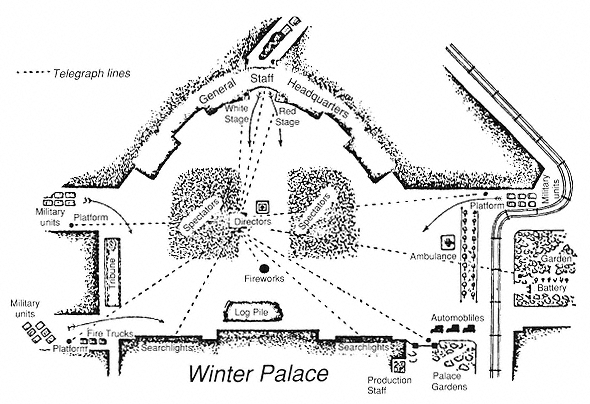
Figure 17.
Layout of Palace Square, Petrograd, for the November 1920 mass spectacle;
image computer-enhanced (Istoriia sovetskogo teatra, Leningrad, 1933).
where conflict, what little there was, occurred. Winter Palace was surrounded, and Lenin desparately wanted it taken, but the commanders were in less of a rush. Vladimir Antonov-Ovseenko, Podvoisky, and Grigory Chudnovsky, directors of the operation (in the production the trio was replaced by the single figure of Lenin), preferred to avoid senseless bloodshed and waited for a surrender. The troops defending the palace surrendered unit by unit over the next day, until finally the numerically superior Red Guard charged the building with scarcely a shot being fired. The eight thousand participants in the 1920 spectacle far outnumbered the attackers of 1917.
Although one hundred fifty thousand spectators were expected that night for the performance, because of dampness, chill rain, and slush, only one hundred thousand showed up—around one-quarter of the entire city. The spectators were well prepared; newspapers warned that the events would all be theatrical and requested that the audience not panic at the gunfire. There would be no reason to move during the performance; the stages were placed so that everyone could see.[61]
Spectators were placed right in the middle of the action (as they had been in Evreinov's Ancient Theater). Built against the facade of the General Staff Headquarters across the square from the palace was a huge stage designed by Annenkov. On the left side he constructed a Red city; dynamic, vertical buildings of red, factories, a large square, and even a memorial obelisk. Action on the Red platform was directed by Petrov. To the right (naturally) was the White platform, directed by Kugel and Derzhavin. Evreinov remained in charge of the entire production. The White platform was a horizontal construction made up of smaller platforms, none of which represented a specific place. On its left side, ladies and gentlemen in evening clothes campaigned for the Liberty Loan—here, Evreinov parodied an earlier mass festival. To the right, ministers of the Provisional Government, wearing top hats and sitting behind a long table, listened to Kerensky give a hysterical speech. Between the two platforms was a gangway, an architectural duplicate of the Headquarters Arch behind it, along which the two worlds met and did battle. The directors were placed on a large platform encircling the Alexander Column, equipped with a complicated network of electric signals. Spectators were cordoned off in large squares on both sides of the column and between the palace and headquarters. A few lucky ones watched from windows of the palace and surrounding buildings.
The Storming of the Winter Palace was conducted with a masterful sense of theatrical timing. At the stroke of ten, Palace Square was
plunged into darkness. A cannon shot shattered the silence, and an orchestra of 500, placed under the arch and directed by Varlikh, struck up Henri Litolff's Robespierre overture, introducing the White (!) platform. One hundred and fifty searchlights mounted on the roofs of surrounding buildings were switched on at once, illuminating the Whites, who opened the action. The Marseillaise, orchestrated as a polonaise, was begun as the ladies and gentlemen of high society awaited Kerensky's arrival. The prime minister, whose appearance caused some stir among the crowd on stage, was parodied brilliantly by an actor dressed in his characteristic khakis. The Whites formed a chorus, with Kerensky in the role of the coryphaeus (the figure who initiates and leads the chorus's response).
Directors of previous mass spectacles had avoided using individual actors, preferring to use masses of bodies to represent mass movements. The directors of Winter Palace reasoned correctly that in a large square filled with human bodies it would not be the huge mass that stands out but the single figure, particularly when that figure is spotlighted.[62] The proposal of Annenkov and Kugel to have twenty actors moving in unison play Kerensky was turned down. The advantages were immediately apparent. Kerensky, like the rest of the Whites, was played in the style of the opera-bouffe and the circus. The actor caught his histrionic gestures perfectly as he mimed a speech. The response of the White chorus was performed in the same style: Kerensky was showered with roses and ovations (all this had occurred during his Moscow Liberty Bond tour). Bankers, pushing money bags across the stage, volunteered their services for the Liberty Loan. Bureaucrats, backs bent in humility, vowed fealty to the first minister. And officers in cocked hats, monocled and bedecked with medals, held posters proclaiming "War to a Victorious End!"
Previous mass spectacles suffered most from an inability to transfer action from one episode to the next. This difficulty was similar to that experienced by writers of the medieval annals. The "syntax" of events was a coordinate system: this happened, then that happened. The subordinate syntax of events that underlies historical understanding was not truly available to the directors of the first mass spectacles, just as it had not been available to the annalists. In Mystery, the scenario might have specified that action shift at a certain point from the failed Spartacus rebellion at the top of the steps to renewed popular unrest, led by Razin, at the base of the staircase. The spectators, however, would see it differently; several hundred people in togas would still be milling about at the top of the
steps, and viewers would have to wonder what Romans were doing in Razin's Russia. The directors, then, had to take time out to clear the stage of the previous scene, as if erasing a blackboard. As a result these early performances took from four to five hours to complete.
Winter Palace, uniquely, was produced simultaneously as a drama and a film.[63] The analogy to film provided a solution to the time problem, which reduced Evreinov's production to only one and a half hours. In film, scenes can shift instantaneously; the time wasted in the theater occurs while the movie camera is turned off. In Winter Palace, action was moved not by shifting its location, but by shifting spectators' attention. The 150 searchlights were the solution: after Kerensky had made his speech and held court, and the scene shifted to the Red stage, a director on the column platform simply flicked a switch, plunging Kerensky and retinue into darkness, and another switch, lighting the Reds.
Lighting for the first time allowed for the division of a mass spectacle into distinct episodes and sharp contrasts. The dramas would no longer operate on "uninterrupted, festival" time[64] but on the subdivided time of theater, which yields to the manipulations of a director. In ritual drama (medieval mysteries or early Soviet mass dramas) there is a unity of performance time—the time frame in which the performance is viewed. There are no breaks in performance, no time when the performance is "turned off" and the spectator leaves the performative frame. Depicted time, however, is not unified; sharp, unexplained breaks and shifts—for example, from Spartacus's Rome to Robespierre's Paris—are the rule. Modern theater works on another scheme: performance time is broken, while depicted action is more continuous. Winter Palace, which finally solved the technical problems of mass spectacles, was the first in which depicted time was unified. With action concentrated in a single place and time, the festival was able to establish the palace seizure as the center of the Revolution. No historical myth is complete without that center, the moment of absolute change.
Action on the Red stage was in a monumental style; performers wore no make-up.[65] Acting was done in "collectives": characters were groups, not individuals like Kerensky, a device that demonstrated the collective character of the Reds. A few hundred workers come onstage from the factories Annenkov built for his city. While about half the group stand forestage and hold statuesque poses, the other half rhythmically strike anvils with their hammers. More people flood onstage and gather round a large red flag. The ever-increasing crowd falls silent, as if straining to hear something. The Internationale becomes faintly audible; then
cries of "Lenin, Lenin!" echo from the audience until the word is caught up by the chorus. The Red stage has been changing throughout this scene. Beginning as a gray mass, the workers grow brighter as the searchlights illuminate them ever more intensely. As the masses, which have been pouring onstage chaotically, become increasingly more organized, they gather around the flag and take up the chant. When the Internationale breaks out at full volume to end the episode, the gray mass has completed its transformation into the Red Guard.
Now the Reds can attack the Whites, with their troops surging over the connecting arch; this mystery-play device, used in every mass spectacle from The Overthrow of the Autocracy on, had its place in Winter Palace . Many troops from the White side go over to the Reds; only the Junkers and the Women's Battalion remain to defend the government. Oblivious to the unrest, Kerensky continues his oration, but his ministers, whose bench has begun to rattle and sway to the rhythm of the Red chants, crash to the floor at the clap of the first Red volley. Kerensky nimbly escapes to a car (American flag waving) waiting before the stage and drives away. His ministers follow in another car.
Up to this point, the performance could have taken place on any large stage. Space was conventional, its value assigned by the decor. Time was conventional; the events of a few revolutionary months of 1917 were summarized in an hour's dramatic action. But when Kerensky stepped over the proscenium, he stepped into real space. For Kerzhentsev, Meyerhold, and the symbolist generation, theater would attain its ideal when the audience crossed the same line in the opposite direction. That was the theater as ritual. Evreinov, however, pursued the theatricalization of life, the theater as play; history was replayed according to the rules of art. Ironically, Winter Palace, the height of artifice, was the most real of all the mass spectacles. Previous spectacles could have been performed anywhere anytime and have been about anything. By substituting a different set of revolutions The Mystery of Liberated Labor could become Toward a World Commune; that scenario could be replayed at Krasnoe selo. Winter Palace could only be about the October Revolution, it could be played only on Palace Square, and only on November 7. This performance fixed the final, irreducible center of the revolution.
Kerensky and his ministers, having driven madly across the square between the two masses of spectators, are admitted to the palace. Meanwhile, action continues on the stage, where the Red Guard and White soldiers battle for control of the city; this segment is performed like a
wartime battle spectacle. Suddenly, the lights inside the palace spring on, and in the brightly illuminated windows silhouettes grapple for control of the palace. A different stage of the struggle is depicted in each window, and the battle unfolds as each is illuminated in progression. The Reds gradually take the upper hand in these duels, and the palace finally falls under their control. The Revolution is accomplished. The searchlights of the Aurora, which have backlit the palace in an aura, switch to a point above the palace, where a tremendous red banner is raised, and red lights flash on in the windows. The performance ends with a comic scene from the revolutionary apochrypha; Kerensky flees the palace dressed as a woman. A cannon salute from the Aurora and fireworks end the festival and herald the dawning of a new age.