
Chapter 7—
Improving Crop Management
by Ronald D. Lacewell and Glenn S. Collins
Abstract
Agricultural adjustments to the rising cost and increasing scarcity of water may be expected. One adjustment is to shift production from field crops to high value crops. However, high value crops usually require (1) more water, (2) more risk, (3) new machinery, (4) more labor, (5) more management, and often (6) several years of heavy investment before the first returns. A second adjustment is to plant new drought-resistant crops such as guayule, jojoba, or crambe. Serious marketing, production, and processing issues exist for each of these new crops. Yet another option is to continue producing field crops but alter production systems to improve yields and decrease costs by crop rotation, no-till, residue management, and new technology.
The expected impact of doubling irrigation costs in the United States, as estimated by a national econometric model, was only a slight adjustment in cropping patterns. The major effect was a reduction in net farm income in the West, exceeding 20 percent for many western states. This has serious implications for the future structure of irrigated agriculture relative to consolidation and vertical integration.
Thus, it is likely that most farmers will attempt to maximize profits from the more familiar field crops by adopting more efficient production systems. A number of new systems, such as optimal crop rotation, no-till practices, beneficial residue management, and better irrigation systems are reviewed in this paper.
Irrigation is a most important factor in western water use and is important to total U.S. crop production. However, water is becoming increasingly scarce and costly. Over 15 million acres of U.S. groundwater-irrigated lands are incurring declining water levels in excess of one-half foot per year.[1] A declining groundwater supply increases lifts (cost of pumping), reduces well yield, and may have a negative effect on water quality.
Surface water in many cases is allocated by legal and administrative institutions which may have traditionally favored agriculture. However, currently nonagricultural users are demanding transfers of surface water rights from agriculture, since typically the value of water is considerably less in agriculture.[2] It is suggested that the development of property right rules and organizational facilities to allow water transfers in a market framework is a part of the evolution of water as an economic resource.[3] This suggests water for agriculture will cost more, and some reduction in quantity of available water may be expected.
The purpose of this chapter[4] is to explore the economic implications and management alternatives for irrigated agriculture in the West. First, discussion focuses on the expected impacts of significantly higher costs for ground and surface water. This leads to management options for producers and expected economic implications.
Impact of Increased Water Costs
The impacts on U.S. agriculture, both regional and national, of increasing water costs may be examined using an econometric model (TECHSIM) developed at Texas A&M.[5] TECHSIM is a regional field crop and national livestock model designed to evaluate yield and/or production cost changes. Within TECHSIM, extraneous information is used as a basis to reflect changes in supply and/or demand. Then, economic impacts of a yield and/or cost change can be estimated.
TECHSIM is represented by 13 field crop producing regions, shown in Figure 7.1, and four national livestock categories. The field crops included in the model are: corn, small grains (wheat, barley, and oats), grain sorghum, cotton lint, cottonseed, and soybeans. The model also contains the forward meal and oil products of cottonseed and soybeans. The national livestock products included in the model are fed beef, nonfed beef, pork, and sheep.
TECHSIM is a recursive model which centers on three types of estimates: planted acreage, yield, and demand. The model assumes that producers within a region make planting decisions based on expected net returns of various field crops within the region. The recursiveness of TECHSIM is based upon the expected net returns which are equivalent to the previous year's net returns. The yield equations reflect productivity changes of the model's base period, 1961-1977.
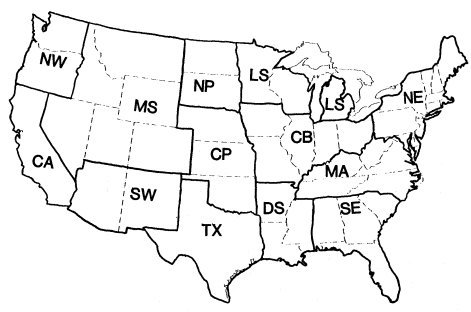
Figure 7.1
Thirteen Field Crop Producing Regions of the U.S.
The demand equations, with the exception of final consumer demands of the livestock sector, are intermediate demands. This implies that additional processing of these commodities is required before they reach the final consumer.
Shifts resulting from increasing ground and surface water costs are introduced into the model by changing each crop's variable per-acre production cost for each region. Once these costs are changed, the model traces the impacts and provides estimates of regional and national planted acres, yields, production and supplies of each field crop. The results also give estimates of national demands (domestic, export, private and government stocks) of all commodities in the model.
To examine the social implications of increased ground and surface water costs, TECHSIM estimates the short-run net returns or profits of all industries in the model plus the agricultural sector of the U.S. economy. These results are obtained by simultaneously solving all markets for prices such that each commodity's total supplies are equal to total demands.
The model is based on 1979 costs and returns. Average costs of groundwater were about $17 per acre-foot and surface water about $7 in 1979 across the West.[6] Two national water alternatives are examined with TECHSIM in this paper. The first is doubling the per-acre costs of both ground and surface water. The second is doubling the cost of groundwater but letting surface water increase to $40 per acre-foot.
Planted Acreage Shifts
Regional changes in planted acres due to the two increased water cost alternatives are shown in Table 7.1. All results reflect the final impact of increasing ground and surface water costs to U.S. agriculture. Total U.S. planted acres decreased under both alternatives for all crops except small grains and grain sorghum. However, the percentage change of these acreage shifts is less than 1.5 percent for each crop for both alternatives. The largest percentage shifts occurred in the western regions where irrigation is predominant in agricultural production. The greatest regional percentage shift by crop was for corn in the Mountain States (MS) region. In this region corn acreage decreased by 27.1 percent when ground and surface water costs were doubled, and decreased by 26 percent when groundwater was doubled and surface water was increased to $40 per acre-foot.
| |||||||||||||||||||||||||||||||||||||||||||||||||||||||||||||||||||||||||||||||||||||||||||||||||||||||||||||||||||||||||||||||||||||||||||||||||||||||||||||||||||||||||||||||||||||||||||||||||||||||||||||||||||||||||||||||||||||||||||||||||||||||||||||||
| |||||||||||||||||||||||||||||||||||||||||||||||||||||||||||||||||||||||||||||||||||||||||||||||||||||||||||||||||||||||||||||||||||||||||||||||||||||||||||||||||||||||||||||||||||||||||||||||||||||||||||||||||||||||||||||||||||||||||||||||||||||||||||||||
Net-Return Shifts
The total regional and national short-run net returns or farmer profits in 1982 dollars are also shown in Table 7.1. For each region these net returns represent the sum of the changes in net returns for all field crops in a region. The national net return figures represent the summation of all regions' net returns.
Nationally, total net returns decrease for field crops. Regional net return decreases are observed for Northwest (NW), California (CA), Mountain States (MS), Southwest (SW), Central Plains (CP), and Texas (TX) regions. The largest decrease in net returns when both ground and surface water costs are doubled occurs for the Southwest (SW) region. However, when groundwater cost is doubled and surface water costs are increased to $40 per acre-foot, California (CA) becomes the largest loser on an absolute and percentage basis. The Corn Belt (CB) region gains the largest dollar amount from increased water costs. Its gain amounts to approximately $300 million for both water alternatives. From a percentage standpoint, however, the Corn Belt (CB) region ranks sixth and seventh out of the seven regions which show positive increases in regional net returns. Nationally, total net returns decrease by 1.4 and 2.4 percent in the two water scenarios.
Price Shifts
The price shifts associated with increased water costs are modest. Price increases occur for corn, cotton lint, cottonseed, and soybeans. The largest price increase is for corn and soybeans. However, these prices increased by less than $.12 per bushel. Small grains and grain sorghum have slight price decreases. These small price changes are to be expected, given the small change in planted acreage of the field crops.
The impact of increased water costs to the livestock sector are also small. Increases in livestock prices are observed for fed beef, pork and sheep and lambs, while only nonfed beef decreased in farm price. This is because feed prices of corn, soybean meal, and cottonseed meal increase proportionately more than small grains and grain sorghum decrease. Hence, livestock producers would shift into nonfed animal units, which tend to increase fed animal prices and decrease nonfed animal prices.
Social Implications
When ground and surface water costs are increased, annual national income would decrease over $.9 billion when both water
cost sources are doubled, and over $1.2 billion when groundwater is doubled and surface water is increased to $40 per acre-foot. Very few agricultural industries gain as a result of these water alternatives. Consumers of field crops lose the most, but U.S. field crop producers and soybean and cottonseed meal and oil industries also lose. The livestock sector of the U.S. economy would gain; however, final consumers of livestock products lose.
The major implication of this analysis is that if water costs increase, western regions which are heavily dependent upon irrigated crop production will have the greatest decrease in net returns. Furthermore, additional losses will result in areas such as California if average surface water costs increase to $40 per acre-foot. Nationally, these water cost increases will result in only modest decreases in planted acres and small changes in prices of farm products. However, other industries besides field crop producers stand to lose with increasing water costs, so that the total annual loss will approach $1 billion.
Crop Management Strategies
As water costs increase and less water is available to agriculture, there are some crop management techniques which may maintain agricultural productivity. This section considers the producer options of shifting to high value crops, practicing residue management and crop rotations, and introducing new crops. Opportunities and limitations are discussed. Often crop management alternatives will be simultaneously adopted with technical adjustments such as sprinkler system modification or irrigation well rehabilitation. They are considered separately in this paper.
High Value Crops
Agricultural regions with very expensive water typically produce high value crops such as vegetables, citrus, grapes, or nuts. This is because the value of field crops is not sufficient to justify $100 per acre-foot for water. Of course, high value crops are also produced in regions with relatively low cost water.
The value of irrigation water in field crops varies significantly from region to region. However, a range of from $10 to about $60 per acre-foot is typical.[7], [8], [9] The value of water in high value crops ranges from a negative value to several hundred dollars per acre-foot.[10] On the average over several years, the value of water in high value crops exceeds that of field crops. Thus, some producers may choose to shift from field crops to high value crops as
water costs rise and water becomes increasingly scarce. This is nevertheless a limited alternative for increasing the value of irrigation water.
Table 7.2 shows water application rates and production costs per acre for some selected field crops and high value crops in California.[11] In many cases, per-acre application rates of water are higher for the higher value crops such as almonds, peaches, grapes, and tomatoes as compared to sorghum, corn, or wheat. Furthermore, yield and quality of the high value crops are much more sensitive to irrigation. This suggests skillful management of irrigation is required.
Of greater importance is the cost of production for high value crops. In very general terms, the costs are greater than $1000 per acre for high value crops and less than $400 per acre for field crops. This creates a serious strain on a farmer's cash flow, particularly if he is borrowing some or all of his operating expenses. Furthermore, for citrus, fruits, nuts, and grapes, a large initial investment is required for several years before any income is returned.
In addition, these crops often require different production techniques, purchase of new equipment and machinery, and intensive labor. Machinery investment can be substantial. For example, a precision vegetable planter costs $15,000, a cultivator, $10,000, a vegetable bed-shaper, $5,000, and harvesting equipment from $40,000 to $100,000.[12]
Lastly, high value crops are generally specialized within a limited market. Once the market is saturated, the price of the product (e.g., vegetables, citrus, or nuts) declines dramatically. This represents a very high level of market risk to the high value crop producer. A study of farming in El Paso County, Texas, found risk to be a major factor affecting a farmer's cropping pattern. Because of high production costs and variability, vegetable production was not observed on small and medium sized farms.[13]
When the price of a product changes one percent, the responding change in quantity demanded is termed "price elasticity of demand", i.e., the percentage change in quantity for a one percent change in price. An elasticity of –.5 means if price increases one percent, quantity demanded will decline 1/2 of a percent. "Price flexibility" is the response of product price to changes in supply. An approximation of price flexibility is the inverse of price elasticity of demand. This estimate of price flexibility is a simplification and requires some simplifying assumptions. For a price elasticity of demand of –.5, price flexibility is approximately
–2. That is, a one percent increase in supply will cause a two percent reduction in price. Here the price effect is greater than the supply change. The smaller the price elasticity of demand, the greater is the price flexibility or the price response to changes in supply.
| |||||||||||||||||||||||||||||||||||||||||||||||||||
The price elasticity of demand for some selected products is –.31 for potatoes, –.72 for apples, –.66 for oranges, –.14 for lettuce, –.38 for tomatoes, –.26 for beans, –.25 for onions, –.49 for carrots, and –.32 generally for fresh vegetables.[14] Since only nine percent of the 50.2 million irrigated acres in the West are in high value crops and the price is very responsive to supply, there is little opportunity to shift to high value crops. If more crops are produced, prices will go down, but cost of production will remain high. Other regions producing high value crops maintain competition. This means some acreages can shift to high value crops, but our subjective estimate is that likely less than 10 percent of current high value crop acres, or less than one-half million acres, may do so profitably. This leaves 45 million irrigated acres in field crops or pasture. Thus, other irrigation management alternatives must be considered for most irrigated cropland.
New Crops
With increasing water costs and a more scarce water supply, producers are encouraged to look at new field crops which are less water intensive. In recent years, several new field crops have gained popular attention. Included among these are guayule, jojoba, buffalo gourd, crambe, kenaf, and pigeon peas. This discussion is based on a number of studies of commercial feasibility of new crops.[15], [ 16]
Guayule
Guayule is a rubber-producing perennial plant native to the semiarid regions of the southwest U.S. and north central Mexico. The growth of guayule is highly dependent upon temperature and water. The plant requires little water, and in fact if rainfall and/or irrigation exceeds 25 or more inches, little rubber production occurs. Guayule withstands temperatures between 0° F and 120° F. However, freezing temperatures can kill young plants and also limit rubber production. While guayule appears to be well-suited to production in the Southwest, the requirement of a major processing facility is a significant limitation to development of commercial guayule production.
Jojoba
Jojoba is a perennial shrub that produces oil seeds. Each seed is approximately the size of an olive and contains about 50 percent oil by weight. Jojoba grows in marginally arable areas. It is natively found in Mexico, along the coast of Southern
California, and in Arizona. Jojoba requires very little water, approximately 5 to 18 inches per year.
Jojoba, like guayule, is suited to commercial agricultural practices. Both irrigation and fertilization promote faster growth and more vigorous plants. The seed of jojoba produces the only known source of unsaturated liquid wax that is a replacement for sperm whale oil. The seed is also used in the manufacturing of detergents. Although available oil seed crushing facilities can be used for jojoba, serious production questions remain.
Crambe
Crambe is an annual plant that grows to a height of approximately 3 feet. Crambe's seeds are a source of plant oil which has a high erucic acid content. About one-third of the seed weight is oil which contains about 55 percent erucic acid. This acid is used in the manufacturing of rubber additives.
Crambe is a cool season crop and does not do well in extremely dry regions. The commercial production practices for crambe are similar to those for small grains. However, a major limitation of this new crop is the shattering of mature seeds during harvest. In addition, crambe faces stiff market competition and may not sell in sufficient quantities to make production profitable.
Buffalo Gourd
Buffalo gourd is a perennial plant that produces fruit on a spreading vine. The plant grows naturally in the semiarid and arid regions of the West, and needs annual rainfall of only 10 to 12 inches.
The seeds of buffalo gourd can be harvested yearly and contain protein and an oil which is similar to corn oil. The meal product of buffalo gourd may also be used as an animal feed.
Many other so-called "new" crops have been discussed, but there are several major limitations to commercialization of any of these. For most, there is no infrastructure for marketing and processing. On the production side, there are questions about weed, insect and disease control, appropriate tillage, fertilization and irrigation practices, use of pesticides, harvesting equipment, yield, and per acre net returns. Lastly, uncertainty over general economic conditions and the risks to grower, buyer, and processor make these only possible alternatives for the future.
Crop Rotation and Residue Management
Crop rotation, residue management, and tillage practices for maintaining agricultural productivity with less irrigation water
may be discussed simultaneously. The many alternatives include each of the options separately or in combination with each other, besides an array of other practices.
Crop residues can control wind and water erosion, increase organic material in the soil, and capture rainfall.[17] However, impacts of residue management on profit and yield must be considered as well as integration with crop rotations.
For example, minimal tillage is designed to leave crop residues on the surface and leave the surface rough. This increases water infiltration and reduces evaporation. For some cases, significant water savings have been shown for cotton with no yield loss and sometimes a yield increase.[18] Similarly, use of tillage systems to increase water conservation in wheat has been reported and is shown in Table 7.3.[19] Wheat yields in the Great Plains have risen from 15.9 bushels in 1916-30 under maximum tillage, to 32.2 with stubble mulch and minimum tillage. Yield is projected to average 40 bushels per acre with an effective no-till system over the next 10 years.
Residues are also important in crop rotations that maximize value of limited irrigation and rainfall. For example, major
| ||||||||||||||||||||||||
increases in yields of dryland grain sorghum have been obtained where residues from irrigated wheat have been undisturbed by no-till methods by using herbicides for weed control during summer fallow.[20] Lower costs and higher average grain yields indicate a major economic advantage for no-till sorghum in an irrigated wheat-fallow-dryland grain sorghum system. Grain sorghum produced under the no-till system averaged 3,150 pounds per acre compared to 2,190 with conventional tillage. This system is also effective with crops other than sorghum, such as cotton.
Unlimited crop rotations may be devised using the no-till system. Multi-cropping options include double-cropping, three crops in two years, and five crops in four years. Yet, no-till is only part of a cropping system and not the system.[21] Optimal crop rotation and tillage systems will be area- and regional-specific. Based on results to date, however, the outlook is promising.
As irrigation water becomes more scarce, relatively drought-tolerant crops should be selected. These include cotton, wheat, sunflower, and grain sorghum. Crops to be avoided, since yield and quality are very sensitive to water shortage or irrigation delays, include corn, soybeans, and vegetables.[22] Also, with limited irrigation it is desirable to grow multiple crops in rotation within an area, so that peak demand periods most sensitive to water stress do not coincide.
Shortcomings and limitations of no-till systems and different crop rotations need to be discussed along with advantages. For example, no-till wheat at Bushland, Texas, showed a higher average yield than conventionally tilled wheat, being much higher in the best year, but much lower in the worst year. This suggests an increase in risk.[23] Also, direct seeding into heavy stubble is difficult. There have been examples of crop yield reductions of 10 to 30 percent where crops were seeded into heavy stubble, as compared to conventional tillage.[24] In addition to poor stands in stubble, there is often increased weed infestation. In finetextured soils in some regions under chemical fallow (weed control with herbicides), the soils become too hard for seeding.
Some agronomic constraints limit cropping pattern adjustments. For example, in the Pacific Northwest nematode buildup limits the extent of potato acreage increase.[25] Disease, weeds, insects, erosion, and other concerns will certainly influence crop selection, rotations, and tillage systems.
Improved Technology
This section examines some economic implications of the many new technologies that often are integrated into an overall management system. The discussion covers equipment as well as more management-oriented options.
Low-Energy Precision Application (LEPA)
This is a sprinkler system which has been modified with drop tubes. It operates at less than 10 pounds per square inch of pressure, applying irrigation water uniformly across the field with little evaporation. The LEPA system in combination with row dams is both water- and energy-efficient. This system on 1.7 million sprinkler-irrigated acres on the Texas High Plains was estimated to increase the value of groundwater by $1 billion over 20 years. Cost to modify current sprinkler systems would be about one-tenth of this. This economic benefit comes from using less energy and reducing the rate of depletion of groundwater.[26]
Furrow Dikes
The LEPA system's effectiveness is very dependent upon row damming or furrow dikes in tight soils. The furrow dikes conserve both irrigation water and natural rainfall. Results indicate that furrow diking on nonirrigated land in Texas and Oklahoma increases cotton yield from 11 to 25 percent, and grain sorghum yields from 25 to 40 percent. The value of furrow diking on nonirrigated land for the Texas High Plains and Oklahoma Panhandle is an estimated increase in farmers' annual net income of $87.6 million.[27]
Limited Irrigation-Dryland System (LIDS)
This system was developed and is being tested by Stewart et al.[28] This system uses a limited water supply to irrigate an area larger than could be fully irrigated. A field is divided into three sections. The upper half is managed as fully irrigated. The next fourth is a tailwater runoff section that uses furrow runoff from the fully irrigated section. The last fourth of the field is managed as dryland, using both irrigation runoff and natural rainfall. This system also uses furrow dikes placed about every 10 feet. These dikes are washed out by irrigation water to the distance that the water advances down the furrows.
This system has increased grain sorghum output per acre-inch of irrigation water from about 302 pounds per acre to 450 pounds. This is about a one-third increase in grain production as compared to conventional irrigation with limited water. With grain sorghum at $5 per hundred-weight, this is an increase in the value of water of $7.50 per acre-inch.[29]
Other
Several other strategies or techniques are available, such as irrigation scheduling, alternate furrow irrigation, row spacing and directional effects, land shaping, distribution systems, skiprow planting, and staggered planting dates. Details of their use appear in numerous published studies. The appropriateness and economic implications of each are influenced by costs of water, quantity of water available, price of products, labor availability, credit, and managerial ability of the operator.
Conclusions
The national effect on cropping patterns of more expensive water is not expected to be dramatic. The effect on producers' net returns is of much more concern, particularly in the West. Reduced net farm income has implications for the structure of agriculture in the West.
High value crops are not likely to be the salvation of irrigated agriculture. The price of high value crops is very sensitive to supply, hence a small increase in production dramatically reduces price. Further, compared to typical field crops, often high value crops use more water, their per-acre costs are several times greater, their risk is significant, and managerial ability is critical for their success.
There are some methods available for farmers, however, that can be economically attractive. These include improved crop rotations and residue management, improved irrigation distribution systems, new tillage practices, better irrigation scheduling, and new crop production systems including a number of improved techniques.
Irrigation will continue in the West, and make a significant contribution to agriculture and the nation. The crop production system, however, can be expected to change significantly in response to high water costs and reduced availability of water.
Discussion:
Donald J. Brosz
As water costs increase and less water is available to agriculture, certain crop management techniques may maintain agricultural productivity. Irrigators in the West today are experiencing limited water supplies in many areas every year. Under the prior appropriation water law system, waters are regulated according to water availability during the irrigation season, particularly surface water supplies during the late season on streams with no storage. Junior water right holders have managed limited water supplies for many years. I believe they serve as a good example of how others may manage a limited supply in the future. It doesn't take an irrigator with a limited water supply long to determine on which lands and what crops he can obtain the highest income with the water supply he has available.
As stated in this chapter, 22 percent of the irrigated land in the West is hay and 10 percent pasture. Much of this is located in high elevation country, ranging from 5000 to 9000 feet. Many of these lands produce only 3/4 to 1-1/4 tons of hay per acre. Herein lies a great alternative for western agriculture. Many of the irrigated hay acres are native hay. Research conducted in several states shows that yields of 4 to 5 tons per acre can be achieved on mountain meadows using improved grass varieties.[1] Studies also indicated that consumptive use of water is essentially the same for growing the low tonnage native hay and growing the improved varieties.[2] By improving water management and planting improved grass varieties on the better lands, production can be maintained at possibly lower costs and water made available from the poorer lands for other uses.
Part of crop management includes the study and proper management of phreatophytes or hydrophytes. Not many studies have been done to date on water consumption by noncrop vegetation. Not all such vegetation is needed for habitat, and a substantial quantity of water might be made available by managing phreatophytes and hydrophytes.
The authors have touched on technical and economic efficiency. As cost goes up and water becomes less available, more emphasis will be placed on increasing efficiency of use. Research shows that often less irrigation water is required than presently used. Using less often results in crop yield increases, less fertilizer lost due to leaching, and less lands "seeped." The end result is that the irrigator will realize a higher net return using less water. More water also becomes available for other
users when irrigation efficiencies are increased. Here we must be careful how we define both technical efficiency and economic efficiency. There is no question that we can demonstrate to the individual irrigator that it often is beneficial for him to become more efficient with his water. But what are the impacts upon the area and basin?
Much information is still needed on the variability of soils in fields, and irrigation practices related to such soil variabilities. Does an irrigator strive to achieve maximum yields in all parts of the field?
Where surface waters are used for irrigation, increases in delivery system and on-farm efficiencies may require additional water storage to provide water supplies to downstream water users. If not, the shortage of water in an area and basin may be accelerated. Present irrigation methods in many cases serve as a water storage system. Excess application of irrigation water in many areas sustains late season streamflows, may be a source of groundwater to present users, and may have created fish and wildlife streamflow habitat. The cost of water may increase, and quantity availability decrease, to all users unless careful planning is done basin by basin. Limiting water to irrigated agriculture in the West may have a substantial impact involving not only agriculture but all water users in a community, area, basin, and/or region.
A method for evaluating irrigation efficiencies and economic results comparing alternative delivery systems and on-farm improvements has been tried in Idaho. A cooperative study by United States Department of Agriculture, Soil Conservation Service, Economic Research Service, and the Forest Service was published in 1977,[3] comparing annual net benefits for various irrigation project improvements in the Upper Snake River Basin. Similar studies are being made elsewhere.
In western Wyoming, in the area known as Star Valley, flood method irrigation systems on over 10,000 acres of land have been converted to gravity pressure sprinkler systems. With the high cost of power and the availability of low pressure systems today, many areas in the West may find that enough pressure can be obtained by utilizing elevation and pipelines. These sprinkler systems have substantially increased water application efficiencies and crop yields. However, since sprinkler systems have been installed, more flooding along streams often occurs during early spring runoff, and much lower streamflows result in late summer. Habitat, fisheries, water supplies, etc., have been
impacted by increased irrigation efficiency practices. Some studies have been initiated to evaluate the technical-economic efficiency of the area as influenced by a change in on-farm systems.
Costs for pumping irrigation water today are causing great concern. Many acres may be taken out of irrigation in the near future. Cost of pumping needs to be further addressed.
An interagency task force study on irrigation water use and management (report published in June 1979)[4] recommends that the governors representing irrigated agriculture initiate and maintain a cooperative program through federal, state, and local agencies and the private sector to study and coordinate water efficiency programs.
Agriculturalists have the opportunity to take leadership in wise water development, use, and management. They have been in the water business a long time. Their influence might bring water users together to cooperatively develop methods and techniques to assure water supplies for all uses for many years to come.
Discussion:
Zach Willey
Methods of quantitative assessment of the impacts of water scarcity within agricultural regions require integrated physical and economic components. This integration can be pursued with mathematical models which link physical and economic variables and allow "what if" scenarios to be evaluated. The state-of-the-
art in the development of such integrated models is at a rudimentary stage, when judged by the test of predictive accuracy. Nevertheless, their development and improvement is of great importance in efforts to resolve the dilemma of water scarcity facing agriculture in the future.
Lacewell and Collins have made a significant contribution to this process in this chapter. In their attempt to quantitatively evaluate the impacts of water cost increases on western irrigated agriculture, the linking of factors underlying the demand for irrigation water, and the ensuing market supply for various commodities with their market demand, is central. This is done with a recursive econometric model which can illustrate relative intraand inter-regional shifts in commodity supply functions and their resulting impacts on prices, crop acreage allocations, and net revenues to producers.
The authors' piece is timely, since there has been, during recent years, a primary emphasis in resource/agricultural policy modeling efforts on large linear programming models which do not allow the kind of intertemporal market equilibrium scenario work possible with this approach. Great strides in the use of L-P models have been made, most notably in the work of the Iowa State team led by Earl Heady, which played a central role, for example, in implementation of the 1976 Resource Conservation Act. The appeal of the Iowa State approach has been that changes in production conditions can enter directly through the "technical coefficients" and resource constraints of the L-P, rather than indirectly through the derived demand for the natural resource and ensuing entry as a cost element in the commodity supply function. The other side of the coin is that the LP approach must impose commodity demand exogenously, instead of incorporating the more realistic dynamic interplay of supply and demand as pursued by Lacewell and Collins. This interplay allows estimates of changes in regional acreage shifts, prices, and producer revenues which will likely be much more realistic. A key problem in either approach is in the translation of water scarcities into economic decisions where technical change and input substitution are possible.
Having provided this perspective on Lacewell and Collins' work, there is clearly not adequate opportunity in this very cursory review to provide a detailed and constructive critique of their approach. A brief discussion of what in my view is the major area in need of work in the future will have to suffice. This concern is primarily that the TECHSIM model has not been
developed to incorporate the "high value" crops which are a major focus in the paper. The question, "How much can shifts into high value crops mitigate the economic impact of water cost increases on producers?" cannot be answered through a quantitative simulation of TECHSIM as it currently exists. TECHSIM focuses only on field crops and livestock, and omits "high value crops," such as vegetables, fruits, and nuts, as well as such forage crops as alfalfa hay and irrigated pasture. Consequently, it cannot address relative adjustments in production of field crops and these other crops as a result of water cost increases.
While the authors' conclusion that rising water costs would increase prices and/or decrease acreage of many crops makes sense, other results do not. That water cost increases would decrease net returns nationally in field crop production, the demand for which is "price-inelastic," is counter to the expected higher prices, lower acreage, and higher revenues. The authors even note that this would be the case in the Corn Belt region for corn and soybeans, where prices and net regional return would rise from increased water costs. But the same scenario would not occur in California, which TECHSIM says would be a big loser in field crops. Presumably this reflects the phasing-out of cotton production in California, which might constitute a net revenue loss if no substitution of acreage of other nonfield crops resulted. Again, TECHSIM doesn't allow this substitution.
TECHSIM also tells us that the livestock sector of the U.S. economy would gain from water cost increases. Yet alfalfa hay and irrigated pasture are not included in TECHSIM. In California, for example, these two feed and forage crops are major water users. Since the demand for livestock products tends to be price-elastic and feed crops such as corn price-inelastic, one would expect livestock production to be among the biggest losers, not winners, with respect to net revenue changes associated with water cost increases.
The authors reason that the demands for "high value" crops are price-inelastic and, therefore, that increases in supply would result in drastic declines in price. When this is combined with the high production costs of such crops, the risks of producing them are substantial, and would act as a damper to their increased production. However, when relative elasticities are considered, the validity of this argument becomes unclear. The demands for fruits and vegetables do tend to be inelastic (estimates in the –.10 to –.40 range at the farm level), but less so than grain crops (estimates of less –.10 for wheat, corn, and barley),
and the demands for many livestock products tend to be more elastic (from around –.50 for cheese to –.70 for chicken and beef to nearly –2.00 for lamb and mutton). It appears that water cost increases would influence dairy and cattle production and revenues relatively more adversely than revenues for fruits, vegetables, and some grain crops. The upshot is that water cost increase could actually increase the ratio of acreage in high value crops considerably, since their relative economic attractiveness has been enhanced compared to many feed and livestock commodities. This enhancement would mitigate the risk of dramatic price declines from increased production of these crops.
In conclusion, Lacewell and Collins have begun an important new effort at simulating the effects of water scarcity on agricultural production in the U.S. I hope that they continue to expand and improve the TECHSIM model. If they do, an important new tool in agricultural and environmental policymaking will be available in the years to come.