
PART IV
INSCRIPTION
Chapter 11
Evidence of the Word
O believers, when you contract a debt
one upon another for a stated term,
write it down, and let a writer
write it down between you justly,
and let not any writer refuse
to write it down, as God taught him;
so let him write, and let the debtor
dictate, and let him fear God his Lord
and not diminish aught of it. And if
the debtor be a fool, or weak, or unable
to dictate himself, then let his guardian
dictate justly. And call in to witness
two witnesses, men; or if the two
be not men, then one man and two women,
such witnesses as you approve of,
that if one of the two women errs
the other will remind her; and let the witnesses
not refuse, whenever they are summoned.
And be not loth to write it down,
whether it be small or great, with its term;
that is more equitable in God's sight,
more upright for testimony, and likelier
that you will not be in doubt. Unless it be
merchandise present that you give and take
between you; then it shall be no fault in you
if you do not write it down. And take witnesses
when you are trafficking one with another.
And let not either writer or witness be
pressed; or if you do, that is ungodliness in you.
And fear God; God teaches you, and God has knowledge of everything.
And if you are upon a journey, and
you do not find a writer, then a pledge
in hand. But if one of you trusts another,
let him who is trusted deliver his trust,
and let him fear God his Lord. And do not
conceal the testimony; whoso conceals it,
his heart is sinful; and God has knowledge of the things you do.
To God belongs all that is in the heavens and
earth. Whether you publish what is in your hearts
or hide it, God shall make reckoning with you
for it. He will forgive whom He will,
and chastise whom He will; God is powerful over everything.
Quran (2:282–84, Trans. Arberry 1955: 70–71)
One of the most revealing expressions of the relationship between the spoken and the written word concerns the use of documents and the rules of evidence. Supplemented by other, less pointed passages, the Quranic text quoted above is the principal source for approved usage of documents. There are also hadiths indicating that the Prophet himself used written legal texts. Among them is one in which the Prophet is reported to have used a document in connection with a sale in which he was the buyer. The gist of the hadith is that a Companion of the Prophet shows a document (kitab ) that the Prophet either wrote himself or had written to embody his purchase of a slave from the Companion. Together with the Quranic verses, this hadith is among those cited by al-Tahawi (Wakin 1972:5 [Arabic text]), a jurist of the ninth and tenth centuries who was deeply concerned with the status of written legal instruments.
The concern of such scholars as al-Tahawi stemmed from an interesting contradiction. Legal documents had been integral to the conduct of affairs prior to the rise of Islam, but although they continued to be widely and routinely used in the Muslim era, their evidential value was not established in doctrine. The manuals do envision witnessing acts associated with the preparation of written instruments, as in the quoted Quranic text, but they do not take such further steps as requiring documentation for specific types of undertakings[1] or recognizing the value of witnessed documents as evidence in court proceedings. "Bearing witness (tahammul al-shahada ) is a collective responsibility (fard kifaya )," al-Nawawi states, "in marriage, and also in acknowledgments, financial transactions and the writing of documents."[2] While witnessing in general is identified as a key social duty, documents so witnessed were not constitutive: "Legal obligations exist whether or not they are
spelled out in the documents" (Wakin 1972:30).[3] In al-Nawawi's sections on evidence and court procedure, the ruling assumption is that evidence is oral, mainly taking the form of spoken testimony (plus confession and oath). Deprived of the doctrinal legitimation that would render them admissible in court actions, yet considered crucial to the everyday conduct of affairs, legal documents remained "ambiguous" (Wakin 1972:4).
Ordinary contracts of sale, lease, debt, credit, loan, and so forth, the most mundane of all legal writings, raise issues, by now familiar, surrounding the relationship of the spoken and the written. A structural tension in the sphere of evidence between testimony and text, resulting in a decisive but unstable privileging of the former, is a further very specific instance of the wider valuation of the unique authority of the spoken word. Within the specialized domain of evidence, the unity and certainty, Derrida would say the embodiment of "presence," of the testifying human witness, stood opposed to the dangerously open interpretability, and the human absence and alienation of the written test. The particular transition from speech to writing that occurred in the creation of legal documents carried a trace of the debilitating general stigma associated with the move from the divine to the human.
Al-Tahawi, a Hanafi by school, was one of a number of distinguished jurists who authored works in what became known as the shurut (lit. "stipulations") literature. Cognizant of the gap that existed between the thrust of the formal-evidence doctrine and the ongoing, widespread use of legal documents in practice, scholars such as al-Tahawi developed formularies, or practical guides for notaries. An even earlier guide is attributed to al-Shafi'i, although the later jurists of his school would be the most reluctant of the four in giving any sort of formal recognition to documents.[4] Containing model document texts for the various types of contracts (cf. Wakin 1972), the shurut works might be seen as direct subversions of the formal rules of evidence, although the works and their authors were esteemed rather than condemned. Many jurists managed to make contributions on both sides of the issue, writing at times within the constraints of shari'a doctrine, at other times addressing the diametrically opposed requirements of necessity.
This dual approach to the question of legal instruments persisted down to the period of modernist legislation in all of the schools of Islamic law except one, the Maliki school of North Africa. There the institution of the precertified, "reliable witness" was successfully grafted by jurists onto that of the notarial profession, making possible what
Tyan (1959:84) has characterized as the "triumph" of the legal document as formally admitted evidence. Elsewhere, it was not until the late-nineteenth-century promulgation of the Ottoman Majalla (Art. 1736) that legal documents were given cautious recognition.
Under Ottoman rule in Yemen, court registration of legal documents was introduced in the main towns. New to the highlands, it was a practice consonant with the changed attitude of the Majalla . In addition to formally legitimizing the use of documentation, court registration also involved the key innovation of providing state backing for private acts. With imamic rule in 1918, however, there was a return to older documentary practices, but a similar type of registration was reintroduced following the Revolution of 1962.
The Present Witness
In the commentary by al-Ghazzi, the section on evidence rules opens with a brief discussion of words derived from the sh–h–d root, used in connection with the activity of witnessing. "Witnesses" (shuhud , sing. shahid ) are initially defined as "those present" (al-hudur ).[5] This fundamental quality of presence actually has two aspects: witnessing involves both presence at the word or deed borne witness to and presence at the moment of the process between the adversaries before the judge. In line with the ideal structure of all such muwajaha encounters, the witness must have physically seen or heard, according to the nature of the thing witnessed. Witnessing is an activity grounded in the immediacy and authenticity of the senses. Following this logic, the deaf can testify to seen acts, and the blind to heard ones. A blind person's testimony is accepted provided an individual "makes a statement acknowledging something into his ear and then accompanies him until he gives it as testimony before the judge."[6] On the judge's side, evidence is commonly characterized (as in Western systems) as "heard."[7]
Witnesses "carry" testimony, ideally embodying (memorizing) the evidence involved securely within themselves from the moment of its original apprehension to the moment of its communication to the court. The same terminology (from the root h–m–l) is applied to bearing testimony, the Quran, and academic knowledge, including hadiths. Bearing witness, as was noted earlier, is one of the formal collective obligations of social life. This obligation is also expressed in the quoted verses from the Quran (2:282): "and let the witnesses not refuse, whenever they are summoned." As with learning in the academic context,
however, there are two sides to witnessing, the original receipt of information and its later transmission to others. This last, the obligation to give evidence, is analogous to the obligation to give of knowledge acquired; the same verb (k–t–m: to conceal, hide, keep silent, hold one's tongue) is used to refer to the equivalent faults of withholding testimony and not passing on knowledge.[8] "And do not conceal the testimony; who so conceals it, his heart is sinful" (2:283).
Witnessing is implicitly construed on a recitational model related to the acquisition/transmission format of formal learning. It represents a (usually) short-term, horizontal, and single-node version of the long-term, vertical, and multiple-node transmission of academic knowledge or hadiths. Witnessing pertains to the contemporary bonds of a social community; knowledge and hadiths to the historical links of genealogy. The theory of witnessing also contains an analytic concern for the qualities of the human conveyers that directly parallels the "science of men" on which the theory of hadith evaluation is based.[9] The same specific critical method of jarh wa ta'dil ("disparaging and declaring trustworthy")[10] is applied to both witnesses and relayers of hadiths. The accuracy of reports about words or deeds, whether of the Prophet or of an ordinary contemporary individual, depends on ascertaining the appropriately trustworthy and upright character (the 'adala ) of the human medium. The characteristic problems—fabrications of hadiths and false testimony—represent equivalent adulterations in the transmission of authoritative truth.
The manual treatment of the special case of "testimony on/about testimony" (al-shahada 'ala al-shahada ) is instructive. Unlike Anglo-American "hearsay" evidence (French, "oui-dire"), which is generally deemed untrustworthy and lacking in evidential value, certain types of carefully defined instances of valid evidence transmission between trustworthy primary and secondary witnesses are permitted. One example al-Nawawi gives is when a witness says to another, "I am a witness concerning such and such and I make you a witness (ushhiduka , lit. 'I en-witness you')."[11] The mechanism involved here is based on a refined and ideal form of direct, human-to-human verbal transmission. Predicated on the justness of the two individuals, and on the face-to-face quality of their encounter, this is an evidential version of the crucial linkage of isnad , the essential uninterrupted "chain" joining and guaranteeing the accuracy of the human transmission of hadiths. A second example of such testimony about another's testimony having validity concerns evidence heard as it was given under oath before a judge.
Validity in this instance is anchored in the privileged circumstances of the muwajaha encounter itself. Beyond such pure instances, the evidence of secondary witnesses becomes suspect and inadmissible. The vocabulary of "original" and "secondary" (asl and far' ), used for these two categories of witnesses, echoes the textual relation of original (Quran, Sunna) versus supplement (fiqh jurisprudence).
Aside from the general requirement of witness probity, rules against testifying by interested parties (enemies, relatives) and warnings to watch out for individuals who seem either gullible or overly anxious to testify, a number of precautions are meant to further guarantee the purity of words spoken in the judicial session.[12] For example, a judge is forbidden to suborn, harass, or confuse an individual making statements. Likewise, the judge should refrain from verbal assistance, such as providing appropriate wording or suggesting a type of plea. To assure the integrity and fullness of an individual's words, questioning by the judge should occur only after a statement is complete. Once uttered, a claim or testimony can be retracted only under strict conditions. The legal-ritual purity of evidence transmission is couched in a sworn (shahada ) formula, "I bear witness to God" (ashhadu lillah ), which is also the opening of the fundamental "testimony of the faith" (also shahada ) by which Muslims bear witness to the uniqueness of God and the status of Muhammad as His Prophet. On the receiving end, and with regard to his active part in the judicial encounter, it is understood that the complete and attentive presence of the judge may be impaired by disruptive physical states (extremes of anger, hunger, satiety, thirst, sexual desire, illness, need to urinate or defecate, sleepiness, and being hot or cold).[13]
Ideally, the tribunal is seen as a meeting of a judge and opponents who are ordinary individuals; no specialized speakers, such as the articulate and court-wise "shari'a representatives" who frequently appear in Ibb,[14] are envisioned. The Shafi'i evidence doctrine operates according to a marketplace theory of free circulation of witnesses, and thus of words.[15] Just as restraints on trade—monopolies, hoarding, unfair advantage, illegal weights, and so forth—are combatted in economic provisions of the jurisprudence, so the proper functioning of the market for truth depends on eliminating barriers to the free flow of testimony. In contrast to the institution of the prerecognized "reliable witness," which came to dominate proceedings in many large Middle Eastern towns,[16] and which evolved into the certified notary of the Malikis, is al-Nawawi's dictum "It is forbidden to rely only on designated witnesses to the exclusion of others."[17]
The Chastity of Documents
Replicating in court a pattern found in the sphere of instruction and elsewhere, an oral core is complemented by a written surround. As in instruction, where the recitational forms of darasa were supplemented by reading and writing, an ideal, oral-testimony form of evidence is situated at the center of court processes, which in actuality relied heavily on the services of the written word. Together with orally expressed claims and responses, the recitational shahada (testimony) represented the key theoretical source text of formal judicial procedure, the basic matn subjected to the sharh of judicial interpretation. Given this theoretical emphasis, one that was reinforced by the weight of an entire system of such emphases, it becomes clear why legal documents had to be written out of the evidence doctrine. As was noted earlier, the manuals discuss witnessing support for documents, but they do not consider documents to be potential evidence. Various other court-related writings are mentioned in the manuals, however, and these provide an instructive entrée into the distinctive written environment of the court.
It is perhaps appropriately enigmatic to cite here Abu Shuja"s fourteenth requirement for the post of judge, namely, that the candidate must be able to write (an yakun katiban ), together with the reverse view, inserted immediately thereafter by his commentator. Al-Ghazzi recognizes that the opinion that a judge should be able to write is "sound," but then goes on to say that the "more correct [doctrine] is the opposite." Al-Nawawi is silent on this detail, except for what might be implied in his requirement of "the Arab tongue, [both] in formal language and grammar."[18] That a judge should be assumed to have the capacity to write would seem to fit both the practical circumstances of his academic training and the requirements of his post, unless a truly oral transmission of knowledge and conduct of court were possible.
Court is otherwise portrayed in the manuals as a place of paperwork: transcripts and records are made of proceedings, and judicial memoranda, correspondence, summonses with seals and judgment documentation are produced, copied, and archived.[19] As part of his court staff, a judge should have a secretary, a katib (a "writer"). In contrast to the judge himself, this functionary's job description involves an unambiguous capacity to write: "It is required that he be a Muslim, just, and knowledgeable in the writing of transcripts and records; desirable also are [knowledge of] jurisprudence, abundant intelligence, and excellent script (khatt )."[20]
If, in many routine respects, the shari'a court of the manuals seems the familiar, document-handling institution one might expect, in turning to some further details of its documentary practice one reencounters the characteristic precautions associated with writing. An example is judge-to-judge correspondence. Abu Shuja' says, "A writing (kitab ) from a judge to another judge concerning rulings is not accepted [is not to be relied upon] except after the testimony of two witnesses [who] bear witness concerning what is in it."[21] The two individuals, the commentator adds, must bear witness to the document's contents both at the creation of the document by the writing judge and then again before the judge written to. Al-Ghazzi takes the opportunity here to provide an example of what such a document might look like, making a digression in the mode of the shurut authors. His model document text inserted at this point in the commentary concerns a claim and a resultant judgment in the first judge's jurisdiction against an absent party (gha'ib ),[22] resident in the second judge's jurisdiction. Two pairs of witnesses are involved.
In the Name of God, the Merciful and Compassionate. Present before us, may God forgive us and you, is so-and-so. He made a claim against so-and-so, [who is] absent [and] resident in your district, concerning such and such a thing. He brought forward two witnesses, they are so-and-so and so-and-so; their probity was established before me. I had the claimant swear an oath and [then] I ruled in his favor for the amount. I had so-and-so and so-and-so witness the document.[23]
An essential stipulation is connected with these last-mentioned individuals, the "document witnesses." Al-Ghazzi writes that "their justness must become apparent before the judge written to"; an original acceptance by the writing judge does not suffice. Mobile witnesses, who travel with the text (and whose probity must be so manifest, so little context-dependent, as to be apparent even in districts where they are not known), are the ultimate conveyers of truth. Such traveling witnesses also figure in another type of writing, a judge's appointment letter from the imam.[24] When the imam writes to the appointee, two witnesses must witness the letter (kitab ) and then "go out with him to the district." An ordinary, unaccompanied letter is specifically ruled out.
Remembering, the presence of the memory to itself, is the greatest authority. Al-Nawawi writes concerning the judge that "if he sees a document (waraqa ) containing his judgment or his certificate . . . he should not implement it . . . until he remembers." Neither should wit-
nesses ordinarily depend on the prompting of a document. There are contested opinions, however, that maintain that certain types of documents can be given limited weight as reminders. These include a "protected document" (waraqa masuna ), one "well guarded," "chaste," one with virtue intact because it has been kept in an archive and not allowed to circulate. Certain types of oaths can be made, based on one's personal writing or that of one's father; others concerning inheritance rights may be made by an heir on the basis of a writing of the legator, "if one is confident of his script and of his sincerity." Al-Nawawi concludes this section by holding for the "permissibility of the relating of speech (riwayat al-hadith ) on the basis of a writing securely kept (mahfuz ) in one's possession."[25] A text can support riwaya , oral transmission, if one can relate to it as one's own proper writing or through the bonds of written kinship, and if it is kept well guarded at home and not permitted to be loose in the world.
Texts "loose" in the world are, like jahil individuals, in trouble and troublesome. Socrates observed (in Phaedrus ) that unlike its "parent," which is "living speech,"
once a thing is put in writing, the composition, whatever it may be, drifts all over the place, getting into the hands not only of those who understand it, but equally those who have no business with it; it doesn't know how to address the right people, and not address the wrong. And when it is ill-treated and unfairly abused it always needs its parent to come to its help, being unable to defend or help itself. (Plato 1952: 158)
Temptation of the Pen
Under Zaidi imams, guidance on certain selected points of law was exercised through personal but authoritative interpretive opinions (ikhtiyarat, ijtihadat ). Among the twenty-two opinions published in this century by Imam Yahya Hamid al-Din, one concerns the old problem of legal documents. Originally articulated by the imam as concrete rules, and kept as a reference list at the Appeal Court,[26] the collection of imamic opinions was also rendered (by another scholar or scholars) into the form of a poem, which had to be accepted by the imam as an accurate rendering of his views. When the imam accepted the formulation of the poem he also authorized the preparation of a more extensive prose commentary based on it. The relevant section of this multiauthored text (published as al-Shamahi A.H. 1356 [1937]:31–33) begins with two lines of poetry in which the principle of the imamic
position concerning the status of documents is stated. It is this condensed poetic statement that is elaborated upon in the commentary: "The evidence of just writing, we know, is accepted; / It is humanly transmitted, in an unbroken chain." This acceptance of legal documents as evidence hinges on the key term "just" ('adl ), which directly echoes the wording of the Quranic passages "and let a writer write it down between you justly" and "let his guardian dictate justly." 'Adl also refers to a just person, and in the formulation shahid al-'adl means a "just witness," one whose testimony is accepted as evidence. By extension, especially in Maliki North Africa but elsewhere as well, an 'adil was a notary. The second line of the poem employs words (mu'an'an , "orally transmitted," and musalsal , "linked in a chain") that directly invoke the science of hadith. Through this use of hadith terminology, the evidence contained in written form is characterized as "handed down" or transmitted via a continuous human "chain" in a manner that is asserted to be analogous to an authentic and, therefore, legally binding hadith. There is an attempt to overcome the alienation of writing, the break it causes in the human transmission of truth, by grafting onto it the established theory of the chain of just transmitters.
The commentary itself begins with a historical eulogy of khatt ("script" or "writing"):
Writing is one of the pillars of human undertakings (mu'amalat ), one of the ways of human communication. It is one of the two tongues; in fact, it is the more sublime. With it traditions are conserved; with it the circumstances, customs and history of earlier generations are known; with it laws and jurists are learned about. It is the most important medium, the greatest mediator between those who are living and those who have passed away. Prophets utilized it in the dissemination of their messages to the blacks and the whites, to those near and far. With it they raised their protests against the kings, including caesars and khosraus; with its proclamations they called the nations, Arab and foreign, until the Truth became clear and God's order appeared.
Characterized as "one of the two tongues,"[27] writing is assimilated to speech and yet differentiated from it. Writing stands "between"; it is a "medium" and a "mediator" linking, as in an unbroken chain, the past and the present, the dead and the living. The commentator goes on to describe the Muslim appropriation of writing, moving from the pre-Islamic period (al-jahiliyya ) to the Islamic era:
As they embraced the religion, the pious generation of Companions and Followers took it on, rendering it a Muslim practice. Using it they
delivered their fatwas ; into its texts [mutun , pl. of matn ] went their intellectual disciplines; on its wings their arguments took flight; on its evidential meanings were built their legal principles, while at the same time they used it to settle their cases. They regarded writing as their safeguard for what is uttered by the lips, enunciated in the eloquent sessions of legal interpretation, and articulated as assembly addresses on traditions and proofs.
Writing is a "safeguard," it permits the preservation of life, memory, speech, event; and yet, as becomes apparent later, it harbors within a separation and a threat of falsehood. There was a recognized fear of "loss" without writing.[28] As a protection against death, however, writing was itself predicated upon a kind of death. It is both a remedy and a poison. The evidence for the role and general importance of writing, according to the commentator, is strong:
The Sunna on this is abundant, and the hadiths agree and are numerous; they are without condition limiting the breadth of support for it, without restriction regarding the influence of its evidence.
The writer (katib ) and his writing (khatt, kitaba, rasm ) then are associated and equated with the witness and the oral activities of giving dictation and testimony:
As for the science of the writer and his character, he is among those of cautious procedure and justness. If we know his writing with certainty, then it is just as we take his dictation or as we value his testimony that we take and value what comes to us as his document and his writing. There is no difference between them.
This formulation of an identity between writer and the dictating teacher or testifying witness is ideal and yet duplicitous, especially in view of what the commentator is about to say. The text begins here to deconstruct itself as the commentator presents opposing positions which, together, serve to define the problematic of legal writings.
The views of scholars are divergent concerning the reliance upon the judgment and contract documents [lit. "sale documents" (basa'ir , sing. basira )] of judges and notaries. One group holds that they are absolutely unreliable, for the reason that writing leads to the potentiality of play, and the temptation of pens and geniuses, in the domain of composition and practice. It [writing] is therefore weak with respect to its value, aside from its positive qualities, in establishing legal possession and other matters. Another group holds for the necessity of valuing it [writing], and for the reliance upon it without restriction.
An opposition is now fully opened: writing that earlier served as a vital "safeguard" here also becomes something dangerously open to "play" and "temptation." The two contrary positions constituted for the sake of the argument are now subjected to criticism.
In both of these two points of view there is immoderation and negligence. And the deleterious effect in the realm of justice is great, resulting in the spoilation and squandering of wealth. The two positions may be refuted. As for him who has said it is absolutely wrong to accept documents, the manifest position of the Sunna, and its clarity and concreteness, already mentioned, refute him and defeat him. As for his mentioned reasoning that assumes the potentiality in writing of play and temptation, etc., the reason is ailing, and the potential is distant. It is nothing but the creating of doubt, since a potentiality does not dislodge the manifest and its meaning. As for the falseness of the position of him who holds for the valuation of documents without restraint, this is obvious. Because if the door of unlimited acceptance of them were opened, the wealth of the community would be lost and people's possessions would be removed from the permanence and security of their hands. In this position there is immoderation and a disdain for principles, because any claimant can make for himself what he wants in the way of documents, proceeding with craft and skill in reproducing the papers he thinks will advance his circumstances.
In good dialectical fashion, the constitution, and then refutation, of opposed positions opens the argument space for a resolution through the synthesis of the imam's interpretive opinion.
Therefore the Commander of the Faithful, may God protect him, has taken a position more just than the two positions. It amounts to a middle position, as was indicated in the lines of poetry, and that is that it is absolutely necessary in the reliance upon writing to have knowledge of its writer and his character and his justness, and of the fact that the writing to be relied upon is his writing; or to have knowledge that the writing in question is well known among the old writings for which there is no suspicion of falsehood or forgery. If we were to give up the utilization of such documents it would entail the loss of rights and properties whose (sole) records these old documents are, their writers unknown and unknowable. This ascertainment is entrusted to the jurisdiction of the judge. He is required to undertake a thorough examination to gain knowledge of the locally prominent writings and documents. With detailed inspection and enlightened thought he must distinguish among the writings, and know the valid ones from the false ones. For the practitioners of forgery are skilled in imitation and cleverness in ren-
dering documents for presentation and copying them in the guise of scripts of individuals who can be trusted. What is required is the examination of the script and (the finding) that it pertains to one of those individuals who can be relied on and trusted. This is what accords with the spirit of the shari'a, and what is called for to maintain order and protect civilization. This opinion finds its greatest legal support in the thrust of the Sunna of Muhammad.
The threat of misrepresentation through documents can hardly be considered alleviated by the formulation of this imamic opinion. Writing is addressed with a mix of respect and mistrust; writings remain both indispensable and dangerous. There is just writing and there is false writing, but it is the latter that has prompted this discourse. False writing redoubles the already problematic status of writing: false writing is to just writing as writing in general is to speech. Forgery wears a guise of truth.
The solution proposed for the use of documents rests heavily on knowing—of men by men. The two mandated forms of guarantee are, first, that found in the science of hadith where "accepting the hadith means knowing the men," and second, the critical capacity of the judge to assess the triple link between writing, writer, and legitimate intent. Such guarantees imply the long-term judicial tenures common under the imams.
As articulated in this commentary, the problematic of legal documents has a feature that distinguishes it from the situation of writing in most other domains and genres. The documentary transition from speech to writing is twofold: it involves both the representation of a verbally constituted human contractual undertaking in the form of the document text, and the representation of the legitimizing act of the human notary-witness in the form of his handwriting. There is a double process of representation, in both "his document and his writing," with the worth of the former subordinate to that of the latter. Script, it is assumed, conveys (as precisely as a fingerprint) the person, whether just or forger; the mark of the pen transmits the qualities of the human witness. While it may be difficult, it is not impossible to distinguish the mark of the just writer from the mark of the forger. This sort of double connection between calligraphy and character is not at issue, for example, in the more anonymous identity of the manuscript copyist. The power and mystery of the legal document resides in the nature of writing as human signature.
In the recent legislation of the Yemen Arab Republic,[29] however, a
template is provided for a new world of document writing, one in which the weight of authority is shifted from the notary to the state. The legislation embodies a local version of the "triumph" of the legal document as acceptable evidence. Accordingly, "writing" (al-kitaba ) takes its place (after testimony and oral acknowledgment) as the third of eight modes of "shari'a proof" (Art. 33). This resolution, in legislative theory at least, of the old problem of legal documents is part of the thoroughgoing reconceptualization of the shari'a itself. Two categories of documentary form are identified (Arts. 118–43): "official writings" (muharrarat rasmiyya ) and "customary writings" (muharrarat 'urfiyya ).
Both are new conceptions. The first represents the design of a type of secure instrument required by a contemporary capitalist society, in which the state, through the authorizing signature of an official (such as a court functionary), backs a standardized text. Under the direct colonial influence of the British, this transformation occurred years earlier in nearby Lahj.[30] According to the new legislation, documentary evidence really refers to this type of "official" document. In the case of sale documents, the result is an instrument approximating a Western deed. The second, the "customary" document, is a new incarnation of the old legal document. It issues from "ordinary people" (Art. 120) and can be treated as "official" once the judge has satisfied himself (along the lines suggested earlier by Imam Yahya) as to its authenticity. The "customary" document is actually broken down into three separate subtypes (Art. 124), only the third of which represents the centuries-old standard. Unlike the first two subtypes, which envision parties to the agreement preparing and signing, or at least signing, their own documents, the third subtype alone is the classic form: a document prepared privately by a notary and signed by him (and sometimes other witnesses), but not signed by the parties. In the legislative text (Art. 127) concerned with this venerable old genre of document, there is a clear echo of a former problem and a former solution:
If the customary document is written in the handwriting of an "other" (al-ghayr ), and is unsigned by the party, it requires witnesses for its contents to be accepted, except if the writer of the document has a reputation for justness and reliability and good conduct, and if his handwriting is known to the judge because of its [local] renown, or if he acknowledges before the judge that he is the writer of the document and bears witness to the accuracy of its contents, then it is permissible to accept the document's contents.
The Consumption of Texts
It would be difficult to overstate the high regard ordinary Yemenis have for legal documents.[31] People care for and protect their own papers as the most vital of personal effects. Held in private hands, documents are folded or rolled into narrow scrolls, placed in individual protective tubes or tied together in bunches, and then stored in cloth bundles or in wooden chests. In this originally agrarian society, the basic property documents pertain to land and buildings. These include the two main types of instruments of private ownership, namely, sale/purchase contracts and inheritance documents; separate testaments for property held as endowments; leases, which are the basic instruments associated with the exploitation of both private and endowment properties; and related fatwas, judgments, or settlements. Associated with every one of the thousands of individually named terraces that climb the mountainsides and fan out across valley bottoms in the Ibb hinterland are one or more such legal texts.
In times of turmoil in the town, people sent their documents out to secure locations in the countryside for safekeeping. In its long history Ibb has been plundered many times, and personal documents were often either lost or destroyed. In an account of a raid that occurred in 1708, for example, the destruction of property documents is specifically mentioned.[32] When such disasters befell the town, members of the community gathered afterward at the judge's house to remake their documents. Because of their value, documents are also stolen.[33] In contrast to the equivocal treatment of such writings in the manuals and the imamic opinion, a more straightforward attitude prevailed in everyday contexts. Sound documents are known to have considerable legal weight: they decisively demonstrate ownership rights and are brought forward to that end in transactions and in disputes or court cases.[34]
Some people fear having personal documents taken away from them when they must be examined in a dispute. An extreme example of this fear's being realized concerns a modest cultivator who endeavored to assert an ownership right to a piece of property in conflict with a powerful local shaykh. In a meeting between the two, the cultivator brought out the document in question as proof of his ownership. The shaykh proceeded to extinguish the man's right in an unusual manner: he ate the document. As a precaution, intermediaries are used. These
are people to whom documents may be revealed in security or who can carry copies of documents to show to an official or adversary. One of the most common disputing ploys is to say that someone "has documents" supporting his contentions. It is understood that if such documents do in fact exist, they may not be brought into play until the last moment. The possibilities for bluffing are similar to those in a card game. Withholding documents is a frequently used and effective disputing stratagem. In court, a claimant will either present documents he holds or bring witnesses to the effect that the defendant has the relevant documents.
If an individual's personal documents are not in his or her possession, other people may be holding them. Marriage gives rise to crisscrossing inheritance and endowment-share claims that are frequently the subject of dispute. An expression of this on the documentary level is a precautionary practice whereby husbands and wives keep their personal documents separate. In theory, there is no mingling of assets between a husband and wife, although if the relationship is strong, and especially if there are children, household finances are usually handled jointly. Since women are sometimes in danger of losing control of their personal documents—and thereby the property in question—to their husbands, many keep their documents at their father's house. If a wife's documents are kept at her husband's house, they are often stored in her own locked trunk.
Another standard source of disputes in Ibb pits an oldest brother against his siblings. Younger brothers and sisters are supposed to act respectfully toward their oldest brother; when the father dies, it is said that the oldest son takes his place. Fathers often tried to favor this first son with special benefits from their estate. Documents typically figure in the oldest brother's exercise of family power. At the death of the father, it is the oldest brother who takes control of the estate documentation. At best, he oversees the estate properties and allows the other heirs revenue from their rightful shares. But he will frequently keep his siblings' inheritance documentation in his own hands. This might not be so serious except for the fact that disputes among siblings over inheritance matters are among the most common sources of conflict in Ibb. In this and other types of cases it is essential to have access to the relevant documentation.
Some of these issues of document control are illustrated as an Ibb man discusses a dispute over a town lot that the local governor had been told was unowned.
At the time I didn't have the ownership documents for the property, since they were in the hands of my older brother, who had died. I went to his house and asked his wife if I could look through some papers to find the documents. She gave me a few papers and I found the documents for the lot. I went to the mufti's [al-Haddad's] house to present the documents to him. I asked him to go up to see the governor, which he agreed to do. He went but the governor was preoccupied and he was unable to to bring the matter up. In the meantime, friends of mine made a bond (kafala ) to be offered the governor whereby I would be asked to show what papers I had in my hand. I took my documents to Qasim al-'Ansi [a friend who was also one of the governor's secretaries]. I told him the governor wanted to see them, but that I was afraid he would take them from me. I wanted al-'Ansi to take copies up to the governor's office, and he said he would. He told the governor, "This man is correct in his ownership claim, he and his grandfather and the generations before." (Taped discussion, 1975)
If personal documents are not in an individual's possession and are not with a father or an older brother, one other person may be expected to have them: the local judge. If a judge holds an instrument for very long, it may never be returned. A number of people told me they had lost the documentation for one property or another when an old judge died. In an active dispute, individuals who have initiated court proceedings frequently must bring their documents to the judge for examination. When asked to return such documents after the settlement, the judge will be expected to require the payment of a small fee. Once considered an unsolicited "gift," this fee is now viewed as an abuse. To protect originals and to avoid this payment, many people take advantage of technology that has been available in Ibb since the early 1970s and make photocopies to leave with the judge.[35]
Documents change hands at transaction times. In a land transfer, a sale document (basira ) is prepared to spell out the terms of the contract. When the parcel has been the subject of previous sales there will be at least one old document extant. This ought to be given to the new owner at the time of the sale.[36] In one instance, I was shown a series of such documents, relating to a string of sales of the same plot going back nearly three hundred years, all in the hands of the current owner. When a sale involves inherited property, however, the relevant existing document is the person's inheritance instrument (farz ). In such cases a sale contract is written for the current sale and kept by the buyer, and a notation is written adjacent to the entry for that property on the seller's inheritance document: "The contents of this document (section) are
transferred to the buyer X according to the sale document (basira ) in his hand. Written by Y (date)." The inheritance document, listing properties still owned, stays with the seller. Other documents that ought to change hands at transactions are those resulting from disputes. A man who had purchased both halves of a plot divided as a result of a dispute had two related judgments, copies of the same court decision held by each party to the old conflict. Old settlement documents are often viewed as positively dangerous. One particularly ferocious family conflict over inheritance terminated with the intervention of Imam Ahmad. He saw to it that the final terms were set down in a series of formal documents bearing his authentification and seal and, significantly, that all the previous documentation generated in failed resolution efforts was burned.
In complex undertakings, each of the component transactions can become the subject of a separate document (cf. Wakin 1972:11). In a land sale I observed, the preparation of the final sale instrument was preceded by that of two earlier instruments. Since the buyer did not have the full purchase price on hand, the first of the two prior documents was a fictitious receipt of the full amount of the sale, while the second embodied a loan equivalent to the sum that actually remained to be paid. This maneuver on paper was necessitated by a desire to keep the final sale contract document "clean," that is, unencumbered.[37] It is not always the case, however, that the full transaction terms are recorded in the document. An example is the tanazul , in which an individual "steps down" as supervisor of an endowment. The associated document makes no mention of the money paid to the retiring individual by the new supervisor. Likewise, marriage documentation only mentions the sum known as mahr , which is not actually paid until divorce or at the time of the husband's death. Two other immediate payments to the bride's family are far larger but are not noted in the documents. Dispute settlements usually take the form of transaction documents. In such situations documents can also serve initially as settlement tools: as opponents are brought together, a document writer, acting also as a mediator, will prepare a succession of documents, ever more closely approximating the finally agreeable terms.
There are instances of transactions without documents. While land sales are virtually always placed in writing, in the case of an "oral sale" (bay' lisanan ) no document is prepared and the entire burden of support for the undertaking rests upon witnesses. Their witnessing act is not reinforced by mention in an instrument or by signatures. Such docu-
mentless land transfers are rare, occurring, if at all, among the coresidents of small rural villages. One important sector of legal-economic activity in Ibb is regularly undocumented: commerce. Petty retail sales occur, of course, without any documents (except receipts in recent decades), but the same has also been true of wholesale transactions between the members of Ibb's tightly knit commercial community. Trust alone underpinned even high-value deals between established trading partners. Undertakings such as land sales or estate divisions lack the repetitive character, not to mention the trust, that makes documents dispensable among local merchants. One is reminded here of the exception mentioned in the above-cited Quranic text requiring written documentation: "unless it be merchandise present (tijara hadira ) that you give and take between you." Documentation is on the rise among merchants, however, especially for use in their increasing dealings at a distance with agents and firms representing international business interests.
In their constitution, documents can range the legal gamut from unassailable to weak. The difference often depends on the nature of the social relationship between the contracting parties. A man who had recently moved to Ibb from a village might lend considerable sums to someone from that village with no document or, at most, an extremely simple IOU. But in loaning even a small amount to a townsman he would need a full-fledged written instrument. In general, the soundest documents prepared by the leading document specialists in town tend to be associated with undertakings where the relationship is relatively insecure. Poorly written documents, often authored by nonspecialists, are sometimes found in dealings between friends or close associates. In transactions between some categories of relatives, the documentation may also be less than complete. Full and strict documentation is more likely within a nuclear family than between distant cousins. Relatives are not apt to be casual about their documentation if they are joint heirs to an estate or common beneficiaries to endowment revenue. Trusting behavior between brothers, for instance, is as highly valued as it is rare; in their legal affairs brothers relate to one another with the formalities and legal trappings of total strangers. In undertakings with actual strangers or local individuals with bad reputations, the soundest documents are sought.
Documents can win legal contests, and disputants in Ibb frequently build their strategies around written evidence. In one lengthy, extended-family dispute over an endowment, a man was able to fend off repeated
legal attacks by the rest of the family because of his possession of a single clear-cut text that supported his cause. Through fifteen years of litigation, judgments repeatedly returned to this original document as the basis for findings. But outcomes are not always sure. In one case I followed, secure documentation did not carry the day. Despite his presentation of extensive and sound supporting documents, a man widely perceived as a scoundrel was unable to get a firm ruling in his favor.
Beyond the internal legal construction of the text, a document can be strengthened in external ways. More witnesses than the two normally required for a contract may be used. The bottoms of some very important older Ibb documents are filled with the names of numerous socially prominent witnesses, reading like a local who's who of the era. It is also possible to seek a countersignature from a legal official, the governor, or sometimes even the head of state. Such an authentification (known as a tasdiq or i'timad ) is always located in the large space left at the top of the document. A consequential signature and the date are typically preceded by a simple, one-line affirmation of "what is written below." When such documents are examined, a reader's attention gravitates to the significant space above the text. (It is also in this space that transfers are noted, giving information about the intervening history of the document.) Until about thirty years ago, personal seals, containing the document writer's name and the date of the seal, were also de rigueur. Official seals remain extremely important. In court, a document with an official seal—Ottoman, imamic, or republican—represents an exceptionally strong piece of evidence.
To qayyad a document means to have a copy of it entered into a court register, either between records of judicial decisions or in a separate register. This can be done to increase the security of the instrument. An entry number (giving page number and volume) is placed in one corner of the original. In the Ottoman period, registration was required, and inheritance and land sale documents from that period (1872–1918) bear Ottoman revenue stamps as evidence of the collection of a recording fee (rasmiyya ). Registration, in the form of the authoritative "official writings" legislation referred to earlier, has been reinstituted under the Republic, but it is a phenomenon far removed from the world of the manuals. As Emile Tyan observed, "an essential characteristic of the Muslim notarial system is that it involves neither an authentification furnished by the intervention of public authority, nor the publication of juridic acts."[38] An Ibb scholar concurred: "Why should we register
documents? We have a system based on custom and knowledge that has lasted for one thousand four hundred years." In his view, nothing of a legal nature was added to a document by registration, and, he maintained, no one would ever require that a document be registered to accept it as valid. Goody (1986:154–59) has discussed the advent of registration of title comparatively, especially in connection with the spread of writing and with such associated developments as new patterns of land alienation. In Yemen, where writing itself is not new, document registration is one aspect of a comprehensive extension of state authority into formerly private domains.
Prior to the advent of state intervention in documentary practices, a writer was the first line of defense for the documentation. When documents figure in legal proceedings, it is the writer's identity that must hold up in court. Documents seem to stand alone as pieces of evidence, but this is only due to a judge's intimate acquaintance with the local men who have produced them. In many cases handwriting alone is sufficient for an Ibb judge to know who wrote an instrument; a new judge, however, will rely on his secretaries, who are local men, and in some cases writers are summoned. Old attestations added to documents typically said that the writer is "known to me in person, script (khatt ), and signature/seal ('alama )."
Among men who handle documents frequently, whether they are members of the judiciary, bureaucrats, document writers, or wealthy private individuals, there is an extremely acute sensitivity to imperfections, internal or external, in a text. It is impossible to say how much documentary forgery occurs in Ibb, but it is certainly well known. Once I was given what was described to me as a three-hundred-year-old document. Reading it with me later, a scholarly friend suddenly held it up to the light. This revealed two things to him. First, the paper was yellowed on one side only, suggesting that it may have been aged in a smoker. More significant, however, was the watermark, indicating a brand of heavy document paper (bayyad ) that had not come to Yemen from Istanbul until the early 1920s. Other features of what turned out to be an incompetent forgery were adduced: there was no government seal (not strictly required), there was no writer's signature, the ink was "new" on the paper, and the script style was relatively modern. Another mode of falsification is the reuse of seals: in an especially crude example I saw, an old seal had been cut out and pasted on a fake old document. Antedating and postdating are more subtle and widespread abuses. In general, if a judge finds a document to be blotted
(matmus ) or altered (mughayyar ), or otherwise determines that it is forged (muzawwar ),[39] then he will not rely on it.
Katib , meaning writer, refers to several categories of professionals in Ibb, one being the legal-document specialists.[40] Document writers might be confused with the petition (shakwa ) or letter writers, also known as katib s. As in many countries of the Middle East, these men set up their boxtop desks outside government buildings. They are not qualified, nor would anyone approach them, to write or interpret a formal legal instrument. In their work, these boxtop writers are highly visible, while legal-document writers tend to work in private sitting rooms out of the public eye. Maktari (1971:96) states that in the former Sultanate of Lahj, with the British in nearby Aden, document writing was performed by wakils , legal representatives. In Ibb there are two distinct occupational identities. Since they assess supporting documentation, formulate court claims, and study opposing evidence and claims, wakils should ideally be as well educated as the document specialists. But Ibb wakils tend to be better known as specialists in the public spoken word; they know how to "weigh their words." Until the recent legislation establishing the new profession,[41] the skills associated with a lawyer in the West were subdivided into spoken and written specializations. In Ibb, wakils have ranked distinctly lower in public esteem. They are thought to prey on naive disputants, seeking them out in helpless moments before entering court. The Prophet's dictum "The representatives [are] in Hell" (al-wukala' fi al-nar ) is cited in Ibb, and in the early postrevolutionary years they were specifically condemned and banned from the courts.[42]
Document specialists, by contrast, are considered scholars ('ulama ') who are sought out by their clients rather than the other way around. As was true in the Middle East generally, document writing in Yemen has been considered a high-status, honorable profession.[43] The reputation of such men had to be solid, that is, the community had to produce men of unquestioned stature, for the authority of the crucial documents they wrote depended squarely on their knowledge, honor, and personal probity. Honor was established and maintained before the community (quddam al-nas ), in the course of everyday interaction. As is true for members of the judiciary, appropriate decorum was essential. Notaries cannot engage in frivolity, must be of stern comportment, and ought to wear appropriate attire. Unlike the judiciary, but like wakils (until the new legislation establishing the profession of lawyer), document specialists were not appointed or regulated by the state. Their perfor-
mance of document-writing services depended exclusively on their public acceptance. Public opinion was sensitive in these matters: if any doubt arose concerning a writer's integrity, his writing activity fell off abruptly.
Ahmad al-Basir,[44] a scholar in the classic mold, from his 'imama turban and hennaed beard to his knowledge of jurisprudence and his love of poetry, was the last of the older generation of Ibb document writers. At the height of his career as a writer, the sitting room of his house was filled every day with people seeking his professional assistance. Unlike all the contemporary document specialists, this was for many years his exclusive occupation. His importance as a writer is attested to by the frequency with which his handwriting and signature are encountered on Ibb documents of the last forty years.
There are numerous occasional writers of documents in contemporary (1980) Ibb, but ten men are identified as professionals. In this group are two faqihs , two part-time merchants, and a court scribe—all of whom handle a small volume of documents. Four other men account for the weightiest and the majority of documents produced in town. One is the mufti, for whom private-document writing is one of his unofficial activities. Two hold positions under the full-judge level in the local judiciary. Neither spends more than an hour or two per day in his official capacity. Like many men in the town today, they retain a government position basically for the sake of the monthly salary. They are primarily document specialists, and it is this work that occupies most of their time and provides the bulk of their income. The last of the four principal writers, however, seems to indicate a new direction for the profession. He lacks the scholarly depth of the others, yet he is technically proficient. Out of a shop in the marketplace he operates what is virtually a real estate business, dealing with all manner of transactions and disputes relating to land. With the advance of commercialization in Ibb, the volume and value of land sales have increased dramatically, and this specialist has been in the midst of the action. Another new direction, suggested in the legislation, is that literate private individuals may increasingly prepare their own documents and then have them registered at court. This is attractive because document specialists become privy to their client's legal acts. That such information is sensitive is illustrated by the appeal of a poster boosting education: "Become educated and protect your secrets."
Transactions, especially those involving real estate, generate income for witnesses, intermediaries, and document writers. The writers receive
a fee (ujarat al-tahrir ) paid by the buyer in the case of a sale contract.[45] The fee is nominal for instruments such as marriage contracts or leases, some of which are written for free by nonprofessionals, but land sales, inheritance matters (the province of the judge or his delegate), and dispute settlements may bring the writer, for no more than an hour's work, more than a government functionary earns in a month. A writer's status underlies the pattern of payment. Tyan's discussion of payments to historical Middle Eastern notaries applies to the Ibb case as well. It was customary not to stipulate the fee in advance, but rather to allow the responsible party to set the level of the payment. "Because of the dignity of the profession, notaries avoid, 'out of modesty,' speaking of money at the time of the performance of one of their official acts, which could give rise to bargaining of the sort that occurs in low-status professions and crafts."[46] A reluctance to appear motivated by a base concern for money fits with the aura of noble bearing actively projected by the old educated elite. While such a sentiment may be quite genuine among some document specialists (and others), the younger generation now ridicules what they perceive as the greed of most such men, whose covetousness the young see as only barely veiled by a dignified manner. A writer will accept whatever a client pays and would seek more, if necessary, only after the fact and through an intermediary. Fees are generally customary, varying with the overall value of the transaction and according to whether the writer performed any services beyond the preparation of the document.
The Absent Writer
The meaning process of writing and creating texts such as legal documents rests on parallel movements. The first is from the shari'a to text, from the manual to the document; the second is from the world (as event) to text, from a specific human undertaking, such as a sale, to the document. The first progression, from the shari'a as divinely constituted, to the shari'a as humanly interpreted in the jurisprudence, and then to the shari'a as implemented by notaries in their documents, is a divine-to-human trajectory, the progress of a scriptural word into a fallible human world. The second progression is a parallel, world-to-text movement, which may be similarly broken down into one that proceeds from the "intention" (niyya )[47] of the parties, through their spoken agreement, to the document in which the agreement is embodied. This trajectory is from a pure idea in the mind, to speech as the
sign of the mental idea, and then to writing as the "sign of a sign" (Derrida 1974:29). Although the two movements appear distinguished by their separate starting points in the shari'a and the world, their trajectories from divine to human and from intention to textual representation are analogous. The perfection of the divine and the clarity of the idea together come to rest in the imperfect form of the document.
Behind a given document text is the law, in front of it is the world: a document represents a bringing together of socially constituted and enduring legal principles with individually constituted and ad hoc negotiated terms (respectively, Durkheim's "contract-law" and his "contract" [1933:211–25]). Through his document text, the writer mediates both the reproduction of the law and the incorporation of the world. The document emerges as he considers both the dictates of the law and the facts of an undertaking; he must be both a specialist in this area of shari'a drafting and intimately conversant with the affairs of his society. The notary is a figure in between, and each contract is an interpretation.
In Ibb there were no models for notaries to follow, except for other documents of the same genre. No formularies were in circulation, either of the old shurut type or of the more contemporary practical guides (the tawthiq or watha'iq literature) used in North Africa. The chapters on sale in the manuals contain no example documents and there was no formal instruction in the preparation of written instruments. The reproduction of the local version of the documented contract of sale is thus based on knowledge gained through practical experience in handling local transactions. It is a text model that exists only in its human transmitters, the notaries, and in the concrete examples of their writing—that is, particular, historically contingent documents.
Take as an illustration the sale/purchase instrument, the basira , the basic ownership document for the fundamental type of privately held (milk ) property predominant in Ibb.[48] It was specifically these documents that the imam's commentator had in mind as the troublesome records of Yemeni "rights and properties," the documents essential to "maintain order and protect civilization."
These documents all begin with the phrase "In the Name of God, the Merciful and the Compassionate," written above the body of the text. In this opening of the sale document there is an invocation of God and, at the same time, an invocation of the whole of the Muslim textual tradition. This same phrase initiates the paradigmatic Muslim text, the Quran, as the first words at the beginning of the first sura , itself known
as "the opening." The genealogical connection to the authoritative original text is explicit. The basmala , as the phrase is known, opens up a textual space for "writing" in the broader Derridian sense, in which literal writing is only one specialized form. It is employed not only to commence Muslim writings as diverse as books, personal letters, and amulets, but also for lintel inscriptions at building entrances and to orally bless and begin actions, such as crossing the threshold upon entering a house, taking the first bite of food at a meal, putting the plow into the earth, or engaging in sexual intercourse.
After this invocation, the text proper begins with a verb, following the standard word order in Arabic sentences. This first word, "bought," one of the distinctive lexemes of alienation, immediately makes apparent the identity of the document as a contract of sale (bay ').[49] As a third-person, past-tense verb, "bought" also embodies the transformative textual mediation of the notary. Having heard the uttering of the binding contractual statements, made in the first person by the seller and the buyer, he then records the already existing undertaking in the form of the document text, using the third-person voice of a third-party observer. The documentation of the contract thus involves a complex shift of person and medium: from first-person-oral to third-person-written.
Like Geertz's "ethnographer," the notary "'inscribes' social discourse; he writes it down. In so doing, he turns it from a passing event, which exists only in its own moment of occurrence, into an account, which exists in its inscriptions and can be reconsulted" (1973:19). However different ethnographic and notarial writing may be as practices of writing, they share a transformative, and problematic, relationship to the "said" of the world. In his act of inscription of a contract between two parties, the notary acts as an outsider, a nondirectly participant "other"—the "al-ghayr " of the customary document in Yemeni legislation. His voice, which is not that of a person in direct address, takes instead the third-person pronominal form known in Arabic as "the absent" (al-gha'ib ).[50] The writing intervention of an "other" thus results in a text characterized by an "absence." The only shifts within the document text to the first person occur if the notary refers parenthetically to his relationship to another text, an inheritance document, for example, which might be examined to ascertain property boundaries. While the notary is an outsider with respect to the private transaction, he is an insider with respect to the law and its texts.
The manuals envision the two parties actually meeting each other
(a muwajaha ) and uttering reciprocally binding statements, and this conforms with Yemeni practice. Examples are provided by al-Nawawi of appropriate first-person, past-tense utterances, such as "I sold to you" and "I bought." Basira documents are records of what occurred at an encounter; specifically, they embody undertakings that were constituted as past-oriented, executed contracts (as opposed to future-oriented, executory contracts) from the moment of the binding statements. A verbal agreement alone, employing such statements and made before the required two witnesses, constitutes a sale contract. As is assumed by the statement examples, no writing is foreseen in the perspective of the manuals. In a notary's text, the fact that the necessary binding statements were made is signaled by the formula that the sale was concluded "with the offer and acceptance."
The moment of the sale transfer is reenacted in document texts. A parcel of land, originally the milk property of the seller, figures in the text as the "sale object." A series of formal steps, including the requisite words of offer and acceptance, an affirmation of the completeness of the sale, and then the physical receipt of the price money by the seller from the buyer, lead up to the moment of transfer. First the seller is said to let go, he "surrenders" his property, "guaranteeing" (consecrating) it as it leaves his possession. Then, conveyed in textual representation by the pivotal, third-person past-tense verb sar ("became"), the property, once again, this time in the absent form of the document, is alienated: it becomes the milk property of another individual, the buyer. The relevant section of an Ibb basira reads:
The seller received the entire purchase price from the hand of the buyer at the session, completely and perfectly. The seller surrendered his sale object, vacating legally and guaranteeing any legal fault concerning all the rights of the sale object, and its trees and stones. And at that moment the aforementioned sale object became the individual property of and right of the aforementioned buyer, among the group of his properties to be disposed of as he desires.[51]
Unaltered in actuality by these solemn proceedings, the land in question is "transferred"—through semiotic maneuvers that embody an exchange relationship between humans.
A final section of the document begins with the words "This was written with the witnessing of." There are actually three levels of witnessing that occur in the "witnessing clauses." The names of the standard two witnesses required in the shari'a for a valid contract are stated. These are the eye and ear witnesses to the oral contract, in-
dividuals who could ideally come forward to testify in the event of a contested outcome. God is mentioned as "sufficient witness," suffusing the human undertaking with ultimate authority. And, finally, there is the notary himself. Although not explicitly referred to as a witness, the notary is the witnessing linchpin of the textual representation of the contract.
The chain of witnesses, as the imam and his commentator asserted, constitutes the legitimizing support for the written document. Witnessing supplements writing by situating it in an ideal chain of spoken utterances, in a fictional genealogy of human witnessing links. But as the imam knew, witnesses could both lie and die. The buttressing of writing through the supposedly sound institution of witnessing actually served to cover up the fact that the burden of potential falsification associated with writing attached to speech as well. Lapsus calami conceals lapsus linguae .
A textual change is in progress, however, as this old style of document is being transformed into something we would recognize as a title deed.[52] Associated with the birth of a new notion of the state, this transformation has involved public regulation of the formerly private activities of notaries[53] and the advent in Yemen of lawyers and legal drafting of the Western type. All this involves the displacement of the notary from a central role in constituting the authority of a document. Notaries will still write, but it will increasingly be the state that legitimates. In older sale documents, the names of the parties to the contract and the two witnesses were essential to record, but their signatures never appeared, simply because these were considered to have no legal effect (cf. Wakin 1972:51n, 68n). The buyer and the seller did not sign, because it was the notary who translated the undertaking into a permanent text—a text that was his product. The signature of the notary established the link in the chain of truth. Recently, however, sale documents have appeared bearing, in addition to the signature of the notary, those of not only the witnesses but also buyers and sellers. Together with the requirement of official registration, these newly appearing signatures confirm the onset of a decisive epistemological transformation in the nature of the documentary text.
Chapter 12
Spiral Texts
The handwriting of the Arabians in the common business of life is not legible.
Carsten Niebuhr, Travels (1778)
"It is worthy of mention," a Syrian Arab traveler of the late 1920s observed, "that the method of writing in Yemen differs from the method of writing among us." "I saw some documents," he explains, "and they begin the writing on all of them with: 'In the Name of God the Merciful and Compassionate,' then they write a few lines beneath the basmala ." Compared with "traditional" Arabic writing practices elsewhere in the Middle East, the description was thus far unremarkable. But the conclusion to the sentence brought his readers a genuine surprise: "then they rotate the writing around these lines in the shape of a spiral."[1]
A visual image, a spatial metaphor. The physical features of such "spiral texts" provide insights into the general nature of calligraphic practices and the course of discursive changes. Structures and developments similar to those exemplified by spiral texts are identifiable in related domains of textual practice, including two further examples to be discussed, administrative bookkeeping and the use of official seals. This poetics of written space then can be extended to general domains of spatial organization: towns, architecture, and the space of the state. Finally, earlier observations about changes in the shari'a and in instruction are recalled as a bridge is constructed between alterations in physical space and discontinuities in what Foucault (1970) has called the "space of knowledge."
While the Syrian traveler (an exemplar of the print world, a graduate, with a literature major, from the American Univrsity in Beirut, and a writer of newspaper travel pieces on Yemen) did not report what sort of documents he had come in contact with, these could have been
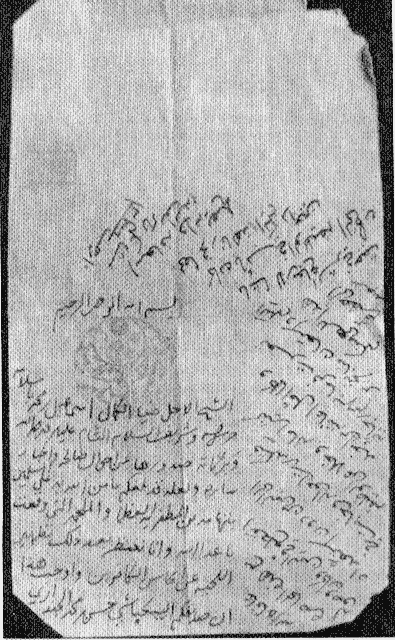
Figure 10.
A spiral letter from Imam Yahya to Ibb governor Isma'il Basalama,
1917 [A.H. 1336].

Figure 11.
Movements of the spiral text.
as diverse as memoranda, official correspondence, legal opinions, testaments, or sale instruments. All such handwritten texts were apt to exhibit the characteristic spiral form he describes. Given a blank page, a Yemeni writer of the period commenced far down on the page and indented radically toward the center. Since Arabic is written right to left, this meant roughly within the lower left quadrant. When the bottom was reached before the writing was finished, the spiral effect came into play. In short texts, completed at or before the bottom edge, there was no spiral, but a very wide margin remained to the right and across the top of the page. When the text continued, however, writer
and writing turned the corner and proceeded, nearly upside-down in relation to the initial lines, back up the right side of the page. Continuing on, the writing might pivot again, adjusting direction so as to are diagonally through the upper right quadrant to a finish in the upper left. The concluding lines were likely to end up directly above and perpendicular to the "In the Name of God the Merciful and Compassionate," the basmala , with which the text began. In their nautilus-like spiral proportions, formal correspondence, including official imamic letters, provided the most dramatic examples (see fig. 10, diagrammed in fig. 11),[2] but there were many versions of this type of spatial movement in Yemeni writing. A local mufti's fatwa -answers, for example, spiraled within the space left above the written query. Staid legal instruments might end in long tails of text that ran in reverse up right margins to culminate in twists at the top (see fig. 12). Lengthy legal judgments ran continuously on long scrolls of carefully joined paper and might finally turn over the bottom edge to conclude in a few upside-down lines on the back.
To look at this phenomenon in historical terms,[3] recall once again the humble land-sale document known as the basira , discussed in the preceding chapter. Many older documents of this type, dating from periods of imamic rule in this or the last century, bear traces of the spiral effect (fig. 12). By contrast, recent but still handwritten basiras are quite obviously organized according to a different spatial principle. In sale instruments from the 1970s, the text begins near the top and appears centered on the page, located between equal and straight-ruled margins drawn in by hand. In a document from 1991, the text is entered on a contract form, which has printed margins and lines for text (see fig. 13). No rotation occurs in the orientation of the new writing; the text proceeds downward in regular horizontal lines, moving margin to margin until completion. In these contemporary documents the writing is constrained in a manner familiar to Western legal instruments; the spiral is harnessed and the lines are straightened and centered. These sorts of changes are also evident with typing, as in the shift from spiraling imamic letters to the standard margin and paragraph form of republican correspondence.
The physical alteration from spiral to straight-ruled text is clear enough at a glance, but what is its significance? In the case of the basira it has to do with changes in the basic epistemological structure of the document, with the principles underpinning the document's construction and its authority. These have to do, in turn, with a backdrop of

Figure 12.
Upper portion of an old sale contract, dated 1856.
Writing in right margin is upside down.
changing relations of production and advancing commercialization.[4] Spatial shifts in such documents are closely linked to the evidence cited in the preceding chapter concerning such interrelated changes in documents as the advent of official court registration, the appearance of

Figure 13.
New sale document, dated 1991.
signatures by the parties to the contract, new evidence rules, and most recently, the licensing of writers, all of which have brought an extension of state control and a displacement of the private notary from his once central role as the legitimizing author-witness. With this displacement it has for the first time become conceivable for a basira to be entered on a printed contract form or even typed; handwriting, formerly the crucial mark of the notary's identity and his authoritative presence in the text, was becoming less relevant.
Physical differences between spiral and straight texts involve more
than a simple matter of design, of curved versus not curved. Ruled or printed margins on the new documents, which are prepared or exist in advance of the actual writing, are an important clue to differences in textual construction. In contemporary documents, writing fills a predefined space between parallel lines, while in spiral texts there is no such prior demarcation of the textual space (beyond page-size constraints). The physical space occupied by the text in such older, spiraling documents is instead produced in the course of the writing itself. Another way of putting it is that behind straight and spiral shapes, and filled versus produced space, lie quite different relations of form and content. In the new, straight documents, form is separate from, prior to, and more determinate of the shape of the textual contents. In the old spiral texts, by contrast, form and content are not clearly separable, and it appears that, if anything, it is textual contents that determine form. That is, in spiral texts, the ultimate shape depends on the physical extent of what has to be said.
Cassirer (1955, 2:84) contrasts two modes of spatial organization along similar lines. In differentiating "geometric space" from "mythical space," he points to differing form and content relationships. While the construction of geometric space is predicated upon the separation of form and content, the opposite is the case with mythical space, in which form "is not something that can be detached from content or contrasted with it as an element of independent significance; it 'is' only insofar as it is filled with a definite, individual sensuous or intuitive content." Cassirer's opposed epistemologies may be related to the contrasting methods of the "scientist" and "bricoleur" in the work of Lévi-Strauss (1966:22). These differ according to the "inverse functions they assign to events and structures as ends and means, the scientist creating events . . . by means of structures and the bricoleur creating structures by means of events."
Scribal Registers
These small techniques of notation, of registration, of constituting files, of arranging facts in columns and tables that are so familiar to us now, were of decisive importance in the epistemological "thaw" of the sciences of the individual.
M. Foucault, Discipline and Punish
Consider now the example of the property and accounting registers kept by the old agrarian state bureaucracies. This apparently dry material—the "ignoble archives" of bookkeeping, files, lists—is given
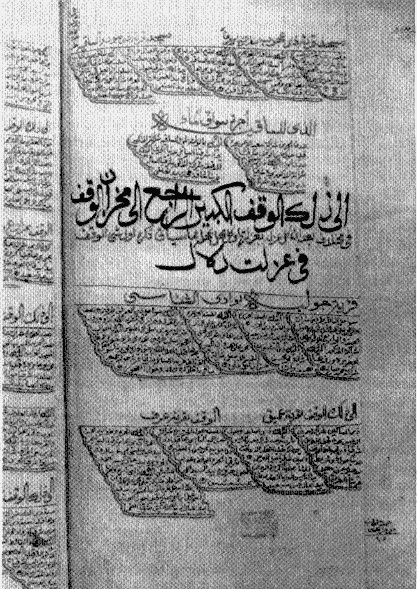
Figure 14.
Register (musawwadat al-'abbasiyya ) of endowment land pertaining to
the Great Mosque of Ibb.
pride of analytic place in the work of Weber,[5] Goody,[6] and Foucault. In some details of textual procedures, the local record-keeping tradition[7] exhibits a history of recent transition parallel to the shift from spiral to straight texts. By the turn of the century the Ottomans had introduced new "international" (duwali ) bookkeeping methods in all the Ibb offices except the endowments (awqaf ) administration.[8] There an older format continued until reorganization efforts of the late 1940s and 1950s.
A typical page in an old-style endowments register, made (as a copy) in 1928 (see fig. 14),[9] reveals a form determined by content relation similar to that found in spiral texts. Although the pages as a whole are ruled, individual entry texts are hemmed in, after the fact, by curved and scalloped lines. Instead of the physical regularity that results from filling in the standardized, printed entry forms currently in use, here each page, even each entry is particular in appearance. Scalloped form follows content: it is the physical extent of the writing, generated by the substantive detail on tenants and tenancy, area measurements, property names and boundaries, that determines the final shape of entries and, cumulatively, the overall appearance of register pages. In their layered arrangement, the property entries in such registers resemble nothing so much as the physical appearance of the curved and stepped terraces they refer to.
Subdivisions in the body of the register are marked by headings done in large decorative script in red and black ink. Together with literary embellishments such as the rhymed prose (saj' ) found in introductory sections, this sort of calligraphy is absent in the more austere and "business-like" contemporary land registers. Similarly, the rounder hand of the old katib contrasts with the sparse, specialized, and more standardized administrative (diwani ) script introduced by the Ottomans and the angular Egyptian-influenced hand that has now become the norm. Although individual items in the old foundation register are separated by scalloping, they are linked grammatically. The register reads continuously, using conjunctions and connecting phrases, from the fancy headings, into and through a series of entries to the next heading, and so on, from the opening basmala to the last word. In addition to the scalloping, a register's integrity was physically ensured by such protective marking devices as small nucleated circles or pairs of dashes, inserted to plug gaps. In the bottom corner the total number of entries on the page is stated in script and in numerals, and the first word of the next page is given.
The writer certified that upon completion the register was free of smudges or other signs of alteration and that his copy was an exact, word-for-word replica of the original. Attestations are included in the original register text, and others are added to the copy. These also bear witness to an exact agreement of copy and original (mentioning the muqabala comparison procedure),[10] specify the total number of entries, and quote the first and last entries. An important attestation of this volume is by Imam Yahya and includes his seal over a brief, physically slanted statement written by a secretary. It reads (referring initially to the previous attestation):
In the Name of God, the Merciful and Compassionate. What the Judge of the Endowments, the distinguished scholar Qasim bin Ibrahim bin Ahmad bin al-Imam may God protect him, has stated is attested to. The copy has taken on the authority of the original and is to be used accordingly. This register is to be kept free of alteration and erasure as it is on this date, the 19th of the month of Ramadan the honored, the year thirteen hundred and forty-six Hegira [1928].
The phrase "has taken on" is my rendering of the pivotal verb sar , encountered in connection with the sale instrument of the preceding chapter. Translated there as "became," it was central to the discursive enactment of a transfer of property. Here the register copy becomes equivalent to the thing itself, a fragile and authoritative original in its own right. Aside from the necessary avoidance of alteration, the register's integrity hinged on the physical and hermetic contiguity of its text and on the indication of a scribal presence, conveyed by a distinctive script. As a "copy" it is virtually the same thing as the original, not because it "looks like" the original in the photo-identity sense accomplished by mechanical reproduction (cf. Benjamin 1968), but because it has passed through an authoritative process of human reproduction and collation. Although they apparently accomplish the same task, manuscript copies and print copies work with differing technologies and epistemologies.
Like the sale instruments of the period, old registers bore the personal mark of a particular katib and displayed the artistry of his scribal craft. The text was suffused with the human presence, the haiba , the prestige, dignity, and awe-inspiring quality of specific men who concretely embodied the state. This was reinforced and perpetuated by kinship relations of descent and marriage among functionaries and officials (see Messick 1978). While the haiba of such a register was highly personalized, the authority of new bureaucratic texts is relatively de-
personalized. Like that of the nation-state to which it pertains, a new register's authority rests on its diffused formal abstractness, implemented through the standardized printed forms now available for all official acts. Like the displaced notary in relation to the new registered documents, the contemporary functionary lends little of his person to the forms he fills.
Forms, that is, documentary blanks to be filled in, appeared in Ibb with the Ottomans. At the local telegraph office, for example, one of the earliest of these forms had a crescent seal at the top, headings in Ottoman Turkish and French, boxes for office use, and lines to contain the message.[11] Such blank forms proliferated in the Ottoman bureaucracies as they would later under the republicans. The commercial receipt, another type of printed form to be filled in, was introduced via Aden. Prior to the "order form" itself, the written purchase-requests Ibb merchants sent to Aden were connected narrations by a scribe (concluding with qala , "said," and then the writer's name).[12] Their internal arrangements were similar to the scalloped entries of the old foundation register. Existing apart from and prior to any particular written content, forms are the mechanical templates of the new age of writing.
As with the Ottomans earlier in the century, the principal goal of the Egyptian advisors attached to Ibb offices in the late 1970s was to facilitate a bureacratic movement in a new direction, to assist functionaries in separating what had formerly been lumped together, to itemize what had been recorded whole. While old accounting registers were predominantly horizontal (written) in orientation, the new exhibited a more vertical (numerical) alignment. Thus while the pages of a tax collector's manual from early in the century contained entries strung across the page like laundry on a line, a comparable manual from circa 1955 had two prominent axes, one of grain types, the other of terrace names, creating a grid for entering the relevant figures. Vertical orientations facilitate whole-page summations and are associated with a new emphasis on the efficient extraction and display of numerical data, which used to be embedded in written text.
Seals of State
As a second example of a related phenomenon also recently transformed consider contrasts in official seals. A consistent presence on this century's texts of state, Ottoman, imamic, and republican, state seals have differed markedly in their significative technologies. Imams of the
early nineteenth century did not use seals and simply signed their correspondence;[13] the later use of seals by the Hamid al-Din imams coincided with the Ottoman presence. As an element of "tradition," this seal usage was not inherited from time immemorial but was of relatively recent adoption.[14] Imams Yahya and Ahmad utilized round seals about the size of a silver dollar, applied in red ink in the space at the beginning of official texts.[15] In a letter, the khatm al-sharif , the royal seal, was placed just under the basmala , and above the beginning of the text proper, like the eye of the spiral (see fig. 10). When used elsewhere, such as on judgments and attestations, a seal was typically accompanied by a few words of affirmation, written at a slant and sometimes in the imam's own hand.[16] Following the completion of the writing and the fixing of the seal, a red powder (called hamura ) was applied by the imam himself. This red dusting left a long-lasting trace indicating the document's lofty source. Anthropologist Carleton Coon, on a visit to Yemen in 1933, witnessed the process one afternoon in Imam Yahya's sitting room. The imam was working with al-Qadi 'Abd Allah al-'Amri.
He and the Imam had little heaps of papers in front of and between them, and after we were seated went back for a while to their discussion of these documents. Some of them the Imam signed, and dipped his fingers in a pot of red pigment to smear diagonally across them. This is the Imam's official sign, and is as important as his seal or his signature. Every document we received from him was crossed by four of these rosaceous smirches.[17]
It is of relevance for what follows regarding detailed changes in seal usage that, contrary to what Coon reports, there were in fact no signatures by the imam.[18]
Twentieth-century imamic seals are composed internally of off-center circles or ovals, with the largest of the crescent-shaped spaces thus created bearing the title "Commander of the Faithful" together with the imam's personal title, chosen and assumed upon accession. The next crescent within contained the imam's name and family name (e.g., Yahya Hamid al-Din); in Ahmad's seal this is preceded by "the Imam" and followed by "God make him victorious" (see fig. 15). This last phrase appears in the smallest circle in Imam Yahya's seal, whereas in that of Imam Ahmad there is the basmala . Like the silver currency minted in San'a' after 1926,[19] which they closely resemble in design, imamic seals were composed entirely of writing. As with the flourishes of the old registers, this was calli-graphy, beautiful writing, elegantly interwoven and sensuously curved to fit the crescent spaces. It also carried authority as the mark of the ruling imam.
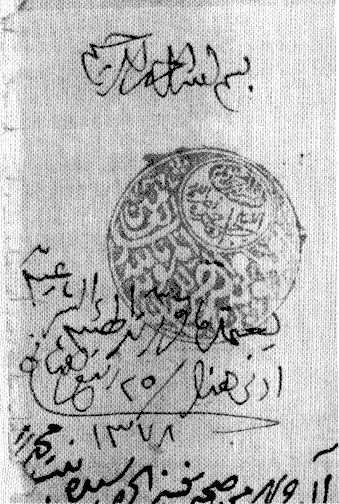
Figure 15.
Seal of Imam Ahmad on Appeal Court ruling, 1958 [A.H. 1378].

Figure 16.
Republican seal printed on official stationery, 1974.
Official seals continued in use after the Revolution of 1962, but both the seals themselves and their methods of employment were different. Aside from the shift from imamic red to republican blue, the most apparent of the semiotic changes is from script to emblem. The new seal of state bears the image of an eagle (nasr ), head in profile and wings spread, together with the national flag and the legend "Yemen Arab Republic." According to one republican writer, this emblem "represents the power of the people."[20] While the imamic seal bore the personal name of the imam, the living embodiment of the patrimonial state, the republican seal bears a symbol and the name of the nation-

Figure 17.
Signature and seal of republican official.
state. In use on official texts, the imamic seal, as was noted, was applied without a signature, or rather, it was itself the mark of the patrimonial imamic ruler. Aside from their appearance at the top of official stationery (see fig. 16), republican seals implement a separation of office and officeholder (and an interchangeability of incumbents) and are always accompanied by signatures: the official signs first, then the seal is placed over the signature (see fig. 17). In imamic states, the name of the state and, potentially, even the location of its capital, the imamic "seat," could change with each new ruler (e.g., the move from San'a' to Ta'izz in this century). In the nation-state conception, by contrast, the name of the state and the location of its capital are not normally subject to such alteration.
The recent appearance in the highlands of the notion of an emblem that is meant to "stand for" the state is traceable to the Ottoman period. In the year 1901, for example, according to the historian al-Wasi'i (1928: 180), the Ottoman governor of Yemen had a tall column

Figure 18.
Old and new city, Tunis. From L. C. Brown, ed., From Madina to
Metropolis (Princeton: Darwin Press, 1973), p. 29.
erected outside the main gate of San'a'. "At its top he had placed the image of a crescent moon, like those put atop minarets, made of copper plated with gold." It was the same symbol that appeared on the printed forms used at telegraph offices. The historian goes on to say that it was the governor's intention that the column with the crescent should serve as "a memorial for the government" (tadhkaran lil-hukuma ).
The Calligraphic World
Speculatively extending this "spiral" analysis to the articulation of space in a wider sense, an excellent example is found in a comparison of the physical layouts of towns, old and new. As was true of madinas from North Africa to central Asia, the old walled town of Ibb was a labyrinth of closely packed multistoried houses on narrow and winding alleys and culs-de-sac. The new quarters, by contrast, are characterized by relatively straight-line, wide thoroughfares with some space left between the buildings. The growth of these newer parts of Ibb is governed, in theory, by a municipal zoning and building "code," which involves plans for the expansion of the town and endeavors to regulate standards of construction. There was no colonial period "ville
nouvelle" or European section here,[21] but the form taken by Ibb's more modest new growth has followed a related pattern. Visually, the curvilinear urban script of walled Ibb contrasts sharply with the roughly rectilinear format of the new quarters. While passageways in the old town were mostly the residual, irregular spaces left and defined by the construction and expansion of buildings, streets in the new have been drawn in first on planning maps and then residential and commercial construction has followed. Although more dramatic in the monumental, whole-city plans set forth for a colonial Rabat,[22] Tunis (see fig. 18), or Cairo,[23] an equivalent separate specification of a projected urban layout and its determination of the possible subsequent locations of houses and shops has occurred in Ibb. Reversing the relation that obtained in the walled town, this new separation and precedence of urban form over urban content is analogous to the changeover from spiral texts to their straightened successors.
On a smaller scale, within the urban setting, architectural innovations carried out related alterations. Ottoman military buildings were among the first representatives in the highlands of a new type of public construction. An impressive barracks complex, housing infantry, cavalry, and artillery units was constructed outside the main gate of San'a', and a large military hospital and a well-run pharmacy inside, while in Ibb a small complex that also included a military bakery and a dispensary were constructed on a hill facing the walled town. These buildings were "new" in that they were physically separated from the old urban contiguities and highly specialized in function.
As a concomitant to the rise of a civil service in Yemen, there occurred a local version of the classic separation of "the bureau from the private domicile of the official."[24] Just as the imam's government operated from the courtyard and the upstairs diwan of his residence, so the local governor's house in Ibb was also the governorate office, with functionaries upstairs and the jail downstairs. Shari'a court was held in front of the judge's home, and, as at the mufti's, petitioners were received in the afternoon sitting room. Although there were some important earlier examples (the Treasury Office, built in the 1940s, and, among residences, Governor Sayaghi's innovative four-house modular complex of the 1950s), specially designed offices became the norm only after the Revolution. The handling of administrative registers, which were always retained at home as the personal effects of officials or secretaries, also changed. As was true of many of the details of the former system, this individual control of registers came to be viewed as an abuse: old registers were called in for deposit in new office file
cabinets, and their removal from the office was forbidden. The transition to work in offices was not abrupt, however: older judges were inclined to receive claimants outside the court building, and many functionaries continued to save exacting bookkeeping tasks for afternoon qat chewing in their own sitting rooms.
Just as the house became more specialized as a home, so the mosque became more specialized as a place for "religion." Instead of being located around pillars in the prayer room of the Great Mosque, schools moved out to separate places for the specialized activity of instruction. A variation on the progression from spiral to straight was again involved: the shift was from class space as the lesson circle, its size and shape produced by the particular daily gatherings of students, to the classroom, a permanent rectilinear space, with rows of desks, positioned like the lines on a form, to be filled with different student content. In the case of military barracks a related separation took place: learning from the Ottoman example, Yemenis eventually made the changeover from a reliance on occasional armed forces, quartered as they moved or living in their own residences, to a standing professional army, uniformed, constantly under a disciplinary regime, and housed in specially demarcated facilities (Foucault 1977; Mitchell 1988).
On a larger scale, a version of the shift from spiral to straight fits the changing physical-conceptual reality of the state. As with the harkas of sultans in Morocco (Geertz 1983; El Moudden 1983), the space of an old imamic state was, in part, created through the movements of the imam and his armies through the countryside.[25] Contrasting with this, in a relation, again, of produced versus filled space, are the fixed or claimed frontiers of the nation-state. Some maps were narratives that consisted of a listing of contiguous places rather than a grid filled in with reference to the four cardinal points. Asked for a sketch map of Ibb town, an old scholar replied by dictating a string of markets and mosques that one would encounter in a walking tour. Without stopping, this "map" continued to one of the town gates and then on out into the countryside and a long series of similarly connected places. Within government "seats" such as Ibb, the local presence of the state was constituted as officials made daily rounds of the markets and streets. Supplementing the physical movements of the patrimonial imam were such extensions of his person as his sons holding provincial posts and (prior to telephone and television) the circulation of texts bearing his seal and the red hamura applied by his fingers.
The "Space of Knowledge"
To conclude this excursus on "spiral texts" I want to sketch some further connections between physical and conceptual space, specifically, between the sorts of detailed changes identified in the space of writing and general changes that have occurred in the "space of knowledge." This last is characterized by Foucault as "an epistemological space specific to a particular period" (1970:xi).
Spiral texts were elements of a reasoned, ordered, and internally consistent intellectual world that was neither convoluted nor unevolved. The basic knowledges involved were bodily ones, and the basic transitions that have occurred involved disciplinary routines normalized at the level of the body. As the fundamental mediating site for the articulation of the physical-conceptual, the body was fully engaged as spiral texts were produced and used. Pivoting bodily movements and a rhythm of page rotation were required either to write or to read such a text. As a group, these and many related bodily techniques for reproducing space were distinct from the types of physical disciplines involved in filling in forms, typing, or working at a computer screen. Opposed to the emphasis on the physical contiguities of produced space (both between writer and text and within the text) are the expected separations that attend the world of filled spaces. The strong indexicality of the old texts, in which writing was a nonarbitrary mark of the person, is distinct from the character of texts, printed and not, in which writing itself ceased to be the mediating bearer of authority. "The relation of the sign to the signified now resides in a space in which there is no longer any intermediary figure to connect them: what connects them is a bond established, inside knowledge, between the idea of one thing and the idea of another" (Foucault 1970:63).
Academic knowledges such as shari'a jurisprudence were understood to be embodied. Both the internal inscription of memorization ("on the surface of the heart") and the human presences and linkages in authoritative knowledge transmission ("between me and the author are two men") were physically conceived. The authoritative knowledge of recited texts lived more in its human interpreters, al-Shawkani maintained, than "in the bodies of pages." In terms of a simple dichotomy between literacy and nonliteracy, it is possible to state that literacy "enables a society to accumulate culture hitherto preserved in embodied form" (Bourdieu 1977:187). But a literate tradition in which knowledges were contained both in human "carriers" and in books
represents an alternative situation to either exclusively "embodied" or strictly "decontextualized" (Goody 1977) forms of knowledge.
Within the sphere of formal knowledge, specifically within the discourse of the shari'a, the codification shift discussed earlier had a structure parallel to that occurring between spiral and straight texts. In a manner analogous to the change in the form/content relation of spatial ordering in writing, the (casuistical) old discourse differs from the (abstractly rational) new. Whereas the former developed principles within cases (form following content), the latter elaborates principles independently of and prior to the cases to which they are subsequently applied (content following form). In the disenchanted thought of shari'a legislation, the old primacy of the concrete instance has given way to a new primacy of the rule. Having cut its ties to the older forms of human embodiment, the shari'a of the legislated code relies instead on an authority internal to the new discourse itself. The "straightened" (Bourdieu 1977:169) thought that has appeared entails a changed character of knowledge, a new locus for truth, and a different relation to and among humans.