
APPENDICES
Appendix A:
The Structure of Leningrad's Municipal Administration
This description of the structure of local municipal administration in the USSR generally and Leningrad more particularly, during the period of this study, is intended as a "road map" for readers who are unfamiliar with Soviet administrative structure and practices or with the Soviet and Western analytical literature about them. It does not reflect reforms in the administrative structure undertaken since 1988. The summary given here may be supplemented by referring to David T. Cattell's study of the structure of Leningrad local government during the 1960s and to Max E. Mote's doctoral dissertation examining the structure of Leningrad administration during the late 1950s and early 1960s.[1]
Soviet Federalism and the City
Soviet Russia has been a federal state ever since the formation of the Union of Soviet Socialist Republics in 1922. The structure of the Soviet federation has evolved over time, becoming enshrined in and modified by new constitutions in 1924, 1936, and 1977.[2] At present, the union consists of 15 republics that are geographical expressions of major nationality patterns. Constitutionally, each union republic must border on non-Soviet territory so that it can exercise a right of secession. Ten larger union republics are, in turn, organized into regional subunits (autonomous republics, autonomous oblasts, autonomous okrugi , and kraia ) defined by officially recognized nationalities (e.g., Tatars, Jews, Mordvinians, Buryats) or by geography (oblasts). Below this intermediate regional level, there are some 50,000 local soviets that serve as the governing bodies for the territorial subunits—raiony , cities (goroda ), urban districts (gorodskie raiony ), workers' settlements, and villages—of smaller union republics and of the regional constituent units of larger union republics (see Table A-1).[3] Prior to Stalin's death in March 1953, most of these subregional local units appear to have been moribund, though they have gained in power and authority since that time.[4]
| ||||||||||||||||||||||||||||||||||||||||||||||||
Probably most Western Soviet affairs specialists dismiss the Soviet Union's alleged federalism as little more than propagandistic dressing for a highly centralized and unified system. American political scientists Donna Bahry, Philip Stewart, Roger Blough, and James Warhola, however, have each attempted in various ways to look beyond the limitations on the Soviet federal system and ask how the system may actually function.[5] Bahry, for example, argues that Western emphasis on the long arm of the center may ignore the impact of grass-roots politics on the dynamics of regional policy-making. Bahry suggests that in a system where officials in every republic capital constantly assert local interests, and where party and government decisions are presumably formulated through bargaining among such interests, policy choices ought to be intimately connected with regional politics. Meanwhile, Stewart, Blough, and Warhola demonstrate that, on the basis of a content analysis of speeches and articles presented by Politburo members between January 1, 1972, and July 1, 1979, the members display several clear regional biases, which at times are also linked to major economic issues. The work of these scholars supports the notion that the activities of regional and local elites are determined by the constitutional structure of the Soviet state, which is federal. This federal hierarchy establishes the bureaucratic, political, national, and geographic context of regional intra-elite conflict.
A major consequence of the federalist structure for Leningrad in
particular is the diminution of its stature as a city. Its location in the same republic as Moscow deprives it of status as a republican capital in the federal system. The hierarchical structure of the Soviet federalist system makes it difficult, for example, for cities that are not capitals of a union republic to rise above provincial status. As noted earlier, Leningrad is a special case among such urban centers, continuing to be a city of national significance. But, Leningrad does not house republican ministries, nor does it as a matter of right maintain a vast selection of the cultural and educational amenities that are mandated in the capitals of all the union republics (a condition that increases the vulnerability of Leningrad's remarkable cultural and educational infrastructure to outside intervention).
The status of Leningrad within the USSR Academy of Sciences provides a small illustration of the ways the city has been adversely affected by its comparatively low stature as only a regional seat in the Soviet federal system. The Russian Imperial Academy of Sciences began operations in St. Petersburg in 1724 and maintained its headquarters there until 1934, when its principal administration, together with several of its more prestigious research centers, moved to Moscow.[6] Many (but not all) of the research institutes remaining in Leningrad lost their status as autonomous institutes as they were reorganized further into mere branches and affiliates of institutes in Moscow. At about the same time, the academy established integrated multidisciplinary branches in each of the union republics and in Siberia, again bypassing Leningrad as the city was not a republic capital. During the late 1940s and early 1950s, most of these republican affiliates were elevated in status to become semiautonomous republican academies.[7] Meanwhile, in 1957, the Siberian branch in Novosibirsk formed the core of the academy's Siberian Division, which by the late 1970s operated more than 50 research institutes and 70 research stations across Siberia and the Soviet Far East.[8] By 1980, regional scientific centers had been founded in Sverdlovsk and Vladivostok, and branches of the national academy were functioning in nearly every capital of the Russian Republic's autonomous republics (Kirov, Kazan', Makhachkala, Petrozavodsk, Syktyvkar, and Ufa).[9]
As capital cities of autonomous republics, such provincial nonentities as Makhachkala, Syktyvkar, and Ufa are qualified for special treatment by the academy. Leningrad, however, could make no such claim, and until 1983 simply offered a home base to research institutes directly subordinate to divisions of the academy presidium or, worse yet, subordinate to branches of Moscow-based scientific research establishments. In other words, there were no regional/republican intermediary bodies to deflect and moderate central intervention in the operation of Leningrad's academy research centers. In March 1983 the Central Committee of the Communist Party announced the long-delayed
establishment of its Leningrad Scientific Center.[10] Only the Soviet Union's federal structure could justify elevating the bureaucratic stature of backwater Ufa's scientific centers over those of an international center like Leningrad.
Republican capitals also reap other institutional advantages. Central power flows through such cities as Dushanbe and Ashkhabad, capitals of the Tadzhik and Turkmen republics, on its way from Moscow to local jurisdictions. Its lower constitutional status, however, gives Leningrad less of an intermediary role and puts it in more of an overtly subordinate status in relation to Moscow. After all, Moscow is Leningrad's national and republican superior. The lack of formal status as a capital of a republic defines Leningrad's eminence as based on its own characteristics and efforts and not mandated by central policies underlying the Soviet Union's federal structure.
The Soviet Municipal Charter
In addition to reaffirming the federal nature of the Soviet state, the October 1977 Soviet constitution, as well as the constitutions of the union republics ratified over the course of the following year, proclaimed a new legal basis for Soviet municipal administration, with the role of the local soviets, or councils, being stated ever more forcefully.[11] In theory, the system of national, republican, regional, and local soviets of people's deputies set forth in the 1977 constitution is the primary instrumentality of state power.[12] Other government institutions—including such varied bodies as industrial enterprises, schools, hospitals, and shops—become subordinate at one level or another to the elected soviets, which direct all branches of state, economic, social, and cultural activities.[13] To guarantee the soviets' juridically superior position, the 1977 Constitution states in Article 105 that "The Deputy has the right to request information from the appropriate state agency or official who is obliged to respond to the inquiry at a session of the Soviet."[14]
Chapter 19 of the 1977 constitution addresses this basic conflict of Soviet local governance in a forthright manner, with Articles 146 and 147 of that chapter forming the basis of municipal attempts to assert local control over economic activities.[15] Article 146 grants local soviets the power to resolve "all questions of local importance, proceeding from the general interests of the state and the interests of citizens residing on a soviet's territory."[16] Still, the constitution's authors seem reluctant to extend the authority of local soviets over conflicts of national importance emerging within their territory.
At this point Article 147 assumes its significance, particularly in its final revised version, which contains new language added to the
preliminary draft that had been released for public discussion. Article 147 declares, in text added after the public debate, that local soviets "ensure comprehensive economic and social development on their territory."[17] This was and still remains the boldest legislative effort to assert municipal control over the activities of national economic organizations operating within the soviets' jurisdictions. The article goes on to state that local soviets "exercise control over the observance of legislation by enterprises, institutions, and organizations of higher subordination located on the soviets' territory; and coordinate and control these entities' activity in the fields of land use, conservation, construction, the use of labor resources, the production of consumer goods, and the provision of social, cultural, consumer, and other services to the population."[18] This statute goes well beyond previous efforts to increase the authority of the soviets.
Almost immediately following the ratification of the new constitution in 1977 the Supreme Soviet began to amend and revise all existing legislation in order to bring the corpus of Soviet law into conformity with the new constitution. Many of these revisions similarly strengthened the authority of local soviets to regulate the activities of the central ministries in such areas as provision of local services, labor regulations, and environmental standards, where primary regulatory control had been ceded to the soviets.[19] The more important of these decrees was a joint resolution issued in March 1981 by the Central Committee of the Communist Party, the USSR Supreme Soviet, and the Council of Ministers; it sought to strengthen and widen the economic powers identified in Article 146 of the 1977, or "Brezhnev," Constitution.[20] Legislation enacted in June, September, and November 1980, governing the activities of local soviets,[21] and efforts during the spring and summer of 1984 by the Central Committee of the Communist Party and the supreme soviets of the union republics attempted to ensure greater local control over economic agencies operating in a given jurisdiction.[22] Consequently, the new constitution and legislation and resolutions of the past several years—taken as a whole—define the functions of the city soviet and its executive agencies.
In any given municipality or district, the soviet of people's deputies, its executive committee (ispolnitel'nyi komitet or ispolkom ), administrative agencies, and commissions serve as the Soviet state's principal agent.[23] The local soviet, which is dissolved for reelection every 30 months,[24] oversees all governmental, administrative, economic, social, and cultural endeavors within its territorial domain.[25] In the city of Leningrad, the city soviet supervises the activities of over 400 industrial enterprises, 800 construction, transportation, and commercial bodies, 900 educational and scientific institutions from primary schools to advanced research centers, and 8,000 service-sector organizations, all subordinate to some 150 ministries and other state agencies.[26] Such
supervision entails the coordination of interests among all of these contrasting local and national ventures, with a view to maximizing the interests of the entire community.[27] The city soviet also directs construction activity within its jurisdiction and has responsibility for enforcing environmental laws.[28]
Until 1989, the regional, city, and district soviets usually have been made up of local workers and notables such as famous actors and renowned scientists, as well as administrators who have stood unopposed in single-candidate elections organized by districts with relatively small populations.[29] For example, in 1985 the composition of the Leningrad city soviet, with a total membership of 600 deputies, was as follows:[30]
|
The deputies, who tend to meet once every quarter, select, according to Communist Party—controlled nomenklatura procedures to be described shortly, an executive committee to conduct the soviet's business during the intervening period. The chairman of the executive committee is also the local government's chief executive officer. The municipality's executive functions are carried out by departments and administrations that are subordinate to the soviet and its executive
committee, and are supervised by citizen commissions chaired by elected deputies who are members of the local soviet.
North American observers might be struck by the relatively large number of participants at any given stage in the process of local governance.[31] The more skeptical among us might conclude that the sheer size of local soviets guarantees that they have only a most peripheral role in municipal administration, as the large numbers of deputies would presumably preclude meaningful participation in the decision-making process. In 1985, for example, the Leningrad regional soviet consisted of 280 deputies, who selected a 25-member executive committee responsible for the operation of several departments and administrations (of which 39 were reported to have been in operation in 1982), as well as for the support of standing commissions (of which there were 15 in operation in 1982).[32] The Leningrad city soviet at that time should have been even more unwieldy, with 600 deputies and a 25-member executive committee responsible for even more departments and administrations (54 at last report in 1987) and committees and commissions (28 in 1987).[33] In July 1987 the structure and membership of executive agencies were as follows:[34]
Chair of the City Soviet Executive Committee
V. Ia. Khodyrev
First Deputy Chairs of the City Soviet Executive Committee
K. I. Labetskii (also Chair, Planning Commission)
Iu. A. Maksimov (Agro-industrial Commission of Leningrad)
L. G. Perekrestov
Deputy Chairs of the City Soviet Executive Committee
A. Ia. Avdeev
N. M. Arkhipov
G. A. Bukin
V. I. Matvienko
A. S. Sokolov
B. A. Surovtsev
Secretary of the City Soviet Executive Committee
L. A. Khodchenkova
Members of the City Soviet Executive Committee
O. I. Beliakov (Secretary, Kalininskii District Party Committee)
A. A. Bol'shakov (General Director, Scientific-Production Association)
A. N. Gerasimov (First Secretary, Leningrad City Party Committee)
G. A. Grigor'eva (Doctor, City Children's Polyclinic no. 58)
V. A. Leniashin (Director, State Russian Museum)
M. V. Riabkova (Leader of Plasterers' Brigade)
T. A. Senina (Chief Engineer, All-Union Draft-Design and Scientific Research Institute of Hydro Design)
V. I. Serova (Secretary, Leningrad Regional Trade Union Council)
V. P. Sidel'nikov (First Secretary, Nevskii District Party Committee)
G. G. Sintsova (General Director, May Day Dawn Association)
I. D. Spasskii (Chief, Construction-Design Bureau)
M. V. Stepanov (Brigade Leader, Sokol Association)
P. I. Timofeev (Lathe Operator, Kirov Factory)
E. A. Vasil'eva [position unidentified]
People's Control Commission Chair
E. P. Iudin
People's Court Chief
V. I. Poludniakov
Chairs of Standing Commissions of the City Soviet
Auditing: A. I. Aleksandrov (First Secretary, Moskovskii District Party Committee)
Construction and Construction Materials Production: Iu. K. Sevenard (Chief, Leningrad Hydro Specialized Construction Association)
Culture: V. N. Zaitsev (Director, State Public Library)
Health: N. V. Vasil'ev (Director, Scientific Research Institute on Trauma and Orthopedics)
Heat & Energy: G. A. Lastovkin, (General Director, Leningrad Petrotechnical Scientific-Production Association)
Housing Accounting and Distribution: V. A. Efimov (First Secretary, Leninskii District Party Committee)
Housing Exploitation and Repair: N. A. Ignat'ev (First Secretary, Oktiabr'skii District Party Committee)
Improvement of Administration and Realization of the "Intensification-90" Program: A. D. Dolbezhkin (General Director, Printing Machine Construction Production Association)
Industry: A. V. Chaus (General Director, Pulp Machine Construction Production Association)
Nature Protection and Well-Being: Iu. A. Balakin (Chief, Leningrad Civil Aviation Administration)
People's and Professional-Technical Education: B. M. Petrov (First Secretary, Petrodvortsov District Party Committee)
Physical Culture and Sports: A. A. Arbuzov (test driver at a scientific-production association)
Plan-Budget: V. P. Koveshnikov (general director of a scientific-production association)
Public Dining: V. F. Poliakov (Director, Leningrad Milk Combine no. 1)
Questions of Women's Labor and Style of Life: V. A. Zhelnova (Chief Doctor, City Children's Polyclinic no. 34)
Servicing of the Style of Life: L. A. Kutuzova (Director, Sewing and Clothing Repair Production Association of Vyborgskii District)
Socialist Legality and the Protection of the Social Order: A. I. Korolev (Dean, Juridical Faculty, Leningrad State University)
Social Insurance: N. Iu. Shumilova (Chief Doctor, Kalininskii District Polyclinic no. 90)
Trade: A. I. Bobrov (First Secretary, Dzerzhinskii District Party Committee)
Transportation & Communications: V. I. Karchenko (Chief, Baltic Steamship Line)
Youth Affairs: Iu. S. Vasil'ev (Rector, Leningrad Polytechnic Institute)
Leaders of Departments of the City Soviet Executive Committee
Cadres & Academic Institutions: A. A. Ponomarev
Construction & Construction Materials: A. D. Beglov
Economic Research: A. I. Denisov
General: G. A. Glukhov
Justice: M. R. Rakuta
Legal: I. A. Sobolevskii
Organizational and Instructional: V. I. Rozov
Price: Iu. V. Keleinikov
Registration of Civil Acts: G. I. Bogdanova
Veterinary: A. N. Romanov
Chiefs of Main Administrations of the City Soviet Executive Committee
Architectural Planning: V. I. Nikitin
Capital Construction: A. N. Alfimov
Construction Materials Industry: V. F. Nikulin
Construction of Engineering Structures: A. V. Veselov
Culture: A. P. Tupikin
Finance: V. N. Lomachenko
Health: G. A. Zaitsev
Heat and Energy: A. S. Khotchennov
Housing, Civil, and Industrial Construction: Iu. R. Kozhukhovskii
Internal Affairs: A. A. Kurkov
People's Education: S. A. Alekseev
Professional-Technical Education: L. A. Gorchakov
Public Dining: A. A. Tomashevich
Supply: V. Z. Grigor'ev
Trade: A. P. Zlobin
Wheat Baking and Macaroni Production: V. K. Ivanov
Chiefs of Administrations of the City Soviet Executive Committee
Archival: N. V. Ponomarev
Consumer Services: Iu. P. Filatov
Cooperative Housing Construction: A. N. Glotov
Dacha Services: A. P. Saksin
Expert: Iu. A. Ponomarev
Film: A. Ia. Vitol'
Flood Control Construction: B. P. Usanov
Foreign Relations: V. E. Kublitskii
Highway-Automotive: V. I. Shugaev
Hotels: N. M. Kazantsev
Housing: M. F. Petruk
Housing Accounting and Distribution: Iu. N. Lukanin
Individual Sewing and Clothing Repair: S. F. Molodtsova
Labor: N. Z. Amonskii
Local Industry: A. S. Vorob'ev
Municipal Services: V. V. Morozov
Parks: Iu. I. Khodakov
Pharmacy: V. M. Musatova
Protection of State Secrets in Print (Glavlit): L. N. Tsarev
Publishing and the Book Trade: E. A. Rozhnov
Servicing of Accredited Foreign Representatives: K. M. Ivanov
Social Insurance: A. A. Avseevich
Specialized Transportation and Ports: G. M. Alekseevca
Streetcars and Trolleybuses: Iu. N. Gorlin
Technical: B. S. Leshukov
Technical Inventories: A. I. Zakharov
Transportation: A. A. Zorin
USSR State Savings Bank (Gostrudsberkass): V. A. Shorin
Chairs of Committees of the City Soviet Executive Committee
TV and Radio: R. V. Nikolaev
Physical Culture and Sports: N. M. Popov
Collectivized Agriculture Services: A. N. Maliutin
Capital Repair and Reconstruction of Public Buildings: E. V. Bozhko
Commissions Subordinate to the City Soviet Executive Committee
Superintendency: A. Ia. Avdeev (Deputy Chair, Leningrad City Soviet Executive Committee)
Minors' Affairs: V. I. Matvienko (Deputy Chair, Leningrad City Soviet Executive Committee)
Struggle with Alcoholism: L. G. Perekrestov (First Deputy Chair, Leningrad City Soviet Executive Committee)
Finally, jurisdictions subordinate to the Leningrad city soviet in 1987 elected 5,420 deputies to 21 district, 3 city, and 4 settlement soviets, just one of which, that of the Vasileostrovskii District, had operated 15 standing commissions the previous year.[35] Deliberative assemblies of such proportions are unsuited for meaningful discussion and control of municipal affairs. For the most part, these sessions are organized around a well-planned succession of speeches on a given set of policy questions such as housing, the new five-year plan, or economic performance; spontaneous participation by soviet members other than those whose remarks have been prepared in advance is discouraged. Consequently, the soviets' executive committees, administrations, and departments inevitably assume such supervisory functions, becoming from necessity the central administrative agencies within this system of local governance. Nonetheless, the deputies provide important liaison between those executive offices and the local citizenry. Interchanges between deputy and constituent begin during the election process.
Local Elections
On December 11, 1984, a constitutionally mandated campaign for local soviets was launched in Leningrad as citizens began to nominate members of specially constituted ward election councils.[36] The events of the subsequent two and a half months represent a reasonably typical Soviet municipal election campaign, before Gorbachev-era proposals for multicandidate elections and subsequent changes in elections procedures.
The campaign's first stage lasted about a month, during which groups of citizens throughout the city met at their places of employment to nominate candidates preselected by party-dominated commissions and chosen from among local officials, managers, scientific and cultural figures, and leading workers to run for seats on the regional, city, and district soviets.[37] Next, one nomination for each available seat was registered with election commissions established to supervise the voting process in each jurisdiction.[38] Then, on February 5, 1985, official lists of all the candidates for all districts in every soviet were verified by the appropriate election commission.[39] Candidates then traveled
throughout their districts, meeting with groups of constituents.[40] Voting by secret ballot took place on February 24.[41] The election commissions announced the final results on February 27: every candidate for the Leningrad regional soviet received the mandatory majority affirmative vote required for election.[42]
The establishment of dialogue between deputies and their electors takes place at the preelection meeting with voters. At the most superficial view, many such gatherings appear to be rather pro forma in character. Played out according to a script prepared by the party officials orchestrating the election in a given district, a candidate is introduced, his or her biography is praised, and there is discussion of a list of topics drawn up elsewhere (perhaps as far away as Moscow). These meetings are nonetheless models for similar discussions held periodically during a deputy's term of office. As with those subsequent postelection sessions, an important interchange can occur between representatives and represented. Such gatherings are supplemented by letters, petitions, and office visits, and provide a primary and effective forum for city residents seeking redress from municipal bureaucratic indifference.[43] In the case of the preelection meeting, this complaint function has been institutionalized in a system of electors' instructions (nakazy izbiratelei ), which provides a much-used communication channel through which interested city administrators can actually learn about the quality of local public services.[44]
Article 102 of the 1977 constitution provides the legal foundation for electors' instructions, while a December 1980 Decree of the USSR Supreme Soviet regulates their implementation.[45] According to these regulations, the instructions are generated by individuals and groups of citizens and must be of a broad social nature (e.g., planning and construction of recreation facilities), as opposed to a purely personal one (e.g., housing allocations). Nevertheless, they can be quite specific in their content (e.g., improve the playground facilities at a neighborhood park, develop a cross-country ski course along a local river, or extend shopping hours at a local food shop). During the early 1970s, requests concerning housing, public services, and commerce dominated the instructions, and there is little reason to suspect that this earlier pattern has been substantially altered in subsequent years.[46] The executive committees of several local soviets have at times established special commissions charged with the evaluation of instructions from local voters.[47] Individual sessions of many soviets have also been set aside to deal with citizen proposals and complaints.[48] According to some Soviet sources, more than 730,000 instructions were generated by citizens nationwide during the local soviet elections of 1982, of which nearly 28 percent were responded to favorably by year's end.[49]
The issue of deputy liaison with the local populace through electors' instructions and numerous other mechanisms holds considerable
significance beyond our immediate task of delineating the rules of the contest by which Leningrad elites must play in their relations with the political center in Moscow. Jeffrey Hahn has argued that political participation may be categorized by two primary modes: electoral activity and constituent contact.[50] There can be little doubt that the role of electoral activity before 1989 had been largely symbolic in the Soviet political system. Nevertheless, Hahn, Theodore Friedgut,[51] and Ronald Hill[52] have argued that constituent activity at the level of the local soviet was a major vehicle for citizen interaction with the political system of the USSR. The municipal soviet deputy in Leningrad and elsewhere fulfilled an important ombudsman function, providing a communication link between local elites and the general population. The institution of the city soviet thus partially opens up the rules of the contest of municipal administration to embrace the citizenry.
The Executive Committee
Ultimately, administrative responsibility for municipal management rests with the local soviet's executive committee and its departments, administrations, and standing commissions.[53] The executive committee retains authority to act on a daily basis to ensure that all aspects of state economic, social, and cultural policies are implemented. National legislation grants the committee a broad mandate to manage the activities of municipal and other agencies operating within its jurisdiction.[54] The executive committee (led by its chairman, deputy chairmen, and secretary, operating through its organizational-instructional department), prepares the agenda for sessions of the full soviet and informs deputies of important developments within their jurisdiction.[55] Finally, interlevel communications with other jurisdictions in the Soviet federal system are conducted through the executive committee.[56]
The executive committee varies in size according to its level of responsibility in the overall state hierarchy. Typically, the executive committee, in addition to its officers, includes the managers of major industrial enterprises and other institutions within the soviet's province, and the first secretary of its equivalent Communist Party committee.[57] In Leningrad's Kalininskii District, for example, executive committee Chairman Shekalin and party committee First Secretary Grachev frequently operated as a single managerial team for their district's development.[58] Shekalin and Grachev's cooperation was facilitated by the physical location of both institutions in a single building, an arrangement frequently found in Leningrad and elsewhere in the Soviet Union.
Officers of the executive committee share their soviet's broad com-
petence. The executive committee's legal counsel, for example, serves deputies, departments, and commissions regardless of specific content.[59] Legal consultants to a local soviet may also provide services for local citizens. One former district legal official now residing outside the USSR described her duties to American University criminologist Louise Shelley, who reported:
Her work was closely connected with the diverse operations of city government and the people of her community. Her job was a juggling act between the protection of the bureaucratic interests of the distant authorities and the needs of the people who appealed to her for assistance. Because the power and the financial resources of city government are limited, its ability to effect changes requested by its constituents is similarly limited.[60]
To assist officials with general responsibility for the entire scope of soviet activities, the executive committee delegates daily management in specific areas to departments and administrations, and monitors the bureaucracy through a system of standing commissions.[61] The departments and administrations constitute the managerial infrastructure for the soviet's actions. The size and number of such offices depend on the level of the jurisdiction in question. By the early 1980s, the Leningrad city soviet operated an extensive bureaucracy through more than three dozen administrations, plus another dozen departments, directly employing approximately 2 percent of the city's workforce.[62]
The executive committee oversees the work of its bureaucracy through a network of standing commissions. Each commission consists of a number of elected deputies, as well as several citizens. Such commissions are charged with general supervisory responsibility for state institutions operating within their area of competence.[63] The composition of each commission is established at the opening session of the newly elected soviet. While the number and purview of commissions will vary according to the size and needs of a given jurisdiction, nearly every soviet will establish an auditing commission; commissions for planning and budget, socialist legality and public order, and youth affairs; and more specialized bodies for specific economic, social, and cultural spheres. Commissions that are attached directly to the executive committee are usually organized to supervise council operational functions, while those serving the soviet in its entirety tend to be specialized according to substantive policy areas.[64] Both categories of commission assist the executive committee with general planning and managerial responsibilities.[65]
Despite their large constitutional mandates, local soviets have encountered persistent difficulty in asserting their authority over local institutions, whose primary loyalty is to all-union ministries in Moscow and union-republic ministries in Moscow and the republic capital. All-
union ministries are directly subordinate to the USSR Council of Ministers, while union-republic ministries are subordinate to republic councils of ministers, which in turn are subordinate to the USSR Council of Ministers. In other words, all-union ministries have no republic-level counterpart and operate as a single, centralized unit for the country as a whole. Union-republic ministries, by contrast, are responsible for coordinating the work of ministries of the same name and similar purpose operating within each of the Soviet Union's constituent union republics.
Prior to 1977, for example, the Soviet community of legal-affairs specialists, as well as many regional planners and politicians, had begun to express heightened concern over the inability of existing institutions to deal effectively with the conflict between territorial interests and those of various economic branches and sectors. Jerry Hough attributed this increased anxiety in part to the higher educational levels and growing economic power of the urban sector. He also noted the limited impact of piecemeal reform attempts, such as the much-ballyhooed effort dating from the late 1950s to bestow on local soviets the responsibility of "single client" (edinyi zakazchik ) for housing, cultural-social, and commercial services within their jurisdictions.[66] In other words, the local soviet could attain sole responsibility for ordering the necessary provisions for such services. The USSR Council of Ministers, it should be noted, reinforced that statute in 1978.[67]
A flurry of legislative activity by the Presidium of the USSR Supreme Soviet and the Communist Party's Central Committee similarly has sought to invigorate municipal agencies down to the level of the urban district (raion ), an administration unit that, while generally regarded as powerless in confrontations with ministries, is nevertheless important in the provision of day-to-day services to the population as a whole.[68] Jeffrey Hahn reports that local governmental institutions in the Soviet Union can and do successfully represent those who elect them.[69] Hahn also notes, however, that only a few Soviet citizens take advantage of the opportunities that do exist for participation.
From a slightly different perspective, Ronald Hill indicates that a number of Soviet scholars have proposed new powers for local soviets that could alter the balance of power between municipal and ministerial operations.[70] According to Hill, specialists centered in and around the USSR Academy of Sciences' Institute of State and Law have urged that legislation specify the "competence" of municipal agencies, as well as their more traditional "rights and obligations." Such advocates, Hill continues, also argue for a strengthening of the economic powers of local state agencies as well as greater legislative attention directed toward relationships between municipal and ministerial agencies. The framers of the 1977 constitution must have been aware of these controversies and may have been among the participants.[71] This presumed
Table A-2.Change in Revenues and Expenditures for Representative Municipal Services throughout the USSR, 1966–1974 | ||
Service | Change in Revenues | Change in Expenditures |
Tram transportation | - 2.9% | + 28.6% |
Trolleybus transportation | + 64.6% | + 100.8% |
Water services | + 230.0% | + 250.0% |
SOURCE : G. B. Poliak, Biudzhet goroda (Moscow: Finansy, 1978), 28. | ||
knowledge accentuates the significance of provisions eventually ratified in the so-called Brezhnev Constitution that still governs the Soviet state.
Taken together, these constitutional and legislative assertions provide the legal framework within which local officials function. They define the juridical rules of the contest for municipal administrators. In any legal system, of course, interpretation and actual implementation are often more significant than published codes in influencing behavior. This is particularly true of the Soviet Union, where legal pronouncements often represent statements of what ought to be, instead of reflecting what has actually come to pass. While recognizing this, we can nevertheless conclude that legislative activity over the past two decades or so has enlarged the bounds placed around municipal elites in their dealings with the center, thus expanding the room for maneuvering at the periphery.[72] The 1977 constitution, legislation, and resolutions of the 1970s taken as a whole thus represent a loose municipal charter defining the rules of the Soviet urban contest for such major municipal institutions as the city soviet and its executive agencies.
City Budgets
The cost of local government has increased as Soviet cities have grown in recent years.[73] From 1959 until 1978, the population of major Soviet urban centers rose by 58.4 percent while city territories expanded 20 percent every five years.[74] Meanwhile, both labor costs and demand for improved quality of city services rose, resulting in expenditures increasing faster than revenues.[75] Although the earnings gap is more prominent in some areas than in others, it is visible across a wide range of city services as rates of increase of expenditure for many services outstrip rates of increases in revenues (see Table A-2). Soviet financial managers have responded by altering the profile of local expenditures and by subsidizing municipal governments through transfer
payments from other administrative levels within the Soviet state system (see Table A-3).
With transfer payments from other administrative levels have come pressures for increased financial oversight.[76] The executive committee of a local soviet is the primary responsible institution that maintains contact with other bureaucratic levels in the state hierarchy, such as the region and the republic. In recent years, executive committee concern with financial management has expanded, with the executive committee serving as a central clearinghouse for budgetary activities. The executive committee, its professional staff, and the budgetary standing commission now work year-round on financial management problems arising from past, present, and future budgets.[77] The executive committee must ratify budgets, disperse income among lower-level units (e.g., districts within cities), collect and distribute taxes, supervise capital construction funds, and also support the soviet's own considerable operations.[78] These activities inevitably involve the executive committee in consultation and negotiation with national monetary institutions as well as those of the republics and regions, and with every economic establishment within its jurisdiction. In fact, financial and budgetary control is fast becoming an executive committee's most absorbing responsibility.[79] This situation is particularly true of a city such as Leningrad, whose municipal budget approaches the size of many smaller union republic budgets. The purpose of such budgets is primarily to provide a mechanism for coordinating the individual plans of city soviet administrative departments and various sources of local income rather than to closely control expenditures or allocate revenues. Decisions on actual expenditure and allocation are made on the basis of budget projections, but frequently do not conform to budget guidelines.[80]
During 1980, some 1.2 billion rubles were scheduled to pass through the financial agencies of the Leningrad city soviet (see Table A-4). Of these funds, approximately 45 percent were generated locally, 43 percent were assigned to the soviet from general state revenues and taxes, and about 12 percent resulted from direct transfer payments from other state budgets (i.e., republic, regional, and district budgets).[81] In other words, although Leningrad is far more self-sufficient financially than most Soviet municipalities, less than half of its operating funds for 1980 were to be derived from the council's own fixed income. Consequently, the council has been drawn into an intricate financial web that not only links it downward to nearly all economic enterprises functioning within its boundaries, which provide locally generated fixed income, but also links it upward to the budgets of more senior strata within the Soviet federal system.
Slightly more than half of all projected 1980 expenditures were to be used to operate the productive capacity directly subordinate to
Table A-3.Changes in Profile of Revenues and Expenditures of Soviet City Budgets, 1950–1975 | ||||||
1950 | 1960 | 1965 | 1970 | 1975 | ||
REVENUES | ||||||
Fixed Income | 47.1% | 35.0% | 27.2% | 30.1% | 30.5% | |
Payments from enterprise profits | 21.0 | 23.5 | 17.6 | 22.2 | 21.5 | |
Local taxes and collections | 21.1 | 7.0 | 5.5 | 4.4 | 3.8 | |
Other | 5.0 | 4.5 | 4.1 | 2.5 | 5.2 | |
Transfer payments from state incomes and taxes | 48.0 | 47.2 | 54.4 | 55.2 | 53.5 | |
Turnover taxes | 17.2 | 28.9 | 35.4 | 34.8 | 31.9 | |
Payments from republican enterprise profits | —— | —— | 3.0 | 2.2 | 2.6 | |
Income taxes on enterprises | 7.4 | 4.1 | 0.9 | 0.9 | 0.8 | |
State taxes on population | 13.2 | 13.3 | 14.3 | 15.6 | 16.6 | |
State land incomes | 10.0 | 0.2 | —— | 0.5 | 0.5 | |
Lottery income | —— | 0.4 | 0.5 | 0.9 | 0.8 | |
Timber income | 0.2 | 0.3 | 0.3 | 0.3 | 0.3 | |
Grants from higher budgets | 0.3 | 0.7 | 1.0 | 0.4 | 0.2 | |
Grants from other budgets | 4.6 | 17.1 | 17.4 | 14.3 | 15.8 | |
TOTAL (in million rubles) | 2,479.6 | 7,482.4 | 10,961.7 | 15,045.7 | 20,379.8 | |
EXPENDITURES | ||||||
National economy | 24.4 | 44.4 | 36.2 | 38.2 | 40.7 | |
Sociocultural programs | 71.1 | 53.8 | 62.3 | 60.0 | 56.5 | |
(table continued on next page)
(table continued from previous page)
Tables A-3.Changes in Profile of Revenues and Expenditures of Soviet City Budgets, 1950–1975 (Continued) | ||||||
1950 | 1960 | 1965 | 1970 | 1975 | ||
Education and Science | 32.6 | 26.0 | 32.8 | 30.3 | 28.8 | |
Health and physical culture | 37.5 | 27.1 | 28.7 | 29.1 | 26.9 | |
Social security | 1.0 | 0.7 | 0.8 | 0.6 | 0.8 | |
Administration | 3.7 | 1.2 | 1.0 | 1.0 | 0.9 | |
Other expenditures | 0.8 | 0.6 | 0.5 | 0.8 | 1.9 | |
TOTAL (in million rubles) | 2,258.4 | 6,566.2 | 9,697.8 | 13,125.6 | 17,847.6 | |
SOURCE : G. B. Poliak, Biudzhet goroda (Moscow: Finansy, 1978), 21, 25–26. | ||||||
the city soviet, while slightly less than half were to be expended for administration and services more closely related to traditional Western definitions of municipal functions. These latter funds were used by the city soviet's departments and administrations, with its standing commissions monitoring the expenditure of funds in specific policy areas. In this way, through the city's budgetary process the entire local economy—both managerial and productive—becomes a single integrated and interdependent financial system, with fiscal ties to the region and republic above and to the districts below via the executive committee and its financial agencies.
Linkages between a local soviet's executive committee and superior administrative levels in the government hierarchy tie local elites to national institutions, and the bond is reinforced by the reliance of local soviets on funds generated by outside state agencies. All these institutions, in turn, operate in an environment created by broad policy directions established by the Communist Party's local and national agencies.
Communist Party Agencies
Thus far we have described the national system of municipal administration. Although it is more ambitious in scale and scope than local governments in the rest of the industrialized world, it is recognizable as resembling those local government systems. Now, however, it is time to discuss the cross-cutting political and bureaucratic structure that differentiates the principles and practices of Soviet municipal gov-
Table A-4.Leningrad City Budget, 1980 | ||
Category | Value (in Rubles) | |
REVENUES | + 1,227,922,000 | |
Source: Turnover tax | 416,365,000 | |
Payments from profits | 478,393,000 | |
Income tax on cooperative and Social institutions and enterprises | 5,001,000 | |
State taxes from population | 93,847,000 | |
State duties, taxes on profits from film shows, local taxes and returns | 23,653,000 | |
Returns in damages of expenditures for upkeep of land | 2,492,000 | |
Savings from reduction in administrative expenditures | 3,483,000 | |
Returns of noncentral sources derived from financing of state plan expenditures | 30,894,000 | |
Other incomes | 25,553,000 | |
Transfers from republican budget | 136,980,000 | |
Transfers from surplus revenues of district (raion ) budgets | 951,000 | |
EXPENDITURES | -1,226,965,000 | |
Source: City economy | 659,105,000 | |
Sociocultural measures | 534,838,000 | |
Maintenance of administrative Agencies | 8,585,000 | |
Other expenditures | 21,298,000 | |
Fund for unexpected expenses | 2,188,000 | |
Surplus of revenues transferred from the city budget | 951,000 | |
BALANCE | + 957,000 | |
SOURCE : "O biudzhete Leningrada na 1980 god: Reshenie Leningradskogo gorodskogo Soveta narodnykh deputatov ot 17 dekabriia 1979 goda," Biulleten' Ispolnitel'nogo komiteta Leningradskogo gorodskogo Soveta narodnykh deputatov , 1980, no. 3:6–9. | ||
ernance from those of any system in the Western world. That cross-cutting structure is the Communist Party of the Soviet Union.
As noted in the introduction to this volume, local institutions in the USSR are subject to a dual system of political subordination: within the state bureaucracy just described and within a parallel network of party agencies.[82] In general, the party is a network designed to establish policies that are to be implemented by the state. The state bureaucracy is thus a network designed to coordinate policy implementation .
At the local level, municipal party institutions supervise all economic, social, political, and cultural activities within their jurisdiction. The local soviets have a rather similar role, but, in contrast to party control of the commanding heights of management, the soviets more often than not end up wrestling with petty administrative detail. In a 1965 textbook prepared for local activists by Leningrad's higher party school, Grigorii Romanov, a regional party secretary at the time, emphasized this supervisory role in discussing the party's function as leader of local social, political, and economic development.[83] In a similar volume published more than a decade later, Anatolii Gerasimov, then chief of the Leningrad regional party committee's industrial department and later city party committee first secretary, underscored the same theme of the party as system overseer. Indeed, Gerasimov perhaps went further than Romanov by noting that the effectiveness of social production rested on economic concentration and specialization, which would facilitate technological innovation, and he emphasized that such innovation was possible only through the review and intervention of a single coordinating institution in daily management: the Communist Party.[84] Other articles in the same volume, such as those by Tat'iana Zhdanova, secretary of the Leningrad city party committee, and Galina Pakhamova, chief of the regional party committee's culture department, stress that the party's helmsmanship extends across all spheres of human activity within a given jurisdiction.[85]
As noted in the introduction to this book, party supervision of local state institutions takes at least three primary forms. First, party members within state institutions are required to adhere to principles of party discipline by working to implement party policies. Second, state bodies officially cooperate with their party equivalent, and both sets of institutions prepare fully integrated plans of action. Third, through a unified system of personnel appointment, the Communist Party's nomenklatura , higher-ranking party and state institutions place key decision-making and leadership personnel in all subordinate organizations.
Virtually no information is available about the operations of the party's nomenklatura in Leningrad. But, as a surrogate source of information, here is a general outline of nomenklatura positions con-
trolled by the executive committee of the Leningrad city soviet in 1980:[86]
• Chairman, Deputy Chairman, and Secretary of the Executive Committee of the Leningrad city soviet are elected by the city soviet.
• Managers of Main Administrations, Departments, and Committees of the Executive Committee are confirmed and dismissed by the city soviet, except during those periods between sessions of the city soviet when such officials are appointed to or dismissed from their positions by the Executive Committee of the city soviet.
• Deputy Managers and Chief Accountants of Administrations and Departments and employees of the bureaucracy of the Executive Committee are appointed to or dismissed from their positions by the Executive Committee.
• Employees of the bureaucracy of the Main Administrations, Administrations, and Departments of the Executive Committee and of organizations subordinate to it (appointed by the managers of such subdivisions) are appointed to or dismissed from their positions by the Executive Committee or by the Nomenklatura Accounting-Control of the Executive Committee
• Managers of Main Administrations, Administrations, and Departments may appoint, dismiss, or transfer employees of the bureaucracy and subordinate organizations in which personnel actions and actions of Nomenklatura Accounting-Control are conducted with the approval of the Executive Committee (or its Deputy Chairman through subordinate organizations, personnel departments, and educational institutions). Such appointments must be presented for the approval of the Executive Committee within one week of assumption of duties.
• The Executive Committees of District (Raion) soviets approve appointments and dismissals of employees of the Executive Committees of District (Raion) soviets through the Nomenklatura Accounting-Control of the Executive Committee of the city soviet upon the approval of the Executive Committee of the city soviet while managers of Departments and Administrations of Executive Committees of District (Raion) soviets may appoint or dismiss employees upon the approval of the corresponding Main Administration, Administration, or Department of the Executive Committee of the city soviet.
Because the nomenklatura procedures utilized by the Leningrad city soviet may be different from those of the party, the data in the outline illustrate basic principles of personnel appointment according to which
lower-level institutions fall under the supervision of superior agencies. For example, when the deputy manager of a city department retires or is transferred, the city soviet's executive committee—and not the department in question—will appoint a successor. Similarly, the appointment or dismissal of a manager of a department of a district (raion) soviet must be approved by the nomenklatura apparatus of the city soviet as well as by the corresponding city department prior to action by district officials . This pattern is repeated throughout the state and party hierarchies until careers fall within the domain of the most senior nomenklatura agency of all, the Central Committee of the Communist Party.[87]
Joel Moses has observed that little consensus can be found among the numerous Western scholars who have examined career development patterns of Soviet elites, except, perhaps, that a single integrated network of job placement encompasses state and party positions alike.[88] Examining regional elite recruitment patterns in the 1970s, Moses argues that in fact a deliberate and planned program of leadership development may be identified. This course of career advancement appears to lock personnel early in their careers into distinct functional specializations that cut across state, party, and mass organizational bureaucratic hierarchies. Moses then identifies five quite distinct functional career assignment areas: agricultural specialists, industrial specialists, ideological specialists, cadre specialists, and mixed generalists. All five career patterns may be identified within the hierarchy of appointments apparently controlled by the Leningrad regional and city party committees, although since the end of World War II both of those institutions have generally divided their areas of responsibility respectively between agricultural and urban industrial concerns.[89]
Both the integrated cross-agency nature of the nomenklatura system and the dominance of party institutions within that system may be seen in the pattern of appointment to the Leningrad region's senior political posts, wherein personnel move across hierarchical boundaries as they are promoted.[90] This point is illustrated by the career of Vladimir Khodyrev, who, in 1980, rose from being a secretary of the Leningrad city party committee to being its second secretary. In 1982, Khodyrev moved over to become Grigorii Romanov's top deputy as the Leningrad regional party committee's second secretary. Then, in 1983, Khodyrev was transferred outside of the party bureaucracy to become chairman of the Leningrad city soviet. All the while, he was responsible for city administration and was moving within a single personnel system, but he undertook his duties at the top of three different and at times competing institutions—the city party committee, the regional party committee, and the city soviet. Moreover, Lev Zaikov, Khodyrev's predecessor as chair of the city soviet, replaced Romanov as first secretary of the regional party committee. Although not completely analo-
Table A-5.Composition of the Leningrad City Party Committee, 1980 | ||||||
Full Members | Candidate Members | Auditing Commission Members | Total | |||
Party officials | 35.0% | 32.5% | 36.9% | 34.6% | ||
Regional | 8.2 | 0.0 | 0.0 | 5.2 | ||
City | 10.3 | 18.9 | 15.8 | 13.1 | ||
District | 13.4 | 8.2 | 15.8 | 12.4 | ||
Institutional | 3.1 | 5.4 | 5.3 | 3.9 | ||
City government officials | 12.4 | 13.5 | 15.8 | 13.1 | ||
Social organization officials | 3.1 | 2.7 | 0.0 | 2.6 | ||
Managers | 6.2 | 5.4 | 10.5 | 6.5 | ||
Military and police | 5.2 | 0.0 | 0.0 | 3.3 | ||
Workers | 11.3 | 16.2 | 0.0 | 11.1 | ||
No identification* | 26.8 | 29.7 | 36.8 | 28.8 | ||
TOTAL | 100.0% | 100.0% | 100.0% | 100.0% | ||
MALE | 77.3% | 86.5% | 63.2% | 77.7% | ||
FEMALE | 22.7% | 13.5% | 36.8% | 22.3% | ||
SOURCE : "Sostav Leningradskogo gorodskogo komiteta KPSS," Leningradskaia pravda , December 28, 1980, p. 1. | ||||||
gous, this situation can be likened to one in which the U.S. Department of Health and Human Services were suddenly to become able to make all personnel decisions for federal, state, county, and city public health organizations.
Finally, in addition to these procedures and structures linking party and state agencies into a unitary administrative system, state leaders are frequently co-opted into leading party governing bodies. The Leningrad city party committee, like the city soviet, includes in its ranks many workers (see Tables A-5, A-6, and A-7). Unlike the city soviet, however, administrative personnel (party officials, city government officials, social organization officials, and the like) dominate the 169-person city party committee,[91] perhaps reflecting both the greater bureaucratic and political presence of the city party committee and the greater liaison function of the city soviet (see Chart A-1). If we look at the membership of the 1980, 1983, and 1985 Leningrad city party committees—as identified in Leningradskaia pravda from 1980 until 1985—it is noteworthy that city party and state officials (secretaries, department chiefs, and so on) are the two largest single groups of mem-
| |||||||||||||||||||||||||||||||||||||||||||||||||||||||||||||||||||||||||||||||||||||||||||||||||||||||||||||||||||||||
bers. In other words, there are men and women who manage Leningrad's municipal affairs. This pattern is magnified if we add district (raion) officials who perform similar duties at their level within the Soviet federal hierarchy. Moreover, the people who actually run key municipal institutions—both party and state—are much more likely to be reelected to successive party committees. For example, both groups dominate the ranks of the city party committee's full members reelected at party conferences in December 1983 and again in December 1985 (see Table A-8).
The Rules of the Contest
This appendix has set forth the institutional context of local governance within the Soviet system by reviewing the governing constitutional and legislative documents—the Soviet "municipal charter." It also has discussed the soviet, the institution most responsible for opening up communications between the city's governed and governors, as well as the soviet's executive agencies that link the city's administrative
| |||||||||||||||||||||||||||||||||||||||||||||||||||||||||||||||||||||||||||||||||||||||||||||||||||||||||||||||||||||||
structure to national bureaucratic institutions. Finally, it has reviewed the role of the party committee—the only municipal institution capable of providing a broad policy framework. Taken together, these institutions and the rules of their operation establish the strictly defined limits of the institutional world within which local officials must function.
These "rules of the contest" in center-periphery relations and municipal administration in the USSR impose order on the myriad institutional and personal relationships necessary to run a modern metropolis.[92] The varied constitutional, legal, bureaucratic, political, economic, cultural, and personal norms that constitute those rules are as diverse as the relationships they seek to control. Taken as a whole, these conventions create the institutional context within which the Leningrad officials mentioned in this study have functioned.
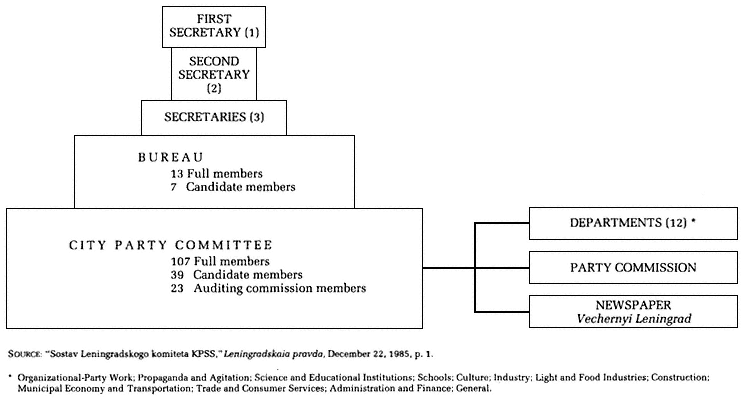
Chart A-1.
Structure of the Leningrad city party committee, December 1985.
| ||||||||||||||||||||||||||||||||||||||||||||||||||||||||||||||||||||||||||||||||
Appendix B:
Senior Leningrad Officials, 1917–1987
During the Revolution of 1917, the Civil War, and the postwar recovery period, the most powerful Bolsheviks involved in local Petrograd politics (first Leon Trotsky and then Grigorii Zinov'ev) assumed the position of chairman of the historic Petrograd soviet (see Chart B-1). With the purge of Zinov'ev and his supporters in 1926, however, prestige and power shifted to the Leningrad regional party committee's first secretaryship, where it has stayed ever since.
In December 1931, regional party institutions were separated from newly created city institutions. Nevertheless, the first secretaries of the regional party committee initially assumed both posts until 1950.
By the 1950s, a clear career pattern formed under which local leaders such as Frol Kozlov were promoted from city party second secretary to first secretary, then from regional party second secretary to first secretary. Later in the decade, regional party second secretaries Nikolai Rodionov and Georgii Popov became city party first secretary, as did Iurii Solov'ev in 1978.
The bifurcation of local party institutions into agricultural and industrial branches under Nikita Khrushchev (1963–1964) briefly obscured this hierarchy among Leningrad party institutions.[1] By the late 1960s, however, the previous pattern had been firmly reestablished.
The personnel changes following the elevation of regional party First Secretary Grigorii Romanov to the Secretariat of the Communist Party's Central Committee in June 1983, as well as the death of Romanov's second secretary, Nikolai Suslov, in an automobile accident the year before, disrupted the normal pattern of personnel advancement.[2] The June 1983 elevation of Leningrad city soviet Chairman Lev Zaikov to replace the departed Romanov would appear to defy all previously established models of Leningrad nomenklatura advancement.[3] No one had ever previously made such a move from the lower status city soviet post to the region's senior party position.
By mid-1985 more traditional appointment patterns had reasserted themselves. In July of that year, former Leningrad city party First Sec-
retary Iurii Solov'ev, returning from a brief stint as USSR minister of industrial construction, was named regional party first secretary, replacing Lev Zaikov, who, in turn, had joined the Central Committee's Secretariat.[4]
| |||||||||||||||||||||||||||||||||||||||||||||||||||||||||||||||||||||||||||||||||||||||||||||||||||||||||||||||||||||||||||||||||||||||||||||||||||||||||||||||||||||||||||||||||||||||||||||
(table continued on next page)
(table continued from previous page)
| |||||||||||||||||||||||||||||||||||||||||||||||||||||||||||||||||||||||||||||||||||||||||||||||||||||||||||||||||||||||||||||||||||||||||||||||||||||||||||||||||||||||||||||||||||||||||||||
(table continued on next page)
(table continued from previous page)
| ||||||||||||||||||||||||||||||||||||||||||||||||||||||||||||||||||||||||||||||||||||||||||||||||||||||||||||||||||||||||||||||||||||||||||||||||||||||||||||||||||||||||||||||||||||||||||||||||||||||||||||||||||||||||||||||||||||||||||||||
(table continued on next page)
(table continued from previous page)
| ||||||||||||||||||||||||||||||||||||||||||||||||||||||||||||||||||||||||||||||||||||||||||||||||||||||||||||||||||||||||||||||||||||||||||||||||||||||||||||||||||||||||||||||||||||||||||||||||||||
(table continued on next page)
(table continued from previous page)
| ||||||||||||||||||||||||||||||||||||||||||||||||||||||||||||||||||||||||||||||||||||||||||||||||||||||||||||||||||||||||||||||||||||||||||||
Appendix C:
Leningrad's Urban Planning Institutions
During the period of this study, the State Committee on Construction Affairs (Gosstroi) was the Soviet Union's principal national institution involved in the regional and city planning process (in addition, of course, to the economic planning agencies subordinate to the State Planning Committee [Gosplan]). Gosstroi began operations in 1950 as the successor organization to the Committee on Architectural Affairs. It was involved in one way or another with every phase of the construction process from planning to general contracting, and directed a centralized national administrative and support network for construction and related planning efforts.[1] This system included more than a dozen major research and design institutes, as well as the State Committee on Civil Construction and Architecture (Gosgrazhdanstroi).[2] As with Gosplan in economic planning, Gosstroi and Gosgrazhdanstroi were replicated at the level of the Soviet federal republics by 15 state construction committees (one for each republic). These same functions were performed at the local level by the Construction and Architectural departments and the Architectural-Planning administrations of the city and regional soviets as well as city planning institutes subordinate to Gosgrazhdanstroi. Major revision of this system at the national level is under way as this volume goes to press.
The city general plan of development is the primary instrument for physical urban planning.[3] This plan, together with accompanying detailed thematic and district plans, elaborates the broad outline of future construction in a city for a period of up to 30 years. Soviet law requires every city to adopt and implement such a general plan, and all have done so with varying degrees of practical result.[4]
Leningrad's planning structure is something of a model version of this planning system, although it is more complex than the national norm. In Leningrad, four major groups of institutions are involved in the city planning process, each containing a number of semiautonomous institutions with quite distinct ties to the policy process, both locally in Leningrad and nationally in Moscow. The first group comprises the Leningrad offices of Gosstroi and Gosgrazhdanstroi: the Architectural-Planning Administration, and the Main Administration of
Housing, Civil and Industrial Construction of the Leningrad City Soviet.[5]
The second group includes the planning and architectural organizations. The most important of these is Gosgrazhdanstroi's Leningrad Planning Institute (LenNIIproekt), which has primary responsibility for compliance with the city's general plan.[6] In addition, Gosgrazhdanstroi's planning center for the Northwestern RSFSR (LenZNIEP) is also based in Leningrad, as are a number of specialized planning agencies for housing, subway, bridge, and engineering construction projects.[7] All these establishments are joined by several design institutes that may be considered the functional equivalents of Western architectural firms, as they design projects in Leningrad and elsewhere on essentially a contract basis.[8]
The group of architectural and planning agencies also includes the Leningrad Division of the USSR Union of Architects, which is one of the most active branches of that organization anywhere in the Soviet Union.[9] This 1,550-member professional association is the focal point of the city's architectural, planning, and construction community. Its seminars and publications are a powerful intellectual force behind the work of local city planners and architects and provide theoretical cohesion. The union is as responsible as any other single institution for the sustained advocacy of a distinctive Leningrad viewpoint on architectural and planning issues.
The third institutional cluster participating in the physical development of the city consists of an extensive network of contractors headed by the Main Leningrad Construction Administration (Glavleningradstroi), which operates nearly two dozen smaller trusts that are, in effect, construction firms.[10] Moreover, it works closely with the Leningrad-based Main Western Construction Administration (Glavzapstroi), which, along with its subordinate trusts assumes responsibility for much of the construction in the Northwestern RSFSR. In addition, a series of specialized construction agencies are charged with such specific tasks as facade reconstruction, subway construction, bridge construction, and university development.[11]
The city's architectural research and educational institutions compose the fourth and perhaps most important institutional concentration, providing valuable support for all the institutions we have mentioned. The Repin Institute of Painting, Sculpture, and Architecture,[12] the Leningrad Engineering-Economics Institute,[13] the Leningrad Polytechnic Institute, the Leningrad Engineering-Construction Institute, and the USSR Academy of Sciences' Institute of Socioeconomic Problems all have trained successive generations of Leningrad planners, architects, and urbanists who share a generally uniform viewpoint on problems of urban development. Such a linkage between common perspectives, professional orientations, goals, and practices on the one hand and
shared educational experiences on the other is not at all surprising and has been commented on by social scientists exploring other, non-Soviet environments.[14]
These four groupings encompass dozens of institutions, and the most prominent of them are among the most influential of their kind in the Soviet Union. The system preserves a multigenerational tradition of competent and well-trained professionals who have a distinctive outlook. The cooperative partnership of Leningrad's educational, planning, design, construction, municipal, and professional institutions fosters a remarkable degree of cohesion within the local planning community on the value of historic preservation, the necessity for social planning, and the need for aesthetic harmony.
Indeed, this consensus facilitates the efforts by Leningrad planners, architects, builders, and managers to preserve an urban environment that is unique in the world. Furthermore, it encourages them to minimize the intrusion on that environment by the standard Soviet fare of mile upon mile of prefabricated reinforced-concrete residential and industrial superblocks.[15] While such superblocks exist in Leningrad, they are kept away from the city's historic core. These features combine to produce a powerful and cohesive local architectural and planning establishment. This establishment forms a professional community and an institutional network that has access to considerable resources of its own when dealing with representatives of the centralized state from Moscow.