
Reger
Like Zemlinsky, the young Reger wrote his share (more than his share) of pieces that imitate many of the master's "symptoms."[13] But there is also one brief, and for Reger rather restrained, work that does something more (and less). It is a short piano piece written after Brahms's death on 3 April 1897 and intended specifically as a memorial tribute. Reger published it in 1899 as op. 26, no. 5, with
[13] On the Reger-Brahms relationship, see especially Wirth 1974.
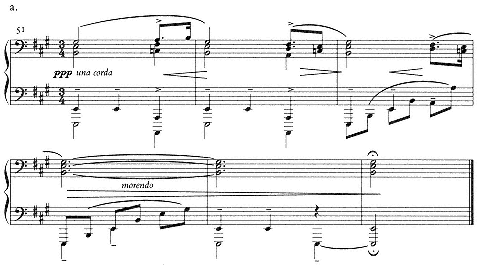
Example 1.5
Max Reger, Resignation , op. 26, no. 5.
the title Resignation and the subtitle 3 April 1897—J. Brahms† .[14] As a tombeau specifically intended to evoke the departed master, Resignation can hardly be taken as representative of Reger's work, or of that of other composers in the "Brahms fog" of the decades around 1900. Yet it shows perhaps better than any other individual work the different ways in which Brahms could be "received" compositionally.
We may distinguish four levels or degrees of Brahms reception in Resignation. Arranged in order from the most obvious or blatant to the most subtle, these might be called quotation, emulation, allusion, and absorption. The piece concludes with a direct, clear quotation of the theme from the Andante of Brahms's Fourth Symphony (ex. 1.5a). The reference could not be more patent; Reger even derails the tonic of Resignation, which up to this point has been A major, in order to bring the final quotation into its original key, E major, thus ending Resignation in the dominant!
[14] Resignation has a kind of companion piece, entitled Rhapsodie and subtitled Den Manen Brahms (To the Memory of Brahms), which is a large, turbulent work modeled closely on Brahms's Rhapsodies, op. 79. It was published in 1899 as Reger's op. 24, no. 6. Both pieces are discussed briefly by Lindner 1938, 165, who notes their "strongly Brahmsian stamp." Both are printed in Reger 1957, where the editor, Helmut Wirth, attributes them to the summer of 1898, even though the autographs bear no dates. I suspect that at least Resignation may have been written a year earlier, perhaps just after Reger heard about Brahms's death.
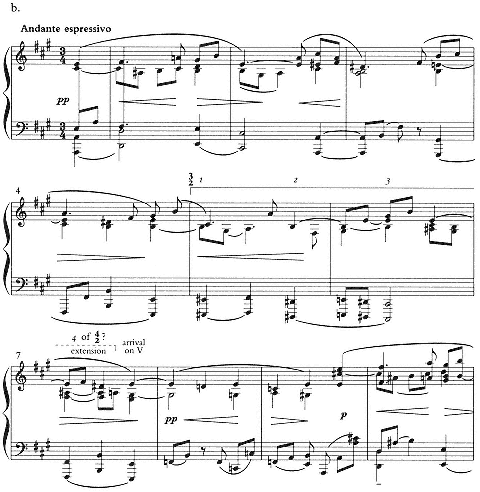
Example 1.5
continued
The body of the piece that precedes this coda shows a considerable degree of emulation, by which I mean a general stylistic imitation of what Schoenberg would call the "symptoms." Such broader features of Brahms's piano style were aptly described by Niemann in 1912 as "motion by thirds and sixths, their orchestral doublings, the preference for wide spacings and for a sonorous, dark, low register, [and] a self-willed rhythmic language, with a tendency toward syncopated and triplet figures of all kinds" (Niemann 1912, 39). Reger's Resignation clearly strives for this more superficial kind of emulation, as can be seen in ex.
1. 5b, which presents the opening portion of the piece. (The overall ABA' form of Resignation is also typical of Brahms's late piano works.)
But Reger also goes beyond emulation to allude more specifically to at least three late Brahms intermezzi that share the two keys of Resignation: op. 116, nos. 4 and 6, both in E major; and op. 118, no. 2, in A major (see exx. 1.6a-d). Reger's deep bass octaves recall 1.6b; the distinctly polyphonic texture, with active middle voices, is a feature of both 1.6a and c. Reger also adopts the opening gesture characteristic of all three intermezzi: Resignation begins on an upbeat with a root-position tonic chord, which moves on the subsequent downbeat to a predominant sonority, ii6 . Brahms uses similar harmonies on the downbeat: in ex. 1.6a, vi6 ; in ex. 1.6b, first a passing chord on A, then ii; and in ex. 1.6c, a

In Reger, as in exx. 1.6a and b, the precise configuration of the pre-dominant chord is obscured by appoggiaturas and (as in 1. 6a) by the holding of notes over the bar line. These rhythmic and/or melodic devices serve in each case to create harmonic ambiguity: we do not know whether to interpret the first chord as a tonic or as V of IV. In ex. 1.6b, Brahms also generates considerable metrical ambiguity. Our ear tends to hear the strong root-position chord as a downbeat, and the subsequent phrasing suggests a broad


At the approach to the dominant in Resignation, mm. 6–9, Reger draws upon precisely these kinds of metrical ambiguity or conflict. As we listen—at least for the first time—mm. 5–6 suggest a


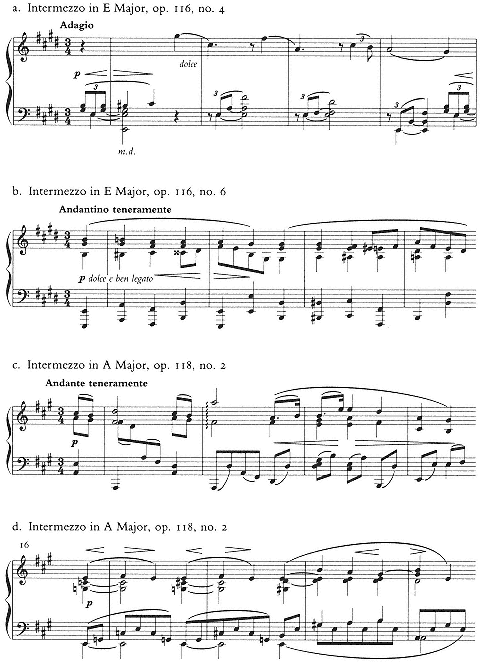
Example 1.6
Brahms Intermezzi.
ian gesture: the A enters a half-beat too "early," sounding deep in the bass underneath the prevailing dominant harmony.[15]
The elegant procedures involving meter, harmony, and phrase structure that I have analyzed in mm. 6–9 of Reger's Resignation fall into the last, most subtle category, absorption. Reger is making no apparent quotation of, or allusion to, any specific passage in Brahms; rather he has fully internalized some of Brahms's most characteristic compositional techniques. This is the kind of "influence" that Charles Rosen has characterized as the most profound, and also the least easily detected: no precise model can be found, and the search for one becomes essentially an endeavor of "pure musical analysis" (Rosen 1980, 100).
Resignation obviously appeared too late to have served as any kind of model for Schoenberg's early Brahms assimilation. A further investigation of possible "influence" in this traditional sense would have to examine the works of Reger that appeared before 1897, thus his opp. 1–16 (1893–96). (Unlike in the case of Zemlinsky's music, where we can assume that Schoenberg would have been familiar with works composed or published in the mid 1890s, we cannot be sure just what early Reger works Schoenberg might have known.) My point in examining Resignation has not been to claim that Reger served as model for Schoenberg, but rather to suggest how Brahms may really have served as model for them both. Even at its most "symptomatic," a work like Resignation can show deeper points of contact with the compositional essence of Brahms, as in mm. 6–9. It is this kind of absorption, rather than the more superficial imitation evident in some of the Zemlinsky works, toward which the young Schoenberg strove; this will be the essential subject of the next two chapters.
[15] Although I have found no specific instance of this procedure in Brahms's piano music, the overlapping of dominant and tonic at moments of return occurs in a variety of ways in the orchestral and chamber music. See Frisch 1984, 138–39, for a discussion of this procedure in the Andante of Brahms's Third Symphony.