
The Pleasures of Manas Singing
The performance genre I am about to describe was not among those I had originally proposed to include in this study, for before coming to Banaras I had no idea of its existence. If the popular traditions of Manas recitation and exposition are little known in the West, the folk tradition of Manas singing is, as will be seen, virtually a nameless art even within its own culture and is little appreciated or even acknowledged outside the circles of those who actually participate in it. Indeed, some of my initial inquiries about the genre turned up only disinterested reports of its demise; "Maybe the village people used to sing like that," one man told me, "but now of course they have radios."
I knew to inquire about this style of singing because of an experience I had on one of the final nights of the monthlong Ramnagar Ramlila in October 1982. The performance on the night of Ram's enthronement is unique in that its concluding arti ceremony is delayed until sunrise the following morning, and the entire night is given over to a mela , or fair. The streets of Ramnagar swell with thousands of Banarsis and villagers who pour in for the auspicious sunrise ceremony. They wander about enjoying the gaudy illuminations that transform the fort and city, sampling treats from dozens of open-air restaurants that spring up for the occasion, haggling over trinkets at tiny stalls, and taking rides on hand-operated ferris wheels. Such diversions, common to any rural fair in North India, are not the sole means of passing the long and chilly night, however, and the devotional flavor of the pageant that occasions this particular fair is reflected in numerous all-night kirtan programs in temples, storefronts, and private homes.
As I walked around savoring the excitement and anticipation of this special night, my attention was attracted by a crowd of men packed into the narrow courtyard of the tiny Hanuman temple that, in the lila , represents Nandigram, the ascetic retreat of Ram's faithful brother, Bharat. In the center of the courtyard was a low, cloth-covered table with a large, well-worn copy of the Manas at each end. Around the table clustered musicians—players of the harmonium, double-headed drum (pa-khavaj ), and finger-cymbals (manjira )—and two singers who were interpreting the text. The passage being sung was one of the ones that had been chanted during the dramatic performance a few hours before, but now the style of rendition was completely different and unlike anything I had heard before. Each stanza was treated as an independent "song,"
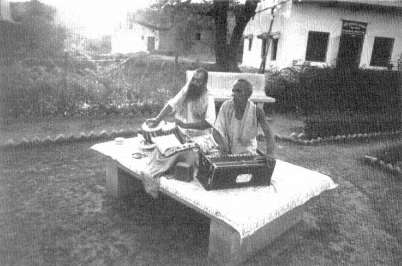
Figure 12.
Two sadhus in the pilgrim town of Chitrakut sing the Manas to
musical accompaniment
performed antiphonally to haunting melodies. Individual lines or half-lines were repeated many times with an emotional intensity that seemed to draw out their full meaning; they were also supplemented with words and phrases not found in the text, but which contributed to the richness of the interpretation. The all-male audience listened with rapt attention, punctuated only by frequent exclamations of wonder and delight. A singer would perform one or two stanzas, then another would come forward, instruments would change hands, and the new singer would take up where the preceding one left off. Certain singers appeared to be well known to the crowd, and when they came forward there would be a visible ripple of excitement as friends nudged one another and murmured the name of the new arrival: "Rama Guru," "Jugal Kishor," "Parasnath."
The crowd around the singers was so dense that at first I could approach no closer than its periphery and had to strain to hear the unamplified singing, but over the course of several hours I worked my way in closer to the charmed circle around the table. During this time several singers had performed—one of them a blind sadhu who, despite his lack of sight, likewise took up the text from where the preceding singer had left off and sang for nearly an hour in a high, clear voice. Whenever he
appeared ready to stop, listeners would entreat him to sing one more stanza and he would go on, while men whispered admiringly that this blind bard was one who had the entire epic "in the throat."[60]
When I left this ongoing performance at about 2:00 A.M. , I carried with me a powerful impression of its beauty and appeal. I was also impressed by its lack of commercialism; at "Nandigram" no money changed hands and no singer received anything but the approbation and admiring looks of the crowd. Despite the high regard in which certain singers were clearly held, there was an unpretentiousness about their performances, and they appeared to be enjoying themselves as much as listeners were. The intimacy and spontaneity of this gathering was in striking contrast to the formal and hierarchical structure of the pageant that had preceded it. Intimate, too, was the singer's relationship to the text: the loving way in which he drew forth its meanings and evoked its images. Lines such as the entreaty spoken by the monkey Angad when Ram is about to send him away,
You are my lord, teacher, father, and mother—
abandoning your lovely feet, where will I go?
7.18.4
seemed particularly to suit the singers' style and would be repeated again and again in an emotional manner that reminded me of Sufi qawwali singing.
The performance at Nandigram whetted my appetite to hear more of this fascinating and, by all appearances, widely appreciated style of Manas interpretation, yet for a long time I experienced only frustration in my efforts to locate additional examples of the genre. Middle-class Banarsi friends seemed scarcely aware of its existence or at best would smilingly tell me that it was an "old-time village custom," now fast dying out even in rural areas. Traditional scholars of the epic seemed to know what I was talking about but appeared incomprehending of my interest in the genre: "It is nothing special; only uneducated people do it." Since Manas singing programs were not electronically amplified, I was unable to "track" them by sound as I often did with formal recitation programs. Consequently, I began to wonder whether the vibrant performance I had witnessed was not perhaps an anachronism peculiar to Ramnagar on coronation night.
Then one evening in early spring there appeared on my doorstep an
[60] Kanthasth[*] ; another expression used to denote memorization is "to place in the heart" (hrday[*]mem[*]dharan[*]karna ).
old man known as Rama Guru—the first of the singers I had heard perform at Ramnagar. I had spoken with him briefly of my appreciation for the singing and had given him a card with my Banaras address—a fact that I had quite forgotten. Fortunately he had not, and had come to tell me of a singing program to be held that very evening—the full-moon night of the month of Chaitra—at the Sankat Mochan Temple. On his traditional "birthday" night, Hanuman would be serenaded until dawn with his favorite form of entertainment: the singing of the Ramayan. I followed Rama Guru to Sankat Mochan and found the temple compound echoing with the simultaneous performances of groups from all over the city; in all, I was told, some twenty groups would perform during the night.
My educated neighbors' reports of the demise of Manas singing had definitely been premature. Although perhaps less popular today than it was a generation ago, this style of singing remains an important recreational activity of Banarsi Hindu males. Its vitality is attested to not by the existence of formal institutions or publicized programs but by the presence, in virtually every muhalla , or neighborhood, of the city, of small groups of singers who meet regularly to pass a few hours enjoying each other's company and singing from Tulsi's epic. The total number of such groups can only be guessed at, but an estimate of one hundred is probably on the conservative side.[61]
My reference to this type of performance as "Manas singing" is not a reflection of any indigenous term. When questioned as to what name they attached to their activity, most people said that it had no special name or referred to it simply as "folksong" (lok git ) or Ramayan-dhun[*] (Ramayan singing or chanting). Nita Kumar, who also investigated this genre, found that group members would often identify their activity simply as something they did "for pleasure," or with reference to its place and time—"We get together every Monday at the Shiva Temple."[62] One reason for the absence of a consistent terminology is that the melodic styles to which the epic is sung by these groups vary with the seasons of the Hindu calendar—the style known as Holi, for example, is sung in early spring, Chaiti in late spring, and Kajli during the rainy months. The music itself is thus not conceived of as a constant; what is
[61] I personally came to know of eight such groups, widely scattered through the city. Kumar, who also studied this genre, collected data on a number of others and is convinced that their total number—based on the number of muhallas in Banaras—may be as many as several hundred; Nita Kumar, personal communication; November 1984.
[62] Kumar, "Music and Popular Culture in Banaras," 14; The Artisans of Banaras, 154-64.
unchanging about a group is its constituency, place and time of meeting, and of course, the Manas .
Each of the seasonal styles has its own body of folksong texts, whose subject matter evokes the characteristic "mood" of the season. Thus, the lyrics of many Kajli songs express virah , or the anguish of separated lovers, an emotion thought to be felt with particular poignancy during the monsoon months. Such seasonal songs are popular throughout much of Uttar Pradesh and may be performed quite independent of any association with the Ramayan.[63] The singing groups with which I am concerned, however, use the Manas as the primary text on which to build performances in seasonal styles, embellishing the text with lines from folksongs to create an improvised composite piece that is at once expressive of the epic story and evocative of the seasonal mood.
It is not clear how Kajli and the other seasonal genres came to be associated with the Manas text or how widespread this association is. Two recent studies of village music in Uttar Pradesh make no mention of Ramayan singing,[64] yet I was told that this type of singing remains popular in rural areas. A number of the singers whom I met in Banaras had come to the city in search of work and had joined Manas singing groups because, they said, they reminded them of similar ones in their home villages. It thus seems clear that Manas singing goes on outside Banaras, and it is possible that its popularity may be localized in regional pockets that have thus far escaped the notice of ethnomusicologists. It is also clear that the seasonal styles readily lend themselves to creative adaptation; Kumar has noted the use of Kajli melodies and themes by literary poets, sometimes to express satirical or even political themes. Earlier in this century, prominent intellectuals like Madanmohan Malviya (the founder of Banaras Hindu University) used to compose Kajli verses for pleasure, and there were public contests at which poets vied to create the most clever or poignant Kajli. In the 1920s the genre was used by nationalist poets as a vehicle for political sentiments.[65] Although many seasonal songs exist purely in the oral tradition, inexpensive booklets of Kajli lyrics still appear in the bazaars each monsoon season and are used by literate singers to expand their repertoire. One may speculate that at some point the seasonal genres became
[63] Henry gives examples of lyrics of village Holi and Kajli songs; "The Meanings of Music," 119-60.
[64] Henry, "The Meanings of Music," and Tewari, "Folk Music of India: Uttar Pradesh." Tewari's research focused primarily on villages in central U.P.; Henry's fieldsite, however, was only thirty-five kilometers from Banaras.
[65] Kumar, The Artisans of Banaras , 149-51.
associated with the seasonless, ongoing performance of the Tulsidas epic to create a hybrid singing style that gradually grew in popularity. The rhyming verses of the Manas , which readily lend themselves to musical elaboration, had probably always been sung and chanted for entertainment as well as for religious instruction; the advent of printed editions in the late nineteenth century—cited earlier as a factor in the popularization of ritualized recitation—also facilitated recreational use of the text.
Manas singing groups tend to be small, often with no more than five to ten regular participants, although the presence of particularly gifted singers may attract listeners from the surrounding neighborhood. The core of every group consists of people who perform regularly, either by singing or by playing an instrument. Even though much of the singing is an antiphonal exchange between two soloists, some groups also sing certain passages in a choral style in which anyone may join. Most groups meet on a weekly basis, and since participants are often artisans, laborers, and petty merchants, they tend to gather at night, after shops and businesses close. Many groups have been meeting for years and participants refer proudly to the fact that their fathers or grandfathers sang in the same group. Groups in the Brahmanal and Khojawan neighborhoods, for example, are said to have been meeting for some sixty years, while the little group that gathers each Monday night at 10:00 P.M. in the neighborhood known as Khari Kuan claims to have been in existence "for three generations." Such impressive continuity is a reflection of the dedication of the core members who attend regularly and transmit the heritage of this form of singing to their sons.
Many of the groups meet in temple compounds, especially temples dedicated to Hanuman, the patron deity of Manas recitation of all kinds. In Visheshvar Ganj, for example, a group meets every Sunday evening in a small, dilapidated temple known as Ram Bhakta Hanuman—"Hanuman the devotee of Ram"—and the group's instruments and copies of the Manas are stored in a locked cupboard in the temple. A similar group, dating back about half a century, meets and stores its supplies in the temple of Bare Ganesh, in the hardware bazaar known as Lohatiya.[66] Other groups meet in houses, on rooftops, or even at crossroads.
A striking feature of the singing groups is their heterogeneous composition, which cuts across caste and occupational lines. The Khari Kuan
[66] On the importance of this temple, see Eck, Banaras, City of Light , 188-89.
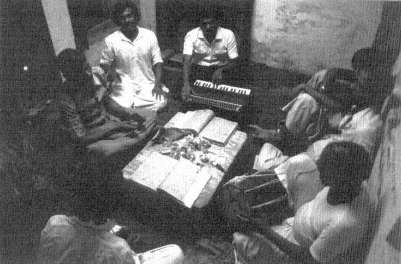
Figure 13.
Ramayan singers meet weekly in a small room in the Banaras neigh-
borhood of Khari Kuan
group, for example, includes among its regular members two brothers who own a small tailoring business, a barber, and a Brahman who works in a machine shop. Nita Kumar has likewise observed of the singing groups she studied, "Brahmans and Chamars sing together with no awareness of doing anything unusual that needs explanation. Similarly, informants do not find it worth commenting on the fact that woodworkers and merchants sing together, although, apart from being of different castes, most of the latter easily earn four to five times as much as the former."[67] One generalization that can be made about participants in such groups today, however, is that the majority represent the strata of society relatively unaffected by modern secular education and the attendant cultural process sometimes referred to as Westernization, which is often accompanied by a shift in artistic tastes. Kumar has found, for example, that, whether by choice or economic necessity, few Ramayan singers are regular film-goers, and their tastes in entertainment continue to reflect a preference—more universal a generation ago—for personal participation in localized and intimate groups rather than for the passive consumption of modern mass entertainment.
[67] Kumar, The Artisans of Banaras , 156.
Kajli in Visheshvar Ganj
The temple of Ram Bhakta Hanuman is situated on a back lane of a commercial district, amid warehouses and cowsheds. A participant in another singing group told me about a program held at this temple every Sunday at 5:00 P.M. , although when I arrived soon after the stated time I found only one old man present, engaged in the methodical and leisurely process of tuning the dhol[*] , or double-headed drum. He continued for nearly an hour, affording plenty of opportunity for conversation and for me to learn that the elderly drummer had been coming to this program for "about fifty years." During most of that period, the group had met at the more prosperous Bara Hanuman Temple, about a block away on the main business street. But about five years before, a dispute had occurred between the singers and a group of sadhus connected with the temple, and the program had shifted to its current location.[68]
By 6:00 P.M. other participants had begun to arrive. A locked cupboard was opened and the familiar paraphernalia produced: harmonium and cymbals, a low table, and two oversize copies of the Manas . The table was placed in the middle of the room and covered with an orange satin cloth. A young man took the books and, after reverently touching each to his forehead and placing them at opposite ends of the table, laid a garland on each. Sticks of incense were lit, waved in the air in blessing above the books and instruments, then placed on a stand in the center of the table. Later some participants would bring packets of milk-sweets and pan , and these too would be placed on the table to be shared among the group during breaks in the singing.
There were still only a handful of men present when my elderly acquaintance began the program by singing the first two lines of the Sanskrit invocation that opens the Manas :
To the creators of letters and their significance,
of poetic moods and meters,
and of auspicious invocations,
To Sarasvati and Ganesh, I do homage.
[68] According to the drummer, the sadhus were holding an akhand[*]kirtan (unbroken chanting of the divine name), which continued during the time when the singing normally took place. When the singers requested the sadhus to turn down their loudspeakers, the sadhus refused and angrily told the singers to "go sing on the roof." This hurt and annoyed the singers. "If it was a matter of singing on the roof," the old man observed, "then we could have sung anywhere. I also have a roof at home, everyone has a roof. But we liked to sing in front of Hanuman-ji." When the sadhus continued to refuse to share the temple space, the singers left the premises and shifted to the less pretentious nearby temple. Its priest died about two years later, leaving no son to succeed him, and since then the temple had fallen into disrepair, although neighborhood people, especially of the Ahir or milkman caste, continued to revere the small vermilion-daubed image enshrined there.
This was followed by the opening couplet of Ayodhya kand[*] —universally known, as it is also the first verse of the Hanumancalisa :
Having corrected, with the dust of the guru's feet,
the mirror of my heart,
I narrate the stainless glory of Ram,
which bestows the four blessed fruits.
2.0
In other groups in which I participated, the performance began with unison singing of the opening stanzas of Balkand[*] (1:0a-e); the effect in each case was the same: the Manas was being begun anew.
The singers then opened their books to the passage in Book One describing the arrival of Ram, Lakshman, and their guru Vishvamitra in Janakpur[69] to attend the contest for the hand of King Janak's daughter, Sita. This passage includes the profound remarks made by Janak when he meets the brothers for the first time and the excited and amorous comments of the women of the city as they watch the boys from their balconies; it concludes with the scene of Ram and Sita's first meeting in a flower garden (phulvari ). The many romantic themes in the passage seemed particularly suited to Kajli, the folksong style of the rainy months, when this performance took place. The singers told me that their practice was to sing at least five stanzas every week, but these might be chosen from any part of the epic. The phulvari scene was a favorite of many of them, especially during the month of Shravan. Their practice of choosing a new passage to sing each week, not necessarily following in sequence the one of the previous week, is shared by many singing groups, although some others, I was told, proceed sequentially through the epic.
Kajli literally means "lampblack" and suggests the dark clouds that drift across the sky during the months of Asharh, Shravan, and Bhadon (June to October), creating a mood that, for Indians, is neither ominous nor depressing but softly sensuous and fecund. The earth, scorched by the heat of the preceding rainless months, suddenly erupts into brilliant green life; a cool, moist breeze blows; lightning flickers across the dark skies; and peacocks dance and cry. The first rains draw people outdoors rather than driving them in; families picnic in damp meadows, and
[69] The city is also known as Mithila or Videha.
young people hang swings from the trees and sing the playful and erotic Kajli songs that contribute to the special seasonal mood. The genre term identifies both the melodies—which are distinctive—and their predominant themes, which typically deal with the sufferings of separated lovers.[70] The songs often make reference to the legend of Radha and Krishna, the emblematic lovers of the North Indian folk tradition. The singer may take the role of Radha and describe the agony of separation from her Shyam—"the dark one" (Ram is also of dark complexion and may be addressed by this epithet)—whose body is of the same hue as the rain-bearing clouds. Sometimes the lyrics simply dwell on the lush beauty of the season or describe girls playing swinging games in flowering bowers—although the girls are just as likely to be identified as Radha and her companions. One occasionally encounters Kajli verses with no thematic connection to either the season or its romantic conventions; Kumar cites an example of a song in praise of Shiva's generosity.[71] Such songs are labeled Kajli on melodic grounds and by virtue of being sung during the monsoon.
By 7:00 P.M. the little room was nearly full, but singers and listeners continued to arrive and somehow space was made for them. Regulars were greeted with warm smiles and if a newcomer was known as a singer of good caliber he was quickly urged to the front and given the harmonium. The August night was hot and humid and the men in the tiny room perspired profusely, while an old-fashioned pankha[*] fan of preelectricity days, activated by rhythmic tugging on a suspended rope, gave some measure of relief. The intensity of the performance developed slowly, but by 8:00 P.M. the atmosphere in the temple was charged with excitement and all the window openings were filled with the craning heads of listeners who could not get into the room.
The overall structure of each song/stanza was the same: a brief introduction on the harmonium followed by an improvisation on a single word or sound, often a phrase containing a name of God, such as "Hari Om." This opening improvisation, corresponding to the alap in classical music, might be developed to considerable length. It was followed by the slow singing of the opening doha in the stanza, the two lines being divided between the two singers.[72] With the completion of the couplet,
[70] For a description of Kajli singing in a village near Banaras, see Henry, "The Meanings of Music," 142-50.
[71] Kumar, "Music and Popular Culture," 11.
[72] Note that in this style of singing, a doha is treated as the beginning of a stanza rather than its end (as in my notation system).
drum and cymbals came in and accompanied the singing of succeeding caupais[*] , which gradually increased in tempo. An individual line might be sung only once in fairly straightforward fashion, with its two halves divided between the two singers, or it might be elaborated on, with certain words or phrases repeated or combined with phrases not found in the written text. These might be relatively simple, such as the exclamation "He Rama!" added at the end of each line.[73] More often, however, they would consist of full lines of an entirely independent Kajli song interwoven with the lines of the stanza and including a periodic refrain. The ever-increasing pace and emotional intensity climaxed in the final lines of the stanza—terminating in a sudden silence broken by sighs and exclamations of delight. A short break followed, during which participants chatted softly while pan was passed around. Then with no formal signal but as if by consensus, the harmonium started up again and the leader launched into the next Manas stanza.
To give the reader a sense of how the two texts—Manas verses and folksong lyrics—are combined in performance, I offer a translation of one of the passages sung that evening. The Kajli text here consists of only four lines; two of these alternate with every two verses of epic text. In the performance, however, individual words and phrases were often repeated and elaborated on in a manner impossible to convey in print. Thus a single half-caupai might be sung for several minutes; the passage translated here lasted about twenty minutes in performance. The lines of the Kajli are italicized to distinguish them from Tulsi's text, which describes the reception of Vishvamitra, Ram, and Lakshman by Janak and his court (1.214-215.8).
O Hari! Hari! Hari![74]
Accompanied by wise ministers, numerous warriors,
noble Brahmans, and family members,
the king went forth
to meet the king of sages.
The rains have come—to my eyes ,
without you, my darling .
The king did homage, bowing at Vishvamitra's feet.
The lord of sages, well pleased, gave his blessings.
[73] The final long vowel may be added for metrical purposes; it can also be construed as a feminine form, making this an invocation of Sita.
[74] Here one of the Lord's names was musically elaborated on as an opening.
The whole company of Brahmans was reverenced
by the delighted king, realizing his good fortune.
The frog, the peacock, the sparrow hawk cry ,[75]my soul writhes in pain, without you, my darling .
Repeatedly asking after his well-being,
Vishvamitra bade the king be seated.
Just then came the two brothers,
who had gone off to see the gardens.
The rains have come—to my eyes ,
without you, my darling .
One dark, one fair, in the bloom of young manhood,
they delighted the eyes and stole the hearts of all.
Everyone rose when Raghupati entered;
Vishvamitra had him seated close by him.
The rains have come , etc.
Beholding the two brothers, everyone was entranced,
tears welled up and bodies thrilled with emotion.
Seeing that sweet and captivating form,
the King of Videha became truly bodiless.[76]
The rains have come , etc.
The juxtaposition of epic text and folksong refrain may appear mechanical or even inappropriate, since the Kajli verse seems to bear little relationship to the passage with which it alternates. The effect in musical performance, however, was more emotionally cohesive. The repeated refrain expressing conventional sentiments of romantic longing, with its often repeated phrase "my darling" (bare[*]balama —an intimate term for a young husband or lover) acquired a special resonance when juxtaposed with the descriptions of Ram's captivating beauty and its effect on beholders. The combined song "made sense" musically in a way that it does not in print.
[75] The cries of these three creatures are associated with the rainy season, and that of the papiha (sparrow hawk) is thought to especially torment unhappy lovers, as it resembles the word piyu (darling, beloved).
[76] This half-line (1:215:8) makes a pun on one of Janak's epithets, Videha—the name of his kingdom—which literally means "without a body." Seeing Ram's beauty, the poet says, Videha became "in a special sense" bodiless (bhayau Videhu videhu visekhi ); i.e., he lost all awareness of his physical being.
In groups in which the singing of the Manas is not carried on sequentially, singers may select passages that are particularly well suited to both the mood and the lyrics of Kajli or other seasonal genres. The Khari Kuan group, for example, is especially devoted to the romantic phulvari scene, with its description of newly awakened passion and longing in young lovers. In its performance of one stanza from this episode (1.228), the juxtaposition of a Kajli refrain with the description of Ram's appearance by one of Sita's girlfriends seems particularly appropriate.
The other companions saw her condition,
her limbs flushed with delight, tears in her eyes.
They all softly asked, "Tell us the cause of your joy."
The arrow of your eye bas struck, dark youth ,
Your smile has pierced my heart, dark youth .
"Two princes have come to see the gardens,
robust youths, handsome in every way,
One dark, one fair; how can I describe them?
Speech lacks eyes, and eyes lack voice to speak!"
The arrow of your eye bas struck, dark youth ,
Your smile bas pierced my heart, dark youth .
The group that meets every Wednesday night at the Bare Ganesh Temple was singing from Sundar kand[*] during the month of Shravan. This book includes the description of Sita's anguished longing for Ram during her imprisonment in Ravan's citadel as well as a description, recounted to Sita by Hanuman, of the similar agonies that Ram is enduring (5.15.1-5); these passages, again, seem particularly well suited to the virah theme of many Kajli verses:
Ram says, "In your absence, Sita,
everything in the world has turned against me.
New buds on the trees burn me like embers,
night is the apocalypse, the moon like the sun,
lotus ponds are forests of spears,
rain clouds shower hot oil,
well-wishers only cause pain,
cool, scented breezes are like serpent's breath.
By speaking of pain, pain is lessened.
But whom shall I tell? None understands my condition."
The dark rain clouds have gathered ,
but my cloud-dark one hasn't come .
In each of the above examples, the added Kajli verses offer an emotive folk commentary on the epic lines, linking them to an idealized seasonal mood and its constellation of evocations.
The performance at Ram Bhakta Hanuman continued until 10 P.M. It was, performers agreed, a good group and a good session, and considerably more than five stanzas were sung. When it was over, the singers, their faces flushed with exhilaration, performed the arti of the Manas and of Hanuman before dispersing into the moonlit and deserted streets.
Holi Singing
Like the music of the rainy season, that of the early spring months of Magh and Phalgun (February/March), known as Holi or phagua , has its distinctive melodies and mood.[77] The seasonal weather, characterized by a gradual warming of the climate after the short North Indian winter, is thought to be brisk and healthy, and the music is merry and irreverent, anticipating the intoxication of the Holi festival (the full-moon day of the month of Phalgun), when normal social etiquette will be temporarily suspended amid the frenzied throwing of colored dyes and powders, a heavy consumption of bhang, and general license. The songs of this season often have romantic/erotic themes, but without the emphasis on separation so prevalent in Kajli; instead they emphasize the passion and coquettishness of young lovers, their teasing and pranks. In songs containing mythological motifs, again the reference is often to the Krishna cycle. Many songs describe Krishna's amorous pranks with the gopis and his throwing of colors with them on Holi itself; however, there are also phagua songs with a Ram-related theme.[78] In any case, as already noted, in Manas singing groups the apparent relevance of the folksong refrains to the text of the epic passage being sung seems of little concern to the singers—or perhaps it is more correct to say that the aesthetics of this genre permit the meaningful and effective juxtaposition of material that, on the surface, appears to be thematically disparate.
The strongest impression I carried away from my attendance at
[77] As I did not have the opportunity to study Holi singing in Banaras, I draw on the general description of this style in Henry, "The Meanings of Music," 119-42, which gives an extensive treatment of this genre and includes translations of song texts.
[78] For Krishna themes, see Henry's songs numbered 55 and 56, pp. 129-31; see also song number 54 (pp. 128-9), which describes Ram's breaking of Shiva's bow to win Sita's hand in marriage. Kumar likewise cites a song describing Ram's Holi-play in Ayodhya; "Music and Popular Culture," 12.
Manas singing programs was of the infectious joy of the performers—their delight in each other's company and in bringing their beloved Ramayan to life. Such singing is above all a recreation, both in the sense of an activity that affords relaxation and pleasure and of one that reconstitutes and celebrates a mythic reality. Although recitation performances serve many functions for the individuals and groups that conduct them, they clearly involve a self-conscious effort at religiously efficacious behavior aimed at securing long-term spiritual dividends as well as, in many cases, more immediate and tangible rewards. In contrast, Manas singing as I heard it in the back lanes of Banaras is so totally without commercial or institutional-religious associations that one may be tempted to label it, in Western terms, a "secular" activity. This label might seem further justified by performers' explanations of why they participate in this kind of singing: "We do it for pleasure" (for khusi or anand ), or "We get a feeling of intoxication" (masti or mauj ). But "pleasure" and "intoxication" are not, for Banarsis, categories to be excluded from the realm of religious experience, and the imposition of a sacred/ secular dichotomy here only tends to obscure the real nature of the experience. The brief puja and arti performed at the beginning and the end of singing programs, the reverent touching of foreheads to books and the garlanding of their pages, are not mere ritual formalities bracketing the "secular" pleasures of male comradeship, gossip and jokes, and the sharing of pan ; to participants the experience is more unified. One of the young singers at Khari Kuan put it very simply when he answered my query as to why he and his friends participated in the program every week: "This is our worship."
The religious dimension of the performances is suggested by another term used by participants in reference to these groups: satsang[*] , or "companionship with good people." In the bhakti tradition, the discipline of keeping satsang[*] is regarded as spiritually efficacious; it is also said to be easy and enjoyable—like salvation in Kashi. The importance of satsang[*] reflects a belief in the active, participatory nature of "being present" at religious performances as well as the notion that intangible but positive "impressions" (samskar[*] ) accrue to one from the companionship of like-minded devotees.
A comparison can indeed be drawn between the use of the Manas in singing groups and its use in public recitation programs—but not along the lines of a secular/sacred dichotomy. Recitation festivals implicitly underscore the hierarchical patterning of society; they reinforce the au-
thority of the priestly caste as ritual specialists and interpeters of the Manas -as-scripture and display the wealth and piety of upper-class patrons. In contrast, the informal singing of the epic temporarily dissolves caste and economic boundaries, with the Manas functioning as a sort of "everyman's book of songs for all occasions." The measure of a participant is less his voice than his enthusiasm, but it is certainly not his jati .
What is common to both kinds of programs is, of course, their choice of text for performance, a choice that reflects the central role of the Manas in North Indian society. In the path[*] festivals the epic serves as a vehicle for the reinstitution of large-scale sacrificial rites and for conspicuous gift giving to religious specialists; in the singing groups it promotes intercaste fellowship and provides a framework for the performance of seasonally appropriate musical genres and for the expression of related concepts of sensual and romantic mood. The presence of Tulsi's epic on its decorated stand gives to informal entertainment gatherings, no less than to highly formalized public rituals, a focus of meaning and beauty.