
Prison Politics (1976–79)
The regime did more than ban torture. It allowed the International Red Cross to make two separate visits to the main prisons. It agreed to try future political cases in civilian rather than in military courts—which broke the precedent set in 1953 and gave defendants access both to the media and to proper defense lawyers. Amnesty International was allowed to observe one such trial in 1977. The regime also began to release political prisoners—first in dirbbles, later in small batches, and eventually in large groups. One batch received amnesty in 1976 with much fanfare. Some had completed their sentences. Others—mostly from the clerical opposition—had signed "letters of regret" known now as goh-khordan nameh (shit-eating letters). Yet others—including guerrilla sympathizers—were granted amnesty in August 1977 to commemorate the anniversary of the 1953 "glorious salvation." By April 1977, when the Red Cross made its first visit, the total number of political prisoners had been cut to three thousand. By the time the Shah left the country in January 1979, it had been further reduced to three hundred.
Prison conditions also improved. Cells got new coats of paint—some walls had graffiti from the early 1950s. Windows were washed—some for the first time since the 1960s. Rugs appeared on the floors. Food improved. Visiting hours were extended. More books and newspapers were allowed. Communal activities were more frequently granted, and Evin prisoners were allowed to visit neighboring wards. When the Red Cross came, prisoners were allowed to talk to the visitors but were warned that such foreign organizations were part of the "international conspiracy to destroy Iran's independence." SAVAK argued that true patriots would never talk to such imperialist meddlers. Few bought this argument. Meanwhile, families and friends formed the Committee for the Defense of the Rights of Political Prisoners. This committee published a bulletin and held demonstrations at Tehran University as well as outside the gates of Evin and Qasr. It also
organized a large social gathering for all former political prisoners.
Conditions further improved in March 1978 when the remaining political prisoners organized a hunger strike. They demanded visiting rights for friends, removal of wire mesh in the visiting rooms, uncensored newspapers, radios, books, and improved medical facilities. The strike was initiated by fifty-three members of the seventy remaining in the leftist komun in Qasr. It soon spread to the Mojahedin komun in Qasr. By the time it ended, it brought in all the main komuns in Qasr, Evin, and Qezel Hesar. The wardens eventually conceded to all the demands—after much hesitation over the issue of radios.[93]
This relaxation brought forth the blossoming of many groups. In fact, prisons became a microcosm of future national politics: they contained the diverse groups that were to emerge in the coming years. In some ways, the future of Iran was played out in these ward komuns—especially in the lively ideological discussions around the eating mats. The heated debates included the older organizations such as the Tudeh, the Kurdish Democratic party, the National Front, the Liberation Movement, and the Maoist offshoots from the Tudeh—the Revolutionary Organization of the Tudeh, which renamed itself the Hezb-e Ranjbaran (Toilers party) in 1980, and the Marxist-Leninist Organization of Tofan, which became known simply as Tofan. (See fig.1.)
The heated debates also included the main guerrilla groups: the mainstream Mojahedin led by Rajavi; the Marxist Mojahedin, which in 1979 took the name Sazeman-e Peykar dar Rah-e Azadi-ye Tabaqeh-e Kargar (Combat Organization on the Road to the Emancipation of the Working Class), known simply as Peykar; and, of course, the Fedayi, some of whom saw Khomeini as the champion of anti-imperialism and others of whom saw him as a reactionary cleric. Soon after the revolution, the Fedayis split into two rival factions: the Fedayi Aqaliyat (Minority Fedayi), which opposed the Islamic Republic; and the Fedayi Aksariyat (Majority Fedayi), which—like the Tudeh—initially supported the new regime. Almost all the lead-
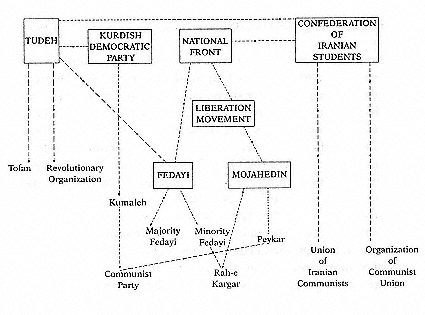
Figure 1.
Leftist Organizations
ers of these groups were fellow inmates in Evin and Qasr until the very eve of the Islamic Revolution.
The prisons also contained the seeds of other organizations that developed immediately after the revolution: the Sazeman-e Kargaran-e Enqelabi (Organization of Revolutionary Workers), composed of former Fedayis and Marxist Mojaheds who had second thoughts about the whole strategy of armed struggle (this group became known for its newspaper, Rah-e Kargar ); Kumaleh, launched by former Fedayis and Kurdish Democrats (in 1984 Kumaleh renamed itself the Communist Party of Iran); the Ettehadieh-e Komunist-ha-ye Iran (Union of Iranian Communists), created by activists from the Confederation and the National Front; and the Sazeman-e Vahadat-e Komunisti (Organization of Communist Union), founded by Trotskyists critical of both Stalinism in the Soviet Union and Maoism in China (this group became known for its newspaper, Rahayi (Free-
dom). These small groups were to bear the brunt of the early terror unleashed by the Islamic Republic. As one prominent cleric openly admitted to a leftist prisoner as he was leaving Evin: "If we come to power we will have no choice but to eliminate all you leftists."[94]