
APPENDIX: PERFORMANCE AND PRACTICE AS DOMAINS OF ACTION
Schematizing conceptual relationships is often risky, but it strikes me as potentially valuable to offer a tentative synthesis of the critical conceptual distinctions that underlie the basic distinction I have drawn between performance and practice. In figures 4 and 5 I present the structures of performance and practice as I understand them, not as a model I have applied (in which case they would have appeared in the introductory chapter), but as a hypothesis about the relations among concepts that have been central to the analysis in this book. Note that what is portrayed is explicitly the conceptual structure of two interacting and interpenetrating domains of action. The issue of context is inevitably raised by such an exercise, and here it is safest to invoke the broadest understanding of "a relationship between two orders of phenomena that mutually inform each other to comprise a larger whole" (Goodwin and Duranti 1992: 4). The diagrams would need a third dimension in order to portray the sense of context given in the body of our analysis by the telescoping focus on increasingly wider spheres of act, genre, event, and social life (see Duranti and Goodwin 1992 for a variety of conceptualizations of context from the standpoint of language use).
My limited intent here is threefold: to suggest that these domains have a parallel structure that is the condition for them to be mutually transformative; to sort out the different levels of analysis (identified by the terms in the left-hand column of each diagram) in these parallel domains; and to locate the contributions of several leading scholars with
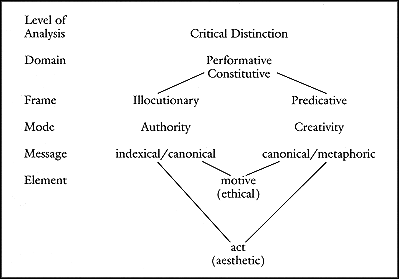
Fig. 4.
The Structure of Performance
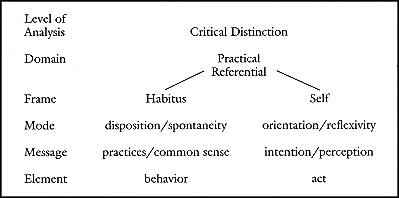
Fig. 5.
The Structure of Practice
reference to these levels of analysis. To begin, what I have referred to as the performative and practical domains correspond in large part to what Peter Stromberg (1993) has labeled the constitutive and referential domains. The fundamental difference is between language or other action that sets the conditions for social life and language or action that forms the connective tissue of mundane social life.
Within the performative domain (fig. 4) social action can occur within either an illocutionary or a predicative frame, a distinction we have adopted from Tambiah (1979/1985) that allows us to frame analysis of the relationship between force and meaning in ritual. In the diagram I have glossed the mode of social interaction associated with illocutionary force as authority and that associated with predicative meaning as creativity, precisely the relation made problematic by the ethnographic case we have been dealing with. Performative interaction in each of these modes is characterized by two options for encoding messages. In the authoritative mode these two options are elaborated by Rappaport (1979) as indexical messages that point to the immediate state of participants and canonical messages that articulate cosmological truth. Stromberg's (1993) analysis demonstrates that messages in the creative mode can be encoded either in canonical language (in Rappaport's sense) or metaphoric language. In both modes it is the relation between the two types of messages (indexical/canonical or canonical/metaphoric) in performance that is critical in the performative efficacy of authority or creativity. Finally, the elementary form of performance is characterized by the relation between motive and act. Motives are terms in the sense we have borrowed from Mills (1940) and Burke (1966, 1970). They condense and summarize canonical language and its ethical import. The acts by means of which those motives are circulated are the instances of utterance or gesture that always, insofar as they are characterized by a style of performance, have aesthetic import. In the diagram I have drawn a link through act between the metaphoric and indexical to draw out the aesthetic predication of metaphors onto the immediate state of participants, a relationship elaborated by Fernandez (1974) in his account of how "inchoate pronouns" are given identity and form by performance.
In the practical or referential domain (fig. 5) we have pursued an account of the transformation of self and habitus, and the diagram schematizes these as equivalent frames of analysis. As was the case with the illocutionary and predicative frames in the performative domain, I would argue that the same data of social action can often be understood simultaneously in terms of both frames. Although habitus has more of a
collective and self more of an individual connotation, I would continue to insist that both are grounded in embodiment, and that this fact is what requires us to consider them to occupy the same level of analysis/abstraction. My understanding of habitus follows Bourdieu (1977, 1984) insofar as the mode of social interaction is given by a structured and structuring structure of bodily dispositions inculcated in people such that social life has an aura of spontaneous improvisation and that the essential messages of interaction are inscribed in practices and have to do with issues of common sense. Correspondingly, the characteristic mode of interaction in the frame of self is orientation in the sense I elaborated in the introduction to this book (see also Hallowell 1955; Csordas 1994a) in which self is constituted by processes of bodily/sensory engagement with features of the social world. This is not only necessarily reflexive and therefore constitutive of subjectivity (see Merleau-Ponty's [1962] reworking of the Cartesian cogito), it also implies a mutual orientation when the object is another person and is therefore constitutive of intersubjectivity (e.g., "I am aware that she is aware that I am aware . . ." ). Messages are thus imbued with intention and have to do with the manner in which the perceptual reality impinges on and is taken up by persons in the immediacy of being-in-the-world. Finally, each element of social action in the practical domain can be understood as a behavior insofar as it is characterized by anonymity or as act insofar as it is characterized by intentionality.