
Some Notes on the Symbolic Construction of the House
We have so far been moving into successively smaller spatial units. When we reach the house, we are at the boundary of one of the city's (here, literally) walled-off units, whose internal organization is hidden as far as possible from larger units, whose integrations and controls are largely internal, and whose concern to the larger city is in their public outputs. Although the symbolic organization of the house, like the life of the households within it, is, of course, elaborately influenced by Newar culture and tradition, it is for our purposes here, "below" or "outside" the level of public city life, and is part of the host of smaller private forms that are sometimes consonant with, sometimes antagonistic, sometimes irrelevant to the integrating forms of the public city. The interiors of these units—and above all the life within the house—reflect larger public institutions and arrangements, stand against them, prepare members for them, defend members and console them against them, and punish and reward members in their own ways and for their internal needs as well as the needs of the larger system.
This chapter is a convenient place for a summary description, making much use of others' studies,[21] of some spatial characteristics of the
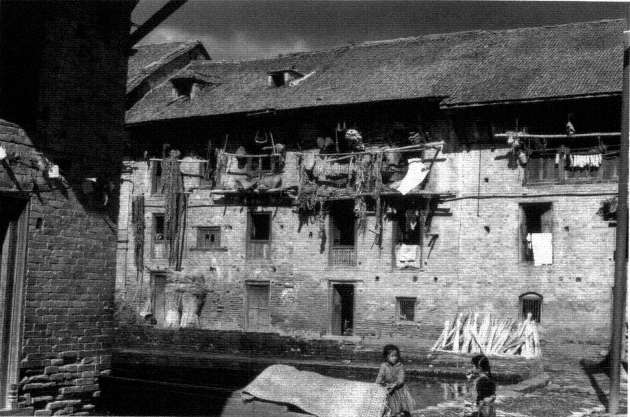
Figure 8.
Farmers' houses. Adjoining houses of families of one Jyapu phuki.
Bhaktapur Newar house (see fig. 8), sharply bounded from outer city space by a precisely marked symbolic boundary. The ideal Newar urban house is built, repaired, and lived in by the middle and upper thar s, and those members of the lower thar s who can now find the money for it. The poor, notably the Po(n), live in much simpler ones, often single-story thatched houses. The ideal traditional Newar house consists of four, and occasionally five, stories. It is constructed by means of a wood frame and beams and thick supporting walls of fire baked bricks made of valley clay held together by a mud-based mortar.[22] The roofs, traditionally of tile and now sometimes of metal sheets or wheat straw thatching, slope from a peak towards the front and back, the peak, being at the long axis of the rectangular (as viewed from above) houses. The eves are supported by external struts that buttress the roof against the walls of the house; on a few houses these struts are elaborately carved. The upper story opens out into a porch, the ka:si , of occasional important ritual use, including the worship of the sun (chap. 8).
The house is internally divided longitudinally into two equal halves, front and back, by a division that runs parallel to the front of the house and consists of a wall in the lower stories and columns in the upper ones. The sections formed by this middle division are called dya , and are designed as "outer" (pine ) or "inner" (dune ), with "outer" being the half on the street side. The inner half often faces on a central courtyard, which is ideally surrounded on all sides by houses of members of the phuki , or at least of the thar , although this pattern is often disrupted in recent building.
The house is symbolically set off at its boundary with the outer city, and its vertical space and horizontal space are used as resources for symbolic meanings. In its vertical dimension the house becomes progressively more sacred, differentiated, and vulnerable to pollution at progressively higher levels. The lowest floor of the house, the cheli , is, in fact, in some contexts "outside" of the house, a kind of bordering outside, like the zone just outside of the city's boundaries. The origin of the word "cheli " is uncertain. Manandhar (1976) proposes that it may come from "che (n )," "house," plus "di ," support. Some Bhaktapur scholars surmise, in what is perhaps a folk etymology but is suggestive of their sense of the connotations of the term, that it may be derived from "che (n )," "house," plus "li ," an "old term" said to mean the lower and impure part of the body below the umbilicus. Middle-status and lower-status families sometimes keep livestock on the cheli , but even
upper-status families often keep animals such as goats who are being kept for sacrifice, and sometimes pet animals, such as rabbits and turtles in this out-of-the-house space. It is sometimes said that animals kept on the cheli will absorb diseases and the malevolent influence of dangerous spirits trying to enter the house and will thus protect people in the upper part of the house.[23]
The "outside" status of the cheli is further shown in that people from polluting thar s were—and for the Po(n) this is still true—allowed to enter the cheli , but were forbidden to go any higher into the house, which would have been polluted by them. Work areas for occupational castes and shops are often located on the cheli level of houses and are adapted in various ways. The cheli is also often used for the storage of materials that are said to be "not worth stealing," such as firewood, straw, hay, bricks, and old furniture.
The next floor (the second floor in the American system of designation, which will be used here), is the "floor of the mata (n ) (or mata [n ])," the mata (n ) tala . This second story is the entrance to the first of the house's internal and progressively more inward areas. It is reached from the cheli by an interior stairway, which must be placed so that persons using it do not face the inauspicious direction south. On the mata (n ) ordinary visitors (those who are not family members or of higher status than the family) and friends of junior members of the household are received. The mata (n ) story is divided by a longitudinal partitioning wall, producing a large front room running the length of the house and facing on the street. This is the mata (n ) proper, although in other contexts the entire floor may be referred to as the mata (n ). The back half is divided by perpendicular secondary walls or partitions into small rooms that serve as sleeping quarters and storerooms for valuable goods.
The next higher story is the "floor of the cwata ." The longitudinal dividing wall is represented here by columns, so that the entire floor is open, and constitutes a large "hall," the cwata . Traditionally in high-status houses, and still remaining in many old houses, large carved ornate trellis windows (one of the representative forms of Newar art [S. P. Deo 1968-1969]) were located here, allowing people to look out on the streets without being seen. It is on this floor that the formal feasts associated with many family ceremonies, particularly for auspicious rites of passage, are held and high-status guests are received. In Brahman, Chathariya, and some Pa(n)cthariya houses this floor (or sometimes the floor above it) is the site of a shrine of the Tantric lineage goddess, the Aga(n) God (hidden in a room of its own), in accordance
with the ideal that that shrine should be located toward the physical center of the house. The cwata is also the place where important Brahman-assisted family worship is usually held. Such worship is associated with rites of passage, and with some major festivals and other ad hoc special occasions (app. 4). Some members of the household, often the older ones, sleep here and there on bedding on the unpartitioned cwata .
The household shrine and images of household gods, in contrast to the Aga(n) God, are placed at one of the highest levels in the house. This is usually on the next highest floor, which is often the top floor, the "floor of the baiga ." This is usully under the overhanging eaves of the house and is the location of the cooking and family eating area as well as the household shrine and its associated equipment. Daily household worship is held here and, occasionally, Brahman-assisted rituals if the group involved is small and does not include people from outside of the household or phuki group. Many houses have a fifth story. In this case the floor above the cwata is called a "fourth floor," and the top floor is still called the baiga (Korn 1976, 23).
Korn (1976, 3) provides a useful sketch of the typical furnishing of a Newar house:
The interior furnishings and decorations are very simple in contrast to the often extravagant facades. After the clay and tile oven, the most important is the all-purpose straw-mat which serves as a carpet during the day and for sleeping on during night. Other carpets and blankets may decorate the floor, but these are reserved only for eating on special occasions. In the morning the bedding of blankets and cotton rugs is rolled up and stored away. Clothing and valuables are kept in wall recesses and wooden chests. A stove as a heating apparatus is unknown, and in its place portable clay bowls of various size are filled with burning charcoal. The kitchen is seldom used as a meeting place. Clay or metal oil lamps, available in many different shapes and sizes, stand in wall recesses to give light during the dark hours. Stocks of rice and other grain are stored in wooden chests or clay pots, while potatoes and vegetables are kept in bamboo baskets hanging below the overhanging roof. Clay and brass pitchers are used as water utensils. Wood, carried into the town from hills by porters, is the usual heating fuel although the poorer people burn dried cow dung. Foreign influences, however, have recently introduced Western-style furnishings. Electricity and kerosene have simplified the tasks of cooking and lighting.
In horizontal space the house's boundary with an exterior encircling space is indicated by a stone placed about two to three feet before the front door, under the forward edge of the front overhanging eaves. The
stone, the pikha lakhu (which is also the term for the area it covers), is considered to be the seat of a protective divinity (chap. 8). The pikha lakhu is used in many rites of passage as the division between the inner world of the household and the outer world. It is here that a bride is greeted by the chief woman of the household to be purified of spirits and malevolent influences before being conducted into the house. It is at the pikha lakhu that the corpse of a household member is left for a moment and then is picked up by the members of a funeral guthi to be carried to the cremation grounds. The pikha lakhu is cleansed and purified each morning, as other god images in the house are, and it is also purified before major household worship.
Houses are ideally supposed to be oriented to one of the cardinal points of the compass other than the inauspicious south, with the most auspicious direction being east. In fact, the available spaces for city building, the meandering direction of many of the roads and alleys, the attempt by middle-level and upper-level families to build adjacent family houses in a rectangle around a central courtyard, all require violations of these orientations, which are largely ignored.[24] Within the horizontal space of the house, however, there are some arrangements following compass orientations. Thus the cooking area is generally toward the east, as is the household shrine.[25] As we have noted, stairways must be placed so that people using them do not face the inauspicious south. Similarly people avoid sleeping with their body in a north-south axis. They do not want to have their heads facing south. But if they were facing north, then their faces would face south when they sat up. Therefore, the entire north-south axis is inauspicious.
Because the front of the house faces on the street, and the back faces on the inner courtyard, the front/back contrast is equivalent to outer/ inner. What are considered the private parts of the house—the bedrooms, the treasury, and the position of the Tantric shrine are at the back or inner section of the house.
At the time of the construction of a house, there are very elaborate additional symbolic spatial characterizations. The detailed symbolism of the construction of a Newar house would require a full study in itself. A significant beginning has been made by Vogt (1977) on which the following description is based. The choosing of the site for a new house, the setting of the proper date to commence construction, the construction itself (by masons and carpenters), the completion of the building of the house, and the purification of it after its physical completion, all entail a vast collection of symbolic references and practices. The new
house and its foundations are being carved out of a "natural" area, disturbing the deified earth, Prthivi[*] , and the supernatural serpents, naga s, beneath its surface, as well as the spirits who may have clustered there. The disturbance of the natural space is dangerous, and powerful Tantric rites, including blood sacrifice, must be performed at key points. Sacrifices are made to the dangerous gods who protect civic space against external chaos and who—along with the dangerous god Bhairava who inhabits the wood block forming the base of the threshold of the main door of houses—exist protectively at the boundaries of these spaces. The house is considered, by the ritual experts responsible for its proper symbolic construction as a body and some of the successive rituals performed during its construction, as something like human rites of passage. The house, if improperly sited (in space and time), improperly constructed, or improperly purified, is dangerous. Without the proper ceremonies people may die, not only the construction workers (who have their own protective rituals, and rituals for effectiveness) but also members of the immediate or even the extended family. But, as we emphasize in many analogous situations (e.g., the symbolic procedures during the construction of masks or icons), most of this symbolism concerns the activities and special understandings of the experts involved in the physical and symbolic construction of the house—the carpenters, masons, astrologer, and Tantric priest. Most people live in houses that were constructed before their birth. They have to think about its setting or construction only if some family illness or disaster is attributed by some diagnostican of the supernatural to a disturbance in the house's relation to its environment, whereupon they must attempt the proper ritual readjustment or placation. Those who have a new house built or live in an old one need only to know that it is, or has been, properly done.