
Newsreel:
Old and New—Towards an Historical Profile
Michael Renov
Our films remind some people of battle footage: grainy, camera weaving around trying to get the material and still not get beaten/trapped. Well, we and many others, are at war. We not only document that war, but try to find ways to bring that war to places which have managed so far to buy themselves isolation from it. . . . Our propaganda is one of confrontation. Using film—using our voices with and after films—using our bodies with and without camera—to provoke confrontation. . . . Therefore we keep moving. We keep hacking out films, as quickly as we can, in whatever way we can.
Robert Kramer, New York Newsreel, 1968[1]
Documentary remains the major form of political filmmaking in this country. It has always been and probably will be in the foreseeable future. And yet, there has been very, very little discussion of how documentary films actually function. The political efficacy of documentary is derived from the relationship of the audience to the film—not the relationship of the filmmaker to the subject.
Larry Daressa, California Newsreel, 1983[2]
Vol. 41, no. 1 (Fall 1987): 20–33.
December 1987 will mark the twenty-year anniversary of the formation of Newsreel, a radical film-making collective conceived during the last flush of New Left activism. Once boasting offices in New York, San Francisco, Boston, Los Angeles, Detroit, Chicago, and Atlanta, Newsreel now survives in two versions: California Newsreel, San Francisco, producers and distributors of films about the workplace as well as South Africa and apartheid, with a new focus on media education (educating Americans about rather than through media); and Third World Newsreel, New York, vortex of film and video activities intended as the cultural interventions of the disenfranchised. In the following pages, I hope to suggest areas of conceptual as well as functional continuity and discontinuity between the two extant Newsreel organizations, as well as between the present enterprises and their Newsreel predecessors. In doing so, I seek to draw attention both to the achievements of a generation of American film activists and to the necessarily altered requirements for survival for politically committed documentarists in the late eighties. An historical profile of this sort can only point to a few of the most dramatic tendencies across decades of activity; this account will be supplemented by the soon-to-be-updated Third World Newsreel catalogue featuring descriptions of the Newsreel films in circulation (in addition to the hundred or so independently produced films and tapes they distribute) and by more in-depth accounts of the Newsreel infrastructure and output during its several phases.[3]
Newsreel Pre-history
The counterculture of the New Left tended toward negation, the issuing of shocks against presumed middle-class sensibilities, all the while reinforcing oppositional ties. Consequently, one must look elsewhere than to the culture of the American Left of the thirties for radical antecedents, perhaps to the Surrealist or
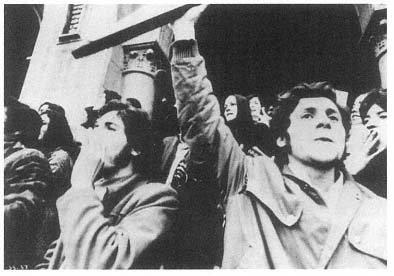
Columbia Revolt (1968): one of Newsreel's first films
Constructivist positions earlier in the century. If one may judge from the rhetoric of first-generation Newsreelers such as Robert Kramer, it is the utopian socialism of the immediately post-revolutionary Soviet Union that resonates most deeply with the cultural radicalism of the New Left, not the populist humanism of the American thirties.
It is the combination of youthfulness, enthusiasm, and volatility that links the work and writing of Dziga Vertov with the first wave of Newsreel practitioners. Both were dedicated to the concept of a continuing revolution and the potential of the cinema to mobilize a shared political identity necessary for broad-based social change. What separates the two and forces us to pose them in dialectical tension are their respective relations to state power and to technology. Vertov and his comrades worked at the cutting edge of a state-run revolution. Newsreel was a manifestation of the counterculture, defining itself always in opposition to the dominant, generating and encouraging resistance to the authority of the prevailing system of social, political, and economic relations.[4]
Vertov, trained as were so many other Soviet film artists for a scientific vocation, envisioned cinema as a technological vehicle for extending human powers of observation and cognition. His kinoki were labelled as "pilots" or "engineers" whose machine eye and radio ear could transform history. A child of his time, Vertov praised the beauty and perfection of the mechanical world and of chemical processes as the triumphant extension of natural forces.
A half-century later, the relationship of New Left media activists to technology was chiefly one of negation. Early Newsreelers harbored little hope of appropriating or re-routing channels of communication to further their political goals. ("None of us are old enough to have any illusions about infiltrating the major media to reach mass consciousness and change it—we grew up on TV and fifties Hollywood."[5] ) Unlike Vertov and his kinoki , or even the American Old Left, the founders of Newsreel in late 1967 could claim no institutional or mass-based source of support. Rather, as suggested earlier, mass base had become mass culture; party was replaced by a constituency-in-media. And yet, as with Vertov, there was within the early Newsreel movement a feverish impulse toward an elemental reconstruction for its audience—if not of perception, at least of consciousness. These radical cineastes were inspired by the enforced aesthetic privations of true guerrilla footage, documents of forces fighting wars of liberation in Vietnam, Africa, or Latin America, or by the pre-industrialized methods of the American underground film, which also offered refuge from the seamless, ideologically complicit products of the culture industry.
There is a further point of historical tangency between early Newsreel and Vertov's efforts in the pre-dawn of radical cinema. Just as the Soviet agittrains, armed with camera equipment, film lab, and projector, traversed the land from 1919 to 1921 helping to forge a nascent cultural identity, so too did early Newsreelers mobilize their own community outreach program. Recent Academy Award recipient Deborah Shaffer (Witness to War , 1985) has spoken of the methods of distribution and exhibition in the Ann Arbor, Michigan chapter of Newsreel in 1969–70:
We had two motorcycles and we put this box on the back of the motorcycle to hold the projector. We'd go off on motorcycles with the projector and films. We would show them in dormitories, churches, people's living rooms, union halls, high school auditoriums.[6]
Vertov and his New Left cousins shared the zeal and inventiveness of the bricoleur-evangelist.
The reconstruction of consciousness for the Newsreel audience was to be achieved by a willed abdication from the standards of quality or craft; the intention was a return to an essential cinema dedicated to the requirements of building an adversarial culture. The simplicity of the appellation "Newsreel" figures a desire for a fundamental reinscription of values and practices. The unstinting revisionism which underlies this naming and its return to the blank slate of historical representation is an act of both youthful bravery and of a willing forgetfulness which breaks ties with a set of complex histories. The
popular frontism of the American Left in the late 1930s and early 1940s was rooted in a hope of base-building and eventual unification while the political radicalisms of the late 1960s implied a contrary motive—the intensification of social contradiction to the point of rupture. For while the founding membership of Newsreel in New York included a core of veterans of mid-sixties community-organizing campaigns, the organization was forged in a moment of communal anger and indignation following the October 1967 March on the Pentagon. The agenda for a grass-roots, participatory democracy was buckling under the weight of a growing militancy.[7]
The altered agenda of an increasingly apocalyptic moment is expressed quite succinctly in Garbage (Newsreel, 1968), a film which examines a planned provocation by the members of a New York anarchist group calling itself "Up Against the Wall, Motherfuckers." During a prolonged strike of garbage collection workers, the Motherfuckers devise a plan to bring rotting garbage to the bastions of high culture and political power. They therefore dump enormous heaps of trash at the entrance-ways of Lincoln Center, home of the Metropolitan Opera and New York Philharmonic Symphony. As footage of this confrontation unspools, one demonstrator observes in voice-over that the difference between the Old Left and the New is expressed by their differing approaches to problems—the former sought to solve them, the latter to intensify them.
Institutional Ties—The Myth of Creation
As interviews with early New York Newsreel members indicate, the first generation of this radical film-making group represented a convergence of disparate impulses and constituencies.[8] There were the former SDS activists whose political sensibilities had been forged through a decade of community-based activism and programmatic wrangling. Of this number, Robert Kramer and Norm Fruchter, with his ties to such influential journals as Studies on the Left and New Left Review , remain the prototypes. These were the ideologues, the political "heavies" whose Movement credentials and rhetorical skills were capable of intimidating opposition in mass meetings. In addition, there were the "underground" film-makers whose concerns were loosely tied to notions of alternative art-making and self-expression, products of the boom period of the New American Cinema when the Brakhages and the Baillies commanded a sizable audience in the museums and on the campuses. The former Newsreel faction was likely to give priority to the construction of correct political organizations expressed in filmic terms while the latter tendency defined itself more directly in terms of its craft, guided by political concerns but not subsumed by them. This is, of course, a rough approximation or profile of some forty or
fifty people whose idiosyncracies tended to obscure any such general tendencies.[9]
There is a larger and quite striking commonality decipherable, however; neither faction could claim for itself an organized or structurally coherent base of support—in short, an audience. Neither the Marxists nor the underground film-makers could presume to know their constituencies in any but the most abstract terms, the political activists because the Movement was undergoing a painful process of fragmentation typified by the SDS splits while the film artisans were rooted in a tradition of expressivity which valued the isolation of the artist within the hegemony of mass culture. The very values which united every Newsreel audience or potential audience were based on a fundamental negation of institutionalized frameworks (alienation from accepted social and political forms, cynicism toward the trade unionism that had been the bastion of the Old Left, a preference for vaguely articulated rather than explicit associations). A politically inflected cultural group like Newsreel, in bearing what Bill Nichols has characterized as a barometric relationship to the Left,[10] could only reproduce the soft boundaries and conceptual dissonance of late sixties political dissent typified by the rainbow of orientations and agendas that combined to protest the 1968 Chicago Democratic Convention—from the Dave Dellinger–style anti-war pacifists to the anarchic Yippie contingent.
Despite the conceptual pluralism of Newsreel's position in the early years, we can discern certain frequently unstated premises of the organization. From an interview with a range of Newsreelers published in a 1968 Film Quarterly , Marilyn Buck and Karen Ross gave voice to the mythic origins of the collective: "And all the TV channels and American films speak from the same mouth of control and power. We looked around . . . and Newsreel was conceived and born."[11] There is the suggestion of a kind of autochthony here, of a cleansing oracle arisen from within the belly of the mass-cultural beast. The two films which catapulted Newsreel to success in countercultural terms (Columbia Revolt, Black Panther —both 1968) offer further evidence of such a mythos of spontaneous generation. The films share an aura of revolutionary romanticism, offering direct contact with what appeared at the time to be the most advanced elements of the struggle—in short, news from the front. The Panther film, alternately titled Off the Pig (a phrase hypnotically chanted by a phalanx of Panthers during a demonstration at the Alameda County Courthouse), brought the words and images of Huey P. Newton, Eldridge Cleaver, and Bobby Seale to Movement audiences everywhere. More importantly, by its mise-en-scène and incantatory music track accompanying bereted and leather-jacketed Panthers-in-training, the film manages to suggest a great deal more than it can show. "No more brothers in jail/The pigs are gonna catch hell" sing the militant brothers and sisters while Cleaver speaks of the bald-headed businessmen in the
Chamber of Commerce whose exploitation will be countered by mass insurgency as soon as the rest of America catches on (which Cleaver assures us will be very soon). Here is a mixture of buoyant militancy and a political optimism which is well nigh infectious—or would have been for a sympathetic 1968 audience. In any case, hundreds of prints sold in a matter of months.
As for Columbia Revolt , one need only consult the published responses of student audiences to be found in the underground press of the day. According to an October 1969 account appearing in Rat , a New York–based organ of the radical counterculture, Revolt was responsible for an incendiary outburst at a college campus in Buffalo: "At the end of the second film, with no discussion, five hundred members of the audience arose and made their way to the University ROTC building [the Reserve Officer Training Corps, target of much campus protest during the Vietnam War]. They proceeded to smash windows, tear up furniture and destroy machines until the office was a total wreck; and then they burned the remaining paper and flammable parts of the structure to charcoal."[12] What the Buffalo student body had observed (and the apocryphal nature of the tale is no hindrance to a discussion of mythic contours) was the vanguard action of their Ivy League cousins, a model of energetic but sustained resistance to malign authority. The analysis contained in Columbia Revolt is muted in comparison to the spectacle of solidarity and community it offers. The New Age marriage rites of two students, the support marches of sympathetic faculty members, the pitch-and-catch of food stuffs holding intact the supply lines which, like the Ho Chi Minh Trail, meant sustenance for the guerrillas under siege—all these depictions of newly conceived social relations live on long after the immediate gymnasium construction issue is forgotten.
The efforts of the early Newsreel collectives aimed to inform and inspire their Movement audiences, with the balance between the two functions always in question. While a pre-Newsreel film like Troublemakers (1966), which follows the struggles of a community organizing group in a black neighborhood in Newark before the riots (examining the project's achievements and defeats), explores the contradictions inherent in grass-roots political activism, the post'68 Newsreel film was likely to stress action and elicit engaged (if not educated) response. In a pronouncement that echoes the Surrealist position of the 1920s, Robert Kramer outlined the Newsreel program circa 1968: "We strive for confrontation, we prefer disgust/violent disagreement/painful recognition/jolts—all these to slow liberal head-nodding and general wonderment at the complexity of these times and their being out of joint."[13]
Given the avowedly confrontational status of the work, the emphasis upon a collective scheme of organization and production ("Newsreel is a collective rather than a cooperative; we are not together merely to help each other out
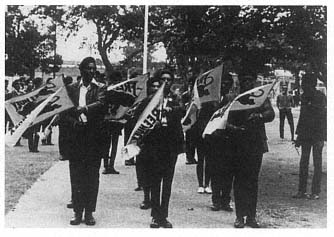
Columbia Revolt
as filmmakers but we are working together for a common purpose"),[14] what can be said about the precise division of labor of the groups in question and the material conditions of production? As every Marxist knows, consciousness does not anticipate productive relations but is conditioned and determined by them. But a major philosopher of the New Left like Herbert Marcuse was quite willing to theorize (in An Essay on Liberation , 1969) that, in a stage of advanced capitalism, imagination could show reason the way. Artists and free-thinkers could reshape the horizons of a society soured and desensitized by an over-rationalized ethos of thought and action. As a loosely bound group of like-minded cultural interventionists, Newsreel was the ideal manifestation of this New Age dogma.
Decision-making and the setting of policy were matters of some contestation given the lack of clear lines of authority and the diverse backgrounds of the participants. At a time that felt like a crisis period, specific goals (even ill-defined ones like "stop the war") offered sufficient binding power to keep the wheels turning and the Movement audience served. Those who, like Norm Fruchter, were accustomed to a greater precision of shared principles and a more disciplined group dynamic found the Newsreel experience a trying one. "I was . . . more of a Marxist, I think, than a lot of people in Newsreel," says Fruchter, "and so I was both interested in those congeries of different folks, and at the same time skeptical about whether we were going to hold together. The energy was awesome."[15]
So far as the mechanism for production decisions was concerned, the pattern was erratic at best. The most fundamental decisions always surrounded the initial question—what films should be made. But a second question—how to finance a given project—often proved determinant. Films could be made if there
were those within the collective who could manage to make them by whatever means might present themselves. If the final result was unacceptable to the group, the film could not receive the "Newsreel" imprimatur. Several funding routes seem to have recurred in the early days. There was a core elite within the New York collective who matched the profile of the SDS leadership throughout the sixties—college-educated white males, verbal, assertive, confident, with access to funding sources both personal and institutional. Robert Kramer and Robert Machover could call upon family resources to finance projects. (Indeed, this pattern is a time-honored one in American Left circles, most recently exemplified by Haskell Wexler's anti-Contra feature, Latino —bankrolled in part by his mother.) The Fruchters, Kramers, and Machovers of Newsreel were the bright and persuasive young men who could function within the world of capital, either by virtue of birthright or by acquired expertise. Fruchter, for example, was well suited for fundraising given his scholarly and literary credentials (as a published novelist) and his first-hand experience with Left funding networks. Fruchter has estimated that he succeeded in raising more money for Troublemakers , his film about the Newark Community Union Project, than had the Project itself over its several-year lifespan. There were simmering animosities over this relative monopoly of capital-access, rooted as it was in class background. Furthermore, this same group of men (who were a key faction of the New York collective's coordinating committee) possessed far greater technical skills and experience; Fruchter, Kramer, and Machover had formed Blue Van Films several years before.
A second faction consisted of yet another group of white males who, though less likely candidates for institutional support, were well under way as independent film-makers. By 1968, Marvin Fishman and Allan Siegel had both organized film-making workshops at the Free University in New York and were able to translate their expertise into Newsreel product. At the moment of Newsreel's formation in December 1967, it was decided that a film was needed to chronicle the October 1967 March on the Pentagon; Fishman was farthest along with a personal project along those lines. Newsreel #1 (1968), entitled No Game , was the result, despite the fact that the film bears only a passing resemblance to the "Newsreel style" familiar from the later works—scenes of conflict; lively, nonsynch music interspersed with multiple voice-over narrations from impassioned participants. There were concerted efforts made to disseminate the technical skills, but the difficulties were more deeply embedded than these well-intentioned attempts could hope to rectify. Women and minorities—after lifetimes of limited access to resources, possessing severely stunted self-images as producers of culture—were incapable of closing the gap overnight. Frustration and unspoken critiques festered beneath the surface of the organization.
And yet a necessary pragmatism reigned. In the words of Allan Siegel: "It was the kind of thing that if you came up with the money to do it [make a film], well then, you could do it. You made a film. I always used to stash myself away someplace and make things out of nothing. So I kept turning things out . . ."[16] Power and status were thus linked to the ability to produce despite the unequal distribution of the requisite tools for the task. In his discussion of Newsreel's collective process in the early days, Norm Fruchter recalls the inequities with some regret:
Your participation depended on having another means to finance yourself. There was a group of people who worked and therefore could never stay up all night . . . and couldn't shoot certain sequences. . . . And there were a lot of arguments about the contradictions of being in, not a rich person's organization, but certainly an organization which required the leisure to be full time in it. We talked about income-sharing but never did it. We talked about finding some way to subsidize the people who had to work and never did that. All the income that was brought in and all the fundraising that was done went right into the production of more films and that perpetuated the reign of the people who had self-sufficient resources or could somehow juggle their lives or their jobs or whatever so that they could do that. And I don't think it bothered us that much at the time. I remember thinking that, yeah, it was absolutely unfair and there was nothing to be done about it.[17]
Problems arising from inequities internal to the collective—income differentials, housing, or childcare needs—were viewed as secondary to the pressing struggle for social change. The politics of sexuality and of everyday life remained issues to be addressed in a later phase of the organization.
By the early seventies, although the first-generation Newsreelers had left the organization, factionalism based on differences of privilege and access enjoyed by collective members prevailed. From 1971 to 1973, New York Newsreel members split themselves into "haves" and "have-nots," with the distinctions among ethnicity, class background, and functional class position somewhat blurred. Thus Christine Choy, a Chinese woman, at 22 the holder of a master's degree in architecture from Columbia University, was a have-not, due in part to her activities within the organization's Third World Caucus. While salary differentials posed no basis for contention—minimal stipends and rent support for collective dwellings were the extent of financial support—stratification was expressed in subtle forms: the haves edited on a Steenbeck while the have-nots made do with an old Moviola.[18]
But the rift within the collective evidenced by the have/have-not division was only one stage among a series of convulsions that left New York Newsreel a three-person collective by 1973. The success of the San Francisco–shot The Woman's Film (1971) had coincided with the emergence of an outspoken feminist faction within the New York organization, which began to control distribution and exhibition; most of the men left the collective in the months that followed.
As the Third World faction within the group began to focus on recruiting minorities and passing on production skills, the rift between white members and those of color intensified to the breaking point. With the dwindling of the membership, the resources capable of sustaining the collective enterprise were near exhaustion. Gone were the human resources—years of experience in shooting and assembling footage under pressure for no money, and the financial reserves—family wealth to be tapped, as well as most of the equipment.
It should be noted that while the schisms that developed within Newsreel during the early seventies around class, gender, and race effected a series of ruptures at the localized, institutional level, these organizational convulsions serve to reinforce a sense of continuity at a broader historical level. For indeed, these were the same issues (gender, race, class) that increasingly split the always tenuous coalition of New Left/countercultural forces as the focus on war resistance waned. As debates over contradictions, primary and secondary, came to occupy center stage within Movement organizations, consensus collapsed. Newsreel was never merely a reflection or conduit, that is, about Movement tactics and sensibilities; it has always remained of the Movement, a palpable index of shifting fortunes and newfound necessities.
The single factor that ensured New York Newsreel's viability in 1973 remains the material basis for twenty years of continuity despite convulsions from within—that is, the collection of films themselves. The resurgence of production in New York did not occur until 1975, when work began on From Spikes to Spindles (1976), a project that established Third World Newsreel's reputation for compact, historically situated overviews of ethnic minorities in crisis (in this case, Chinese Americans in New York). Until that time, the focus of collective activity remained the revival of distribution of the original Newsreel collection (achieved in part through the issuing of a new catalogue), which was recognized as the backbone of the organization. The films were the sole resources that remained to the New York organization in 1973; they have sustained the Newsreel effort since that time as financial asset and historical legacy even as the New York and San Francisco collectives move toward a reordering of goals and priorities.
California Newsreel
The film-making collective calling itself California Newsreel was formed in 1975 from the ashes of a San Francisco Newsreel branch which had absorbed the sort of gut-wrenching political upheavals and bitter factionalism that shook the New York group during the same period. (The chief source of San Francisco's division was a move toward the Revolutionary Communist Party by certain influential Newsreel members.) By 1978, California Newsreel was comprised of three white males—Larry Daressa, Larry Adelman, and Bruce Schmiechen—none of whom had been a part of the earlier incarnation of the San Francisco Newsreel collective that produced Black Panther and other militant films from 1968 to 1973. Several years later, another collective member was brought on to deal exclusively with archival and distributional matters (a black man, Cornelius Moore), while only recently Schmiechen has left the collective to pursue independent projects.
No greater contrast could prevail between Cal Newsreel and its predecessors with regard to its financial underpinnings, organizational precision, and concentration on distribution over production. Unlike New York Newsreel of the early years (and to a lesser extent Third World Newsreel), California Newsreel has emphasized distribution over production. Indeed, in the twelve years of its existence, the collective has produced only two films of its own while becoming a major player within a clearly demarcated sector of the educational film market. Cal Newsreel distributes films of particular interest to an audience of economists, sociologists, and labor historians for classroom use; to labor educators and organizers within the trade union movement; and to various progressive and special interest groups at the grass-roots level (churches, action groups, campus organizations). The two films produced, Controlling Interest and The Business of America . . ., were the results of the collective's perception of a felt need within this clearly defined audience and within the Left in general. Controlling Interest attempts in its 45 minutes to explain the complex nature and operating procedures of the multinational corporation and was produced at a time when no such study was available for purposes of political education. The film has sold over 800 prints since its release in 1978.
The Business of America . . . likewise aimed to fill a gap in the available public-educational resources. It was conceived in the aftermath of the Reagan victory and was intended as a more personalized treatise than the data-heavy Controlling Interest , capable of exposing the massive failures of the Reagan economic program and its supply-side, trickle-down ethos. Both films "found" their audience precisely because they were tailored to its particular needs—arrived at through a variety of feed-back mechanisms and close contact with the client groups.
No longer can the Newsreel audience be defined as an amorphous mass of like-minded individuals concerned to stay abreast of breaking stories of exploitation and political victories. It's now a discrete body of buyers or renters of a media product deemed vital to the educational needs of their organization or curriculum. What is interesting about this shift is that, to a certain extent, these two audiences overlap inasmuch as the 1980s generation of Left academics, organizers, and educators are largely drawn from that ill-defined body of radicalized spectators of the late sixties/early seventies. If California Newsreel seems a more briskly functional and business-like version of its progenitors, the same can be said of its audience, the Left activists who have survived into the eighties, who have withstood the onslaught of budget cuts, diminishing numbers, and the nation's mood swing to the right.
Since I have discussed the two California Newsreel productions at length elsewhere, it seems more appropriate to concentrate here on the significant features of the organization as a business enterprise.[19] The San Francisco group has remained profitable by a combination of prescience and hard work. In the months after the Soweto uprisings in South Africa (June 1976), a collective decision was made to choose a Southern African focus—to purchase the distribution rights to a variety of films about Southern Africa and related issues in order to distribute them to interested parties worldwide. At the time, no such collection of films existed; even now, California Newsreel is the world's principal source of films on apartheid, divestment, and related issues with a total of 21 documentaries acquired from independents and the BBC alike.
The escalation of apartheid aggression throughout Southern Africa over the past several years and the upswing of world interest in countering the brutality of the Botha government through sanctions and strategies of resistance have subsequently rendered these films a resource in high demand. During the recent nationwide surge of campus protests against corporate investment in South Africa, California Newsreel played a vital role in boosting the level of educated debate simply by providing a range of relevant films as well as printed material researched and developed over nearly a decade.[*] Once again, although perhaps in a less dramatic fashion than in 1968, Newsreel was in the right place at the right time.
California Newsreel's formula for fiscal success combines business acumen with a knack for low-budget production made possible by the shrewd recy-
Over its 12-year lifespan, California Newsreel has published eight separate catalogues and five books including an 88-page text entitled Planning Work , a manual of resources on technology and investment for labor education funded by the Ford Foundation and the German Marshall Fund. Using Films in South Africa: An Activation Kit on Investment contains suggestions for post-film discussions, a series of fact sheets exposing the scope of U.S. investment in South Africa, and a packet of reprinted articles covering precise, related topics culled from newspapers, scholarly journals, and pamphlets.
cling of archival footage and, in the beginning at least, the ability to attract donated labor (crew members, editing assistants, etc.). Controlling Interest was made for $30,000 with only 10% of that figure generated internally. The Methodist Church, small foundations, and concerned individuals provided the bulk of the funding for that project while The Business of America . . . was financed largely (2/3 of the $120,000 total cost) by the Corporation for Public Broadcasting, the corporate arm of the Public Broadcasting System now firmly controlled by Reagan acolytes. In the first year of its circulation, more than 250 prints of the film were sold to what can only be considered its secondary market (a series of nationwide PBS airdates broadcast the film to approximately four million Americans).
The remarkable truth is that California Newsreel can boast liquid assets sufficient to ensure its existence for years to come. In spite of its bountiful resources, each collective member draws the same salary ($25,000 annually) and will continue to do so, no matter how bullish the Left-wing educational film market may become. In fact, all workers—from Daressa and Adelman to the person who sweeps the floors at the crumbling, warehouse-district office perched in its San Francisco alleyway—receive the same base pay. This feature of the organization is its clearest link with Newsreel's past. There is one additional point of tangency with the early days, at least with one faction of the first New York collective. California Newsreel's activities as producer and distributor are deeply tied to the perceived requirements of the American Left and are calculated in pragmatic, politically sophisticated terms. Like the core membership of New Left ideologues of the late sixties, Cal Newsreel (and Daressa in particular) is equal to the task of mastering the vagaries of contemporary Marxist theory as well as mainstream economic thought and of offering cogently argued, conceptually sound analyses and critiques of national labor policies and long-term economic programs.
In something of a departure from its past achievements, California Newsreel has chosen to mark its twentieth anniversary year by launching a major five-year project aimed at deconstructing media as conventionally produced and received. This "Media on Media" project will attempt to use the prevailing technology (namely, broadcast television) to generate a meta-discourse on communications, an anti-television capable of exploring new modes of expression as well as new techniques for reading—in effect, to establish a context for exchange between media products and their audiences. California Newsreel thus commits itself to the creation of an environment favorable to a rejuvenated, experimental, reflexive documentary form at a moment of flagging hopes among American independent producers.
California Newsreel thus announces a dramatic shift of emphasis from "point of production" (the workplace) to "point of reception" (the home)
consistent with its analysis of the political/cultural focus that Left organizations need to develop in present circumstances. But the concern for engaging a nationwide rather than Movement audience is in accord with the organizations's public profile for nearly a decade. As co-chair of the National Coalition of Independent Public Television Producers, Larry Daressa has lobbied strenuously in Washington for a more meaningful role for independent producers within public broadcasting's program schedule as a way of insuring the vitality of contestation within an ever more uniform cultural climate. The present "Media on Media" project, while unique to the American airwaves, is clearly consistent with the efforts of British Channel Four's Michael Jackson, producer of "Open the Box" (1986), a six-part series exploring the complexities and social effects of television, and Jean-Luc Godard, whose groundbreaking videoworks of the seventies (Six Fois Deux and France/Tour/Detour/Deux Enfants ) radically challenged the French viewing public's media expectations at formal and thematic levels. Indeed, California Newsreel's ultimate aim is to intervene in the viewing habits of America, to alter not so much what we see but how we see it. This will mean working to establish a space for innovation and experimentation on American television, perhaps through the creation of an Independent Programming Service on the order of Britain's Channel Four to explore new dissemination technologies and sponsor unconventional programming. Perhaps it is the sheer scale of such aspirations that provides the clearest vector of continuity with the New Left utopianism of Newsreel's founding moment.
Third World Newsreel
As we have seen, the early Newsreel operation was able to offer battlefront coverage of contemporary struggles from a recognizably Left perspective—quickly and in vast number. If that function has been lost at California Newsreel, it lives on at the Manhattan headquarters of Third World Newsreel. At a time when politically oriented documentary film-making in the United States has suffered a near-catastrophic decline, Third World has remained capable of producing films at a dizzying pace. The garment district offices of the collective are always alive with production activities at several stages; the editing rooms are in constant use for in-house projects while visiting independent film-makers frequently avail themselves of the facilities and expertise at hand. In 1985, Third World shot and completed two 50-minute films, both of them commissioned or initiated by outside sources rather than generated from within the organization. Namibia: Independence Now was commissioned by the United Nations Council on Namibia; distributed by Third World Newsreel, the film has been translated into
seven languages. Chronicle of Hope: Nicaragua was a project developed in coordination with the Nicaraguan Peace Fleet, a Florida-based organization that regularly ships clothing and medical supplies donated by concerned Americans. The film traces a single journey from its source in upstate New York, through a series of American communities, to the point of embarkation in Florida, and at last to safe harbor in Nicaragua, thus establishing a human bridge among nations.
The primary sources of this productive momentum remain Christine Choy and Allan Siegel, who, while maintaining a long-standing personal relationship, manage to stay involved in countless projects simultaneously, all at different stages of completion. Siegel's relationship with Newsreel extends from the original December 1967 meeting through 1970 and from 1974 to the present. During that time, he has worked in a range of capacities: shooting much of Columbia Revolt; editing and directing such early works as Garbage, America, Community Control, Pig Power , and We Demand Freedom . Siegel's recent credits include the Nicaraguan film and one of the three segments of The Mississippi Triangle , a 1984 film that examines a particularly eccentric ethnic conjuncture—Chinese/black intermarriage in white Mississippi—with film-makers of each ethnic background directing the appropriate segments.
Choy has directed at a furious pace for the past decade, receiving in the process fellowships from the Guggenheim Foundation, the American Film Institute, and the National Endowment of the Arts. Having come to the U.S. as a teenager from the People's Republic of China to attend school, Choy retains something of the outsider's view of American culture and politics. She has a photographer's eye and the skills of a graphic artist refined during her years of architectural training; she designs many of the layouts for the pamphlets and booklets which Third World distributes. Choy has also maintained a high profile in the Asian-American film and art-making communities and is active in a range of related organizations, coalitions, and support groups.
Unlike its San Francisco cousin, Third World Newsreel cannot begin to support its many projects through the sales and rentals of its films. Films are financed on an ad hoc basis, each one having a life and history of its own. In answer to a question concerning the economic health of the organization, Siegel replied: "Generally, we survive. There's a certain tension to that survival which just has to do with being a marginal-type arts organization. . . . Basically, we're a small business. It's taken us a while to figure out how you survive as a small business, and in that sense, California Newsreel is much more adept. . . . We've been somewhat more anarchistic in that regard."[20]
And yet, the track record of Third World Newsreel is a tremendously solid one. When increased funding for women's and minority arts projects began to become available in the late seventies, Third World Newsreel was already a veteran organization with an impressive roster of completed films to its credit.
Choy's enduring advocacy in the field of Asian-American cultural studies and her high visibility within ongoing lobbying efforts for minority access to public funding have helped to secure for Third World Newsreel and other minority media groups some measure of financial stability. Another avenue of Newsreel's sponsorship has been the establishment of the Third World Producers Project administered by the Film News Now Foundation, conduit for a variety of Newsreel-related projects. Under the leadership of Choy and Renee Tajima (a frequent Third World Newsreel collaborator), the program provides one-on-one consultation to Third World and women media producers in all aspects of their work (fundraising, film and video production skills, distribution). Still another increasingly significant component of the Third World Newsreel portfolio is the Advanced Production Workshop. Begun in 1978, the workshop offers ten to fifteen people a year-long experience in film and video production through weekly classroom sessions culminating in several finished works. The workshops offer valuable training and experience, a community-based alternative to the competitive, industry-oriented film school model.
On another front, Third World Newsreel's exhibition programs constitute a vital sector of the collective's activities. Former Newsreel member Pearl Bowser was responsible for conceiving and programming a series of travelling film exhibitions. "Independent Black American Cinema 1920–1980" began as a retrospective of more than forty films and videotapes showcased in France in 1980 which then toured the United States over a two-year period. Other major efforts of this type have included the publication (in 1982) of a booklet entitled "In Color: Sixty Years of Images of Minority Women in the Media," which offers a series of essays intended as a contribution to the dialogue around the imaging of Third World women and the position occupied by women within the media. A related program of a dozen films ranging from Ousmane Sembene's Ceddo to short independent works such as Sylvia Morales's Chicana was organized as an exhibition event in the New York area. A more ambitious exhibition series and accompanying publication was completed in 1983—"Journey Across Three Continents," which combined a diverse selection of films by African cineastes and film-makers of the black diaspora with a lecture series and 70-page catalogue. The series toured 35 cities over a three-year period in an attempt to expose new audiences to the work as well as to convey the richness and diversity of the black experience in Africa, Europe, and the Americas. "Journey Across Three Continents," assembled and curated once again by Pearl Bowser, drew upon the research contributions of seven Black Studies scholars. Through its exhibition projects, Third World Newsreel has sought to facilitate dialogue between minority artists and concerned spectators, to develop an American audience for black and Third World media works outside the major urban centers. In this sense, Third World Newsreel shares California Newsreel's emphasis upon organizing at the "point of reception."
Spearheaded by Ada Gay Griffin, who joined Third World Newsreel through the Advanced Production Workshop, distribution has become an area of intensified focus, with the collection including more than 150 films and tapes. In addition to the early Newsreels, Cuban and Vietnamese films of the late 1960s and early 1970s, and the subsequent Newsreel projects of Siegel and Choy, the Third World Newsreel catalogue features the work of such independent producers as Arthur Dong, Charles Burnett, Steve Ning, Lourdes Portillo, and numerous lesser-known artists. By opting for nonexclusive contracts with minority producers, Third World seeks further coverage and heightened visibility for producers, while offering an average 50% return to the film-maker. Griffin has emphasized outreach to educational and community groups on a sliding scale: "I use discretion to give discounts to people I know should have access to the film."[21] The priority here is to promote the work of minority artists unable to find distributional outlets elsewhere due to the limited appeal or controversial nature of the work—or its aesthetic roughness. In Griffin's opinion, the time has not yet arrived when aesthetic standards alone can be allowed to determine the life of socially concerned programming. Training programs and consultational services rather than elitist distributional practices have been chosen as the way to raise the level of professionalism within the minority media community.
The Anthology of Asian-American Film and Video functions as an additional and ongoing distribution project for the collective. Begun in 1984, the Anthology houses some thirty films by and about Asian-Americans, making this the most significant collection of such work. Like the larger Third World distributional scheme of which it is a part, the Anthology functions as a clearinghouse and organizational vehicle for independent productions, both documentary and fiction, which would be hard-pressed to find their appropriate audiences. The Anthology is a serious contribution toward the redress of an historical imbalance, the exclusion from public view of the dreams, aspirations, and achievements of minority populations within the United States. Given its history and the tenacity of the core collective members, Third World Newsreel's position in the vanguard of cultural-political change seems assured.
Conclusion
In assessing the complex contributions of Newsreel in its various incarnations, we must note the relationship of the local and cultural to the macro-economic or infrastructural level which is, in the end, determinant. The unceremonious retreat of progressive forces in this decade has by now convinced us that a Marcusean analysis sacrifices explanatory or predictive power for inspirational zeal.[22] Fredric Jameson, in a recent ambitious attempt to periodize the
sixties, concludes that the turbulent decade represented, after all, a moment of transition from one infrastructural or systemic stage of capitalism to another. The eighties can, according to Jameson, be characterized as global capitalism's moment of reentrenchment, the era in which the unbound social forces and liberating energies of the prior moment must be brought to heel. The sixties' unleashing of prodigious and unexpected new forces, issuing from the social movements of blacks, students, feminists, and Third Worlders, produced a kind of "surplus consciousness" disinclined to forward the multinational corporate agenda.[23] It is these emergent, relatively maverick constituencies that late capitalism must now attempt to proletarianize. But Newsreel has, from its beginnings, remained an active contributor to the development and dissemination of this "surplus consciousness," advocating resistance to the hegemonic while cultivating the values of a nascent political culture. Amidst the conservative backsliding and backlashing of the eighties, Newsreel has emerged as America's most consistent radical documentary voice. If, in the early years, its films spoke primarily to the Movement vanguard, Newsreel has moved toward a deepening of its ties with a broad spectrum of working Americans, offering a coherent Left perspective for an analysis-starved audience as well as a route to public access for minority artists. And finally, through continuing distribution of the early films of struggle and confrontation, the Newsreel enterprise has sustained the popular memory of concerted, energetic political activism. If the efforts of the sixties are to escape recuperation, to survive and, in time, to be renewed, it will be through cultural as well as political agitation. Given the history of the organization and its achievements to date, one can reasonably look to Newsreel for leadership in the struggle ahead.