
Theologians and Jurisconsults vs. Birth, Honor, and Tradition
One of Condé's propaganda tactics was to complain that the great nobles in general and the princes of the blood in particular had not been sufficiently honored by the queen mother. Their voices had not been heeded in the kings's councils, and their traditional role in the government of the kingdom had been undermined. (This claim was largely untrue; the rebels simply belonged to the less-influential faction at court.) The moderates among the queen mother's advisers adopted a tone of conciliation toward this claim. They protested that the princes held their accustomed place in the council, but that, at the same time, it was natural for the queen mother's most experienced ministers and officers of the Crown to handle much of the government's business.[11] It was emphasized that these ministers were, after all, the same advisers upon whom Henry IV had relied; their ability and integrity ought to have been above reproach.
The queen mother's more militant supporters were much more strident. Very early in the campaign an anonymous apology addressed to Condé in the voice of the queen suggested that the rebels "consult the theologians and jurisconsults" in order to see for themselves "what the divine and positive laws permit to be done to those who are found planning to assemble for the purpose of troubling the peace of their country."[12] This was an obvious reference to legal concepts of sovereignty and lese majesty, and an only slightly veiled reference to treason. Lese majesty was a capital offense and the charge had been used as recently as the reign of Henry IV against the great nobility. Henry had the duc de Biron executed for lese majesty, based (among other things) on the thin evi-
[10] . B.N. Cabinet des Estampes, Qb1 1617.
[11] . The queen stressed this point in her letters of February 1614 to dignitaries around the kingdom; e.g., her letter to the marquis de Mirabeau, acting governor (lieutenant général ) of Burgundy, 13 February 1614, published in Correspondence de la Mairie de Dijon , 1:126-129.
[12] . Response pour la royne a monsieur le prince (1614), 19.
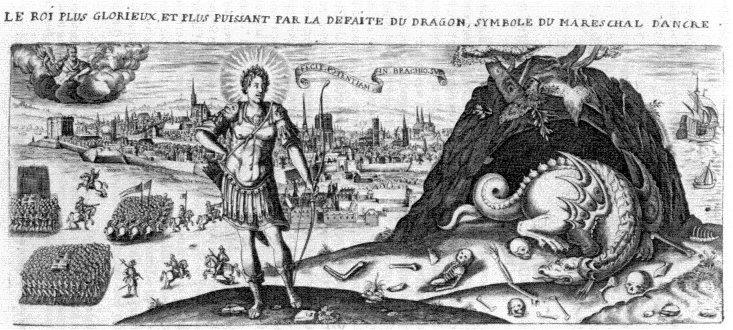
Figure 3.
A placard celebrating the victory of young Louis XIII over the monster Concini. One of the banners reads,
"He takes the power in his own arms." Reproduced with the permission of the Bibliothèque Nationale
de Paris.
dence that the duke's troops may have once fired on Henry's royal entourage.[13] A quick glance at the relevant passages in Bodin and Loyseau reveals that the monarchy's leading theorists had decisively categorized armed rebellion and political organizing on the part of les grands as lese majesty.[14]
In practice, however, the opinion of the public was more significant than that of "jurisconsults." The pretensions of the great nobility were persistently tolerated, but how far could the "peers of the realm" and "princes of the blood" go before they violated the political norms in 1614?
The deputies to the Estates General in 1614 appear to have concurred with theorists such as Bodin and Loyseau on lese majesty. In the discussions of the assembly on the comportment of the nobility, the deputies were generally sympathetic to the plight of poor country gentlemen, but were quite unsympathetic toward insolent military officers. This view was particularly prevalent among the members of the Third Estate, most of whom were both judicial officials and members of the urban elite.[15] Several articles in the cahier of the Third Estate complained that the governors and lieutenant governors of provinces, in addition to military commanders, extorted money and produce from local populations, protected brigands, interfered with the administration of local justice, and the like.[16] Even more revealing was an article in the cahier of the Second Estate (the nobility), urging the king to curtail the political power of
[13] . The duc de Biron's alleged complicity in a Spanish conspiracy against Henry (which never materialized beyond the planning stages) seems also to have played a part in the duke's execution. The formal charge was "lese majesty," but many saw the punishment as far out of proportion to evidence against the duke. In order to get the Parlement to go along, it was apparently necessary to stress that Biron had not only conspired against the "authority" of the king but had also once tried to have Henry murdered. Biron protested violently against this charge all the way to the scaffold and was still fuming when the charges were read to him publicly just before his execution. See the account in the Bibliothèque de l'Institute de France, Ms. Godefroy 112, ff. 5-24.
[14] . Bodin's rejection of the great nobles' political authority, that is, of "feudal" political authority, is set forth in Six Livres de la République , book 3, chap. 5. He was nonetheless aware that, as a practical matter, the claims of the heads of great noble families to certain "offices" had to be handled respectfully: see book 4, chap. 3. Loyseau was even more hostile to the political pretensions of the great nobility; see Cinq livres du droit des offices , book 4, chaps. 4 and 6. Cf. Harding, Provincial Governors , 11.
[15] . For the occupations of the deputies of the Third Estate, see Hayden, France and the Estates General , app. 3, pp. 266-283. Of the 196 deputies, 111 were royal officers of some kind, mostly judges in bailliage -level jurisdictions; cf. my "Judicial Corruption and Legal Reform."
[16] . Lalourcé and Duval, eds., Recueil des cahiers généraux , 4:305-322 (see second section of the Bibliography). This collection has an account of the Third Estate's grievances in 1614, including those against the nobility.
les grands by suppressing their patronage networks. "Let no pensions, charges, estates, or other benefits be awarded through the intercession of the Princes and Lords of your Kingdom; in this way the obligation of those who receive [such benefits] will be entirely to Your Majesty, and not to [the said princes and lords.]"[17]
The deputies of the Third Estate were adamant on the issues; they used their cahier to explicitly repudiate the efforts of les grands to usurp the functions of the central government. In particular they repudiated the formation of political factions for the purpose of undermining sovereign authority. At the head of their cahier they placed a series of policy statements on this matter that they hoped the queen mother's government would ratify.
Let it . . . be held as a fundamental law of the State that no subjects of Your Majesty, of any estate or condition whatsoever, be allowed to form leagues or associations among themselves, or with other princes and foreign lords, without written letters of permission [from the king.]
Let all gentlemen and others receiving pensions from foreign princes be held as criminals guilty of lese majesty, and let none of your officers or domestics take any pensions from any princes, lords, or communities.
Let all those who would raise troops and arms, [or convoke] assemblies and councils without Your permission be considered criminals guilty of lese majesty, and let no grace be extended to them. Let it be permitted to all persons to descend upon them, cut them to pieces, and attack them at the sound of the tocsin for this purpose.[18]
The deputies of the Third Estate were not upset that les grands were being excluded from positions of power, but that such men were already too powerful. They rejected the great nobility's use of organized violence as a political tactic and stated unequivocally that political authority emanated from the king alone and that the nobles could not usurp public functions without his explicit written permission. The determination of the Third Estate on this issue and their attachment to the discourse of sovereignty are underscored by their use of the legal term lese majesty to describe organized resistance against the central government. It would be hard to imagine a more explicit defense of absolutism and unequivocal condemnation of the tactics used by Condé and his confederates to challenge the administration of Marie de Médicis.
The deputies' rejection of the political pretensions of the great nobility was noteworthy in itself, but it was even more so when bound together with the "divine right" issue. The three articles that the Third Estate placed at the head of their cahier were originally to be preceded by an-
[17] . Ibid., 4:192.
[18] . Ibid., 4:273-74.
other article, the famous first article exalting the "divine right" sovereignty of the French king. This article (if it had been adopted) would have required all officials of France to take an oath of allegiance to the king, acknowledging him as the absolute monarch by divine right and explicitly repudiating ultramontanism. Roland Mousnier was certainly correct to emphasize that the first article was not simply about the events of 1614.[19] The oath was also part of an extended reaction to the assassination of Henry IV and yet another turn in the old quarrel about the French church—that of the Gallicans and politiques on the one hand, and of the militant Catholics (Jesuits and other ultramontanists) on the other; Denis Richet's discovery that the author of this article was Antoine Arnauld—the well-known lawyer with politique and anti-Jesuit views—reinforces this interpretation.[20]
Paradoxically, the first article was a tremendous embarrassment for the queen mother. Her ultramontane supporters, so crucial in her struggle to defeat Condé, were violently opposed to it. They viewed the article as an essentially Protestant proposal modeled after an oath that James I had drafted for English subjects.[21] For many militant Catholics, important theological and moral principles were at stake. What of an individual's religious convictions and conscience if he happened to be the subject of an absolute, divine right monarch who was an incompetent, a tyrant, or a heretic? The Gallican position, defended by members of the Parlement of Paris and most of the legally trained royal officials of the realm, exalted royal obedience and favored the adoption of such an article. The deputies of the Third Estate from every province of France, with the exception of Guyenne (whose delegation was under the watchful eyes of Cardinal de Sourdis), voted unanimously to adopt the first article into the general cahier . These local notables of the Third Estate, many of whom were royal officials, were also important members of the queen mother's political coalition.
[19] . Cf. Mousnier, L'Assassinat d'Henri IV . Hayden discusses parts of the confrontation in greater detail, in Estates General , 131-148. Cardinal Du Perron's pamphlet opposing the oath, allegedly a version of his speech delivered to the Estates, is Harangue faicte de la part de la chambre ecclesiastique, en celle du Tiers Estat, sur l'article du serment . . . .
[20] . Richet, "Paris et les Etats de 1614," 73. Cf. Salmon, "Gallicanism and Anglicanism," 166-173, 182-185.
[21] . Ibid., 184. Drawn up following the Gunpowder Plot in November 1605,, King James I's "Oath of Allegiance" was also directed against the militant Catholics—the Jesuits in particular—and thus contained a clause denying the pope the kind of moral influence over political issues that the Catholics believed he should have. James and other English writers took a great interest in the French dimension to the debate. The Cardinal Du Perron's polemic (mentioned in n. 19) was the occasion for James's celebrated tract, "A Remonstrance for the Right of Kings," in Political Works of James I (see sec. II of the Bibliography). Similar responses to Du Perron were published by Frenchmen. Bignon's Grandeur de nos roys (Paris, 1615) was typical.
The queen mother was persuaded by her militant Catholic advisers, however, to request that the article be stricken from the cahier . The Third Estate eventually complied, but not very willingly. The final vote of 20 January 1615, on whether to withdraw the article from the cahier or to protest further to the queen mother, was a narrow victory for Marie. The delegations of two of the twelve provinces were split, and the delegations from four of the provinces voted to protest. Since six of the provinces voted to obey the queen mother, however, the article was withdrawn.[22] The deputies' attachment to the Gallican interpretation of divine right and royal authority, even in the face of intimidation from the Crown, was obviously powerful.
On the whole, Marie benefited greatly from these ideological confrontations, despite the short-term political awkwardness. The debate over the first article involved two factions of the best educated, most politically sophisticated, and rhetorically skilled people in the kingdom eager to disseminate their versions of absolute divine right in support of the queen mother's administration. The Protestants, politiques , and royal officials supported their interpretations of an absolute divine right for the French monarch. They were willing to associate this defense of divine right with a general defense of the queen mother's administration in part because a stronger royal government would be better able to resist the influence of the militant Catholics. Although the militant Catholics opposed the extreme statement of absolute divine right found in the article, they strongly favored the regent's religious and foreign policies. Thus, they were eager to keep the queen mother in power and were more than willing to emphasize the need for absolute obedience to the sovereign as part of a campaign to keep Condé out of power.