
| • | • | • |
Theories of Islamization in Bengal
It was relatively late in their experience in Bengal that Englishmen became aware of the full extent of the province’s Muslim population. With British activity centered on Calcutta, in the predominantly Hindu southwest, colonial officials through most of the nineteenth century perceived Bengal’s eastern districts as a vast and rather remote hinterland, with whose cultural profile they were largely unfamiliar. They were consequently astonished when the first official census of the province, that of 1872, showed Muslims totaling 70 percent and more in the Chittagong, Noakhali, Pabna, and Rajshahi districts, and over 80 percent in Bogra (see map 3).[17] Writing in 1894, James Wise, a government official with considerable experience in the province, wrote that “the most interesting fact revealed by the census of 1872 was the enormous host of Muhammadans resident in Lower Bengal—not massed around the old capitals, but in the alluvial plains of the Delta.” He went on to observe that “the history of the spread of the Muhammadan faith in Lower and Eastern Bengal is a subject of such vast importance at the present day as to merit a careful and minute examination.”[18]
The subject certainly was examined. The census of 1872 touched off a heated debate that lasted the rest of the nineteenth century and well into the twentieth. Its opening salvo was fired by the compiler of the census report itself, Henry Beverley. Noting the apparent incongruity of masses of Muslims turning up in regions far from the ancient centers of Muslim domination, Beverley concluded that “the existence of Muhammadans in Bengal is not due so much to the introduction of Mughul blood into the country as to the conversion of the former inhabitants for whom a rigid system of caste discipline rendered Hinduism intolerable.”[19] In short, he rejected the Immigration theory and instead sketched out an early version of the Social Liberation theory. Henceforth this theory would dominate British thinking about Islamization in the province, and eventually most Muslims would subscribe to it as well.
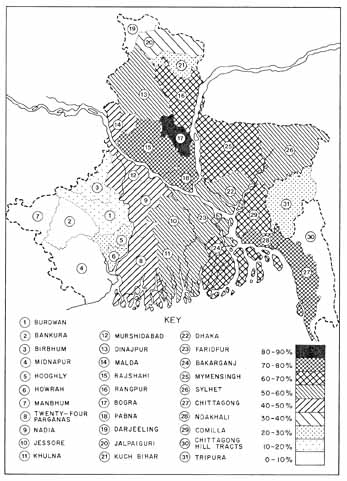
Map 3. Distribution of Muslim population in Benghal, 1872
But Beverley’s interpretation did not go unchallenged. Soon after the publication of the 1872 census findings, a respectable Muslim gentleman of Mymensingh District, Abu A. Ghuznavi, submitted a report to the Collector of his district strenuously opposing Beverley’s argument that mass conversion had taken place. Ghuznavi proposed instead that “the majority of the modern Mahomedans are not the descendants of Chandals and Kaibartas but are of foreign extraction, though in many cases it may be of more or less remote degree.”[20] In favor of his argument, Ghuznavi cited Arab migration before the Turkish conquest, land grants made by Sultan Husain Shah to foreigners, the dispersion of Afghans “in every hamlet” after the Mughal conquest, the greater fertility of Muslims owing to their practices of polygamy and widow remarriage, their greater longevity, and the absence among Muslims of a caste system or institutionalized celibacy.[21] Although he conceded that there had been “some” conversions, Ghuznavi insisted that they had not been among low-caste Hindus. “Why should we speak of conversion of low-caste Hindus only?” he asked, “Why should we forget the Musalman Rajput diwans of different districts and notably of Maimensing.…Similarly, there are Mozumdars of Sylhet, Raja Sahebs of Faridpore, Gangulies of Bikrampore, and a host of others.”[22]
Ghuznavi was here outlining the Immigration theory of Islamization, the view favored by ashrāf classes throughout India. To the extent that local conversions took place at all, Ghuznavi argued, they came not from the despised low castes, but from the upper orders of Hindu society. At the turn of the twentieth century, claims were indeed made that in the Mughal period some members of Bengal’s landed elite and even of the priestly caste had converted to Islam. The rajas of Kharagpur (in Midnapur District), defeated by one of Akbar’s generals, were said to have accepted Islam as the condition for retaining their family estates; Raja Purdil Singh of Parsouni in Darbhanga, in northern Bihar, became a Muslim by way of expiation after having rebelled against the Mughal emperor; the Muslim dīwān families of pargana Sarail in Tippera, and of Haibatnagar and Jungalbari in Mymensingh, had formerly been Brahmans; and the Pathans of Majhouli in Darbhanga sprang from the family of the raja of Narhan.[23] These instances, however, could have accounted for only a tiny fraction of the total Muslim population and cannot explain the appearance of the millions of Muslim peasant cultivators recorded in the census figures.
Meanwhile, in the final decades of the nineteenth century, a consensus on the Islamization issue began to emerge in British official circles. Here we may examine the work of James Wise, a veteran official who had served ten years as civil surgeon in Dhaka, and who elaborated his views in an important article entitled “The Muhammadans of Eastern Bengal” (1894).[24] Wise opened by dismissing the Immigration theory favored by ashrāf spokesmen like Ghuznavi. “In Muhammadan histories,” he noted, “no mention is made of any large Muhammadan immigration from Upper India, and we know that in the reign of Akbar the climate of Bengal was considered so uncongenial to the Mughal invaders, that an order to proceed thither was regarded as a sentence of banishment.”[25] Wise then offered a number of arguments to explain how and why ethnic Bengalis became Muslims. First, he invoked the Religion of the Sword thesis, citing without evidence the “enthusiastic soldiers who, in the thirteenth and fourteenth centuries, spread the faith of Islam among the timid races of Bengal, made forcible conversions by the sword, and, penetrating the dense forests of the Eastern frontier, planted the crescent in the villages of Silhet.” He also accepted the view that the Chittagong region had been colonized by Arab merchants. The latter, he argued, again without citing evidence, carried on an extensive trade along the Chittagong coast, where they “disseminated their religious ideas among the people.” Furthermore, he suggested, captured slaves from the villages of eastern Bengal might have swelled the ranks of the Muslim population, since desperate and impoverished families would have been driven to sell their children to Muslims as slaves. He also suggested that Hindus might have converted “as the only means of escaping punishment for murder, or adultery, as this step was considered full atonement for either crime.”[26] All of this was conjecture.
Wise’s central argument, however, was the one that would achieve widest currency in government circles. “When the Muhammadan armies poured into Bengal,” he wrote,
This is as vigorous a statement of the Social Liberation thesis as can be found anywhere, and contains all the essential elements of that theory: the a priori presence of a highly stratified Hindu social order, an exploited class of menial outcasts, an oppressive class of Brahmans, and an understanding of Islam as an ideology of social egalitarianism that would be “joyfully” embraced by the masses.it is hard to believe that they were not welcomed by the hewers of wood and drawers of water, and that many a despairing Chandal and Kaibartta joyfully embraced a religion that proclaimed the equality of all men, and which was the religion of the race keeping in subjection their former oppressors. Hinduism had prohibited the outcast from residing in the same village as the twice-born Brahman, had forced him to perform the most menial and repulsive occupations, and had virtually treated him as an animal undeserving of any pity; but Islam announced that the poor, as well as the rich, the slave and his master, the peasant and the prince, were of equal value in the eyes of God. Above all, the Brahman held out no hopes of a future world to the most virtuous helot, while the Mulla not only proffered assurances of felicity in this world, but of an indefeasible inheritance in the next.[27]
But Bengal’s ashrāf Muslims did not accept such reasoning. Even if inclined to agree with Wise’s characterization of Brahmans as cruel oppressors, they would not agree that the majority of the Muslims of Bengal were indigenous to the delta. So in 1895, the year after the publication of Wise’s essay, Khondkar Fuzli Rubbee published his The Origin of the Musalmans of Bengal. Like his predecessor Abu Ghuznavi, Rubbee denied “that the natives of this country, either from compulsion or free will, were converted to Islam, in any appreciable number at a time.”[28] Rather, he asserted, “the ancestors of the present Musalmans of this country were certainly those Musalmans who came here from foreign parts during the rule of the former sovereigns.”[29] In fact, Rubbee viewed the delta’s geographic isolation as evidence for this process, arguing that the region “always enjoyed immunity from foreign invasions, and consequently it formed a great asylum for the Musulmans.”[30] Rubbee did not explain why the same natural frontiers that had protected Muslims from foreign invaders failed to protect Bengalis from Muslim invaders. Presumably he did not consider Muslims to have been invaders, but merely immigrant settlers.
Rubbee also cited numerous charitable grants (aima) to “venerable Muslims” in Bengal, suggesting that these became the bases of foreign settlement. “With regard to the three ancient divisions of Bengal,” he wrote, “namely Rarh [the southwest], Barind [the north], and Bang [the east], Aimas are to be found mostly in Rarh, less in Barind, and rarely in Bang.”[31] But the difficulty with this reasoning is that the majority of the Muslims were found in the very areas where, according to Rubbee, there were the fewest charitable grants. The author also had difficulty explaining how one of the largest peasant populations in the world could have been descended from high-born immigrants who refused to cultivate the soil. They took to agriculture, he speculated, when “their resources failed them,” or when those among them who were soldiers failed to obtain military employment. Subsequently, when agricultural productivity improved and internal peace and security prevailed in Bengal, these classes of Muslim cultivators naturally multiplied.[32]
The publication of Rubbee’s book was soon followed by the controversial 1901 Census of India, which restated the position to which Ghuznavi and Rubbee had reacted. In his report in this census, E. A. Gait concluded that probably nine-tenths of those returning themselves as “Shekhs”—the typical response of Muslim Bengali cultivators when asked their caste—were of local origin.[33] Gait doubted that any significant migration of Muslim settlers had taken place even within Bengal, much less from beyond the delta. Observing that Muslim settlers generally sought the higher levels of land near the old capitals, he reasoned that “they would never willingly have taken up their residence in the rice swamps of Noakhali, Bogra and Backergunge.”[34]
Gait’s most important contribution to the ongoing debate was his observation that in Bengal high Muslim populations correlated with the simplest social organization—that is, with the least elaboration of castes. Noting the affinities of the Muslims of the east with indigenous Pod and Chandal communities, and those of the north with indigenous Rajbansi and Kuch communities, Gait remarked that “the proportion of Hindus of other castes in these parts of the country is, and always has been, very small. The main castes are the Rajbansis (including Koches) in North Bengal, and the Chandals and other castes of non-Aryan origin in East Bengal.”[35] This observation might have led to a breakthrough in the fuzzy and tendentious thinking that had theretofore characterized the debate. For it follows that where there was little caste elaboration, there was little Brahmanic dominance, and hence little oppression of outcasts. And without such oppression, the Social Liberation theory collapses, since the “lower orders” would not have had an entrenched, Brahman-ordered society against which to rebel.
But Gait did not follow up on the implications of his own observation; indeed, he offered no coherent theory of Islamization at all, apart from stating that the vast majority of Muslims were of local origin. But since they were published in the authoritative Census of India, even these views carried weight. Soon they were replicated in the Settlement Reports and the widely influential Bengal District Gazetteers that began appearing in the early twentieth century. For example, the gazetteer for Noakhali District (1911) stated that the “vast majority of the Shekhs [i.e., Muslim cultivators] and lower sections of the community are descended from the aboriginal races of the district,” meaning, primarily, the Chandals.[36]Similarly, the Settlement Report of Bogra and Pabna districts (1930)traced the Muslim communities of those districts to “Hindus convertedat a comparatively recent date,” and stated that the majority of thepopulation were “descendants of the aboriginals of North Bengal, theKoches.”[37]
In the decade before 1947, three anthropological studies produced data corroborating the consensus view in official circles. Although differing in methodology, sampling techniques, and regions studied within the delta, they all agreed that the masses of Bengali Muslims were descended from indigenous communities and not from outsiders. In the first of them, conducted in the Twenty-four Parganas District in 1938, Eileen Macfarlane concluded that “the blood-group data of the Muhammadans of Budge Budge show clearly that these peoples are descended from lower caste Hindu converts, as held by local traditions, and the proportion remains almost the same as among their present-day Hindu neighbors.”[38] Three years later, B. K. Chatterji and A. K. Mitra made another study of blood-group distributions comparing not only low-caste Bengali Hindus with rural Muslims, again in the Twenty-four Parganas District, but also the latter with both urban Muslims and non-Bengali Muslims. This study found an affinity between rural Muslims and their low-caste Hindu neighbors, the Mahisyas and Bagdis, and further concluded that urban Bengali Muslims were serologically closer to the distant Pathans of India’s Northwest Frontier than they were to rural Bengali Muslims, lending substance to the urban Muslims’ claims of their own descent from foreign immigrants to Bengal.[39]
Finally, in 1960, D. N. Majumdar and C. R. Rao published a study based on data collected in both East and West Bengal in 1945, just prior to the massive population shifts that followed partition of the province in 1947. Using stature, frontal breadth, and nasal height in defining group divergences, these investigators concluded that “we should look among the tribal and scheduled caste Non-Muslim groups of Bengal for a possible origin of the Muslim population in Bengal.…The serological data obtained from the Muslim population of Bengal (pre-Partition) tends to the same view, viz., the dissociation of the Bengali Muslims from those outside India, and even from the Shias and Sunnis of Uttar Pradesh. This indicates the local origin of the Muslims, if blood group evidence has any meaning at all.”[40] The authors also found that in terms of the more important anthropometric indicators (head length and breadth, nasal length and breadth), East Bengal groups, both Muslim and non-Muslim, differed fundamentally from West Bengalis.[41] This last finding would diminish the historical significance even of internal migration from western to eastern Bengal.
In the early twentieth century, as the Indian nationalist movement gathered momentum, and especially after the founding of the Muslim League in 1906, when the drive for a separate Muslim “homeland” in British India began to gather strength, arguments for or against the various theories of Islamization became more heated. Indian nationalists tended to sidestep the issue altogether, since any recognition of foreign origin of a large segment of the Indian community, or of past Islamization among that community, would have weakened the nationalist position concerning the fundamental unity and homogeneity of all Indian peoples. Nor was it easy for Hindus to embrace the thesis favored by Muslim intellectuals, the Religion of Social Liberation argument, since it placed high-caste Hindus in the unsavory role of oppressors.[42]
For many Muslims, on the other hand, the issue of a separate Muslim community on the Indian subcontinent was fundamental, since it formed the historical justification for the future state of Pakistan. This made it difficult to relinquish the Immigration thesis entirely, even though, so far as Bengal is concerned, considerable ethnographic data had shown that the ancestors of the Muslim masses had been indigenous to the delta long before the thirteenth century. This led some to embrace a hybrid theory that combined elements of both the Immigration theory and the Religion of Social Liberation thesis. In this view, ashrāf immigrants had settled the land and become naturalized Bengalis, while at the same time masses of ethnic Bengalis were attracted to the egalitarian ethic of Islam. As this mutual accommodation was said to have obliterated social differences between the ashrāf and the masses, the theory became ideologically convenient for post–1947 Muslim governments, which naturally sought to stress the unity of all Muslims residing within their borders.[43]
Historiographically, the legacies of the colonial era and the independence movement were to polarize Hindus and Muslims into exclusive and even hostile categories, to project these categories into the past, and to read premodern Bengali history in terms of a struggle between them. Here is a lurid portrayal of the Turkish conquest penned in 1963 by the reputed linguist and historian of Bengali language S. K. Chatterji:
And here is how the well-known Indian Bengali historian R. C. Majumdar, writing in 1973, described the growth of Islam in premodern Bengal:The conquest of Bengal by these ruthless foreigners was like a terrible hurricane which swept over the country, when a peace-loving people were subjected to all imaginable terrors and torments—wholesale massacres, pillages, abduction and enslavement of men and women, destruction of temples, palaces, images and libraries, and forcible conversion. The Muslim Turks, like the Spanish Catholic conquistadores in Mexico and Peru and elsewhere in America, sought to destroy the culture and religion of the land as the handiwork of Satan.[44]
Implicit in Chatterji’s overheated rhetoric, and explicit in Majumdar’s military imagery of forts and gates, is the presumption that religions themselves are timeless essences—closed, self-contained, and mutually exclusive. Although such an ahistorical and normative conception is not confined to the modern age, it has become especially widespread in the twentieth century. From the Partition of Bengal (1905) down to the razing of the Babri Masjid at Ayodhya in nearby Uttar Pradesh (1992), colonial and post-colonial politicians have encouraged and effectively exploited the idea. Nor have historians been immune to this essentialist conception of religion, which Chatterji and Majumdar simply projected backward in time and displaced onto Bengal’s premodern history.[46]The Hindu and Muslim communities resembled two strong walled forts, standing side by side, each of which had only one gate,—that of exit in the case of the Hindus, and that for entrance in the case of the Muslims. Even for the slightest deviation from the rules of touch and purity the Hindus were cast out of society, with no chance of re-entry, and once they entered the fort of Islam the door of exit for the new-comer was forever barred. This, together with forcible conversion, and voluntary acceptance of Islam by temptation of material gain or benefit, rarely by conviction, resulted in the steady flow of the Hindus to the fold of Islam, which constitutes the most important change in the Hindu society during the middle age.[45]