
Chapter Three
The Sophist
1. The Sophist and Its Predecessors (216a-217e)
In the middle dialogues such as the Phaedo and Republic , Plato defines reality with reference to the criterion of rationality. Reason apprehends what is universal and unchanging, but not what is particular and in flux. The senses apprehend what is particular and in flux, but not what is universal and unchanging. Since reason is a more trustworthy guide to truth than are the changeable and deceptive senses, true reality is to be identified with "being" (the universal and unchanging) rather than "becoming" (the particular and fluid). This is the dichotomy represented later in the Sophist by the gods (friends of the forms) and giants (materialists), respectively. The former maintain against the materialists that "through the body we have intercourse with becoming by means of the senses, and by means of reason through the soul we have intercourse with real being, which always remains the same in the same respects, whereas becoming is different at different times" (248a). The leader of this dialogue is not Socrates but an unnamed stranger from Elea, who apparently is proposing to give up this dichotomy by neutralizing the difference between the gods and giants—in which case he would destroy the theory of forms in one of its most fundamental features. Consequently it is more important in the case of the Sophist than with most other dialogues to consider its standpoint in relation to that of its predecessors. There are in fact notable differences between the way soph-
istry—the defining focus of the present dialogue—is portrayed here and in the Socratic dialogues.
In the Republic , where the dichotomy between the divine and the corporeal is most thoroughly worked out, there is no thematic discussion of the nature of the sophist, but through the characterization of Thrasymachus and the views he champions in Book 1 the sophist appears as the paradigm of the unjust man, who subordinates his rational faculty to one or both of his lower faculties, appetite and spiritedness (which in him take the extreme forms of greed and ambition).[1] The entire teaching of the Republic , especially that of the tripartite soul, arises out of the challenge posed by these views in their restatement by Glaucon and Adeimantus in Book 2. The connection between sophistry and injustice will seem arbitrary and even question-begging to us if we think of sophistry as skepticism about objective knowledge, which eventuates in techniques for winning arguments. Skepticism in itself is neither just nor unjust, and the techniques of argument can be employed for just as well as unjust purposes; the Republic itself insists on this double-edged nature of techne (333e-334b). For Plato, however, sophistry is not simply equivalent to techniques for winning arguments. Otherwise, Socrates would have been for him, as for Aristophanes, a kind of sophist. The key to Plato's equation of sophistry with injustice lies in the sophist's boast to enable the weaker argument (


Accordingly, in the Gorgias Socrates says that there seems to be no use for Gorgias's techne except as a means to unjust ends (481b). There,
[1] I have discussed this at length in "Socrates' Refutation of Thrasymachus and Treatment of Virtue" (Philosophy and Rhetoric 7 [1974] 25-46).
too, injustice means the defeat of reason by appetite.[2] Gorgias's techne is called rhetoric (449a), however, which Socrates distinguishes from sophistry: rhetoric is related to the sphere of justice (


This conclusion is supported by the Protagoras , whose fide character is a sophist, both by general repute (311e) and by his own avowal (317b). Protagoras, however, is less candid than is Callicles or even Polus in the Gorgias , and he cites the popular view that an unjust person ought never to admit that he is such (323b). He does reluctantly admit that self-control (

Coming to the Sophist from the Protagoras, Gorgias , and Republic , we would expect that here too the sophist will be identified in terms of his fundamental injustice, his use of reason not as an intrinsic good but as an instrument of gain, whether for the sake of power or the satisfaction of appetites. It comes as a surprise, therefore, to discover that at the end of the dialogue the sophist is defined in merely technical terms, as (1) the maker of semblances rather than likenesses (266d-e), (2) op-
[3] Gorgias 464b-c. In the same place rhetoric and sophistry are, in turn, related to each other as medicine is to gymnastics. The Sophist (227e-229a) will use medicine and gymnastics as analogues of, respectively, chastisement of evil souls (resulting in justice) and teaching of ignorant souls (resulting in knowledge). So in both dialogues justice appears as analogous to medicine in distinction from gymnastics.
erating on the basis of opinion rather than investigation into his subject (267b-e), and (3) making his claims with irony (268a).[4] There is no explicit reference to the tripartite soul, and nothing is said about the subordination of reason to ambition or hedonism. Indeed, sophistry is made an aspect of production rather than acquisitiveness (265a).[5] The absence of any reference to appetite and ambition is the more perplexing in view of the fact that these categories return as central at the end of the Sophist's sequel, the Statesman , where they define the two fundamental types of citizen, the moderate and the courageous.
A second question, which will turn out to be related to the previous one, is why Plato begins the dialogue with several apparently inconsequential preliminary captures of the sophist. For the purposes of demonstrating the method of division, the Angler division would have sufficed. The key to both these questions lies in the original one, the relationship of the Sophist to the doctrine of the tripartite soul in the Republic . Although that doctrine is never explicitly mentioned in the Sophist , there are numerous indirect references to it in the preliminary divisions of the dialogue, which depict the sophist in terms of moneymaking and conquest. Following the Angler division, there are a total of six "sophist" divisions (according to the enumeration at 231d-e): four main divisions plus suggestions for two additional versions of the second.
2. Preliminary Divisions (218a-232b)
The fundamental dichotomy from which all the subsequent divisions proceed is between the art of production and the art of acquisition, and
[4] Moreover, as Guthrie 5.158 points out, in the final dichotomy the sophist is identified with the maker of contradictions rather than speeches, the reverse of what Plato's usual characterization of sophists (in the Gorgias, Protagoras , and Republic 1, for example) would lead us to expect.
it is remarkable that although the subsequent final division will locate the sophist under the form of production (265a), all but the last of the preliminary divisions find the sophist under the form of acquisition. Moreover, the latter, which alone tries to locate him within the productive rather than acquisitive arts, fails to discover the sophist at all (230e-231a), and precisely for that reason.
The stranger summarizes the results of these preliminary divisions at 231d-e. In the first division the sophist showed himself as "the paid hunter of rich young men, . . . second, as a kind of merchant [


The precise number of divisions is thus overtly ambiguous. In fact there are only four fundamentally different preliminary divisions of the sophist, and they systematically reflect the Republic's account of the sophist based on the tripartite soul. In order to avoid the numerical ambiguity, and to collapse the variations of merchant-retailer-vendor into one, I shall designate the four as A [= I], B [= II/III/IV], C [= V], and D [= VI].
The demonstration division of the Angler (218e-221c), which provides the model for the others, begins with the words, "Shall we consider him as having an art or as someone without an art but with some other power?" (219a). Implicitly, then, the division begins with the form of power (


The Angler division is followed by division A of the sophist (221c-223b), which recapitulates steps 5 and 6 of the Angler division, before
[6] The inaccuracies are noted also by Klein (PT ), Rosen (PS ), and Benardete.
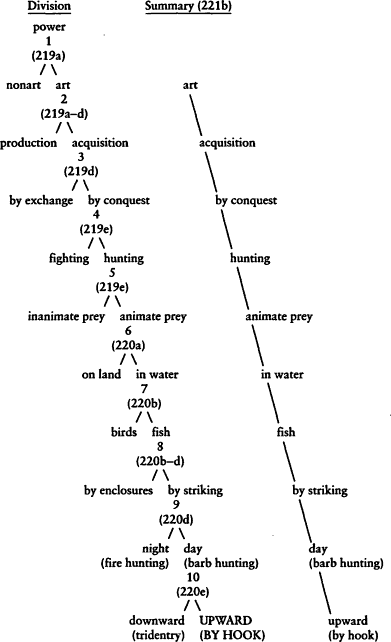
Figure 3
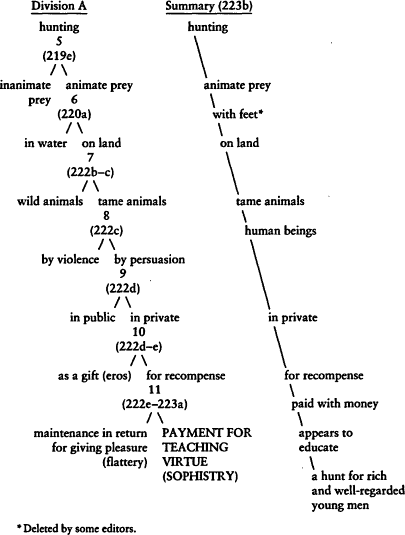
Figure 4
taking its own departure from 6a (see Figure 4). Although the summary is more explicit than the division in some places, it also drops one (and only one) of the division's steps, the distinction between persuasion and violence in step 8, and thereby the distinction between reason and spiritedness. We shall return to this point later.
The third subdivision of the Angler (exchange/conquest) corresponds
to the Republic's distinction between the commercial and spirited alternatives to reason. Accordingly, the fact that the first division of the sophist begins on the side of conquest suggests that we are here looking at him under his spirited aspect. But this is somewhat moderated by the next subdivision, step 5, which casts him in the role of a hunter rather than a fighter. Since a hunter aims at providing himself with sustenance, hunting makes reference to the appetitive as well as to the spirited side of our nature.[7] The stranger's description of this sophist as "the paid hunter of rich young men" (231d) combines both the attributes of commerce and aggression. Where this first division incorporates the spirited and appetitive elements jointly in its starting point, the starting points of divisions B and C will present each one separately.
Division B follows immediately, beginning under the heading of exchange, that is, subdivision 3a under Angler (see Figure 5). Here again the summary omits precisely one of the original steps, namely, step 5 (there is also a difference in the wording of step 8), the distinction between selling one's own products and those produced by someone else. The collapsing of that distinction implies that a sophist may be a merchant of his own products, which completes the symmetry: merchant of someone else's products (division II), retailer of his own products (division III), and retailer of someone else's products (division IV). Moreover, it implies that what matters is not whether he is productive, but that he is mercenary. In this appearance the sophist is guided exclusively by appetitive motives. He is out to make money by selling his knowledge of virtue.
The implicit symmetry mentioned above is made explicit when the stranger suggests that the sophist need not travel (224d), and might therefore be a retailer (6a) rather than a merchant (6b), and (224e) that he might make his own products (5a) rather than selling someone else's (5b). If these alternatives had been pursued, they would have yielded three more divisions (all variants on the appetitive aspect of the sophist). But they are not pursued, and Theaetetus, as we saw, counts this in one place as one more division (225e) and in another place as two (231d). He might equally have counted it as three (as the discrepancy between the division and the summary implied above), or as none, since all are minor variations on the preceding one. The introduction of so many variations emphasizes that the crucial point is the selling, not the
[7] In the Republic , hunters enter the city (373b) only when the formerly healthy, basic polis becomes feverish (372e) and begins to change from an agrarian (appetitive) society to a warrior (spirited) one (373d-e).
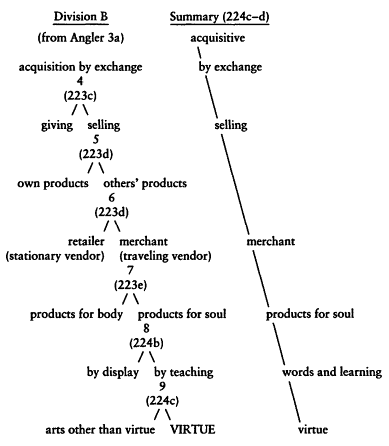
Figure 5
further distinctions under 5 and 6. The point common to them all is the restriction of sophistry to commerce, which is reflected later in the stranger's description of this group as showing the sophist to be a merchant or retailer (231d-e).
After this comes division C, which begins with species 4a under Angler (fighting), although the summary begins with division 2b (acquisition). The italics indicate where the initial steps are recalled from the Angler division in accordance with (although in more detail than) the summary (see Figure 6). Once again, a single step is omitted from the summary, namely, the distinction in step 3 between exchange and conquest.
Here it is the spirited element that is isolated as the starting point. "Fighting" rather than "hunting" leaves no doubt that only the spirited
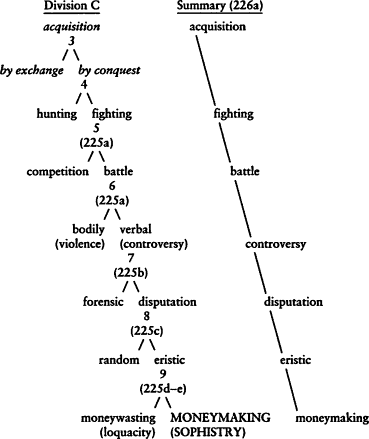
Figure 6
element is initially considered. The spirited nature of this aspect of the sophist is confirmed by the stranger's summary of the present division, which reveals the sophist to be "an athlete in contests of words, who has appropriated the eristic art" (231d-e). Nevertheless the final distinction is between moneywasting and moneymaking, which suggests that even at his most spirited the sophist is never entirely free of mercenary motives—a point that is emphasized by the summary's implicit collapsing of the exchange/conquest distinction, and its addition of the prior category of "acquisition." By contrast, in the case of the specifically appetitive sophist of division B, no spirited factors entered at all.
The Republic's third element, reason, is present in all three divisions,
but always in the role of a means to an end, rather than an end in itself or point of departure. In division A it appears in the form of persuasion (8b), which the sophist as hunter uses in lieu of violence to catch his prey. Its subordinate role is emphasized even more in the summary, which omits the distinction in step 8 between persuasion and violence. In division B it appears among the works that serve the soul rather than the body (7b), particularly those concerned with virtue (9b), which are sold by the sophist as retailer or as merchant. And in division C it appears as the verbal rather than physical weapons that are employed by the sophist as fighter (6b). In each case reason is subordinated to appetite or spiritedness, and the three cases correspond to the two types of injustice, and their combination, which are developed in the Republic and illustrated in the person of Thrasymachus.
Division D, which follows, is the only one in the dialogue (including the final one) that does not follow from the Angler division, and the only one that follows from a preliminary "collection," in accordance with the way the method is described in the Phaedrus (265c-266b).[8] The stranger surveys various types of tasks performed by servants (226b-c), the common denominator of which is that they all involve an act of division (


Here we do not find the sophist (or any discrepancy in the summary). What we find is a species about which the stranger says, "I'm afraid to say [these are] sophists . . . lest we accord to them too great an honor"; they resemble sophists, but only as the dog resembles a wolf (231a). He calls this species instead "noble sophistry" (231b). The "noble sophist" is generally recognized to be a reference to Socrates (cf. 230a-d), and the general form from which the division begins, "discrimination" or "division" (

[8] Socrates' opening remark in the Sophist , that the stranger may be a god in disguise (216a), is perhaps meant to remind us of the Phaedrus , where someone who is able to perform collections and divisions properly is compared to a god (266b).
[9] The belief that ignorance is never voluntary, is held not only by both the noble sophist and Socrates, but by the stranger as well (228c).
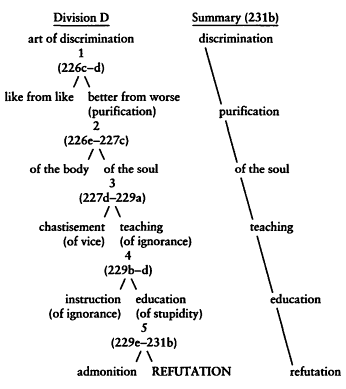
Figure 7
irrational parts of the soul, and when we confine ourselves to the soul's purely rational operations, we do not find the sophist. If we think in terms of appetite (division B), or spiritedness (division C), or both together (division A), we will find the sophist, but if we confine ourselves to rational discrimination alone (division D), we will not.
The most direct reference to the tripartite soul occurs in division D, step 3, when the stranger draws a distinction between chastisement, which corrects vice, and teaching, which corrects ignorance (227d-e). The difference between vice and ignorance is that ignorance, like deformity in the body, is a kind of missing of the mark, whereas vice, like disease in the body, is a kind of disharmoniousness.[10] The latter is in
[10] The distinction turns out to be less absolute than it seems at first. At 230c the stranger compares one aspect of the instruction that corrects the soul's ignorance to the practice of physicians. This draws an implicit connection between ignorance and disease, whereas previously ignorance was connected with deformity, and vice with disease. The implication is that even though ignorance is no longer conceived as a necessary condition for vice (as it was by Socrates), it is still conceived as a sufficient condition. Someone with the wrong ideas about goodness will not be virtuous, even though the right ideas are no guarantee of virtue either. For a perceptive and carefully annotated discussion of this passage, see Paul Gooch, "'Vice Is Ignorance': The Interpretation of Sophist 226A-231B," Phoenix 25 (1971) 124-33.
fact the definition of vice (injustice) given in Republic 4 in terms of the tripartite soul—both as disharmony (444b) and disease (444c-e). Moreover, during the discussion of vice the stranger remarks, "In the souls of people who are in a worthless condition, do we not see opinions opposed to appetites [


Even the distinction between ignorance and vice already implied the tripartite soul. The Socrates of the early dialogues had equated virtue with knowledge, and thereby vice with ignorance. But these equations could not explain what Aristotle later called moral weakness (

[11] All this means that the opening divisions have more substantial importance than is generally recognized. What importance they are usually thought to have is limited to their exhibition of diversity. For Taylor 381 they are meant to show that the sophist is the one who "can masquerade in all these guises" and is accordingly "a pitter of discourse against discourse, a contradiction-monger." For Cornford (PTK 187), "the first six Divisions actually, though not formally, serve the purpose of a Collection preliminary to the seventh," a view shared by Sayre (PAM 154-55), except that for him "the first five Sophists serve as a collection for the seventh, and . . . the definition of 'Sophist VI' illustrates the way in which a common property is to be sought." Other writers such as Friedländer, Rosen, and Benardete take the details of the opening divisions more seriously and find much of interest to say about them, although they do not see the divisions as embodying an underlying pattern.
The fact that the Sophist does retain—even if only implicitly—the doctrine of the tripartite soul makes more interesting the question why Plato now abandons his former practice of using this model in order to distinguish philosophy from sophistry. All the more so, because the distinction that he draws between them at the end of the dialogue, without that model, proves to be unsatisfactory.
3. Beginning of the Final Division (232a-236c)
The stranger now undertakes the search for the sophist, for which the preceding divisions were preparations. From the very beginning this final division lacks the rigor of its predecessors. Several of the steps remain entirely implicit. Moreover, when the division is resumed after a long digression, there will be some significant departures from the present model. Because of the first of these factors I shall summarize the steps before diagramming them, and because of the second I shall use Roman numbers here, reserving the Arabic numbers for the final form of the division.
i. In another reminder of the Republic , the sophist is now described as someone who can produce everything through a single skill (233a f.), as the poet had been described in Republic 10 (596c f.).[12] The stranger asks, "[What] if someone would claim that, by a single art, he knew how, not to speak or dispute about, but to produce and do all things whatever?" (233d). This is an odd beginning, for after thus contrasting "speaking about" and "producing" as two different arts concerning all things, the present division looks for the sophist under the species of a producer rather than a talker, which is not what we would have expected.
ii. The stranger continues, "And furthermore, having quickly produced [images of] them all, he sells them for very little money" (234a). As with step 4 of division B, the sophist sells his products rather than giving them away.
iii. The fact that he charges little for "all things" means that he must be playing (rather than serious; 234a).
iv. This species of play is a form of imitation (234b).
v. Specifically, it is imitation in words rather than pictures, resulting in spoken images (

[12] Compare especially Sophist 234b with Republic 598b-c.
vi. Images may further be divided into likenesses (


The preceding steps may be schematized as shown in Figure 8.
In all three "successful" preliminary divisions, the sophist was sought among the acquisitive rather than productive arts (division D, which was unsuccessful insofar as it caught only a noble cousin to the sophist, did not make use of the productive/acquisitive distinction). Here for the first time he will be sought among the arts of production. And where the first four divisions classified him under verbal (or pedagogical) skills, here he is classed as producing things rather than talking about them.[14] Why then is he portrayed here as productive rather than, as before, acquisitive?
There would have been no difficulty in pursuing the present course once again under the heading of acquisitiveness. The model for doing so was already provided in division B, which begins with acquisition instead of production (Angler 2), by exchange rather than by conquest (Angler 3), and by selling rather than giving (Step 4). At that point there is a distinction between selling one's own products (5a) and those other than one's own (5b), which leads (according to Theaetetus's enumeration at 231d) to the fourth and third appearances of the sophist, respectively. Accordingly, the final division might have begun with 5a, in which the sophist would be seen as a vendor of his own products, and the division might then have proceeded to specify the precise nature of the products, as it does here. The difference would be that all these divisions, including his art of production, would fall within the form of acquisitive arts. In fact there is nothing here against so interpreting the present starting point (i.e., as proceeding from 5a of division B rather
[13] Cf. the Phaedrus 259e-260d, where Socrates criticizes rhetoricians for being more concerned with accommodating themselves to their audience's beliefs, whether true or false, than with accommodating themselves to the truth.
[14] I.e., in step i. The verbal component is, however, readmitted in step v as a species of production: images in words are distinguished from images in pictures.
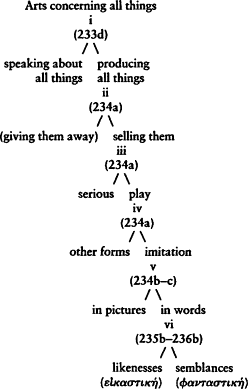
Figure 8
than 2a of the Angler division), except that no explicit encouragement is given to such a move. The only reference to the sophist's acquisitiveness (and therefore the only common ground with the Republic's conception of sophistry) is to the fact that the sophist sells his products rather than giving them away, and even here the money seems relatively unimportant, since he sells them "for very little money." Curiously, when this beginning is recalled at the end of the dialogue, even the slight reference to acquisitiveness is eliminated, as well as any ambiguity about whether the starting point might be located within division B, and therefore within the form of acquisitive rather than productive art.
4. Likenesses and Semblances (236a-242c)
The division founders on the problem of how to say that something "is not." If something is an inaccurate image, then in a significant sense it "is not" the original. But Parmenides argued (and his arguments in-
spired sophists like Protagoras) that it is impossible to say or think that something is not. When we attempt to do so we must conceive the nothing (what is not) as if it were something, and so we fall into contradiction. If this aporia cannot be resolved, the present attempt to define sophistry in terms of false images will fail (236a-239c).
The stranger now appears to shift his ground. It seemed at first that the problem lay only with the falsity of semblances. But now a less obvious problem arises that tacitly broadens the problematic to include not only semblances (inaccurate images) but likenesses (accurate images) as well. Without calling attention to the shift, the stranger now asks, not for a definition of semblances in particular, but for one of images in general (239d). The ensuing discussion will consistently put its questions in terms of images in general rather than semblances in particular (239d-240c, 241e, 264c). Most surprisingly, in one place the problematic is formulated not only not in terms of false images— semblances—but not even in terms of images in general, and rather in terms of true images, likenesses. The stranger says, "Without really being, then, it really is what we call a likeness?" (240b). Shorty thereafter he explicitly collapses the distinction between accurate and inaccurate images, and puts all images on the same basis for the purposes of the present discussion: he speaks of "false statements or opinions—whether images, likenesses, imitations, or semblances" (241e).
Why has the stranger broadened his attack to include all images, whether accurate or inaccurate? A semblance "is not," in the sense that its proportions are not those of the original. As long as we confine our example (as the stranger does) to the relationship between a statue and its model, the difference between semblance and likeness is clean But the present case is about semblances and likenesses in words (


But the question of whether the distortion is voluntary or not is irrelevant: if the image is a distortion, it cannot be a likeness. The intention of the producer tells us what was aimed at, but not what was produced. Only the nature of the product tells us that.
To put the matter more radically, in a sense any image is by nature a distortion of the original. At the very least the material from which it is made is different from that of the original.[15] This is true to a relatively small degree if we compare a well-sculpted and well-painted statue with the original model, and it approaches a vanishing point if we compare a painting of a painting or a sculpture of a sculpture with the original painting or sculpture; but it becomes clearly evident when we try to compare justice itself, for example, with words about justice. The medium of words is so different from that of forms that the very concept of an accurate image is seriously problematic. Since physical things are images of forms, as the Divided Line avers, then they necessarily fall short, if only because their mode of existence is so different. The Phaedo and the Parmenides ,[16] too, allude to the ambiguity of whether things can be said to be similar to the forms in which they participate, but the clearest statement of the problem is in the Cratylus :
SOCRATES : Would there be these two such things as Cratylus and a likeness [
] of Cratylus, if one of the gods not only copied your color and shape, like painters, but also made all the things within the same as within you, and bestowed the same softness and warmth, and put in them movement, soul, and intelligence like yours. In a word, everything that you have, he would place another instance of beside you. Would then this be Cratylus and a likeness of Cratylus, or two Cratyluses?

CRATYLUS : They seem to me, Socrates, to be two Cratyluses.
SOCRATES : Do you see then, my friend, that we must seek a different kind of correctness of likenesses, and of the things we were just talking about [names], and not require that if something subtracts
[15] Rosen puts the point more strongly: "An (accurate) image of a given original 'is and is not' the original, and in the same respect, not in two different respects. An accurate copy of a certain look is the same look. And yet, precisely as the copy (not, in other words, as a distinct material realization of the copy look), it is not and cannot be the same as the original. In sum: if it is the same, it is not a copy. If it is a copy, it is not the same" (PS 191). I am not sure, however, that one can speak of a copy as "not . . . a distinct material realization of the copy look." It does not seem possible to distinguish a copy and original as separate things unless an individuating material substratum is built into the modal.
Gilles Deleuze is highly sensitive to this ambiguity/instability in his treatment of the Sophist in chap. 1 of Difference and Repetition.
[16] Phaedo 74c-d (see PP 60-62) and the second and fourth arguments of the Parmenides (132a-b, 132d-133a).
or adds something it is no longer a likeness? Or do you not perceive how far likenesses are from having the same qualities as those things of which they are likenesses? (432b d)
If no image can perfectly represent the original, we can understand why Plato extended the problem of falsity from overtly false images (semblances) to images in general, expressly including overtly true ones (likenesses). Accordingly, if the following discussion is to be successful, it must explain not only how sophistry is possible but also how philosophy is possible. We will see that this is not adequately achieved in the Sophist ; and when we get to the Statesman we will find that the stranger, without distinguishing between likenesses and semblances, relegates all images and imitations of the unformulatable "science of the mean" to the same inferior status, and calls those who produce the images "sophists of sophists," regardless of whether the images they produce are the best possible (the regime of a constitutional monarch) or the worst (that of a tyrant; 303b-c).
Moreover, if, according to the Divided Line, physical things are related to forms as images to originals, the ontological status of physical things also comes into question at this point. In fact, the stranger will later suggest that connection himself when he divides the form of divine production into "entities themselves" and "images" (265e-266a)—a dear reminder of the two-world ontology of the Divided Line. What makes it even more emphatic is that there was no need to divide the form of divine production at all, since the sophist is pursued within the collateral form of human production.
There is no need to wait until that point in the dialogue for a reminder of the two-world ontology. As soon as the problem of images is defined, the stranger asks Theaetetus for a definition of "image," and Theaetetus, as he had done with Socrates in the Theaetetus , responds with a list of examples. One way in which this is suggestive is that the list uses examples reminiscent of those used to explicate eikasia and pistis in the Divided Line and the Cave: "images in water and mirrors, and, further, in paintings and statues and all other such things" (239d). Even more suggestive is the stranger's reply. He does not simply say, as Socrates did in similar circumstances, that what he wants is not a list but the quality that enables all items on the list to be called by the same name. Instead he prefaces that request with the comment that a sophist would reply by acting as though he had no eyes and had never seen these things; he would want to know "what follows from words alone" (239e-240a). By putting it in this way the stranger draws a distinction
between the visible world and the intelligible world, and insists that philosophy (for which "the sophist" here stands ironic proxy) is concerned only with the intelligible world.
Theaetetus's ensuing attempt to give a proper definition of "image" complements the problematic with which the section started. Previously the stranger emphasized the falsity of images. Now Theaetetus conversely emphasizes the truth of nonimages. An image is "another such thing made in the likeness of the true one [


5. Being and Not-Being (242c-251a)
"When I was younger," says the stranger, "whenever anyone spoke of what now brings us to an impasse—'not-being'—I thought I understood it exactly. But now you see what an impasse we are in with regard to it . . . . Then perhaps we have admitted this same condition into our soul no less with regard to 'being'" (243b-c). He proceeds to establish this by showing that (a) neither the pluralists nor the monists have given an adequate account of being, and (b) neither those who equate being with corporeal matter nor those who equate it with intelligible form have done so either. His refutations of these positions will be along the general lines of the Phaedo's method of hypothesis, as will his replacement of them by a higher hypothesis. Accordingly, the method of division cannot be regarded as a replacement of the method of hypothesis,
as is often claimed. They complement rather than compete with each other.
A. The One and the Many (243d-245d)
In a passage that recalls the Phaedo's complaint that previous philosophers relied on metaphor and physical explanations to a degree that blurred the distinction between philosophy and mythology (99c), the stranger mocks the anthropomorphic explanations of his predecessors who, as if they were telling stories to children, speak of their principles as fighting wars with each other, or falling in love, marrying, and having children (242c-243a). Because their fundamental principles were never clarified and subjected to rigorous scrutiny, the stranger proposes to undertake such scrutiny now, especially with respect to the concepts "being" and "not-being," which appeared so opaque in the previous section.
The stranger focuses first on dualism, which he takes as paradigmatic for pluralism generally. What is the relationship between the dualists' fundamental principles and "being"? Being must be either an additional principle, or identical with one of the original two principles (e.g., the hot and the cold), or with both of them in combination. If it is an additional principle, then there are three principles, and the dualists were wrong about the number of principles. If it is identical with one of them, then the other cannot be said equally to be. If it is identical with the combination, then there really is only one fundamental principle, and the dualists become monists (243d-244a).
Next, using arguments familiar to us from the Parmenides , the stranger goes on to show that monism is no more able than dualism to give an adequate account of being.
1. If being is the same as the One, we end up with two names for the same. Are the two names identical with the One, or different from it? (a) If the name is different from the. One, there will be two beings rather than one. (b) If the name is identical with the One, then the One will be a name, either a name of nothing (since there is nothing besides the One) or a name of a name (i.e., of itself; 244b-d).
2. Is the One the same as the whole (i.e., the world)? (a) If it is the same, then, since a whole has parts, the One will be multiple. (b) If the one being is not the same as the whole, then being will lack something of being. (c) If we deny that the whole exists, then neither coming into
being nor quantity can be said to be (244e-245d). "And so myriad other questions, each involving limitless aporiae, will appear to anyone who says that being is either two kinds or only one" (245d).
B. Form and Matter (245e - 249c)
The stranger then considers the other dichotomy mentioned above, that between the champions of matter and the champions of form, who are assimilated to champions of motion and champions of rest. This opposition between the "friends of the forms" and the materialists is described as gigantomachia , a war against the giants. The reference is to the mythical war in which the giants tried to drag the gods out of heaven. The giants, literally, the "earthborn" (248c), clearly refer to the materialists, while the friends of the forms, like the gods, derive their weapons from the invisible (immaterial) realm above (246b). In Hesiod, the gods defeat the giants. Whether that will be true here in the long run remains to be seen; in the short term there will be no victor.
For the materialists, "being and corporeality are identical." For the others, "true being is certain intelligible and incorporeal forms," while corporeality is not being but "a certain becoming that is in motion" (246a-c). The materialists, says the stranger, are too dogmatic and intolerant to participate in civilized argument, so we need to suppose them to be better than they really are, if any rapprochement is to be possible (246c; repeated at 247c). We may take this as an admission that the following argument would not in fact prove its conclusion to the materialists' satisfaction, although it does so to the stranger's (and perhaps Plato's) satisfaction. The argument is as follows:
1. The existence of living animals implies the existence of souls (246e).
2. The fact that souls can be just or unjust, wise or unwise, implies the possession and presence of these qualities (247a).
3. Such qualities exist without being visible or corporeal (a-b).
4. Therefore the materialists' exclusive materialism collapses (c).
We can see why the materialists would have to be reformed to accept this argument. Step I would not bother them since they conceive souls in material terms, as Theaetetus points out (247b). But the implication in step 2, and assertion in step 3, that the virtues (and perhaps the vices) have an existence that is distinct from that of bodies, would certainly be
unacceptable to them (as indeed it will be to Aristotle). The argument is similar to the second of the three refutations in the Phaedo of epiphenomenalism (the theory that the soul is a harmonia of corporeal elements), which similarly appeals to the reality of the virtues (92e-94b). That argument was not irresistible,[17] nor is this one, as the stranger's need for "reformed" adversaries acknowledges. Nevertheless it perhaps articulates the stranger's own reason for rejecting materialism. It is significant that that reason is based on the reality of virtue, rather than (as we might expect) the reality of universal kinds, for we shall find that the stranger's method of division cannot accommodate distinctions among "values," whether moral or otherwise.
The reformed giants have now acknowledged two kinds of being— corporeality and incorporeal virtue—and so some definition of being must be found to embrace both. The stranger suggests the definition of being as "power" (

The stranger next seeks to extend this definition to the position of the friends of the forms. They acknowledge that there is a difference between becoming and being. We commune (

[17] See PP 103-6; cf. 108-14.
[18] Cf. Phaedo 99a-100e.
objects of knowledge. But in both cases we are speaking only analogically, as we always do when we speak of forms. In the crucial sense forms are not active: they do not produce alteration in other things by means of any kind of alteration in themselves. Nor in the crucial sense are they passive: in being "acted upon" they are not in any sense altered.
What this discussion does illustrate is that we conceive of forms in relation to the realm of change. Forms and changing things are not two radically distinct worlds, or we would be vulnerable to the fifth argument of the Parmenides . Forms are the timeless aspect of changing things, the being of becoming. But in that case they must somehow presuppose the realm of change and motion. This is the direction that the stranger now takes, by means of an argument analogous to the one he used against the materialists:
STRANGER : What then, by Zeus? In truth shall we be so easily persuaded that motion and life and soul and wisdom are not present to perfect reality, and that it neither lives nor thinks, but that august and holy, without mind, it is immovably fixed?
THEAETETUS : That would certainly be a terrifying statement, stranger, to agree with . . . .
STRANGER : But then are we to say that it has mind and life and soul, and yet stands absolutely immovable although it is ensouled?
THEAETETUS : All these things seem to me to be unreasonable. (249a-b)
So there must be motion. But there must also be what is not in motion. The stranger had previously forced the reformed materialists to concede the existence of incorporeal virtues but had said nothing about whether or not these are in motion. To make the latter point, he now focuses not on virtue but on knowledge. On one hand, because knowledge comes and goes in the mind, the existence of mind forced the friends of the forms to concede that reality includes motion. On the other hand, because mind cannot exist without "what is in the same respects and in the same way and in relation to the same thing," and the latter cannot exist without rest (249b-c), the existence of mind also forces the reformed materialists to concede that reality includes rest.
Although in a purely formal way, then, it is the category of power that reconciles the materialists and the friends of the forms, in a concrete way it is the existence of mind that reconciles them. There is thus a double reconciliation: a formal one (the definition of being as "power") and a substantial one (each party's recognition of the reality of its opponent's realm). When the stranger said that the positions of both the materialists and the friends of the forms can be regarded as claiming
that being is a kind of power, he did not thereby show that there was any common ground between the two positions except in words only (the concession that the virtues were incorporeal was not strictly necessary to that reconciliation). He merely effected a collection of the two positions within a common class.[19] What the two camps meant by power might still be very different. But if he can now show that they share a belief in the existence of mind, which requires the reality of both motion and rest, then a reconciliation of substance may be possible.
It is not dear, however, on what grounds the champions of rest are required to accept the "perfect reality" (


To take the latter question first: it may seem as though the formula is a reference to the forms, but it is in fact simply an echo of the principle of noncontradiction formulated in Republic 4: "It is dear that the same thing [


[19] Sayre writes that since tangibility and unchangeability are not opposites, "'the battle of the Gods and Giants' is not a conflict between two groups who follow opposite branches in an exhaustive dichotomous subdivision of a common Kind" (PAM 166). However, although they are not opposites in their intention, they imply each other's contradictory, and so are opposites in their extension. In other words, what is tangible is changeable and thus opposed to the unchangeable, and what is unchangeable is intangible and thus opposed to the tangible. Cf. Phaedo 80b: "Soul is most similar to the divine and immortal and intelligible and uniform and indissoluble and what is always related to itself in the same way about the same things [sc . "unchangeable"]; and body [sc . "what is tangible"] is most similar to the human and mortal and multiform and unintelligible and dissoluble and what is never related to itself in the same way about the same things." I suspect that Plato chose nonantonyms to emphasize that the contrast is between dusters of concepts rather than one specific opposition.
opposite, then knowledge must itself always be becoming nonknowledge (182c-e). He inferred that "if everything is in motion, every answer about anything one is asked will be equally right," and language itself will break down (183a-b). Even if the stranger's formula is not meant initially as a reference to the forms, therefore, it must ultimately imply the forms nevertheless. Only the forms fulfill the condition of being at rest in the requisite way. Nevertheless we cannot suppose that the unregenerate materialists would be convinced by this, since the Heracleitean and Protagorean schools, at least, would not be troubled by the relativity of knowledge. But if the materialists were "reformed" enough to accept the independent reality of immaterial virtues, presumably it would not be too much for them to accept the necessity for absolutely stationary objects of mind. The stranger does not claim to have refuted materialism; he has only put forward a position that "more reasonable" materialists ought to accept.
The other question raised above has, of course, more serious implications for "Platonism." If the champions of rest are required to include within the concept of "perfect reality" not only the static forms but also mind, motion, life, and soul, how seriously is the classical theory of forms compromised? There have been approximately four ways of answering this.
(1) The phrase "friends of the forms" is conceivably not a reference to Plato's middle period theory of forms at all, but to some other theory.[20] Such an approach goes back at least as far as Proclus, who construes the phrase as a reference to "the wise men of Italy," that is, the Pythagoreans.[21] But Plato can hardly have been unaware that, in the absence of any other identification, such a phrase would naturally call to mind his own earlier writings. (2) On the assumption that the reference is to proponents of the earlier theory of forms, it may be that this episode reflects a radical revision of Plato's earlier thinking on the subject.[22] (3) We may, on the other hand, accept the assumption that the reference is to the earlier theory, but deny that any change in that theory is indicated. This would be possible if "life," "soul," "motion," and "reason" referred not to these qualities as phenomena but only as
[20] E.g., John Burnet (Greek Philosophy: Thales to Plato [London: MacMillan, 1914]) 280, Taylor 385, Runciman 76. W. D. Ross further cites Schleiermacher, Zeller, Bonitz, Stallbaum, and Campbell (Plato's Theory of Ideas [Oxford: Clarendon Press, 1951] 105 nn. 4-6).
[21] Proclus, p. 106.
[22] E.g., Burner 349; Sayre., PAM 165-66 n. 25; Guthrie 5.141.
forms—that is, the form of life, the form of soul, and so on.[23] However, such an interpretation goes against the whole sense of the passage, which portrays the friends of the forms as making a concession and extending their concept of reality.[24] (4) It may be that a change in the earlier theory of forms is indeed indicated, as the second position claimed, but the change may not affect any of the central doctrines of the theory.[25]
For the reasons given in the preceding paragraph I believe that the evidence is against the first and third interpretations, which are advanced by more recent friends of the forms in the hope of rescuing the earlier theory. Does it need to be rescued? Are the changes required by the stranger of a kind that are crucial to the integrity of the earlier theory? That theory posited a dichotomy between what is apprehended as real by reason and what is perceived as real by the senses: the former is universal and unchanging; the latter, particular and in flux. Since reason is more trustworthy than the senses, therefore, the true reality must be "being" (the universal and unchanging) rather than "becoming" (the particular and fluid). These are the alternatives that are now championed, respectively, by the friends of the forms and the materialists, so if the stranger's reconciliation of the two camps implies the collapse of this dichotomy, then the classical theory of forms would indeed have been modified in one of its most fundamental features.
But matters are not so simple. The primary polarity within the theory of forms was between the intelligible realm of being and the visible realm of becoming. Where do life, soul, and mind belong in this dichotomy? They are not forms, nor are they entirely at rest. Nevertheless, they are known by reason and not by the senses; which means, according to the earlier theory of forms, that they are species of being rather than becoming.[26] Throughout the Phaedo there is a contrast be-
[23] Harold Cherniss, "The Relation of the Timaeus to Plato's Later Dialogues" (1957), in Allen, ed., SPM 352.
[24] See Guthrie's (5.144) reply to Cherniss.
[25] See, e.g., Cornford, PTK 246; Ross 111; Friedländer 3.268-70.
[26] Recall 248a: "Through the body we commune with becoming by means of the senses, and by means of reason through the soul we commune with real being- which always remains the same in the same respects, whereas becoming is different at different times." Guthrie 5.144 observes that "the idea that Plato should ever have allowed the sensible world to cross the bridge between Becoming and Being is contradicted by every other dialogue early or late Here however he says that Being includes not only the Forms Rest and Motion, but also 'whatever is unmoved and whatever is moved', which gives colour to the view . . . that it includes all or some things in the physical world." This latter point will be addressed below.
tween being, characterized as intelligible, unchanging, and eternal, and becoming, characterized as corporeal, changing, and mortal. Even there, in the locus classicus of the theory of forms, soul (and by extension reason and life) is assimilated to being rather than becoming: we are told that soul is eternal because it resembles the invisible and unchangeable, which is eternal—rather than resembling the corporeal and changeable, which is mortal (79b-80b). Accordingly, in the Phaedo and other dialogues of this period, soul, life, and reason quite dearly do not belong to the realm of becoming; they do not quite belong to the intelligible realm either, because they are active. They really act as a kind of intermediary between the two realms,[27] enabling the visible realm to know the intelligible realm (by means of individual souls) and enabling the intelligible realm to be present in the visible (by means of the world soul). Although they are intermediate between being and becoming, they do not constitute a completely independent third type, distinguished equally from both, but are closely assimilated to the realm of being. To move from the Phaedo's position that life, soul, and reason have a kind of quasi being, to the position of the Sophist that they may be included in a broader conception of being, is not a fundamental change. They may be said to have being because they are (as the Phaedo argued) eternal. Even though they may be characterized by "becoming" insofar as they are active, nevertheless they do not change in the way corporeal things change. They are not undergoing generation and destruction. Moreover, because they are not corporeal, they are perceived by reason rather than the senses. The rigorous distinction between the intelligible world and the visible world seems to be as firmly drawn as ever, perhaps even more firmly drawn, since the middle is now more completely assimilated to one of the poles.
Socrates concludes with the words,
For the philosopher who most honors these things, there is, it seems, every necessity on these grounds neither to accept the account of those who say that the universe [
] is at rest, whether as one or many forms, nor should he listen at all to the account of those who set being [] completely in motion. Rather he must say, following the children's prayer, that "however many things are unmoved and moved," being [] and the universe [] are both together.
(249c-d)


Here again the two-world distinction is maintained rather than collapsed, because rest and motion are predicated of different subjects: the
[27] Cf. the concept of the daimonic in the Symposium (202d-203a).
philosopher who honors these things is to reject those who say that the universe (literally, the "sum" or "all") is at rest and those who say that being is in motion. It follows then that the (corporeal) universe is in motion but that being is at rest. The final sentence retains this linkage between the universe and motion, and being and rest: "unmoved and moved, being and the universe." The philosopher who honors these things embraces both poles within the more general class of "being" (i.e., "power"), but without collapsing the distinction between them. The reason that there is so much disagreement and confusion among commentators about what is being said in this section is that the stranger uses the same word, "being," both generically (as "power") and specifically (as "unchanging," or the counterpart to "becoming"). The definition of "passive power" (being affected) has just been made broad enough to include "being known"; and now the definition of "being" is broadened to include instances of active power.[28] The position of the friends of the forms (who understand "being" as unchangeability or rest) is collected together with the position of the materialists (who understand "being" as corporeality or motion) both formally and substantively, as I remarked earlier. Formally, they have been collected into the genus "power." Substantively, they have been combined into an extended conception of reality that comprises both "being" and "becoming," with soul (as the principle of both mind and motion) as the middle term that bridges the extremes. But the change from the earlier theory of forms is only terminological. In the middle dialogues Socrates had reserved "being" for what is unchanging and "becoming" for what is changing. He was concerned to distinguish rather than combine them, and so he offered no name for the whole. The stranger chooses instead to call the whole by the name of its primary species, but does not in other respects depart from the earlier ontology.[29] "Being" is now said to include "becoming," but this genus is no longer what the friends of
[28] Thus Charles Kahn takes this sense of "power" to be an instance of the "locative-existential" use of "to be," which "means something like 'to be effectively there, as a physical presence'" (The Verb 'Be' in Ancient Greek [Dordrecht: Reidel, 1973] 376 n. 6).
[29] This is essentially similar, I believe, to what Rosen means by saying that "There are two distinct ontologies at work in the Sophist.. . The doctrine of forms, so to speak, is the Stranger's version of a precise speech about being. The doctrine of the divine ousia is his version of imprecise speech" (PS 223; emphasis in original). Rosen goes on to say that "the Stranger . . . does nothing to reconcile these two ontologies" (ibid.). If by this Rosen means that the stranger does not collapse the distinction between them, then I would agree. But the stranger does reconcile the two in another sense, i.e., by comprehending the "precise" one, together with its counterpart (materialism), within the "imprecise" one, both formally and substantively. The greater logical generality of the imprecise one does not, however, confer upon it ontological primacy.
the forms meant by "being"; hence their principle has not been repudiated but has only been subsumed under a more inclusive class. The principle of the friends of the forms continues to retain its integrity, and continues to be referred to as "being" or "rest." As Socrates will say in the Philebus (12e-13a), the fact that things may be classed within the same species does not prevent them from being fundamentally opposed to each other in nature.
The preceding discussion has suggested that the problem of being can be solved by defining it as "power." But the stranger remarks that this solution may be undermined in the same way that dualism was undermined earlier. There the problem was in the relationship of being to the opposed principles of the dualism. Here we again have the opposed principles of motion and rest, and consequently the problem of coordinating them with being. If being is common to both rest and motion, it must be different from either one. But in that ease it would be neither at rest nor in motion, which is impossible. As the stranger predicted at the beginning of this section, the concept of being has collapsed into aporia just as had the concept of not-being. He now suggests that the discovery of the true nature of either one of them may entail the discovery of that of the other (250e-251a). This symmetry between them will turn out to be significant.
6. Combining of the Forms (251a-259e)
The aporia about being was how it is possible to call it by more than one name—rest and motion, for example. This difficulty may be no more puzzling, the stranger suggests, than the fact that we attribute to a person colors, shapes, sizes, vices, and virtues. Thus, "we say that a person is not only a person but also good, and endless other things" (251b). Only the young, and those who learn late in life, would say that what is one cannot be many in this way, and "would not allow us to call a person good, but only the good good, and a person a person" (251b-c). The question, then, is whether such things as "being" and "rest" can combine as do "person" and "good"—more precisely, whether all such things combine, or only some of them, or none at all (251d).
This may be the first time that Plato thematically explores the combinability of forms, but that does not mean—as is often inferred—that in the middle period the forms are conceived as absolutely discrete and incapable of combination. On the contrary, there would have been no point in Socrates' insistence that opposite forms cannot combine, as he
insists in the Phaedo (102d-105e), unless it were assumed that non-opposite forms are capable of combining. In fact it is clear from the same passage that in some sense the form of three combines with that of oddness, the form of fire with that of heat, and the form of snow with that of cold. Similarly, in the Republic it is dear that not only do the just and beautiful combine with the form of the good (505a-506a), but so in some sense do all other forms (508e-509b). The Sophist may be the first dialogue to explore the combinability of forms in detail, for it is the first one that examines the formal basis of language (and not just names, as in the Cratylus ), but in so doing it expands on what Plato has said elsewhere, rather than contradicting it.
The stranger addresses his question by pointing out that if none of these things combine, then motion and rest will not share in being and will not be. In fact, if different things cannot combine, then atomism is ruled out as well, since the atoms will not be able to join together (252b—although presumably the atomists would reject this assimilation of physical combination to formal interaction). More important, the "late learners" can thus be seen to contradict themselves, for they cannot express themselves without employing all kinds of verbal attribution, and this makes a mockery of their claims. On the other hand, if all forms combined, then so would opposites, and we would be left with contradictions, such as that motion is at rest, and rest in motion (252c-d). The remaining possibility, that some forms combine and some do not, is likened to the way letters combine to form syllables, or the way high and low sounds combine to form music. It is for the art of dialectics-the free person's art, philosophy—to know which forms combine and which do not, just as that of grammar (

In music there are no specific elements (notes) that account for the ability or inability of the notes to combine. That ability has a formal rather than a material explanation. Sequences of sounds that manifest beauty or harmonia may be said to combine, and those that do not manifest it do not combine. The example thus suggests the possibility that the question of combinability may ultimately rest with forms of value , not merely forms of kind. In the other example, grammar, the combination of letters into syllables is made possible by vowels (although nothing is said of the combination of letters or syllables into meaningful words). It is possible to see the three examples as forming a progression. In music there are specific elements neither for combining
nor for separating the other elements. In grammar there are elements that enable combination, but no elements that account for uncombinability. In dialectics there will be both.
The question, then, is whether there are some forms that make possible the combining of forms, and others that are responsible for their separation (252e-253c). There follows one of the most puzzling passages to be found anywhere in Plato:
STRANGER : To divide according to kinds, without thinking the same form to be different or a different one the same, shall we not say that this belongs to the science of dialectic?
THEAETETUS : Yes, we shall.
STRANGER : Will not he who is able to do this sufficiently perceive (1) one Idea extended everywhere through many, each one of which lies apart; (2) many Ideas different from one another, embraced from without by one; (3) and again one through many wholes brought together into unity; (4) and many forms apart from each and separate? (253d)
If only the first two were given, they would naturally seem to be examples of the two forms we are seeking: the first, that which combines ("one idea extended through many"); the second, that which separates ("different . . . embraced from without"). But the third and fourth categories apparently repeat this dichotomy with slight variations. The term "wholes," in 3, seems to be equivalent to "forms" in 4, in which case it refers not to individuals but to species: a species is already a combination of all the lower species into which it can be further divided, and therefore a whole of parts. In that case, "wholes" in 3 and "forms" in 4 seem to mean the same thing as "Ideas" in I and 2, and it is hard to see what the difference is between the first pair and the second.
The passage is so laconic that any interpretation runs the risk of being arbitrary. According to Julius Stenzel, writing in 1917, the most common interpretation was
that in (2) Plato is describing the inclusion of subordinate classes within a higher one, and in (4) contrary classes, mutually exclusive to each other, such as Rest and Motion. But Maier rightly draws attention to the point that (2) and (4) partly coincide: "Sheer disparity between them," he says, "is unthinkable." He is entirely in the right.
Stenzel's own interpretation is:[30]
Where he is concerned with the Division of wholes or unities, he says
'. From the point of view of sense, the important thing is not that the


[30] Plato's Method of Dialectic (New York: Russell and Russell, 1964 [orig. 1940]) 97, 100-101.
Division extends through "all," but that it passes through wholes or unities. (2) Conversely, where the process of Collection is described, as it was in the preceding phrase, the essential thing is to include all the kinds (
) under certain higher ones . . . . On our view, then,[wholes] takes the place of the plural of[one] . . . . (3) and (4) are closely related, and describe the process of obtaining the definition,, of a single form,.


Cornford, basing his own interpretation on that of Stenzel, argued that the first pair refers to the genus and species in the act of collection, and the second pair refers to them in the act of division.[31] This has been the prevalent interpretation in our century. It has the virtue of bringing the passage into a clear relationship with the overall theme of division in the Sophist ; although against this must be balanced the fact that there is no discussion of collection in the Sophist . The interpretation has the further disadvantage of requiring that the pairs represent movement in opposite directions—the first pair upward and the second pair downward—and the text gives no clear encouragement to such a reading. Not surprisingly, in spite of the general prevalence of Cornford's interpretation, a daunting variety of alternatives to it have been proposed. I shall list (without comment) four more of them to give some idea of the diversity of possible interpretations.
a. G. E. M. Anscombe: "(i) Species-individual [individual forms], (ii) genus-species [unifying forms such as "one," "whole," "being"], (iii) transcendentals-other forms, (iv) perfectly specific forms considered in themselves [such as the series of natural numbers]."[32]
b. Alfonso Gomez-Lobo: "Soph . 253d1-e2 does not describe Division, it anticipates the comparison of Being and Not-Being with other Forms which will ultimately provide Plato's answer to the dilemma of Parmenides."[33]
c. Jacob Klein: "Let us understand what the Stranger says, by means of examples. Example a : 'mammal' extends every way through 'lion,' 'camel,' 'dog.' . . . Example b : 'Being' embraces, 'from the outside,' Change and Rest . . . . Example c : 'animal is assembled into unity through 'mammal,' 'fish,' and 'bird.' Example d : 'justice,' 'cloud,' and 'fish' are entirely apart and separate."[34]
[31] PTK 267. He has been followed by Sayre (PAM 178-79), Guthrie 5.131, and Teloh 190, among others.
[32] "The New Theory of Forms," The Monist 50 (1966) 403-20 at 419-20.
[33] "Plato's Description of Dialection in the Sophist 253d1-e2," Phronesis 22 (1977) 29-47 at 47.
[34] PT 52.
d. Seth Bernadete: "Every idea of type A1 [ = 1] is manifest as one idea among many other ideai , all of which are comprehended by another idea of type A2 [ = 2]. And every idea of type B1 [ = 3] is manifest in manifold ideal of type B2 [ = 4], which are not comprehended by another idea ."[35]
Faced with such a bewildering variety of readings, the most prudent course might be to suspend judgment.[36] Nevertheless, I prefer to offer a different interpretation, recognizing at the same time that there is insufficient evidence for maintaining it (or any other) against its rivals— especially Cornford's—with much confidence. It seems to me that the simplest explanation would be to take the passage as describing a pair of divisions. Thus I ("one Idea extended through many, each one of which lies apart") refers to the starting point of division, and 2 ("many Ideas different from one another, embraced from without by one") to the results of that division. The opening words of 3 ("and again , one through many wholes brought together into unity") may be intended to suggest that we do not stop after one division but continue further to subdivide the preceding species. In step 3 we recognize that each resultant species is a whole with further subordinate parts brought together within it. Finally, in 4 ("many forms apart from each and separate") we distinguish the subspecies within the previous species. The point of listing four steps instead of only two would thus be to illustrate that the combining and differentiating functions that underlie diaeresis operate at more than one level.
On that interpretation, the present passage would be the counterpart of an equally obscure passage of the Theaetetus , where the aviary is said to contain "all kinds of birds, some in flocks apart from the others, others in small groups, and some alone flying randomly through them all" (197d). Although the Theaetetus makes no explicit mention of the methods of division and collection, they had already been adumbrated in the Phaedrus , and the Theaetetus passage may be intended as an illustration of collection, an illustration that is now comprehended in the Sophist by an illustration of division. On that interpretation, the single birds represent specific or individual cognitions that have not yet been brought into relation with others. The small groups represent col-
[35] 2.145.
[36] Rosen forthrightly says, "I prefer not to read my speculations into the text, because I see no secure basis for a detailed positive account of what is here meant by 'dialectic'" (PS 261).
lections taken only to the first level—the first species or genus. And the flocks represent the possibility of bringing the results of our first collections into progressively more inclusive ones.
However that may be, the question at hand concerns the combinability and divisibility of the forms. We have already seen that rest and motion do not combine with each other because they are opposites, but that both combine with being (250a-d). This means that the three are distinct: all are different from each other and each the same as itself (254d). What then is the status of "same" and "different"? Are they additional forms, or are they somehow reducible to the other three?
STRANGER : But surely motion and rest are neither different nor the same.
THEAETETUS : How so?
STRANGER : Because whatever we would call motion and rest together cannot be either of those two.
THEAETETUS : Why?
STRANGER : Because motion will be at rest and rest will be in motion; for with regard to both of them, whichever one becomes the different would force the one that is different to change to the opposite of its nature, since it would participate in its opposite.
THEAETETUS : Exactly.
STRANGER : Both surely participate in the same and the different.
THEAETETUS : Yes.
STRANGER : Then let us not say that motion is the same or the different, or that rest is. (255a-b)
In other words, if motion were equated with the different, then rest, which is different from motion and therefore participates in the different, would participate in motion (which ex hypothesi is the same as the different). Thus rest would be in motion. On the other hand, if we identified rest with the different, then, by the same reasoning, motion would be at rest. Same and different cannot, therefore, be reduced to motion and rest.
Nor can they be reduced to "being." If "same" were equivalent to "being," then (1) "motion and rest both are " would mean (2) "motion and rest are both the same." "Then it is impossible," the stranger concludes, "for the same and being to be one." Theaetetus replies only, "Virtually so" (


dox if interpreted in the same terms as sentence 1? Sentence 2 is in fact ambiguous. It may mean " . . . the same as themselves" (as it does half a page later, 256a), in which case there is no paradox. Or it may mean (as the stranger takes it to mean) " . . . the same as each other." In fact it is only in the first (innocuous) sense that sentence 2 follows from sentence 1. Sentence 1, in saying "both are " does not mean that both are each other ; it is existential rather than attributive, and therefore intransitive rather than transitive. But the stranger encourages Theaetetus to interpret the second (putatively isomorphic) sentence as being transitive . The two sentences must, however, be interpreted in parallel ways for the inference to be cogent. If sentence I speaks of same and different not in relation to each other but only in relation to themselves, then this is the only legitimate way to understand sentence 2: motion and rest are the same as themselves . With this argument, unlike the preceding one, the reductio fails. But it need not have failed. The stranger could have used an argument similar to the preceding one. He could have argued that if we equated one of the pair same-different with "being," then, if the other member of the pair is , it becomes its own opposite. That is, if "same" were equivalent to "being," then when we said that the different exists, we would be saying that the different is the same; and similarly if different were equivalent to being, we would be forced to conclude that the same is different. Why did the stranger abandon this successful kind of reductio in favor of a questionable one? Theaetetus's initial hesitation suggests that Plato may not have been unaware of its weakness. By reflecting on Theaetetus's hesitation, we saw that "being" and "the same" are in one way very dose in meaning. We will shortly find that one sense of "nonbeing" is "the different," so it should not surprise us to find that one important sense of "being" is "the same" (

[37] Rosen observes that to "replace 'sameness' by 'identity' and explain that, in turn, as one sense of 'is' . . . destroys the distinction between the two forms being and sameness " (PS 272). Nevertheless, the fact that "difference" is a sense of "nonbeing" does encourage such an explanation. It may well be that the distinction between "being" and "sameness" is only one of quasi genus and species. (Quasi genus because "being" cannot be a true genus: the stranger's dialectic against the One [244b-245d] implies that if being were a true genus, the differentia, which must come from outside the genus of "being," would by definition be "nonexistent.") In fact we can regard all four of the other "greatest kinds" as species of "being": "sameness," "motion," "rest," and even "not being" qua "difference." "Rest" and "motion" are species of "being" if one thinks of them in terms of the positions of the friends of the forms and the materialists, respectively: "being as opposed to becoming" (i.e., "rest") and "becoming" (i.e., "motion") are species of the strangers "being as power." Again, since "not being" qua "difference" exists as negativity, it too is a way or species of "being."
that the friends of the forms are never asked to give up their belief that reality is unchanging. They are asked to accept the reality of what is in motion, but not the reality of what is in a state of essential becoming. Life, soul, and reason are essentially connected with motion, but, unlike visible things, they never become different from themselves. A living body becomes a nonliving body, solid stone becomes sand, fire extinguishes, water evaporates; but life itself never becomes nonlife, soul never becomes nonsoul, reason never becomes unreason. In the highest sense, to be is to be selfsame or "in oneself" (

Finally, the remaining possibility is eliminated. The different cannot be equated with being, because some things have being in themselves (

In discussing the sense in which these forms do and do not combine with each other, the stranger implicitly distinguishes between the "is" of sameness and the "is" of connection. This distinction is more familiar to us as the distinction between identity and predication. However, if we speak in this way it is important to bear in mind that the grammatical relations of identity and predication are only analogues of ontological relationships in the stranger's account.[39]
[39] Cf. Paul Seligman, Being and Not-Being: An Introduction to Plato's Sophist (The Hague: Nijhoff, 1974) 72. We should also keep in mind Kahn's important observation that the distinctions among senses of "to be" do not imply an ultimate lack of unity in the concept of "being" generally: "The verb has a number of distinct uses or meanings that are all systematically related to one fundamental use" (VBAG 401). Also see his article "The Greek Verb 'to Be' and the Concept of Being," Foundations of Language 2 (1966) 245-65.
We have just seen that in one sense "to be" means to be the same. In that sense, when we say x is F we can only mean that x is the same as F. This was the only sense admitted by the "late learners"; but the stranger has now expanded the meaning of "is" from that restrictive sense in such a way as to include predication. That distinction is brought to bear now in a series of conclusions drawn from the foregoing discussion:
1. Motion is not in any sense rest It is neither the same as rest (255e), nor does it participate in rest (256b).
2. Motion both is and is not the same. It is not the same in the sense that it is different from (not identical with) "the same," but it is the same insofar as it is the same as itself (it combines with sameness with respect to itself; 256a-b). Keeping in mind the caveat on the preceding page, we can make the distinction clearer by saying that it is not identical with sameness, but sameness may be predicated of it.
3. Motion is different from the different, so in one sense (identity) it is not "different," but in another sense it is different (it combines with difference with respect to other things) (256b-c). As With the previous case, we might say here that motion is not different if we are using the "is" of identity, but is different if we are using the "is" of predication.
4. Even though motion is , in the sense that it combines with being (256a), it nevertheless is not , insofar as it is different from being (250b, 256d).
In the same manner as 4, we may say that each of the four greatest kinds other than "being" both is and is not. Accordingly, "'being' is many, while 'not-being' is unlimited [

The stranger's implicit distinction of a connective sense of "being" is now transferred to "not-being." "When we say 'not-being,' it seems, we do not speak of the opposite of being, but only of what is different" (257b). In other words, what is not-F need not mean what does not
exist but only what is different from F. The different is entirely relational. It is analogous to knowledge, which is divided into various technai and epistêmai in accordance with its objects. In a similar way the different is particularized and defined by the object from which it distinguishes itself (257c-258c). Of the three examples that are given— beautiful/not beautiful, large/not large, and just/not just—the first and third are once again examples of value. Even large (


This conclusion, that not-being exists qua difference, formally contradicts Parmenides' prohibition against saying or thinking that not-being exists (258d). But it does not contradict the spirit of that prohibition, because "we long ago said goodbye to any talk about an opposite of being, whether it exists or not, and whether it can be spoken of or is absolutely incapable of being spoken" (258e). To say that not-being exists qua difference is not to say that it exists qua the opposite of existence .
We saw that the stranger has maintained a parallel between the nature of being and the nature of not-being. The present discussion has distinguished two senses of being and two senses of not-being. (a) The two senses of "being" are "is the same as" (even difference is "the same as" itself ) and "combines with" (even not-being, i.e., difference, "is" a kind of being). The primary sense has been combinability, since identity has been distinguished as the additional kind, sameness; but the latter sense has hovered in the background as the legacy of the late learners. (b) The two senses of "not-being" are "difference" and "nonexistence." The primary sense has been "difference," but the sense of "nonexistence" has been present in the background as the legacy of the sophist, who, as the stranger earlier remarked, has eluded capture by hiding himself in apparently unintelligible not-being (239c). Are the two pairs parallel? In fact they are not, as we can see from the following chart:
BEING | NOT-BEING | |
sameness | difference | |
combinability | ? | |
? | nonexistence |
Sameness and difference. are counterparts, as are being and not-being, but combinability and nonexistence are not. The counterpart of combinability is not nonexistence but uncombinability, and the counterpart
of nonexistence is not combinability but existence. The lack of symmetry is disconcerting because at 253c the stranger spoke of the importance of discovering those forms that make combination possible and those that make separation possible. "Being" qua combinability certainly answers to the first of these, but we have not been shown the second. Commentators often assume that the form responsible for uncombinability is "difference,"[40] but to say that forms are different is not to say that they do not combine. "Rest" and "being" are different, but they combine. Otherwise combinability would be synonymous with sameness, which is just what the late learners claimed, and what the stranger is at pains to deny.
The example that we are given of uncombinability is "motion" and "rest" (252d). This suggests that the form—or at least one form— responsible for uncombinability is "opposition," a conclusion that accords with the Phaedo (102d-103c) and that is suggested by the stranger's frequent use of this word. We might go on to make "opposition" a species of "difference," as "difference" is a species of "nonbeing," and in that case it would be true to say that "difference" (in one of its species) is responsible for the inability of some forms to combine. But that goes beyond anything that is explicit in the stranger's presentation. It would seem more natural to make "opposition" another species altogether. Thus, one species of "nonbeing" would be "difference," that is, simple diversity, while another would be "opposition."
This would give us "opposition" as the counterpart to "combinability," but we still have no counterpart for the third species of nonbeing, "nonexistence." For this we need to recall the stranger's earlier collection of the senses of "being," proposed by the materialists and by the friends of the forms, into the form "power." "Power" appears to be the counterpart to "nonexistence." This would explain, too, why the stranger treats "power" as the most ultimate form, from which all but one (division D) of his divisions begin. The equation of existence with power, like that of uncombinability with opposition, accords with Plato's earlier dialogues. When Cebes, for example, asks Socrates to show that the soul exists after death, he asks for proof that it has power and intelligence (Phaedo 70b). In that context "power" seems to mean something like "existence." Again, in the Republic the exalted status of the good is emphasized by saying that it is "beyond

(6.509b). In that case, we can complete the chart above' and vindicate the stranger's claim of parallelism between being and nonbeing:
BEING | NOT-BEING | |
sameness | difference | |
combinability | opposition | |
power | nonexistence |
We can see from this that Plato has not abandoned his earlier, metaphysical, conception of being in favor of a purely logical or grammatical one, as is often argued. The metaphysical concerns are relegated to the background of the Sophist , for reasons that have already been suggested and that I shall return to later, but we are reminded of them nevertheless, however briefly and however indirectly.[41] The fact that the discussion of being as "power" is not explicitly followed up in the present passage does not mean that we are entitled to disregard it when we consider the implications of this section as a whole, as commentators sometimes assume.[42] When we draw inferences from the stranger's deliberate parallelism between the problematic of being and the problematic of nonbeing, it is important that we take into consideration all aspects of that parallelism. It is true that the stranger focuses primarily on the concept of not-being as relational ("difference"), but he makes it quite dear that the relational sense is not the only sense of "not-being." "Not-being" can also mean "nonexistence" (

[42] Thus Ross concludes that "the supposition that knowing is an action and being known a passivity, which is only one of several suggestions put forward in 248d4-7, is simply dropped . . . . It is silently dropped when the consequence of accepting it has been pointed out" (pp. 110-11). Ross is far from being the only one to believe that the previous discussion can be safely ignored—although usually the question is not even addressed.
It is worth noting that the two concepts that are combined in the above passage from the Republic , dignity and power, are both used by the stranger as well, but only one is endorsed by him. He appears to be as indifferent to the concept of dignity as he is partial to that of power. His method, he tells us, abstracts from all questions of whether something is more or less dignified,[44] or whether it is more or less ridiculous (227b). Curiously, however, despite his apparent indifference to distinctions of value, when the stranger now recapitulates his dissatisfaction with the late learners, he does so precisely in terms of the language of values: the ability to ignore the late learners' quibbles and make the necessary distinctions is "both difficult and beautiful" (


7. Logos And the Forms (260a-264c)
The Theaetetus , which made no explicit use of forms, or kinds, or any universal concepts, foundered in an attempt to exhibit the nature of logos. Here such an exhibition turns out to depend on the discussion of the forms just completed. The purpose of forcing the late learners "to allow different things to combine with each other . . . was to show that discourse [

The point that was previously made about letters and about the greatest kinds is now extended to names: some are capable of com-
bining, and some are not. The test is whether or not the resultant sequence is a meaningful one, and it will not be so unless nouns are combined with verbs, as in the minimal sentence "Man understands" (261a-262c).[45]
Every sentence must be about something and must have a quality (262e).[46] In the case of the two sentences "Theaetetus sits" and "Theaetetus, with whom I am now conversing, flies," the subject is the same but the truth quality is different. The first states the facts (

[46] The fact that in the following examples this quality will be truth or falsity does not mean that Plato failed to recognize that some sentences are neither true nor false. Questions and commands may be said to have a quality also, but of a different kind; there is no point in discussing them here, since the entire discussion is subservient to the question of whether false logos is possible. Runciman is therefore precipitous in speaking of Plato's "apparent belief that every combination of noun and verb must be a statement and as such must be either true or false" (p. 109).
[47] Commentators have wondered whether "sitting in an airplane" is an interesting refutation of the stranger's claim. Cf. Sayre: "It does not go without saying, as Xenakis avows, 'that "sitting" means here "sitting on the ground " not, say, "in an airplane"'"(PAM 208 n. 85; emphases in originals). Certainly the stranger intends sitting and flying to be mutually exclusive (otherwise the conjunction of the two sentences loses much of its force). Such an intention is entirely defensible, for sitting is normally construed as a passive state (being supported), while flying is an active state. Strictly speaking, when we are in an airplane, it is not we who fly but the airplane; and when the airplane is not flying we say that it "sits" on the ground. Actively flying, as distinct from being carried by a vehicle that is flying, is incompatible with sitting. It is parallel to the earlier opposition between motion and rest.
How do these examples demonstrate that meaningful discourse is possible because of the combining of forms? In the second case the answer is clear enough. Flying cannot combine with sitting (or with being human), and so "Theaetetus flies" is contingently (and necessarily) false. But the first sentence appears to contain only one form, "sits," and a proper name, "Theaetetus." Why did the stranger choose this as an example of a true sentence, instead of his earlier example, "Man understands," in which a combination of forms may be discerned? It is tempting to try to minimize the tension between the example (an individual participating in a form) and the thesis it is meant to illustrate (discourse as rooted in the combinability of forms) by taking only one of the two literally and "making allowances" for the other.[49] But it would be better not to have to make allowances at all.
Assuming, for the moment, that Plato both stated and illustrated his thesis competently, we need to ask how "Theaetetus sits" can involve a combination of forms. "Theaetetus flies" may be false either because "flying" does not combine with "sitting," or because it does not combine with "being human"; but in the case of a true sentence matters are not so simple. It is important to bear in mind, however, that the combination of forms is meant to explain initially not how sentences come to be true or false, but how they come to be meaningful (259e). To be meaningful they must be capable of truth and falsity, but to explain how a sentence is able to be true or false is not necessarily to explain whether it is in fact true or false. We saw earlier that meaningfulness requires both that some things combine and that some things be unable to combine. If nothing combined, then predication would be impossible, as the late learners contend; but if everything combined, then opposites could be predicated of each other, which would destroy meaning (251d-252e). If, now, we take "sitting" and "flying" to be in opposition to
[49] Cornford gives the example precedence over the thesis when he writes, "All discourse depends on the 'weaving together of Forms' . . . . We can also make statements about individual things. But it is true that every such statement must contain at least one Form" (PTK 300). The last sentence twists the first one beyond recognition. A single form cannot illustrate a "weaving together of forms." Ross, on the other hand, gives the thesis precedence over the example. He states that the two present sentences ("Theaetetus sits," "Theaetetus flies") "do not illustrate Plato's thesis," and dearly regards this as a lapse on Plato's part (p. 115). See Guthrie 5.161-62 for a discussion of some other approaches to this issue. John Ackrill, "S YMpL OKH EIDW N" (in Vlastos, ed., Plato 1.201-9), gives a perceptive analysis of this passage.
each other, then the examples do indeed illustrate thee stranger's thesis. Their opposition can be expressed by interpreting "flying" as overcoming the pull of gravity (or, in classical terms, overcoming the downward tendency of the earth in us) and "sitting" as a suspension of struggle against the pull of gravity (cf. n. 47, above). Therefore, if one of these can be truly predicated of Theaetetus, the other will be excluded. Understood in this way, "Theaetetus sits" is meaningful because some forms combine and some do not. It is meaningful because its truth entails the falsity of statements whose predicates are forms that do not combine with "sitting," such as "flying." Presumably the stranger chose "flying," rather than "standing," "walking," or "lying down," to illustrate his thesis because it implies necessary falsity as well as contingent falsity. But in other respects any of these other examples would have done as well.
The status of logos or discourse has thus been legitimated: it has been shown to be meaningful and thus to combine with being. Since thinking (


8. Resumption Of the Final Division (264c-268d)
The final division, as it is now recalled and completed, takes the form shown in Figure 9.
No longer is the initial distinction an opposition between speaking about and producing all things, as it was prior to the digression. Now, as in the preliminary divisions, it is between acquisitive and productive arts. It is no longer even conceivable that the division might fall within the form of acquisitiveness. In addition, the reference to selling has been removed, so all question of selfish motivation is now eliminated. Why should Plato have taken so much trouble to establish the sophist as acquisitive in all the preliminary divisions, only to end up looking for him in the form of productive arts? The stranger explains:
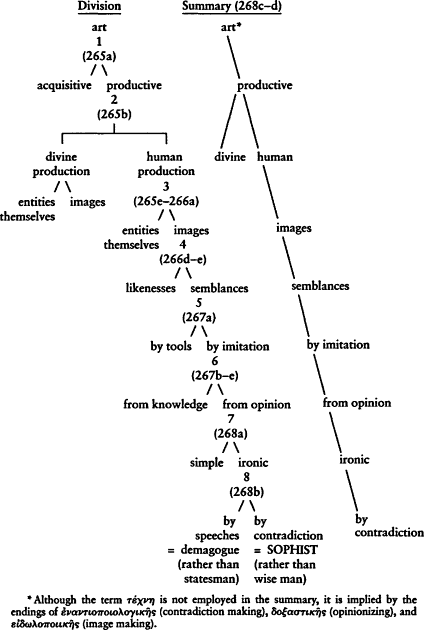
Figure 9
STRANGER : Did we not begin by dividing the productive and acquisitive arts from each other?
THEAETETUS : Yes.
STRANGER : And under acquisitive art the sophist showed himself to us in the arts of hunting, competition, commerce, and other such forms.
THEAETETUS : Absolutely.
STRANGER: But now, since the mimetic art has encompassed him, it is dear that we must first of all divide the productive art itself in two. (265a)
This is not sufficient grounds for removing the sophist from the acquisitive form, since division B (the commercial sophist) showed us that the productive art can reemerge within the acquisitive arts (step 5a) when the production is ultimately for the sake of gain, as it was for the sophists. If the sophist makes his products not because he sees such creativity as an intrinsic good, but rather because they are instrumental to profit,[50] then he belongs in the acquisitive class. He becomes an example of the sophist as a merchant who sells his own products (224d-e). There is thus no immediately clear reason why the stranger shifts the inquiry out of the sector within which all the preliminary divisions led us to believe the sophist is to be found. It is not a question we would need to worry about if the ensuing division led to a satisfactory definition of the sophist; but it doés not. The sophist is defined as (1) the maker of semblances rather than likenesses (step 4, 266d-e), (2) operating on the basis of opinion rather than knowledge of his subject (step 6, 267b-e), and (3) making his claims with irony (step 7, 268a). This definition gives rise to a number of serious questions.
Since the chief burden of the dialogue is to distinguish the sophist from the philosopher, how successfully can we differentiate them in terms of the above definition? If we look to the first of those three distinctions, the difference will be that the models (images) used by the philosopher will always be accurate (likenesses), and those Of the sophist inaccurate (semblances). But the difference between philosophy and sophistry is not that the former is always true and the latter always false. In that case a philosopher whose conceptions were not perfectly accurate would be nothing but a sophist; and a sophist who happened to give an accurate description of some state of affairs, when it suited his
[50] In the Republic Socrates shows that Thrasymachus's unjust person is unjust not by virtue of his knowledge of the principles of ruling, but because he uses that knowledge in the service of moneymaking (345c-346e).
purpose, would be a philosopher, however manipulative his intentions might be. The stranger's point would be more defensible if he meant that for the purposes of a sophist semblances are adequate , whereas for the purposes of a philosopher likenesses are necessary. But to introduce the notion of purpose, whether explicitly or implicitly, is to show that what really distinguishes the philosopher and the sophist are their values and goals, to which their "products" (likenesses or semblances) are only a means. In this way too the present definition misses what is essential. We shall return to this point.
If we try the second distinction, between knowledge and opinion, there will be an analogous distortion. The philosopher always knows what he is talking about, while the sophist has only an opinion. In that case, once again, there could be no such thing as a mistaken or even partially ignorant philosopher; he would be a sophist by definition. The Socrates of the aporetic dialogues, who frequently professes his ignorance (as he does again in the Theaetetus ) and even the Socrates of the Republic , who claims to have only opinion rather than knowledge of the good (506b-e), would be a sophist by definition. And any sophist who happened to have attained knowledge about his subject matter would be a philosopher, regardless of the use to which he put that knowledge. Neither of these criteria, whether taken singly or jointly, provides an adequate account of the essential difference between philosophy and sophistry.
The third distinction, in terms of irony, sounds more promising. To say that the sophist is ironic may seem to suggest that he is insincere and disguises his true intentions, in which case he might be using argument as a means to mercenary or political ends. But it turns out that this is not what the stranger means at all, for those who are characterized by irony are said to "have a great suspicion and fear that they are ignorant of the things that they give themselves the appearance of knowing in front of others." Their irony is thus a kind of modesty, remarkably like Socratic irony. The species with which they are contrasted, the counterpart of irony, is the simplicity (


tween them is whether they suspect and worry about this shortcoming or not. It is rather surprising that Plato places the sophists in the class of those who do have this suspicion and worry. For throughout the dialogues Plato portrays the sophists not only as makers of semblances, but as pleased with their calling, and as denying any ultimate distinction between knowledge and opinion—or, by extension, between likeness and semblance.[51] They are never depicted as suspecting, much less fearing, that they have only opinions when they ought to have knowledge. By endowing them with what is, in effect, Socratic irony (which in this case may be represented by the Socratic awareness of "knowing only that one does not know"), Plato prevents the present dichotomy, like the other two, from distinguishing between the sophist and Socrates, or any philosophers who are aware of their own limitations.[52]
However we interpret this species of irony, it must ultimately be the home of the philosopher as well as the sophist. At 268b the stranger asks whether the type of person that is isolated at step 8b is the wise man (


[51] Cf. 264a, where semblance is the product of opinion.
[54] Only in the Republic is it even hypothesized that philosophers might finally reach their goal of wisdom—and that hypothesis is always subservient to the attempt to envision the (perhaps unrealizable) perfectly just city, which by definition would have to have wise rulers.
tween the wise man and the philosopher in step 6, or collapse the distinction between the philosopher and the sophist in step 7. The only alternative would be to relegate the philosopher to those who are "simpleminded, believing that they know things about which they only have opinion."
The goal of the dialogue was to distinguish the sophist from the philosopher and the statesman (cf. 217a), but the final division has not succeeded in doing so. The definition of the sophist is too broad, because sometimes philosophers, too, (a) are forced to rely on opinion, (b) are then destined to produce semblances, and (c) because of this they will sometimes feel "a great suspicion and fear that they are ignorant of the things that they give themselves the appearance of knowing in front of others." The definition is also too narrow, because it is conceivable that sometimes sophists will (a) have knowledge of their subject, and (b) create a likeness of it; and (c) because of this, when they do produce semblances (which is most of the time) they will sometimes think they "know things about which they only have opinion." At most, the definition provides an initial basis for a distinction between the sophist and the philosopher, to the extent that it implies that for the sophist semblances are adequate, whereas the philosopher must strive for likenesses. But we can understand this difference in their "instruments" only if we understand the difference in their values and goals: only their end can explain their means. As I previously mentioned in section 4, in the Statesman (303b-c) the stranger will collapse the distinction between likeness and semblance, and describe as "sophists of sophists" all those who produce images of the uncodifiable "science of the mean." Since this does not distinguish between images as semblances and images as likenesses, even the philosopher, as defined above in terms of likeness making, would fit that description and be classed with the sophists. We will have to wait for the Statesman to hear the stranger's final word on the distinctions among sophistry, philosophy, and wisdom.
Although the sophist is never successfully distinguished from the philosopher, he is distinguished at least in a perfunctory way from the statesman. Theaetetus agrees that the person located under step 8a (making speeches) is a demagogue rather than a statesman, and that the sophist differs from the demagogue by employing the art of contradiction rather than extended speeches (268b-c). The distinction between the sophist and statesman is therefore only indirect, since they are not distinguished from each other but mutually from the demagogue; and indeed the distinction between the statesman and the demagogue is only
nominal, since Theaetetus does not explain in what way they differ from each other. The philosopher , on the other hand, is never even mentioned in the final division. The failure to differentiate the sophist not only from the statesman and the wise man, but also from the philosopher, is a serious shortcoming, and not only for reasons of definition. The difficulty of distinguishing between the philosopher and the sophist was a major factor in Socrates' conviction and execution (which was alluded to at the end of the Theaetetus , hence implicitly at the beginning of the Sophist , 216a); and this difficulty has been kept before our eyes throughout the dialogue. For example, (1) the philosopher, like the sophist in this dialogue, shows himself in a multitude of forms—one of which is that of the sophist (217c). (2) Both the philosopher (218d) and the sophist (221d) are depicted as hunters. (3) When the sophist (who makes inaccurate images, or semblances) is said to hide in an impenetrable place (236d, 238c), we find that the philosopher (who makes accurate images, or likenesses) is there with him. As we saw, the impenetrability is due to the nature of images in general (239d-240c, 241e, 264c), not of semblances in particular, and in one place they are referred to only as likenesses (240b). (4) The sophist resembles the Socratic philosopher as the wolf resembles the dog (231a). (5) Like the philosopher (cf. Theaetetus 146c-d), the sophist rejects strings of examples in place of definition (239d-240a).
However, not only does the final division never completely define the sophist in a wily that makes explicit how he differs from the philosopher; it is the only division in the dialogue in which we cannot even implicitly locate the distinction between the sophist and the Socratic philosopher. In division A's depiction of the sophist as a hunter of youths, step 10 distinguished the lover who hunts youths in order to give them something, from the person who hunts them in order to take something from them. If we divided 10a ("as a gift") along the same lines as 10b ("for remuneration"), the Socratic philosopher would be visible as one who teaches virtue as a gift rather than for financial reward. In division B the sophist is once more identified as a teacher of virtue (9b) for the sake of marketing (4b) rather than as a gift (4a). The Socratic philosopher could therefore be found by means of a parallel division within 4a, that is, as one who teaches virtue freely. In division C (step 9) the sophist is a verbal warrior engaged in eristic:
STRANGER : That which, within an art, argues both about justice itself and injustice and about all the others generally, are we not accustomed to call this eristic?
THEAETETUS : Of course.
STRANGER : Of eristic, one kind actually wastes money, and the other makes money.
THEAETETUS : Absolutely.
STRANGER : I suppose that the one that, through the pleasure of this pursuit, causes someone to neglect his affairs, and the style of which gives no pleasure to most of his listeners, is, in my opinion, called nothing other than loquacity.
THEAETETUS : That's more or less what it is said to be.
STRANGER : The opposite of this, which makes money from private eristic [is the sophist]. (225c-e)
As is often observed, the first of these subdivisions sounds very much like a satiric description of Socrates,[55] so here again the differentia between sophistry and Socratic philosophy would be the subordination of the former to personal gain. Division D distinguishes the two negatively, by showing that if we confine our attention to reason without reference to the acquisitive parts of the soul, only the philosopher and not the sophist will be found.
Not only is the sophist excluded from division D, but for another reason so is the Eleatic stranger's method, and noticing the reason for this will help us understand why, in the course of the employment of that method, the dialogue moves gradually from its Republic- like beginnings to its sterile conclusion.
It is worth noticing, in passing, that even if the final division is not successful in answering the original question of this dialogue (that of the fundamental difference between the sophist and the philosopher), it is successful in offering a plausible answer to the Theaetetus's question about the nature of knowledge—although it does so only implicitly. Since the difference between likeness and semblance is that the first is an accurate image of reality while the second is only specious, it is possible to define knowledge as the ability to produce likenesses of reality.[56] Those who have knowledge can infallibly distinguish between a likeness and a semblance, whereas those who are guided only by opinion cannot. The final division is also successful in giving a plausible answer to
[56] This does not mean that those with knowledge will always want to create a likeness, but only that they are able to do so.
the related question on which the Theaetetus finally foundered: the nature of epistemic logos. Such a logos would be a likeness in words (cf. subdivision vi), and the Sophist abounds with examples of this kind. I do not mean to suggest by this that the aporiae of the Theaetetus have thus been definitively resolved; I do not think that Plato regarded such questions as fully answerable. Consider, for example, the question of whether logos makes knowledge possible or knowledge makes logos possible—a question that haunts the dialogues from the Meno to the Theaetetus , and is in between laid to rest only provisionally by metaphors like "recollection." If logos makes knowledge possible, then we must be able to formulate a logos of something before we know that thing, which seems impossible. If, on the other hand, knowledge makes logos possible, then we must have knowledge before we can formulate a logos of that thing, in which case philosophical inquiry no longer seems possible. But even though the Sophist provides no definitive resolutions of such perplexities, and provides us with no model of knowledge that confronts the problem addressed by the doctrine of recollection (as the Statesman will do in the "method of paradigms," 277d-278e), our understanding of what is involved in the questions is raised to a higher level by virtue of the dialogue's focus on kinds rather than individuals.
9. Diaeresis and Value
The form from which division D began was the art of division (


the method of definitions [
] does not care more or less about sponging than about taking medicine, nor whether one provides us with greater or smaller benefits than the other. It aims at acquiring an understanding of what is akin and what is not akin in all the arts, and, with this intention, it honors

all of them equally. Moreover, in view of their similarities it does not consider one of them more ridiculous than another.
(227a-b)
Unlike the Socratic pursuit of philosophy, then, the stranger's method does not discriminate better from worse. It is value-free. That is why the stranger—once he has aligned himself with the pursuit of sorting like from like rather than the purificatory separation of better from worse—no longer has the means to distinguish the sophist from the philosopher.[57] In fact, at the end of division D the stranger does make an informal distinction between the sophist (whom the division did not find) and the Socratic philosopher (who was found instead), and the distinction was precisely in terms of value: "I am afraid to call them sophists . . . lest we confer upon them too much honor [

In principle, Plato might still have had the stranger discriminate between the sophist and the Socratic philosopher by distinguishing the giver of gifts from the vendor of wares as two different types, neither of which is posited as better than the other. The fact that he does not do so after leading us, by means of the preliminary divisions, to expect
[57] Stanley Rosen is, as far as I know, the first commentator to appreciate the implications of this passage. He suggests that the strangers "insistence upon the apolitical nature of his method . . . [is] falsified by his inability to keep sharply distinct the criteria of like/unlike and better/worse" (PS 326). The reason is that "Plato was experimenting with a technical resolution to the problems of non-being and falsehood and at the same time was indicating . . . that a technical resolution to these problems is not feasible. In other words, Plato is both presenting a plausible philosophical accusation against Socrates, by means of the persona of the Stranger, and himself refuting that accusation . . . . [T]he Statesman is the Strangers recantation" (p. 308). I agree with Rosen about the importance of this tension, but it is not necessary to regard Socrates and the stranger as serious adversaries whose enmity can be reconciled only through recantation. I argued in the previous chapter that in the Theaetetus Socrates leaves the forms in the background in order to show how the inquiry fails without them. In the Sophist the stranger brings back the categorial aspect of the forms, but leaves the valual aspect in the background to show the shortcomings of the inquiry without it. When he reintroduces it in the Statesman , therefore, this can be construed as the completion of the project of the Sophist , rather than a recantation of it. It is the positive counterpart of the Sophist's indirect demonstration of the importance of value. The Theaetetus-Sophist-Statesman trilogy is a cumulative exploration of the elements implicit in the theory of forms, in terms of both the absence and the presence of those elements individually.
It might be objected that when the strange/rejects value distinctions in the present passage he is doing no more than his "master" Parmenides had done in the eponymous dialogue, when he rebuked Socrates for doubting that there are forms of lowly things: "You are still young . . . and philosophy has not yet taken hold of you as, in my opinion, it eventually will; at which time you will not despise any of these" (Parmenides 130e). In that passage, however, the question was not whether some forms are more important than others, but whether some kinds of things were too lowly to have forms at all.
some such differentiation may be a way of suggesting that the distinction cannot fully be appreciated without reference to better and worse. It is not merely a question of whether philosophy is "better" than sophistry, although that is at least implicit. What distinguishes the philosopher and the sophist is just their differing beliefs about what is good. For the philosopher what is good is the love of wisdom, and the sharing of it with others; for the sophist what is good is personal gain—whether in terms of honors or riches—and skill in reasoning is good only as a means to this end. According to every other dialogue in which the question arises, the difference between the two is that, in the philosopher the better (part of our nature) rules the worse; in the sophist the worse rules the better. As long as we try to distinguish them without reference to the idea of value—the good—but only by means of the products that they generate in the course of these pursuits, we will be no better than those whom Socrates ridicules in the Phaedo for trying to understand reasons in terms of their material results rather than in terms of their underlying purposiveness. Such people would say that the reason Socrates sits in jail instead of running away is the mechanical arrangement of his limbs in a sitting position; whereas the true reason is his belief that it is better not to run away (98c-99a). The difference between the philosopher and the sophist is not that the philosopher always creates accurate images and the sophist inaccurate ones (for a sophist does not stop being a sophist when he happens to give an accurate description of something, nor does a philosopher cease to be a philosopher when his descriptions are imperfect), but that the philosopher always desires to create accurate images, while the sophist desires to create persuasive ones whether or not they happen to be accurate; and so the former strives for likenesses while the latter is satisfied with semblances. Only if we understand the differing values from which these different desires spring, will the distinction between likeness and semblance tell us anything about the real difference between the sophist and the philosopher. As Aristotle remarks, in a passage cited in the previous chapter, what distinguishes the philosopher from the sophist is a difference in the purposes of their lives.[58]
In the Parmenides Plato explored the difficulties that result from adherence to the theory of forms. But his character Parmenides also insisted that "in the case of each hypothesis you must examine what follows not only if what is hypothesized exists, but also if it does not exist "
(135e-136a). In the trilogy that follows he explores the difficulties that result from hypothesizing the nonexistence of the central features of the forms. The Theaetetus was a negative demonstration of the importance of the forms, which shows that if the epistemological aspect of the forms is absent, it will not be possible to give an account of knowledge. Subsequently, something like this epistemological aspect of the forms is reintroduced in the Sophist in terms of the stranger's conception of "kind" (generally

With this in mind let us recall the stranger's substitution of "power" as the criterion of reality or existence, in place of Plato's earlier criterion of "rationality." It is striking that in that very passage where the stranger gives his value-free speech, two examples reminded us of the value-committed speech of the friends of the forms. To secure the materialists' agreement that some things are both immaterial and real, the stranger used the example of virtues (247a-b). And to illustrate the sophists' technique of failing to distinguish between the "is" of identification and the "is" of attribution, he compared "Man is good" with "Man is man" and "Good is good" (251a-b). He further reminded us that the phi-
[60] Klein (PT ), Rosen (PS ), and Benardete are exceptions.
losopher can never be free of valuation, for "the philosopher especially honors"[61] knowledge, wisdom, and reason (249c).
There, in the middle of the dialogue, we were reminded of the limitations of the stranger's value-free method. The importance of value was also anticipated at the beginning of the dialogue, with Socrates' opening speech about the gods' concern with whether or not we are virtuous (216b). Now, at the end of the dialogue, we are once again reminded of the primacy of virtue.[62] In step 6 of the final division, the stranger divides imitation into that based on knowledge and that based on opinion. He uses the following example:
What about the pattern of justice and of virtue taken as a whole? Aren't there many who, although they are ignorant of it, still have a kind of opinion, and who try hard to be eager to make this, which they believe to be virtue, appear to be in them, by imitating it in their behavior and speech as much as possible?
(267c)
I believe that it is against this background that the substitution of "power" for "reason" is to be understood. The middle dialogues were concerned with distinguishing the better from the worse; but the stranger is interested here only in distinguishing similarities and differences. On that basis he is able to ask a question that Plato has never before asked: What do being and becoming have in common? For the friends of the forms, the task was to distinguish being from becoming. The stranger, on the other hand, wants to collect them together into a common form, and he uses the form with which he began the Angler division—that of power, implicitly understood as existence. But at the same time the repeated references to virtue and other values remind us of what has had to be sacrificed in order to proceed in this way. Another such reminder may be found in steps 2 and 3 of the final division, where the stranger divides the form of divine production into "entities themselves" and "images" (265e-266a). The division appears to be a deliberate reminder of the two-world ontology of the Republic's Divided Line. The resemblance is intensified by the fact that in step 3 the stranger divides not only the right side of the division (human production), but also the left side (divine production). "Since there are two," he says, "cut each of them again into two" (265e). There is certainly no need to cut both, because the sophist is pursued only on the right side, and nothing is
[62] Cf. Friedländer 3.279.
gained by dividing the left. This is in fact the only place where the stranger symmetrically divides both the left- and right-hand forms—a "superfluity" that is repeated in the summary. Since there was no methodological basis for the symmetrical division, and indeed every precedent has been against it, the reason for it must lie elsewhere.
Not only is the procedure of step 3 without precedent, but step 2, on which it is based, is invalid. A properly exhaustive division should be, first, between divine and mortal production, with mortal production then subdivided into human and animal. Even this latter division may require intermediate steps.[63] The most obvious explanation for making the present kind of division despite the above objections is that, thus cut, the divisions resemble those of the Divided Line. The four resultant kinds are divine production, images of divine production, human production, and images of human production. Taken together, they present a vivid echo of the Divided Line seen in terms of the Allegory of the Cave (509d-517c): (1) the divine forms (represented in the Cave allegory by natural objects, especially celestial bodies), (2) images of the divine forms (represented by shadows and reflections of natural objects), (3) the physical world (represented by human-made artifacts), and (4) images of the physical world (represented by shadows of the artifacts).
The implications of such a reminder in the context of the Sophist should not be underestimated. Two in particular are worth pointing out. The Sophist has treated the realms of being and becoming as parallel divisions. within the form of "power." Even here, in the passage just discussed, the divine and the human are treated as parallel. In the Republic , however, the entire visible realm is treated as an image of the intelligible realm (532c), and so human production would be an image of divine production (cf. Republic 596a-597b). The importance of this is that an original model has an ontological priority over its imitated image, as the stranger himself had earlier pointed out (240a-b). But the stranger abstracts from all such ontological priority when he collapses being and becoming into collateral species of "power," and when he collapses the divine and human into collateral species of "production." The reference to the Divided Line and the Cave reminds us that the stranger's principle of abstracting from value distinctions such as noble and base, or higher and lower, is not without its questionable side.
The other implication leads in a similar direction. Any reminder of the Line-Cave section suggests the possibility of a comparison between
[63] cf. Statesman 262a ff.
the strangers unifying concept of "power" and Socrates' unifying concept of "the good." There are three important differences between these two concepts. First, the good is a first principle, not an inclusive class. Second, it is a source of value, not only of existence. Third, the good is directly relevant only to the level of being, not to that of becoming—it is the ground of the being of forms, not of the existence of particular things and events. These differences lead us to notice the same deficiencies in the stranger's ontology that we observed in the previous paragraph. In theory, one might turn this argument around and suggest that the reference is not meant to make us criticize the Sophist in the light of the Republic , but to criticize the Republic in light of the Sophist . The reminder of the Republic might be a way of calling attention to the position that is being superseded . There are two reasons why this is unlikely. The first is that in his dialogues after the Sophist , Plato consistently returns to an ontology more like that of the Republic , in which being is given ontological priority over becoming—the intelligible world over the visible. The second reason is that the recurring reminders of the importance of value, which we have observed at work throughout the Sophist , would be inexplicable in a dialogue whose fundamental orientation was toward an overcoming of the connection between ontology and value.
The stranger's provisional overcoming of that connection, in the service of showing how all existence can be neutrally classified in terms of sameness and difference, is an important philosophical point. It represents the isolation of one of the necessary conditions for the theory of forms, namely, the principle of "sameness." But the fact that it operates as a bridge between the ontology of the friends of the forms and that of the materialists does not mean that it is a dialectical synthesis of and therefore improvement over each. It is rather the kind of synthesis that belongs to a common denominator, and it stands midway between them.
The first three of the five "greatest kinds"—being, rest, and motion—correspond to this highest kind of quasi genus (see above, n. 37) and its two primary aspects. The highest kind is being as power or existence (


[64] I cannot, therefore, agree with Cornford that there is no special significance to the use of motion and rest here, and that "the only fact about them that is relevant is that they are contrary and incompatible" (PTK 277-78). The present interpretation also gives significance to 243d-245d, where the stranger shows that if we take. as an ontologically first principle, either a dyad of opposites or the One itself, absurdity will result. The passage in question may be seen as embracing both the rejected one-sided positions dialectically: the first principles are both a One (existence or power) and a dyad (rest and motion). (Cf. Klein's documentation of the leitmotiv of "both": PT 60 and passim .) A precisely analogous dialectical ascent occurs in the Phaedo to illustrate the upward stage of the method of hypothesis: from the "wise" (100c) but unreliable hypotheses of the materialism (96a-97a), to the "safe" but "simpleminded" and "ignorant" version of the theory of forms (100d), to their eventual synthesis in a more complex formulation of the theory of forms—forms as bearers of material properties. The latter is still "safe," like the previous formulation, but now "sophisticated" instead of "ignorant" (105b-c), because it includes the physical causality of the "wise" materialists.
est kinds, sameness and difference, are the necessary conditions for division of a form into its aspects (254d-e). The aspects are collected into the common form by virtue of their sameness and distinguished within the form by virtue of their difference. Such a classification is obviously of great philosophical interest; but the considerations discussed above show that, while classifications such as these can enrich and extend the valuational inquiry of the friends of the forms, they can not replace or supersede it.
The stranger refers to the antagonism between the friends of the forms and the materialists as a gigantomachia or "war against the giants" (246a), a reference to the battle between the giants and the gods. "Giants" explicitly refers to the materialists (246a, 248c), while the friends of the forms, whose weapons come from the invisible (immaterial) realm above (246b), are implicitly identified with the gods. The metaphor suggests that the stranger appreciates that there is a difference not only of kind but also of value between the two philosophies. It may be that he is on the side of the "gods" after all, but is pushing Theaetetus and us to make the connections ourselves. This possibility gives heightened significance to Socrates' opening words in the dialogue: "Did you not notice, Theodorus, that you have brought not a stranger but some god?"