
Appendix:
Culture
The term culture , unfortunately, has no precise, settled technical meaning in the social sciences, despite its centrality in them. The variable and ambiguous use of key concepts generates unprofitable arguments that are merely definitional. Hence I append a note that places my use of the term, as sketched in the first section, in its conceptual context.
My use of the term culture tries to make explicit, at the axiomatic level, what is implicit (occasionally almost explicit) in the works of Almond and his various collaborators. Their use of the concept seems to be based squarely on Talcott Parsons's "action frame of reference." Parsons first worked out that "frame of reference" as a way of synthesizing four apparently diverse, all highly influential, early modern social scientists: Mar-
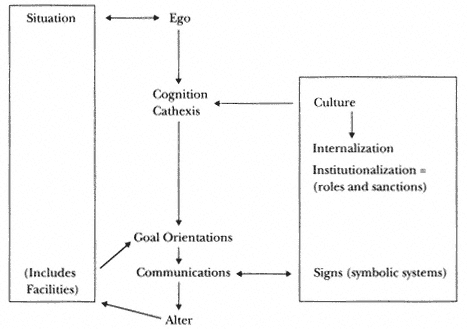
Figure 7–1.
Interaction in the Action Frame of Reference
shall, Pareto, Durkheim, and Weber.[33] He and collaborators developed action theory in a large series of works, the most useful of which probably is the multiauthored book. Toward a General Theory of Action .[34]
The action frame of reference is based, at the microlevel, on Parsons's notion of an interaction, societies being complexes of interactions (some earlier sociologists called them acts of "sociation"). The notion is depicted on Figure 7–1. In brief translation, (1) ego (an actor) is in a "situation"—an objective context; (2) ego cognitively decodes that context and invests it with feeling (cathexis)—thus the context comes to have meaning for the actor; (3) the manner of investing situations with meaning is acquired through socialization, which consists mainly of early learning—this imparts the modes of understanding and valuing prevalent in societies or subsocieties or both, and in aggregate, these may be called a society's "culture"; (4) socialization leads to the internalization of cognitive and affective meanings (viz., the cultural becomes personal) and their institutionalization (the definition of expected behavior in social roles and of sanctions in case of deviation from expected behavior) makes smooth and regular patterns of interaction possible; (5) cognitions and affective responses to them define goals and ways to pursue them; (6) cognitions, feelings, and goals are communicated to alter (another actor) through the use of "signs" (symbolic expressions of culture that make ego's actions intelligible to alter)—but actions also depend on objective facilities that are part of any actor's situation and that independently affect the choice of goals; (7) alter responds, changing the situation in some respect, so that the process resumes.
Note especially that the action frame of reference emphasizes neither subjective nor objective factors but rather how the two are linked in interactions. Culturalists focus on the matters in the box on the right, but they should also bring that on the left into interpretation and theories. This I have tried to do throughout this essay, emphasizing how culture conditions change in varying contexts of objective change.
Alternatives to the notion of culture I use come chiefly from cultural anthropology. I use the plural intentionally because the meanings of culture vary a great deal in that field. One can probably subsume these meanings under four categories: (1) Culture is coterminous with society: it is the whole complex of the ways of a "folk," of human thought and action among particular people. Park comes close to that view.[35] (2) Culture is social life in its subjective aspects: the knowledge, beliefs, morals, laws, customs, habits of a society. One finds this meaning (and these illustrative words) in the seminal work of Tyler and, later, Benedict and Kluckhohn.[36] (3) Culture is what differentiates societies from one another, for the purpose of idiographic description but also for theorizing through compar-
and contrasts (agreements and differences). I take the seminal work here to be Malinowski's.[37] (4) Culture is the distinctive, variable set of ways in which societies normatively regulate social behavior.[38]
The fourth set of meanings comes closest to that used here. My use of the concept of culture here seems to be justified by usage in political science and, more important, by its suitability to testing theories through the catholic deduction of unknowns once its postulates are explicitly stated. Anyway, my version of the concept is that about which theoretical conflicts have thus far occurred in political inquiry.