
Idealized Perspectives
Two basic aspects of bureaucratic behavior may be subject to constraint: the procedures used to make decisions and the substance of the decisions actually made. Procedurally, an administrator may be required to hold hearings, to consult certain groups before taking action, or to hire personnel in a prescribed fashion. Substantively, the administrator may be limited, for example, to making decisions
[24] As Dahl explains, "control need not be intentional; it may also be unintentional. Although Beta's action x must be brought about by Alpha's preferences, desires, or intentions, Alpha need not specifically desire or intend that Beta do x . What is crucial is that Alpha wants x to occur (or wants the results of x ), and that, as a result, Beta does x " (Dahl, Dilemmas , p. 17).
that serve to increase the amount of rice produced in the country or that provide low-cost housing for the elderly.[25]
The distinction is not absolute. "Procedure" and "substance" are in part determined contextually. The holding of public hearings may at one and the same time be the process by which decisions are made and the substantive result of an earlier decision about how to proceed. Procedure may also be a determinant of substance. The way a decision is made can significantly influence it. Nonetheless, the distinction is both heuristically useful and practically applicable. Every decision has both a procedural aspect and a substantive component. Either or both may be constrained through specific control mechanisms.
Constraints do not merely exist or not exist; they can be imposed in varying degrees. The more constrained behavior is, the smaller the range of permissible alternatives open to the bureaucrat—that is, the less his or her discretion. A central point of contention among theorists and practitioners concerned with reconciling bureaucracy and democracy has been just how much discretion a bureaucrat should have. It was a major issue in the early colloquy between Carl Friedrich and Herman Finer on the nature of administrative responsibility.[26] It remains
[25] Other analysts have used similar distinctions to characterize a variety of political phenomena. Hanna Fenichel Pitkin describes both formal and substantive approaches to representation. The former are concerned with institutions and rules; the latter focus on purpose, intention, and motive (Pitkin, The Concept of Representation [Berkeley and Los Angeles: University of California Press, 1972], p. 238). Joseph Tussman argues that there are "two great moods of deliberative life," the purposive and the casuistic, or legal (Tussman, Obligation and the Body Politic [New York: Oxford University Press, 1974], p. 86). While realizing that "the interplay of purpose and law … is constant," Tussman nonetheless is able to "imagine a scale or spectrum marked at one end 'rule dominated' and at the other end 'purpose dominated'" and then to locate tribunals on the scale.
[26] Friedrich, "Public Policy," p. 6; Herman Finer, "Administrative Responsibility in Democratic Government," Public Administration Review 1 (1941): 335–50.
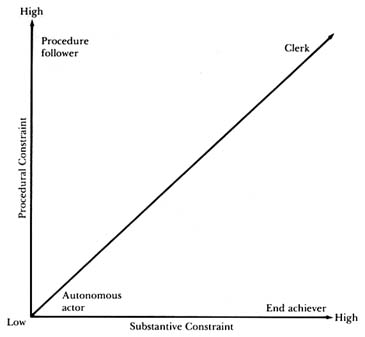
Figure 1. Idealized Perspectives of Bureaucratic Democracy
an essential difference among proposals for bureaucratic control today.
Control mechanisms are located on the map, then, on the basis of two variables: the degree to which the mechanism constrains bureaucratic behavior and whether it is the procedure by which bureaucrats make decisions or the substance of those decisions that is constrained. The borders of the map consist of two axes—procedural constraint and substantive constraint—with each varying from low to high. (See Fig. 1.)
Before going on, two things should be stressed. First, this is a map of mechanisms for democratic control of
bureaucracy, not a map of all the ways bureaucratic behavior may be constrained. Some mechanisms that in fact tightly constrain the behavior of bureaucrats do not appear on the map because the constraint does not derive from the citizens. For example, virtually all bureaucrats are constrained by the abilities of the people working for them and the limited capacity of complex organizations to harness those abilities. These constraints are a form of democratic control only insofar as they are a product of public pressures or decisions.
Second, discussions of more or less constraint should not be interpreted as discussions of more or less democracy. Whenever constraint is exerted by the citizens or their representatives, some degree of democratic control of bureaucracy exists. As I argue in chapter 2, however, whether that control is sufficient depends on one's definition of democracy. Fairly weak forms of control are congruent with some theories of democracy, but barely acceptable to others. Various positions on the map should therefore be interpreted as representing different, but not necessarily more or less, democratic visions of how a bureaucracy should be controlled.
Situated in the corners of the map are four idealized perspectives on how bureaucrats should behave in a democracy. Since they represent extreme cases, these perspectives are rarely, if ever, reflected in specific control mechanisms. Understanding them does, however, help to locate actually occurring proposals on the map and to clarify relationships among them.
In the lower left-hand corner, where both procedure and substance are very loosely constrained, is the bureaucrat as autonomous actor. Such a bureaucrat's actions may be competent, professional, and otherwise satisfactory to the citizenry, but they primarily result from his or her choice and not the choice of the citizens.
Diagonally opposite the autonomous actor is the democratically
controlled bureaucrat as clerk. Here, both procedure and substance are so tightly constrained as to leave the administrator no discretion at all. It is this vision that formed the basis of the old, extreme, and now largely discredited view that policy and administration are separable, and hence that all administrative action flows directly from democratically made legislative decisions. In caricature, the job of the bureaucrat is to determine what situation he or she is faced with and then to administer the "correct" treatment that has been previously determined by elected officials.
The upper left-hand corner of the map represents the situation where procedural constraint is high and substantive constraint is extremely low. This describes the bureaucrat as procedure follower. The orientation reflected here focuses on the importance of due process to the exclusion of other concerns. Bureaucratic decision making is considered consonant with democracy as long as closely specified procedures are followed; the substance of the decisions is left to the discretion of the bureaucrats.
In the lower right-hand corner is the democratic bureaucrat as end achiever. In this case, the substance of decisions is highly constrained, the procedures not at all. The bureaucrat's role is to secure publicly specified goals using whatever procedures he or she thinks best to reach those goals.[27]