


Antwerp
Early in 1884 Corinth's relationship with Löfftz seems to have deteriorated, and Corinth hurried to leave Munich. Initially he thought of going to Paris, but he dreaded the French hostility toward German visitors that followed the Franco-Prussian War. Rumor had it that a German artist wishing to get ahead in Paris would do well to deny his nationality.[31] This rumor is confirmed by the somewhat earlier experience of Max Liebermann, who lived in Paris and Barbizon from 1873 to 1878. Liebermann had a studio in Montmartre in the building where Viscount Ludovic-Napoléon Lepic—perhaps best known from Edgar Degas's 1873 painting of him and his two daughters—also had an atelier. Lepic wanted to introduce Liebermann to several French painters, including Edouard Manet, but was forced to abandon his plans when these painters resisted even the suggestion that they might share a café table with the German. Liebermann had arrived in Paris with two letters of introduction, one addressed to the Belgian painter Alfred Stevens, the other to Léon Bonnat. Bonnat received him coolly and on a second visit, only slightly more gracious, advised him bluntly: "Make the small sacrifice of having yourself naturalized, and you will be one of us." Ignoring the suggestion, Liebermann nonetheless managed to exhibit regularly at the Salon from 1874 onward, though a critic that year commented angrily that in return for the privilege the painter should have relinquished his German citizenship. To this critic it seemed "a crime to perform Richard Wagner in France and to admit Prussians to our exhibitions." As late as 1882, Liebermann, having joined the Cercle des XV, avoided its meetings so as not to provoke hostile sentiments.[32]
Against this background it is perhaps not surprising that Corinth decided instead to go to Antwerp. Some of his friends in Munich had suggested that once there, he should get in touch with a young Belgian painter named Paul Eugène Gorge. Little is known about Corinth's sojourn in Antwerp, and it seems that in later years he did not even want to be reminded of the experience. He writes in his autobiography that he came to dislike the city after about three months and found the people he met through Gorge incompatible—probably because "they belonged to a different nation," and "the genuine East Prussian simply does not mix with strangers."[33] Only for Gorge did he reserve a special word of praise, calling him a man of "charm and pure character."[34]
Paul Eugène Gorge (1856–1941), a graduate of the Antwerp Academy, was affiliated with the artists' group Als Ik Kan, founded in October 1883 by a number of Antwerp painters, including the young Henry van de Velde. Con-
ceived as an artists' cooperative to further opportunities in the art market, Als Ik Kan was not avant-garde but conservative and traditional in outlook, as the group's name, taken from Jan van Eyck's famous motto, implies.[35] Gorge, for instance, about whom little else is known, painted landscapes and interiors in soft grayish tones. His work shows the influence of Charles Mertens's early paintings, which reflect the meticulous naturalism of Henri de Braekeleer. The artists Corinth met through Gorge were most likely associated with Als Ik Kan. He may also have been aware of the more adventurous efforts of Les Vingt, who held their first exhibition in Brussels in 1884, but in any event he was not impressed by what he saw of contemporary Belgian painting.
By 1884, Corinth later said, "the time of Rubens and Brouwer and the history painters Gallait, Verlat, and Leys was over."[36] He was not entirely correct. Charles Verlat still taught at the Antwerp Academy in 1884 and was not appointed director of that institution until 1887. His advocacy of a native tradition in painting in fact set the tone for the organization Als Ik Kan until the early years of the twentieth century.[37] Though colored by negative feelings, Corinth's comment reflects his own early admiration for nineteenth-century history painting. It also suggests that he engaged in more than a fleeting dialogue with the leading masters of the Flemish baroque. Although he knew paintings by Rubens and Jordaens from the collection in the Alte Pinakothek, only on Flemish soil did these masters begin to inspire him. The four paintings he completed in Antwerp all show a marked increase in colorism and a freer handling of the paint.
In the portrait of Paul Eugène Gorge (Fig. 13) Corinth juxtaposed the grayish blue of the background with the sitter's ruddy complexion and blond hair. The paint has been applied in fluid strokes, accentuating the contrasts of light and shade engendered by a strong source of illumination just outside the picture to the sitter's left. Gorge's posture is casual and relaxed. His gentle gaze gives credence to the purity of character Corinth admired in him, which helped to forge a lasting friendship between the two men.
Still more vigorous, in both execution and expression, is Corinth's painting of a black man (see Plate 2), poetically inscribed "Un Othello" in the upper right. The shirt, painted with a broad, loaded brush in stripes of red and white, stands out boldly against the grayish black ground. The subtle turn of the torso and the figure's close proximity to the picture frame reinforce the impression of immediacy conveyed by the energetic brushstrokes. Despite the literary allusion of the title, the portrait is no more than a character study, possibly of a sailor from the Antwerp harbor; it compares favorably with Rubens's similarly sympathetic studies of foreign sailors. Although it has been widely as-
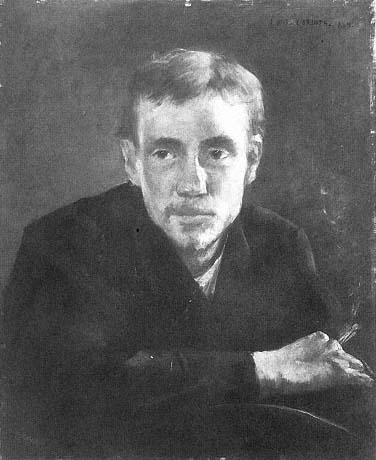
Figure 13
Lovis Corinth, Portrait of the Painter Paul Eugène Gorge , 1884.
Oil on wood, 56 × 46 cm, B.-C. 22. Von der Heydt-Museum
der Stadt Wuppertal, Wuppertal-Elberfeld.
Photo: Studio van Santvoort.
sumed that Corinth was directly inspired by Rubens's and Jordaens's paintings of blacks,[38] it is unlikely that he knew these works at this time since they were not on public view. The sensitive conception that the painting shares in particular with Rubens's oil sketches must simply be accepted as a case of parallelism. Wilhelm Trübner's pictures of black men, painted in 1872 and 1873, might have served as iconographic precedents. Although Corinth did not mention seeing these until many years later,[39] they could have been among the works he had pondered at the weekly exhibitions of the Munich Artists' Association in the early 1880s. But even then Corinth's portrait remains highly original, differing markedly in its forthright naturalism from Trübner's predominantly anecdotal approach.
Although Corinth spent his last month in Antwerp in the congenial company of his father, his dislike for the city continued to grow. To make matters worse, when he submitted to an exhibition in Brussels a painting for which he had entertained great hopes, it was rejected by the jury. In 1917 he still remembered his disappointment acutely. "Out of revenge," as he put it, he eventually overpainted the picture with a kitchen still life (B.-C. 68) because it continued to remind him of the rejection.[40] Fortunately, news reached him at about this time that The Conspiracy , which he had sent to London, had been awarded a bronze medal. When he later referred to the painting as his "fledgling work,"[41] he was no doubt thinking of this, his first public recognition. The unexpected success apparently gave Corinth the confidence he needed to conquer his fear of the hostile French, for he quickly determined to leave Antwerp and to continue his studies in Paris after all.