
The "Look of the World" and Redemption
In the face of this nihilism, what kind of hope can there be? In the first place, if one sees things as they are, that should certainly be more hopeful than false
consciousness, which would conceivably be even more helpless in the face of the world. Second, the motion that is brought into awareness by translation, the instability of the original text, brings with it a sense of potential—like the contradictory potential of Hölderlin's abysmal silences, or Fortini's assertion that the working class have no homeland. It is a process of learning to take possession of what is properly one's own, and this process is not one of stasis but one of movement. By becoming aware through translation of an original's distance from Benjamin's postulated "pure language," one comes to know one's own unstable position. De Man cites Benjamin's contradictory position within and against the tropes of language.
Benjamin, who is talking about the inability of trope to be adequate to meaning, constantly uses the very tropes which seem to postulate the adequation between meaning and trope; but he prevents them in a way, displaces them in such a way as to put the original in motion, to decanonize the original, giving it a movement which is a movement of disintegration, of fragmentation. This movement of the original is a wandering, an errance , a kind of permanent exile if you wish, but it is not really an exile, for there is no homeland, nothing from which one has been exiled. Least of all is there something like a reine Sprache , a pure language, which does not exist except as a permanent disjunction which inhabits all languages as such, including and especially the language one calls one's own. What is to be one's own language is the most displaced, the most alienated of all.[39]
Although this quality of homelessness in language is inescapable, that does not mean that meaning is impossible. On the contrary, the purpose of this nihilism is to understand history in order to be able to live in it as it is. Understanding consists of recognizing the instability of meaning and being aware of one's own relationship to it. De Man cites Gadamer as seeing "understanding . . . as a process between author and reader in which the reader acquires an understanding of the text by becoming aware of the historicity of the movement that occurs between the text and himself" [sic ].[40]
Being aware of one's position in an impersonal motion is not far removed from Brecht's Lehrstücke (learning plays) or the tentativeness of Hölderlin's images. The awareness that relations of this kind are tentative and not determined by any preexisting or transcendent authority can lead to the silence of the abyss or to a sense of unlimited potential. The absence of transcendent justification also gives to the smallest detail of everyday life the same importance as great events of history or theology. In Santner's analysis of Hölderlin's poetry, this is the comfort that is discovered beyond the "narrative of redemption." "The poet begins to find a place and a comfort within the errancy and drift that in 'Hälfte des Lebens' had appeared so horrifying. [. . .] [T]he poet begins to discover the pleasures of 'die Tageszeichen,' or 'signs of the day.' [. . .] They connote the things, the concrete particulars
that populate one's immediate life world; unassuming objects that may give the poet a sense of calm, security, equipoise. It is as if the poet had discovered, for the first time, the possibility of a life in nonsacred, mundane space and time."[41]
Santner goes on to connect this attention to "concrete particulars" to John Berger's description of the "look of the world" from an essay on photography. "The look of the world is the widest possible confirmation of the thereness of the world, and thus the look of the world continually proposes and confirms our relation to that thereness, which nourishes our sense of Being."[42]
With Santner's repeated invocation of criticism of film and photography in regard to Hölderlin's images, we return to the juxtaposition of those poetic images with the "look of the world" in Straub/Huillet's films. As we have seen, the connections between Hölderlin's poetic and narrative strides, as between the shots in the film, is a tenuous one. The term "tenuousness" or "temporariness" (Vorläufigkeit ), has been applied to Benjamin's translation, Hölderlin's verse, and Straub/Huillet's mise-en-scène. Benjamin writes, "This, to be sure, is to admit that all translation is only a somewhat provisional [Vorläufig ] way of coming to terms with the foreignness of languages."[43] In the case of Hölderlin, the fragmentary nature and parallel variants in his work, made visible by the Frankfurt edition, reveal a similar quality. "But rather than simply destroying the 'illusion' of the completed poem and demonstrating the provisional character—the Entwurfscharakter —of the later Hölderlin, which the editors set as their goal, the Frankfurt edition suggests something even more radical: a certain undecidability between the draft or working sketch, on the one hand, and the finished work of art, on the other. This sort of undecidability becomes chronic in the later work, indeed it seems to be at the core of Hölderlin's poetic practice at this time."[44]
Since the recitation of the poetry in film cannot preserve the tenuousness of the verse, it is placed in a tenuous relation to the "thereness" of the speakers themselves and the look of the world. The endeavor is to "empty the image" of all intention and meaning, so that the impersonal "life" that Benjamin envisions is a result of extremely controlled structuring juxtaposed with complete openness to "the signs of the day." Straub/Huillet consciously structure their films rigidly, so that accident or chance can be perceived as such.[45] As Krebs writes,
When Straub/Huillet have the actors recite in this way . . . and when the editing confronts shots of landscape, earth, faces and persons with each other, a dialectic of image and language is constructed that resembles the experimental structure [Versuchsaufbau ] of Brecht's Lehrstück . The text itself is an experimental structure, i.e., both in recitation and in the film image, it repeatedly enters new constellations. . . . It may appear that this is off-putting and "clumsy," the experience of the friction between actor and costume, gesture and language,
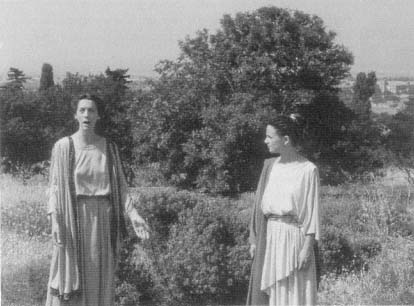
Ute Cremer as Delia and Martina Baratta as Panthea in
The Death of Empedocles . Courtesy Edition Manfred Salzgeber, Berlin.
space and figure, speaker and text. But in this friction, far from all sterility and stringency, dwells the anarchic power and joy [Lust ] of speaking and seeing.[46]
Krebs uses terms very similar to Benjamin's as he argues that his structuring of the text as an "experiment" shows "solidarity with literature," for which a reading "makes up a position of the work in its own history." The tension between the speakers, the text, and the image of them reciting is also one of anarchic potential: "In them [the images] the actors appear tenuously, experimentally arranged while yet giving a thoroughly 'classical,' stable and determinate impression."[47]
The method of opening up wide avenues by way of rigorous structure is perhaps one of the things that Peter Handke had in mind when he emphasized Straub/Huillet's nearness to the Greeks. Straub also has indicated such an affinity in his unwillingness to choose, for instance, between comedy and tragedy in the drama of Empedocles.
Straub: In life, one can never say at what point it's tragic, but one can also never say at what point it's funny; and a film isn't interesting unless
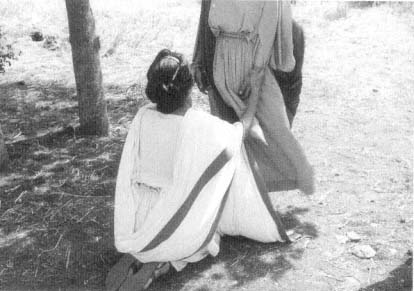
Delia (Ute Cremer) kneeling to Panthea (Martina Baratta) in The Death
of Empedocles . Courtesy Edition Manfred Salzgeber, Berlin.
one senses these two things at the same time , I mean at each second and not in alternating strokes à la Tchaikovsky . . .
Huillet: The Greeks, with their myths, knew that already.[48]
Straub's description of their films as having the shape of "a fan" is an appropriate one at this point. The reference to a fan (regarding Othon ) concerned the range in actors from polished native speakers (theatricality) to lay actors and non-native speakers, for whom Straub did use the term "authenticity."[49] If the rigorous structuring of the text, the placement of the actors, and the composition and editing of the shots make up Straub/Huillet's "classicism," here is their "romanticism": in the conviction that through the "documentary" aspect of their cinema, directed at young lay actors laboring with a well-memorized linguistic text or recording the play of wind, light, and shadow on a landscape, some sort of authenticity can be perceived.
On the one hand, the authenticity that the camera gives us access to is merely the "thereness" of the world, the "signs of the day" that, for all the concern for the destruction of Nature, still conveys the striking impression that, as Jean Narboni quotes Straub, "the world is still habitable."[50] At another screening Straub had said that the only "Aussage" (message) of The Death of Empedocles is that the world is a cradle, an invocation of the Communist utopia,
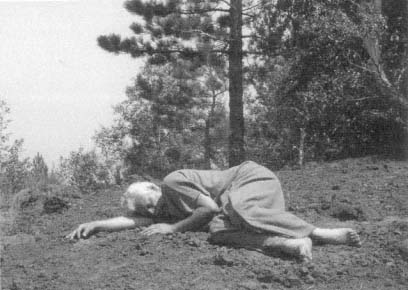
Empedocles (Andreas von Rauch) on Etna, in Black Sin .
Courtesy Edition Manfred Salzgeber, Berlin.
"Das Einfache, das schwer zu machen ist" (The simple thing that is hard to do).[51]
The word expressionism has already been mentioned in regard to the extreme visual contrasts in the Empedocles films, but it could apply to other aesthetic aspects as well. Indeed, Expressionism is one modern connection between Romanticism and formal rigor (see Schoenberg). But the emphasis placed on the equal value of all elements in the film, as structures with their own logic and their own history, also has an expressionistic effect. Nature, photographed with a neutral, contemplative camera without narrative motivation, is not human. The words of the texts, in their careful, rhythmic delivery, are also not human; or at least, as Benjamin's "translation" reveals, they are part of the afterlife of something that is already dead. Against this background, the live performance of the actors, the presence of any living human bodies is almost a striking contradiction, an impossibility.
Hence the powerful effect of the spectacle of the actors breathing in order to deliver this dead text: "What one hears, as never before, is breath, and the body with its gestures is like the seismograph, the point of application: it redistributes the essential focus [focalisation essentielle ], accompanies it, prolongs it: the body, this musical instrument."[52]
Straub's description of how meaning arises not from the text itself or from the interpretation by the actor but in the actor's physical production of the words
that make meaning is yet another version of Benjamin's assertion that a translation can only approach an original's "Art des Meinens" —its manner of indicating—and not what it indicates. After so much rehearsal, Straub says, the actors "understand what they are speaking so well that they no longer need to understand the sense of each word: the sense (meaning) becomes bodies that think and breathe [des corps qui pensent, qui respirent ]."[53] Distancing himself somewhat from Brechtian acting as "quotation" (cited in the opening titles of Not Reconciled ), Straub sees this manner of speaking a thoroughly memorized text as creating moments "where actors simply explode. But not by blowing up like fireworks—which has nothing to do with the text. But rather the text itself becomes an explosion—just what no one attempts anymore."[54]
Against the severe structural restraint of the text and against the narrative impetus of the revolutionary leader into "death in the heavenly fires" (without a tomb), it is youth that stands as the hope of the future. (De Man: in spite of everything, hope.) Panthea and Pausanias, young amateur actors who are sister and brother, expressing their perhaps fragmentary, perhaps intuitive understanding of the hero's worth, are the future. Delia kneels to Panthea in one of the most striking gestures of the physically restrained film. And it is Panthea who introduces the film, "This is his garden," and describes the harmony between Empedocles and Nature in the most beautiful poetry. And Pausanias, in his loyalty to Empedocles as the young friend, concludes through the course of the narrative what Straub has called a "school of freedom."[55] When the citizens say they will not know what to do without Empedocles' counsel (ratlos verläbt du uns? ), he instructs them, "Ask this youth!" Similarly, the young woman who would play Antigone was spotted by Straub and Huillet (independently of each other) by chance at an acting school in Berlin; her sister plays the role of Ismene. Despite their supposed "asceticism" and "classicism," Straub/Huillet have the romanticism to look to the young and unspoiled for authenticity. And despite all the "redemptive" concern with history and Nature, one strain of expressionism remains; What is old must pass away and be replaced by something completely other.
Extreme expressionistic abstraction is placed alongside documentary simplicity and a romantic vision of "authenticity." It is my contention that this juxtaposition of opposites in Straub/Huillet is an example of the "Stillegung" (arresting) of thought, as proposed by Benjamin and Adorno. It is not the "unification of opposites" of idealism or even a "Marxist redemption myth" that abolishes all division and alienation[56] but the confrontation or even forcing of division. Divisions in the audience, in the layers of textual signification, in the cinematic ways of producing meaning are also not to be confused with a postmodern position: instead, it is utopian.
As in Adorno's view of Hölderlin's parataxis, the utopian force lies not in Hölderlin's ideas but "in the primacy of abstraction, in the purity of form itself."[57] Rather than blemishes, the disruptions caused in "narrative vigi-
lance" by these pure forms are gestures toward this utopia. As Santner has concluded, "The harte Fügung so typical of Hölderlin's later poetry becomes the emblem of the poet seer; the rifts of silence become the openings where the Unnamable can only be circumscribed."[58] The mortification of language points toward utopia with the force of both religion and revolution but without the "redemptive myth" of either. Like Benjamin, Straub/Huillet look to Hölderlin with a "combination of nihilistic rigor with sacred revlation."[59]
Nihilism, expressionism, revolution—how are they combined in the conclusion of The Death of Empedocles where the "poet-seer" speaks for the last time in a utopian hymn to nature? Like a coda, the end of the film repeats its themes, and the question is whether they are resolved in one direction or another. The repetition of the visual of Etna links the shot to the earlier exchange in which Empedocles personally renounced his opportunity to return to the city. The narrower angle of the lens removes some of the verdant foreground of the view of the volcano, continuing the geographic ascent through the course of the film: mountain, clouds, and sky are the main compositional elements. Since the entire speech is delivered in voice-over, there is a sense in which Empedocles is already dead as it is spoken; perhaps the higher view of the volcano suggests his impending plunge. However, since so much of the film has been directed to nature and to the future of civilization without the poet-seer, there is a sense in which the absence of Empedocles is not threatening but is a liberation. Given the expressionistic tension present through most of the film by way of the live image of actors performing the text, the final hymn accompanied only by the view of the mountain, with its long duration and the fact that it is already somewhat familiar, is an image of peace. The disruption of the human presence between these words and this landscape is removed, and we witness only the juxtaposition of these two "inhuman" abstractions. This juxtaposition continues after the image of Etna has disappeared as well, since the sound track continues with two different cuts: first, the opening of the Bach violin concerto that had been quoted at the beginning of the film (the first instance was the ending, so the result is a sort of reverse framing; second, following closely on this highly structured sound, a recording of sounds from nature, birds twittering on the mountainside and the thunder of an approaching storm. If the thunder promises rain (one is tempted to think of T. S. Eliot's The Wasteland ), both this and the Bach are beginnings, promises of a future, one with a structure and one without.
Straub has said that he had three precedents in mind in thinking about the ending: Eisenstein's Alexander Nevsky (1938), Hitchcock's Foreign Correspondent (1940), and Chaplin's The Great Dictator (1940).[60] All three films end with a male voice addressing some version of posterity. In the Eisenstein film, the message is to all potential enemies of Russia, present and future. The vow to defeat all attackers is spoken by Nevsky, then repeated in text super-
imposed over a shot of armored soldiers bearing spears. Both Chaplin and Hitchcock use the radio, one of Hitler's own effective propaganda weapons, to appeal to "the people" to resist fascism in Europe. Foreign Correspondent , filmed before the United States entered the war, uses abstract terms to appeal to people in "America" to keep the lights burning while Europe has been plunged into the darkness of war. Rather than this anti-isolationist message, Chaplin's message is to the little people, urging them to maintain their hope in the face of Nazi aggression. Chaplin, like Eisenstein, visualizes "the people" as this message is being conveyed, but in the form of an idyllic Alpine family scene rather than soldiers on their guard.
Striking in each case is the withdrawal of the speaking voice into help-lessness and the appeal "an die Nachgeborenen"—to those born after—as Brecht repeatedly varied it. The stress on the apparatus of communication in each case—superimposed type in the Russian and the radio of the American examples—extinguishes the character of the speaker and breaks the message out of the narrative that went before. Indeed, the humanistic earnestness of Chaplin's appeal is almost unbearable in contrast to the irreverent comedy that has gone before.
Empedocles' voice is similarly disembodied, and, to a subtle extent, the cinematic apparatus is emphasized by the switch from recitation to reading of the voice-over text.[61] Consistent with all the other utopian moments in Straub/Huillet films is the absence of "the people" to whom this speech might be addressed; if the text is revolutionary, the revolution cannot be depicted, and the point of Empedocles' drama is that his kind of "revolutionary leader" is no longer needed, must no longer be needed. What remains are the two poles between which the drama has unfolded: the ability of the camera to record, in this case the somber beauty of the peak of Mount Etna, and the reality of the world, which like the text read by a voice from the dead past, outlives human history.
The sense of this final shot is certainly the extinguishing of the subject and the loss of identity in the unbounded. For the first time in the film it reconciles language and nature,[62] but at the expense of the human. As Benjamin wrote, "meaning plunges from abyss to abyss until it threatens to become lost in the bottomless depths of language."[63] "Aber es gibt ein Halten," Benjamin asserts in spite of everything: "There is, however, a stop."[64] For Benjamin, it is to be found in no text but in Holy Writ, "in which meaning has ceased to be the watershed for the flow of language and the flow of revelation."[65] The space between the filmed image of nature and the disembodied text is Straub/Huillet's way of indicating this "Halten" as well. It is a "space between" much as Benjamin's "interlinear" commentaries on the Scriptures; it is stressed at the film's conclusion by its repetition in two forms: between the text about nature and the "look" of nature and between the sound of Bach and the sound of thunder.
Hüser has objected that the thunder at the conclusion does not succeed. He considers it too great a resolution and validation of Empedocles, because his speech is about death. I do not agree, since the effect of the film has been to erase any regret about Empedocles' death, or about time in general. The fact that the sound track "outlives" the visual track, as it often does in Straub/Huillet films, is a further step away from the temporality of the body. The "inhuman" is what lives on, in the text or in the inhuman history of nature, and only if it does will human life still be possible on the earth.