
21—
Su Shih (1037–1101)
Su Shih, widely known by his artistic name, Tung-p'o (Eastern Slope), became one of the dominant figures in Chinese literati culture, influencing not only prose and poetry but aesthetic theory, painting, and calligraphy as well. He was born into a gentry family of limited means and educated primarily by his father, Su Hsün (1009–1066), later famous as a political essayist, and also by his mother, née Ch'eng. He and his younger brother, Su Ch'e, were regarded as newly discovered talents after passing the Presented Scholar examination in 1057 under Ou-yang Hsiu. In 1061, Su Shih passed the special examination held to recruit new officials and began his career as a case reviewer at the Court of Judicial Review. During these early years, he wrote numerous memorials identifying critical national problems in areas of finance and military defense. Although interested in reform, he opposed Wang Anshih's New Policies, objecting to the dislocation caused by their rapid implementation and Wang's use of legalist methods. In 1079, Su was arrested in a "literary inquisition" for allegedly defaming the court in one of his poems. After several months of investigation, he was released, demoted to the nominal post of assistant military training commissioner, and exiled to Huang Prefecture in what is today Hu-pei. There, he wrote some of his best-known travel pieces while continuing to address current issues. Given a slight promotion to Ju Prefecture in 1084, he passed through Nanking on his way and met Wang An-shih, with whom he continued to maintain cordial literary relations despite political differences.
Su Shih returned to the capital after the reversal of Wang's policies under the Empress Dowager Hsüan-jen, regent for the young Emperor
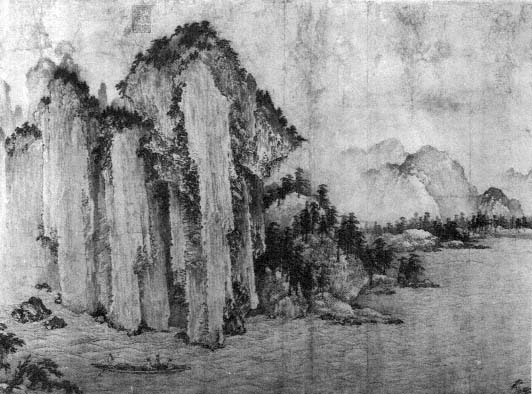
Fig. 28.
Wu Yüan-chih (active late 12th cent.), Red Cliff (detail). National Palace Museum, Taipei.
Che-tsung (r. 1085–1100), and served as a Han-lin Academician when the conservative party of Szu-ma Kuang gained power. He angered them, however, when he protested the indiscriminate dismantling of Wang's New Policies, with none of their beneficial aspects preserved, and was sent to administer Hang-chou in 1089. A series of other local posts followed in which he was able to institute progressive changes despite the reigning conservative atmosphere. In 1094 when the Chetsung Emperor assumed personal rule, another faction supplanted those favored under the Empress Dowager, and Su Shih was again exiled, this time to remote Hai-nan Island in the south, where living conditions were particularly severe. Here, too, he wrote travel pieces, which continued to express his acceptance of the vicissitudes of life and
a vitalistic engagement with his surroundings. Pardoned in 1100 upon the accession of the Emperor Hui-tsung (r. 1100–1125), he died the following year while on his way north.
Though an activist Confucian official, Su Shih was eclectic in his intellectual interests. He was deeply influenced by Ch'an Buddhist concepts of enlightenment, the mind, and human nature, and searched for transcendence through engagement with social reality and the natural environment. He was also enthralled by the mysterious pageant of universal transformation. Such themes as the equivalence of objective and subjective viewpoints, the Tao as a ceaseless alternation between change and constancy, the affirmation of happiness in this life, equanimity toward fate, and unflagging curiosity about the natural world pervade his prolific writings. Su's shih poems alone number almost 2,800, of which those containing perceptions of Nature and his philosophical views have been the most widely read. His tz'u poems, numbering about 350, expanded the range of content in this genre and are considered innovative examples of an attitude of "heroic abandon" (hao-fang ). One of the Eight Masters of T'ang and Sung Prose, Su was further canonized by the literary tradition as the personification of the Northern Sung zeitgeist, an expansive, optimistic personality who later was celebrated in drama, painting, and the decorative arts.
As a travel writer Su employed a variety of forms such as letters, fu rhapsodies, travel records, random notes, and prefaces. His two pieces on Red Cliff were written during his exile in Huang Prefecture. The first is perhaps the best-known work of Chinese travel writing. In it, Su Shih achieved an optimistic solution to a lyric vision imperiled by an awareness of tragic history. His mood shifted in the second piece to a sober recognition of Nature's awesome power and the limits of human ambition. Yet even here he concluded with an affirmation of the possibility of transcendence. Together, these pieces became monuments of Chinese literature and art, establishing the place as a literary shrine.
Red Cliff I  (1082)
In the fall of the year jen-hsü in the seventh month on the day after the moon had reached its height [August 12, 1082], I traveled in a boat with some guests to the foot of Red Cliff.[1] A light wind wafted by, and not a ripple was stirred. I poured wine for my guests as we chanted the poem about the bright moon and sang the song about the graceful
maiden.[2] Before long, the moon appeared over East Mountain and lingered by the constellations Dipper and Ox.[3] White dew extended over the Long River; the water's gleam mingled with the sky. We let this reed of a boat follow its course as it traversed an expanse of myriad ch'ing . I felt boundless, as if gliding through the void not knowing where I might land; I felt like I was soaring about, having left the world behind to stand alone as I sprouted wings to become a Transcendent.
Then we drank more wine and reached the height of joy. I beat out a rhythm against the side of the boat and sang:
Cassia-wood oars,
Magnolia-wood rudder,
Stroke the moon's pure reflection
As we glide upstream on its shimmering light.
Ever distant, the object of my longings.
I gaze at the beautiful one
In a faraway corner of Heaven.[4]
One of the guests could play the flute and accompanied my song.[5] Yet his sounds—"wu-wu "—were plaintive, yearning, weeping, accusing. The lingering notes meandered through the air, drawn out like silken threads. They would have aroused a submerged chiao -dragon to whirl around in the cavernous depths, and caused a widow to weep in her lonely boat.
I was saddened. Straightening my clothes, I sat up and asked my guest, "Why are you playing this way?" He replied,
"'The moon is bright, stars are few
Crows and magpies are flying south.'[6]
"Isn't this from the poem by Ts'ao Ts'ao? Westward is Hsia-k'ou; to the east lies Wu-ch'ang.[7] The mountains and the river encircle one another; how dense the viridian growth! Yet, is this not the place where Ts'ao was trapped by Chou yü?[8] He had just conquered Ching-chou and sailed down to Chiang-ling[9] as he followed the course of the river eastward. His fleet stretched bow to stern for a thousand li ; his banners and flags blotted out the sky. As he drank wine by the bank of the river, he lay down his lance and composed this poem. Indeed, he dominated his age, yet where is he now? And what about you and me,
conversing here by the riverbank like a fisherman and a woodcutter, joined by fish and shrimp with the deer as our companions? We ride on a boat no bigger than a leaf as we drink to each other out of simple gourds. We exist no longer than mayflies between Heaven and Earth, and are of no more consequence than a kernel in the vast ocean. I grieve that my life is but a moment and envy the Long River's endless flow. If only I could grasp hold of a flying Transcendent and wander with him through the Heavens to embrace the bright moon and live forever. But I realize this cannot be, so I confide these lingering sounds to the sad autumn wind."
I said, "Do you really understand the water and the moon? Here, it flows by yet never leaves us; over there, it waxes and wanes without growing or shrinking. If you look at things as changing, then Heaven and Earth do not last for even the blink of an eye. If you look at them as unchanging, then I along with everything am eternal. So why be envious? Moreover, each thing within Heaven and Earth has its master. If I did not possess it, then I would not take even a hair of it. However, the pure wind over the river becomes sound when our ears capture it, and the bright moon between the mountains takes on form when our eyes encounter it. There is no prohibition against our acquiring them, and we can use them without ever consuming them. They are from the inexhaustible treasury of the Creator-of-Things, which you and I can enjoy together."
My guest became happy and laughed. We washed out the cups and drank again. Soon the food was gone, and the cups and plates were strewn about. We lay down in the boat, leaning against each other for pillows, unaware that it was becoming light in the east.
Red Cliff II  (1082)
In the tenth month of the same year on the day the moon reached its height [November 7], I walked from the Snow Lodge back toward Lin-kao.[1] Two guests accompanied me as we crossed over Yellow Clay Slope. Frost and dew had already fallen; the leaves had all dropped off from the trees. Our shadows lay on the ground as we gazed up at the bright moon. We looked around us, delighted by the scene, and sang songs for each other as we walked along.
After a while I sighed, "I have guests but no wine, and even if I had wine, there is no food to go along with it. The moon is white, the wind, gentle. But how can we enjoy such a fine evening?" One of the
guests replied, "Today at twilight, I cast a net and caught a fish with a large mouth and fine scales. It resembles a Pine River perch.[2] But where can we obtain some wine?" I went back and discussed this with my wife, who said, "There are two gallons of wine which I have been keeping for some time in case you should ever need it."
So we took along the wine and the fish and traveled once again to the foot of Red Cliff. The river flowed vociferously, the cleaved banks rose a thousand ch'ih . The mountain was high, the moon small. The water level had fallen, rocks protruded. How long had it been since my last visit? The scene was no longer recognizable! I lifted up my robe and alighted. I made my way among sharp crags, parting the overgrowth to crouch on rocks shaped like tigers and leopards and to climb up trees twisted like horned dragons. I pulled myself up to the precarious nests of falcons and peered down at the hidden palace of the river god P'ing I.[3] My two guests were unable to follow me this far. I suddenly let out a sharp cry. The plants and trees were startled and shook; mountains resounded, valleys echoed. Winds arose, and the water became agitated. For my part, I became hushed and melancholy, then awed and fearful. Then I began to tremble so that I could no longer remain there. I returned, got back on board, and had the boat steered into the mainstream. We let it drift until it came to rest there.
By then it was toward midnight. All around us it was deathly silent. Suddenly, a solitary crane came toward us across the river from the east. Its wings traced cartwheels in the air. It seemed dressed in a white jacket over a black gown, and let out a long, piercing cry—"chia "—as it swept past our boat and headed west.
A short while later the guests left, and I fell asleep. I dreamed of two Taoists clothed in feathers, fluttering about.[4] As they passed by Lin-kao, they greeted me and asked, "Did you enjoy your journey to Red Cliff?" When I asked their names, they looked down without answering. "Oh! Now I understand! Last night, was it not you who called out as you flew by?" The Taoists looked back at me and laughed. And then I suddenly awakened. I opened the door and looked outside but saw no trace of them.[5]
Stone Bells Mountain  (1084)
In 1084, Su Shih was given a slight promotion and transferred from Huang Prefecture to Ju Prefecture. He traveled to his new post by boat along the Long River together with his son, Su Mai (1059-?), stopping
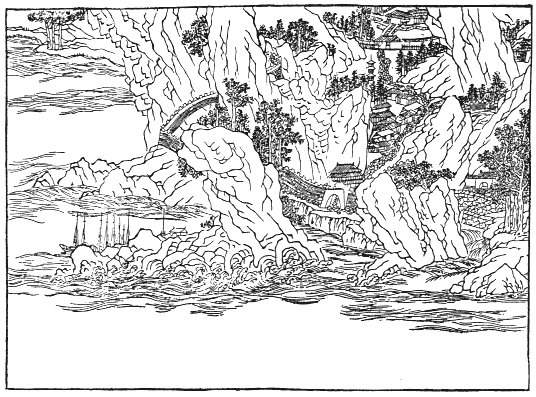
Fig. 29.
Stone Bells Mountain . From T'ien-hsia ming-shan sheng-kai chi
(Hong Kong, n.d.; rpt. of Ch'ung-chen era [1628–1644) ed.).
at Hu-k'ou in present-day Chiang-hsi. His expository piece on Stone Bells Mountain reflects a more Confucian side of his travel writing, an empirical quest to investigate things and rectify names. Many travelers both before and after Su Shih sought to explain the phenomenon of the "stone bells," and Su confidently propounded his own explanation based on personal inquiry rather than on textual tradition. His effort only stimulated more debate, and the place became another site of literary pilgrimage as later travelers felt challenged to confirm or revise Su's conclusions. Among those visiting the place during the Ming and Ch'ing periods were Ch'iu Chün (1420–1495) and Lo Hung-hsien (1504–1564), who argued that the name was based on the mountain's
shape, and P'eng Yü-lin (1816–1890), who discovered an underwater grotto and asserted that the mountain was hollow like a bell.
The Guide to Waterways states, "At the mouth of Lake P'eng-li stands Stone Bells Mountain."[1] Li Tao-yüan believed that "where the foot of the mountain meets the deep lake, a slight breeze stirs up the waves so that the water strikes the rocks, producing sounds like that of great bells." People have often doubted this explanation. Recently, some bells and chimes were placed in the middle of the water, and although a strong wind stirred up the waves, they did not emit any sounds. So how could this be true of the rocks? Li Po of the T'ang was the first to travel to the site,[2] and he found a pair of rocks protruding from the lake. "I struck them and listened," he wrote. "The one to the south sounded deep and turbid, the one to the north had a high, clear pitch. After they were struck, the sounds continued to reverberate as the vibrations slowly faded." He thought that he had thus solved the matter. But I still had my doubts about this theory. There are many places where rocks can emit a clanging sound like metal. Why was this one named "Bells"?
On the day ting-ch'ou in the sixth month of the seventh year of the Yüan-feng era [July 14, 1084], I took a boat from Ch'i-an to Lin-ju,[3] and because my son Mai was on his way to Te-hsing in Jao Prefecture[4] to serve as magistrate, I saw him off as far as Hu-k'ou.[5] So I was able to view the so-called Stone Bells. A Buddhist monk had a boy bring along an ax and strike one or two of the scattered rocks. They gave off a dull thud—"hung-hung "—and I laughed in disbelief. In the evening when the moon shone brightly, I went with Mai alone in a small boat to the foot of the cliff. The huge rock rose slanting up a thousand ch'ih , resembling a ferocious beast or a strange demon, terrifying as if it was about to seize one. The perching falcons on the mountaintop were startled by the sound of humans, and their piercing cries—"che-che "—rang out through the sky. And then there were sounds like an old man yelling and laughing in a canyon. Someone said, "That must be a crane." I had just begun to feel uneasy and wanted to return when loud sounds were emitted on the surface of the water, booming "tseng-hung " like continuous bells or drums. The boatman was frightened. We slowly approached to investigate and found that at the foot of the mountain were grottoes and fissures in the rock. I could not tell how deep they were, but it was the small waves which entered, surged around, and crashed against each other that were causing this sound.
As the boat returned, it passed between two mountains and was about to enter the harbor. There was a huge rock standing in the middle of the current, which could accommodate a hundred people seated. It was hollow inside, and it also had many holes in it. It swallowed and spit out the wind and water, giving off ringing sounds—"k'uan-k'an t'ang-t'a "—as the water struck it. It seemed to reply to the booming sound we had previously heard, just like a musical performance. I laughed and said to Mai, "Do you recognize this? The booming sound is the bell Wu-i of King Ching of the Chou dynasty,[6] and the ringing sounds are the Singing Bells of Wei Hsien-tzu.[7] The ancients have not deceived me!"
Should one arbitrarily decide about the existence of something without personally investigating it? Li Tao-yüan probably witnessed what I did, but his description was vague. Since gentlemen would never moor a small boat at the foot of a sheer cliff at night, none of them could know about it. Fishermen and boatmen may have known, but they could not express it. This is why the facts have not been transmitted by my contemporaries. Moreover, an unintelligent person investigated it by striking it with an ax, and thought that he had found the truth. I have written this down because I regret Li Tao-yüan's simplicity and laugh at Li Po's shallowness.[8]
From Tung-p'o's Forest of Jottings 
The following three pieces were included in Tung-p'o's Forest of Jottings (Tung-p'o chih-lin ), a miscellany posthumously published that was quite influential on later Ming and Ch'ing writers of prose miniatures. Most of these pieces are no more than one or two hundred characters in length, but they deftly reveal Su's personality and moods through his vignettes of people and places. Sandy Lake and An Evening Stroll to the Temple That Receives the Heavenly were written during Su Shih's exile in Huang Prefecture.
Sandy Lake  (1082)
Sandy Lake is located ten miles southeast of Huang Prefecture[1] and is also known as Whelk Station. I bought some land there but fell ill when I went to oversee the property. I heard that P'ang An-ch'ang[2] of Hemp Bridge, though deaf, was an expert in medicine, so I went to seek a cure from him. An-ch'ang may be deaf, but his intelligence and
insight surpass others; I used a sheet of paper to write down the words. No sooner had I written a few characters than he instantly understood what I meant. I teased him by saying, "I use my hand as a mouth. You, sir, use your eyes as ears. Both of us are extraordinary people in our time!"
The illness was cured, and I traveled with him to the Temple of the Pure Spring. The temple is located less than a mile beyond the outer gate of the town of Ch'i River.[3] There is the Spring Where Wang Hsichih Washed His Brushes.[4] The water is extremely sweet. Then we went down to Orchid Stream. The stream flows westward. I wrote a song:
The orchid sprouts at the foot of the mountain
are short and drenched by the stream;
A sandy road through the pines
is immaculate, without any mud.
In the whispering evening rain,
cuckoos cry.
Who says
"youth never returns"?
Just look
how the water still flows west.
And don't think about
the white hair increasing with every cockcrow.[5]
That day we drank heavily and returned home.[6]
An Evening Stroll to the Temple That Receives the Heavenly  (1083)
On the evening of the twelfth day of the tenth month of the sixth year of the Yüan-feng era [November 24, 1083], I had already taken off my clothes and was about to fall asleep when the moonlight came through the doorway. I happily arose and walked outside. I realized that there was no one else there to enjoy this with, so I went to the Temple That Receives the Heavenly to find Chang Huai-min.[1]
Huai-min had also not yet retired, so we went together into the central courtyard. The ground resembled a body of water illuminated by moonlight. The intertwining "aquatic grasses" were just the shadows of the bamboo and junipers.
Is there ever an evening without a moon? And what place lacks bamboo and junipers? But rarely are there carefree men such as we two![2]
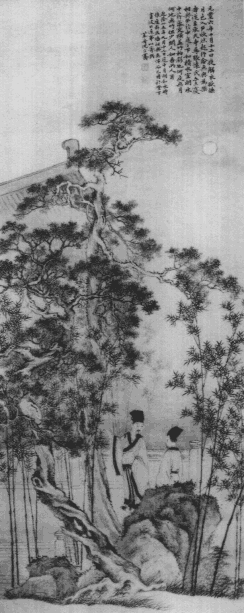
Fig. 30.
Shen Tsung-ch'ien (1736–1820), Su Tung-p'o's
Evening Stroll to the Temple That Receives the
Heavenly (October 30, 1770). Nanking Museum,
Nanking. Su's account is inscribed as a colophon.
An Account for Kuo of Our Visit to Mount White Water  (1094)
This miniature was written during Su Shih's last period of exile. He was ordered to the distant island of Hai-nan at the southern end of the empire, where he suffered from financial hardship and appalling living conditions. It was jotted down as a memento for his third son, Su Kuo (1072–1123), who accompanied him on this journey. The combination of objective recording of sights, subjective response, poetic description, and the quotidian details of their meal conveys the spontaneity of an ink sketch and the casual attitude so appealing to later writers.
On the twelfth day of the tenth month of the first year of the Shao-sheng era [November 22, 1094], I traveled to the Temple of Buddha's Imprints at Mount White Water[1] 1 with my younger son, Kuo. We bathed at Hot Springs.[2] The water was quite hot and at its source was perhaps capable of cooking things. We followed along the mountain eastward, then slightly north, to where there was a waterfall about seventy feet high. It made eight or nine breaks, and at each break there was a pond. They were so deep that a weighted rope fifty feet long failed to touch bottom. With snow white splashes and a thunderous roar, the waterfall was both delightful and frightening. Beside the water were tens of giant imprints—these are what are known as "Buddha's Imprints."
We returned in the evening by the same route we had taken, observing the lights on the mountain. Often, we had to crouch as we crossed through several valleys. The moon appeared when we reached the river. We struck at the ripples in the middle of the current, scooping up the watery pearls and the jade-disc moon. We arrived home during the second watch [9:00–11:00 P. M.]. I then drank some wine with Kuo, dining on some olives and cooked vegetables. I noticed the shadows fading but was not very sleepy, so I wrote this out for Kuo.
OLD MAN TUNG-P'O[3]