
Social Science and Policy-Making
We have noted how sociological research defined the scope of Leningrad's labor deficit. The computer and mathematical-modeling revolution in Soviet social science also made possible the simultaneous analysis of the many factors and variables that were now included in the modeling techniques used in socioeconomic planning.[91] By the 1970s, methodological issues such as modeling had become a paramount concern of social scientists. In October 1977 the USSR Academy of Sciences' Institute of Sociological Research organized a national conference at which 240 sociologists, economists, demographers, and statisticians from 64 research centers met to discuss methodology.[92] This growing dominance of methodological concerns testifies to the continuing institutionalization of social and economic planning by the end of the 1970s. Beginning with the Tenth Five-Year Plan (1976–1980), the general national plan had also become designated as a plan of social and economic development.
As socioeconomic planning moved beyond the individual enterprise, it was quickly associated with new Soviet academic definitions of the city as an integrated system. The emergence of this new conceptualization reflected the growing interest of Soviet social scientists in systems theory and approaches. The systems approach to urban analysis gained wide legitimacy following extensive discussions at a national sociological conference on quantitative research methods convened in the Georgian resort town of Sukhumi in April 1967.[93] As noted in Chapter 3, many, though not all, Soviet demographers, geographers, and sociologists have come to view the city as a social organism uniting various linked subsystems, and therefore in need of integrated planning techniques.[94] The city thus becomes a social system that requires an interdisciplinary approach to its conceptualization, planning, and management.[95] Economic and social aspects of city life cannot he distinguished and separated. Economic productivity rests in large part on the optimizing of social development.[96] Finally, it is at this point that socioeconomic planning techniques come to shape the face of the city.
The goal of harmonic and balanced urban social and economic development could be achieved through the integrated, proportional development of all subsystems within the organic urban whole. Ukrainian urbanist Anatolii Stepanenko, in a typically Soviet attempt to categorize and prioritize complex social reality, has defined no fewer than 31 subsystems constituting the single urban system (see Chart 6). Stepanenko's subsystems represent the core variables that are thought to interact with one another in shaping the totality of the city. Each subsystem is subject to measurement and analysis as social scientists develop numeric indices to capture each of these 31 urban characteristics (e.g., sex and age data for "demographic structure," number of patents and inventions for "science and scientific services," school enrollments for "education"). Ultimately, the component subsystems are analyzed in relation to one another over time. Such systems approaches, when carried by Soviet urbanists such as Stepanenko to their logical extreme, reduce the urban agglomeration to a discrete social unit, one well suited for an effective socioeconomic plan.[97] By the 1980s, Soviet theorists had moved far beyond the enterprise and the district in their approach to socioeconomic planning.
Numerous Soviet geographers and other social scientists elsewhere joined with their Leningrad colleagues in putting forth new concepts to explain the process of urbanization. While systems approaches certainly were not the only acceptable way to define and understand the socialist city, the theory proved markedly compatible with socioeconomic planning. Leningrad social scientists used systems theory to provide an intellectual justification for new urban planning methods and approaches.[98] In so doing, they developed a new ideology of socialist urbanization, which has since been institutionalized in the Academy of Sciences' Institute of Socioeconomic Problems. The institute's director, Ivglaf Sigov, once defined the city as a territorial area of labor and population, usually in the form of economic and cultural centers, serving major territorial formations such as a region or republic.[99]
The emergence and continued support of sophisticated socioeconomic planning techniques in Leningrad's policy climate of the 1960s and 1970s were largely the result of the combined effect of (1) academic breakthroughs in urban studies and mathematical methods, (2) sociological research, with the political support given the new planning approaches, and (3) the permanent labor shortage. Facing a workforce profile that did not meet the labor needs of the local development strategy, Leningrad political, economic, and academic leaders responded by developing socioeconomic planning and vocational education programs, and implementing them citywide. This response quietly reduced the labor crisis of the 1950s and 1960s. Although that crisis no longer exists, the availability of a skilled workforce remains a pressing long-term economic and policy concern.
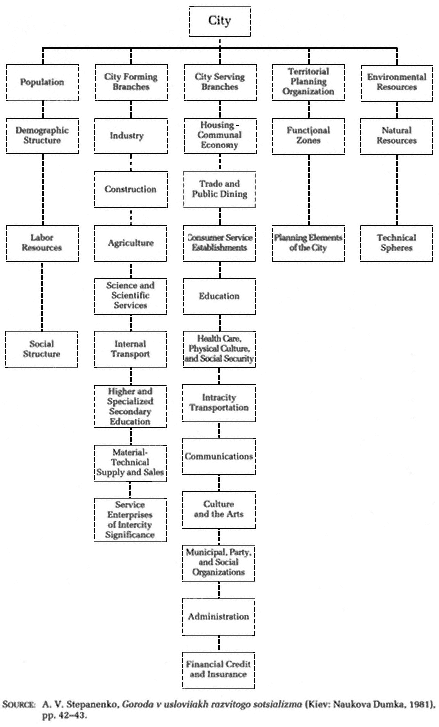
Chart 6.
Structure of the city as a system.
The Leningrad Approach
As noted earlier, shortly after Stalin's death, Leningrad regional party First Secretary Frol Kozlov announced a new economic development strategy for his city and region. This scheme was predicated on an unquestioning belief in technical progress, increased economic specialization and concentration, and a diminution in the relative importance of light-industrial production. Local managers saw almost immediately, however, that the available labor force could not meet the new demands. In confronting this problem, local officials moved primarily on three fronts: (1) they sought to improve the interaction of science and industry, (2) they resuscitated a dying factory-based vocational-technical education network, and (3) they launched industrial sociological investigations, which eventually generated a planning program that integrated social and economic indices. The upshot was that Leningrad elites developed an innovative and comprehensive approach to the socioeconomic dimensions of a city.
On the other hand, they were not alone in seeking to improve socioeconomic management. The Soviet Union has witnessed a cavalcade of national and local campaigns to achieve those same ends.[100] The Leningrad innovations discussed in this chapter, and in Chapters 4 and 5, were not even the most celebrated among an endless procession of labor proposals. The famous Shchekino experiments launched at a Tula chemical combine can probably lay claim to that distinction.[101] Nor have the Leningrad programs described here altered in any profound manner either the structure of the Soviet labor market or the general governmental policies that govern it.
Nevertheless, Leningrad science-industry linkages, vocational-technical education programs, and socioeconomic planning efforts had substantial local impacts. They even influenced the physical shape of contemporary Leningrad and its metropolitan region. Vocational school enrollments have increased, with two fifths of the city's secondary school students now attending vocational schools. To a degree unprecedented elsewhere in the USSR, Leningrad plant managers must now consult with district and city officials in planning factory social and cultural services. Perhaps even more important, these programs have transformed the way Leningrad's leaders look at socioeconomic problems, policies, and objectives. They have helped forge a distinctly Leningrad-oriented approach to managing the urban workforce in particular and urban socioeconomic development in general.