
2—
Toga! Toga!
Blake Allmendinger
In 1983, a hiker, walking among the dunes of central California, tripped over the head of a sphinx, which the windswept sands had uncovered. The artifact was something that Cecil B. DeMille—not an Egyptian ruler—had conceived long ago. Before filming his first version of The Ten Commandments, sixty years earlier, DeMille had constructed a series of sets in the desert. One of these sets re-created the city of Ramses the Magnificent. Twenty-four sphinxes, weighing five tons apiece, and four 35-foot-tall statues of the pharaoh, made of concrete and plaster, had been erected and photographed, then dismantled and buried. Although film historians had subsequently searched the region for years, it took decades before the sands revealed where the lost city lay. In 1993, ten years after the hiker had rediscovered the head of one sphinx, a team of experts was still slowly digging to see what else was there. "Ground radar readings confirm that materials lie below the shifting dunes," claimed one cautious reporter.[1] But whether they indicated the presence of vast secret treasures, no one would speculate.
The U.S. frontier has provided the inspiration and setting for many great epics, some of which ostensibly take place in exotic foreign locales. Ben-Hur (1880), one of the best-selling novels of the late nineteenth century, tells the story of one man, a Jew, who escapes Roman bondage, finding personal salvation at the foot of Christ's cross. The author, Lew Wallace, governed the New Mexico territory in the late 1870s while he was writing Ben-Hur. In addition to using the southwestern landscape as a substitute for the deserts of Palestine, Wallace based the action in his novel on contemporary local historical incidents. While he was working to make the recently acquired U.S. territory "safe" for white settlement, placing Indians on reservations and arbitrating range wars between bandits and cattlemen, Wallace was simultaneously narrating "civilization's" rise over "savagery." Ben-Hur
demonstrated the hero's conversion and triumph over pagan, decadent Rome. The novel glorified the decline of a barbaric culture and the dawning of a new Christian age at the same time that U.S. imperialist policies were attempting to justify white expansion on the western frontier. However, a decided ambivalence—an identification, first with the agents of "civilization," then with the forces of "savagery"—plagued Wallace throughout his life and careers. Ben-Hur was the best-known but not the only example of Wallace's mixed views on the subject of empire, both at home and abroad.
Lewis Wallace was born in 1827 in Brookville, a small town on Indiana's frontier. His father, David, after training and teaching at West Point, had given up the military, returned to his home state, and gone into politics. In the early 1830s, before his father became governor and moved to the capital, Wallace's family lived in the small town of Covington. Here, near the Indiana-Illinois border, Indians had begun to wage war. The Illinois state militia, fighting on behalf of white settlers, had tried to remove native peoples from land near the border. The warrior Black Hawk, however, having rallied five tribes of Indians, had declared war on intruders. In the spring of that year, tribes had killed two settlers not far from Covington. Because of his military experience, the townspeople elected Wallace's father (whom they nicknamed "the Colonel") to train a defensive militia. Although the militiamen never faced war, they prepared for encounters with Indians in a field next to town. In his autobiography, published in 1906, Wallace recalled watching the troops and then going home, inspired by this dress rehearsal to sketch "real" battle scenes in chalk on his slate. (Wallace would later use the same materials to compose the first draft of Ben-Hur. ) "Alexander, Caesar, Napoleon, Genghis Khan, and Tamerlane the limp-legged, were heroes in reserve," he wrote, compared to the subjects of his early battlefield drawings; "none of them—no, not all of them together—slew half the number of men I wiped from my fields of carnage in [the] course of a week."[2]
Wallace enjoyed watching and reproducing scenes of men armed for combat. The reproduced scenes, in fact, realized the bloody encounters in which Covington's men never fought. Reared on the literature of Irving and Cooper, Wallace could sympathize with the victors and with the vanquished as well. When he read about the death of Uncas, for example, it caused him "the keenest anguish," he claimed.[3] For the Indians, once they were wiped from his slate, could be remembered as noble heroes of a now extinct race.
As a child, Wallace sympathized with both sides in battle. As an adult, he demonstrated the same conflicting loyalties, both in life and in literature. In 1846 he served as a second lieutenant in Company H of the First Indiana Infantry during the Mexican War. Although he never saw action, he nevertheless supported the cause of Manifest Destiny, which claimed divine title
to northern Mexico's land. But after returning to the private sector and practicing law, and after serving in the Civil War as a low-ranking general, Wallace went back to Mexico in 1865, this time joining forces with Benito Juárez. Having earlier defended the right of the U.S. to annex part of Mexico's land, Wallace now worked with a rebel Mexican army to prevent another invasion and colonization by foreigners. By ousting Archduke Maximilian of Austria, the puppet dictator whom Napoleon III had installed, Wallace hoped to prevent the expansion of the French ruler's empire.[4]
His first novel, The Fair God, demonstrated that Wallace could side first with the conquerors and then with the conquered in what was now Mexico. Wallace finished the first draft of the novel in 1853, after serving in the Mexican War, and published the final draft in 1873, after working with Benito Juárez. Set in the past, the epic narrates the conquest of the Aztecs by Spain. Rallied by the hero, Guatamozin, Aztec warriors attempt to fight off invading Spanish troops led by Cortés. At times Wallace seems to sympathize with the Aztec leader, whose courage and cunning in war help the Aztecs win several battles. But at times Wallace seems to identify with the Spaniards, whose triumph is destined by history. The author, sometimes referred to on the title pages of his books as "General Lew Wallace," was a military man who had fought on the winning side in two recent wars. His family, along with the rest of the nation, had also been waging an undeclared war on American Indians who refused to give up their land. For example, while he was governor, Wallace's father had ordered hundreds of Indians sent west to Kansas; traveling by a route called The Trail of Death, 150 captives had died on the way. And while Wallace was writing The Fair God, the U.S. was continuing to displace and eliminate its own native peoples. Spain's victory over the Aztecs, in Wallace's novel, if not intentionally justifying U.S. acts of aggression against its indigenous people, at least inaugurated a history of imperialistic conquest and settlement, one which dated from the arrival of the Spanish in Mexico to the nineteenth-century U.S. government's invasion and colonization of various western domains.[5]
The political imprint of one culture on that of another was sometimes accomplished using the stamp of religion. In 1878, President Rutherford B. Hayes appointed Wallace, a well-known war hero and loyal Republican, to govern New Mexico. Until then, the Catholic Church, led by Franciscan friars, had enjoyed only partial success in their efforts to convert Pueblo Indians. In The Land of the Pueblos (1888), Wallace's wife, Susan, depicted the Pueblos as a passive race, yearning for Anglo-European missionaries to rescue their souls. Perhaps because her husband was writing Ben-Hur at the time, she compared the Pueblos to the Jews who had been converted by Christ. Although they were as different from the white settlers as "the Jews are from the other races in Christendom," the Pueblos were one day
bound to adopt the "one model" of Christ and to succumb to "the influence of the same inspiration," she prophesied.[6]
Wallace himself, however, entertained conflicting opinions about the "civilizing" role that religion should play. In a lecture entitled "Mexico and the Mexicans," delivered in 1867, Wallace blamed the Catholic Church for making the people complacent, arguing instead that the Mexican peasantry should protest against members of the landowning elite who exploited them.[7] In The Fair God, published just six years later, Wallace seemed almost to prefer the Aztec religion, which included disturbing elements of superstition and sacrifice, but which appeared no worse than the enslaving Christian religion that was introduced by Cortés.
While the Catholic Church was trying to convert the Pueblos, the U.S. government was attempting to confine the Apaches and Navajo.[8] During Wallace's years in New Mexico, the government made a series of efforts to contain warring tribes. In 1877, the year before Wallace arrived, 453 Apaches and Navajo were transferred to Arizona from their home reservation in Warm Springs, New Mexico. In transit, approximately three hundred Indians escaped from captivity. Although some eventually turned themselves in, the rest, led by the Apache warrior Victorio, remained at large for four years, running south into Mexico and returning periodically to attack U.S. cavalry. In 1881 Joaquín Terrazas, the cousin of the governor of Chihuahua, in league with the U.S. government, led a posse that tracked down the fugitive warrior in Mexico, killing Victorio and seventy-six fellow conspirators.[9] Wallace, who had asked the U.S. government for more money and troops to help capture the Indians, was satisfied when the warring escapees were killed, believing, as his wife claimed, that the natives were "what they were when the Spaniards found them—cunning, blood-thirsty, untamable." But during the feud, Wallace had also grudgingly admitted that he admired the chief for resisting white rule. "In some respects," he said of Victorio, "he is a wonderful man, and, commencing with a band of seventy-five warriors, he succeeded in uniting tribes always hostile to one another before, and in a few weeks he had three hundred well-armed followers. He has held his own against us from that day to this."[10]
Wallace had good reasons for respecting Victorio. By comparison, some of the white invaders who appropriated Indian land were themselves less than admirable. The recent acquisition of California and the Southwest by the U.S. had made it possible for white bankers, lawyers, cattlemen, gamblers, and bandits to move into the area. Establishing their own rings of influence, these vigilantes and entrepreneurs had murdered men, rustled cattle, and conspired in their efforts to wipe out competitors. In Lincoln County, in southeast New Mexico, during Wallace's tenure as governor two factions held sway; and in 1878, shortly after Wallace took office, violence
between the two factions broke out. Wallace declared a state of insurrection and then offered amnesty, but neither his threats of force nor his promises of forgiveness stopped outlaws who would continue their depredations for the next several years. Finally, Wallace attempted to prosecute some of the worst offenders in court. As part of a program to make witnesses testify, Wallace struck a bargain with Billy the Kid, a hired gun who had worked at different times for various gangs. In exchange for his testimony, Wallace allegedly promised not to punish Billy for his own role in the war. (Billy had killed one man in Lincoln and was thought to be implicated in the deaths of at least several more victims.) But after appearing in court in 1879, Billy escaped from jail and went on a killing spree, violating the terms of his amnesty. After being captured and jailed several more times, Billy was eventually tracked down and killed in 1881 by sheriff Pat Garrett.[11]
History reveals Billy to be not a noble hero who fought selflessly for a worthwhile cause but a ruthlessly violent and pragmatic man. The facts, few though they are, cast a harsh light on Wallace as well. Some critics have argued that Wallace tricked Billy into testifying in court by promising to give Billy amnesty, and that Wallace then revoked or conveniently forgot the promise once the case was resolved. Others have contended that Wallace made the promise in earnest but that Billy's later crimes violated the terms of his amnesty. Letters exchanged between the two men suggest that both of them, being in difficult straits, tried to strike the best deal that they could. Billy, a troublemaking loner who fought for both sides but who had no stake in the feud, gave his testimony not because he cared whether justice prevailed but because he wanted to save his own neck. Wallace, a former military leader who had no experience governing disorderly citizens and a political novice who had little initial understanding of the complex rivalries of New Mexico's gangs, also seemed desperate to find a solution that worked. Negotiating with an unsavory criminal was a means to this end. The man who, when he first came to New Mexico, declared a state of insurrection and then proclaimed amnesty, again switched back and forth, threatening and conciliating Billy in letters that he wrote to the outlaw-in-hiding. In a letter dated March 15, 1879, Wallace told Billy that he had arranged for them to meet on neutral ground so that the two men could talk. "The object of the meeting at Squire Wilson's is to arrange the matter in a way to make your life safe. To do that the utmost secresy [sic] is to be used. So come alone. "[12] If history were as dramatically satisfying as westerns, in which heroes and villains play well-defined roles, this meeting between Billy the Kid, the West's most famous outlaw, and Lew Wallace, the territorial governor of New Mexico and the author of the epic Ben-Hur, would have been a momentous showdown. Instead, two men, who desperately needed each other for their own distinct purposes, came together under the cover of darkness to transact their shady business in a small frontier town. The clear-cut victories and
defeats in western legend and literature gave way to a historical reality that was problematic and much more mundane.
Wallace's career as a soldier-politician was shaped by some of the most important events of the mid- and late nineteenth century: by the Black Hawk War, the Mexican War, the Civil War, various local Indian skirmishes, and the famous range wars in Lincoln County, New Mexico. Wallace's novels, however, were set in the long distant past. Writing at a time when literary realism was beginning to come into prominence, Wallace clung to romances that he had read as a boy, writing adventure tales that were situated on foreign frontiers. Having fought, Wallace could realistically describe the grisly horrors of war in his autobiography. Having governed in peacetime as well, he could chronicle the historical process of conquest and rule with the calm detachment of one who knows which side is destined to win. But in his historical fiction, looking back on the past, he tended to idealize and romanticize those who were doomed to defeat. Wallace made various careers for himself, first as a soldier, then as a politician, and finally as the author of one of the most popular historical epics in American literature. But sympathy for the losing side sometimes caused him to criticize institutions that had contributed to Wallace's success in real life. The army, the government, and even the Catholic Church could appear as instruments of oppression, used by the conquerors to impose their will on the conquered. Wallace's identification with one side, then the other, continued throughout his life and his literature. But nowhere did it play itself out more dramatically than in his famous novel, Ben-Hur.
Because Wallace wrote parts of Ben-Hur while he lived in the West, and because he based it on a conflict between "civilization" and "savagery," the novel in certain respects resembles the formula western, which was then in development. No western, no matter how representative, fulfills every requirement of the genre, and Ben-Hur, because it isn't a member of the genre but merely a relative, lacks certain signs of affinity. But in addition to its resemblance to the historical epic and religious conversion tale, the novel manifests three traits whichJohn G. Cawelti claims all westerns share. According to Cawelti, one of the most influential critics to posit a formula, the typical western is characterized, first, by an action that "takes place on or near a frontier."[13] This action, occurring at "the epic moment" when "civilization" and "savagery" clash (66), loosely resembles the plot of Wallace's own epic narrative. Ben-Hur's defeat of the Romans in battle, his victory in the chariot race over his former friend and rival, Messala, and his conversion to Christianity at the end of the novel, which redeems the Jewish hero as well as his followers, mark successive stages in the dismantling of Rome's evil empire and the founding of a new holy society.
Cawelti's ideal western is also populated by three types of characters:
law-abiding "townspeople" who make up society; "savages" who inhabit the unredeemed wilderness; and a "hero" who remains poised between these two opposed spheres (46). In Wallace's novel, these three types of characters are represented by the Jews, the Romans, and Ben-Hur, respectively. The hero lives among Jews, who are destined to be converted to the new Christian faith, and among Romans, who are heathens and blasphemers. Born as a Jew in Jerusalem, Ben-Hur is later adopted by a tribune from Rome. Subscribing first to the Old Testament law of an eye for an eye, he seeks revenge against Messala and schemes to attack Rome with his troops; accommodating himself later to the New Testament teachings of Christ, he scuttles his plans for further destruction and dedicates himself instead to constructive good works. Just as the western hero performs acts that are alternately ruthless and civilized, so he finds himself attracted to women who are both morally dangerous and honorable. Simultaneously drawn to the heroine (a schoolmarm, for instance) and to the villainess (typically a saloon girl or prostitute), the hero identifies equally with characters who exist both inside and outside society. Moving back and forth between "civilization" and "savagery," Wallace's hero also finds himself drawn to two different women: Esther, a Jew, who is modest and loyal, and Iras, a Roman spy who betrays Ben-Hur while seducing him at a desert oasis.
Finally, Cawelti insists that the western be staged against the backdrop of nature (39–40). The desert or high plains, a sweeping prairie or mountain range, dramatizes the fact that pioneers could easily become stranded, dwarfed, or engulfed by the wilderness in the process of attempting to tame the frontier. In addition, the harsh extremes of the climate and the hostile "savages" who inhabit the unfriendly environment contribute to the impression that the chances for white survival are slim, that the struggles confronting a new civilization are great, even epic. Wallace modeled his Middle Eastern landscape on deserts in the southwestern U.S. While living in New Mexico, he observed that the Rio Grande Valley looked more like "the region of the Nile" than did any other place he had visited; his wife noted that scenes of "low adobe houses" and herdsmen with their flocks, gathered to drink at a stream, reminded her of illustrations of biblical stories set in far distant lands.[14]
As Cawelti's work demonstrates, westerns share many of the same characteristics on film and in literature. Reading Wallace's novel, one can understand why Ben-Hur was filmed more than once. Because of its depiction of exploits, crowd scenes, and spectacles, many of which exist in the reader's imagination as indelible images, the novel anticipates the later techniques of cinema. At times, Wallace's audience seems to function less as reader than as spectator, not so much processing narrative as simply witnessing scenes. (In the chariot-race scene, for example, the reader becomes one of the crowd in the Circus seats, watching and cheering Ben-Hur.) The un-
named narrator serves as an impersonal camera's eye, patiently guiding the reader-as-spectator through the excitement of the tumultuous throng. (In the race scene, again, the narrator says: "try to fancy it; . . . look down upon the arena, and see it glistening in its frame of dull-gray granite walls.")[15]
Unlike Cawelti, the critic Will Wright, limiting himself to a discussion of films, argues that westerns follow one of four basic plots. In the "vengeance" plot, the hero is a member of civilization who temporarily leaves it in order to protect it from villains. But at some point during the struggle, a member of society asks the hero to give up his quest for revenge. Only after defeating the villains, however, does the hero return to society.[16] On film, as well as in literature, Ben-Hur narrates the archetypal "vengeance" plot. The hero first seeks revenge when Messala sends Ben-Hur into slavery. While in exile he fights, as an individual and as a representative of Jewish society, against bondage to Rome. The word "vengeance" appears more frequently than just about any other word in Wallace's novel. The hero swears "vengeance" when his mother and sister are cast into prison (105); he threatens "vengeance" when he thinks that his family is dead (163); he tells Sheik Ilderim that he is racing against Messala for "vengeance," not money (225); and he spends three years training troops to fight against Rome because he craves "vengeance" in war (445). Only at the end of the book, when he witnesses Christ's death on the cross, does the hero realize that he must accept God's will and lay down his arms.[17]
Cawelti and Wright agree that the western hero moves back and forth between the worlds of his friends and his enemies. Wright claims, for example, that the hero, in his effort to befriend civilization by engaging the villains in war, becomes like the villains, realizing his latent potential to kill or do harm.[18] This seeming paradox explains one of Ben-Hur's early crucial decisions. Even before he goes off in chains to serve as a galley slave, Ben-Hur indicates that he holds a grudge against Rome. In a conversation with his mother in the Palace of Hur, he says that he has decided to beat the Romans by joining them. If he wants to train an army to conquer Rome's troops, he must learn how to fight. And since Jerusalem doesn't have an army, he must therefore leave home. Infiltrating the ranks will enable Ben-Hur to spy on his enemies, thus allowing the hero to develop his own counter-strategy. "I will fight for her," Ben-Hur says of Rome-"if, in return, she will teach me how . . . to fight against her," he promises (100).
Ben-Hur has a showdown with Rome—but not on the battlefield. On the racetrack at the Circus at Antioch, he finally conquers Messala. (Having been adopted by one of Rome's tribunes and having been given the chance to race horses enables Ben-Hur to master Rome's favorite sport. Thus, in the chariot race he beats the enemy at the enemy's game.)[19] Wallace stages the race as a shoot-out between two western gunfighters, stating that the contestants' horses burst forth from the gates "like missiles in a
volley from so many great guns" (318). The fastest gun wins. The "quick report" of Ben-Hur's whip urges his horses on, causing them to pull the hero across the finish line first (327). The 1925 and 1959 films simplify the encounter between Ben-Hur and Messala, representing it as a clear-cut triumph of good over evil. But Wallace problematizes the race, suggesting that the adopted Ben-Hur, who over time has become more and more like the Romans, has also come to have few moral differences with Messala. In the 1959 film, Messala, seeking revenge, maneuvers his cart next to Ben-Hur's, using a protruding, rotating spike on one of his wheels to rip through the spokes of his competitor's wheel (see fig. 2.1). In the novel, however, Ben-Hur attacks first, driving his chariot up to Messala's, running his "inner wheel" behind the other's cart and causing his rival to crash (328). Ben-Hur's vengeful feelings match those of his enemy: they motivate the hero to commit an act of aggression and savagery. The film versions rid themselves of this disturbing complexity, reducing Ben-Hur and Messala to allegorical types. Here, the hero and villain drive white and black horses, respectively. In the novel, however, these distinctions are blurred, and the colors of each man's horses are mixed (303).
Wallace's historical epic and religious conversion tale, set overseas in the biblical past, has something in common with westerns, which originated in the late nineteenth century.[20] Wallace spent much of his life manning outposts on distant U.S. frontiers. His experiences, which influenced Wallace while he was writing his masterpiece, explain why Ben-Hur has some of the qualities that all westerns share. But his ambivalent feelings about those experiences make Ben-Hur even more problematic than most western narratives.
Wallace wrote Books 6, 7, and 8—the last three books of Ben-Hur —while he lived in New Mexico.[21] Book 6, which Wallace wrote shortly after assuming office as governor, opens with the announcement that a "great change" has occurred: Pontius Pilate has replaced Valerius Gratus as governor. Wallace's doubts about the benefits of empire may explain why the appointment of a new governor in the novel is represented as no cause for joy. Wallace chose to use this transitional period in history, when the U.S. government was removing New Mexico's previous territorial governor and installing Wallace instead, as the time to write about Rome's appointment of a new and even more evil tyrant. As Wallace noted, "the Jews knew the change of rulers was not for the better" (342), just as New Mexico's natives must have suspected that Wallace's tenure as governor would adversely affect their autonomy.
Wallace, the ruler, partially identified not with the Romans but with the subjugated Jews and their hero, Ben-Hur. In an essay entitled "How I Came
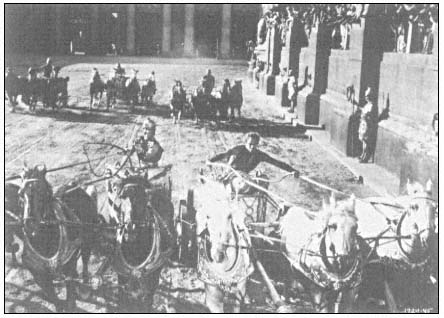
Figure 2.1
A still from the famous chariot-race scene: the villain, Messala,
and the hero, Ben-Hur, drive horses of contrasting colors.
Copyright 1959 Turner Entertainment Company.
All rights reserved.
to Write Ben-Hur, " first published in 1893, Wallace alleged that a conversation with the famous agnostic Colonel Robert G. Ingersoll had inspired him to write a religious conversion tale. In a debate about the existence of God and the divinity of His Son, Jesus Christ, Wallace was forced to acknowledge his ignorance, confessing that he had spent his whole life dealing with worldly concerns and that he had previously "neither believed nor disbelieved" in the cornerstones of Christian theology.[22] Wallace converted to Christianity after resolving to study the question and make up his mind. The result was a novel, Ben-Hur, which tells the story of one man's religious awakening. Wallace, who stated years later that he had written the novel with a growing sense of reverence and awe, identified with the novel's protagonist, finding personal salvation while tracing Ben-Hur's road to enlightenment.
Wallace and his hero made the same holy pilgrimage. But Wallace and the Romans shared the same military and political goals: to invade, conquer, and govern their foes. Wallace's process of composing the novel was, to say
the least, odd. After drafting the first version in chalk on a slate, Wallace then wrote the final version on paper in bold purple ink.[23] Deliberately or not, Wallace linked himself with the enemy in the act of writing Ben-Hur. For purple is the color adopted by imperial Rome. When they sweep through the streets of Jerusalem, the Romans barely touch the ground with the hems of their togas, which are trimmed in rich royal hues (97, 1 12). When they march on parade, they deck their horses in plush purple livery (101). When they attend sporting events, races, and games at the Circus, they sit under bright colored canopies while the spectators sweat (236).
Wallace's identification with both the Jews and the Romans explains why differences between the two groups sometimes seem blurred. In theory, Ben-Hur, like the formula western, dramatizes the conflict between "civilization" and "savagery." But the notion that Jews represent "civilization," and that Romans represent "savagery," is problematic at best. Can the Romans be said to represent "savagery" when their culture, even though it is now in decline, is at the same time responsible for bequeathing to western civilization numerous cultural legacies? And can the Jews, whose history reveals an equally impressive and extensive list of accomplishments, be viewed as exclusively "civilized" when Wallace characterizes them as unrefined natives who are destined to be subdued, either by Roman troops or by Christ? Like the Indians in westerns, the Jews are indigenous members of (Israelite) tribes. They are invaded by military forces representing an encroaching civilization that is looking for new land to inhabit and rule. If the Jews who defend their homeland aren't defeated by the Romans in war, they will be admonished and sweetly chastised by Christ, who will tame them by harnessing them to the yoke of religion. Like the Pueblos in the territory of New Mexico (whom Susan Wallace compared to unredeemed Jews) and, before them, the Mexicans in the New Viceroy of Spain, the Jews in Ben-Hur are refined only to the extent that they believe in one God; they will achieve total redemption when they come to accept that Christ is God's Son.
Ben-Hur resembles the formula western, yet, at the same time, it doesn't. The chariot race between Ben-Hur and Messala, which concludes with Ben-Hur's triumph at the end of Book 5, represents, in the defeat of his rival, Ben-Hur's symbolic resolution of his conflict with Rome. After this, the conflict remains between Ben-Hur and Christ. By meekly suffering humankind's scorn and betrayal, the Savior teaches Ben-Hur that it is better to lay down his arms and spend his life performing good works than it is to fight against Rome. Slightly more than the first half of Ben-Hur is concerned with the Jewish hero's adherence to Old Testament law. The principle of an eye for an eye justifies Ben-Hur's righteous wrath against Rome; as an ideology it motivates the same kind of vigilante behavior that occurs in most westerns. But the remainder of Wallace's novel addresses the hero's need to accept
and put into practice the teachings of New Testament law. This part of Ben-Hur reads not like a western but like a tale of religious conversion, emphasizing the virtues of self-sacrifice, love, and humility.[24]
Conforming alternately to one of two different kinds of behavior, Ben-Hur appears simultaneously passive and active, meek and recklessly bold. Thus, as a hero, Ben-Hur seems like a statue in motion, a static figure whose action seems more symbolic than real. In the novel's first epic set piece, during the battle with pirates at sea, the galley slave is chained to his bench in the hull of the ship, forced to watch through the ship's porthole as the action plays out. Ben-Hur enters the chariot race, the second set piece, and wins. But his triumph, although meaningful, is mainly symbolic: the race is a game, and the win is merely a ceremonial victory over one of Rome's men. Christ's submission to his enemies not only motivates Ben-Hur's decision not to fight against Rome but justifies his inconsequential actions (or his relative inaction) in the first part of Ben-Hur. For the hero learns, through witnessing the crucifixion of Christ, that submission on earth leads to triumph in heaven.
As a boy, Wallace had been disappointed that the Black Hawk War had ended before his father's militia could fight. As an adult, Wallace had felt frustrated that his infantry's company hadn't participated in any significant action in the Mexican War. In the Civil War, General Ulysses S. Grant had scapegoated and martyred Wallace's troops, blaming them for arriving at Shiloh too late to help the Union side win. Later, during the range wars and Indian wars in Lincoln County, New Mexico, Wallace had pleaded in vain for more assistance from the U.S. cavalry, believing that military action would have helped restore rule. Wallace's military career, in other words, had been marked by disappointment, postponement, and failure. But his excursion into literature yielded him an escape from the frustrations that he had encountered in life. Although the hero of Wallace's novel is associated with peripheral action or with a central action that never transpires, Ben-Hur is justified by Christ in the end. His heroic status, as an advocate of peaceful resistance, is eclipsed only by Christ's shining martyrdom.
Wallace's religious experience, however, was less intense than Ben-Hur's. His admission, that he had become a believer in the process of writing his novel, piqued the interest of his readers to such an extent that Wallace eventually felt compelled to say more. At the outset of his autobiography, he attempted to satisfy his readers' profound curiosity. "In the very beginning, before distractions overtake me, I wish to say that I believe absolutely in the Christian conception of God. As far as it goes, this confession is broad and unqualified." Wallace didn't use the opening chapter of his autobiography to proselytize his readers or to proclaim his own fervent faith. He took the opportunity merely to issue a reticent statement ("As far as it goes") and to
answer a seemingly tiresome question that fans of his novel, writing to him, had apparently asked more than once. Adding that "I am not a member of any church or denomination, nor have I ever been," Wallace made a profession of faith that consisted of bland generalities.[25] In addition to his conversion, another event—of more worldly importance and of more immediate interest to Wallace, perhaps—occurred shortly after the author finished writing Ben-Hur. Reading the novel and being impressed by the author's religious devotion, which had led Wallace to write so movingly about the last days of Christ, PresidentJames A. Garfield offered Wallace the U.S. ambassadorship to the Ottoman Empire. Willing to forget his troubles in the New Mexico territory and take a new job abroad, Wallace was also no doubt pleased to accept a position that paid approximately four times his governor's salary.[26] It would be cynical to suggest that the career benefits were more important to Wallace than the spiritual rewards for writing Ben-Hur. Indeed, it seems unlikely that Wallace wrote with the idea of personal advancement in mind. But Wallace's military and political promotions, as they have been chronicled by Wallace and others, seem to have played a more obvious role in his life than his religious conversion did. His conversion, in fact, on the surface, at least, seemed to help his career. For it was part of the President's plan that a devout Christian such as Wallace should be appointed to represent the U.S. in a heathen land overseas. Although Ben-Hur had been forced to choose between commanding troops on the battlefield and serving as a soldier for Christ, Wallace, professing his faith in the Gilded Age, when the gospel of wealth achieved dominance, didn't have to choose between earthly and heavenly glory. Conveniently, his well-known religious beliefs helped Wallace prosper that much more easily.
After reading The Fair God, an acquaintance of Wallace's remarked that Wallace wanted to be both a "conquistador" and a "Moses" in Mexico;[27] that Wallace fantasized about liberating the nation through both violent and nonviolent means. Again in Ben-Hur, Wallace identified with soldier-politicians and religious converts as well. His equal affinity with "civilization" and "savagery" force one to question whether those concepts represent polar extremes. Like Ben-Hur, the western defines "civilization" and "savagery" in relative rather than absolute terms. Through the actions of its hero, the western indicates the difficulties inherent in opposing these worlds. Moving back and forth between (moral) civilization and (spiritual) wilderness, the western hero—like Ben-Hur—exists in each sphere. Paradoxically, he defends civilization by resorting to uncivilized means, as Ben-Hur does when he wreaks havoc on Rome. In order to maintain social order he practices anarchy, claiming the vigilante's right to judge, punish, and kill, instead of leaving these decisions and actions to God. Although he fights for (Jew-
ish) society, the individual hero has no social ties. Indeed, Ben-Hur doesn't seek revenge until he mistakenly thinks that his mother and sister are dead. (The supposed death of his family makes his rebirth as a war-hero possible.) The ambivalence that plagued Wallace throughout his life and careers resembles the dilemma that provides the tension in his novel, Ben-Hur. And the tension between "civilization" and "savagery" resembles the conflict that the western, through the actions of its hero, finally seeks to resolve.
Ben-Hur is a western in toga, in drag. Wallace used the conflict that motivated many formula westerns not only to work out issues that concerned the West as a region but to explicate matters that affected the U.S. as a whole. The Mexican War and the Civil War—which dealt with issues of national priority, such as sovereignty, conquest, and race—were as influential for Wallace in the process of writing Ben-Hur as were matters of local priority: the Black Hawk War, the removal of the southwest Apaches and Navajo, and the resolution of range wars in Lincoln County, New Mexico. The novel, which relives the conflict between Romans and Jews, also re-enacts major political and cultural struggles that were waged in the U.S. in the midand late nineteenth century. Ben-Hur contemplates imperialistic U.S. acts of aggression by narrating the historically and geographically distanced encounters between Rome and Jerusalem during the dawning of a new Christian age.
As a "spiritual" western, Ben-Hur functions as a transitional text in the history of American literature. The novel's enormous success was due to the fact that it combined characteristics of two popular genres, one of which predated and the other of which succeeded Ben-Hur. As a tale of Christian conversion, the novel modeled itself on the sentimental literature of the early and mid-nineteenth century. It endorsed the same brand of feeling and piety that had made Uncle Tom's Cabin (1852), the nineteenth century's other best-selling novel, such a triumphant success. Ministers who warned their congregations against the evils of reading fiction for pleasure made an exception and approved Ben-Hur because Wallace's novel was religious in emphasis. Clergymen testified to the phenomenal power that the novel exercised in converting their flocks. And some of those converts went so far as to write Wallace, claiming that Ben-Hur had inspired them to become missionaries and to preach overseas.[28]
As a tale of frontier adventure, Ben-Hur looked back to the works of Irving and Cooper, which Wallace had read as a child. It also looked forward to the genre of westerns, which would be developed in the decades to come. The theme of moral redemption, reverently explicated in the novel's contemplative passages, competes for the reader's attention with scenes of manly contests, heroic adventures, and war. And as the novel combines two
different genres, so the novel's hero alternately plays two different roles. Ben-Hur is the sentimental hero(ine) whose spheres are the church and the home. In the course of the novel, he converts to Christianity, reunites with his mother and sister, and returns to his home/land, Jerusalem, where he is restored as the rightful Prince in the Palace of Hur. Wallace gives Ben-Hur soft womanly features that are intended to express extreme states of feeling: a "dimpled" mouth, "full eyes," and the rosy cheeks of a blushing young girl (71). When he asks Quintus Arrius for information about his mother and sister, Ben-Hur clasps "his hands in appeal" (126), using the same sentimental gesture that he later uses when he supplicates Christ. But passive humility gives way to anger when Ben-Hur believes that Messala has murdered his kin. The emotional change that comes over Ben-Hur is "instant," "extreme" (126). His womanly, expressive countenance becomes steely and stern. His muscles flex in rebellion, signifying Ben-Hur's intent to destroy his arch-nemesis. Immediately, Ben-Hur transforms himself into the avenger, into the vigilante hero whom fans of westerns admire.
Wallace's novel was one of the late nineteenth-century's best-selling books. It combined sentimental literature, one of the favorite genres of women, with literature of the strenuous life, for which there was a correspondingly large male readership. Like the novels of Harriet Beecher Stowe, Susan Warner, and others, Ben-Hur privileged the domestic and sacred spheres. (The hero's need for family and home/land is as great as his yearning for Christ.) But like the writings of Theodore Roosevelt, the works of Jack London, and early formula westerns, Ben-Hur glorified the adventures of men who lived on a distant mythic frontier. It became astoundingly popular, appealing to a diverse national audience by accommodating contradictory, multiple views on such subjects as race wars, religion, and Manifest Destiny, and by packaging such serious issues in an entertaining literary hybrid that incorporated the historical epic, the sentimental conversion tale, and the early formula western.