
A—
First Phase:
Journey out of the Gulf of Pagasae (519–79)
In the first phase of their journey from Pagasae to Lemnos, the Argonauts board the ship at dawn and head out of the Gulf of Pagasae on the first leg of their journey to Colchis. As indicated above, elements in the first subsection (a) balance comparable elements in the third (a ), thus creating a ring (rowing » sailing; song in honor of Apollo » song in honor of Artemis; concluding simile comparing the wake of the Argo to a path in a plain » concluding simile comparing fish sailing behind Argo to sheep following after a shepherd). Before looking at the portrait framed by these two stages of the first phase, I would call attention to two details of the framing sections that hark back to earlier themes, the second pertaining to one of the principal focal points of the episode.
Close examination of the portrayal of Heracles in the first subsection (a) with that of Tiphys in the second (a ) reveals that Apollonius has once again reintroduced the thematic antithesis of the man of strength versus the man of skill. In the former, Ancæus and Heracles, the latter with his celebrated club beside him, sit in the middle of the ship:
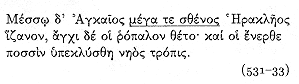
In the middle, Ancæus and the extremely powerful Heracles
took their seats; the latter set his club at his side, and below
his feet the ship's keel sank beneath the waves.
As scholars have observed, the sinking of the keel under the hero's feet refers to the tradition that Heracles was abandoned at
Aphetae Argous because of his excessive weight.[11] In addition to this clever allusion to an alternative version of Heracles' abandonment, the brief description of the massive Heracles at his seat with his club at hand parallels in the second subsection the sketch of Tiphys, who skillfully wields the rudder as he steers the ship out of the harbor:
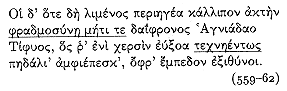
After they left the harbor's curving beach
following the instructions of Hagnias's son,
Tiphys, who with great skill was maneuvering the polished
rudder in his hands in order to keep the vessel on a steady course.
Apollonius calls attention to this antithetical corresponsion by mentioning the respective virtues of both men (


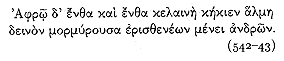
Here and there the dark brine was churned into foam,
boiling furiously from the strength of the mighty heroes.
[11] See Mooney ad 1.533; Blumberg 13; Faerber (supra n. 6) 93; Vian 251 ad 400. Sad 1.1289–91a attributed this version to Antimachus in the Lyde (fr. 58 Wyss [= B. Gentili and C. Prato, Poetae Elegiaci Pars II (Leipzig 1985) s.v. "Antimachus" fr. 4]; cf. Pherecydes FGrHist 3 F 111, Apollod. 1.9.19); in this he was followed by Posidippus, identified, incidentally, as one of the Telchines by the diegesis on the opening lines of the Ætia (Schol. Flor. ad Ætia 1–12 Pf.).
[12] As they leave Cyzicus later on in the book, Heracles will even row the Argo by himself (cf. 1.1153–71).
On the other hand, through Tiphys's skill and direction, the men need not work; rather, taking advantage of the wind, they travel at ease:



In addition to their comparable importance in the driving of the Argo , Apollonius may have associated Heracles and Tiphys at the moment of the Argo 's departure because, as it will turn out, neither will complete the journey to Colchis. When Heracles in Mysia rushes off in search of Hylas, Tiphys's call to sail will result in Heracles' abandonment (1.1273ff.). Not long after this, the Argonauts will also lose the services of Tiphys when he dies among the Mariandyni (2.851–57).[13] Moreover, the loss of each Argonaut threatens the continuation of the mission because of the resulting discord and despair among the group (1.1280–1309, 2.859–63); but in both cases, thanks to divine intervention (Glaucus at 1.1310–25, Hera at 2.864–66a), the others pull themselves together and the journey continues.
Second, the corresponsion between Apollo in the rowing (aa ), and Artemis in the sailing section (aa ) also recalls an earlier contrast. In his description of the departure of Jason and the Argonauts from Iolcus, discussed in Chapter 3, Apollonius emphasized in structure and content the different reactions to the departure of the men and women of Iolcus, of the male and female slaves
[13] It is noteworthy that the episode in which Tiphys dies contains a reference back to the abandonment of Heracles in Mysia. When Heracles had visited these very people earlier, after securing the girdle of Hippolyte (see 2.775–85), he arrived on the occasion of Priolaus's funeral. The latter had died in battle with the Mysians, which resulted in the celebration of an annual dirge in his honor. At the funeral games, Heracles defeated in a boxing match Titias, whom in one account (Nymphis FGrHist 432 F 5b) nymphs carried off while he was fetching water, and for whom the local peoples performed an annual search while singing dirges; see Vian 277–78 ad 785. The parallels with Hylas's fate are obvious (cf. 1.1221–39, 1345–57).
at the home of Æson, of Jason and Alcimede, and of Jason and Iphias. He completed this extended contrast in gender by comparing Jason, who encounters the aged priestess of Artemis, to Apollo (306–16).[14] In the present episode, the close relationship between Jason and Apollo is viewed once again in a simile.[15] In this case, Apollonius compares the rhythmical rowing of the Argonauts accompanied by Orpheus to the dance of Apollo's devotees at one of his cult sites (536–39). Because the group of rowers resemble the god's worshippers, the captain would appear to be the nautical analogue of the god.
In the corresponding section, Orpheus sings a hymn to Artemis (569–72). One recalls the mention of Iphias, her Iolcan priestess, not only because of the similar juxtaposition of Apollo and the functionary of Artemis, but because in both passages, Apollonius highlights the protective function of the female divinity (



Hypsipyle resembles this goddess in that when the Argonauts arrive she is a virgin queen ruling over an all-female society. After the love-struck young woman provides Jason and his men with the use of her harbor, city, and citizens—including herself—for an unspecified period of time on Lemnos (cf. 1.861–64), her guest will cooly abandon her in pursuit of his mission. In particular, in her farewell to Jason, Hypsipyle, like Iphias, holds his hands when, among other things, she asks to be remembered:[16]
[14] One should note that Iphias is a syncopated form of Iphianassa, a name with Artemisian associations; cf. Vian 64–65 n. 3.
[15] J. F. Carspecken, "Apollonius Rhodius and the Homeric Epic," YCIS 13 (1952) 96–97, concluded that Jason and Apollo were so closely linked that it would be impossible to think of one without being reminded of the other.
[16] The reminiscence in these lines of Nausicaa, another woman associated with Artemis, will be discussed in the next chapter.
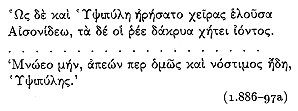
Hypsipyle too offered this prayer, clasping the hands
of Æson's son; she began to cry, realizing her loss in his departure.
. . . . . . . . . . . . . . . . . . . . . . . . . . . . .
"Remember, then, both while you are away from home and when
you return,
Hypsipyle."
After a brief response, Jason is the first on the ship (1.910). In the case of Medea, Apollonius explicitly compares her to Artemis when the Colchian maiden goes to meet Jason at the temple of Hecate (3.876–84); and her assistance to, and protection of, Jason are what will ultimately give him the ability to achieve the goal of his mission. Moreover, like Hypsipyle she too will hold Jason's hand as she asks to be remembered for her favor:[17]
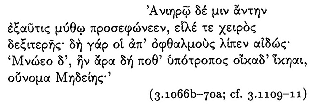
Looking him directly in the eye,
again she gave voice to her painful feelings, taking his right
hand—for shame had by now left her eyes.
"Remember, if ever you make it back to your home,
the name of Medea."
Within the poem, Jason wavers in his protection of Medea, especially when handing her over would appear to ensure the success of his mission (4.338ff.). Beyond the conclusion of the poem, Jason will abandon Medea, once again to further his own interests. Thus
[17] Vian 24 n. 2 observed these and other comparisons between the experiences of Hypsipyle and Medea.
the Apollo-Artemis pairing would seem to represent an emblem of Jason's infelicitous relationships with the women of his life. Moreover, this suggestive pairing frames an appropriate picture within; for implications that can be drawn from the personages described in the central panel point to another famous male-female relationship that, like Jason's with Medea, turned sour, that of Peleus and Thetis. This relationship not only adds another perspective from which to view Jason's future abandonment of both Hypsipyle and Medea, but it also ties in closely with the action of the second phase of the journey to Lemnos.
In the central position of the first phase of the journey from Pagasae to Lemnos (Ab), Apollonius sketches an idyllic scene in two parts. In the first (ba ), all the gods from the sky and the nymphs from the peaks of Mount Pelion look down in admiration on both the ship and the Argonauts. Apollonius refers to the Argonauts as the


which point Chiron and Chariclo stepped in to help Peleus raise Achilles.[19]
The interest shown by the gods in their children and by Chiron in showing Peleus his infant son recalls an earlier motif. In the Catalogue, Apollonius gave several touching sketches of parental concern for the well-being and success of their sons (69–70, 97–100, 115–17, 146–50, 164–71, 190–96); immediately after the Catalogue, Apollonius focused in greater depth on Jason's departure from his home and the reactions of his parents. As the group of

Finally, although the rearing of heroic children by Chiron was a well-known motif, Apollonius invites the reader to see a similarity in the fates of Medea and Thetis through an imitation of
[19] On the divorce of Peleus and Thetis, see Vian (3) 178 ad 879, and N. J. Richardson, The Homeric Hymn to Demeter (Oxford 1974) 237–38 ad 237ff. On Thetis's anger with Peleus, see Sad 4.816, Livrea ad 4.816, 868.
[20] This, however, will not come to pass; for Jason does return to Greece, and we find a son of Jason and Hypsipyle, Euneus, ruling at Lemnos during the Trojan War (Il. 7.467–69, 23.745–47).
[21] The comparison between the experiences of Peleus and Thetis and Jason and Medea is similar to the more explicit association of the experience of Theseus and Ariadne to that of the latter pair made later in the poem; cf. 3.997–1007, 1074–76, 1096–1108; 4.424–34.
a pertinent text.

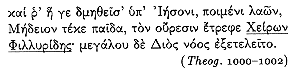
And she [sc. Medea], submitting to Jason, shepherd of his people,
gave birth to a son, Medeius, whom Chiron , the son of Philyra ,
raised in the mountains. In this way the will of Zeus was fulfilled.
The reference to the eponymous hero of the Medes[23] anticipates the trouble the Argonauts encounter in the second phase of the journey.[24]