
Caron and the Anonymous Missa, SPB80, Folios 122-29
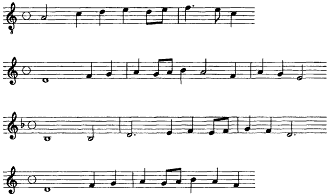
An anonymous Mass in layer 1 of SPB80 has compelling ties to Masses by Caron. Initially the most striking similarity is the high degree of motivic correspondence. The head motive was a familiar one to Caron. Example 5 juxtaposes the head motive as it appears in the Kyrie and Agnus to statements in the Missa Clemens et benigna , the Missa Thomas (transposed), and what might be the beginning of the missing Agnus for the Missa Sanguis sanctorum ,[17] as well as in Masses of Ockeghem, Bedyngham, and Domarto and in Dunstable's motet Salve scema sanctitatis . In these as in other instances tallied in Table 17, the motive often occurs in one section of the Sanctus. Of all the motives shown in Example 5 and listed in this table, those by Caron consistently show the rhythmic pattern found in the Missa . Although it is not included here, the Pleni of the third Naples Missa L'homme armé is rhythmically close to the Missa Sanguis sanctorum fragment.
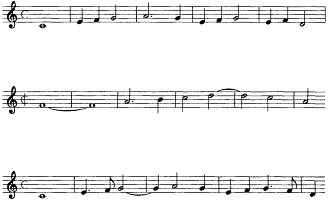
This motive doubtless relates to a widely popular motive of the same period, a motive with possible Marian associations that had a special appeal to Dunstable and other British composers and also to Du Fay (Table 18). Example 6 has a representative sampling, beginning with three appearances at Et in terra: this SPB80 Missa , Caron's Missa Sanguis sanctorum , and Du Fay's Missa Sancti Antonii Viennensis . The Patrem of Bedyngham's Missa Deuit angouisseux and a Benedictus by Sovesby provide precedents for the rhythm used by Du Fay and Caron. Among the many examples of this motive with a Marian text are two motets by Dunstable, his Sancta Maria, non est tibi similis and Sub tuam protectionera , and the anonymous Missa Regina coeli laetare in Tr91. Marian interpretations of the Song of Songs doubtless influenced the application of the motives in Tables 17 and 18 to the settings of
[17] This fragmentary superius line is in Ver755, fol. 42v, immediately after the conclusion of the Sanctus.
EXAMPLE 5. Comparison of Sanctus motive in Anonymous, Missa (SPB80, fols. 122-29) with occurrences in works by Caron, Ockeghem, Bedyngham, Domarto, and Dunstable
EXAMPLE 5A . (i) Missa , Kyrie I; (ii) Missa , Agnus I
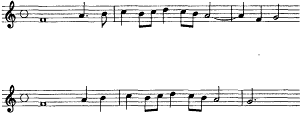
EXAMPLE 5B . (i) Caron, Missa Clemens , Benedictus (transposed from G); (ii) [Caron], Missa Thomas , Pleni (transposed from G); (iii) Caron, Missa Sanguis , Agnus I?
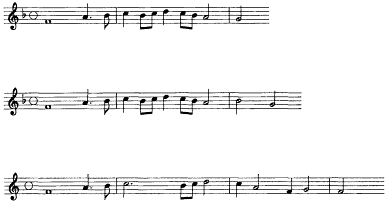
(continued )
Descendi in ortum meum, Quam pulchra es , and Quae est ista by Dun-stable, Hothby, and the anonymous composers. And in secular settings a Marian association presumably also lies behind Busnois's use of the motive at the beginning of his chanson Ja que line and as counterpoint midway through Je ne puis at the text "Noble femme."
EXAMPLE 5 (continued )
EXAMPLE 5C . (i) Ockeghem, Missa Mi mi , Pleni; (ii) Bedyngham, Missa (Tr88), Sanctus; (iii) Domarto, Missa, Et in terra; (iv) Dunstable, Salve scema sanctitatis
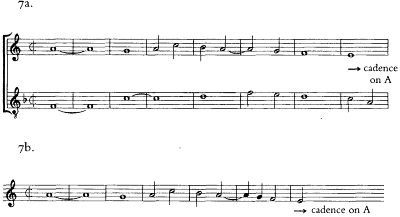
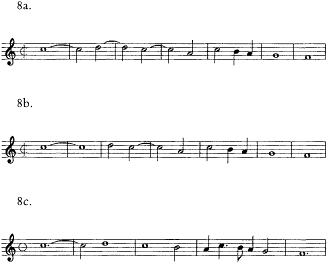
But in addition to some of the same fashionable motives in the SPB80 Missa and Masses of Caron, there are others less common. The Christe motive turns up in the Missa Accueilly , Osanna I (Ex. 7; other settings by Caron are shown in chapter 8, Ex. 31), a movement that also follows the same sequence of cadences as the Christe: a, c, and then f. Additionally, the Benedictus relates motivically to two Mass movements—the Missa Accueilly , Agnus I, and the third Naples Missa L'homme armé , Agnus II (Ex. 8)—and also to a Caron chanson, Pour regard doeul . The chanson connection, discussed in chapter 10 and shown there in Example 67, links not only the first motives but also an interior phrase of the Benedictus to part 2 of the chanson. Likewise, the Agnus II of the Missa is related to another Caron movement, the Missa L'homme armé , Agnus II, and another one of the Naples L'homme armé Masses, the Benedictus of the sixth Mass. This network of motivic relationships also includes both voices of the Ockeghem three-voice Missa , Agnus II.
Motivic resemblances to Caron extend to interior motives. The SPB80 Missa features a sequential pattern used by more than one
EXAMPLE 6. Comparison of Marian motive in Anonymous, Missa (SPB80, fols. 122-29) with occurrences in other fifteenth-century compositions
EXAMPLY . 6A . (i) Missa , Et in terra; (ii) Caron, Missa Sanguis , Et in terra; (iii) Du Fay, Missa Sancti Antonii , Et in terra (transposed from C)
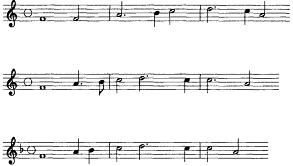
EXAMPLE 6B . (i) Bedyngham, Missa Deuil angouisseux , Patrem; (ii) Sovesby, Benedictus (Aosta, fols. 252v-53)
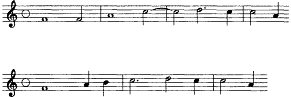
EXAMPLE . 6C . (i) Dunstable, Sub tuam protectionem ; (ii) Anonymous, Quam pulchra es (Tr90, fol. 342v); (iii) Busnois, Ja que li ne
EXAMPLE 7. Motivic comparison of (a) Anonymous, Missa (SPB80, fols. 122-29), Christe; and (b) Caron, Missa Accueilly , Osanna I
EXAMPLE 8. Motivic comparison of (a) Anonymous, Missa (SPB80, fols. 122-29), Benedictus; (b) Anonymous, Missa L'homme armé (Naples 3), Agnus II; and (c) Caron, Missa Accueilly , Agnus I
EXAMPLE 9. Comparison of counterpoint in (a) Caron, Missa L'homme armé , Crucifixus; and (b) Anonymous, Missa (SPB80, fols. 122-29), Agnus II
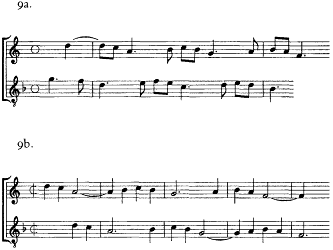
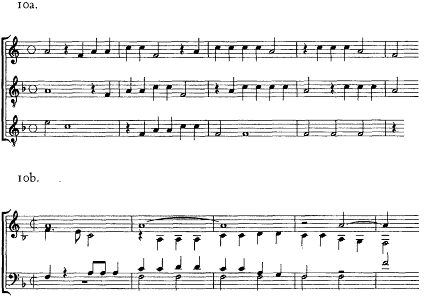
composer in the 1460s. In the Agnus II the imitative form of this sequence compares closely to the same descending line in the Crucifixus of Caron's Missa L'homme armé (Ex. 9).[18] It also appears, although not in imitation, in the Agnus II of the Ockeghem Missa just cited because of the resemblance between the opening gestures. Caron, as many of his generation, was also fond of F-major triadic figures such as those in the Patrem and Qui tollis of the Missa . This sort of trumpetlike fanfare could easily bring harmonic movement to a momentary stasis, as in the Missa , Patrem, and Caron's Corps contre corps (Ex. 10).[19]
Last, the conflicting signature present throughout the Mass,

[18] See also Philippe Caron, Missa Accueilly , Et resurrexit, mm. 8-9.
[19] There are similar passages in O vie fortunée and Cent mille escus . Caron's Madame qui tant est mon cuer also has an extended "C-major" triadic passage, min. 49-54.
EXAMPLE 10. Comparison of counterpoint in (a) Anonymous, Missa (SPB80, fols. 122-29), Patrem; and (b) Caron, Corps contre corps
O vie fortunée, Pour regard doeul, Rose plaisant, Se doulx penser , and Vous n'avez point .
Despite all of these similarities, this is not likely a Mass by Caron but by someone who influenced him. There are too many important ways in which it departs from the conventions of Masses securely attributed to Caron. This Mass is not a tenor Mass but has a motto for the Kyrie, Sanctus, and Agnus, and there are no independent settings of either the second Osanna or the third Agnus, as there are in all known Caron Masses. Further, instead of duet beginnings, all movements begin with all voices, a difference that may be excused because we have no Masses for three voices attributed to Caron for comparison. Its mensural usage is, for the Kyrie, Gloria, and Credo, much like that of the Missa Sanguis sanctorum . The Sanctus, however, goes its own mensural way at the Osanna I by its use of Ø. All of Caron's Masses use either tempus perfectum or tempus imperfectum diminutum for the Osanna I
(see Table 23 on p. 398). Perhaps most of all, and difficult to demonstrate in a musical example or two, the rhythms are too straightforward to be from the hand of Caron, whose predilection for syncopated lines inspired the highly irregular bar lines that render the complete edition of his works so difficult to use.
Bedyngham or one of his compatriots warrants consideration. Of the attributes described above, Bedyngham also used static harmonies on F triads in his Tr88 Missa in the Confiteor (mm. 185-88), while in the compositions of John Plummet—for example his Anna mater matris —they are particularly common. And the same conflicting key signature occurs in several works of Power and Bedyngham, usually with the identical clef combination of the SPB80 Missa (C1, C3, C3), the same high ranges, and the same degree of voice crossing, as in Bedyng-ham's Missa Deuil angouisseux and his Benedicamus Domine (Tr88).[20]
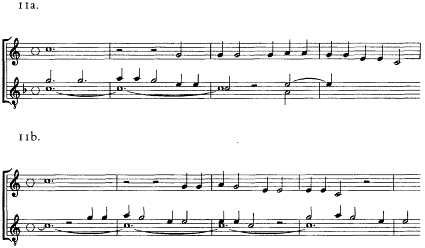
The motives from the Missa listed in Tables 17 and 18 occur frequently in English works, as does the following motive, found throughout the SPB80 Missa (Ex. 11). In Stone's Tota pulchra es and in the Missa attributed in Strahov to the little-known British composer Standly, the motive fulfills a similar function as a kind of contrapuntal filler. In contrast, when Du Fay handled it, as in the canonic duet that appears in both the Ave regina coelorum and Ecce ancilla Masses, the contrapuntal texture is more complex. In later decades, as discussed in chapter 9, Martini turned to this motive reflexively. Last, if the Christe motive shown above in Example 7 is close to Caron, it is contrapuntally closer to Bedyngham (Ex. 12). Together with its tenor it appears as the second phrase of Bedyngham's Myn hertis lust , with texts that could not be more rhetorically appropriate for the Christe: "Which are the guide unto my perfect life" [Which is the guide unto my par-
[20] The fauxbourdon cadence in the SPB80 Missa , Et in spiritum, mm. 55-61, occurs virtually note for note in the anonymous Kyrie in Tr88 (fols. 26v-27), mm. 27-32 of the Christe (see the edition in Rebecca Gerber, "The Manuscript Trent, Castello del Buonconsiglio, 88: A Study of Fifteenth-Century Manuscript Transmission and Repertory, 2:3-7). This Kyrie appears to be related to the Missa angouisseux (though I agree with David Fallows that this Kyrie is not characteristic of Bedyngham's style ["Johannes Bedyngham," 348]). But because fauxbourdon cadences are so prescribed, the identity of three contrapuntal lines for six breves is less significant than it would be for other types of cadential counterpoint.
EXAMPLE 11. Motivic comparison of (a) Anonymous, Missa (SPB80, fols. 122-29), Patrem, mm. 12-15; and (b) Standly, Missa , Patrem, mm. 9-13
EXAMPLE 12. Bedyngham, Myn hertis lust , mm. 8-11
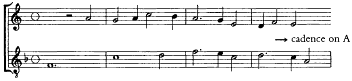
faite liffe] and "Whom I serve with attentive heart" [Whom that y serve with herte atentiffe].[21] As demonstrated shortly, when Caron sets this phrase he does so in a different harmonic and contrapuntal context.
The SPB80 Missa stands as a musical hybrid, the likely product of an English composer working on the Continent or a Continental composer with pronounced insular tendencies.
[21] The translation is by Howard Garey (Perkins and Garey, The Mellon Chansonnier , 2: 386).