
4
Popular Shi'ism
The account of the Awadh Shi‘is' social origins in the preceding chapter explains why scattered Shi‘i lineages existed to support the Nishapuri nawabs and to benefit from their rule. But it does not explain how these Shi‘i or proto-Shi‘i groupings developed into a community. In the Mughal period, and especially under Awrangzib, Shi‘is had no public rituals separate from Sunnis which could serve as the matrix of community formation. Religious identity and social networks within a genuine religious community could only grow up around a set of uniting public rituals. Under the patronage of the nawabs and their Shi‘i courtiers and notables, such public rituals developed in Awadh.[1]
The Shi‘is of nawabi Awadh created a distinctive set of practices and rituals. Many new believers in the Imams entered the fold in this period, making their own contributions. Their rituals changed over time, shrines grew up, and lay believers of various classes and both sexes practiced their faith in their own ways, sometimes in opposition to the strictures of the growing corps of scripturalist ulama. Large numbers of Sunnis and Hindus were drawn into participation in the mourning rites for the martyred Imam Husayn, bringing their own influence to bear. Yet popular Shi‘i practices most often resulted from the cultural dynamism and creativity of ordinary laborers, artisans, and shopkeepers, themselves partisans of ‘Ali, rather than de-
[1] My conception of a growing community identity that could lead to communalism derives from Sandria Freitag, "Religious Rites and Riots: From Community Identity to Communalism in North India, 1870-1940" (Ph.D. diss., Univ. of California, Berkeley, 1980); clearly, however, here I am discussing a much earlier phase, which might be called community formation.
riving from "corruption" by Hinduism. As Turner argues, popular religion involves a specialization of religious services for different lay markets.[2]
The rites of popular Shi‘ism in early-nineteenth-century Awadh had two conflicting effects. On the one hand, widespread urban participation in Muharram rituals helped integrate, through a central ritual, the nawabi cities' diverse and growing populations. Lucknow's patron saint became the Imam Husayn. On the other hand, the divisive nature of some Shi‘i practices, especially cursing the caliphs honored by Sunnis and forbidding Hindu celebrations during Muharram, encouraged the growth of an incipient communalism.
The Nawabi Transformation of Lucknow
Under the nawabs, Lucknow became the Realm of the Shi‘ah (Dar ash-Shi‘ah). There, artisans and laborers who newly adopted the faith of the Twelvers inventively honored the Imams. The nawabs' administrative and architectural transformation of the city formed a crucial prerequisite for this development. Nawab Asafu'd-Dawlah (1775-97) moved the Shi‘i nawabi court from Faizabad to Lucknow in 1775. Already more than a small town then—indeed, a major textile-producing center—it had often served as the region's administrative capital.[3] Nevertheless, the 1775 move marked the beginning of a new era.
When the nawabs lived primarily in Delhi they could change the provincial capital according to their perception of military and security needs.[4] From the last quarter of the eighteenth century, however, they found themselves increasingly boxed in by the British. Unchanging territorial boundaries after 1801 and a stabilization of revenue collection within them brought into existence a fixed capital wherein the service elite congregated. For several decades Faizabad, with its begams, large landholders, and tax-farmers, continued to compete with Lucknow. But the capital soon grew so large that it constituted the only true metropolis in Awadh and one of the great cities of the subcontinent.
The huge expenditures by the notables based in the capital supported tens of thousands of artisans and attracted merchants "of large property" from all over India.[5] The substantial textile and horse trade between Kashmir and
[2] Bryan S. Turner, For Weber (Boston: Routledge & Kegan Paul, 1981), p. 126.
[3] See Rosie Llewelyn-Jones, "The City of Lucknow before 1856," in K. Ballhatchet and J. Harrison, eds., The City in South Asia, Pre-Modern and Modern (London: Curzon Press, 1980), pp. 91-98; and H. K. Naqvi, Urban Centres and Industries in Upper India, 1556-1803 (Bombay: Asia Publishing House, 1968), p. 139.
[4] C. A. Bayly, Rulers, Townsmen, and Bazaars (Cambridge: Cambridge Univ. Press, 1983), pp. 115-17.
[5] Viscount George Valentia, Voyages and Travels to India , 4 vols. (London: F. C. and J. Rivington, 1811), 1:120.
Bengal passed through Lucknow, and the town increased rapidly in extent and population. In 1799 Tennant put the city's population at half a million (probably an exaggeration) and marveled at the wide-ranging architectural works undertaken under Asafu'd-Dawlah. "There are," he wrote, "perhaps no buildings in Britain equally brilliant in external appearance as the palaces of Lucknow."[6] But he also remarked on the city's great poverty, filth, and vice, and on the large number of idle workers and artisans.
Asafu'd-Dawlah implemented an extensive building program, tearing down old buildings to landscape spacious gardens in the Persian style. Indeed, the city grew so fast in the 1770s and 1780s that Azfari found it "unbalanced" (na-mawzun ). The: building program was given added impetus by the drought years of 1784-85, when, even in Awadh, no rain fell for an entire year. The areas to the west were even more badly hit, causing a great influx of refugees into Lucknow. Laborers and peasants suffered terribly, many being sold as slaves, and the price of wheat in the capital went up to an astronomical nine or ten sers to the rupee. Sayyid ‘Abbas Ardistani's grandfather could remember the drought and told him that people were reduced to eating animal dung.[7]
Asafu'd-Dawlah, Hasan Riza Khan, and Tikait Ray, in response to this crisis, initiated construction projects on an almost pharaonic scale as a means of absorbing the influx of laborers thrown off the land and of avoiding urban food riots. In 1785 several large works began, including a market, Tikaitganj; a huge gate, the Rumi Darvazah; and the Great Imambarah. Thousands of workers labored day and night on these projects for several years. Tradition has it that even men of respectable family worked incognito at night to earn food. The nawab-vizier spent a million rupees a year on buildings, and his many projects fueled a spiraling inflation rate as construction materials and food soared in price.[8]
Lucknow's population may have increased in the period 1775-1800 from two hundred to three hundred thousand.[9] In about 1805 Shirvani estimated that the city had 100,000 dwellings, 30,000 shops, 2,000 taverns, and 1,000 mosques.[10] The expansion was spurred not only by government-sponsored employment and markets and the famine but also by a spurt in the growth of
[6] Reverend Wilham Tennant, Indian Recreations , 3 vols. (London: Longman, Hurst, Rees, and Orme, 1804), 2:405.
[7] ‘Ali Bakht Azfari, Vaqicat-iAzfari , ed. T. Chandrasekharan (Madras Nuri Press, 1957), p 96; cf. Incam ‘Ali, "Awsaf al-Asaf," Farsi Tarikh, MS 95, foll. 63a-65a, Mawlana Azad Lib., Aligarh Muslim Univ., Aligarh, and Murtaza Bilgrami, Hadiqatal-aqalim (Lucknow: Naval Kishor, 1879), p. 155; Sayyid ‘Abbas Arsistani, "Al-hisn al-matin fi ahwal al-wuzara,' wa's-salatin," 2 vols., Arabic MSS 235a-b, 1.94, Nat'l Archives of India, New Delhi; see also H. R. Nevill, ed., Lucknow DG (Allahabad: Government Press, 1904), p. 30.
[8] Abu Talib Isfahani, Tafdihal-ghafilin , trans. W. Hoey (Lucknow: Pustak Kendra, repr. 1971), pp. 72-73
[9] Llewelyn-Jones, "The City of Lucknow before 1856," p. 104.
[10] Zaynu'l-‘Abidin Shirvani, Bustanas-siyahah (Tehran: n.p., 1897), p. 523.
the textile trade with Calcutta. The resulting influx of uprooted Muslim and Hindu laborers and artisans into the city created new social networks and cultural traditions. Because of the pervasive influence of the Shi‘i ruling class in the capital, they often adopted some Imami practices even where they retained a formal adherence to Sunnism or Hinduism. Urban immigrants held Shi‘i-style mourning sessions for the Imam Husayn, and Muharram processions, organizing them on a neighborhood basis.
The Institution of the Imambarah
The need for a physical site where the partisans of Imam ‘Ali could publicly mourn his martyred son, Husayn, brought into being the Great Imambarah and smaller similar structures. Nawab Safdar Jang raised a building for this purpose in Delhi, though the term imambarah (Urdu for house of the Imam) had not then come widely into use. During Shujacu'd-Dawlah's reign ,Aqa Baqir Khan constructed an imambarah in Lucknow for his nephew, a high Mughal official, and the edifice served as a model for the Husaynabad Imambarah almost a century later. The north Indian imambarah of the eighteenth century may have been influenced by the Iranian Husayniyyah , or takiyyah , and by the south Indian cashur-khanah .[11]
The court invited architects to submit designs for the Great Imamabarah, the winner being the Delhi architect Kifayatu'llah. Because neither the Mughal emperor nor the nawab-vizier controlled Rajasthan any longer, the sort of marble used in the facade of the Persianate Taj Mahal proved unobtainable, and Kifayatu'llah was forced to have his engineers fall back on more native Indian techniques. They used clay bricks and stone, with ingenious mud molding that allowed the architect to achieve an immense, unsupported ceiling "more durable. . . than our most scientific Gothic vaulting."12 Mashhadi estimated the cost of the building at half a million rupees, but the Iranian traveler Shushtari put the Imamabarah and mosque complex with its lavish decorations at a million rupees.[13]
Isfahani also attested to the huge expenditures made by the nawabi court on the Imambarah and its ornamentation.[14] He said that even after the building's completion in 1791 (A.H. 1205) the nawab spent four or five hun-
[11] K. A. Nizami, "Imam-bara," EI2 ; S. Agha Mihdi Lakhnavi, Tarikh-iLakhna'u (Karachi: Jamciyyat-i Khuddam-i ‘Aza, 1976), pp 152-53
[12] James Ferguson et al., History of Indian and Eastern Architecture , 2 vols. (London: John Murray, 1910), 2·328-29.
[13] For the building of the Imambarah, see ‘Abdu'l-Latif Shushtari, "Tuhfat al-calam," add. 23,533, British Lib. fol. 194a (the figure mentioned is 2 crores, but an Iranian crore equals half a million, or five lakhs); Murtaza Bilgrami, Hadiqat , p 155; Kamalu'd-Din Haydar Husayni Mashhadi, Savanthat-i Salatin-iAvadh (Lucknow: Naval Kishor, 1896), p 112; Nevill, ed, Lucknow DG , pp 30, 203.
[14] Isfahani, Tafdihal-ghafilin , Hoey trans., pp 73ff
dred thousand rupees on its decoration annually. Hundreds of gold and silver replicas of the Imam Husayn's tomb in Karbala were placed in the edifice as offerings to the Imam, along with innumerable glass chandeliers and candelabra. These offerings left no room for spectators and mourners to sit in the main hall. Valentia wrote that the Imambarah was stunningly illuminated with candles during the month of Muharram, and that in various parts of the building believers said prayers. He remarked that "every evening all unbelievers and followers of Omar, Othman, and Abu Bakr were anathematised, to the edification of the Hindoos, who, on this occasion, crowded there in great numbers."[15]
Asafu'd-Dawlah's courtiers emulated his construction program in their own areas, so that in every neighborhood they put up new mansions, imambarahs , and mosques.[16] Hasan Riza Khan built an imambarah and a mosque, and as soon as his mosque was ready he transferred Friday prayers there from his palace. Later they were held in the large mosque Asafu'd-Dawlah constructed next to the Great Imambarah.[17] Most of Lucknow's Shi‘i grandees, the likes of Afarin ‘Ali Khan, Tahsin ‘Ali Khan, Ramadan ‘Ali Khan, and Tajammul Husayn Khan, built imambarahs in this period, as did many Sunnis and Hindus. In the early 1800s some 2,000 large imambarahs and 6,000 smaller tacziyah-khanahs embellished Lucknow.[18] The eminent Shi‘i cleric Sayyid Dildar ‘Ali Nasirabadi constructed an imambarah in the early 1790s, which became a major center of religious culture and a burial site for many Shi‘i ulama.[19] For the notable class, imambarahs performed many functions. They served as places for ritual mourning and worship, as literary salons, as personal monuments, arid as family cemeteries. Increasingly the endowment (waqf ) of such buildings became a secure means of passing on wealth to future generations, since they could not then be sold and any income associated with them could be assigned to descendants as remuneration for supervision.[20] This institution also provided employment to subaltern ulama, who served as caretakers and read Qur'an verses for the deceased.
Notables spent much less on such buildings than did the nawab and his immediate circle, however. For instance, Mirza Jangali had a monthly allowance of Rs. 3,000 from his brother, Nawab Sacadat ‘Ali Khan. He bought a
[15] Valentia, Voyages and Travels , 1:122-23.
[16] Isfahani; Tafdihal-ghafilin Hoey trans., p. 72.
[17] Mihdi Lakhnavi, Tarikh-iLakhna'u , p. 49.
[18] See, e.g., ibid., pp 49-50, 77.127, 182-83, 192-93; and Zaynu'l-‘Abidin Shirvani, Riyadas-siyahah , 3 vols. (Moscow: Shucbah-'i Adabiyyat-i Khavar, 1974), 3:1053.
[19] Mihdi Lakhnavi, Tarikh-iLakhna'u , pp. 154-55; M. H. Zaidi, "Eine Einführung zu der Muharram-Feierlichkeiten von Lucknow zur Zeit der Avadh Dynastie, 1722-1856," Zeitschrift der Deutschen Morganlandische Gesellschaft Supp. 3 (1977) 639.
[20] Cf. Sayyid Dildar ‘Ali Nasirabadi, "Najat as-sa'ilin," Fiqh Shi'ah, Persian MS 256, fol. 7a, Nasiriyyah Lib, Lucknow. This is a collection of legal rulings by Lucknow's first chief mujtahid, made in the first decade of the nineteenth century.
piece of land in Patna toward the end of his life for Rs. 3,000 and built a mosque and an imambarah on it. He appointed Rs. 50 per month for a manager, a caretaker, and the expenses of Qur'an readings and prayers. When the Mirza died he was buried on the grounds of this complex. Later nawabs continued the pension to his descendants, including the money for the upkeep of the imambarah and the mosque, but the British cut it off because of the family's involvement in the 1857-58 rebellion.[21] In contrast to Iran, such endowments rarely came under the supervision of the high ulama. In the case just cited the deceased's own sons supervised the endowment.
The elegiac poetry that dominated the religious culture of the imambarahs gave more public exposure to poets and reciters than to the staid ulama. Asafu'd-Dawlah's court attracted numerous poets and reciters of elegies (marsiyyah-khvans ), who came to hold an important place in public life. Mirza Muhammad Riza, a friend of Hasan Riza Khan's and the greatest reader of elegies in his day, used to chant from the Qur'an at the commemorations of Nawab Shujacu'd-Dawlah's passing held by his widow in Faizabad.[22] Elegy reciters, such as Mulla Muhammad Shushtari and Shah Husayn Vilayat, came to Lucknow from Iran, and found appreciation at the nawab's court. Asafu'd-Dawlah appointed Shushtari, a poet and rawzah-khvan with some clerical training, to recite elegies in the Great Imambarah. An expert in music (an art forbidden by the legalistic ulama), he had a beautiful voice, which could melt peoples' hearts.[23]
Poets, such as Mirza Raficu'd-Din Sawda and Mir Taqi Mir, began making their way to Lucknow from fading Delhi, where they often turned their talents to religious elegiac, or marthiyyah , poetry. Some, such as Miyan Sikandar, Gada, Miskin, and Afsurdah, began specializing in the marthiyyah . In the late eighteenth century poets replaced the four-line form of the Urdu elegy, favored in the Deccan, with a more reflective six lines, beginning a transition to the almost epic feel of the mid-nineteenth-century elegies- of Imam Husayn.[24]
The poetry had both a literary and a ritual purpose. As ritual, reciters read it at mourning sessions as a means of making present the eternal, sacred time of ‘Ashura', when the Prince of Martyrs redeemed Muslims with his
[21] Farzand ‘Ali Khan to Chief Commissioner. Oudh, 7.9 60, Board of Revenue, Lucknow File 2607, Uttar Pradesh State Archives, Lucknow.
[22] Muhammad Fayzbakhsh, Tarikh-ifarahbakhsh , trans William Hoey, Memoirs of Delhi and Faizabad , 2 vols (Allahabad: Government Press, 1888-89), 2 112.
[23] Shushtari, "Tuhfat al-calam," foll. 197b-198a; Azfari, Vaqicat , pp. 104-5.
[24] See Muhammad Sadiq, A History of Urdu Literature (London: Oxford Univ Press, 1964), ch. 9; Ralph Russell and Khurshidul Islam, Three Mughal Poets. Mir, Sauda, Mir Hasan (Cambridge. Harvard Univ. Press, 1968); ‘Abdu'l-Halim Sharar, Guzashtah Lakhna'u: mashriqitamaddun kaakhiri namunah (Lucknow: Nasim Book Depot, 1974), pp. 100-1; trans. E. S. Harcourt and Fakhir Hussam as Lucknow: The Last Phase of an Oriental Culture (Boulder, Colo.: Westview Press, 1976), p. 84. Cf. Zahra Eqbal, "Elegy in the Qajar Period," m Peter J. Chelkowski, ed, Tacziyeh : Ritual and Drama in Iran (New York New York Univ. Press, 1979)
blood. The rhythmic character of poetry lent itself to this task better than prose, the mourners working the rhythms into their fiagellations. The symbolic appeal of Husayn for the Shi‘is of Awadh, who felt themselves to be in exile from Arabia or Iran, is well demonstrated by one of Mir's verses. Imam Husayn stands facing his bloodthirsty foes after the loss of most of his supporting troops, holding his infant son, ‘Ali Asghar. He addresses the Syrians, saying:
I now swear to you an oath
that I shall restore my honor
I shall go elsewhere, having left this Arab
army; I shall make India my abode.[25]
Even Sunni scholars, such as Mawlavi Mubin Farangi-Mahalli (d.1810), made contributions to devotional literature mourning the Imam Husayn. Shi‘i ulama worked the events of Karbala into their sermons, and produced studies of the tragedy based on Arabic oral reports from the Imams.[26]
The development of the imambarah as an architectural form under the patronage of the nawabi court and courtiers provided a crucial meeting place for Shi‘is. The Shi‘i community, previously scattered and reticent, could now come out in public to commemorate the death of its Imams. Although the notable classes met in salons in any case, Shi‘i tradespeople and laborers might otherwise have had no place to make one another's acquaintance. The imambarahs and smaller buildings, as well as the homes of believers, became centers of new Shi‘i social networks and places where displaced Sunnis and Hindus could adopt Shi‘ism.
The Shrine to the Standard of Hazrat ‘Abbas
Popular religion in northern India often centered on the tombs of holy men, and Shi‘is no doubt yearned for a like institution within their own branch of Islam. In the late eighteenth century such a shrine grew up. One Mirza Faqir Beg returned to Lucknow with a relic from the shrine city of Karbala in
[25] Mir Taqi Mir, Kulliyaii Mir . ed. S Ihtisham Husayn, 2 vols. (Allahabad Ram Naram Lal Beni Madhu. 1972), 2·259
Yeh karta hun main tum se payman ab
keh namus apna utha'un ga sab
kis-su aur ja'un ga chhora 'Arab
javsh Hind apna karun ga maqam
For Mir's marthiyyahs , see Safdar Ah, Miraur Miriyyat (Bombay ‘Alavi Book Depot, 1971), pp 342-46
[26] S. Agha Ashhar Lakhnavi, Tadhkirat adh-Dhakirin (Jhansi Shams Press, 1942), p. 26; the death of one of his sons prompted Sayyid Dildar ‘Ali to pioduce one such Karbala hadith study, see his "Itharat al-ahzan," Arabic MS H L. 2292, Khudabakhsh Oriental Public Lib., Patna.
Mamluk Iraq during the reign of Asafu'd-Dawlah (1775-97). He said that a dream helped him unearth the rectal crest that had surmounted the banner of ‘Abbas, the Imam Husayn's half-brother, at the battle of Karbala. He kept the crest. at his home in Rustamnagar, where people began bringing offerings (sing. nazr ) and giving them into his care. The building at first consisted of four bare walls, an unadorned roof, and a small courtyard.[27] The site's growing popularity attracted Nawab Asafu'd-Dawlah's attention, and he built a dome for the dervish's house, rendering it a proper shrine.[28] The place became popular for the little people in search of healing, sons, and spiritual blessings, and flower and sweets merchants began doing a booming trade in front of the gate. Brigands and ruffians also began gathering in that part of the town, attracted by the new wealth the shrine brought to Rustamnagar.[29]
A turning point came when Nawab Sacadat ‘Ali Khan fell seriously ill, in about 1801, making a vow to construct a splendid new building for the standard should he recover. Restored to health in 1803, he took out a magmficent procession with his courtiers to the shrine of ‘Abbas, distributing money along the way to the thronging multitudes lining the streets. At the shrine he said a prayer of thanksgiving, then ordered that a new edifice, with an impressive gilded dome, be raised on the site. He established a fund to cover the shrine's expenses, and people began gathering there regularly on Thursday evenings.
As members of the notable class gradually appropriated the shrine to themselves, it became necessary to provide more security. The nawab stationed patrolling police in the vicinity, with a daroghah over them, who cleared out the ruffians.[30] Mrs. All reported that during Muharram "by the condescending permission of the Sovereign, both the rich and the poor are with equal favour admitted," implying that during other months access for the poor was more restricted.[31] Ever more precious offerings were kept at the shrine, including a collection of fifty-two priceless jewels. A woman's quarter was added so that females of the notable class could pray in private.[32] Notable-class women took out processions to the shrine, with great pomp and parade, after giving birth to a male child and after his circumcision. Female relatives and friends, as well as domestics and eunuchs, accompanied them, with the men riding behind and helping guard the sanctuary while the women were inside. Similar processions were taken out by both men and
[27] Ghulam ‘Ali Naqavi, ‘Imadas-sa'adat (Lucknow Naval Kishor, 1897), p 172
[28] Mihdi Lakhnavi, Tarikh-iLakhna'u , pp 116-17.
[29] Naqavi,Imad , p. 172
[30] Ibid, Ardistani, "Al-hisn al-matin" 156-57
[31] Mrs Meer Hasan Ali, Observations on the Mussulmans of India (London Oxford Univ Press, 1917), p. 36
[32] Mihdi Lakhnavi, Tarikh-iLakhna'u p 116.
women of the upper classes on their recovery from illness or their preservation from possible danger.
After Mirza Faqir Beg's death his son Fath-‘Ali succeeded him as caretaker of the shrine, which in the 1820s yielded great amounts of cash and clothes, some of which the guardian of the shrine distributed to the poor in charity if he was "a good mart."[33] Finally, the shrine was integrated into the mourning rites of Muharram in Lucknow, a process discussed below. A Sufi Shi‘i whom the ulama would have excoriated as a heretic founded the shrine of ‘Abbas, a purely folk phenomenon. It remained under the supervision of the founding family. Some ulama cast doubts on the authenticity of the crest of ‘Abbas's standard, which the shrine allegedly housed, and this may indicate their own frustration at having so popular a religious phenomenon outside their control.[34] This expression of skepticism had no discernible effect upon the great numbers frequenting the shrine. The notable class made a more successful attempt to assert control over the spiritual resource, and by their patronage they gradually made it and its environs so wealthy that the area had to be strictly policed. The notable class partially restricted the access of the common people, whose creation the shrine had been, so that their ladies might safely visit it.
The shrine was only one manifestation of popular love for the family of the Prophet and belief in the efficacy of supplicating its members. In the event of sickness or loss of property Shi‘is called upon the particular Imam whose characteristics made him suited to deal with the problem. On Fridays believers wrote supplications to the Twelfth Imam, who they thought to rule the world from a supernatural sanctuary until his millennial advent, folding them up and placing them in the Gomti River, certain that they would reach the Imam Mahdi.[35]
Some Shi‘is drew pictures of the Messenger of God and the Imams, based on what they knew of their virtues and appearance, and set them up as household shrines, to which they performed visitation (ziyaral ). When informed of this practice. Sayyid Dildar ‘Ali ruled that drawing living things large enough to have a shadow was strictly forbidden in Islam, and that the "visitation" of such images had no meaning.[36]
Another indication of popular beliefs diverging from the mujtahids' orthodoxy was the widespread existence of millenarian expectations among Awadh's Shi‘is. Mrs. All reported that many north Indian Shi‘is believed that the Twelfth Imam would return in A.H. 1260 (A.D. 1844), and that "'When the four quarters of the globe contain Christian inhabitants, and
[33] Ali, Observations , pp 34-35; Naqavi, ‘Imad , p. 172, Emma Roberts, Scenes and Characteristies of Hindostan , 3 vols. (London. Wm. H Allen and Co., 1835), 2:180.
[34] Mihdi Lakhnavi, Tarikh-iLakhna'u , p 116.
[35] Ali, Observations , pp. 91, 156.
[36] Nasirabadi, "Najat as-sa'ilin," fol. 21b.
when the Christians approach the confines of the Kaabah, then may men look for that Emaum who is to come.'" The Imam, they believed, would be accompanied by Jesus Christ, and together they would purge the world of wickedness so that" 'all men shall be of one mind and one faith.'"[37]
The Shi‘is of North India keenly felt that they were encompassed by Christian power, which had effectively penetrated their quarter of the globe. The insecurity and cognitive dissonance produced by the extension of East India Company rule were involved in the sentiments expressed to Mrs. All that the old world order was about to be rolled up in 1844. Such millenarian expectations devalued existing institutions, posing. a threat to Establishment figures like the mujtahids.
Household shrines to images of the Imams, and the shrine of ‘Abbas's standard made the sacred, manifested for Shi‘is in the Imams, present to the ordinary folk of Lucknow. Yet the sacred, like material goods, became the object of a struggle for control by various social groups. As the shrine to ‘Abbas's standard drew multitudes, including neighborhood toughs running protection rackets, its prestige caused the court and notables to invest it with wealth and with their own aspirations. This patronage in turn made it necessary for the state and the notables to assert control over the shrine through police and restricted access for the public, who had created the shrine by their hopes. In times of large-scale public ritual performances the notables allowed greater access to the shrine. At the same time, scripturalist ulama attempted to discourage such practices as keeping household shrines to the Imams, with their decentralizing implications for religious authority, and beliefs like millenarianism that undermined faith in the Establishment. Nevertheless, the popular classes in Awadh appropriated the Imams for their own devotion.
Observance of Muharram
The story of the martyrdom of Imam Husayn and his family, and the ritual observances Shi‘is developed to commemorate it, proved central to the formation of a Shi‘i community in Awadh. This central story, called by Fischer the "Karbala paradigm," communicated profound existential truths about justice and injustice, life and death.[38] The distinctive manner in which Awadh Shi‘is, as well as Sunnis and Hindus, responded to the mourning month of Muharram merits investigation in its own right. But their response is all the more important in that it had implications for communal relations.
[37] Ali, Observations , p 76.
[38] Fischer defines a paradigm as having three elements (1) a story that could include every-day problems, history, and cosmology, (2) a background contrast (e.g., Sunnism), and (3) ritual, or physical drama; see Michael M .J. Fischer, Iran: From Religious Dispute to Revolution (Cambridge Harvard Univ. Press, 1980), pp. 13-27
Extravagance marked the observance of the month of ritual mourning, Muharram, during the Asafu'd-Dawlah period. In 1784 the nawab beat himself so violently on the tenth of that month that he bled profusely, falling seriously ill after accompanying representations of the Imam's tomb to the river, into which they were thrown at the end of the day. The nawab's officers followed his example in demonstrating particular munificence during the mourning session. Khwaja ‘Aynu'd-Din, the tax-farmer of Bareli as of 1779, used, "every year, after the 10th of Muharram, to scramble his household furniture, and refuse no one who asked him for a present."[39]
Sacadat ‘Ali, Asafu'd-Dawlah's British-imposed successor, set a rather more restrained tone. Because of his territorial, and hence financial, losses to the British, he pursued greater economy, melting down several of his predecessor's gold ornaments for bullion and spending far less on Muharram ceremonies. Although the scale of expenditure for the ceremonies never again matched that of Asafu'd-Dawlah's days, it remained far from inconsiderable. Roberts, expecting a "fast of the most mournful kind," remarked with surprise that it was "accompanied by so much pomp and splendour that strangers are at some loss to distinguish it from festivals of pure rejoicing."[40] Believers manifested the impulse of generosity in many ways. To commemorate the thirst Imam Husayn and his companions felt when denied water by their tormentors, Muslims in Lucknow distributed rose water. Some ladies gave out milk in the streets, and often people erected stands beside their houses where passersby could quench their thirst.[41]
In the early 1800s, only the high notables had their own imambarahs , whereas the middle notables held mourning ceremonies in their large homes.[42] In the 1820s, when Mrs. All lived in the capital, many more of the wealthy had built imambarahs . They erected them on the public, male (mardanah ) side of the house, designing them as square buildings with cupola tops. Their size depended on the wealth of the builder, and they often served also as family mausoleums. Guests sat on a calico covering overlaying a cotton carpet on the floor of the imambarah . Its walls boasted many mirrors, intended to multiply the candles and reflect the brilliance of the chandeliers, and the notables competed in decorating their imambarahs with great splendor.
Two ritual props graced the room, a stairway-like pulpit (minbar ) and a replica of the tomb (zarih or tacziyah ) of the Imam Husayn in Karbala, both facing Mecca. The pulpit, constructed of silver, ivory, ebony, or other fine materials, often matched the cenotaph. The reciter of elegies sometimes sat,
[39] Harcharan Das, "Chahar gulzar-i shujaci," British Lib., Or 1732, foll 254a-b; Isfahani, Tafdihal-ghafilin , Hoey trans., p 35
[40] The quote is from Roberts, Scenes and Characteristics 2 178-79, see also Valentia, Voyages and Travels 1:121.
[41] Ali, Observations , p. 13.
[42] Valentia, Voyages and Travels , 1 121
and sometimes stood, on the steps of a pulpit covered with gold cloth or broad cloth (green, if owned by a Sayyid). On each side of the cenotaph were ranged banners of silk or with gold or silver embroidery and fringes, hanging from staffs topped by crests with outspread hands whose five fingers represented the "five pure souls": Muhammad, Fatimah, ‘Ali, Hasan, and Husayn. At the base of the cenotaph the host arranged objects that might have been used by the Imam, such as a fine sword and belt, set with precious stones, a shield, bow and arrows, or a turban.[43]
Believers fashioned the cenotaphs from all sorts of materials, from pure silver. to paper and bamboo, depending on the wealth of the owner. Different styles of cenotaphs developed in Lucknow, Delhi, Calcutta, and Hyderabad.[44] In the Great Imambarah stood fourteen tombs of pure silver, one for each of the Twelve Imams, the Prophet, and Fatimah.[45] The tomb replicas designed for an imambarah or a private residence were often made of ivory, ebony, sandalwood, or cedar. Mrs. Ali saw some wrought in silver filigree, and admired one the nawab had made in England of green glass with brass moldings. The inexpensive cenotaphs, made in the bazaar from bamboo and colored materials, ran from two to two hundred rupees in price. The laboring and lower middle classes set these up in their homes during Muharram and carried them in street processions.[46]
The imambarahs of the notables inspired wonder in the artisans and laborers, who visited them in the early evening before the services began. However, notables did not allow the popular-class pilgrims to remain during the mourning sessions in the imambarahs , to which they invited only their friends and relatives and their servants.[47] The imambarahs made statements not only of piety but of wealth, power, and status. They constituted an interface between the wealthy and the poor who honored Husayn. But they also served to demarcate social lines, since the participatory mourning sessions held in them were very exclusive affairs.
The upper-class form of mourning spread from Lucknow into the rural provinces through the influence of the prestigious nawabi court at Lucknow. The nawabs of Farrukhabad became Shi‘is in the late eighteenth century. In Awadh, the great landholder Imam ‘Ali Khan of Bhatwamau (d. 1815) was the first Sunni tacalluqdar to become a Shi‘i and begin mourning practices in his provincial seat of power.[48] Some Shaykhzadah leaders in Lucknow had
[43] Ali, Observations , pp. 19-21
[44] Syed Husain Ali Jaffri, "Muharram Ceremomes in India," in Chelkowski, ed, Ta'ziyeh , pp. 222-23
[45] ‘Abdu'l-Vahhab Qazvini, "Siyahat-namah-'i mamalik-i hindustan," p 220, Persian MS in the library of Professor Amin Banam, UCLA
[46] Ali, Observations , p. 18; cf Jacfar Sharif, Islam in India, or the Qanun-i-Islam , trans. G. A. Herklots (London. Oxford Univ. Press, repr 1921), p 164
[47] Ibid, p 27.
[48] Muhammad Imam ‘Ali Khan, Asar-iyadgar (Lucknow. Tasvir-i ‘Alam Press, 1902), pp. 47-48.
converted to Shi‘ism under Safdar Jang, maintaining marital links with the Sunni rural magnates. Muhammad Imam Khan (d. 1760s) of the large Mahmudabad estate in Sitapur married a Shi‘i Shaykhzadah woman. One of their sons, Muhammad Mazhar ‘Ali Khan (d. 1790s), under the dual influence of his mother and the Lucknow court, converted to Shi‘ism, inheriting the smaller portion of the estate in Belehra, Bara Banki. Although his conversion gave him an entiée into the ruling circles in Lucknow, he faced a great deal of hostility from his father and other relatives.
The larger Mahmudabad portion of the estate remained under the control of Mazhar ‘Ali Khan's Sunni brother, Ikram ‘Ali Khan (d. ca. 1775). One of Ikram's sons, Musahib ‘Ali Khan, ruled tile Mahmudabad estate 1805-19, ruthlessly building up his holdings to a huge 232 villages and establishing good relations with the Awadh court by supporting it against rebels. Although he remained a Sunni, he initiated mourning rites for the Imam Husayn in a building inside the fort at Sitapur. He had no male issue, and in 1836 his widow adopted a son of the Shi‘i Belehra branch of the family, Raja Nuvvab ‘Ali Khan, who had lived long in Lucknow and become close to Nasiru'd-Din Haydar's court. From his accession, Mahmudabad, one of the largest rural estates in Awadh, was Shi‘i-ruled.[49] Even the Sunni Raja of Nanpara kept Shi‘i ulama, many of them from Kashmir, at his provincial seat to read elegies for the Imam Husayn.[50]
The accounts of European travelers make it very clear that the poor as well as the wealthy commemorated Muharram. Even in villages, Shi‘is during that month marked their homes with the spread-hand symbol.[51] Although notable Mughals and Sayyids may have been most prominent in promoting Shi‘i practices. many of the popolino , the little people of Awadh's urban centers, enthusiastically embraced the cult of the Imam Husayn during Muharram. Roberts wrote that "every person who has a small sum to spare subscribes, with others of the same means, to purchase the necessary articles for the purpose."[52] The public processions in the streets, where mourners displayed bamboo cenotaphs, banners, and parasols, were easier for the popular classes to participate in, as they did not require ownership of a large room. Persons of all classes took out processions for the Martyr, filling the streets, some effusing pomp and splendor, and "others content with a very humble display."[53]
Since the lower-middle-class mourners could not afford to build a separate imambarah , they decorated the best room in their dwelling as a substitute. The
[49] ‘Ali Hasan, "Mahmudabad ki tarikh." 5 vols., Urdu MS in the library of the Raja of Mahmudabad, Lucknow, 1:38-82, interview with the Maharajkumar of Mahmudabad, 17 June 1982, Lucknow
[50] Interview with the Raja of Nanpara, April 1982, Lucknow
[51] Ali. Observations , p 20 note.
[52] Roberts, Scenes and Characteristics 2:181-82.
[53] Ibid.
banners about the cenotaph in these humble homes were of coarse materials, tinsel or dyed muslin, with cheap metal staffs. Where mirrors proved too expensive, they resorted to oil-burning lamps of various shapes, brightly painted and decorated with cut paper.[54]
Oil for the lamps came dear to people on the edge of subsistence, and many families of lower-middle-class means scrimped and saved all year so that they could put on an extravagant show for the Imam (and for their neighborhood).[55] Such zeal denoted not only piety but something of the same striving for status through lavish expenditure that characterized Awadh's magnates. In this practice as in the extravagant expenses associated with weddings, the artisan and laboring classes attempted to usurp status by emulating the lifestyle of the notables, an emulation financially ruinous for classes more often exploited than exploiting. Only through collectivism, pooling their resources to share in the paraphernalia of Muharram, could many laborers participate in the commemorations at all.
The Mourning Session
Two central rituals for Shi‘is dominated Muharram: the mourning session (majlis ), held in an imambarah or a private dwelling, and the procession. The procession, by far the more ancient of these rituals, originated at least by the time of the Shi‘i Buyid dynasty in early-tenth-century Iraq. The stylized mourning session developed during the Safavid period in Iran, though gatherings to mourn the martyred Husayn had more ancient antecedents.[56] In Awadh in the early nineteenth century, notables held mourning sessions in their imambarahs twice a day during the first ten days of Muharram. The evening sessions, with their dazzling lighting derived from myriads of candles, mirrors, and chandeliers, were the best attended. The host and his male relatives sat on the carpeted floor near the cenotaph, the guests crowding in wherever they found room. The host hired a mawlavi to read that day's passage from a Persian prose text that described the sufferings of the Imam Husayn and his supporters and family in their struggle against the Umayyads. Among the Persian-educated notable class in Awadh, such readings could be extremely effective, particularly if the mawlavi wept and groaned with great sincerity from his minbar.[57]
[54] AliObservations , p 21
[55] Ibid., p. 28.
[56] For mourning sessions, see Mahmoud Ayoub, Redemptive Suffering in Islam A Study of Devotional Aspects of 'Ashura' in Twelver Shi ism (The Hague Mouton, 1978), pp 158ff., Jean Calmard, "Le Patronage des Ta'ziyeh Elements pour une étude globale," in Chelkowski, ed, Ta'ziyeh , pp 121-23, and Peter J. Chelkowski. "Ta'ziyeh. Indigenous Avant-Garde Theatre of Iran," in ibid., pp 3-4.
[57] All, Obserations , p 22
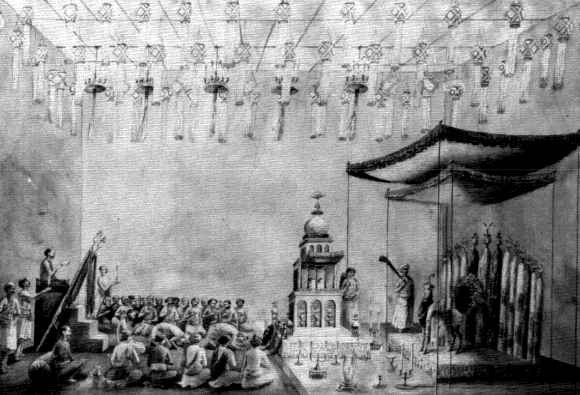
Figure 2
Rawzah-Khvani (mourning session). Courtesy of the British Library.
Since this role only required some Persian education, the mawlavi could be one of the subaltern ulama or even relatively untrained in specialized religious sciences. High ulama often held their own sessions, where they tied their recitations of the martyr's sufferings more closely to Arabic oral reports from the Imams, a style known a hadis-khvani . One of his students described Sayyid Muhammad Nasirabadi, then Lucknow's chief mujtahid, reciting oral reports from the Imams with translation: "I found him on the tenth of Muharram in the mourning session mentioning the calamities that befell the Martyr at Karbala, weeping violently, as was his audience. Then he descended from the minbar, barefoot, bareheaded, tears streaming from his ruddy cheeks. This was always his wont on such days. He thereafter went home and people gathered there."[58]
After the Persian reading, called the "ten sessions" (dah majlis ) because the works read from had ten chapters (one for each of the first ten days of Muharram), came an intermission during which servants handed around sweetened rose water to the gathering of mourners. Devout Shi‘is in the 1820s refrained from chewing betel leaves during Muharram, so servants passed about an assortment of spices on small silver trays. The highest-ranking members of the assembly smoked water pipes during the intermission, though the rest of the guests, of even slightly lower rank, dared not join them.[59]
After the refreshments, specialized reciters chanted elegiac poetry in Urdu. Even the illiterate could understand this part of the session, which must have formed the core of popular mourning sessions. Some of the verses had refrains, and the whole assembly often joined in.[60] In the early nineteenth century some reciters of such poetry employed a vocal technique that approximated singing. Readers presented verse works commemorating the martyrdom of the Imam Husayn in various rhetorical styles. The ulama favored the straightforward reading of the poetry (tahtal-lafz-khvani ), similar to that practiced by poets in secular poetry readings. Another style, antedating in India the rise of Shi‘i culture in Awadh, involved the chanting (suz-khvani ) of elegies. In Asafu'd-Dawlah's time Haydari Khan, a great singer, further innovated in this field, teaching Sayyid Mir ‘Ali, a highly respected performer at the court of Sacadat ‘Ali Khan. In such performances the musical modes (raginis ) could be emphasized or played down, according to taste. Women, and artisans and laborers, whether Shi‘i, Sunni, or Hindu, greatly loved the more musical styles. At the time of Ghaziyu'd-Din Haydar (1814-27) people came from all over Awadh to Lucknow during Muharram in hopes of hearing the courtesan Lady Haydar sing elegiac lyrics mourning
[58] Muhammad Mihdi Lakhnavi Kashmiri, Nujumas-sama " takmilah , 2 vols. (Qumm. Maktabat-i Basirati, 1397/1977), 1 245.
[59] Ali, Observations , p 23; cf. Sharar, Guzashtah Lakhna'u , p 358, Eng trans, p. 216
[60] Ali, Observations , p 23; Roberts, Scenes 2:192.
the Imam.[61] Women commonly sang marthiyyahs in public, though the ulama condemned such mixed meetings.
Some of the more strict, legal-minded Shi‘is questioned Sayyid Dildar ‘Ali Nasirabadi about the singing of elegiac poetry. He replied that listening to elegiac verses for the Imam Husayn, weeping for him, and mourning him all have great rewards. If read with a sorrowful and pained voice, they presented no difficulty at all. But he disapproved of chanting marthiyyaghs with remodulation (Persian tarjic , Urdu katkar ) as being too close to music, promising that anyone who avoided listening to such performances would be spiritually rewarded.[62]
After the mourning verses the entire congregation rose and enumerated the legitimate successors after the Prophet Muhammad according to Shi‘is, the Twelve Imams, asking blessings upon them individually. Then they repeated the names of the early caliphs, whom Shi‘is regard as usurpers, pronouncing imprecations on them. These two rituals consisted of taking an oath of allegiance (tavalla ) to the Imams and pronouncing imprecations (tabarra ') on the caliphal usurpers.[63] The mourning session concluded with a frenzied period of self-flagellation called the obsequy (ma'tam ). Even Shi‘i notables practiced it, Mrs. All reporting of upper-class ceremonies: "I have even witnessed blood issuing from the breast of sturdy men, who beat themselves simultaneously as they ejaculated the names 'Hasan'! 'Hosein'! for ten minutes, and occasionally during a longer period, in that part of the service called Mortem."[64]
Again, the ulama disapproved of flagellation. Mrs. All wrote that "Maul-vees, Moollahs, and devoutly religious persons" never joined in beating their breasts, although they were present in the audience while others thus violently expressed their grief. The ulama carried on their own mourning practices for longer than most believers in the 1820s, for a full forty days. They apparently did not participate in the mourning processions.[65] Sayyid Muhammad Nasirabadi, asked about self-flagellation in the 1820s or 1830s, replied that wailing and healing one's chest over the calamities that befell the family of the Prophet was only permissible if one lost control of one's self.[66]
Women also commemorated Muharram, though only a few princesses and wealthy courtesans had their own imambarahs . Almost all the hostesses made their best room in the ladies' quarters into a temporary imambarah , allowing only females in. Mrs. All thought the grief of women during the first ten days of Muharram greater than that of men, such that pious women
[61] Sharar, GuzashtahLakhna'u , pp 211-17, trans, pp 139, 147-50 and notes.
[62] Nasirabadi, "Najat as-sa'ilin," fol. 22a
[63] Ali, Observations , p 23, Sharar, GuzashtahLakhna'u , p. 105, Eng trans, p 86.
[64] All, Observations , pp 22-23.
[65] Ibid., p. 30.
[66] Musharraf ‘Ali Lakhnavi, ed, Bayaz-imasa'il , 3 vols. (Lucknow n.p., 1251/1835-36), 3:37.
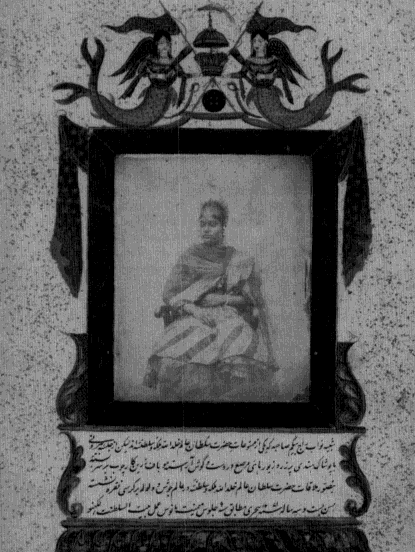
Figure 3
An upper-class Shi‘i woman of Awadh: Nawab Raj Begam Sahibah.
Born c. 1832, wife of Vajid ‘Ali Shah. Courtesy of the British Library.
would neglect their private sorrow during that period. In Hyderabad, Shi‘i women beat their breasts in self-flagellation, just as did men.[67] In Lucknow, women gave up betel leaves, the wearing of jewelry, and bright (especially red) clothes, instead loosening their hair and garbing themselves in dark colors. Some even mortified themselves by wearing their mourning clothes in torrid, sultry Lucknow for ten solid days. Mrs. Ali's serving-maid went the entire time without drinking water during the day. Every evening the ladies gathered about the cenotaph they had set up. with female friends, slaves, and servants surrounding the hostess.[68]
As elsewhere in the Shi‘i world, educated women presided at these distaff sessions.[69] In Awadh they derived for the most part from indigent Sayyid families that lacked the dowry to attract a high-status Sayyid groom but refused to accept one from a less prestigious caste, in accordance with the hypergamy (marrying up bu?? not down) widespread among Indian Muslims. They often served as Qur'an teachers for the daughters of notable families. Hostesses hired them for the first ten days of Muharram, presenting them in remuneration not only with a fee but with fine gifts as well. They read both the Ten Sessions in Persian and the elegiac poetry in Urdu.[70]
The mourning sessions held in homes during Muharram and during other months of the Shi‘i sacred calendar provided crucial opportunities for the development of social networks among Shi‘is, whether male or female, notable or commoner. Mourners went from session to session, spreading news and giving Shi‘is of one neighborhood or village a sense of unity with their coreligionists elsewhere. Lucknow became a place where Shi‘is from all over Awadh could meet at Muharram and thus overcome their sense of being isolated minority communities through congregation in the Realm of the Shi‘ah. The sessions reflected in their social composition the class and status of the host, with tradespeople excluded from notable gatherings. But within social classes and neighborhoods, the sessions did much to foster a sense of community identity.
Processions
The mourning sessions held in homes or imambarahs , although public, largely reflected kin and friendship ties in their composition. The truly civic rites, the
[67] Sharif, Qanun-i-Islam , Herkloi trans, p. 159
[68] Ali, Observations , pp. 23-29; cf. Sharar, Guzashtah Lakhna'u , p 289, Eng. trans., pp 182-83
[69] Compare Elizabeth Warnock Fernea, Guests of the Sheikh An Ethnography, of an Iraqi Village (Garden City, N Y Doubleday Anchor Books, 1969), pp 107-15, 196-97; and Robert Fernea and Elizabeth W. Fernea, "Variation m Religious Observance among Islamic Women," m N. R. Keddie, ed., Scholars, Saints and Sufis (Berkeley and Los Angeles: Univ. of California Press, 1978), pp. 385-401.
[70] Ali, Observations , p 29.
processions, brought together in the streets persons from all over each major city, as well as many visitors from nearby villages. With the development of processions, Shi‘ism came into its own as a religion in Awadh. No longer the furtive creed of isolated Sayyid communities in the service towns, it blossomed as the court's favored rite, central to the ritual life of cities like Lucknow and Faizabad.
Particular activities marked each of the ten days of Muharram. At the end of the preceding month, Dhu'l-Hijjah, middle- and working-class men brought that year's bamboo cenotaphs home from the bazaar with great ceremony. Notable families with permanent cenotaphs prepared a room or an imambarah to receive guests for the mourning sessions. The first day of Muharram witnessed, not activity, but an eerie quiet as shops closed and families began mourning at home.
On the second day, the public marveled at the imambarahs of magnates and visited the cenotaphs of friends. The devout saw such visitation as a ritual obligation substituting for the expensive pilgrimage to Karbala itself.[71] From this day multitudes crowded the streets and alleys, most on foot, but with some notables on horseback or in palanquins, making social rounds, visiting cenotaphs, and participating in the twice-daily mourning sessions. On the third day of Muharram women sent sweet dishes to friends and relatives, as well as to poor families, in remembrance of the Imam's passing, just as they would have on the third day after a loved one's death. They repeated this on the seventh and fortieth days after the first of Muharram.[72]
On the fifth of Muharram believers took out processions throughout Lucknow to Rustamnagar, where they had their standards blessed at the shrine of ‘Abbas. Mrs. Ali witnessed a notable's entourage undertaking the trip. At the head of the procession walked a guard of soldiers around four elephants, which carried men and silk-and-gold banners. In the train of the elephants came a band playing Indian instruments, as well as trumpets. Next in order came a mourner holding a black pole from which two swords hung on a reversed bow. Behind him walked the owner of the banners, accompanied by reciters of verse elegies and a large number of friends. The verses chosen for the procession particularly concerned the sufferings of ‘Abbas. Thereafter came a horse, representing Husayn's steed, Duldul a fine white Arabian. His legs were stained with red, and arrows appeared to be stuck in various parts of his body. A turban rode on the tragically empty saddle. Friends of the family, servants, and private foot-soldiers brought up the rear.[73]
Thousands of other, less affluent mourners also headed for the shrine with
[71] For the significance of visitation to Karbala for Shi‘is, see Ayoub, Redemptive Suffering , pp 180-96.
[72] Ali, Observations , pp 17-18. 32. 57.
[73] Ibid., pp 36-38
their banners. They entered it by a flight of steps-from the courtyard. A shrine attendant took the banner of each person through the right entrance and touched it against the crest of ‘Abbas's own staff. Each mourner moved on after his banner touched quickly to the sacred crest. Mrs. All estimated that shrine attendants consecrated forty or fifty thousand banners in a single day.[74] Whatever the number, the ritual demonstrates a rather high level of organization and corporate cooperation for a premodern South Asian city, given that neighborhoods of all religions and classes apparently took part.[75]
The next big day, the seventh of Muharram, commemorated the battlefield wedding of Qasim, the Imam Husayn's doomed nephew, to the Imam's daughter. In Awadh, mourners remembered the wedding through the staging of premarital processions and formalities. Notables took out processions to the imambarah of a social superior, reproducing the pattern of hypergamy as practiced by Indian Muslims. At the imambarah the mourners reposited a model of Qasim's tomb. After the completion of prenuptial ceremonies for Qasim and his bride, notables distributed money to the poor, just as they would have at a real wedding. Middle- and laboring-class people also commemorated the ill-starred wedding, but did so at home rather than with costly processions.[76] Elsewhere in India mourners introduced variations on this ritual. In Hyderabad to the south, a man sometimes impersonated Qasim and was prepared for burial at the imambarah . On the seventh of Muharram in that city mourners painted a representation of the Imam's horse made of wood and decorated it with jewels.[77]
The climax of the mourning period came on the tenth day, the anniversary of the Imam Husayn's own martyrdom. Participants rose in the early hours of the morning and began preparing for the procession, women sometimes lighting candles at the cenotaph before dawn and making requests. At dawn the mourners set out for a symbolic burial ground on the outskirts of the city, called a Karbala. In Safavid Iran, the laboring classes participated in street processions; the wealthy favored the mourning sessions inside.[78] In Awadh, however, many notables joined the street processions with great fervor. The wealthy put together a military funeral parade, with elephants, bands, a bearer of the sword staff, banners, and a caparisoned and bloodstained Duldul with a royal umbrella above his head. Friends and family of the owner, elegy chanters, incense bearers, and the owner of the cenotaph display himself walked behind, often barefoot and with heads exposed
[74] Ibid., pp. 34, 36
[75] Cf. Bayly, Rulers, Townsmen and Bazaars , ch. 4.
[76] All, Observations , pp. 42-46.
[77] Sharif, Qanun-i-Islam , Herklot trans., pp 161, 166, for Muharram in Hyderabad, see Ghulam Husayn, "Khan-i Zaman," Gulzar-i Asafiyyah (Hyderabad: Sayyid Rustam ‘Ali, 1260/1844), pp. 560ff.
[78] See Samuel R. Peterson, "The Tacziyeh and Related Arts," in Chelkowski, ed., Tacziyeh , pp. 67-68.
to the sun. Next came the cenotaph of Husayn surrounded by banners and covered by a canopy supported by silver poles, in the style of a Muslim funeral, then the cenotaph of Qasim and the wedding paraphernalia. Several elephants brought up the rear, from which servants threw money to the poor, who crowded behind the processions of the grandees. These not only sought money and blessed bread from the train of the notable's parade, but conducted their own humble processions in its wake, with their coarsely made cenotaphs held high. They thereby also sought security, since the wealthy had a guard of matchlock-men in case of trouble from brigands or Shi‘i-Sunni violence.[79]
From time to time the procession halted, sometimes as often as every five minutes. Then the notables listened to the elegies being chanted, or mourners flagellated themselves to the accompaniment of drums. Although the laboring-class mourners could not compete with the splendid pageants of the notables, they could nevertheless gain divine rewards and social status among their peers through extreme breast-beating. In north Indian cities at this time, tens of thousands of people assembled in the streets. The processions often arrived after nightfall at their Karbalas, four or five miles distant, where mourners ritually interred the cenotaphs and performed the whole ceremony of a funeral. Tempers ran high on this day of collective grief, and Sunni-Shi‘i riots sometimes broke out among Awadh's habitually armed men.
On their return home the rich distributed food, money, and clothes to the poor. The horse Duldul and his expensive attire was donated to a poor Sayyid family.[80] In the 1820s the mourning ceremonies were effectively over on the tenth of Muharram. On the third day after, men began shaving their beards again, women threw off their mourning vestments, bathed, and put on jewelry. The populace began chewing betel leaves once more. Only a few very devout persons continued to mourn for forty days.[81]
Shi‘i ulama took a critical attitude toward some of the Muharram practices, incidentally reinforcing their own status as purists. In 1808 the Iranian immigrant scholar Aqa Ahmad Bihbahani endeavored to convince notables in Faizabad to give up the practice of beating drums to the accompaniment of their breast-beating.[82] A believer in Lucknow asked chief Shi‘i cleric Sayyid Dildar ‘Ali Nasirabadi whether it was proper to employ drums and symbolic horses and camels on the tenth of Muharram. He replied that drums were a heretical innovation, but that using camels to evoke the cara-
[79] Ali, Observations , pp 46-49
[80] Ibid, pp 50-53; Roberts, .Scenes and Characteristics 2 194; Fanny Parkes. Wanderings of a Pilgrim in Search of the Picturesque , 2 vols (London Pelham Richardson. 1850), 1:298
[81] Ali, Observations , pp 56-57
[82] Aqa Ahmad Bihbahani, "Mir'at al-ahwal-i jahan-nama," Buhar Coll., Persian MS 96, fol 194b, National Lib., Calcutta.
van of the doomed Imam's family for the purpose of rendering hearts tender presented no difficulties.[83] In later years camels draped in black were brought during the month of Muharram to the Nasirabadis' imambarah itself.[84] Some later Shi‘i ulama condoned other folk practices. Mawlavi Abu'l-Hasan Kashmiri wrote in defense of even the use of drums in mourning the Imam.[85]
Ende has discussed how some Arab ulama in the modern period have defended flagellation, suggesting that they felt it to be in their interest, pecuniary or otherwise, to encourage mass participation in Muharram rites.[86] Since the Awadh ulama in the early nineteenth century received their patronage from the semifeudal notables rather than from the bazaar, they could afford in general to take a much more elitist approach. Even then, they often had to come to terms with the folk practices of the notables; Sayyid Muhammad's ruling allowed flagellation if the mourner forgot himself, providing a convenient out to those who wished to practice it. The ulama's exclusion of music, including drums, from Muharram practices derived from their greater scrip-turalism, but it had the effect of further differentiating them as a status group from their notable patrons.
In Iran very late in the eighteenth century a new practice associated with mourning the Imam grew up, the passion play (tacziyah ). From representational acts in the tenth-of-Muharram processions, wherein mourners poitrayed Husayn and his enemies, a tradition emerged of folk theater centered in a fixed playhouse. In Awadh, no such indigenous development occurred during the period under discussion. Shi‘i notables there did sponsor Hindu-style plays about Krishna, and perhaps these performances preempted the development of alternative theatrical traditions. Accounts by travelers in Bengal and Bihar reveal a higher level of playacting and representing during Muharram than existed in Awadh.[87] Ulama in Awadh gave rulings against the use of tableaux or religious paintings as backdrops during mourning sessions.[88]
The processions of Muharram filled the streets of Awadh's cities with flagellating mourners. The frenzied multitudes that so impressed Western travelers with their zeal hid, in their numbers and the seeming chaos of the
[83] Nasirabadi, "Najat as-sa'ilin," fol 25a
[84] Sharar, GuzashtahLakhna'u , p 359. Eng trans, p 216
[85] Nauganavi. Tazkuah , p 54
[86] Werner Ende, "The Flagellations of Muharram and the Shi‘ite 'Ulama'," Der Islam 55 (1978): 19-36
[87] Tennant Recreations 1 · 218-19. 184, Roberts, Scenes 2 180-81
[88] Musharraf ‘Ali Lakhnavi, ed., Bayaz-i masa'il 3 13 Sharar, Guzashtah Lakhna'u , p 360, Eng trans, pp 216-17 and note 539, says that m the late nineteenth century Mawlavi Mihdi Husayn introduced painted cuitams into the mourning session. The women of his household even staged dramas similar to Iran's tacziyahs But these late innovations, a fad. had no lasting effect in northern India In the Urdu Sharar bfames the development of drama on the laxness of the Nasirabadis themselves, which for some reason does not appear m the English text
crowded streets, an underlying organization. Procession marchers grouped themselves by neighborhood, by patron, by status group. The degree of organization that must have been necessary to consecrate thousands of standards at the shrine to the standard of ‘Abbas bespeaks a vast increase in Lucknow's cohesion and a sophistication in Shi‘i and non-Shi‘i Muharram networks.
Non-Shi‘i Participation in Muharram
The culture of Awadh, a preindustrial society, demonstrated syncretic tendencies. Cultural mediators, such as Sufi pirs, drawing their clientele from both Muslim and Hindu, transmitted symbols from one group to another. Muharram rites in Awadh began to serve the same mediating function for some groups. Boundaries between religious communities existed, and riots occurred between Hindu and Muslim or Sunni and Shi‘i. But to a greater extent in the early nineteenth than in the early twentieth century, cultural mediators linked popular-class groups.[89]
Sunni Muslims in Awadh in the eighteenth and nineteenth centuries also held mourning sessions, but frowned on the breast-beating and ritual cursing of the Shi‘is. Sunnis likewise participated in Muharram processions, but in various ways differentiated themselves from Shi‘is. For instance, although the latter held up five fingers to symbolize the Prophet's immediate family, the Sunnis would hold up three fingers, for the first three caliphs.[90] For Awadh's Sunnis, ‘Ali and his sons were the rightful successors of the caliphs, not their victims. Although Sunni-Shi‘i violence frequently broke out on this occasion, it derived from a different conception of the caliphs, rather than from any sympathy for the Umayyad enemies of Husayn. After the 1820s some Sunnis began to speak well of the Umayyads, probably as a reaction against the Shi‘i atmosphere of Awadh. Only in the first decade of the twentieth century did the two communites became so estranged that even Sunnis who mourned Husayn began taking their model cenotaphs to different burial fields than the Shi‘is for interment.[91]
The vast Hindu majority often also took part in the mourning for Imam Husayn, incorporating his cult into their ritual calendar as yet one more divinity in the pantheon. The Iranian traveler Shushtari saw Hindus com-
[89] For premdustrial Hindu-Muslim cultuial mediation and syncrcetism in Bengal, sec Asim Roy, The Islamic Syncretistic Tradition in Bengal (Princeton Princeton Uuiv Press, 1983). ch 2
[90] Roberts, Scenes 2 192-93: Sharif. Qanun , trans Herklots, p. 159
[91] For the twentieth-century development of Muharram m Lucknow, see Sarojini Ganju, "The Muslims of Lucknow 1919-1939," in Ballhatchet and Harrison, ed, The City South Asia , p. 290, Imtiaz Ahmad. "The Shia-Sunni, Dispute m Lucknow, 1905-1980," in M. Israel and N. K Wagle. eds. Islamic Society and Culture Essays in Honor of Professor Aziz Ahmad (Delhi Manohar, 1984), pp. 335-50, Keith Hjortshoj, "Kerbala in Context A Study of Mohurram in Lucknow, India" (Ph D diss., Cornell Univ, 1977). Sandria Freitag, "Religious Rites and Riots," ch 7
memorating Muharram all over North India in the late eighteenth century. He wrote that in Delhi wealthy Hindus with not the least trace of Islam about them went to great trouble to construct imambarahs . They fasted during Muharram, recited elegies for the Imam in Hindi, Urdu, and Persian, pelted each other with stones in mortification, and fed the poor. They constructed replicas of the Imam's cenotaph, bowed to them, and supplicated them for favors. After the tenth of Muharram they threw the cenotaphs in the river or buried them. Shushtari found some of the Hindu approaches to fasting and self-mortification during Muharram quite strange, maintaining that Indian Muslims copied them.[92]
The Kayastha scribal caste in particular adopted Muslim customs, owing to their long association with Muslim rulers as secretaries and revenue-department civil servants. Many Kayastha notables built their own imambarahs .[93] But Hindu popular-class participation in Muharram processions and attendance at public mourning sessions, such as those at the Great Imambarah, cut across caste lines. Roberts wrote, "Hindoos . . . are frequently seen to vie with the disciples of Ali in their demonstrations of grief for the slaughter of his two martyred sons: and in the splendour of the-pageant displayed at the anniversary of their fate. A very large proportion of Hindoos go into mourning during the ten days of Mohurrum, clothing themselves in green garments, and assuming the guise of fakeers."[94]
Fanny Parkes's Hindu cook spent forty rupees on a bamboo cenotoph for the Imam, performed all the Muharram rites, and then resumed his Hinduism when he had interred his cenotaph with funeral offerings of rice, corn, flowers, and cups of water.[95] In the Hindu-ruled provinces of central and southern India, as well, Hindus celebrated Muharram with processions and illuminations. Strict, scripturalist Brahmins often opposed this practice, but even some of them mourned Husayn. In Sunni-ruled Hyderabad riots would sometimes break out between Hindus and Muslims during Muharram, and the Hindus participating in the mourning rites would actually take the Muslim side against their coreligionists.[96]
Hindus therefore not only widely participated in the Muharram rites but helped influence their shape in India by introducing practices that even high-caste Muslims adopted. Garcin de Tassy pointed out that Muharram, like
[92] Shushtari, Tuhfatal-calam," foll. 199a-b.
[93] Cf K. Leonard, The Social History of an Indian Caste: The Kayasths of Hyderabad (Berkeley and Los Angeles: Univ of California Press, 1978), pp. 81-89, 103-4; for Kayasthas in northern India, see W. Crooke, The Tribes and Castes of the North-Western Provinces and Oudh , 4 vols. (Calcutta: Office of the Sup't of Government Printing, 1896), 3:184-216.
[94] Roberts, Scenes 2:186.
[95] Parkes, Wanderings 1 296.
[96] Roberts, Scenes 2:186; W. H. Sleeman, A Journey through the Kingdom of Oude in 1849-1850 , 2 vols. (London: Richard Bentley, 1858), 1:276; Sharif, Qanun-i-Islam , Herklots trans., pp. 166-67.
the festival for the Goddess of Death, Durga, lasts ten days. On the tenth day of Durga puja Hindus cast a figurine of the goddess into the river, paralleling the Shi‘i custom of often casting the Imam's cenotaph into the river on the tenth day of Muharram. The Muslims made the same offering to the Imam that Hindus proffered their sacred figures.[97] Since high-caste Shi‘is and Hindus considered each other ritually impure and unbelievers, popular-class syncretism of this sort sometimes posed problems for strict Shi‘is. Someone asked the chief mujtahids in the early 1830s whether an unbeliever could properly give an offering in cash or kind to the Imams and distribute cooked food to poor believers during Muharram. The mujtahid replied that the most cautious course was for them to bring such food only if the host of the mourning session asked them to do so (ahvat ast kih bar tibq-i guftah-'i malik arand).[98]
Widespread, though not universal, Sunni and Hindu participation made Muharram rites trans-communal. Sunnis in Awadh genuinely loved and supported Husayn, and the tears they shed for the Prophet's grandson helped soften hardline Shi‘i attitudes toward them. Hindus commemorated Muharram as well, adopting Husayn as a god of death, his bloodstained horse and his severed head lifted aloft on Umayyad staves presenting no less terrible an aspect than Kali Durga with her necklace of skulls. Syncretism and cultural intermediaries, such as readers of elegiac poetry, helped create a Shi‘i tinged traditional culture in a society where, among the popular classes, religious communal identity was still weak or at least not exclusivist in tone.
Conclusion
Muharram rituals constituted a complex of practices carried out on a mass scale. These rituals were highly ambiguous, both in regard to vertical stratification among religious communities and in regard to horizontal stratification within the Shi‘i grouping. Some of these practices, bearing an ecumenical aspect, were joined in by many Sunnis and Hindus. Others helped spread Shi‘i ideals among the masses and promoted social networks among believers, not only within city quarters, but between city dwellers and visitors from the qasabahs in the hinterland. More than anything else, the practice of cursing the caliphs helped erect communal barriers between Shi‘is and others, and the violence it provoked helped reinforce internal Shi‘i solidarity. Yet that solidarity did not completely obscure the social distinctions separating notables and commoners.
The Muharram commemorations, including the "pilgrimages" to the cenotaphs and the focus on death, demonstrate the coexistence of structure
[97] M. Garcin de Tassy, Mémoire sur des particularités de la religion musulmane dans l'inde (Paris: L'Imprimerie Royale, 1831), pp. 11-12, 30, 38-41.
[98] Musharraf ‘Ali Lakhnavi, ed., Bayaz-imasa'il 3:97.
and anti-structure. On the one hand, social distinctions temporarily broke down into liminality and a generalized feeling of leveled community (communits ), which the late Victor Turner found typical of such rites.[99] The notables of both sexes demeaned themselves in bereavement for the Imam, men walking barefoot and bareheaded under Lucknow's harsh sun, and highborn ladies wearing the same sweaty clothes for ten days in a climate that called for frequent baths.
The mourning processions and the notables' distribution of largesse created a sense of solidarity among social classes. But in important ways mourners intensified structure, emphasizing distinctions of class and status in the exclusivity of the mourning sessions at imambarahs and in the primacy of notable pageants during the Muharram processions. Indeed, the processions constituted a microcosm of Awadh's prebendal hierarchical social structure. Muharram was a prime opportunity for the display of wealth and various sorts of expenditure that contributed to the expression of high status. Moreover, at the same time that the ceremonies drew together the participants from various classes and religious communities, they often sparked communal violence because some Sunnis and Hindus objected so strongly to them.
The mourners of Husayn in the bazaar or in the large villages worked their own genius on Muharram rites, such that they often created ritual forms later usurped by the notables, including veneration at the shrine of ‘Abbas. Although the notables excluded the popular classes from the services at their private imambarahs , and forced them to march behind their elephants in the procession, the popular classes in many ways led the way in venerating the Martyrs, expressing their grief in everyday ways that helped make the Imam and his family real to them. For they were, after all, the experts in what it meant to be oppressed.
The Shi‘i notable class, whose distribution of gifts and cash during processions helped ensure the participation of the poor, promoted the extensive mourning rites for Husayn. Fenced in by the East India Company, the notables had little opportunity to invest in territorial expansion, expressing their culture and prestige through religious architecture and patronage instead. In addition, informal laboring-class associations shared expenses and promoted the rites. In some places Sufi faqirs organized the ceremonies, during which they received offerings.[100]
People used the story rhetorically and allegorically as well as ritually.
[99] Victor Turner, Process, Performance and Pilgrimage. A Study in Comparative Symbology (New Delhi: Concept Publishing Company, 1979), ch. 4 "Death and the Dead m the Pilgrimage Process," and The Ritual Process Structure and Anti-Structure (Ithaca, N.Y., Cornell Univ. Press, repr. 1977), pp. 94-130.
[100] Marc Gaborieau, Minorités musulmanes dans le royaume hindou de Nepal (Nanterre: Laboratoire d'Ethnologie, 1977), pp. 121-22, 182-83.
Some notable-class Shi‘is depicted the encroaching British as the evil Yazid in the 1857-58 rebellion. Among laboring-class devotees of the Imam the tax collectors and police of the Shi‘i government itself may have been seen at times as the real Yazid. Moreover, where Muslim villagers were a small minority surrounded by unbelievers, the Umayyad armies attacking Husayn came to be portrayed as Hindus.[101]
The artisans, laborers, and peasants depended on the largesse of the Shi‘i rulers, and this link of dependency encouraged the little people to share with the rulers in their religious practices. In this way a general Shi‘i community came into being, still loosely organized, but enjoying new and wide-ranging social networks built around the sacred calendar of Imami mourning sessions and processions. In the early nineteenth century this calendar was also shared by many Sunnis and some Hindus. Yet some Awadh government policies helped make Muharram rites, at times, divisive of religious communities. When the early stages of political mobilization began late in the nineteenth century, Muharram processions and violence began serving a new purpose in creating communal identities, which grew into political ones in the twentieth century.[102]
[101] Ibid., p. 121
[102] See, especially, Freitag, "Religious Rites and Riots."