
5—
Rendez-vous with Marcel Duchamp: "Given"
Besides it's only the others that die.
—Marcel Duchamp
During the last twenty years of his life, Marcel Duchamp secretly worked in his Fourteenth Street studio with the help of his wife, Teeny Duchamp, on his testamentary work, Given: 1) the waterfall, 2) the illuminating gas (Etant Donnés: 1) la chute d'eau, 2) le gaz d'éclairage ). During those twenty years, from 1946 to 1966, Duchamp's friends and critics alike were willing to take his "apparent" artistic inactivity as the final statement of his abandonment of art. They wanted to believe that Duchamp had finally abandoned art for chess.[1] The public began to take literally Duchamp's pronouncement that he preferred "living rather than working," by accepting his self-description "I am a breather" (Je suis un respirateur ), heavy or otherwise.
Once Given was reassembled and displayed as an installation at The Philadelphia Museum of Art, its defiant presence challenged the critics to a reevaluation of the entire Duchampian corpus. Exhibited posthumously, this work illuminates Duchamp's oeuvre retrospectively, recasting the viewer's perceptions and inviting a renewed evaluation of his contribution to the history of modern art.[2] Given Duchamp's overt admission that "eroticism" is the only ism he believes in, the sexual nature of this work was not surprising, although the androgyny of the nude continues to occasion discussion. Rather, what upset art critics more was Duchamp's apparent rejection of his own antiaesthetic position, as exemplified by the ready-mades. In spite of the multimedia nature of this installation,
Duchamp's ostensible return to a "figurative approach," was, for many, a sign of his return to aestheticism.[3]
The most obvious and objectionable aspect of Given is its peephole character: the fact that the viewer is fixed in a voyeuristic position, more akin to carnivals or pornographic shows than to a museum. This sense of discomfort is all the more pronounced, given that Duchamp's best known work, the Large Glass , is transparent and affords the spectator a view from all sides. Despite these notable differences, John Cage suggests that Given may be a translation of the Large Glass :
He would like us to believe, I think, that the Etant Donnés is a translation of the Large Glass —the same work restated in a way which is very uncomfortable for us, because we had grown to like the transparency for one thing. In Etant Donnés he does the exact opposite, imprisoning us at a particular distance and removing the freedom we had so enjoyed in the Large Glass .[4]
Cage's hypothesis is based on Duchamp's own repeated observations (like a "refrain"), that "he thought it would be interesting if artists would prescribe the distances from which their work should be viewed. He didn't understand why artists were so willing to have their work seen from any position."[5] Thus the spectator's predicament as voyeur reflects Duchamp's deliberate gesture to hold the viewer at an arm's length. But why, and why now? In our previous discussion of the ready-made In Advance of the Broken Arm , I suggested that this work reflects Duchamp's effort to abandon painting by literally holding it off, at an arm's length. At first sight, Given may be interpreted as a return to figuration, and thus, by extension, to pictorial conventions. However, Duchamp's strategy of imposing the peephole set-up on the spectator, while denying the public visual access to this work (since for fifteen years this work could not be photographically reproduced), attests to his continued inquiry into and challenge of the spectator's position as a consumer of works of art.
But how is Given a "translation" (to use Cage's terms) of the Large Glass? The double subtitle of Given: 1) the waterfall, 2) the illuminating gas provides some interesting clues. Since both the waterfall and the illu-
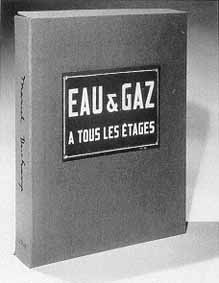
Fig. 68.
Marcel Duchamp, Water and Gas on All Floors
(Eau et gaz à tous les étages), 1958. Imitated
ready-made: white lettering on blue enamel plate
(5 7/8 x 7 7/8 in.), facsimile of the plates affixed to
apartment houses in France in the early 1890s.
Courtesy of The Philadelphia Museum of Art,
Louise and Walter Arensberg Collection.
minating gas are explicit visual elements in Given , their itemization in the title suggests their affinity to ready-mades. This association is not altogether surprising considering that the sign Water and Gas on All Floors (Eau et gaz à tous les étages ; 1958) (fig. 68) designating the comforts of modern life, or rather, its "conditions of possibility," was one of Duchamp's favorite "ready-mades." During his first solo retrospective at the Pasadena Art Museum (1963), Duchamp not only insisted that the ready-mades be exhibited in the same room with the Large Glass but he also specified that the three ready-mades Paris Air, Traveler's Folding Item , and Fountain be installed as they appear in the Box in a Valise (fig. 69). To Walter Hopps's query, Duchamp responded that they were like "ready-made talk of what goes on in the Glass ."[6]
Considering the nature of these works, dealing with air (gas, a pun on art and evaporated paint) and water (Fountain , an instance of "dry art," signifying a departure from the "splashing of paint"), we may begin to understand their implicit commentary on both the Large Glass and Given. The typewriter folding case that separates the two (bearing the brand name "Underwood") takes on new meaning once we consider Duchamp's comment to Cage, that having a second studio "was a way of going underground."[7] Duchamp's deliberate effort to go "underground,"
by hiding his work on Given for twenty years, illuminates the challenge that this work presents to posterity: that of "getting out of the woods," a figurative allusion, perhaps, to Duchamp's own efforts to move away from a traditional concept of artistic representation. The traveling case of the Box in a Valise reiterates Duchamp's continued desire for movement, already present in such early works as Nude Descending a Staircase . But Duchamp's move away from pictorial traditions, which has defined so conclusively the meaning of art to this day, is a movement that has unwrapped and unfolded them, a gesture already hinted at in his earlier Traveler's Folding Item . By exploring how Given functions not as an individual work but as a context for the entire Duchampian corpus, the following pages will demonstrate how this work stages the strategic interplay of the various artistic media, those of painting, photography, and sculpture. The "appearance" of this work will be examined as a function of these different media, as modes of "impression," that conflate artistic and mechanical forms of reproduction.
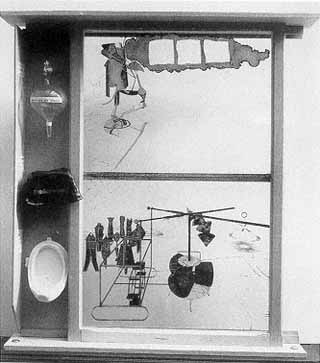
Fig. 69.
Marcel Duchamp, Centerpiece Of Box in a Valise, series of 1961.
Galleria Schwarz, Milan.
Courtesy of Arturo Schwarz.
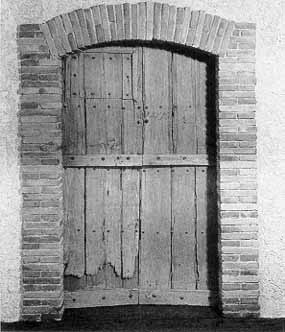
Fig. 70.
Marcel Duchamp, Given: 1) The Waterfall, 2) The
Illuminating Gas (Etant Donnés: 1) La Chute D'eau,
2) Le Gaz d'Éclairage), 1946–66. Exterior view.
Courtesy of The Philadelphia Museum of Art, gift of the
Cassandra Foundation.
Rendez-vous with the Visible: Cul-de-Sac
No need for birds and bees to tell us that.
—Lord Byron
Most critical discussions of Marcel Duchamp's last work begin at the threshold, as if one were looking at a painting:
At the end of a narrow, underlit room, little more than a corridor, stands an ancient weather-worn door of wood, arched and encased in a surround of bricks. One senses at once that the door cannot be opened but one is drawn towards it as if by a magnet, and as one comes closer one becomes aware of two small holes, at eye level, drilled through the wood. Beyond the door lies an extraordinary sight.[8]
John Golding's description of the door (fig. 70) is an echo of Anne d'Harnoncourt's catalog notice, which is repeated by other critics since the work was not allowed to be photographed for fifteen years. Invariably, an account of the door is followed by the story of what is given, of what one sees beyond the door, as if this obstacle did not really exist.[9] Octavio Paz, underlining the material obstacle presented by the door, observes: "The door sets its material doorness in the visitor's way with a sort of aplomb: dead end."[10] But this dead end becomes for him,
as for Golding, a mere pretext, the invitation to step through the threshold of the door into the scene beyond. This door, "A real condemned door" (to use Paz's words), "magnetically" (Golding) invites transgression, that is to say, it provokes one to look beyond it and thus challenge its objective inviolability. Paz sees this door as different from Duchamp's previous door, Door: II, rue Larrey , which is described by Arturo Schwarz as a "three dimensional pun," a door which is permanently open and shut at the same time.[11] The door of Given is for him "the opposite of hinges and their paradoxes," that is, a door whose objective reality condemns further exploration.[12]
It is exactly on the door, however, that the narrative of the spectator hinges. Such a narrative presupposes another unspoken given: that of the enlightened spectator or informed critic. What Golding's and Paz's interpretations fail to take into account is the difficulty the viewer might have in finding the door and the peepholes in the first place in a narrow, underlit room. Rather than being "magnetically" (Golding) attracted by the door, the first-time observer has trouble identifying the room as a site for art, since an underlit room does not correspond to our expectation of what constitutes display in a museum. The darkened room, which is accidentally stumbled upon, is often disregarded, despite the label of a work not visible within its confines. The only thing that draws us into the room is the presence of other spectators like us, looking. Their look initiates us into the possibility that there is something worthy to look at. Conspiratorially, we join them, since after all, we are expected to look in a museum. Unless the viewer is already initiated, she or he risks missing out entirely on the experience, intoxicated as one is with the conviction that the museum is an archive for visual consumption.
By contrast, the initiated critic comes to the museum informed. She or he "knows" that Given is Duchamp's last and most mysterious work, and thus rediscovers only that which is already given as looked for —the raison d'être of the museum as a ready-made . Before the question of visibility, of what we see in Given , can even begin to be posed, Duchamp has already fragmented the spectator's point of view, repositioning us through this "hinge" experience within the institutional space of the museum. Detouring the spectator from simply looking, Duchamp's Given makes us stumble on the idea of the museum, on which "hinges" the reality of a
work of art. The idea of the museum is no less opaque than the door of Given , guarding a mythical testament, that of the visible immortality of works of art. This visual immortalization supplants the mortality of the artist, however, by substituting itself for it.[13] The "visibility" of the work of art functions as the "cemetery" of the artist, since it objectifies and perennially simulates the gesture of creation as the illusion of life. Before we can ever begin to experience a work of art, we are "unhinged" by the realization of the "ready-made" character of all art: the tautological logic of the institutional conventions establishing the legitimacy of the museum as a cemetery of authority, of "uniforms and liveries" (to use Duchamp's terms in the Large Glass ).
This experience of encountering the door to Given is prefigured by the experience of Duchamp's ready-mades. Before arriving at the doorway of Given , the viewer has already been initiated into the fate of ready-mades as artistic "givens." Despite one's resistance to seeing ordinary objects transformed into art objects, the viewer has already witnessed the artistic legitimization of works such as Bicycle Wheel (fig. 40, p. 98) and Trap (fig. 39, p. 93). These ready-mades resist the visual appropriation of the public by instilling a sense of discomfiture: an internal doubt or split as spectators, before the elevation of an ordinary object through the artist's nomination (a rendez-vous, in Duchamp's terms), into something different—an art object. The ready-made is a visual lure; it is the perfect copy of an object, since it is the object itself. Roger Dadoun understands Duchamp's materialist intervention in terms of this dissociation marking the visible character of the object as "a sign which expropriates the object of its proper character."[14] The visible appearance of the object thus emerges as an obstacle to its perception as an "art-object." This visual expropriation of the object marks the contextual nature of the ready-made as a sign that is only legible as a punning hinge between an ordinary object and/or an art object. As a hinge, the ready-made is the doorway between the visible and the discursive, between art and nonart, whose "objective" character is merely the construct of this interplay as a "delay" effect.
At first sight, Duchamp's door in Given , which is an imported real-life Spanish country door, resists because of its material abjectness and its being nailed shut its immediate assimilation to the ready-mades. Since one
can look through the peepholes, however, this door also functions as a window, recalling two of Duchamp's earlier door/windows, Fresh Widow (1920; semi-ready-made) and The Brawl at Austerlitz (1921). These works, like the door in Given , block the spectator's view, thus inviting a reflection on the accessibility of vision as constructed through spectatorship. Thus the door that the viewer literally stumbles on in his or her efforts to see beyond is not merely the obstacle but also the medium through which the always extraordinary dimension of the visible is figured. The problem is not merely that the visible is "ready-made," constructed through the logic of the museum, but also that the act of looking involves a construct (as that which gives itself to sight—the "peep show") of varied modalities combining the image and its discursive frames of reference. This door thus emerges as a pun on the immediacy of the visible, since it also acts as an obstacle to understanding the structures of spectatorship that frame visual experience. The material obstacle that the door presents becomes the site of reflection on the mediated character of vision within the institutional space of the museum. In the pages that follow the construction of vision, spectatorship, and gender will be at issue.
Looking at the Looking, Even
The mystery of the world is the visible, not the invisible.
—Oscar Wilde
The spectator makes the picture.
—Marcel Duchamp
Once we are on the threshold of the door to Given , an unusual sight confronts us (fig. 71). Looking through two small holes at eye level, we find ourselves in front of a display akin to both window displays and to a rudimentary peep show. Golding summarizes this "extraordinary" sight as follows:
On a plane parallel to the door and some few feet beyond is a brick wall with a large uneven opening punched through it. Beyond and bathed in an almost blinding light is the figure of a recumbent woman modelled with great delicacy and veracity but also slightly troubling because the illusion of three dimensionality is strong but not totally convincing (the figure is in fact in about three-quarter relief). She lies on a couch of twigs and branches and she opens her legs out towards the spectator with no false prurience or sense of shame.[15]
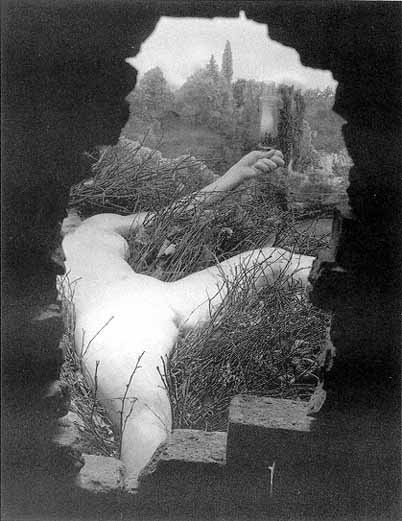
Fig. 71.
Marcel Duchamp, Given: 1) The Waterfall, 2) The Illuminating Gas (Etant Donnés:
1) La Chute D'eau, 2) Le Gaz d'Éclairage), 1946–66. Interior view.
Courtesy of The Philadelphia Museum of Art, gift of the Cassandra Foundation.
Before examining this scene, it is important to consider the voyeuristic context in which it takes place—the way in which the gaze of the viewer is set up. The problem with the scene is its "hyperreality," its excessive realism, which stages eroticism as a "too" obvious spectacle.[16] The dioramalike character of the scene is further emphasized by the presence of an almost blinding light, an excess of illumination. The enigma that Given presents to the viewer is like no other. What mystifies the viewer is exactly
the overdetermined "explicitness" of Given : its hypervisibility and emphatic sexuality. The excessive clarity of the scene makes us question the unquestionable: "What then is less clear than light?"[17] This scene problematizes one of the major givens of the Western pictorial and philosophical tradition: the equation of reason and light, since light here functions as the sign of doubt. The excessive illumination of the scene makes us uncomfortable, breaking up the structure of voyeurism, its raison d'être—as the equation of sight and pleasure.[18]
The perspective of the viewer is fragmented by the hyperreality of the image, by its overdetermined character. The illumination of the scene illuminates our gaze, effectively disrupting the coincidence of vision and the reality of sex. Thus, the verisimilitude of the scene, the reduction of the body to reality, is derealized, since vision itself is refracted by being staged through the peephole apparatus. The scene presented to the spectator can be neither anticipated nor participated in. The traditional structure of spectatorship is dislocated, since the viewer cannot simply identify him- or herself through looking, and thus take pleasure in "making" or appropriating the picture by inscribing his or her own desire. This image "unmakes" its viewer. The authority and the legitimacy that Western "retinal" painting confers on its spectator are here undone, since the blatant sexuality of the image challenges the act of looking. The coincidence of the eye and the "I," represented in the notion of perspective as a point of view, is irrevocably disrupted.[19] This is why, despite its explicit sexual content and its peephole character, Given cannot be equated with the objectification of the female body through voyeurism. While feminist and film studies have elucidated the ideological underpinnings of the male gaze through an analysis of the role of the camera and structures of spectatorship, Given challenges such a reduction by objectifying the very presuppositions that govern the visible"[20]
A tableau vivant that travesties itself as a "nature morte," Given restages the issues that Duchamp elaborated in sculpture-morte (fig. 57, p. 150), or more explicitly, in TORTURE-MORTE (fig. 56, p. 148). Contemporary to Given, these assemblages stage the dead-end character of visual illusion, as it attempts to replicate the real. The excessive realism of these assemblages reveals that they, like Given , are false doorways to the "real." They problematize the indexical nature of vision, its ability to
refer or point, since their simulated reality cannot be resumed either in the order of demonstration or designation. Rather than taking for granted the referential relation of vision and sexuality (as art historians have done), or by reducing vision to the ideology of the gaze (as feminist critics have suggested), this essay will resituate the notion of sexual difference by questioning how vision determines its "modes of appearance" (to use Duchamp's terms) in Given . At issue, therefore, is the phenomenality of vision, its construction, and its effects.[21] In order to explore how the visible is constructed in Given through the displacement of indexical relations, it is vital to examine two of its major "hinges," the body and the landscape, which are both traditional sites in the history of art for the mimetic creation of "reality."
To begin with, the androgynous nature of this nude figure (the "last nude," to echo Lyotard) is ambiguous, with passively and/or aggressively bared genitals that are echoed in the pointed gesture of the raised and disproportionately enlarged arm that is assertively clasping a gas lamp. Recalling Gustave Courbet's Woman with a Parrot (1866), the nude's upraised arm holds a gas lamp, instead of the vividly colored parrot. The painterliness of the parrot, whose range of colors recalls the painter's palette, may be an allusion to Courbet's own fascination with pictoriality.[22] Replacing the parrot, the "phallic" upturn of the gas lamp illuminates Duchamp's invitation to the spectator to renew his or her "gaze," by literally casting painting in a new light. While drawing on the conventions of painting, Duchamp's installation of the plaster cast nude also announces its imminent demise. The androgynous character of the nude, manifest in the deictical gesture of the raised arm with the gas lamp, activates the nude as a potential agent or subject, rather than as a mere object of display. Although more can be said about the androgyny of the nude, little has been said about its "dead" or "mechanical" character. The sexual ambiguity of the nude is compounded by a more profound ambiguity: that of the reality of its "life." Before examining some of Duchamp's explicit references to nudes in a series of lithographs based on Courbet, it is helpful to consider his allusions to René Magritte's (1898–1967) painting The Threatened Assassin (L'Assassin menacé ; 1926) (fig. 72).[23]
In addition to presenting a mannequin (a "dead nude"), Magritte's The Threatened Assassin , like Given , stages the structure of voyeurism as a
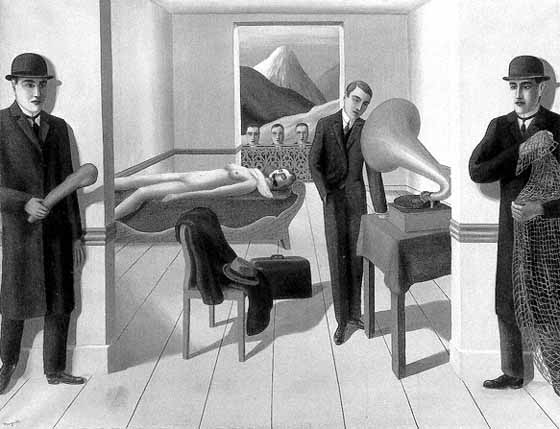
Fig. 72
René Magritte, The Threatened Assassin (L'Assassin Menacé), 1926.
Courtesy of The Museum of Modern Art, New York.
gendered gaze, since the ambiguous "assassin" and/or "policeman" in the foreground is conflated with the gaze of the viewer. This painting represents the fragmentation of pictorial perspective or point of view through the multiplication of figures of assassins, policemen, and/or witnesses within its frame. The two "assassins/ policemen" in the foreground are conflated in the figure of the man listening to the gramophone, as witnessed by three men in the background, surveying the scene from behind the balcony. These three figures look at the viewer looking. The painting sets into motion a delirium of vision, a variety of male spectators—potential assassins and policemen, organized around the spread-eagled nude. Magritte's painting, like Duchamp's Given , stages both the transgressive (assassin) and the rationalizing (policing) dimensions of the spectator's gaze. The victim at the center of the scene, the nude as both text and pretext of representation, embodies the "deadening" or even "murderous" character of the male gaze, as it objectifies (and thus "kills") the body offered for viewing. The body of the nude thus emerges merely as residue, the dead torture (torture morte ) of the male gaze that has immortalized it in the history of painting. The violence of the gaze, however, paradoxically killed a mannequin, a figure embodying ready-made conventions.
Duchamp's allusions to Courbet's paintings make explicit the structures of spectatorship and voyeurism implicit in his works. The lithograph Selected Details After Courbet (Morceaux choisis d'après Courbet ; March 1968) (fig. 73) reproduces Courbet's famous painting in the Barnes's Collection Woman with White Stockings (fig. 74), with one remarkable difference. At the bottom of Duchamp's lithograph is the additional figure of a falcon (faucon , in French, a pun on faux con ) who disrupts our perspective of the visual field, since the falcon in the foreground is disproportionately smaller—although it is closer to our field of vision. Presented as a peeping torn, the falcon embodies visual prurience since his name is a pun on faux con (false sex, in French). This verbal pun on false sex (faux con ) competes with and displaces our attention from the visual referent, the "true sex" (vrai con ) of the nude's bared genitals.[24] Embodying the voyeuristic desires of the spectator, the falcon makes explicit the representational conventions that define the construction of sexuality as visual referent. The supposed reality of sex as visual fact is reframed by the verbal puns that play the falcon off against the facticity of sex.
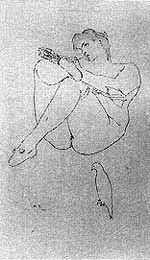
Fig. 73.
Marcel Duchamp, Selected Details
after Courbet (Morceaux Choisis
d'après Courbet), second state, 1968.
Etching pulled on japan vellum, 19 7/8 x
12 3/4 in.
Courtesy of The Philadelphia Museum of Art,
Louise and Walter Arensberg Collection.
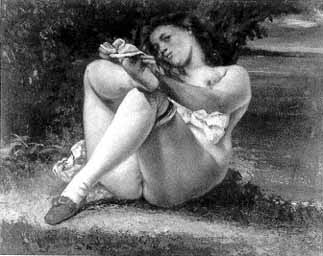
Fig. 74.
Gustave Courbet, Woman with White Stockings
(Femme Aux Bas Blances), 1861.
Courtesy of The Barnes Foundation, Merion Station, Pennsylvania.
The punning reference to the genitals of the nude can also be seen in another lithograph from the same series as Selected Details After Courbet , entitled The Bec Auer (January 1968) (fig. 75). Superimposed in this lithograph depicting a nude who is clasping a gas lamp like the one in Given is the figure of a male companion whose hairy head decenters our gaze from the woman's genitalia, thus resituating the sexual referent of the image. The viewer's gaze of the woman's head is physically blocked by the man's elbow and internalized within the image through his gaze back at her. The spectator's voyeurism is illuminated, as it were, by the man's privileged visual access to this scene. The title of this lithograph. The Bec Auer , which refers to the brand name of an electric bulb, reinforces this suggestion. Duchamp thus illuminates the spectator's gaze in a manner that recalls the falcon (faux con ) in Selected Details After Courbet (Morceaux choisis d'après Courbet ), which is a pun on the viewer's gaze as visual delectation. As the figure of desire, the gaze is equated with the falcon's beak pecking at favorite morsels, "morceaux choisis ." This interplay of visual and verbal puns suggests that the "illuminating gas" in the title of Given may refer to and illuminate the "gaze" as well. These lithographs illuminate the conventions of spectatorship by documenting the failure of the male gaze to penetrate or objectify the notion of sexuality.
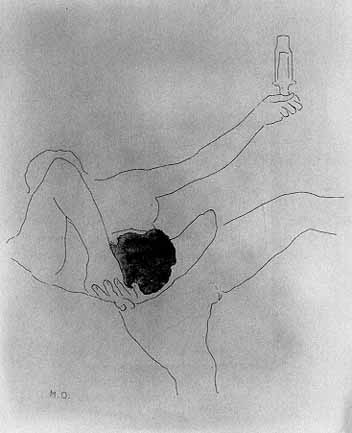
Fig. 75.
Marcel Duchamp, The Bec Auer, Second State, 1968. Etching pulled on
Japan vellum, 19 7/8 x 12 13/16 in. Courtesy of The Philadelphia
Museum of Art, Louise and Walter Arensberg Collection.
For the display of nudity in these works makes visible the dead-end character of painting understood as a peep show
Duchamp's allusions to sexuality in Given parody its "reality" through his punning reproductions of Courbet. The "sexuality" of the nude is depicted as it is being "reproduced," assembled and taken apart, realized and derealized, simultaneously. Thus, the pictorial representation of sexuality emerges as a mere decoy, an object simulating the illusion of life by acting mechanically as lifelike. The nude in Given derives her eroticism from her mannequin-like character: her lifelike semblance stages life hyperrealistically—more successfully than life itself. The discourse of eroticism in Given is thus revealed transitively, not as an attribute of
appearance but as a movement, the declension of an apparition (recalling Duchamp's famous Nude Descending a Staircase , No. 2) (fig. 7, p. 27). Rather than merely revealing the naked sex, the absence of pubic hair on the sex of the nude also alludes to the pictorial tradition throughout which the female sex had been dissimulated, and thus outlined, even more emphatically. Duchamp's allusion in his notes to the veiled sex, the "Abominable abdominal furs" (Notes , 232) becomes a pun on fur (fourrure ) as mad laughter (fou rire) (Notes , 272). This pun stages the ambiguous meaning of genitalia in Given . It designates the recognition that sexual organs may be only the "indirect" index of gender, and consequently, no more reliable than a joke, like the false mustache and beard added to Leonardo's Mona Lisa in Duchamp's rectified ready-made L.H.O.O.Q. (fig. 53, p. 140). Instead of veiling the female sex in Given by covering it up with "abdominal furs," Duchamp bares it, or rather, shaves it like L.H.O.O.Q. Shaved (fig. 55, p. 146). The field of twigs (shavings) surrounding the nude marks this displacement. Sexuality is thus presented as a movement, the imperceptible visual and linguistic slip (the fake striptease), enacting through the anamorphosis of a pun the transitional character of eroticism.
This construction of eroticism as a movement can also be seen in Duchamp's implicit reference in Given to Albrecht Dürer's Draftsman Doing Perspective Drawings of a Woman from De Symmetria Humanorum Corpum (Nuremberg, 1532) (fig. 76). In this print a stylus is interposed between the eye of the spectator and the view point (which corresponds to the sex of the woman). The stylus is an archaic instrument, a machine for the organization of perspective, at whose edge or point the viewer adjusts his or her eye. At some distance, there is a small gate through which the visual rays of the body are projected. Jean Clair, in "Marcel Duchamp et la tradition des perspecteurs," describes the scene in similar terms, without dwelling, however, on its meaning.[25] The figure of the body viewed through the stylus elucidates the nature of eroticism in Duchamp as a rhetorical operation .[26] In the Dürer etching the stylus , which is normally a writing utensil, doubles as a visual instrument for the construction of the body, designating sexuality as the site (sight) of coincidence, constituted through both writing and vision. By analogy to Dürer's etching, sexuality thus emerges in Duchamp's Given
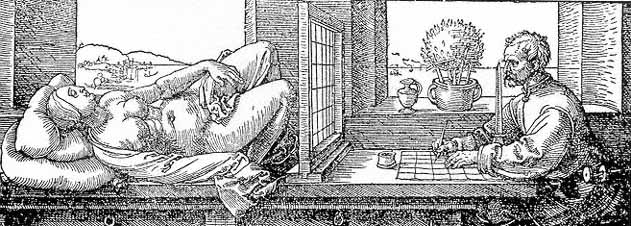
Fig. 76.
Albrecht Dürer, Draftsman Doing Perspective Drawings of a Woman,
from De Symmetria Humanorum Corpum (Nuremberg, 1532).
as an artificial construct, like the construction of the body in the history of perspective. Rather than merely representing an anatomical destiny or the embodiment of a gendered gaze, as Dürer does, eroticism in Given emerges as the figure of passage. Its transitional nature as the movement of style marks it simultaneously as the site of composition and decomposition, of life and death—Eros and Thanatos. The transitive nature of this movement cannot be embodied and figured through the body as either an object or image. Instead the body becomes the "hinge," a frame of reference for sexuality understood as the figure of style . For Duchamp, "the logic of appearance" is expressed by the "style" (Notes , 69), indicating his recognition that form is merely "conditional" (Notes , 71). This is why the transgressive aspects of voyeurism in Given are short-circuited. Eroticism cannot be reduced to a gaze that isolates sexual difference from its metonymic position, its circuit of signification. Since sexual difference in Duchamp's works is conditional , it can also be assimilated to indifference. Femininity and masculinity are set not in opposition to each other, but in conjunction. Their strategic coincidence marks a repetition, whose difference emerges not as a set term, ontologically grounded, but as the declension, the descending nude outlying the trace of the figurative movement of style.
Casting: The Die of Eros
. . .males and females are cast in the same mold.
—Michel Eyquem de Montaigne
The transitive nature of the nude in Given , its "passage," becomes explicit once we examine the nude in the context of the scene, framed by the brick wall through which it is perceived. This brick wall also acts as a screen, blocking a view, already restricted by the peepholes of Given . This wall marks the site of an ambiguous passage, since it is unclear whether the break in the wall acts as a "doorway" for the nude or whether it is more like a window whose solid frame impedes the viewer's visual perception of the scene.[27] This inability to distinguish the function of the frame as a foreground or as a background element is present in a lithograph, contemporary to Given , from the same series mentioned above, entitled The Bride Stripped Bare . . . (February 1968). In this lithograph a female nude crouches, surrounded by an aura that makes the figure look like a cutout, rendering its outline undecidable as far as questions of foreground or background are concerned. This allusion to the visual aura of the figure can also be seen as a pun on The Bec Auer (fig. 75), a lithograph in the same series, of a female figure holding a gas lamp whose outline is disrupted by the superimposition of a male figure cradling his head in his hands. These two lithographs are visual and verbal allusions to the aura (nimbus shape) outlined in the wall, framing our vision of Given . The opening in the brick wall acts as a doorway, whose shape frames and thus brings the visible into view, while bracketing it off as a screen.
This carved brick aperture brings to mind yet another example of Duchamp's doors, his Door for Gradiva (Porte pour Gradiva ; 1937) (fig. 77), a glass door for André Breton's gallery, destroyed at Duchamp's request when the gallery closed down. A drawing of this door, Sketch of "Door for Gradiva ," depicts the silhouette of a couple of enlaced lovers as a cutout. Resembling René Magritte's painting The Unexpected Answer (La Réponse imprévue ; 1933), Duchamp's door—like Magritte's—is ambiguous, since it is closed while bearing the outline of an aperture. Duchamp's Door for Gradiva presents yet another instance of a "hinge," since its transparence outlines an undecidable passage. This glass door thus functions as a visual pun that affirms incompatible realities. It acts as a hinge demarcating the play of the door as site of both opening and closure, a transparent surface opening onto a space only to block entry into
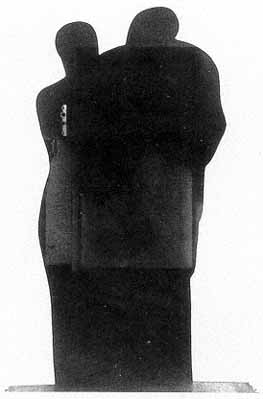
Fig. 77.
Marcel Duchamp, Door for Gradiva (Porte pour Gradiva),
1968 (original version of 1937, Paris, destroyed). Plexiglass,
78 x 52 in. Hessisches Landesmuseum, Darmstadt.
Courtesy of Arturo Schwarz.
it. The outline of this couple in profile confuses the viewer's perception by its reversible character, since it is impossible to distinguish the inside from the outside and depth from surface. This glass door that frames the viewer's field of vision, like the brick wall in Given , brings the visible into view only to draw attention to its limited character.
Door for Gradiva thus acts as a "hinge," whose liminal surface alludes to Duchamp's exploration in his Notes of the "infrathin" (infra mince ) principle (Notes , 9–10). The "infrathin" is defined as a surface that acts both as a separating interval and a screen: "infrathin separation—better/ than screen, because it indicates/ interval (taken in one sense) and/ screen (taken in another sense)—separation has the 2 senses male and female—" (Notes , 9). The infrathin is both a surface and an interval, whose deictical character points in two different directions at the same time. Its ambiguous
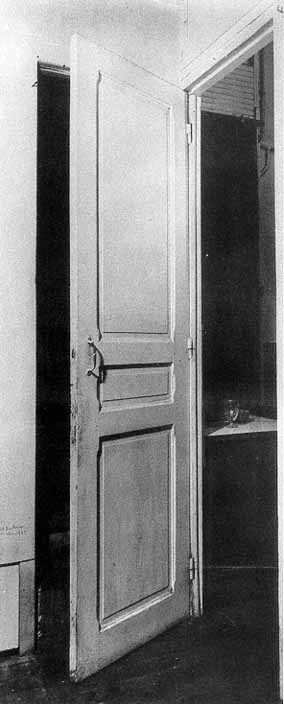
Fig. 78.
Marcel Duchamp, Door: 11, Rue Larrey (Porte: 11, Rue
Larrey), 1927. Three-dimensional pun: a door that
permanently opens and shuts at the same time, made
by a carpenter after Duchamp's design, 86 5/8 x 24 11/16 in.
Collection Arman, New York. Courtesy of Arturo Schwarz.
nature prefigures the role of eroticism in Given , as the "index mark" of the androgynous sexuality of the nude, pointing in two different senses, or sexes (male and female), at the same time.[28] The opening in the brick wall in Given can thus be understood according to the logic of the "infrathin" principle, acting as the hinge to what is seen (a pun on "thin") in Given . This hinge opens onto two directions in the erotic scene of Given , like Duchamp's Door: 11, rue Larrey (fig. 78), indicating that sexuality is "hinged" on the reversibility of the male and female positions.[29] Sexuality is presented, therefore, as an interplay whose ambiguous indexical character resituates the notion of sexual difference and its equation with visibility.
Duchamp's definition of the "infrathin" suggests that this principle may also be applied to the nude in Given , insofar as it is a mold. Commenting on molds, Duchamp observes the same principle of infrathin separation: "2 forms cast in/ the same mold(?) differ/ from each other/ by infra thin separative/ amount" (Notes , 35). The molded character of the nude (its lifelike sculptural dimension) erases the separation between life and death through an imperceptible, artificial difference. This difference that marks the nature of the mold is summarized by Anne d'Harnoncourt as follows: "The paradox of an impression taken from life, captured in lifeless material, works to create a form of realism that seems highly artificial, so intimately related to the real thing and yet so remote."[30] This artificial separation between life and death stages their difference as "hinged" on the principle of their "infra-thin" separation. The mold is "the (photographic) negative," a negative impression "from the perspective of form and color," as Duchamp observes in his notes to the White Box (In the Infinitive, [WMD , 85]). The photographic aspects of the molded nude in Given thus allude to its artificiality not merely as an object but also as an art object. In this work Duchamp plays with the concept of art, insofar as its modes of impression (apparition), photographic or sculptural, highlight the contrived "look" of the nude, its hyperreality.
This analysis of the nude as a mold is reinforced by Duchamp's implicit allusion to molds in Door for Gradiva , since the imprint of Gradiva's existence, the trace of her apparition, is preserved in a mold. The notion of the mold is embedded in the reversible hinge character of the wall in Given serving as a further reflection on the transitive nature of
the eroticism of the nude. The nude is a mold, and thus a "ready-made," a form molded on another, similar and yet different from itself. The "infrathin" separation between the model and its copy becomes the site (a pun on sight) of the fragile interval separating a body from its impression, life from art, a work of art from its copy. In Given this "infrathin" separation becomes the deceptive and reversible interval of sexual difference.
Duchamp's obsession with molds, captured in such objects as Female Fig Leaf (fig. 79), Dart-Object (fig. 80), and Wedge of Chastity (Coin de chasteté ; 1954) (fig. 81), can be seen as yet another exploration of his theories elaborated through the notion of the "infrathin." These figures turn eroticism inside out like a glove. Sexuality emerges as the obverse trace of the female sex molded negatively by the imprint of the female body, as in Female Fig Leaf . In Dart-Object the protrusive presence of the "dart" (simulated riblike phallus) suggests the outward projection of an absence as a positive shape. Jean Clair notes that in Dart-Object gender is envisaged as a break (coupure ), as a division within being, as a lack that is but the effect in three-dimensional space, of a four-dimensional projection. In other words, he suggests that gender is merely the effect of an ironic causality, that of a system of projection whose laws challenge the conventional rationale both of conventional geometry and the gendered gaze.[31]
The conjunction of the male and female positions is made explicit by Duchamp in Wedge of Chastity , where both shapes are embedded in each other. The concavity of "femininity" is welded to the convexity of "maleness" in the outline of the wedge, yet another "hinge" by which Duchamp marks the liminal character of sexuality. The two shapes emerge as
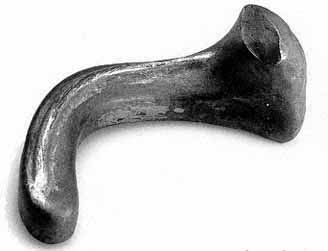
Fig. 79,
Marcel Duchamp, Female Fig Leaf (Feuille de Vigne Femelle),
1950. Galvanized plaster, 3 1/2 x 5 1/2 x 4 7/8 in.
Courtesy of The Philadelphia Museum of Art, gift of Mrs.
Marcel Duchamp.
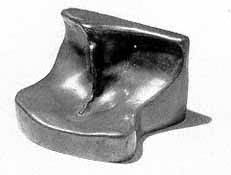
Fig. 80,
Marcel Duchamp, Dart-Object (Objet-Dard), 1951.
Galvanized plaster with inlaid lead, 3 x 8 x 2 3/8 in.
Courtesy of The Philadelphia Museum of Art, gift of
Mrs. Marcel Duchamp.
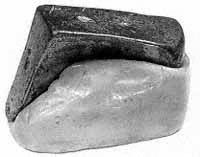
Fig. 81.
Marcel Duchamp, Wedge Of Chastity (Coin De
Chasteté), 1954. Sculpture of two interlocking parts,
galvanized plaster for the wedge and dental plastic
for the base, 2 1/4 x 3 3/8 in.
Courtesy of The Philadelphia Museum of Art.
reversible molds of each other, an interpenetration of forms that informs their interpretation. This visual and discursive ambiguity that marks Duchamp's representation of sexuality is elucidated by his comment on the Wedge of Chastity as "the meaning of the wedge driven in (like a nail), not the place" (le sens du coin qui s'enfonce, pas le lieu ).[32] The word enfoncer also means breaking open a door, thus referring explicitly to the ambiguous character of the door in Given , which is both broken open and shut with nails, at the same time. The wedge as a corner (coin, in French) in Wedge of Chastity becomes the mark of sexual difference through coitus (coit , in French), a turning point that through reiteration marks the objective "coincidence" (or is it "coitcidence"?) of the male and the female positions.
This pun on eroticism as a wedge, corner, and turning point, is made explicit in Duchamp's Anemic Cinema (Anémic Cinéma; 1925–26) (fig. 82), where the anagram on the rotary disk "Have you ever put the marrow of the sword into the stove of the loved one?" (Avez vous déjà mis la moëlle de l'épée dans le poêle de l'aimée? ) captures, through the spiraling movement of the disk, the visual and literary convergence of the male and female positions as puns on the "sword/penis" and the "stove/vagina." The figure of sexuality is here dubbed through further wordplays on stove (le poêle , which in French also means a shroud that covers the dead).[33] This process of bilingual dubbing inscribes death within eros as its obverse. Commenting on the effect of the movement of the spiral on the viewer, Duchamp remarks that "The spiral at rest doesn't give/ any impression of relief/ (or at least only imagined/ psychologically)/" (Notes , 170). Duchamp's observation confirms the vertiginous conflation of sexuality
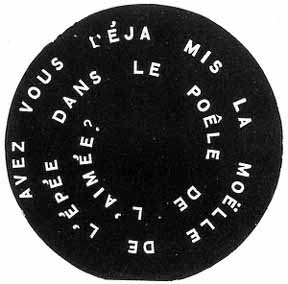
Fig. 82.
Marcel Duchamp, Anemic Cinema (Anémic Cinéma),
1925–26. Film made in collaboration with Man Ray and
Marc Allégret. Ten optical discs alternated with nine
discs with puns. Courtesy of Arturo Schwarz.
and death, as motion (life) and rest (death) converge in the rotation of the spiral.
In the quote above Duchamp also suggests that the spiraling movement of the rotoreliefs is connected with the visual illusion of relief, thereby suggesting the affinity of motion to both molds and photographic negatives. Likewise, the puns on "la moëlle de l'épée " and "lepoêle de l'aimée " converge anagrammatically, signifying the reduction of sexual difference to indifference.[34] This punning visual and literary play in Anemic Cinema helps elucidate the status of eroticism in Given . It suggests that sexual difference cannot be understood as a difference intrinsic to the body, as a set visual and discursive signifier, but rather that "difference" is merely the illusory effect of movement, that is to say, shifts in the rotation of the body as a punning "hinge." Thus sexual difference in Given emerges not as an anatomical fact but rather as the projection of the gaze of the spectator that attempts to "fix" and thus put to rest the androgynous appearance of the nude. The nude is merely a "hinge," a figurative device that acts like a pun, swinging back and forth between the male and female positions. Consequently, Given stages the gaze as a mechanical illusion whose "truth" is no more real than the reality of puns.[35]
The visual seduction operated by the nude in Given can be considered as the "collapsible approximation" (one that can be taken to pieces, dismantled) (l'approximation démontable ), that is, a seduction that is undone by the way in which it is set up. As Duchamp specifies in his instructions to Given , "By approximation I mean a margin (or edge) of ad libidum (a play on libido and male genitalia) in the dismantling (dismounting) and the remantling" (remounting) ("Par approximation j'entends une marge d'ad libitum dans le démontage et remontage ").[36] The gaze of the viewer is dismantled by the very spectacle that stages it as an assemblage of puns that simulate sexuality. The sexual connotation of the work is undone by its contextual character, since the nude is not a static object but a "hinge" to an assemblage of visual and literary puns. Given presents an assemblage (montage ) of visual, literary, and institutional givens , whose play, as contextual frames of reference, dismantles the reality of vision, bringing out its approximate nature as the "hinge" between appearance and apparition.
Given: The Delayed Snapshot
An oeuvre by itself doesn't exist. It's an optical illusion.
—Marcel Duchamp
To make a painting or sculpture as one would wind a reel of cinematic film.
—Marcel Duchamp
Having examined the nude and its function in Given , I will now focus on the illusionistic landscape that frames it, on its "startlingly naturalistic and eerily unreal character," to evoke Anne d'Harnoncourt and Walter Hopps's description.[37] The background landscape in Given is a photograph retouched by hand, which is yet another ready-made alluding to the general photographic illusionism of the work. Duchamp's references to photography, and particularly chronophotography, in works such as Nude Descending a Staircase, Nos. 1 and 2 (figs. 9 and 7), express his interest in the ready-made character of photography. This interest is already manifest in Pharmacy , a commercial print of a winter landscape retouched through the addition of red and green dots. When seen through special red and green glasses, these dots tend to overlap and produce the illusion of relief. Considered as an early instance of Duchamp's experiments with anaglyphic vision, Pharmacy anticipates both the photographic aspects of Given , as well as its anaglyphic character: its play with the illusion of relief, and thus, an implicit allusion to sculpture.
This double allusion to photography and sculpture can also be seen in
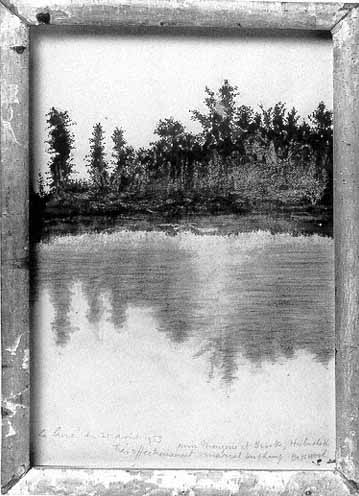
Fig 83.
Marcel Duchamp, Moonlight on the Bay at Basswood (Clair De
Lune Sur La Baie A Basswood), 1953. Pen, pencil, talcum powder,
and chocolate on blue blotter, 10 3/8 x 7 1/4 in.
Courtesy of The Philadelphia Museum of Art.
another of Duchamp's later works. Moonlight on the Bay at Basswood (Clair de lune sur la bale a Basswood ; 1953) (fig. 83), a work contemporary to Given , which is partly drawn from life and partly from a photomural, so that two different gestures are simultaneously conflated in one image. The traditional role of painting as a mimetic rendering of reality is subverted, since this drawing also takes a photomural as its point of reference. Photography undermines painterly traditions, since it substitutes itself for them. It displaces artisanal production through mechanical
reproduction (its "ready-made" nature), and thus redefines artistic creation. Moreover, Moonlight is no ordinary drawing, since it includes a variety of materials—ink, pencil, crayon, talcum powder, and chocolate on blotting paper. The addition of such unusual materials as talcum powder and chocolate to the drawing of this landscape modifies our painterly and photographic expectations.[38] Their inclusion suggests the intrusion of material ingredients from everyday life. Both the talcum powder and the chocolate are associated with molds: talcum powder can be applied to the body, like the plaster of a mold, and chocolate is often molded into different shapes. The landscape of Moonlight thus presents the allusion to relief, inscribed this time not visually (anaglyphically) but literally, insofar as these elements are constitutive of the image. They inscribe anamorphically the trace of the body into the image, like the negative imprint of a body in a mold.
This inscription of photography, which is also an indirect allusion to sculpture in the landscape of Given , is echoed by Duchamp's own gesture of drawing a landscape into the Large Glass in Bedridden Mountains (Cols Alités ; 1959) and in his literal association of ready-mades and photography in his note entitled "Without glue" (Sans colle ): "/Make an assembly of/ 'ready mades' balanced/ one on top of the other/ and photograph them/ (Jackstraws so to/ speak)" (Notes ) 167). This statement clarifies the contextually assembled, photographically superimposed, and ready-made character of both the nude and the landscape in Given . The reference to "jackstraws" provides a clue to the game that Given sets up. It tells us that no element in the scene can be picked up and singled out without disturbing all the others.[39] Duchamp's reference to "jackstraws" suggests that Given can only be deciphered strategically, so as to preserve the contextual nature of the elements, since each element of the assemblage is merely a "hinge."
Likewise, the photographic and sculptural references in Given do not provide stable frames of reference as distinct modes of artistic representation. Their instability is prefigured in Tu m' (1918) (fig. 84), Duchamp's "assemblage" of his ready-mades in a painting. In Tu m' Duchamp does not reproduce the ready-mades directly; instead, he casts their elongated shadows on a canvas (the bicycle wheel and the hat rack). Instead of a depiction of Bottle Rack (fig. 37, p. 93), however, we only find its
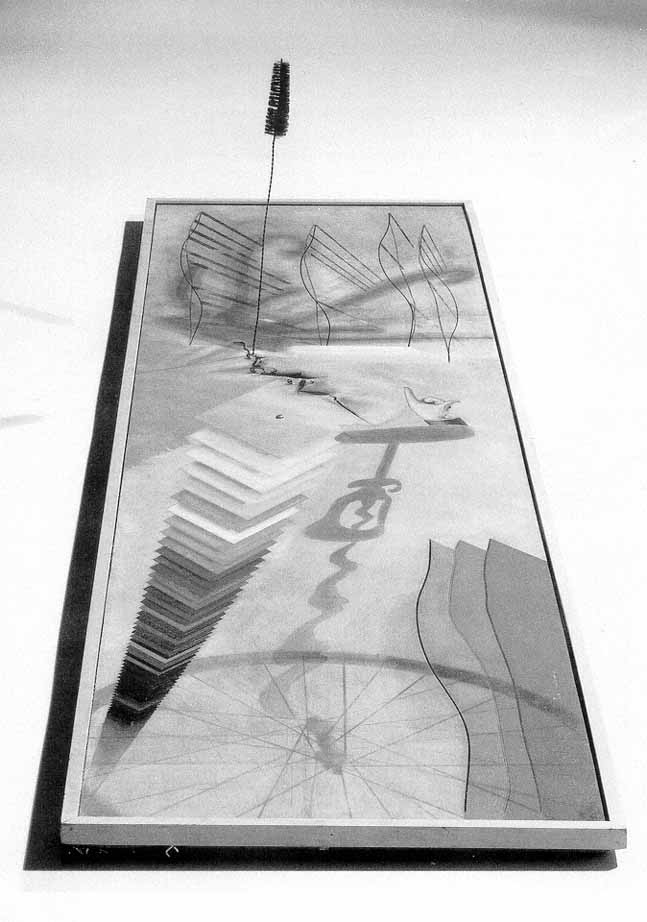
Fig. 84.
Marcel Duchamp, Tu m', 1918. Oil and pencil on canvas with bottle brush, three safety pins,
and one bolt, 27 1/2 x 10 ft., 2 3/4 in.
Courtesy of Yale University Art Gallery, New Haven, gift from the Estate of Katherine S. Dreier.
metonymic displacements: the projection of a corkscrew on the canvas and a brush (used to clean bottles, or lamps) sticking out, perpendicular to the field of vision of the viewer.[40] As if to further underline the pointed nature of this work, a painted hand (signed by the commercial artist A. Klang) points its index finger to the brush and to a series of strips of commercial paint samples (copied from a catalog of oil paints, according to Schwarz).[41] At the center, the canvas is slashed and held together by safety pins. Rosalind Krauss interprets the cast of the shadows as "signifying these objects by means of indexical traces." Her argument relies on the pointing finger as evidence of the indexical character of the image, which she interprets as a photographic allusion.[42]
Tu m' , however, cannot be reduced to a photographic allusion, since the photographic character of the ready-made is also equated by Duchamp with the act of nomination. Although he summarizes his operation on the ready-made in photographic terms, as a matter of timing, this "snapshot" effect is also equated with the temporal and performative dimension of nomination: "The important thing is just/ this matter of timing, this snapshot effect, like/ a speech delivered on no matter/ what occasion, but at such and such an hour ."[43] The analogy between the photograph and the ready-made involves a "snapshot effect" triggered either by the push of a button or by the shutter (stutter) of language. In both of these cases the indexical gesture is undermined, since the pointed hand and the ability of language to point are turned back on themselves. This reflexive gesture is alluded to by the title Tu m .' The photograph and the ready-made thus present the reification of the artist's hand: they negate its intervention in the creation of the object.
Duchamp summarizes the ambivalent nature of his artistic intervention when he comments in his interviews to Cabanne: "It's fun to do things by hand. I'm on guard, because there's the danger of the 'hand' (la patte ) which comes back, but since I'm not doing works of art, it's fine" (DMD, 106.) The danger of the "hand" (literally, the paw, but also a homonym of paste, an allusion to the mold, in French) brings together references to the indexical character of the hand, only to suggest the erasure of its imprint (the mold). The ready-made is marked by a process analogous to both photographic impression and the sculptural mold, both of which, however, paradoxically derealize the object by pointing to it (indexically).
The gesture of pointing (demonstration) thus signifies their ambiguity as modes of representation. The indexical character of Tu m ' and of Given points to their ready-made reality as artistic objects, the fact that their "completed illusion negates the process that went into its artistic creation."[44] The pointing hand is erased by the ambiguous indexical inscription of the ready-made, which points toward the object, photographically and sculpturally, only to elide the intervention of the hand through verbal intervention. This play on the index is already suggested in the text of the Preface to the Large Glass (fig. 85), which also establishes the major formal elements of Given .
For Krauss, this language of rapid exposures that produces a state of rest as an isolated sign is the language of photography. She finds this process implied in the subtitle of the Large Glass , which is Delay in Glass .[45] However, this insight is complicated, as shown earlier, by the ambiguous nature of the indexical sign in Duchamp's Tu m' and in Given . The photographic illusion of Given is merely an appearance, the construct of the index, as a mode of determination. Given can no more be reduced to a photograph than to a ready-made.
The impossibility of reducing Given to a photographic allusion is prefigured in the ambiguity of indexical gestures in Tu m .' The index finger in Tu m ' points toward pictoriality, to the bottle brush and painting samples, only to redirect the viewer's gaze to their commercial, ready-made character. Thus the gesture of pointing to painting corresponds to pointing away from it. By alluding literally to the ready-mades (the brush sticking out of the painting), Duchamp also undoes the very gesture of painting, since the brush (a sculptural ready-made object) points to itself as the instrument constructing the appearance of objects in painting. Tu m ' thus stages the play of painting, photography, sculpture, and language as different modes of "impression." Painting as a retinal imprint is mimicked by the photographic negative, which, as the cast of shadows and the brush, constitutes a kind of "shadow sculpture" or mold. As a sculptural mold, however, Tu m ' lapses into language, capturing its deictical fold. Tu m ' inscribes both literal allusions to Given (the brush stands in as the indexical mark of the gas lamp) and formal allusions to its mixed-media character as an assemblage of painting, photography, sculpture, and language.
However, neither painting nor photography nor sculpture nor language
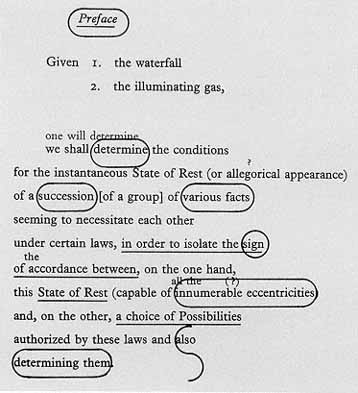
Fig. 85.
Marcel Duchamp, Preface to The Large Glass, from The Bride Stripped
Bare by Her Bachelors, Even: A Typographic Version by Richard
Hamilton of Marcel Duchamp's Green Box, trans. George Heard
Hamilton. Stuttgart: Hansjörg Mayer, 1976.
functions traditionally. In each of these cases the hand of the artist is elided by a mechanical procedure. The painter's brush is displaced by the camera, the photograph as a negative imprint or mold threatens to become sculpture, sculpture is undermined by the ready-made object, and the object is derealized through its title. Visual meaning thus dissolves into linguistic pun. This movement through the visual arts into language and back in Tu m ' and in Given demonstrates that all lifelike illusion is captured through mechanical procedures. Both visual and discursive reproductions suppress the artist's hand, the artisanal intervention, only to draw attention to it, a gesture analogous to the ready-made.
The "assembled" character of Tu m ' suggests that Given does not function as an individual work but as a context for the entire Duchampian corpus. While Duchamp expresses the reservation regarding Tu m '
that "summarizing one's works in a painting is not a very attractive form of activity," this does not stop him from later assembling his works in Box in a Valise and reassembling them in Given , his testamentary work.[46] When Duchamp mentions his desire to have all his works assembled in one museum, we begin to see that this preference expresses a fundamental aspect of his work: "I had a certain love for what I was making, and this love was translated in that form" (DMD , 74). This inscription of eroticism in the gesture of assemblage suggests Duchamp's particular understanding of his own work as a corpus: "I wanted the whole body of work to stay together" (DMD , 74). This assembled body of work stages an eroticism that "hinges" on the strategic play of different artistic contexts and media. As such, it reiterates the eroticism of the nude in Given as referring not to the anatomical body but to its assembled character as a set of visual and artistic determinations. The "appearance" of the nude, like that of Given , is but the "effect" of the contextualized media of painting, photography, sculpture, and language. The active play of visual and linguistic puns elucidates the status of eroticism in Given as a transitive moment, generated by shifts in the position of the body acting as a punning "hinge." Like Duchamp's Door: 11, rue Larrey (fig. 78, p. 214), which is open and closed at the same time, the body in Given, like the assembled structure of this work, becomes an undecidable frame of reference for eroticism. Given is but an "allegorical appearance," a work whose anamorphic and anagrammatic character is "eccentric." It is a work whose meaning cannot be situated analogically (put to rest), but which is constituted through movement, the delayed collision (or even assault, to use Duchamp's terms in the "Avertissement" following the "Preface") of all determinations.
Epitaph: Cenotaph: Epigraph
Thel future can give an ironic tone to/ the sentence.
—Marcel Duchamp
Duchamp's dismantling of the hegemony of vision in Given , as indexical and institutional givens, resituates the position of the artist. By questioning the criteria defining the construction of the visible, Duchamp challenges the immortality of both the work of art and the artist as sanctioned by the museum. In Given this visual immortalization no longer supplants the mortality of the artist by substituting itself for it. Echoing Duchamp's
statement that "men are mortal, pictures too" (DMD , 67), Given stages the shared mortality of the artist and the artifact. In doing so it destabilizes both the authorial persona and the work: it delays them both by encrypting them in a snapshot, postponing life and death in the illusory temporality of the future-perfect. It is this postponement of pictorial and artistic intent that opens up Duchamp's works to future forms of artistic appropriation, anticipating the developments of postmodernism.
Arturo Schwarz describes Duchamp's death in the same terms that he used to describe his life, as an unannounced, informal departure:
The following morning I found him on his bed, fully dressed, and wearing his favorite tie. Beautiful, noble, serene. Only slightly paler than usual. A thin smile on his lips. He looked happy to have played his last trick on life by taking a French leave. No better ending to no better life. His last masterpiece.[47]
Duchamp's "departure" is presented as being consistent with his life, a French leave that evacuates the drama of death by its informal character. This "departure," which Schwarz assimilates too readily to the reality of a work of art (as Duchamp's last "masterpiece"), marks the accidental confluence of life and death of an artist whose focus had been the mortality of both art and artist.
Anticipating the desire for canonization that haunts the fate of the artist as a historical character, Duchamp explicitly questions the necessity of such fictions: "The idea of the great star comes directly from a sort of inflation of small anecdotes. It was the same in the past. It's not enough that two centuries later we have to look at certain people as if they were in a museum, the entire thing is based on a made-up history" (DMD , 104). For Duchamp, the effort to canonize historical figures amounts to the "inflation of small anecdotes" in a process corresponding to museumification. It is exactly this process of mummification that Duchamp actively resisted, both in his life and in his works. As if anticipating this desire, Duchamp plays one last joke on the spectator with his epitaph: "and besides/ it's only the others that die" (fig. 86). Engraved on his tombstone, this statement affirms the fact of death as an impossible experience. Impossible, if only because we can only witness the death of
another and not our own. Duchamp's epitaph haunts the spectator by evoking, through our utterance of it, Duchamp's lifelike presence. Although it may be construed as a denial of death, this statement challenges the facticity of both life and death as fundamental givens. This epitaph ironically recasts the relation between life and death, engraving the shadow of life into the traces of death. Duchamp's death is notorized, as it were, by his testamentary statement. Like François Villon's literary testament, Duchamp's epitaph casts a retrospective light on a grave whose significance is defined not by how one dies but by how one lives.[48] Duchamp's humorous epitaph derealizes the gravity of death by suggesting that its reality is no less subject to humor than life itself.
Duchamp's epitaph points to another cenotaph—Given —the lifelike assemblage of the immortal mannequin simulating life in the artificial confines of the museum (the "cemetery" of visual artifacts). If Given holds its viewer at a fixed distance, this distance becomes both the interval and the delay marking the separation and/or continuity of life and death. It is the last "hinge," the sign of "Life on credit" (Notes , 289), to use Duchamp's own words. Given , an apparent "snapshot" of life, is engraved with the imprint of its negative, of death obversely reiterating its outline. Within it is inscribed the figure of the artist in movement, the double signature Rrose Sélavy , alias Belle Haleine : Eau de Voilette , androgynous embodiments of the art of "heavy breathing."[49] Delayed in the interval between these signatures, Duchamp "breathes," he lives (Sélavy or c'est la vie ) not as himself but as an alias, ready-made for a rendez-vous with the spectator.
So how does one take leave from Marcel Duchamp? Duchamp's comment about his own taking leave from his dying friends Francis Picabia and Edgard Varése (1883–1965) provides a humorous, yet poignant reminder. His response to Pierre Cabanne captures with ironic simplicity his recognition of both the pathos and the reality of death:
Duchamp: It's hard to write to a dying friend. One doesn't know what to say. You have to get around the difficulty with a joke. Good-bye, right?
Cabanne: You cabled, "Dear Francis, see you soon."
Duchamp: Yes, "see you soon." That's even better. I did the same
thing for Edgard Varèse, when he died a few months ago . . . . So I simply sent, "See you soon!" It's the only way of getting out of it. If you make a panegyric it's ridiculous. Everyone isn't a Bossuet. (DMD , 87)
Thus we take leave of Marcel Duchamp, without a panegyric, like an old friend in whose honor we send our own telegram "Dear Marcel, see you soon!"
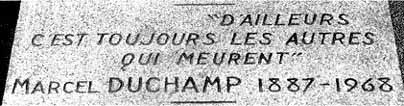
Fig. 86.
"And besides/ it's only the others that die" ("D'ailleurs c'est toujours les autres
qui meurent"). Epitaph on Marcel Duchamp's tombstone in the cemetery in Rouen.
Courtesy of The Philadelphia Museum of Art.
In conclusion, Given: 1) the waterfall, 2) the illuminating gas , Duchamp's testamentary installation, emerges as an assemblage, the living corpus of his previous works. Despite its figurative character, its gross naturalism, and its staged voyeurism, this work posthumously exhibited to the public functions as a testamentary work insofar as it is a compendium that references his previous works. It embraces the trajectory of the nude as a pictorial genre from its earliest embodiments in Nude Descending a Staircase , through its passage in The Bride Stripped Bare by Her Bachelors, Even (The Large Glass ), and its fragmentary reembodiments in such sculptural works as Female Fig Leaf and Wedge of Chastity . Just as The Large Glass reproduces and transposes his previous pictorial works on glass, so does Given restage artistic conventions by reproducing and literalizing them through their exaggerated realism. This corpus cannot be assimilated to a corpse, since what is dead and rendered obsolete in this installation is the spectator's gaze. The obscenity of the spread-eagled nude lies less in its outward appearance than in the fact that it deliberately
stages the spectator's look as an apparatus of display. The violence of the nude concerns less the way it looks than the violence that is made explicit by the pictorial history of the gaze as a mode of objectification.
If painting was stripped bare and rendered transparent in The Large Glass , in Given the nude, as the subject matter of painting, returns with the dead-weight literalness and opacity of an object whose density incarnates the figurative conventions of classical painting. The nude as subject matter of painting thus emerges as a reflection on the matter of painting, restaging the rules that define its specificity as a genre. By literalizing the mimetic impulses of painting in a three-dimensional installation, Duchamp dismantles its generic specificity by its affiliation and contextualization through other media, such as photography, sculpture, and language. Thus the reliance on painting as a medium for reproduction becomes the stage for enacting through literal reproduction the possibility of its demise. The simulational logic of Given restages the conventions that define art in order to generate objects that are the obverse of readymades. Whereas the ready-mades look like ordinary objects that are redefined as art, the landscape and nude in Given look like art in a grossly exaggerated sense only to challenge its conditions of possibility. While the ready-made is the perfect copy of an object because it is the object itself, the objects in Given are literal renderings of conceptual prototypes—they are projections of the rules governing pictorial mimesis. In both of these cases Duchamp uses reproduction as a way of expropriating objects of their visual appearance through a strategy of redundancy and repetition whose logic is akin to puns. By literalizing the figurative ambitions of painting, either by generating perfect copies or perfecting its conceptual prototypes, Duchamp brings painting face to face with its conditions of possibility. While The Large Glass brought painting into the realm of transparency by drying out conceptually its pictorial intent, Given returns to notions of figurality as a rhetorical projection of painting, which makes tangible its otherwise invisible conventions.
If The Large Glass held a mirror up to painting by reifying its visual appearance, that is, by reducing the spectator's gaze to gas, then Given recondenses the gaze, making visible its material properties. The water and gas alluded to in the subtitle of Given suggest Duchamp's intervention, his recondensation of the spectator's gaze. Just as The Large Glass
unpacked through its transparency pictorial appearance, so does Given unpack the spectator's look as a ready-made, or given of pictorial conventions. Whether it is a question of challenging pictoriality through the logic of the ready-made, or of returning to figurality as a way of uncovering its ready-made character as a given, Duchamp persists in questioning and challenging the limits of the pictorial as a system of representation. Duchamp's originality consists in the discovery that the way out of painting does not involve the movement from figuration into abstraction, since such a move would still preserve the material properties of the pictorial medium. Rather, finding a way out of painting means reframing it in the mode of reproduction, a strategy where the figural emerges as a rhetorical condition of painting dispossessed of its outward appearance. Staging its complicity with the viewer's gaze, with painting understood in the mode of a peep show, Given as an installation disassembles and reassembles the gaze, freeing it from its constraints by delaying its impact. Recontextualizing painting through its generic crossover into other media, Duchamp de-essenrializes the referentiality of gender, and by extension, that of art. In so doing, he once again reactives the interval that separates art from nonart.