
Fathering Domestic Legislation
In May 1981, the World Bank and the Philippine government sealed an agreement for what was termed the "apex loan." Just as the SAL marked the Bank's pioneer venture into an overall Philippine industrial-sector loan, so too the apex loan stood with distinction as the Bank's "first financial sector loan" for Philippine industrial financing.[1]
Step by step along the path toward this final agreement, the interactions between the Bank and the Philippine government closely paralleled the pattern already narrated for the SAL negotiations. (See Figure 3's timeline.) The March 1979 financial-sector mission followed on the heels of the February 1979 industrial-sector mission. A June 1979 draft financial-sector report was discussed with the Philippine government along with the draft industrial report in August 1979.[2] This marked the commencement of "policy dialogues" that, within the year, carried a series of financial
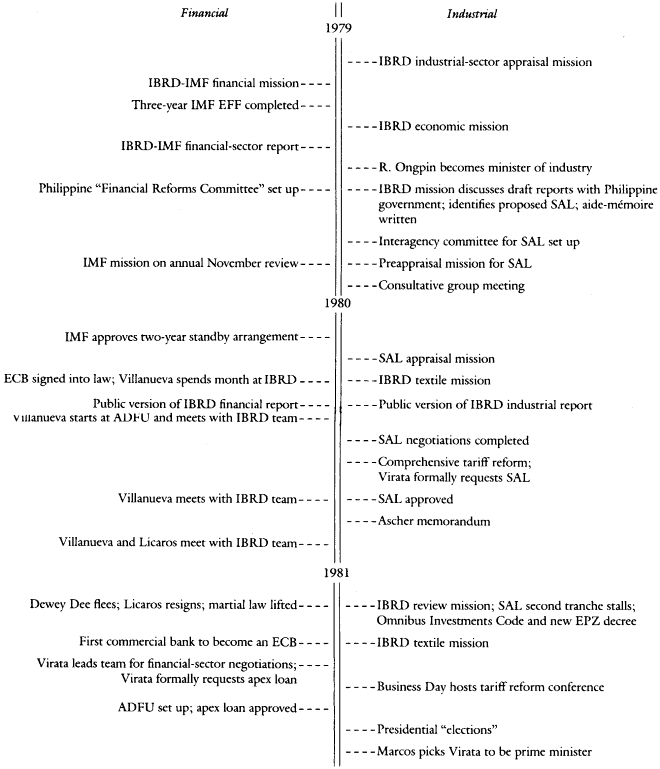
Figure 3.
Timeline: Industrial- and Financial-Sector Negotiations, January 1979 to July 1981
reforms onto the Philippine legislative slate. Once again, the germ of each reform was to be found in the Bank's report.[3]
With the reforms in place, Virata could dispatch his requisite letter (March 13, 1981) to the Bank. Just as Virata's industrial policy letter of eight months earlier had been skillfully drafted to camouflage the Banks leading role in domestic legislation, this letter feigned total Philippine government autonomy in recent major financial policy changes.[4] Then, and only then, was the apex loan sanctioned in Washington.
Given the mirrorlike pattern of interactions over the two loans, detailed elaboration of the apex loan's chronology analogous to that presented for the SAL in Chapters 4 and 5 is unnecessary. Rather, this section will highlight key maneuvers and debates in Bank, Fund, and Philippine government interactions over the financial sector and will bring some critical questions into perspective:
1. How did the two sectoral loans work together to further common aims? Why were they conceived as separate loans rather than one loan?
2. What was the IMF role in this Bank loan? How did the loan shuffle the boundaries of Bank and Fund historical roles?
3. Why did the Bank deem it necessary to move inside the Central Bank for this facet of its Philippine policy dialogues? Could it not have been assured greater success if it had concentrated on its alliances in ministries outside Governor Licaros's realm?
4. How was the Bank able to surmount strong domestic opposition to the enumerated reforms?
Just as Philippine government officials often slipped into more comfortable references to the industrial structural adjustment loan as a program loan, so they tended to refer to the apex loan as either a structural adjustment loan or a program loan.[5] For World Bank purposes, this was not so: the apex loan never reached the "nonproject" loan classification in which structural adjustment loans (the Philippine SAL among them) are categorized.[6] The confusion among Philippine government officials is, however, understandable, for in the Banks quest to restructure the financial sector, it deployed the apex loan in the same all-encompassing fashion as a structural adjustment loan: it pinpointed a sector and helped reshape it according to Bank specifications. If the apex loan was not a sector-specific structural adjustment loan in name, it certainly was in essence.
Part of the mistaken terminology on the Philippine Side undoubtedly also grew from the two loans' shared birth. At the outset, the Bank framed its Philippine restructuring as one package of "industrial and financial policy improvements" that would "provide the basis for . . . World Bank financial support for the industrial sector."[7] By the time of the August 1979 aide-mémoire and the commencement of policy dialogues, the Bank was willing to concede that a single packet might not be the most efficacious: "Changes in the financial sector could be introduced either simultaneously with or independently of industrial policy measures as deemed most effective for achieving the acceptance and objectives of both."[8] As the Banks structural adjustment experience grew worldwide, so did its realization that the magnitude and complexities of the reforms it demanded were such that the programs were better spread over a period of years.[9] By late 1981, it became established Bank policy to bifurcate structural adjustment programs to achieve maximum leverage. The split was accomplished, a Bank official explained, "either by sector, as in the Philippines, or by stages . . . as was done in Turkey." [10]
Traditionally, the World Bank had left all lending geared toward financial-sector restructuring to the IMF. Still, in addition to technical assistance on such matters as capital-market development and local-savings generation, the Bank had managed to leave its imprint on LDC financial sectors in one area: the fostering of national development finance companies. It had entered this activity by an ingenious route. The Bank's desire to fund certain private enterprises in LDCs was greatly restricted in practice by a statutory requirement that all such loans to nongovernment entities be guaranteed by national governments. LDC governments often shied away from this activity, to avoid accusations of favoritism to individual enterprises. A further restriction on deeper involvement was that only the International Finance Corporation within the World Bank group and not the overall Bank could undertake equity investments.[11]
To circumvent such criticism and limitations, the Bank had found it could underpin private enterprise instead through project loans to provide (in its own words) "catalytic support for either the creation or reorganization" of development finance companies that, in turn, pumped equity or loans to the private businesses.[12] Such Bank loans served the dual role of aiding private industry and strengthening financial institutions that the Bank felt could play a more central role.[13] Until the late 1970s, these in-
stitutions stood as the World Banks main contribution to LDC banking systems worldwide.
The Philippines had been no exception to this institutional practice. From 1962 to 1980, the World Bank had channeled its limited lending for the Philippine industrial sector through three development finance companies, molding and strengthening these institutions in the process. As of 1978, the Bank had allocated ten loans, totaling $225 million, to the government-owned Development Bank of the Philippines, fostering what Bank officials termed "heavy involvement" and "close dialogue" with that institution.[14] Referring to a second beneficiary, the foreign-backed Private Development Corporation of the Philippines (PDCP), the World Bank bragged of its "considerable impact" on the corporation ever since it had been created in 1963 at the urging of the Bank itself.[15]
In 1978, a Bank assessment of its Philippine industrial support admitted to "increasingly serious misgivings" about the level of industrial development supported through its development-finance-company loans.[16] It was simply not meeting the growing needs. In order to accelerate the transformation of the Philippine economy toward export-oriented industrialization, then, the World Bank resolved that
future loans to financial intermediaries would concentrate on the resolution of major financial sector policy issues. In order to widen the institutional coverage of Bank financing and address sector issues more effectively, industrial lending to financial intermediaries will be channelled through an "apex" unit in the Central Bank. . . Such "apex" lending would replace conventional finance company lending.[17]
Switching to the more centralized "apex"-type loans was a careful strategy to shift the World Bank from the periphery to the center of financial-sector decision-making. As the Bank reported elsewhere, "The most important justification for the loan is that it would enable the Bank to work closely with the Government on policy issues concerning the country's financial sector."[18]
The Bank decision ushered in a third stage of external influence on the Philippine financial sector during this half-century. In the 1940s, in line with the pattern of U.S. dominance over Philippine macroeconomic policies, a U.S. mission had fabricated the grand designs for a new Philippine financial sector, legislated through the General Banking Act of 1948.[19]
With the 1963 creation of the IMF's Central Banking Service, the preeminent role in remodeling banking systems in the Philippines and other developing countries had been transferred to the IMF.[20] For newly independent African nations, this meant relying on the IMF to chisel the outlines of central banking systems and to supply senior officials to staff the infant central banks' highest offices. For countries like the Philippines, with a financial infrastructure already in place, the IMF's role entailed advisory missions offering technical advice on both central and commercial banking.[21]
Therefore, when the Philippine General Banking Act was amended in the early 1970s, the reforms built on IMF recommendations. Following a pattern initiated by the United States nearly three decades earlier, the official formulation of the proposed reforms was presented as the culmination of a six-month study by a Joint IMF-Central Bank Banking Survey Commission composed of three representatives from each side.[22] But there was never any question as to who was in command. As Armand Fabella, a Filipino Commission member, recollected, "It was called the IMF-CBP [Central Bank of the Philippines] Commission and not the CBP-IMF Commission for good reason. On these matters in which we in the Philippines have little expertise . . . we defer to the greater experience and wisdom of the IMF."[23]
"Coincidentally," Fabella continued, "if I'm not mistaken, our ninety-nine recommendations were published officially in September of 1972, the month martial law was declared."[24] Mistaken Fabella was not; nor was it coincidence. With martial law in place, the translation from suggestions into domestic law proceeded smoothly and expeditiously, unencumbered by the nationalistic debate over the banking sector that had rocked the Philippine Congress immediately prior to that month.[25] In order to facilitate matters even further, the commission took it upon itself (in the words of then Central Bank Governor Licaros's cover letter to the September 1972 report) to draft "bills for the suggested reforms which require legislation" and to prepare "plans or programs for the implementation of recommendations which need only administrative action."[26]
Thus, in the first years of martial law, the financial sector was overhauled in accordance with IMF proposals. Minimum capital-base levels for commercial banks were hiked fivefold, from a long-standing P20 million to P100 million.[27] Room was thus conveniently created for the 40 percent
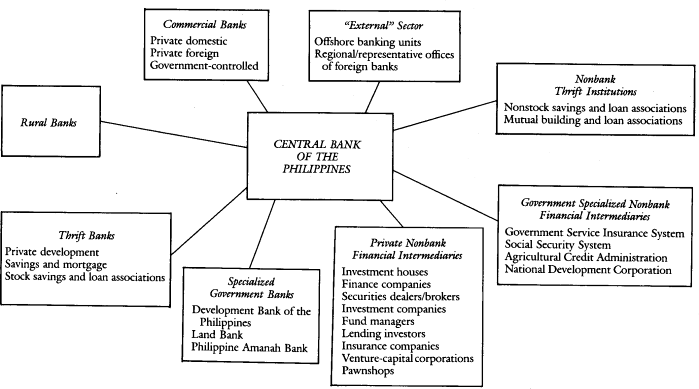
Figure 4.
The Philippine Financial Sector Prior to the 1980 Reforms
Source: Adapted from figure in Ibon Databank, The Philippine Financial System—A Primer (Manila: Ibon Databank, 1983), p. 8.
TNB equity presence newly allowed in domestic banking institutions, a policy that reversed a historical Philippine de facto prohibition against foreign-equity participation in banking.[28]
The reforms also included provisions that would be rethought in the 1980 banking reforms. The 1972 decree reinforced and further delineated the separation of functions among the various types of financial institutions originally outlined in the 1940s legislation. Mirroring the 1933 U.S. Glass-Steagall Act, investment banking—that is, underwriting of government and corporate securities,[29] stockbroking, and buying and selling securities—was split off from the normal functions of deposit-taking commercial banks. This left a financial sector dominated by commercial banks (both domestic and foreign) with an array of other banking and nonbanking financial institutions performing specialized functions (see Figure 4 and Table 6). This was not so much a new move as an attempt to update statutory distinctions and to cover more thoroughly the new banking activities for which demand had evolved over the decades.[30]
Finally, in keeping with the centralization of power inherent in martial law, the early 1970s reforms sought to strengthen the hand of the Central Bank, enlarging its domain to encompass nonbank financial institutions as well as banks.[31] The Philippine Central Bank summed up the rationale: "The pressures in 1972 were related to the consolidations of the banking and non-banking sectors of the financial system under the supervisory and regulatory powers of the Central Bank so that the primary responsibilities of maintaining domestic and external monetary stability could be more effectively discharged by the Central Bank."[32]