
Seize the Custom House
Tension had been mounting between the federal troops of President Huerta in Tampico and the Constitutionalist forces operating in the surrounding environs. The British government recognized Huerta. The American administration openly supported the Constitutionalists. Foreign oilmen became involved insofar as they needed to operate with all parties and as they represented an increasingly substantial source of revenues for contending factions. Perhaps an explosion was not inevitable, but the revolution in the Huasteca Veracruzana was as volatile as some of the belching oil wells. A local spark (struck by a nervous foreign manager) or a bolt of lightning (sent down by diplomatic misstep taken thousands of miles away) might have been enough to set off a political conflagration consuming the entire oil industry. The Tampico incident was almost it.
For several months before the spring of 1914, Constitutionalist and federal troops had engaged in sporadic skirmishes around the city of Tampico. To protect foreign property and life, the gunboats of the United States, Great Britain, and the Netherlands cruised up and down the Pánuco River among the oil barges, tank steamers, and federal gunboats. The battleship USS Virginia had been stationed two miles off the entrance to the harbor.[53] By November of that year, the Navy Department had been making contingency plans. Rear Admiral Frank F. Fletcher had reported no fighting or disruption of the oil industry as yet but estimated that the Constitutionalists had 4,000 men in the district while the Federalists had a force of 1,500 men at Tampico. Fletcher had drawn up plans to place 3,500 American servicemen with machine guns, field guns, and one-pound mortars into the field to protect the oil installations. On one occasion, the Americans had even ordered the evacuation of its citizens. In December 1913, when three thousand troops under General Aguilar took up positions on the Pánuco River opposite Tampico, approximately five hundred evacuees, including two hundred Chinese, gathered for evacuation. Gunboats
ferried the first refugees to the battleships Virginia, Rhode Island, and New Jersey lying offshore.[54] The action turned out to be somewhat precipitate, and the Americans soon returned to work.
The Constitutionalist siege of Tampico began in earnest on April 7. A force under Gen. Luis Caballero probed, somewhat desultorily, the federal defenses at the railway trestle just north of the city. Meeting resistance, the Constitutionalists fell back. Federal gunboats also fired back at rebel positions in the southern industrial suburbs of Doña Cecilia and Arbol Grande. Their shells landed near the Pierce refinery, setting fire to two oil tanks and a warehouse. Some foreigners were brought aboard British and American naval craft, and the German cruiser Dresden arrived to protect German nationals. Meanwhile, Aguilar apparently had menaced El Aguila's oil fields because of Lord Cowdray's alleged support of Huerta.[55] To this point, no group of foreigners had as yet been singled out for reprisals by any of the combatants. But the situation was tense.
The feverish activity of the American naval vessels had consumed their supply of petrol. As the city lay nervously under siege, the U.S. gunboat Dolphin dispatched its paymaster and a crew aboard a small whaleboat flying the American flag. The American refineries were now closed for business, and this crew rowed along the river and up a small canal to the wharf owned by a German merchant in order to buy gas. They landed within blocks of the northern railway bridge, where the Federalist forces were expecting a Constitutionalist advance. Once onshore, the American sailors were arrested by federal troops and held at gunpoint for one hour. American naval officers notified the federal commander, Gen. Ignacio Morelos Zaragoza, who promptly released the men with his profound apologies about the misunderstanding of his subordinate officers. The American sailors returned to their gunboat with a cargo of gasoline.[56]
Cables passed between the American naval commanders at Tampico and Veracruz and their superiors in Washington. Admiral Henry T. Mayo demanded that General Morelos Zaragoza order his forces to fire a twenty-one-gun salute to the offended American flag. The American government also demanded that President Huerta compel his commander to comply. To some in Mexico City, Huerta almost seemed to welcome U.S. intervention as the only way he could rally enough support to shore up his weakening government. Huerta's defiance motivated the secretary of the navy, Josephus Daniels, whose assistant secretary at the time was young Franklin D. Roosevelt, to dispatch six
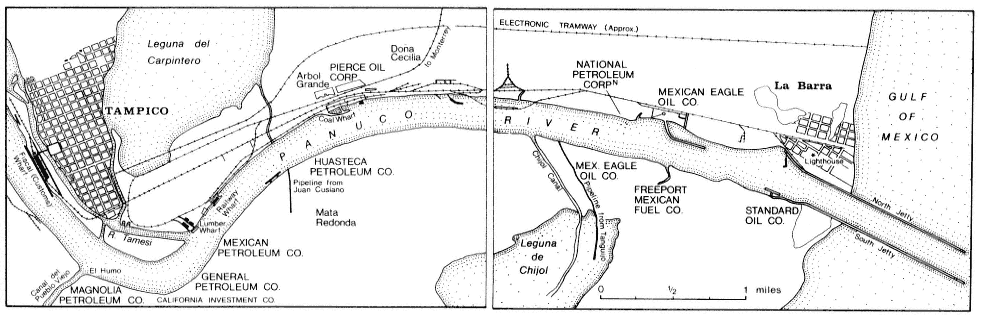
Map 3.
Tampico in 1918
more battleships to Tampico.[57] Were Daniels and Roosevelt recreating the momentous decision of Uncle Theodore Roosevelt, who as assistant navy secretary in 1898 and on his own authority sent Admiral Dewey's fleet to Manila? Apparently not. The decision to "get tough" with Mexico had come from President Wilson himself. At the time, Wilson told his personal physician and golf partner: "I sometimes have to pause and remind myself that I am president of the whole United States and not merely of a few property holders in the Republic of Mexico."[58] Cooler heads did not prevail. It soon became clear that no one was thinking at all about the oil industry in Mexico nor about the Americans who worked there.
An armed invasion of Mexico was ordered. Instead of having the marines storm ashore to protect the oil fields of the Huasteca Veracruzana and the refineries of Tampico, the Wilson administration sent the expeditionary force to the port of Veracruz. Naval planners had contemplated an invasion or at least a bombardment of Tampico. But their inability to sail their battleships across the sandbar at the mouth of the Pánuco River deterred them. Admiral Mayo worried that his smaller gunboats and cruisers on the Pánuco River would be susceptible to Mexican artillery fire. American policymakers had chosen Veracruz because Huerta still obtained arms and supplies
through the port. An American interdiction of the Veracruz port — although not invited by Huerta's principal adversary, Carranza — was intended to rid Mexico of this "tyrant" and "assassin" once and for all. A report that the German cargo vessel Ipiranga was nearing Veracruz sealed the decision. The Americans did not want Huerta to obtain arms.[59]
In the haste of decision making, officials in Washington dismissed the danger that armed intervention posed for U.S.-Mexican relations or for the relationship between Americans working in Mexico and their hosts, the Mexican people. No one, for example, had queried the American consul at Tampico, Clarence A. Miller. He would have warned that a troop landing at Tampico or Tuxpan would lead to the Mexicans' destroying all the oil fields, tank farms, pipelines, and refineries in the district. "A war of American intervention would be a great calamity. All other nations will stand to reap all the advantages; whatever the result might be," he warned; "our country would bear all the expense and reap all the crop of resulting hatred and vengeance. Americans will be unable for many years to come to work in the outlying districts in the oil fields and other parts of Mexico."[60] Miller had not even considered what would happen in the oil zone if American troops landed at Veracruz instead.
The navy's plans to protect the oil fields remained on the shelf. Instead, Daniels cabled his admirals: "Seize custom house [at Veracruz]. Do not permit war supplies to be delivered to Huerta government or to any other party."[61] By the second day of the invasion, by which time the Congress had approved Wilson's action, more than 3,300 American troops were ashore at Veracruz. The German merchant vessel Ipiranga was indeed detained by the American occupation of Veracruz. But the invasion forces, not being at war with Germany, could not confiscate the cargo. Once allowed to depart, the Ipiranga headed for the federally held port of Puerto México, where the arms were off-loaded for Huerta's troops.[62] The Americans could not even prevent the shipment of arms to Huerta, which had been the ostensible excuse for seizing Veracruz.
As soon as the news spread along the Mexican Gulf Coast that the United States had declared war on Mexico (which was not true), all American gunboats pulled out of the Pánuco River and sailed to Veracruz. The Americans at Tampico were stunned. Within hours, refugees with white skin began descending on Tampico from the oil fields. Englishmen, Dutchmen, and Germans accompanied the Americans. Europeans had little faith that the Mexicans, at the moment, cared about the differences between the nationalities. As the American workers saw it, "Brown howling mobs, armed with clubs, stones and pistols, immediately congregated all over the city, parading the streets and howling for 'Gringo' blood. To a Mexican everything with a white face is a hated `Gringo.'"[63] The fearful Americans gathered at the Southern Hotel, where they bolted the doors against a mob of Mexicans who had gathered to wreck Sanborn's American Drug Store. No doubt, the Mexicans were not calmed by the sight of the American flag waving above the Southern Hotel. Finally, the German commander of the Dresden and a detachment of German marines marched on the hotel, where the Americans were trapped. The Germans gained the cooperation of the federal commander and escorted 150 Americans to the waterfront, where they were evacuated. The Americans credited the Germans with having saved them from being overrun by Mexican "mobs."[64] It was a curious exchange for the U.S.'s presumption of having intercepted a German merchant vessel during peacetime.
The American naval commander, Admiral Charles T. Badger, later considered this withdrawal of the gunboats from Tampico to have been a grave error. If the gunboats had subsequently returned to save the Americans, they would have come under fire by both federal and rebel
forces, because the navy's reappearance at Tampico would have been a provocation.[65] Indeed, the British and German commanders cautioned the American vessels not to return. They requisitioned the barges and tankers belonging to the Huasteca and El Aguila oil companies, raised the German and British flags over them, and evacuated Americans as well as their own citizens.[66] In any case, the withdrawal of U.S. gunboats from Tampico had had the approval of the Navy Department. Secretary Daniels stated that he did not want the Mexicans to think that the United States was at war, he did not desire to endanger all foreigners at Tampico, and anyway the British naval commander had agreed to protect American citizens. Indeed, the commander of the Kortenaer, which arrived in Tampico to take on the Dutch citizens from the Dresden, was certain the Mexicans would have destroyed the oil industry if the American forces had reappeared in the river. In fact, he was concerned that the Constitutionalists might destroy the wells anyway.[67]