
Moon Goddess:
Speculations on a Pictograph
In every archaic culture, a grammar of images, of pictographs, precedes that of letters: the sign, or sema, is first of all pictorial. Even if these pictographs evolve with time into phonetic units—find themselves transformed, that is, into so many verbal signifiers—at first it is the pictures themselves that speak . Carved into wood, rock, deer's antler, it's the sign, the linguistic antecedent, that signifies . Having neither the aesthetic pretension of sculpture nor, as yet, the verbal attributes of the written character, it belongs to an intermediate idiom of its own.
Five kilometers northeast of Arles and only several hundred meters beyond the Abbaye de Montmajour, a series of such pictographs can be found scattered over open ground. Carved in limestone on flat, recumbent slabs or, in one case, upon the flank of a menhir, they each describe an inverted U . Down the center of that inverted U runs a prolonged dash. Taken together, the vaulted U and the vertical dash it encloses form the two movements—reciprocal
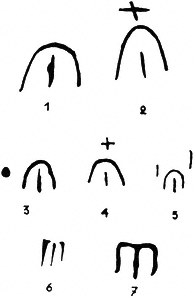
Carved pictographs from Les Collines de
Cordes. Drawing by J. Granier;
courtesy Palais de Roure, Avignon.
gestures—of a single, singular pictograph. This pictograph may or may not be accompanied by outlying dashes, crosses, cupules: signs that have traditionally been interpreted as stellar. As to the meaning of the pictograph itself, we have only what the archeologists would call working hypotheses. We may safely assume, however, that the sign, unmistakably female, represents the vulva and, as such, signifies birth, fecundity, perpetuation. It's not by chance that this immediate area, Les Collines de Cordes, is rich in hypogea: underground burial chambers carved in long corridors out of the surrounding rock.
Clearly the pictographs relate directly to the burial chambers themselves. For everywhere throughout the megalithic culture of this period, symbols of re-birth and regeneration accompanied the dead. Nowhere, we may safely say, was life represented in all its procreant magnitude more fully than in these late Neolithic burial sites.
Far earlier, though, in the midst of the Aurignacian (in about 30,000 B.C. ), the inverted U -shaped pictograph had already made its appearance. Labeled "vulvaform" by André Leroi-Gourhan, it was often represented, painted or engraved, deep within the recesses of any number of late Paleolithic underground sanctuaries such as those at Abri Cellier and Abri Castanet. In the Cabinet des Félins at Lascaux, the inverted U of the vulva is repeated three times in a concentric, vibratory pattern, thus bracketing the vertical stroke mark of the vagina within. The form, of course, is ineluctable. In an iconographic rendering of the female anatomy, the pubic section—be it oval, triangular, quadrilateral, or claviform—could hardly be treated otherwise. Evidence indicates that Magdalenians would travel great distances to collect this very sign in the form of a seashell, a delicate bivalve known, appropriately enough, as a cypris . Named after Aphrodite, the Cyprian, its form bears a striking resemblance to that of a vulva. The sign itself must have constituted a privileged element in an alphabet of signs, be it carved upon the face of a wall or simply collected as a naturally endowed ideogram.
Here, though, in Les Collines de Cordes, we're no longer in the Paleolithic, but in the late Neolithic (about 3000 B.C. ). Although graphically identical, the sign itself has undergone a fundamental symbolic change. Throughout both the Paleolithic and Neolithic, it signified, of course, fecundity. If, however, in the former period that fecundity was exclusively perceived in terms of the living (and most especially in regard to the propagation of the species), in the
latter period it came to be associated with the regeneration of the dead. In the afterlife of the corpse, laid in fetal contraction within the cella of some chamber tomb, it suggested—we may safely speculate—rebirth and resuscitation, but in a world apart. Symbolically charged, the pictograph not only invoked that second world but indicated the way—the very passage—by which the dead might accede. Manifestly enough, the way was matricular.
It would be tempting to compare this relatively discreet sign with that, far more explicit, of the famous "Cuttlefish of Lufang" pictograph, carved upon the wall of a chamber tomb at Crach in the Morbihan, or the painted frescoes of that same sea creature as they appear at the palace of Knossos in Crete. The similarities are remarkable. Scarcely disguised by so many surrounding appendages, couldn't this cephalopod be the very signature of the vulva itself? What's more, can't we speculate that we're dealing, in each instance, with a moment in the late Neolithic in which lunar (and thus aquatic) divinities reigned over the consciousness of humankind? In which the diaphanous figure of the moon goddess herself still flooded the fields of the human psyche? Indeed, with these scattered pictographs in Les Collines de Cordes, we might well be witnesses to the very last moments of those "lunar-telluric-agrarian hierophanies," as Mircea Eliade describes them.[1] Soon, we know, these somewhat subliminal, if all-determinate, divinities will be replaced everywhere by male counterparts. Undergoing a steady process of "virilization," the mythologies of late Neolithic and Chalcolithic societies will gradually solarize : gradually abandon the discreet, somewhat esoteric signatures of the lunar divinities in favor of the ever more figurative, "activated" representations of the nascent sun gods. We're on the verge, now, of history. It's a time in which humankind would come to take increasing technological control over its natural environment. Along with farming and stock breeding, the advent of metallurgy (bronze and,
soon after, iron) would permit societies to live with a growing sense of independence in regard to their immediate environment. In greater and greater numbers, agropastoral communities would spring up, developing, as they did, an increasingly hierarchical, increasingly male-dominated socio-religious mentality. Chieftains, now, would be consecrated upon death and treated as divinities, gods invested with the fecundating powers of the sun, as opposed to the germinal effusion of those far earlier "lunar-telluric-agrarian" goddesses whom they'd come to replace.
One profound transformation would beget another. Along with new societal structures would come an increasing need to abstract: to eliminate the last mimetic traces of nature with an entirely fresh set of cognitive signals. Already, out of the Fertile Crescent in the Near East, the first alphabets would have made their appearance. Soon, even in Provence, the carved sign would be replaced by the written sound. A new order would come into play. The pictograph—resemblant, reflexive, metonymic—would vanish forever.
It's all the more moving, today, to find traces of that lost language and, perhaps, one of its quintessential signs: the vulval imprint of the moon goddess herself. Here, though, in Les Collines de Cordes, that scattered sign lies exposed to vandalism, growing atmospheric pollution, and the increasingly frequent brushfires that have come to ravish the surrounding undergrowth. Reduced today to a terrain vague , the area itself has been enclosed in wire fencing by its irate proprietors, but little can be done, ultimately, to protect these rare pictographs from the incursion of squatters, delinquents, or, far worse, the well-informed treasure hunters who come to pillage the hypogea.
We're left, as ever, with what remains. Isn't history, in fact, never more than that which, miraculously enough, survives history ? The salvaged document? The patiently deciphered tablet? The accidentally uncovered tomb? Yes, we're
left, at least here, with the scattered pictographs of a culture that hadn't yet codified its signs into script, hadn't yet "civilized" its divinities by the mediation of abstract signifiers. It still basked in mimetic effigy; with these vulval imprints it still felt itself rung—we may assume—in the matricular outlines of an all-embracing lunar cosmogony. Far more advanced cultures would come, soon enough, to replace it. But it's not altogether certain that this culture and the profound deposits it left within the human psyche could, in fact, be replaced. For at an operative level, there'd be nothing, absolutely nothing, with which to replace it. It constitutes foundation itself.