
The Point of View
Besides the apparent accuracy of representation of these mechanical 'mirrors of truth', writers also sought their optical detachment. Like the exhibition, the daguerreotype or photograph presented the world as a panorama, a picture-world set apart from its observer. The predecessor of the photographer was in many cases the panorama painter, men like David Roberts and Robert Ker Porter who travelled to the Middle East in the first three decades of the nineteenth century. They returned to produce not just prints or easel pictures but enormous panoramic paintings, often with moving shadows and mechanical animations, which the general public came
to see in places of entertainment such as the Leicester Square Panorama.[66] Daguerre himself, the inventor of the photographic process, was a panorama painter in Paris (where he had pioneered the technique of changing shadows known as the diorama). In 1839 his diorama burnt down, and it was that year that he announced the invention of the daguerreotype.[67]
The problem, then, for the daguerreotypist visiting the Middle East, or for the writer who desired the same accuracy of representation, was to separate oneself from the world and thus constitute it as a panorama. This required what was now called a 'point of view', a position set apart and outside. Edward Lane lived while he was in Cairo near one of the city's gates, outside which there was a large hill with a tower and military telegraph on top. This elevated position commanded 'a most magnificent view of the city and suburbs and the citadel', Lane wrote. 'Soon after my arrival I made a very elaborate drawing of the scene, with the camera lucida. From no other spot can so good a view of the metropolis ... be obtained.'[68] Such spots, however, were difficult to find. Besides the military observation tower used by Lane, visitors to the Middle East would appropriate whatever buildings and monuments were available in order to obtain the necessary viewpoint. The Great Pyramid at Giza had now become a viewing platform. Teams of Bedouin were organised to heave and push the writer or tourist to the top, where two more Bedouin would carry the European on their shoulders to all four comers, to observe the view.[69] At the end of the century an Egyptian novel satirised the westernising pretensions among members of the Egyptian upper middle class, by having one such character spend a day climbing the pyramids at Giza, to see the view.[70] The minaret presented itself similarly to even the most respectable European as a viewing tower, from which to sneak a panoptic gaze over a Muslim town. 'The mobbing I got at Shoomlo ', complained Jeremy Bentham on his visit to the Middle East, 'only for taking a peep at the town from a thing they call a minaret ... has cancelled any claims they might have had upon me for the dinner they gave me at the divan , had it been better than it was.'[71]
Bentham can remind us of one more similarity between writer and camera, and of what it meant, therefore, to grasp the world as though it were a picture or exhibition. The point of view was not just a place set apart, outside the world or above it. It was ideally a position from where, like the authorities in the panopticon, one could see and yet not be seen. The photographer, invisible beneath his black cloth as he eyed the world through his camera's gaze, in this respect typified the kind of presence desired by the European in the Middle East, whether as tourist, writer or indeed, as we will see, as colonial power.[72] The ordinary European tourist, dressed (according to the advice in Murray's Handbook for Travellers in Lower and Upper Egypt , already in its seventh edition by 1888) in either 'a common felt helmet or
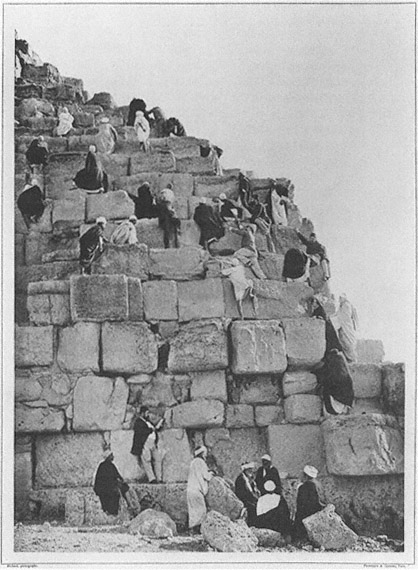
2 Giza: climbing the Great Pyramid.
wide-awake, with a turban of white muslin wound around it' or alternatively a pith helmet, together with a blue or green veil and 'coloured-glass spectacles with gauze sides', possessed the same invisible gaze, the same ability to see without being seen.[73] It was no wonder that an Egyptian writer had to explain, as I mentioned, that one of the beliefs of the European was that the gaze had no effect. To see without being seen confirmed one's Separation from the world, and corresponded at the same time to a position of power. Certain of the more Europeanised members of the country's Turkish ruling elite, such as Adham Pasha, whom we will encounter in a later chapter as the man who introduced into Egypt a modern system of schooling based on constant surveillance, began to wear green- or blue-coloured spectacles with gauze sides when they went on tours of inspection.[74] By the 1860s even the Khedive himself travelled the country wearing coloured glasses. When the first satirical political journal appeared in Egypt in 1877, attacking the power of the Europeans in the country and ridiculing their Turkish collaborators, it was shut down almost immediately by the government and its editor deported. It had called itself Abu al-nazzara al-zarqa ', the man in blue-coloured spectacles.[75]
The writer shared with the authorities this desire to see without being seen. The representation of the Orient, in its attempt to be detached and objective, would seek to eliminate from the picture the presence of the European observer. Indeed to represent something as Oriental, as Edward Said has argued, one sought to excise the European presence altogether. 'Many thanks for the local details you sent me', wrote Gautier to Nerval in Cairo, who was supplying him with first-hand material for his Oriental scenarios for the Paris Opéra. 'But how the devil was I to have included among the walk-on's of the Opéra these Englishmen dressed in raincoats, with their quilted cotton hats and their green veils to protect themselves against ophthalmia?'[76] Representation was not to represent the voyeur, as the Algerian scholar Malek Alloula has described the colonial presence in a study of colonial postcards, the seeing eye that made representation possible. To establish the objectness of the Orient, as something set apart from the European presence, required that the presence itself, ideally, become invisible.
On the other hand, however, while setting themselves apart in this way from a world-as-picture, Europeans also wanted to experience it as though it were the real thing. Like the visitor to an exhibition, travellers wanted to immerse themselves in the Orient and 'touch with their fingers a strange civilisation'. Edward Lane wrote in his journal of wanting 'to throw myself entirely among strangers, ... to adopt their language, their customs, and their dress'.[77] This kind of immersion was to make possible the profusion of ethnographic detail in writers such as Lane, and produce in their work the
effect of a direct and immediate experience of the Orient. In Lane, and even more so in writers like Flaubert and Nerval, the desire for this immediacy of the real became a desire for direct and physical contact with the exotic, the bizarre, and the erotic.
There was a contradiction, therefore, between the need to separate oneself from the world and render it up as an object of representation, and the desire to lose oneself within this object-world and experience it directly; a contradiction which world exhibitions, with their profusion of exotic detail and yet their clear distinction between visitor and exhibit, were built to accommodate and overcome. The problem in a place like Cairo, which had not been built as an exhibition, was to fulfil this double desire. On his first day in Cairo, Gérard de Nerval met a 'painter' equipped with a daguerreotype, who 'suggested that I come with him to choose a point of view'. Agreeing to accompany him, Nerval decided 'to have myself taken to the most labyrinthine point of the city, abandon the painter to his tasks, and then wander off haphazardly, without interpreter or companion'. But within the labyrinth of the city, where Nerval hoped to immerse himself in the exotic and finally experience 'without interpreter' the real Orient, they were unable to find any point from which to take the picture. They followed one crowded, twisting street after another, looking without success for a suitable viewpoint, until eventually the profusion of noises and people subsided and the streets became 'more silent, more dusty, more deserted, the mosques fallen in decay and here and there a building in collapse'. In the end they found themselves outside the city, 'somewhere in the suburbs, on the other side of the canal from the main sections of the town'. Here at last, amid the silence and the ruins, the photographer was able to set up his device and portray the city.[78]
It was Edward Lane who found the ideal device for meeting this double demand, to immerse oneself and yet stand apart. The device was that of hiding beneath a deliberate disguise, rather like the tourist in coloured spectacles or the photographer beneath his cloth. In order 'to escape exciting, in strangers, any suspicion of ... being a person who had no right to intrude among them', Lane explained, he adopted the dress and feigned the religious belief of the local Muslim inhabitants of Cairo. The dissimulation allowed him to gain the confidence of his Egyptian informants, making it possible to observe them in their own presence without himself being observed. His ethnographic writing seems to acquire the authority of this presence, this direct experience of the real. But at the same time, as Said points out, in a preface to his ethnography Lane carefully explains the deception to the European reader, thus assuring the reader of his absolute distance from the Egyptians. The distance assured by the deception is what gives his description its 'objectivity'.[79]
The curious double position of the European, as participant-observer, makes it possible to experience the Orient as though one were the visitor to an exhibition. Unaware that the Orient has not been arranged as an exhibition, the visitor carries out the characteristic cognitive manoeuvre of the modern subject, who separates himself from an object-world and observes it from a position that is invisible and set apart. From there, as Pierre Bourdieu says of the modern anthropologist or social scientist, one transfers into the object the principles of one's relation to the object and 'conceives of it as a totality intended for cognition alone'. The world is grasped, inevitably, as though it were 'a representation (in the sense of idealist philosophy, but also as used in painting or the theatre)', and people's lives appear as no more than 'stage parts ... or the implementing of plans'.[80] I would add to what Bourdieu says that the anthropologist, like the tourist and the Orientalist writer, had come to the Middle East from Europe, a world as we have seen that had been set up more and more to demand this kind of cognitive manoeuvre, a world where objectivism was increasingly built-in. They came from a place, in other words, in which ordinary people were learning to live as tourists or anthropologists, addressing an object-world as the representation of something, and grasping personhood as the playing of a cultural stage part or the implementation of a plan.