
6
Duke Ellington (1899-1974) and His Orchestra
Edward Kennedy Ellington once put the story of his life into two paragraphs.
Once upon a time a beautiful young lady and a very handsome young man fell in love and got married. They were a wonderful, compatible couple, and God blessed their marriage with a fine baby boy (eight pounds, eight ounces). They loved their little boy very much. They raised him, nurtured him, coddled him, and spoiled him. They raised him in the palm of the hand and gave him everything they thought he wanted. Finally, when he was about seven or eight, they let his feet touch the ground.
The first thing I did was to run out into the front yard, and then through the front gate, where I found someone who said, "Go ahead, Edward! Right over there." Once on the other side of the street, I ran into someone else who gave me the Go sign for a left-hand turn to the corner. When I got there, a voice said, "Turn right, and straight ahead. You can't miss it!" And that's the way it has always been. Ever), time I reached a point where I needed direction, I ran into a friendly advisor.[1]
Thus the words of a venerable black musician, an American institution by the time he published them in 1973. Ellington's words bring us into the presence of a powerful persona—a mask fashioned by an artist whose works included the public role he created for himself. "When I was a child, my mother told me I was blessed," he explained, "and I have always taken her word for it."[2] The character that Edward Ellington played in public, spoke through in interviews, and used to write his
autobiography was one of aristocratic confidence and grace. He was the Duke—the composer of hundreds of pieces who never seemed in a hurry; the black butler's son who talked with relaxed ease to audiences all over the world; the tough competitor in a cutthroat business who seemed unaware that he was competing at all. When Ellington lit up his famous smile and told an audience, "We love you madly," who were they to doubt him?[3]
Like many other things in Ellington's life, his persona has its roots in the central metaphor of his career: the tale of the favored child's journey. Mark Tucker's study of Ellington's beginnings in Washington, D.C., confirms his parents' key role. James ("J.E.") and Daisy Ellington, Tucker concludes, gave Edward "more than a sense of being well fed and much loved: they instilled in him a pride about who he was and what he could achieve."[4] The Ellington family's high expectations rubbed off on their son.[5] Asked late in life what had led him to begin composing "as a very young man," he replied: "The driving power was a matter of wanting to be—and to be heard—on the same level as the best."[6] Fueled by such aspiration, he set out on a lifelong quest to excel but with little technical training and no clear destination. That's where the "friendly advisors" came in. For at each crossroads, as Ellington faced a need for some new skill or a push in a new direction, he found help. Ellington's tale identifies two of the forces behind his accomplishments: competitive drive rooted in a deep hunger for personal achievement, and a gift, based on social shrewdness, for finding collaborators who could help him solve the problems he encountered.
Those who knew Ellington agree that he was a complex, enigmatic man.[7] Much the same could be said about his life's journey as a musician, for it led him to unexplored territory whose precise location remains a matter of disagreement even today, well into the second decade after his death. What did Ellington the musician really accomplish? Where did his journey take him? Clear-cut answers are hard to come by within our tradition of musicological inquiry. Just as Ellington's intense individualism and his easy sociability may seem contradictory rather than complementary impulses, it is not easy to fix his place in the world that music historians have rationalized for study.
Ellington's standing as a creator of music is one example of the problem. Gunther Schuller has called him "a major composer," indeed, perhaps "one of the half-dozen greatest masters of our time."[8] Major
composers, however, are usually thought of as people imbued with musical inventiveness, an instinct that appears early in life and persists thereafter; who seek and receive formal training, taking open pleasure in perfecting and exercising their craft; who work alone, courting inspiration and inventing structures of sound for performers to realize; and who "write" music, the verb implying both invention and the notation required to fix and preserve the music they create. Ellington's career contradicts these norms. He began sporadically, apparently composing his first piece at fifteen and writing songs from his mid-twenties on but concentrating on composing only after his career demanded it (he was twenty-seven at the time).[9] Except for a fairly brief period of harmony instruction from a Washington pianist and music master, Ellington was self-taught as a composer, and he showed no interest in discussing the technique of his art in public. (His resistance to more training later in life is a matter of documented fact.)[10] As for the notion of a composer working alone, significant parts of many "Ellington" pieces, especially their melodies, were contributed by other members of the ensemble.[11] Moreover, writing played only a small role in the creation of many Ellington compositions. Trumpeter Rex Stewart, who played with Ellington from 1934 to 1945, remembered the process of composition as it sometimes took place in the recording studio.
Ellington would usually arrive late, then warm up at the piano for a quarter-hour or so. If he played fast, the band knew it was to record a stomping, roaring piece; if he played slowly, they were to record a lament. Ellington would then invariably suggest to the musicians that they make sure the piano was in tune; this in fact meant that they themselves should be.[12]
When the musicians were tuned up, Ellington might then produce the score of his new "composition," most likely written on "some scraggly pieces of manuscript paper." Stewart remembered one session at which Ellington pulled out "about one-eighth of a page on which he'd scribbled . . . some notes for the saxophones . . . but there was nothing for Johnny Hodges. Duke had the saxes run the sequence down twice, while Johnny sat nonchalantly smoking. Then Duke called to Hodges, 'Hey Rabbit, give me a long slow glissando against that progression.' " Next, Ellington urged Cootie Williams to try entering "on the second bar"
of the passage with one of his patented trumpet growls. Then the leader turned to trombonist Lawrence Brown. "You are cast in the role of the sun beating down on the scene," he prompted. When that announcement brought no response, Ellington went on: "What kind of a sound do you feel that could be? You don't know? Well, try a high B-flat in a felt hat, play it legato, and sustain it for eight bars." Then, with these possible component parts in place, Ellington gave the downbeat and tried out the sound. The saxophone section played its melody, backed by the rhythm section and overlaid with Hodges's glissando, Williams's growl, and Brown's sun-warmed, muted B-flat. If the leader's guesses were on target and the men responded as he hoped, "the Ellington effect" might be invoked. "And," Stewart concluded, "that's the way things went—sometimes."[13]
On the occasion Stewart describes, Ellington composed not by drawing abstract tone combinations from his imagination but by working with his musicians so that their "tonal personalities"—their particular sound, way of playing, and inventiveness—actually helped to create the piece.[14] Perhaps the saxophone melody was his, perhaps not.[15] Certainly, Ellington determined the final result. But that result was the fruit of a collaborative encounter whose participants had already proved themselves unblendable individuals in Ellington's tonal coat of many colors. When trumpeter Fred Stone spent a few months in Ellington's orchestra in 1970, he was struck by the demands Ellington placed upon his musicians, far different from anything else in his experience.
The Ellington Orchestra is the only musical outfit I know where the members are hired solely on the basis of their strength and individuality. It is the only orchestra I know where you are not required to become an exact percentage of the section you're playing with; where you are not required to match the sound of the previous member. You must function as an individual—and you are judged solely on your personal musicianship.[16]
That is what Gunther Schuller seems to have had in mind when he noted Ellington's "unique" partnership with his players, in Schuller's view "unprecedented in the history of Western music." Ellington, Schuller writes, "forged a musical style and concept which, though totally original and individual, nevertheless consistently incorporated
and integrated the no less original musical ideas of his players."[17] Sound was surely foremost among those ideas. Stewart's description of Ellington at work demonstrates Schuller's point. For it was Hodges's glissando, Williams's growl, Brown's muted B-flat that gave Ellington the elements from which, with the help of his ear and piano, he molded his compositions.[18]
The gateway to Ellington's accomplishments as a composer, the seminal moment of arrival on his artistic journey, was the discovery by 1927 of "the Ellington effect"—the unique sound that was a product of his ideas about music, the "tonal personalities" of the players he hired, and the exploration he conducted of the sound possibilities of his own instrument, the piano.[19] The Ellington effect made the orchestra easily recognizable, a big advantage in the commercial environment in which Ellington worked. But the Ellington effect was more than a distinctive sound quality. It was a carrier of emotion through which he connected with his audience.
To the question of what Ellington accomplished as a musician, one of the most obvious answers is that he managed to stay in business as leader of a working jazz orchestra for more than fifty years. Only by finding and pleasing listeners could he have achieved such longevity. In Music Is My Mistress , Ellington leaves little doubt of his respect for audiences. Sometimes he describes himself as their servant: "I travel from place to place by car, bus, train, plane . . . taking rhythm to the dancers, harmony to the romantic, melody to the nostalgic, gratitude to the listener."[20] Elsewhere, he notes how rhythm can bring musicians and an audience into a state of profound, if short-lived, empathy. "When your pulse and my pulse are together," he writes, "we are swinging, with ears, eyes, and every member of the body tuned in to driving a wave emotionally, compellingly, to arid from the subconscious."[21] And sometimes, in his view, a knowledgeable audience can act almost like a skilled adversary who, by raising the competitive stakes, forces from the musicians the best performance they have to give.
When one is fortunate enough to have an extremely sensitive audience, and when every performer within the team on stage feels it, too, and reacts positively in coordination toward the pinnacle, and when both audience and performers are determined not to be outdone by the other, and when both have
appreciation and taste to match—then it is indeed a very special moment, never to be forgotten.[22]
Comments like these reaffirm Ellington's solid grounding in society. Banking his professional fate upon the musical personalities of his sidemen, he fashioned music for a social realm in which, by connecting emotionally with dancers and listeners, the music proved its worth.
It was Ellington's ability, first, to reach new audiences and, second, to employ the Ellington effect in new and different ways that kept him moving on his long, wide-ranging, and profitable journey. Rooted solidly in African-American culture, he began early in life to make music that reached beyond his own community.[23] And from November 1926, when Irving Mills became his manager, he courted new audiences on several fronts. In the United States sixty years ago, it was rare for black jazz bands to be listed in white record catalogs, to appear in Hollywood films, to perform in Broadway shows, or to receive prestigious bookings of the kind Ellington enjoyed when he played opposite French entertainer Maurice Chevalier at New York's Fulton Theater in 1930. Moreover, no other jazz ensemble, black or white, had a leader capable of producing a steady flow of new recorded compositions, much less one who—apparently at his manager's prompting—could write a "rhapsody" filling both sides of a 78-rpm disc. Finally, it was unusual, though not unprecedented, for black American ensembles to perform in Europe. With Mills's help, Ellington accomplished all these things by 1933.[24] Perhaps Mills's motive in each case was economic. But whatever the manager's goal, these challenges also had the effect of sharpening Ellington's technical skill and enlarging the expressive resources he commanded. Each, while broadening his audience, also enhanced Ellington's growth as an artist (and the artistic growth of his men) while at the same time undermining the public's notion of the boundaries within which black musicians worked. Mills's energetic pursuit of accessibility—his desire to reach a bigger and bigger audience on its own terms—had found a perfect foil: a group of black musicians, no less eager for popular approval than he, but with a leader whose music, at its best, struck a balance among three diverse forces: his own restless inventiveness, the imagination and skill of his players, and the audience's appetite for entertaining experience.[25]
What Ellington accomplished as a composer must be considered in light of that three-way relationship. Locating the balance point was Ellington's own doing. That he was able to maintain it over so many years is a tribute not only to his musicianship but to extraordinary personal qualities. In fact, the more closely one studies Ellington's career, the more clearly one sees his "enigmatic" personal complexity as an indispensable tool in the process of weighing, balancing, and negotiating that lay behind his rise to fame. Ellington described himself as an observer by nature, a trait he attributed to artists in general.[26] As a musician, he says, he was always an avid listener.[27] As an African-American, he became a close student of artistry in all its forms and an admirer of theatrical effects.[28] As a man, though to claim it for himself would be "square," Ellington was in all things "hip"—possessor of the quality he once defined as "up-to-the-minute awareness."[29] These traits helped him create an environment in which his players' tonal personalities could flourish, even in the face of a grinding year-round performing routine, while still satisfying an attentive, critical, dancing, listening audience.[30] Ellington's resources of character and personality left even those who knew him best in awe—reedman Otto Hardwick, for example, who grew up on Washington's T Street just a block away from the house where Ellington lived, and who played with Ellingtonled groups from the 1920s into the 1940s. "The amazing thing about him," Hardwick told an interviewer in the 1960s, "is that the language, the slant, everything, it's all acquired. It didn't rub off from someone else, and it wasn't a legacy, either. He went inside himself to find it."[31]
When Ellington began his professional life, the standard persona of black men in American show business was a shuffling, comic stereotype inherited from nineteenth-century blackface minstrelsy. Ellington rejected that stereotype, creating instead, surely with the help of Irving Mills, a dignified public image. In the. 1920s, an African-American artist with aspirations to compose found himself in what Lawrence Gushee has called a "mine field" of ideological polarities: "first of all," Gushee writes, the polarity of "classical and popular—that is to say, enduring and ephemeral, inspirational and industrial, idealistic and functional"; second, he continues, a black composer had to deal with the polarity of "Old Europe" and "New America"; and third was the "American polarity" of black and white.[32] During the first half of this century, African-Americans created, within the field of popular dance music, a
music that, if it did not demand, nevertheless invited the development of expert musicianship and intensity of musical expression.[33] This music, jazz, mediated between and among the existing polarities. Jazz, Gushee writes, was a music not for high financial profit, "yet not coopted by institutions, neither absolutely contemporary nor traditional, partly 'functional' and entertaining, partly not, and finally, neither completely black [nor white], American [nor] European."[34]
Ellington, as we have already seen, was one of the pioneers whose instinct for the delicate balance enabled him to flourish, even prosper, in the music business's "minefield." He succeeded, during the late 1920s and early 1930s, in forming and leading a successful dance orchestra, in making himself into an effective pianist, and in finding a personal voice as a composer. He accomplished these things not in seclusion but on the job, while leading his orchestra's nightly engagements. What he did was hard to do. But through his achievements, Ellington maintained an urbane, relaxed presence that concealed the difficulty of what he and his men were accomplishing.[35]
It was Billy Strayhorn, Ellington's close collaborator, who made the now-familiar observation that "Ellington plays the piano, but his real instrument is his band."[36] As leader of a band whose members, especially in earlier days, were not all schooled musicians or secure readers of music, Ellington was also a composer who worked in an improvisatory tradition. Of this polarity, Francis Newton has written that Ellington "solved the unbelievably difficult problem of turning a living, shifting and improvised folk-music into composition without losing its spontaneity."[37] Moreover, the orchestra's long engagement at the Cotton Club in Harlem, beginning in 1927, required Ellington to write not just for dancing but for the club's floor shows. Hence, he learned to work for effects and to master musical forms that reached beyond the standard conventions of dance music. Nevertheless, as Martin Williams has observed, whether writing for dance hall, nightclub, or theater, Ellington was in show business. The circumstances of his employment dictated that his music always be immediate in its impact.[38]
Sound was Ellington's primary tool for achieving that immediacy. Indeed, this sharpest of listeners, this man who sought tonal "charisma" in his players,[39] learned to distill his extreme aural sensitivity into unprecedented timbres, thereby seizing listeners' rapt attention. When he began working in the band business, Ellington recalled, "the chief req-
uisite was good personality of tone."[40] Experience in the music business had taught him that some musicians revealed their inner selves most deeply in their sound and that audiences knew it. Johnny Hodges's "sultry solos," for example, were powerful because Hodges played them "in true character, reaching into his soul for them, and automatically reaching everybody else's soul. An audience's reaction to his first note was as big and deep as most applause for musicians at the end of their complete performance." But Ellington also noticed that listeners' responses to Hodges, affirmed in "grunts, oohs, and aahs," with an occasional "Yes, daddy!" thrown in, were "never too loud to prevent their hearing the next note he played."[41]
It was this kind of response—assenting, delighted, unreserved, yet also attentive and ready to be led—that Ellington sought to elicit through the immediate impact of his orchestra's sounds. (Admittedly, their impact can only be conveyed by hearing them, and the description that follows depends upon having recordings handy for listening.)[42] By all accounts, the chief architect of the Ellington effect as it first emerged in a piece like "East St. Louis Toodle-Oo" (ex. 19) was trumpeter James "Bubber" Miley, who discovered that by blowing, gargling, and humming at the same time, and shaping the sound with a plunger mute, he could "growl" through his trumpet.[43] Ellington loved this sound. For him it was no mere technical trick but a call from Miley's heart. "He was raised on soul and saturated and marinated in soul," Ellington wrote of Miley. "Every note he played was soul filled with the pulse of compulsion."[44] After Miley left the band in 1929, his successors had to master the growl, which shows up again and again in Ellington's later music.[45]
After entering Ellington's arsenal of sounds, the trumpet growl quickly took on programmatic implications as a feature of the so-called jungle music Ellington sometimes played to accompany the Cotton Club's exotic floor shows.[46] But this style combined elements that could also be used separately. In "Concerto for Cootie" (1940; ex. 20), written to display the versatility of Charles "Cootie" Williams, the trumpet growl, which can sound like a distorted human voice, is liberated from the minor mode and from the jungle and used as just one of the many timbres at Williams's command.[47] Or the minor mode and chromaticism of jungle music could be detached from trumpet growling, as in the minor blues, "Ko-Ko" (1940; ex. 21). The menacing sound of the beginning is built on the foundation of Harry Carney's room-filling bari-
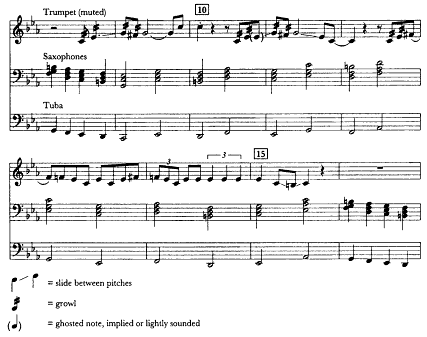
Example 19.
Duke Ellington and Bubber Miley, "East St. Louis Toodle-Oo," bars 8-16
(29 November 1926, Vocalion 1064; composite transcription after Gunther Schuller,
Early Jazz [New York, 1968], 327, and Mark Tucker, Ellington: The Early
Years [Urbana, Ill., 1991], 249)
tone sax, with the trombone section responding to Carney's rhythmicized pedal point.[48] Then, Juan Tizol on valve trombone plays a repeated riff—Schuller calls his sound "leathery, slithery"—responded to by the full saxophone section.[49]
Another kind of Ellington sound is found in a large family of pieces slow in tempo, rich and often chromatic in harmony, meditative in mood, of which the most famous is "Mood Indigo." In "Dusk" (ex. 22), after Ellington's piano introduction, the theme is played by a closely voiced trio: muted trumpet with the tune, muted trombone in the middle, and clarinet on the bottom, as in "Mood Indigo." In performance, the trio surrounds the mike and plays as one. The sound's impact lies perhaps as much in the intentness of listening that underlies such a delicate blend as in the notes themselves.[50]
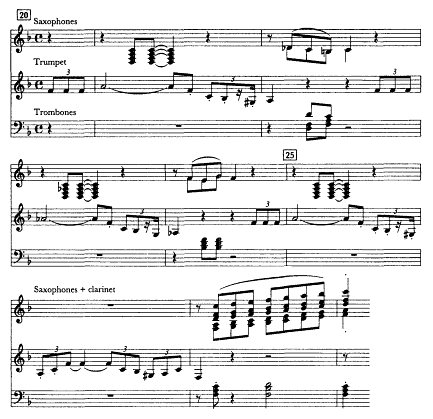
Example 20.
Duke Ellington, "Concerto for Cootie," bars 20-27 (15 March 1940, Victor 26598;
after Ken Rattenbury, Duke Ellington, Jazz Composer [New Haven, 1990], 183-85)
From this brief primer of Ellington sounds, let's move to some of his and his men's effects that can only be described as astonishing, both in conception and execution. "Braggin' in Brass," featuring the band's trumpet and trombone sections, begins with scurrying passagework for muted trumpets over the harmonies of the last strain of "Tiger Rag," an Ellington favorite. Then it's time for the trombones to brag. How does Ellington show them off? Through stinging attacks and a coordination that perhaps only Brown, Tizol, and Nanton, among trombone
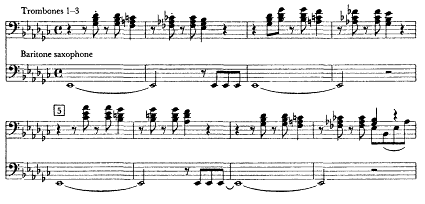
Example 21.
Duke Ellington, "Ko-Ko," bars 1-8 (6 March 1940, Victor 26577;
after Rattenbury, Duke Ellington, 107-10)
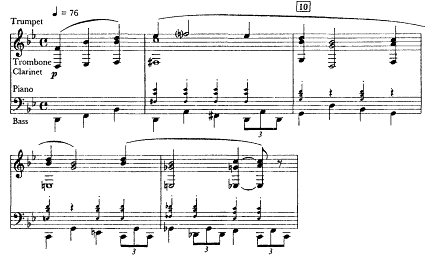
Example 22.
Duke Ellington, "Dusk," bars 8-12, (28 May 1940, Victor 26677;
after Gunther Schuller, The Swing Era [New York, 1989], 122)
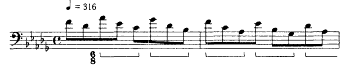
(a) Chorus 2, bars 1-2, conflating three trombone parts into one line
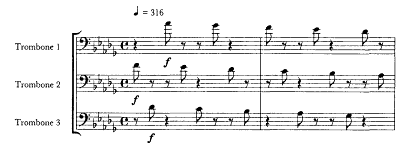
(b) Chorus 2, bars 1-2, showing the three trombone parts
Example 23.
Duke Ellington, Henry Nemo, and Irving Mills, "Braggin' in Brass"
(3 March 1938, Brunswick 8108; after Schuller, Swing Era, 94)
sections, could have managed. Ellington writes a descending broken chord figure whose notes look conventional enough on paper (ex. 23a). In performance, however, it's another story, for he divides the line so that each man plays only every fourth note (ex. 23b). Given the tempo—Schuller has clocked it at

"The New Black and Tan Fantasy" (1938) contains another marvel. Its third chorus is ostensibly a trombone solo by Nanton, with Ellington playing a stream of mysterious, parallel chords in lagging quarter-note triplets behind him. Further in the background, at least at the start of the chorus, is Barney Bigard's clarinet. At the very end of the preceding chorus, Bigard has swooped up to a high concert D-flat (the "blue" third in the piece's key of B-flat), which he sustains softly, without vibrato, like a tiny beam of light. As Nanton's solo unfolds with Ellington's backing, the D-flat begins to increase in volume and, ever so slowly, to rise in pitch. By the downbeat of bar 10, Bigard's note has blossomed
into a fortissimo F, a dominating dominant ringing high above the orchestra.[52]
Ellington sometimes took advantage of the freedom that introductions afforded. For there, whatever strangeness he wanted to hazard could be set forth audaciously, then jettisoned in favor of more conventional material when the main tune entered. "The Sergeant Was Shy" begins with a riff that was to be heard again in the novelty pop hit "Boogie Woogie Bugle Boy (from Company B)."[53] Ellington starts with clarinets playing that riff figure on B-flat in


But Ellington's music was not made to be swallowed in small doses. His mastery extended to musical form, and especially the short forms determined by the length of recordings of his day. I've chosen "Old Man Blues" (1930) to exemplify what we might call one-side form and "Diminuendo and Crescendo in Blue" (1937) for two-side form.
Bearing no relationship in its phrase structure or harmonies to the standard twelve-bar blues or its relatives, "Old Man Blues" shows Ellington's fondness for playing with musical form—for sparring with the listener through unexpected extensions, ellipses, and new melodic strains.[55] It also illustrates two other techniques that pervade Ellington's music. One is the quality of wordless singing that the plunger-mute technique produces, whether on trumpet or trombone. And this imitation of the voice, though a somewhat grotesque one bordering on the comic, leads one to hear many Ellington pieces or passages as conversations between instruments—often in the form of the call-and-response pattern that lies at the very heart of the blues. "Old Man Blues" is scored for three instrumental groups: the reed section (clarinets and saxes), the brass (trumpets and trombones), and the rhythm (piano, guitar, bass, drums). While Ellington's sections often play as units, a listener never knows when an individual voice will detach itself to comment on what other instruments are saying or singing.
TABLE 4 | ||
Formal function a | Featured instrument(s ) | Key |
I8 | soprano saxophone | E  |
A30 (aaba') | trombone and clarinet | |
B20 (vcd) |  | |
saxophone section (8) | ||
trumpet section (8) | ||
A32 | brass tune (16) | F |
trombone (8) | ||
brass tune (8) | ||
A32 | baritone saxophone and piano | |
brass backing on bridge | ||
A30 | soprano saxophone backed by | |
brass (16) | ||
trumpet (14) | ||
B10 (c'x) | saxophone section (6) | |
brass (4)  | ||
A32 | brass tune with clarinet swoops (16) | |
trombone and clarinet (8) | ||
brass tune (8) | ||
aI stands for intro; A, B for full thematic statements; a, b, c, d for parts of thematic statements; v for vamp; x for extension; and superscript numbers for the number of bars. | ||
After its introduction, "Old Man Blues" begins with such a conversation, though perhaps it would be better to call it a series of assertions by trombonist Nanton, around which clarinetist Bigard deftly dances. To borrow a line from a well-known poet, Bigard floats like a butterfly, while Nanton stings like a bee. "Old Man Blues" teems with unexpected details (see table 4). The second strain (B), for example, comes in two bars early both times it appears. The move from E-flat to F after the second strain is more a tonal ratcheting than a modulation, and by way of parallel fifths and octaves at that. The real tune isn't introduced until the second A section (A32 ). The trumpet solo in the fourth A section evokes a standard piece of stage business by beginning hopelessly behind the action and then catching up. And the brass section's break (x4 ) just before the last A is twice as long as expected.[56]
Even though the ending of "Old Man Blues," a ritard, sounds a bit stilted, the quality of playing on this recording is sharp, disciplined, crackling with excitement, and utterly convincing as an artistic statement.[57]
Ellington is renowned as one of the first jazz composers to explore "extended" form—that is, to write pieces too long to fit on one side of a ten-inch 78-rpm recording.[58] One such piece was "Diminuendo and Crescendo in Blue" (1937).[59] When Ellington composed this piece (actually a combination of two pieces, "Diminuendo in Blue" and "Crescendo in Blue," each written for one side of a 78-rpm record), there was no form in jazz more familiar than the twelve-bar blues, with its three four-bar phrases, its characteristic harmonic progression (moving from tonic to subdominant in bar 5 and to dominant in bar 9), and the implied call-and-response built into every phrase. Ellington's achievement in "Diminuendo and Crescendo in Blue" was to use this straightforward, conventional form, on which many of the musicians in his band could have improvised effectively, as the basis for a fanciful, beautifully shaped composition in which improvisation played only a small role. Ellington made his piece, of course, to be experienced from start to finish. But to appreciate the strangeness of its beginning, perhaps we should first discuss some of the work's simpler, more straightforward sections.
The fifth chorus of "Diminuendo" (bars 53-64)—one chorus of the twelve-bar blues pattern upon which the whole composition is based—features a call-and-response pattern operating in two-bar units. The trumpets give out an abrupt, two-beat call, and the saxes respond with a four-beat answer (ex. 24a). In the jazz tradition of Ellington's day, the chorus is the basic unit. And it is axiomatic that the harmonic progression of the chorus, tended by the rhythm section, recurs through a piece as its chief organizing force. When the chorus is as short as it is here—twelve bars at a brisk tempo—changes are most likely to occur from one chorus to the next rather than within choruses. That premise holds for "Diminuendo and Crescendo in Blue." In Chorus 6, the trombone section, silent in Chorus 5, takes the lead with a new melodic figure; the saxes respond, now in unison where before they had played four-part harmony (ex. 24b). In Chorus 7, short figures are replaced by a fully harmonized tune played by the saxes while the brass sit silent (ex. 24c).
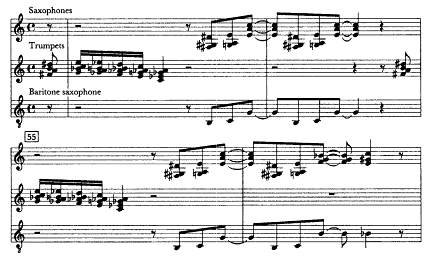
(a) Chorus 5, bars 1-4
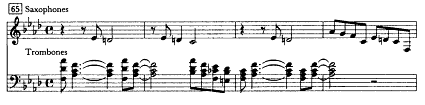
(b) Chorus 6, bars 1-4
Example 24.
Duke Ellington, "Diminuendo in Blue" (20 September 1937, Brunswick
8004; manuscript in Smithsonian Institution, Duke Ellington Collection)
Sectional interplay has dominated Choruses 5-7; but the next three choruses feature soloists. First, trombonist Nanton, master of the sub-verbal growl, responds with hoarse mockery to the saxophone section's calls (Chorus 8). Then baritone saxophonist Carney fits his own responses into the windows in the trombone section's clipped chordal gestures (Chorus 9). And then Ellington himself plays a chorus that begins high and descends to a concluding cadence (Chorus 10). Through
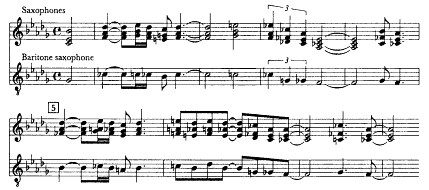
(c) Chorus 7, bars 1-8
Example 24.
(continued)
Choruses 5-10, colors have been gradually growing darker, the range moving downward, and the dynamic level decreasing. The trumpets do nothing important after Chorus 5. The key level has moved from the sharp side (G major) to the flat side (D-flat). Ellington has reached the end of the first half of his piece (and of side A of the disc on which it was first recorded). The "Diminuendo" is complete.
By now the "plot" of Ellington's "Diminuendo and Crescendo in Blue" is obvious enough, even if we have yet to discuss its beginning. Its shape is concave. Starting at peak level, intensity gradually subsides, all the way down to the pianissimo that ends the first half. Then the process is reversed. Table 5 shows a map of the "Crescendo in Blue," the piece's second half (side B). Among the striking features of its beginning is a brand new sound. Ellington's four reed players exchange their saxophones for clarinets, which they play with round, liquid fullness in the low-register unison tune that begins the "Crescendo" (ex. 25a). Behind them, the trombone section enters softly with dark, mahogany warmth. The unison tune, moreover, harks back to the lyric saxophone chorus heard in the "Diminuendo" (Chorus 7). And, as table 5 shows, its opening rhythmic motive recurs through the first three choruses of "Crescendo." One more thing sets off the beginning of the "Crescendo": Each of its first two choruses ends with a two-bar extension—Ellington's way of warning listeners away from complacent formal expectations.
TABLE 5 |
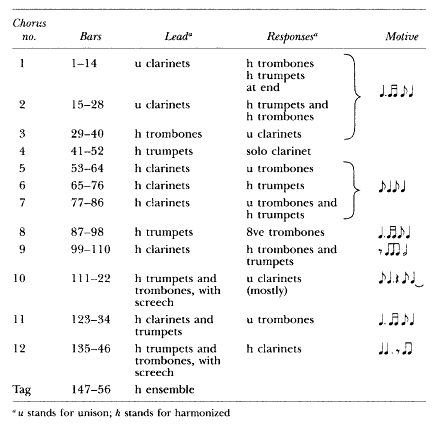 |
au stands for unison; h stands for harmonized |
The fifth chorus of the "Crescendo" finds clarinets once more in the lead. But now they play a new, busier tune, and they are harmonized. Again, clarinets are answered by trombones, this time with a unison countermelody, which they phrase uncannily together, with the deftness of a single voice and the weight of three (ex. 25b). By Chorus 10, the orchestra is in full cry. The volume has been growing, chorus by chorus. The range has expanded, the melody rising to higher and higher registers. The brass join in on what's left of the thematic statement, now pared down to the briefest of motives (ex. 25c). In the gaps left by brass rests, clarinet responses are heard. And, as often happens toward the

(a) Chorus 1, bars 1-4
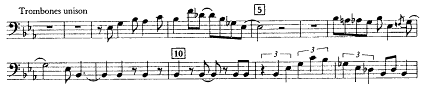
(b) Chorus 5, bars 1-12, trombone part
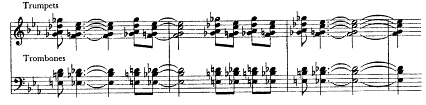
(c) Chorus to, bars 1-3
Example 25.
Ellington, "Crescendo in Blue" (20 September 1937, Brunswick 8004;
manuscript in Smithsonian Institution, Duke Ellington Collection)
end of Ellington's up-tempo numbers, one trumpet breaks loose from the others to fill the rest of the unclaimed space with screeching high notes. The texture has thickened; the instruments now play clusters of tones that are acidly discordant. Consonance is being overwhelmed by dissonance as the piece builds toward its conclusion.
With the full-throttle ending of Ellington's "Crescendo" in mind, let's go back and pick up the opening bars of the "Diminuendo." The music there, as expected, is loud, dense, and dissonant. But where the acrid pillars of sound with which the "Crescendo" climaxes are firmly and obviously embedded in the twelve-bar blues structure, the "Diminuendo" begins with less formal clarity. To recognize what Ellington is up to in these opening bars, it is worth recalling that in later parts of the work he follows both the standard harmonic structure and two more blues conventions as well. Ellington consistently begins the first two phrases of each twelve-bar chorus with a statement and restatement of the same melody. (The figure that begins bar x of a chorus also begins

Example 26.
Ellington, "Diminuendo in Blue," bars 1-4, melody
only (Smithsonian, Duke Ellington Collection)
bar 5.) And he relies heavily on call-and-response: the instrumental dialogue in which a statement by one voice is answered by another. These habits are missing from the beginning of "Diminuendo." In fact, through its first four choruses (bars 1-52), something is always out of kilter. In Chorus 1, it's the cross-rhythmic, athematic character of the material, coupled with a small glitch in the harmonic progression (ex. 26). Despite the theme's strident asymmetry, the blues structure could still be heard if the tonic chord returned in bar 11. But in bar 11, instead of rounding off the chorus, Ellington offers lurching, offbeat figures over some kind of F chord; the expected return to tonic E-flat is postponed until bar 12, leaving listeners with the feeling that a bar has been added, or at least that they've somehow lost their way.
The harmonic resolution at the end of a blues chorus usually fills two bars (bars 11-12), typically with one bar of tonic and one of dominant, which prepares for the tonic downbeat of the next chorus. But because the resolution at the end of Ellington's first chorus fills only one bar, bar 13, which starts Chorus 2, doesn't sound like the beginning that it is. Nevertheless, Chorus 2 gets under way with a call-and-response pattern: saxes and trumpets, densely packed, with the call, and unison trombones with the response (ex. 27). And in bar 5 of Chorus 2, the second phrase starts with the call repeated on the subdominant. So far, so good. In bar 6, however, instead of the active response heard in bar 2—and expected in the supposed restatement—we get from the trombones a sustained, stationary whole note. In bar 7 the call is repeated on the tonic. If it were repeated again in bar 9, we might still hear it within the twelve-bar blues framework, for the blues chord progression remains intact. But instead, bar 9 delivers new, confusing offbeat figures. The original call from bar 1 sounds again in bar 11. (Bars 11-14 of Chorus 2 repeat bars 1-4 almost exactly.) In retrospect, it's as if two new bars have been added to the melodic voices in bars 9-10, pulling them loose from the harmony. Or maybe bars 5-6 are the added ones.[60]
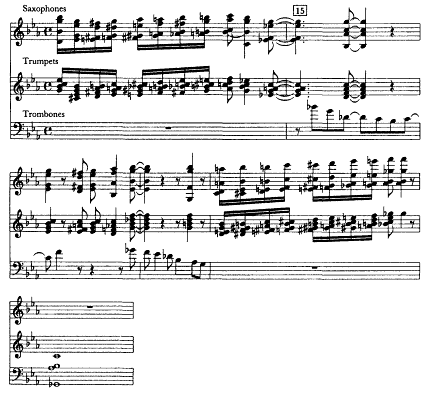
Example 27.
Ellington, "Diminuendo in Blue," Chorus 2, bars 1-6
(Smithsonian, Duke Ellington Collection)
In any event, even more than Chorus 1, the second chorus of "Diminuendo" leaves the listener disoriented, and especially so because it ends with a tag that carries the tonality from E-flat to G. Bars 27 and 28 of the piece prepare the listener for the next chorus.
On the downbeat of Chorus 3, the bass withholds the new tonic, clouding somewhat the new section's beginning. Ellington's material clouds the issue further. In a kind of role reversal, the brass call that begins the chorus sounds like a response—not a "melody" but a series of offbeat chords—and the sax section responds with a melodic statement more in the style of a call (ex. 28). Because the brass chords resemble the end of something more than the start, even a sharp ear
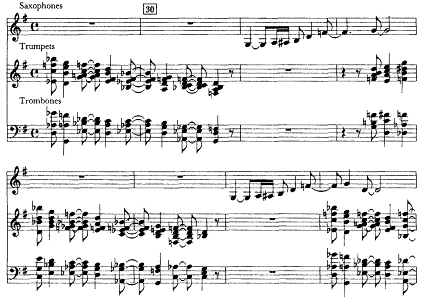
Example 28.
Ellington, "Diminuendo in Blue," Chorus 3, bars
1-8 (Smithsonian, Duke Ellington Collection)
could hear the saxes' entry with their tune (bar 3) as Chorus 3's beginning. However, when the subdominant arrives two bars later, repeating the opening brass chords, we learn belatedly that we're hearing a restatement. By bar 7, when the sax melodic response returns, the ear has regained its place in the form, only to have it dislodged in bar 8 by the entrance of the brass call—one bar early. And that call returns in bar 11, keeping the ear formally at sea until the chorus's end.[61]
In bar 41 of the "Diminuendo," Ellington finally delivers a clear-cut beginning: an arrival on the tonic, as expected, with a fresh new melodic figure beginning in the saxes on the downbeat (ex. 29). But it takes him only four bars to resume his undermining tactics. In Chorus 4's second phrase (bar 5), instead of the sax melody's restatement, a new figure is heard from the brass. The saxes answer with a response in kind, itself a restatement. Once again, however, the absence of a restatement in bar 5 contradicts the listener's expectations, so that it is not until Chorus 5, which puts the pieces of the blues puzzle together "correctly," that the blues form's conventions finally establish themselves.
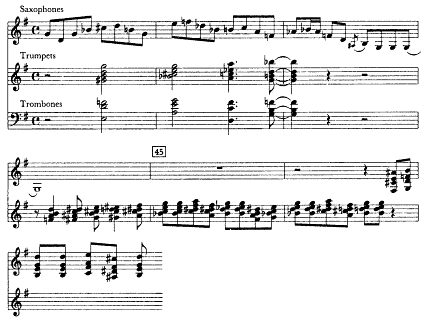
Example 29.
Ellington, "Diminuendo in Blue," Chorus 4, bars 1-7 (Smithsonian,
Duke Ellington Collection)
Barney Bigard once said of Ellington: "At first, just after I joined Duke . . . I used to think everything was wrong, because he wrote so weird."[62] The opening of "Diminuendo and Crescendo in Blue" illustrates that side of Ellington, showing a capacity for obfuscation and formal play far beyond what his audience expected or his vocation as a dance band leader required. "Diminuendo" is, on the one hand, another of Ellington's adventurous introductions, like "The Sergeant Was Shy" but on a larger scale. At the same time, it's a commentary on the nature of the twelve-bar blues as an instrumental form. In each of the first four choruses, the ingredients of the standard blues form are there: the chord progression, the call-and-response pattern, and the principle of statement and restatement. Yet, by changing some element in each—by delaying a harmonic arrival point, by switching the expected ordering of melodic statements or the character of calls and responses, or by adding measures—Ellington sows seeds of doubt in his listeners. Are we, in fact, hearing standard blues choruses or aren't we? We can't
be sure, at least not until Chorus 5 arrives. Thus, "Diminuendo in Blue" moves from dissonance to consonance, from loud to soft, from density to spareness, from rhythmic disruption to smoothness, and from formal opaqueness to formal clarity. Once the structure is clearly established at the start of bar 53, the ear shifts its focus from form to the flow of events—changes in texture, sound, time intervals between calls and responses, melodic invention—leaving the rather frequent modulations as the only unusual feature. Beginning on a manic note of disconnection, as if Ellington were a cubist painter probing the shape of the blues structure by pulling its pieces apart, then fitting them back together in unexpected ways, the piece settles into a groove, hits a point of calm relaxation, and then reverses the process. And it is unified not only by the harmonic progression that underlies all twenty-two of its choruses but by the melodic motive that begins the "Diminuendo," that returns in the seventh chorus in the saxes as the start of a longer melody, that begins the "Crescendo" and is heard through its first three choruses, and that reappears at the beginning of both Chorus 8 and Chorus 11 of that section.
I think Ellington's "Diminuendo and Crescendo in Blue" is an artistic success by any measure.[63] The strong first impression it makes gets stronger with more listenings. Unity and variety are well balanced. The composer's melodic invention seems fully up to the task. The music communicates on the levels both of fine detail and broad gesture, and the overall shape is there not just to be discovered analytically but to be experienced through the ears and body. Within a framework of relaxed spontaneity, the performance is polished and precise. We can feel comfortable calling Ellington's "Diminuendo and Crescendo in Blue" an excellent piece of music by an American composer of first rank.
One of the more admirable values of Western culture is its respect for works of art and the customs of preservation and connoisseurship that keep masterworks available to the public. In music, the chief means of accomplishing this are familiar: making and disseminating scores, giving concerts, and recording performances. While all lovers of music can think of pieces, even repertories, they wish were more readily available through these means, a great deal is within our reach already. And we who are curious about music from other times and places tend to assume
that the masterworks of almost any tradition will be available to us.
But for a long time, Ellington's "Diminuendo and Crescendo in Blue" escaped the musical world's preservationist net. A score? We now know that Ellington's short score and parts are preserved in the book of his now-defunct orchestra. But until the Smithsonian Institution purchased these materials and established its Ellington Collection in the late 1980s, the only access performers and scholars had to most of Ellington's music was through transcriptions of his recordings—an option open only to those with sharp ears, a profound knowledge of the style, and lots of time. (Even after a transcription was made, copyright and performance restrictions would hinder its ready circulation.) Concert performances? By whom? It's true that jazz repertory ensembles are being formed and do exist, especially (though not exclusively) in colleges and conservatories. But they need scores. Recordings? Here "Diminuendo and Crescendo in Blue" would seem to be on safe ground, since that's the form in which it was first offered to the public in 1937. "They" wouldn't let a great American piece like this get lost in the shuffle, would they?
Even here we can't be too sure. At the time this chapter was first drafted (in the winter of 1985), Ellington's 1937 recording of "Diminuendo and Crescendo in Blue" was not commercially available. (That situation has now been remedied, for this performance appears in the revised edition of the Smithsonian Collection of Classic Jazz. ) In fact, one of my anxieties as I prepared to lecture in public on Ellington was that somehow, in recording my examples, I would erase the dubbing from the tape sent me by a friend, leaving me without access to any recording at all. The precariousness of the existence of "Diminuendo and Crescendo in Blue," and of other masterpieces in its tradition, dramatizes a key point. Ellington worked in a commercial music business where salable performances were the commodity. The fate of his music, then, and, though to a lesser extent, even now, has depended, as Gushee has written, not "on the judgment of history nor of an elite of musicians, arrangers, teachers and critics" but rather reflects "the realities of selling phonograph recordings."[64]
In Ellington's drive to be "the best"—the competitive fire that propelled his "journey" as an American professional musician—the encountered no foe more intractable or persistent than the cultural "cat-
egories" against which he spoke and wrote from the time a public forum was available to him. The reach of Ellington's ambition made his life as a competitor especially complex. As a bandleader he competed against other leaders for employment. As a composer he competed, as all composers do, against the inherent difficulty of communicating with listeners through a sounding, nonverbal medium. And as an African-American artist, he battled attitudes that judged people and art by their fancied place in a network of categorical classifications: race, formal education, cultural prestige. No better emblem of his skill as an illusionist exists than the spirit in which he waged the latter struggle. As in other things, he staked out a position on high ground—not the familiar territory of "prejudice," about which many Americans held fixed positions, but the less explicit terrain of "category," free of political taint and bearing an air of philosophical detachment. (Did any of Ellington's interviewers ask him what, exactly, he meant by "category"?) Then, using an often gnomic style of expression drawn from home, school, poolroom, and the Bible, he denounced categories: the human propensity to overgeneralize and underestimate, to classify rather than respond. On racial discrimination in the United States, for example, he held strong feelings. Yet, understanding that the Declaration of Independence and the U.S. Constitution embody an ideal of social equality, he embraced without hesitation his identity as an American. As a man of the theater in its broadest sense, he believed that "a statement of social protest in the theater should be made without saying it."[65] His own career undermined and overthrew cultural categories at every turn. Black musicians of Ellington's generation were not called "Duke," didn't play in Carnegie Hall, didn't compose "extended works," and didn't receive honorary degrees or invitations to be fêted at the White House. Ellington did all of those things, mindful that, in the categorical world of American culture, his personal achievements might carry reverberations that would change the way Americans thought about American music—might, perhaps, even help to ease some of the restrictions under which other African-Americans led their lives. He was certainly right about the former. For today, rather than placing in a lesser category all musicians who pursue accessibility and broad commercial acceptance, historians and critics are more likely to find the commercial framework unworthy of some of the great figures who have toiled within its limitations. (Gunther Schuller sometimes writes of Ellington this way.)[66] In
such an ambience, "the realities of selling phonograph recordings" becomes a jejune detail, which indeed it may appear to be in the reordered world that Ellington helped to create.
Today we are free to declare record sales and popular acceptance dead issues and to say of Ellington, in effect, "now he belongs to the ages." But to take that position, to treat the world of popular entertainment in which he lived and excelled simply as an inhibiting force on his art, is to risk underestimating one of his primary achievements as an American artist. Living his professional life in a world devoted to ephemera—to fads, the pursuit of pleasure, and musical means (improvisation, recordings rather than scores, distribution of music by commercial hawking) geared to immediate economic gain—Ellington left an enduring legacy, both as a man and a composer. His personal achievement deserves the honor that it now is beginning to receive. It also testifies that, as noted in earlier chapters, in American music the need for "accessibility" does not always overwhelm artistry. Perhaps Ellington did spend his life overcoming artistic limitations his profession imposed on him; but in the course of that effort, by having to be concise and to create an impact or a mood immediately, he also gained needed discipline and skill that other composers might envy.[67] Rather than decrying commercial influence, we might do better to think of how Ellington turned it to his artistic advantage. Here, as elsewhere, we encounter the extraordinary blend of private and social, of independence and collaboration, that characterizes his music-making. The inner drive to be the best, coupled with the knowledge that only by creating a unique social network could he be the best in the way he wished, is another such instance. Thus the chapter title, "Duke Ellington and His Orchestra," like the tale of his life's journey, is intended to suggest the pull of opposing forces that somehow, in his hands, were reconciled—a kind of magnetic field in which (individual) inspiration is realized through the (collaborative) execution of musicians who, though nominally under his direction, are left firmly in control of their own "tonal personalities."
As Ellington grew older, he was invited more and more often to think of himself as transcending the world of present-day concerns in which his professional life had always been lived.[68] Here, for example, are two exchanges from the seventy-four-year-old composer's autobiography:
Q: | Which of all your tunes is your favorite? |
A: | The next one.[69] |
Q: | Is there satisfaction in knowing that what you have created gives you a chance to live and be known beyond your time? |
A: | I have no interest in posterity.[70] |
There's that Ellington persona again. Perhaps we should take his professed indifference to us no more at face value than the sunniness of his autobiography—or than the assumption that the lightheartedness of much of his music's surface and the circumstances of its creation mean that it's superficial music.[71] In the years since his death Ellington has been enshrined on the Mount Rushmore of American musical heroes. Songs like "Satin Doll" and a Broadway revue like Sophisticated Ladies , coupled with the vast Ellington iconography and the Ellington legend, are enough to maintain his presence before the public. But let's not be misled by that smiling presence. Behind it, Ellington and his music lie like a submerged subcontinent that is only now beginning to be seriously explored. I can think of no tougher scholarly challenge in the field of American music than such an exploration, nor, at the same time, any task that promises to shed more light on the question of what, in the broadest terms, it means to be an American composer.