
Hydraulic Mining
The extent to which these laws contributed to the growth of hydraulic mining is uncertain, but they did nothing to restrain that growth. Hydraulic mining flourished only in those parts of California blessed with abundant surface water. The Argonauts could not have washed away mountains of topsoil to get at ancient stream beds except on California's remote and mountainous public domain, where no substantial industries competed with mining and no traditional riparian water rights prevented diverting water from natural channels. North of the Feather River, thick volcanic deposits covered rich Tertiary gravels, but in the Southern Mines the Ter-
tiary deposits were far smaller. The most profitable hydraulic mines were located on the ridge running between the South and Middle forks of the Yuba River, ten to twenty miles northeast of Nevada City. There, the mining communities of French Corral, Birchville, Sweetland, North San Juan, Columbia Hill, Lake City, North Bloomfield, Relief Hill, and Moore's Flat flourished. By the 1860s, Nevada was the leading mining county in California. As early as 1864, one observer reported that "so great has been the quantity of ground washed away, that many of the ravines are covered with a depth of twenty feet and upwards of tailings from the sluices." Nevada County's gaping hydraulic mines were as much as a mile long and exposed walls of earth five hundred feet high.[20]
In 1861, a thicker canvas hose, reinforced with iron hoops, tripled the velocity of water that miners could direct against the earth. Eight-inch nozzles produced a force great enough to kill the hapless miner who ventured into the water's path.[21] After the drought of 1862-1864, corporations consolidated most of the smaller companies. English capital poured into hydraulic mines, in part because of high profits, in part because of the promises of geologists like Benjamin Silliman of Yale, who reassured potential investors: "It is proven by the most ample testimony that the ancient gold bearing gravel of California contains an inexhaustible store of gold diffused with wonderful uniformity throughout the mass, and, in the aggregate, far exceeding the entire product which the golden State has yet sent into the commerce of the world." This, coupled with Silliman's promise that investors could expect a 20- to 25-percent annual return for an "indefinite time to come," won plenty of financial support.[22]
The hydraulic mines of Nevada, Sierra, and adjoining counties produced great wealth for decades after the Gold Rush, but the mining industry became more and more localized. In the 1860s and 1870s, it faced a serious challenge from the expansion of wheat farming in California's Central Valley. The flood of 1862 washed huge quantities of debris into the Yuba River, and thence into the valley. Marysville, at the confluence of the Feather and Yuba rivers, became a walled city, surrounded by levees as high as chimney tops. As the years passed, the Sacramento, Feather, and Bear rivers, as well as the Yuba, filled with silt, which affected navigation and commerce as far away as Suisun, San Pablo, and San Francisco bays. Thirty thousand acres of prime alluvial farmland became choked with mud from mining sites in the foothills. Once mining had been supreme, but by the 1870s, agriculture played an increasingly prominent role in California's economy.[23]
The mining debris controversy became a prominent issue in California politics, prompting the first debates over flood control in the Sacramento Valley.[24] In 1884, Judge Lorenzo Sawyer of the U.S. Circuit Court permanently enjoined the mining companies from damaging the property of Central Valley residents. Ironically, he used the same argument for equality of opportunity that had once justified free mining. "It
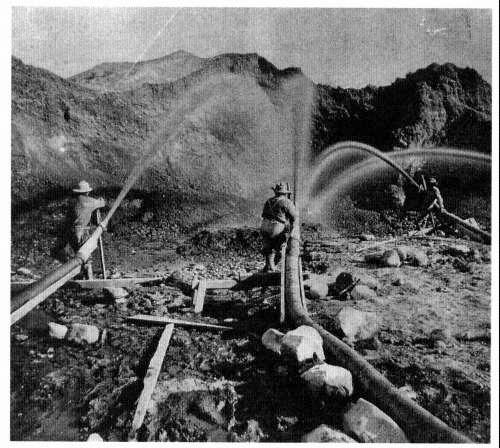
"Piping the bank" near the community of French Corral, hard by the South Fork of the Yuba
River in the richest of all the hydraulic mining districts of California, about 1865. Despite the
compelling aesthetic of the photographer's powerful composition, hydraulicking was a terribly
destructive technology, laying waste to rolling hills, devastating streams, and covering down
stream farmland with "slickens." "It is impossible," wrote an observer, "to conceive of anything
more desolate, more utterly forbidding, than a region which has been subjected to this hydraulic
mining treatment." Courtesy Society of California Pioneers .
is by protecting the most humble in his small estate against the encroachments of large capital and large interests," Sawyer proclaimed, "that the poor man is ultimately able to become a capitalist himself. If the smaller interest must yield to the larger . . . all smaller and less important enterprises, industries, and pursuits would sooner or later be absorbed by the large, more powerful few; and their development to a condition of great value and importance, both to the individual and the public, would be arrested in its incipiency."[25] Shaft, or hardrock, mining survived, but never again would the mining industry exercise the political clout it enjoyed in the 1850s and 1860s.[26]
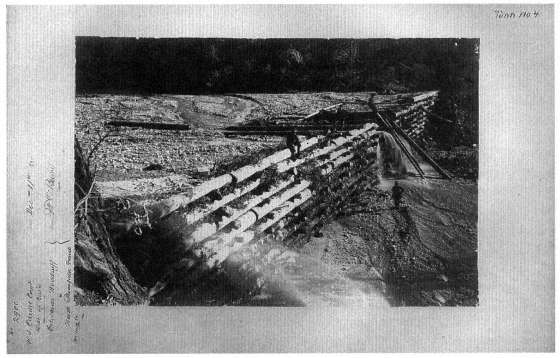
An impoundment dam choked with hydraulic mining debris forms the subject of one of a series of
photographs by John A. Todd that were introduced as evidence in the celebrated case of Woodruff
v. North Bloomfield Gravel Mining Co . Ruling for the plaintiff in 1884, U.S. Circuit Court Judge
Lorenzo Sawyer effectively brought an end to hydraulicking in the Golden State—a landmark
decision in the first environmental pollution battle in the American West. California Historical
Society, FN-29933 .