
9.
Kinds of Seers and Contact Between Social Classes
The Kinds of Seers People Heeded
The visions at Ezkioga occurred in a society whose members believed that certain kinds of people were closer to the sacred than others and thus more likely to have visions. These biases affected the seers' acceptance or rejection by the community. They also set limits on our knowledge. We may assume that those whom society penalized rather than rewarded for having visions reported them less. Ecstatic religion surely has systematic relations with the social order, but we can know of these relations only through social facts. Secret, private, and unrecognized seers evade us.[1]
Lewis, Ecstatic Religion, 23.
In the first months of summer 1931, when the Ezkioga visions were respectable, stereotypes and prejudices determined which seers people recognized. For instance, the priests, doctors, and town officials of the informal commission at Ezkioga made a special effort to obtain the statements of adult male seers; these authorities were all males and they seem to have trusted the
male visionaries most. The Zumarraga priest Antonio Amundarain declared in mid-July 1931,
We have, gathered by us and examined by doctors and priests, about sixty cases. Of these about half are rejected immediately after a very summary examination, either because of the physical condition of the declarers or because of the state of their nerves, etc. There are others, however, who interest us intensely, as they offer an extraordinary sense of reality.[2]
PV, 18 July 1931. For the committee at Oliveto Citra see Apolito, Cielo in terra, 49-56, 59, 135-136.
According to a Catalan pilgrim, the Zumarraga doctor was the first hurdle: "Dr. [Sabel] Aranzadi (who is quite strict) examines the psychic state of each alleged seer, and only after he decides that a case offers certain guarantees is it considered by the office." Aranzadi himself told a reporter the men especially interested him.
Thus for instance we see healthy and strong men profoundly affected who return time and time again to Ezquioga because they continue to be troubled when they go back to their homes and cannot bring themselves to think that what they have seen so clearly could be a hallucination. The trouble is that these men, precisely because of the emotion that takes hold of them, are the persons least willing to come to the first-aid room [to make statements] so as not to encourage what they consider a morbid curiosity.[3]
F. D., at Ezkioga, August 6, in CC, 16 August 1931; Aranzadi in ED, 26 July 1931.
Others on the commission shared this attitude: "In general little attention is paid to the statements of the women (Pardon, fair sex) [sic ]. The statements of tough, strong men, like those of children, give one pause and are profoundly troubling." Newspaper reporters usually selected certain seers to feature from those the commission interviewed, and they shared the commission's respect for men. In spite of the virtual absence of repeat male visionaries in the first month, newspapers printed photographs of seven of the twenty-three adult men, as opposed to none of the sixteen women seers they reported. Those photographed included a farmer, three cattle merchants, a chauffeur, and a taxi driver. Reporters played on the religious indifference of the male seers, especially the San Sebastián taxi driver. The Irish observer Walter Starkie was told that the driver had been "a drunken dissolute sot" and was now "a model of holiness." Subsequent literature dwelt similarly on the conversions of two or three workers who were anarchists and socialists from Bilbao. But adult men were a small minority of the seers. They were newsworthy because they were exceptions and because they gave the visions dignity.[4]
Lassalle, PN, 6 August 1931; S 128.
Patxi Goicoechea was one of the few male "youths" with multiple visions, and from July 8 until mid-October press and public paid him exceptional attention. Although he had already been a practicing Catholic and a "man of order," the press presented him as a model of conversion. In analogous fashion, the highlight of parish missions was the Communion of hitherto lukewarm men on the last dramatic day.
Throughout Spanish history until very recently authorities have consistently discounted the visions of adult married women. The attention women received at Ezkioga was no different. Only in its later, disrespectable phase did any mothers come into prominence. Reporters named many women as seers but generally did not describe their visions in detail. The following account, for 18 July 1931, is an exception that reveals the underlying attitude:
A woman at our side with a tearful voice says [to the Virgin], "Mother, mother, why have you been scaring us for so many days?" Can this poor woman be aware of what she is saying? Later she says [again, to the Virgin], "You have come very late tonight; what do you want?" Frankly, it would never have occurred to us that this woman could see the Virgin Mother…. Every firefly brings forth two or three cries from women.
We may assume that many of the women seers had repeat visions that the press ignored.[5]
For history of women in visions, Christian, "Visions in Spain"; for quote see Luzear, ED, 21 July 1931.
There seems, however, to have been a reverse discrimination, a certain partiality for young and unmarried women. Teenage girls from urban Tolosa and Pasaia and from farms in Azpeitia, Gabiria, Ataun, Bergara, Beizama, and Ormaiztegi, some of them servants in town houses, were regular seers at Ezkioga from the second week. By covering them extensively the newspapers encouraged and rewarded them for their visions.[6]
Visions before 21 August 1931 reported in the press (excluding the original two seers):
|
Seers with visions in this period not reported in the press who later became prominent: four women (M. A. Aguirre, E. Aranda, P. Ciordia, M. Recalde), one young woman (G. Viñals), and one male child.
Why did people consider young women particularly credible as seers? During the first half of the century in the Basque Country much religious effort had as its goal the control of females, particularly unmarried ones, and thereby the salvation of men as well. For girls this control centered on the Daughters of Mary, which placed them in a quasi-sacred role in the parish. In revival missions the Daughters of Mary received Communion after the children, by this measure becoming the group second closest to God. The missioners knew they could count on adolescent girls for piety and enthusiasm. The Jesuits, the Daughters of Charity, and the secular clergy all promoted the sodality. The first chapters in Gipuzkoa were in Azkoitia and Azpeitia in 1860; by 1930 there were one hundred chapters. Catholics mobilized this sodality in the crisis of 1931. The assembly of 1,500 Daughters of Mary at the shrine of Itziar in early May was a kind of public witness of support of the exiled bishop. And in Bergara on May 31 the monthly Communion of the group coincided with municipal elections; in this tense atmosphere the clergy paraded 350 girls through the streets, showing the flag. La Constancia reported the sortie with the headline, "The Fine Example Set by the Daughters of Mary."[7]
Bishop Mateo Múgica of Vitoria promoted the sodality: Echaniz, Estrella del Mar 1931; LC, 12 May, p. 4, and 5 June 1931, p. 8. See also Asociación de Hijas de María de la diócesis de Vitoria, Reglamento, 9th ed. (Vitoria: Montepío Diocesano, 1929).
A measure of the effectiveness of the church's control of girls is that even anticlerical skeptics took the purity of the teenage seers for granted. The republican schoolmaster of Ezkioga wrote to a Madrid newspaper, "All the hysterical señoritas are confirming the famous apparitions; we say give them a good
boyfriend and they will be cured of their neurasthenia." One kind of "miracle" at Ezkioga in the autumn of 1931 consisted of medals, seemingly from the sky, falling to girls in vision. The medals were those of the Daughters of Mary, badges of heavenly approval and certificates of good conduct for visionaries.[8]
Romero, HM, 5 August 1931.
Those present at the visions have pointed out to me that beauty enhanced credibility. Patxi Goicoechea was held to be quite dashing. Walter Starkie himself was smitten with Lolita Núñez. Photographs of seers in vision show that some quite ordinary faces took on a special attractiveness when rapt, and spectators likened the young girl seers to young saints. A Catalan compared one girl seer to Gemma Galgani, and photographs of the seers resemble Gemma in pose and facial expression. Others besides Raymond de Rigné compared seers to Jeanne d'Arc, whose resistance to foreign rule had a special resonance for Basque nationalists. The adolescent girls stood ultimately for the Virgin herself, whom one seer described as "very young" in one vision and "age nineteen or twenty" in another.[9]
For Galgani see Elías, CC, 19 August 1931, and Sans, "Problemática"; a later example of facial transformation in Staehlin, Apariciones, 387-389. For Jeanne d'Arc see B 275, 291, 413; for the teenage Virgin see PV, 12 July, and ED, 19 July 1931.
Children were another sacred category. Up to 21 August 1931 newspapers reported, in addition to the original two seers, ninety-two separate visions of nine girl and eight boy visionaries aged three to fourteen. The percentage of child seers, especially girls, who had two or more visions reported in the newspapers is quite high, indicating that children persisted in visions and that the press was interested in them. The children most involved, after the original seers from Ezkioga, came from the adjacent towns of Ormaiztegi, Zumarraga, and Urretxu and the slightly more distant towns of Legazpi and Albiztur. Parents and sometimes parish priests accompanied them to the site. While 80 percent of the regular teenagers were from farms, children with visions were more likely to be from village centers or towns; many spoke Spanish. Their more sophisticated backgrounds may have helped them receive and produce vision messages with political overtones.
People expected young children at Ezkioga to see something. A brother and sister from Estella in Navarra agreed to believe in the visions if, on an excursion, their younger brother, aged seven, saw the Virgin. The sister remembers continually inquiring, "Have you seen anything yet?" as the boy peered into the darkness and replied dispiritedly, "No … no …" In mid-July 1931 a thirteen-year-old boy from San Sebastián went to Ezkioga with his father and his young cousin from Legazpi. The cousin pointed out a spot in the trees where he saw the Virgin on July 8. The city boy then had his first vision in the same place. He moved in with the Legazpi relatives and went to Ezkioga daily, and his picture was in El Día on July 21. Once children started having visions, it was hard for them to stop. The seven-year-old girl from Ormaiztegi who first heard the Virgin speak had visions from July 6 to July 10; the next day the child did not want to go to the site, but believers came and bundled her into a taxi. The deputy Antonio de la Villa protested in the Cortes against school excursions to Ezkioga because of the unhealthy pressure to have visions.[10]
For Estella children: Bienvenida Montoya, San Sebastián, 11 September 1983. All 1931: for San Sebastián city boy, ED, 19 July, p. 9, 21 July, p. 8, and 6 August, p. 2; for seven-year-old girl, ED, 15 July, p. 8; for de la Villa speech, DSS, 13 August; Crisol, 27 July.
Image removed -- no rights
Two priests take Benita Aguirre's declaration of a vision, 1931 (?). Photo by Raymond de Rigné, all rights reserved.
Several persons who went to Ezkioga in these first months of 1931 told me they were impressed especially by visions of very young children or infants. Children have been models for the devotional behavior of adults since the Gospels. At the time of the visions, parishes often organized skits or processions, with children as angels or saints; some parents dressed their children as angels with wings for First Communion; in some areas adults considered children privileged intercessors for the dead. The boy Guy de Fontgalland was a new model for a holy child in France.[11]
On children in Basque culture: AEF, 1924, pp. 71, 85, 148; as intercessors for the dead: Ott, Circle, 91; and mission processions: Perea, El Modelo, 2:997-1001. For Guy de Fontgalland see Perroy, La Mission d'un Enfant. On children as mediators with the supernatural in other contexts, Frijhoff, Evert Willemsz., and Apolito, Dice, 141-144.
Children also played prominent parts in village missions. Hear a priest describe one in Navarra in 1920:
On the second day the Communion of the children was followed by the consecration of all of them to the Sacred Heart. This was a tender and moving ceremony, during which I saw many fervent tears quietly falling, not being foreign to this holy weakness he who writes this. The ceremony was a very powerful way to rend completely the hearts of parents and other adults present.
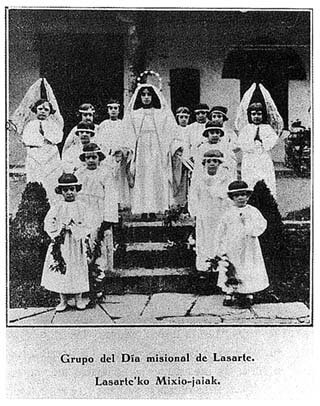
Children as angels on mission day at Lasarte, 1930. The
girl in the center is the Miraculous Mary. From Nuestro
Misionero, January 1930. Courtesy Instituto Labayru, Derio
Similarly, in a secular context in Spanish-speaking Navarra, I have seen reticent, suspicious parents won over to an interest in Basque culture by witnessing their own young children performing folk dances and singing the Basque soldier song. A cultural group from Bilbao prepared the children with one afternoon's rehearsal.[12]
Legaz, "En Navarte," 317.
What made children important as visionaries was their alleged lack of guile and their supposed ignorance of the wider world. A man from Lezaun remembers being the only child in Lizarraga who did not see the saints arrive in the sky. As a result, his own mother considered him, age seven, "incrédulo [lacking in faith]." His mother had taken him so he would have a vision, for at the time in Lizarraga people simply assumed that all young children would see. The Catholic press placed great emphasis on the spontaneity of the first children's visions, and Antonio Amundarain took pains to refute the idea that they had heard in the Eskioga school about the visions at Torralba de Aragón.[13]
Argandoña, "Apariciones en Lizarraga"; for Torralba connection: Romero in La Prensa, 8 July; Masmelene, EZ, 15 July; and Amundarain in PV, 18 July 1931.
Nevertheless, articles about the child seers at Fatima, La Salette, and Lourdes must have contributed to the number of child seers at and around Ezkioga. Consider the girls of Ea in Bizkaia, for instance. In April 1931 ten of these girls,
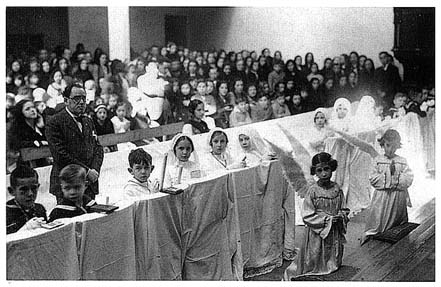
Children as angels for First Communion at Piarists in Pamplona, 1934. Collection
of Ramón Goñi Nagore, Basque Studies Program, University of Nevada, Reno
who look from a group photograph to be between eight and fourteen years old, saved their pocket money and sent it to La Obra Máxima to baptize a pagan girl whom they wanted to name María Fátima "because the recent apparition of the Virgin to three little Portuguese shepherds enchanted us." We have seen that Bernadette was especially important for girls from Albiztur. The child seers in general are good examples of a kind of circular validation: when children reproduce material from adults, they enhance or consecrate it.[14]
La Obra Máxima, August 1931, p. 253, letter of April 9. The children could have read about Fatima in the magazine Jaungoiko-zale.
As potential visionaries children had skills that most adults had forgotten. Children throughout the Catholic world play "church" just as they play "doctor," "teacher," and "house." The historian José Ignacio Tellechea, who like a seasoned bloodhound put me on the track of many documents and witnesses for this study, writes in his autobiography about his childhood games. He remembers at age eight in 1936 confessing and saying mass for his pals on a makeshift altar in the Navarrese village of Ituren. The children held processions, prayed, and sang hymns in the attic, where an image of the Infant Jesus of Prague (his mother signed him up in the sodality right after he was born in 1928) presided over the ceremonies. Tellechea writes that his play church was "immensely serious." Here are all the ingredients of the child visions in the Barranca, not far away in time and space.[15]
Tellechea, Tapices, 59-60; Basque children still play "church": Manterola, Juegos, 580.
The step from game to vision is short. The children of La Salette were erecting a play altar of flowers when their visions began. Two vision sequences in Spain in 1961 began when the religious game children were playing took on a life of
its own: at Garabandal (Cantabria) they were imagining the devil and the guardian angel; at Villaesteva (Lugo) they were playing mass.[16]
Blackbourn, Marpingen, 47; for Garabandal, García de Pesquera, Se fue, 16-21; for Villaesteva, Manuel Moreira, Villaesteva, 6 August 1977.
Children having visions were often deadly serious. But in presenting their visions and organizing the spectators they applied the skills they developed in play. All children know how to imagine, how to intensify emotion, and how to abstract themselves from those around them. It seems that one reason the Ezkioga visions multiplied was that in a region suddenly alert to divine help, the adults were eager to join the game. Schoolteachers, village priests, and parents were willing to take children and children's claims seriously. Young children had an unusual mandate to play, and play was rampant.It was not chance that children started off the Ezkioga vision sequence. Adults would not have been credible. Ten days before the visions of the two original seers, Santa Lucía schoolchildren, a respected farmer from Ezkioga allegedly had an accident with his oxcart loaded with logs; the Virgin appeared, saving the oxen and his son, who had been on the cart, from falling down an embankment. The man, Ignacio Galdós, told the story at home and in the tavern, but nobody believed him. In late July he showed the site of the accident to the Valladolid priest Baudilio Sedano and wept in gratitude that finally somebody cared. Galdós later became an assiduous and well-respected seer, attending the visions from August on. But even so the press paid him little heed. As an uneducated, pious peasant, his visions were less newsworthy than those of more distinguished or less devout men. Men served as confirming witnesses and as exemplary converts, but it seems that adult men were not acceptable, at Ezkioga or in most of the other twentieth-century Spanish visions, as initiators of a vision sequence.[17]
For Ignacio Galdós: Sedano memoir, 5-7, and Elías, CC, 15 August 1931. For confirmatory visions of men, Blackbourn, Marpingen, 142. The visions of the farm laborer Auguste Arnaud at Saint-Bauzille-de-la-Sylvie in 1873 attracted only local attention (Commission, N-D de Dimanche).
The Kinds of People Who were Seers
We have seen how clergy and press tended to promote some men, teenage girls, and child seers and to exclude adult women. As the church and urban arbiters of culture gradually relinquished control of the visions, some kinds of seers became more "visible." From all my newspaper, printed, photographic, manuscript, and oral sources I compiled a list of about 250 persons who had visions in Ezkioga proper, the rest of the Basque Country, and Navarra from 29 June 1931 until the Civil War in 1936.[18]
Evarista Galdós predicted in 1932 there would be 250 seers, SC D 64-69. For some seers I have only fragmentary information; newspaper reports might give the hometown and indicate the age and sex but little else; sometimes reports did not give a seer's name.
Of the seers I identified, about 50 had no visions at Ezkioga. Most of these were children who had visions only in their home villages.The remaining 200 or so persons, those with visions at Ezkioga proper, fall into two groups. One group comprises those (40 male and 28 female) who turned up in the press only once, about whom subsequently we hear no more. Most of these had their visions in July 1931, and it is among these early seers that reporters seemed to have skewed their reports to emphasize older males. We may assume that there were many more casual seers on the days of mass attendance like July
12, July 16–18, July 25 and 26, and October 15–20, when reporters referred to other, unnamed seers; it is likely that women predominated among the unnamed.
For July 1931 I know of about 100 seers in all, many identified only by gender and town. My sources are almost exclusively the press. From August through December, when there are letters, diaries, and photos but fewer newspaper reports, I know of 37 new seers, many of them children and teenagers who visited Ezkioga from the Barranca, Albiztur, Zegama, and Urretxu. After the vicar general's note in October that discredited Ramona's wounds, turning the tide against the visions as a whole, there was no longer the stimulus of thousands of people praying together and singing Basque hymns which earlier produced seers out of spectators.
From 1932 to 1936 I found 39 additional seers at Ezkioga, almost exclusively in the writings, photographs, and memories of believers. Here there was no bias against women, but these sources mention few casual seers (the 3 named were women on the Catalan trips). The regular seers in this period were well known, since literate believers were busy chronicling the events. We can thus safely say that from 1931 until the Civil War children and women predominated, that they were largely poor by national standards, and that as the visions lost public respectability the proportions of children, women, and the poor increased.[19]
Seers at Ezkioga proper, date of first mention (in parentheses, number of these seers photographed):
|
Sixty percent of the seers I know were female. This proportion was roughly the same for children, youth, and adults. For the repeat seers at Ezkioga proper, the proportion of female seers ranged from two out of three (67 percent) in the first month to four out of five (80 percent) of the new seers in the last years.
Children aged fourteen and under accounted for 40 percent of the seers at Ezkioga proper and 70 percent of the seers whose only visions we know about took place away from Ezkioga. After July they accounted for about half of the new seers at Ezkioga. Children—Benita Aguirre foremost among them—retained prominence until the Civil War.
Youths (jóvenes, mozos , or mozas , terms that seem to refer approximately to the age range 15 to 25) accounted for about 40 percent of the seers in the first month and less as time went on. Ramona, Patxi, Evarista Galdós, and Cruz Lete worked actively to organize and promote the visions. Unmarried and with few family responsibilities, they were able to find the time to build reputations and create a following at the visions.
Adults—whom I define as those over twenty-five years old, about when youths began to marry—comprised only about 33 percent of the seers overall. As we have seen, for the first month the newspapers inflated this number by including casual seers who were men. Only at the end of July 1931 did three men emerge as habitual seers. They were all of humble background: the farmers Ignacio Galdós of Ezkioga and León Zabaleta of Oñati and the foundry worker José Garmendia of Legazpi. Thereafter there were only two more male seers and they were prominent after the Civil War. Among the habitual adult seers, then,
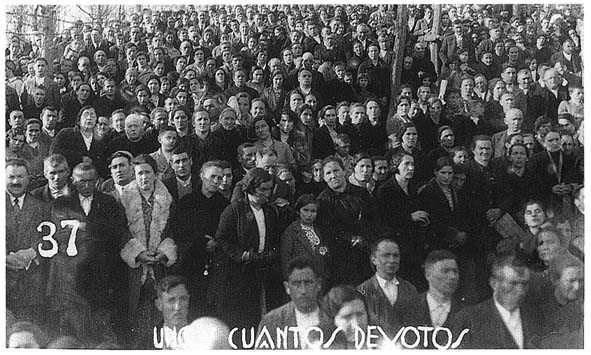
Spectators at Ezkioga, Lent 1932. Photo by Joaquín Sicart
women were the great majority. The audience, however, was mixed: crowd photographs show men and women in equal numbers.[20]
In four photographs 15 and 18 October 1931 I could distinguish 495 males and 480 females and in four photos from Lent 1932 I found 262 males and 289 females.
Women, youths, and children, in comparison with adult men, have in common a lack of power. What we know about the backgrounds of the seers confirms that on the whole they were persons with little public power in society. Those who became "regulars" tended not to be well-off or well educated. I was able to place about 75 percent of the seers at Ezkioga roughly on a social scale. Some were "distinguished"—the kind of people the press referred to as Don, Doña, Señor, Señora, Señorita, or Señorito. Such deference was never gratuitous and referred exclusively to those, including children, with a high rank. One in six seers (about 16 percent) at Ezkioga overall fit this category, but only about one in ten in this group admitted to more than one vision and none admitted to many. The newspapers featured these seers because they provided credibility to the visions as a whole. Similarly, distinguished seers were highlights in the literature about the Christ of Limpias. One of the reasons the diocese of Pamplona did not make public the visions at Piedramillera was precisely because none of the seers was a Don.
At Ezkioga, in fact, there was not much "society" to boast about. No priests or doctors admitted to having visions. One nun from Barcelona did tell about a vision, but only to her fellow pilgrims. The absence of priests was troubling for
the seers, and Evarista claimed that some clerics had visions and kept mum about it: "The Virgin told me that here in Zumarraga there is one who has seen her and there are two in Navarra." A Madrid lawyer was a seer, as was a diplomat, the director of an electric company, and the son of a bank manager from Zarautz; but each reported a vision only once. A few of the summer people had visions, as did some upper-class Catalans in 1932, mostly notably a woman from a prominent landed family of Vic. The upper-class child seers included Iñaki Jaca, the son of a manufacturer of wicker furniture in Zumarraga and the boy from San Sebastián on vacation in Legazpi. But these were exceptions as well. In retrospect, the most famous "distinguished" seer was Haydée de Aguirre, a young woman who later became well known as a fiery speaker at mass meetings for the Basque Nationalist party. She said she saw one or more rosaries in the air above the hands of a little girl.[21]
Emilia Cantero Llaurado from the convent of the Esposas de la Creu had visions on 7 and 8 March 1932 (Cardús to Rimblas, 10 March 1932); Evarista vision of 5 April 1932, SC D 64-69—clerical seers would have had every reason to keep quiet. Loreto Albo Molins was from a landed family of a village near Vic, the unmarried sister of two priests and a doctor; she had visions 4 and 5 April 1932, ARB 109, B 633, Sicart photos 15, 39. For Iñaki Jaca see B II 625 and ED, 26 July 1931, LC, 28 July 1931, and ED, 29 July 1931.
Haydée de Aguirre talked to Salvador Cardús (SC E 101-102) October 17 about what she had seen the day before: "[The girl] was in ecstasy, and all at once some of us realized that a little above the seer were hanging suspended in the air some rosaries. Some invisible being was holding them with two hands by two upper ends, so that they took the form of an elongated triangle. The child, still in ecstasy, reached out a hand and took it.... Today has been the day of my life that I have received Communion with the most devotion." See also R 34, and for Haydée de Aguirre at Ezkioga, Easo, 16 October 1931, p. 10.
A big step down on the social scale were people from the trades in the market towns—cattle and pig dealers, a draughtsman, the child of a furniture restorer. From this level there were about twenty seers; only three—Lolita Núñez, Jesús Elcoro of Bergara and Bilbao, and Cruz Lete—became seers of renown. Others from Ormaiztegi, Beasain, and Zarautz had visions for shorter periods.
But the seers well represented the peasant families of Gipuzkoa, or at least the farm women and children; the rural folk who went to the visions would have recognized in them their own kind. Fully half of the seers I know at Ezkioga were from farming families or families of artisans—blacksmiths, rope-makers, and woodworkers—who directly served the farm communities.
Servants, like Ramona Olazábal, were in this class. In the early decades of the twentieth century service in the homes of the wealthy or the shorthanded was part of the life cycle of rural women in Gipuzkoa, who learned domestic skills that would serve them in married life. The mother of the first two seers had worked in the home of some rural bakers of Urretxu before she married. Service was also a recourse when running a farm was no longer an option. The seer Juliana Ulacia grew up on a farm her parents rented in Beizama, but when in 1932 her father died in an accident, her mother took a job as a servant in Tolosa. Juliana began to have visions a year later, when she was thirty-three.[22]
Niece of Ulacia in Tolosa, 6 June 1984, and Boué, 92.
Seers also included a few urban workers or members of their families. Most were from the company towns around Ezkioga and had farm backgrounds. Included here are four chauffeurs (mecánicos ), servants of the wealthy. Like the "distinguished" male seers, they had their visions once and dropped out of the picture. Whereas female servants, as we will see below, had incentives to keep on having visions, male servants and industrial workers had reason in the ridicule and political distrust of their fellows to stop having them.
Finally some seers came from Gipuzkoa's underclass of temporary labor, the poorest of the rural poor, the homeless kind who subsequently died in hospices or had to be taken in by believers. I know of eight of these seers. While the very
rich quickly shied off, the very poor, the downwardly mobile, and the unconnected stuck to the visions. Such persons through their visions found a spiritual shelter and a caring community. But by no means were they the norm.[23]
For the very poor see O'Neill, Social Inequality.
Certain kinds of people in Gipuzkoa were less likely to be seers, or at least they were less likely to reveal visions: adult men, male and female factory workers, men and women dependent on fishing, merchants, priests, the liberal professionals, town dwellers (especially "distinguished" ones), and nuns. By and large the visionaries we know about were rural and Basque by birth. Out of one hundred Ezkioga seers resident in Gipuzkoa and Bizkaia whose surnames I know, only ten might not have been Basque in origin.[24]
Non-Basque family names: Aguado, Aranda, Bedoya, Cabezón, Fernández, Miranda, Núñez, Rodríguez, Sánchez, and Taboada.
Contact between Social Classes
While there were no "distinguished" regular seers, we have seen the interest the visions aroused in the wealthy and the aristocratic. Many summer visitors to San Sebastián, Zarautz, and the watering spots of Zestoa and Ormaiztegi went to Ezkioga. As a member of the gentry wrote in the Madrid monarchist daily in August 1931, "Going to Ezquioga this year is the unavoidable duty of every good vacationer, as it was to go to Limpias in 1919." Bilbao industrialists and stock-brokers, their wives and friends, also went. These people shared with the rural Catholics a deep anxiety about the Second Republic, and some were equally hopeful that God would step in.
On the Ezkioga hillside the well-off prayed side by side with the poor, an anomaly not lost on observers of all stripes. La Constancia 's correspondent from Tolosa wrote on July 15 that pilgrims to Ezkioga were "numerous in all classes and conditions in this city, from the best known to the most humble." The same newspaper returned to the theme:
One of the most distinctive aspects of this constant pilgrimage is the mixing of people of all social classes. Indeed, next to the local and summer aristocracy, which gives such an extraordinary contingent of devotees to Ezquioga, go the most modest people, who willingly make the financial sacrifice that the trip entails.
Rural folk noticed the mix as well. The Argia correspondent from Matxinbenta argued that the presence of the rich proved the seriousness of the visions: "Those who say this is the stuff of witches or the foolishness of farmers should go to Ezkioga to say the holy rosary, and there they will see if all those cars belong to farmers or people from towns, and when they see rich folk kneeling in the mud they will know who has faith."
Outsiders too found the mixing remarkable, as did the canon and deputy from Toledo, Ramón Molina. A decade earlier, Catholic commentators found similar relief from the class struggle at Limpias.[25]
Gentry quote in Santander, ABC (Madrid), 13 August 1931, p. 16. LC, 16 July 1931, p. 8, and 19 July 1931, p. 2; also the pamphlet ¿Qué Pasa en Ezquioga? p. 8, and Lugin, A, 23 August 1931; Molina, El Castellano, 24 August 1931, p. 1; Christian, Moving Crucifixes, 97-99.
Social hierarchy was as rigid and economic differences as sharp in rural Gipuzkoa as in the industrial towns and cities. Apart from the gap between nobles and nonnobles and between those with degrees and liberal professions and those without them, there were steep gradients separating wealthy from poorer farmers and those with access to land from the rootless. Religious houses reproduced these differences. They distinguished between fathers and lay brothers, mothers and lay sisters, the former educated and fulfilling the sacerdotal, teaching, and healing tasks, the latter uneducated and limited to the menial maintenance tasks. And in the diocese there were major differences between priests after years in the priesthood. Benita Aguirre heard the Virgin address these differences: "During the chastisement the rich will be poor and the poor will be better off than before, but nobody will be rich."[26]
On class structure see Caro Baroja, Los Baroja, 273; "El Castigo: Declaraciones de Benita Aguirre" (vision of 8 February 1932), printed, in Laburu papers in Loyola. B 488-489 omits these lines.
The extremes met in the arena of domestic service. Antonio Amundarain's mother, who married a Carlist soldier, served before her marriage in the Liberal household of a San Sebastián shopkeeper. During the Carlist bombardment of the city in the 1870s a grenade hit her employers' balcony and she heard them say, "The Carlist pigs, full of cider and beans!" Her grandson felt the slur like a whiplash more than one hundred years later; for him it epitomized the gulf between the devout agricultural countryside and the mercantile city. We find the same resentment in Pilar Ciordia's vision of the vicar general's untimely death and abrupt removal to hell. She asked rhetorically, "What good to you are so many servants, being driven so much in automobiles? Poor thing, what good is it to have a rich family, if you cannot take anything with you?"[27]
Juan María Amundarain, San Sebastián, 3 June 1984, p. 2. The vicar general Echeguren described José Garmendia to the Jesuit Laburu, "smelling like wine, hardly able to articulate words" (notes in FL). Ciordia vision, B 692-693.
Whereas the servants were the poor in the houses of the rich, priests and doctors were the rich (or at least the learned) most likely to enter the houses of the poor. Benita in her visions learned from Jesus that doctors who charged too much and priests who did not believe in the visions would die in the chastisement.[28]
B 579, undated.
Doctors and priests served as go-betweens. The doctor from Tolosa who examined Ramona's wounds had assisted at her birth. The local Zumarraga doctor, Sabel Aranzadi, was the ideal intermediary between the seers and the press; he was at ease with both, for the grew up on a nearby farm, as did the Ezkioga priest, Sinforoso de Ibarguren. Another doctor provided Laburu with inside information on seers and their work experience in San Sebastián. When the milkmaid, herself an intermediary between the farm and town folk, wanted to spread the news of the initial visions, she went to a priest from her social class, Miguel Lasa. Doctors, priests, and servants were links between the classes; they introduced seers to believers and to the press.The intensity of the visionary experience fused disparate elements—at least temporarily—into unusual compounds: women and men, mistresses and servants, children and adults, peasants and urbanites, priests and confessants. Previously, well-determined patterns had connected the different elements. Potentially, every farm girl was an urban servant, every wealthy person a master.
Farm families paid rent to urban and noble landlords, sold milk to town families, sold pigs, lambs, and calves to town dealers, and bought from town stores and bread trucks. Children and adults, men and women, all knew the patterns and the degrees of deference.
They also knew the system was changing, that workers could make a decent living in the new factories and bright children could find a career in the church. They saw how entrepreneurs, originally canny farmers, could gain economic leeway in the changing society and, like Juan José Echezarreta of Legorreta and Patricio Echevarría of Legazpi, build industrial empires in a lifetime. And they had learned that younger sons could make their fortunes in Latin America and return to live in leisure in new chalets.
In any case, the wealthy and the poor, the socially prominent and the anonymous, interacted. The rural and urban elites were visible in their summer places, on the beaches, and at their rural "palaces," like one near the foot of the Ezkioga hill. Women of modest means who took turns as servants saw the wealthy from inside these houses. Just as in the preindustrial rural South in the United States there was a certain familiarity between blacks and whites, so in Gipuzkoa wealthier and poorer families made alliances and knew each other well. Walter Starkie noticed the ease with which Carmen Medina interacted with the people around Ezkioga: "She stopped to speak to every peasant she met and later in the day she visited sick women of the parish and gave money for the poor."[29]
S 125.
Juan Ignacio Tellechea in his autobiography alludes to the friendship between his modest family and a wealthy one. In 1910, at age twenty, his mother, who was from Zumarraga and then unmarried, started sewing for the family of the owner of a large textile factory in Vilabona. On occasion the family would invite her to eat with them or take her to the theater in San Sebastián. The relation lasted all her life. She made christening gowns, wedding dresses, even shrouds, for five generations of the family. Over the years she formed a close bond that she passed on, when she married, to her own children. The lifelong confidante of the mother, she was also close to the children. And when her own son José Ignacio lay critically ill in the hospital of San Sebastián seventy years later, her employer's children were among his visitors. When one of the employer's daughters became a Carmelite, Tellechea's mother made her habits. In turn, the nun became Tellechea's spiritual godmother when he became a priest. She organized her convent to pray for him in his illness.[30]
Tellechea, Tapices, 83, 311, 413.
Benita Aguirre's large family had a series of connections with those more wealthy. Patricio Echevarría of Legazpi chose Benita's father as foreman of a production line at his tool works and helped him acquire a large old house. Benita's eldest sister, Bitori, described the visit of a wealthy woman who knew her parents well, perhaps from earlier employment, and carried Bitori off, then age twelve, as a maid with the promise of taking her for the first time to the beach.
A third wealthy family, the Garayaldes of Tolosa, later befriended the Aguirres during the visions and provided a refuge from the press in their home.
When the subordinate members of these alliances had visions they gained new options. They did not necessarily gain the options in current relationships (with fathers, landlords, employers, politicians, parish priests, shopkeepers, doctors) in their daily lives. These partners may not have been believers. But for farm girl visionaries there were aristocratic ladies who took them on as servants because of the visions; for children there were adults who served as temporary adoptive parents; for confessants there were priests who wanted to hear more about the other world.
The system of connection up and down the social scale could be played in both directions, and prior to the visions some families were better at playing it than others. Of course, under normal circumstances, those higher in society had the most options. Patricio Echevarría chose which man he wanted as foreman. Benita's father could do little more than say yes or no. Workers, servants, and confessants were not a scarce resource in an economy that counted on over-population. But as in Spain today people from any level of society could initiate the process of establishing chains of long-term contacts up and down the social structure, and the links could be extraordinary durable. For what was at stake was a trust that transcended class or personal short-term interest—a moral bond that would ensure that a transaction would not go sour, that a maid would not steal, that a worker would not go on strike, that a client would pay for goods he bought on credit. In such a system a person with a complaint could go to other members of the family or to the intermediaries through whom the contacts were made. Obligations to kin served as bonds for economic transactions. The visions at Ezkioga took place in a rural society in which economic bonds were moral bonds, even in the local factories. It was a society well aware of the alternative—the more purely economic vertical connections between workers and employers in Bilbao, Irun, San Sebastián, and Madrid. In these places workers needed the countervailing horizontal bonds of socialism or anarchism for protection.
The groups of Basque farm neighbors who as a matter of course worked together in material and spiritual matters turned up in the cuadrillas of the rural seers. And the long-term help that the Virgin at Ezkioga offered reaffirmed this kind of long-term cooperation of rural folk at the same level. The Virgin ordered the people of Bachicabo to harvest Eusebio's potatoes, as they would normally do when a neighbor was sick or injured.
The Virgin's attitude reaffirmed as well the long-term bonds of patronage that had grown up between the wealthy and the rural poor. The seers replicated this kind of bond with the major promoters. Benita's family moved easily between the Echevarrías, Bitori's employer, Padre Burguera, and the Catalans. But in these new relationships there was no longer such an imbalance of options. Benita's father may have had few choices economically, but Benita herself, once people
understood that God had chosen her, could select from among all the promoters, reporters, and photographers. Even the boss's family took a lively interest in her visions.
The women who had visions at Ezkioga worked in the houses of persons who could patronize the visions. We know of seers who were ex-servants (Ramona Olazábal) and servants (Evarista Galdós and the Ataun girl). We know of seers who began having visions while servants of believers (Carmen Visa), seers whom believers took on as servants because of the visions (Evarista Galdós and the Ataun girl, both by Carmen Medina; at least one seer by Isabel Arcelus in Ormaiztegi; and Luis Irurzun as aide-de-camp in the Civil War), and seers who made believers out of their masters by having visions in the houses where they worked (the case of servant-seers in Tolosa, Ordizia, San Sebastián, and Madrid). We know of visions by the chauffeurs of a lady from Eibar, of the duke of Infantado, and of the owner of the apparition site.
The same spiritual adventure joined servant, mistress, and sometimes master in a new way. In Tolosa a sister of a servant held visions and there would appear on her tongue a white wafer, seemingly out of nowhere, all in the house of believing masters. A Portugalete family held regular vision sessions with two servants, a man and a woman, as seers. Anna Pou had visions in the house of her masters near Vic in the winter of 1933. In Barcelona some of the same people who went to Ezkioga were followers of the washerwoman Enriqueta Tomás, whose messages appeared written on her arms. For all of them the story of Gemma Galgani must have had a special resonance. She too was a kind of servant, experiencing visions and reenactments of the Passion in a house where she helped with the laundry and the ironing.[31]
Cf. Blackbourn, Marpingen, 126.
The visions inevitably affected the relations of seeing servants and believing masters. In his lecture denouncing the visions Laburu used the fact that Carmen Medina and the girl from Ataun ate together as evidence against the visions. We saw that a male visionary told Carmen Medina that the Virgin had said they should marry. A servant seer prominent in Spain in the 1980s went from serving meals to her masters to being served meals by them.
Servants are trained cultural mediators. In order to serve they have to learn the idiom of their masters and be sensitive to their needs and inclinations. The messages the servant seers of Ezkioga received from the divine at the same time transcended and resolved their bicultural way of life, providing for them, their families and communities, and their masters' families and class a common enterprise. Masters sometimes treated servants as ignorant and innocent boys and girls, which made the servants' visions more believable for their masters.
The cultural historian David Sabean has written that "the position of anyone in a hierarchy of the exercise of power is not simple, and there are satisfactions and deprivations at all levels."[32]
Sabean, Power, 25.
Some of the seers seem to have taken pleasure in getting their wealthy, powerful, or prominent believers to do things for them.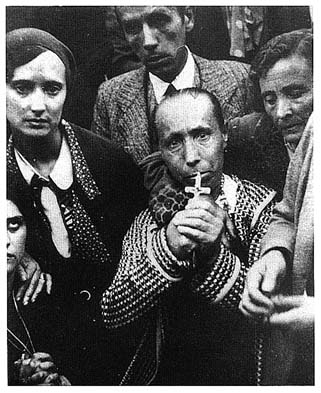
Carmen Visa in vision at Ezkioga, 22 June 1932. Courtesy
Arxiu Salvador Cardús i Florensa, Terrassa
Benita Aguirre came to control Padre Burguera's life almost absolutely. María Recalde at the drop of a suggestion got Luisa Arriola to drive to Burgos. Patxi got Carmen Medina to take him to Toledo. And for a while seers throughout the region got their parish priests to act as their secretaries.
But as Sabean suggests, there could be a converse pleasure. In the visions I have studied, the powerful and sophisticated refresh themselves by shedding power and placing it, however symbolically, in the hands of the less powerful. What interests me is not so much the sudden intoxication that the less powerful experience when they have new options. After all, that transformation we understand intuitively because it is part of the process of growing up. What interests me more is the refreshment that the powerful experience when they withdraw from control, which is more counterintuitive. In some ways child seers could become like adults because certain adults joyfully became like children, like the Priest-Niños. The ultimate model for this relinquishment of power was Christ in the Passion.
The unseemly mixing of social classes as a result of the visions at Ezkioga provided one way for opponents, like Laburu, to discredit the seers and the apparitions. When referring to Patxi's connections with Carmen Medina and her
like, Rafael Picavea played on its unnatural aspect: "They take you back and forth in automobiles. Marquises and duchesses, sisters or consorts visit you. Aristocrat? Come on, Patxi, be reasonable. I like you better as a regular lad at the Basque social club."[33]
Picavea, PV, 13 November 1931, p. 3.
But there was a deep logic in the mingling. Patxi was an anomaly, a peasant among aristocrats as well as a young man who was devout. Whether by inspiration or nudging, he was able to reach the edge of the possible and voice the unspeakable, the unpublishable: the call for a holy war to reclaim the state from the unholy republicans. His vision was a "hidden transcript," a scenario that many people already feared and many hoped for. He could voice the scenario only because conditions were extreme, because he was a Basque country lad, and because of the charisma he had accumulated in his spectacular trances. I doubt that the general public would have accepted the message as divine had it come from a priest or an upper-class seer.[34]
Scott, Hidden Transcript.
The mixing of classes itself was clearly an incentive both for seers and believers. The visions provided a way to overcome barriers that kept people apart. Although the class struggle was not as burning an issue in rural Gipuzkoa as in Catalan textile towns, the visions at Ezkioga, like the movements of Father Vallet and Magdalena Aulina, were attractive in part because they provided one way to transcend social tensions. In Gipuzkoa the gap the visions bridged was that between rural farm families and the urban elite. This bridge was achieved at a time when both urban Nationalists and Integrists idealized rural life for its cultural traditions and intense faith. For years the Catalans had been singing wishfully in the Parish Exercises hymns with words like:
We are brothers! both rich and poor
Away with strife and bitterness!
We are brothers! With good works
Let us unite our hearts.
At Ezkioga they saw their ideals in action.[35]
L. Valls and Ll. Millet, "Som germans! [We are Brothers]" in Obra dels Exercicis Parroquials, Manual de l'Exercitant (Barcelona: P. Calmell, 1928), 48.
Many of these elements come together in María Recalde's account of her meeting with Padre Laburu in Durango. She claimed that she reminded him of his errant youth and his own conversion by a woman as humble and miserable as she, and this allusion supposedly made Laburu burst into tears. At least in the retelling, Recalde challenged hierarchies of gender, class, and respectability by using her position as underdog. For the bourgeois Catalan and Bilbao supporters, the Ezkioga visions in general and the Recalde/Laburu story in particular resonated with the old traditions of apparitions to the powerless and the despised. Believers saw Laburu, as they had seen Justo de Echeguren before him, as obstructing a divine will that made no distinctions based on gender, wealth, or education. But Laburu too, so this story went, could be touched, just as he had been converted (in the story) by a poor woman, perhaps a nurse or a servant.[36]
For Recalde Laburu accounts, ARB 73-74, and Cardús to Pare Rimblas, 17 June 1932.
The Ezkioga visions suggest the hidden potential of intimate contact between social classes throughout the hierarchically organized Spain of the 1930s. The left labeled and identified social class as an issue. But it was the right that through religion forged an interclass alliance of the devout peasantry, the regional bourgeoisie, and the monarchist aristocracy. It is typical of these inspired interclass movements that the seers or mystics are from the better-off peasantry and either have been or subsequently come to be servants in the households of the powerful. In their visions and divine messages they formulated a worldview and agenda that spoke to the world they came from and the world they were coming to know. Part of the excitement, even exhilaration, of the movements came from a catalysis of social classes. A parallel would be the exhilaration and energy released in the American civil rights movement of the 1960s when blacks and whites worked together. Historians have underestimated the popular Catholic support for the military uprising of July 1936 that started Spain's Civil War. That support increased throughout the 1930s. In this critical period a religious mobilization cut across the lines of social class to defend the old society under attack with a preview of the coming reign of Christ.