Tonal-Harmonic Relationships
Equally distinctive is the web of harmonic or tonal relationships from which the sextet is spun. Throughout, Schoenberg explores the possible intersections between what might be called diatonic/dominant and chromatic/half-step worlds. By diatonic/dominant I mean those relationships that revolve mainly around the tonic-dominant axis, especially V-I (or V-I). Although, as Swift notes, the dominant is absent as a "large-scale key area" in Verklärte Nacht, it is nonetheless present as a significant harmonic force, especially in the recapitulatory portions of part II (as will be seen below, in the next section). Other significant relationships are based primarily on half-step motion around certain important pitches or key areas—hence the designation chromatic/half-step.
― 123 ―
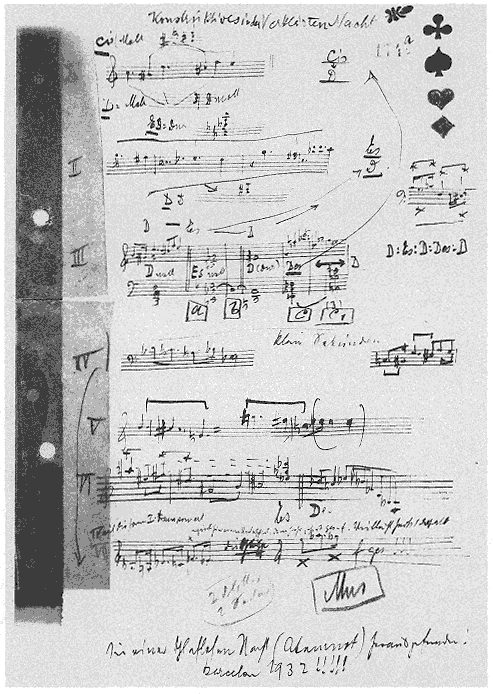
It has been suggested above how half-steps are also important motivic elements in many of the individual themes. This phenomenon, and its relation to the larger tonal dimension of the sextet, was articulated by Schoenberg himself in a remarkable two-page analytical document entitled "Konstruktives in der Verklärten Nacht," which was written out, as the composer notes on the manuscript, "on a sleepless night" in Barcelona in 1932 (see plate 1).[10] This document, which offers a good starting point for a consideration of tonal aspects of the sextet, consists of ten numbered examples (and several other unnumbered ones), each of which demonstrates the larger-scale harmonic resonances of semitones within the themes:
| |
I: | Refers to theme 2b (m. 34). Shows how certain notes of the theme outline a triad, others a D-minor triad. | II: | Refers to theme 4a (m. 75). Shows how certain notes outline major, others D major To the lower right of II is another short example referring to theme 2a (m. 29), in which Schoenberg highlights the semitone pairs and , and (with the bracket underneath) the whole-step G-F. | III: | Refers to several places in the score, to mm. 34 (theme 2b), 225–28, 229, 320–322 (theme 11). Shows what Schoenberg also suggested on other occasions: how the large-scale tonal structure of Verklärte Nacht is shaped by symmetrical half-step relations around the tonic.[11] The D minor of the first part is juxtaposed with the minor at the end of the transition. The D major of the second part is approached first from above, from the minor, then later from below, from (enharmonically ) major. | IV: | Refers to themes 3a (m. 50) and 2b (m. 34). Shows the intervals of "minor seconds" in these themes. | V: | Shows the relationship, consisting of a descending semitone and an augmented fourth, between thefirst three notes of themes 5a (m. 105) and 4a (m. 74). (I have discussed this aspect of the themesabove.) | VI: | Refers to themes 7a (m. 255) and 9a (m. 279). The lower brackets show half-step motion. The upperones show how, although theme 7a is in major, certain notes form a triad, enharmonically .Theme 9 is indicated as being in Although Schoenberg does not |
|
[10] The "Konstruktives" manuscript has been reproduced and briefly discussed twice before, in Thieme 1979, 216–21; and Bailey, 1984, 31–32 and 36–37.
[11] See the remarks reported by Dika Newlin in Newlin 1978, 214, and Newlin 1980, 229.
― 124 ―
Plates 1A and 1B
"Konstruktives in der Verklärten Nacht," manuscript reproduced by permission of the Arnold Schoenberg Institute.
― 125 ―
| |
| | specify the relationship he is trying to demonstrate, it seems that he is again indicating how the and surround the tonic D from above and below. A similar relationship is shown in his example VIII. | VII: | The larger handwritten text above at left reads: "IV auf die form I transponiert." (The remaining text in VII is not readily decipherable.) The music at the left is not found in Verklärte Nacht in this form. Its pitch content is close to the second violin in m. 156 (except for the first two notes, which should be ); but the rhythm resembles that of mm. 311 and 313. Schoenberg's comment seems to suggest that the paired semitones of IV , ) are here "transposed" into the contour of I—that of descending semitone pairs a perfect fourth apart. |
|
― 126 ―
| |
| | Music at right refers to the first violin obbligato to theme 3a at m. 50. | VIII: | Refers to theme 7a (m. 255) and to 6 (m. 230), which appears centered, below 7a. Schoenberg's remark "noch einmal VI" suggests that the example shows (as in VI) how the first two measures of 7a outline a triad, and how mm. 3–4 outline major. As in VI above, then, Schoenberg appears to be suggesting how the two implied triads circumscribe the tonic D major, which here is explicitly shown in theme 6. | IX: | Refers (like VI above) to theme 9a (m. 279), which, although in the key of , is shown to outline an triad and then (in the first viola) to descend to . | X: | Refers to the continuation of theme 7b at mm. 264–65 (at left), to the continuation of theme 3a at mm. 52–54 (at right), and to the further continuation of this theme at mm. 57–60 (below). The brackets and Xs isolate the scale figure descending from to in minor. |
|
At the bottom of page 2 Schoenberg notes that "of all these motivic and structural connections, I was conscious only of those under III a-b-c-c1. Everything else was the diligent effort of my brain, working 'behind my back,' without seeking my approval."[12] In other words, Schoenberg claims to have intended only the symmetrical circumscription of the tonic a half-step above and below. (In the reports of Dika Newlin, however, Schoenberg is said to have claimed not to have been aware of this structural principle while composing. See Newlin 1978, 213–14; Newlin 1980, 229.)
Schoenberg frequently praised the power of his own subconscious in creating musical relationships (see, for example, Schoenberg 1975, 85–86). What should concern us here is less their documentable intentionality (or lack thereof) than their significance within the composition. Some of Schoenberg's observations in the "Konstruktives" analysis seem of minor importance for Verklärte Nacht —for instance, the demonstration in example VIII that certain notes of theme 7a outline
minor, others
major. It is hardly surprising that a theme in
major will feature the diatonic pitches of the dominant and submediant triads. Other relationships seem merely coincidental, such as in IX, where pitches in the
theme 9a are shown to highlight the supertonic triad,
minor. But the basic
[12] The German reads: "Von all diesen motivischen und konstruktiven Zusammenhängen war mir nur die unter III a-b-c-c1 bewußt. Alles andere sind Fleißaufgaben meines Hirns, die es 'hinter meinem Rücken' gemacht hat, ohne meine Zustimmung einzuholen." I am grateful to Anita Lügenbuhl for help with the transcription of Schoenberg's handwriting.
― 127 ―
analytical premise of "Konstruktives"—that Verklärte Nacht is built on both the large and small scale around a few specific tonal relationships—is undoubtedly appropriate. The areas surrounding the tonic by semitone from below and above,
and
, do indeed play an important role, as do other half-step relationships, which are often treated symmetrically. These are the kind of relationships, moreover, that become more prominent in later works by Schoenberg, including those to be examined in subsequent chapters (see also Lewin 1968).
Especially significant at the opening of the sextet are the symmetrical relationships pointed out by Schoenberg in the small example at the far right of II: those deriving from the half-step above the fifth degree,
, and the half-step below the tonic,
. Schoenberg's example refers specifically to theme 2a; but in fact the highlighting of these relationships begins on the first page of the work. The
is the starting point of the stepwise descent in theme 1a; in m. 9 the pedal D yields for a moment to the
. Still greater prominence is accorded the
half-steps in theme 2a, as Schoenberg himself demonstrates. The
motive begins to take on further
harmonic significance in mm. 41ff. Here the bass of the dominant seventh resolves deceptively up by half-step to the
, which supports the famous chord that Schoenberg described as an inverted ninth (Schoenberg 1978, 346).
[13] In fact, the bass line continues up by step well past the
(reaching
in m. 44). But in m. 45, it returns to the A, which after more lower-neighbor motion (
), again resolves upward to
in mm. 48–49. The
now supports an augmented chord less dissonant than the "ninth," and after the fermata it becomes the root of the new harmonic region.
minor.
Across the first fifty measures of the sextet, then, Schoenberg has reversed the original roles of the
and A. In themes 1a and 2a,
clearly functions as as a dissonant upper neighbor. In the passage with the inverted ninth chord, both notes are effectively dissonant: the A is a dominant, the
is the deceptive resolution. But at the fermata the augmented triad begins to take on some harmonic stability; and with the arrival of theme 3a, the
triad becomes fully consonant.
The half-step manipulation is one part of a broader harmonic strategy at the opening of Verklärte Nacht. This strategy seems to have two goals: gradually to infiltrate a purely diatonic D-minor sound with chromatic tones and to unfold a large-scale cadential structure whose basic root motion is i-ii-V-i, as is suggested in ex. 5.2. Let us consider first the chromatic infiltration. As the opening section unfolds, the diatonicism is sustained, not only by the tonic triad, but by the subdominant-type chord, the half-diminished ii7 . This harmony is familiar from several of the songs examined in the previous chapter: the reader will also recall that it formed the central Klang around which Mädchenfrühling was shaped. It
[13] A stimulating essay about the function and the context of the "inverted ninth" chord in Verklärte Nacht is Lewin 1987.
― 128 ―
Example 5.2
Verklärte Nacht, mm. 1–29, harmonic reduction.
likewise forms the most important non-tonic sonority in the first section of Verklärte Nacht. The first significant intimation comes at the sustained, double-dotted quarter note in mm. 5–6, the longest melodic note value up to this point. Locally, the E and G of this chord are upper neighbors to the D-F of the tonic triad; but if we add an implied or inferred
to the chord—the note is never far away on the opening page of
Verklärte Nacht —we have
, or ii
7 in D minor.
In m. 9, Schoenberg introduces the first non-diatonic pitch. The leading tone
appears in the bass, not as part of a dominant, but in an augmented triad spelled
. In mm. II–12 the upper strings ascend to a higher register and Schoenberg intensifies the gesture of mm. 5–6: the tonic root now alternates with G, which supports the complete half-diminished harmony in first inversion (
). With m. 13, the steady D pedal resumes, but now the descending stepwise opening theme is transposed to the dominant (what Swift has called the "dominant hexachord" [1977, 7]). Just as the
has taken on more definition, so now does the mysterious
introduced in mm. 9–10. It is now in the uppermost voice and has annexed an additional note of the dominant triad, A; it is sustained for a half-note and given its own dominant note, the upbeat
, which provides a quasi-cadential melodic motion.
Schoenberg has distinctly upped the level of dissonance: as the dominant of the leading tone, this
is the most remote pitch heard up to this point. Meter and rhythm also play a role in giving the
of mm. 14 and 16 more prominence. Previous dissonant or non-tonic chords have appeared on the weaker second half of the measure (mm. 5–6, 9–10); the
now falls on the downbeat.
From m. 17 on, the dissonance level is intensified still further. The bass at last moves definitively off the D, rising chromatically up to the E. This E supports a ii7 chord with a raised fifth (
), which resolves up by fourth to a half-diminished on A. The progression is repeated in m. 19, then again in augmentation across mm. 20–21; in both instances the first chord is now the original half-diminished,
. As in the song
Jesus bettelt, examined in the last chapter, Schoenberg provides strong, explicit root movement underneath vagrant harmonies. The A chord is thus made to seem like a consonance, or at any rate a chord of resolution, until the second half m. 21, where it resolves by appoggiatura to a full diminished seventh (
) . This latter chord marks the first real articulation point in
― 129 ―
the piece. The sequence of mm. 22–23 is, like what has preceded it, based on vagrant chords, the diminished and half-diminished sevenths, and we end up in m. 24 on the familiar
of D minor (cf. m. 11), which is now sustained for four measures. The dominant to which it resolves in m. 28 is intentionally perfunctory; it consists only of unison and octave As.
From the viewpoint of root motion, the large cadential structure that extends over the first section of Verklärte Nacht is twice interrupted: i–ii-V // ii-V // ii-V-i (ex. 5.2). But, as I have suggested, this tonal scaffolding is by no means straight-forward or conventional, since the diatonic roots, very much as in mm. 14–17 of the song Jesus bettelt, often support vagrant chords. The cadential framework is also unusual in that the pre-dominant ii chord gets considerably more weight than the dominant by virtue of its presence in mm. 11–12, 18–20, and 24–27. The dominant pitch A never supports or is supported by an actual dominant harmony: in mm. 13–17, a D pedal underlies the "dominant hexachord" in the melodic voices; in mm. 18–21 the chords above the bass A are half-diminished and diminished; and in m. 28 there is no harmonization of the A at all.
The dominant withheld in the first section becomes more apparent—indeed, insistent—in the theme 2 group, mm. 29–49. Here the half-diminished ii chord returns in mm. 34–38, where the ascending stepwise bass outlines the diminished fifth
. The chord leads via a still more intense diminished seventh (
to a standard
cadential progression. The resolution, however, is twice interrupted: first by the "inverted ninth" chord, second (m. 46) by a diminished-seventh chord built on
. With this last deceptive move, Schoenberg leaves the tonic region for the remainder of part I of
Verklärte Nacht. At m. 181, theme 2a returns, now accompanied by the harmonic progession of mm. 41–44. Although labeled the first "recapitulation" by Swift, this passage cannot be heard as a tonal return to D minor. The harmony remains intentionally ambiguous and open-ended, leaving the way open for the definitive return to the tonic in part II.