
Going on the Air
The distinctive feature of the Radiation Laboratory's approach to particle accelerators was reliance on radio technology. Many of the Laboratory's earliest workers, including Lawrence, had been radio hams in their youth; they continued the sport on a grand scale by a ham link between the Laboratory and one of its earliest satellites at the University of Michigan.[70] The heart of Livingston's first cyclotron was a pair of off-the-shelf Radiotrons, air-cooled, rated at 75 watts each and arranged in a standard radio circuit, with the single dee in place of an antenna. The analogy is not idle. The cyclotron could interfere with commercial broadcasting or police communications; the Laboratory listened to itself on the radio so as to correct spillage into others' air waves and "prevent investigations by the Radio Commission which may result in our having to put in elaborate and expensive protection devices." It is said that Lawrence used to tune his home radio to the cyclotron's operating frequency to monitor its, and his students', performance.[71] The second cyclotron required a 20-kW water-cooled oscillator in another standard radio circuit; the third cyclotron used two 20-kW tubes, which also drove Sloan's x-ray machine.[72] As we know, their cost provoked the Laboratory to make their own and to enter still more deeply into the art of radio engineering. This move so far from ordinary physics was a surprise even to people familiar with Lawrence's methods.[73] The Laboratory was so filled with radio waves that its members could light a standard electric bulb merely by touching it to any metallic surface in the building.[74] Many cyclotron laboratories were to eke out their resources by cannibalizing old radio parts.[75]
[70] Cork to Lawrence, 21 Aug 1936, and Lawrence to Cork, 26 Aug 1936 and 9 Feb 1937 (5/1).
[71] Lawrence, memo to Purchasing Dept., 31 Jul 1935; Childs, Genius , 251.
[72] Terman, Radio-engineering , 228, 253, 258–9; Livingston, Production , 13–4, and fig. 3; Lawrence and Livingston, PR, 40 (1932), 28, in Livingston, Development , 127; Lawrence, "Workbook," 139 (39/4).
[73] Cooksey to Lawrence, 6 May 1933 (4/19).
[74] Alvarez, Adventures , 42.
[75] E.g., disused tubes from a radio station, at Rochester, Dubridge to Lawrence, 20 Sep 1935 (15/26); an old radio transmitter from the navy, at Har-Lawrence, 20 Sep 1935 (15/26); an old radio transmitter from the navy, at Harvard, Hickman to J.R. Wier (GE), 1 May 1937 (UAV, 691/60/3); out-of-date radio tubes for ionization gauges at Berkeley and elsewhere, Lawrence to H.W. Edwards, 18 Jan 1934 (7/2).
The maximum energy given particles by a cyclotron depends not on the power but on the frequency of its oscillator. From the fundamental equation 2.1,

where R is the radial distance to the collecting cup. Livingston achieved million-volt protons with the second cyclotron with the cup at 11.5 cm and the oscillator at 20 MHz. This last number represented close to the practical limit on frequency: to have gone higher would have required, first, a more intense magnet (since the frequency is proportional to the field strength) and, second, a tube capable of changing polarity over twenty million times a second and delivering around twenty thousand watts of power. The first requirement would have pushed the art of magnet design, the second that of power oscillators, to or beyond the edge of available technology. The only immediate way to increase the energy of the protons by an order of magnitude was to increase R three-fold . Hence the great value to the Berkeley cyclotroneers of Federal's derelict magnet, which could be rebuilt to give a field of appropriate intensity between pole pieces 27.5 inches (70 cm) in diameter.
The Federal magnet, like the oscillator tubes, was a product of radio technology, the Poulsen generator, which had at its heart a periodic arc between electrodes in hydrogen. When the arc struck, it carried the oscillatory discharge from a large condenser, which fed an antenna; when the discharge current diminished sensibly, the arc went out and a battery recharged the condenser, which, when full, relit the arc (fig. 3.4). The magnet assisted the extinction of the arc: it made the ions carrying the current run in a curved path from one electrode to another; they therefore could not create by collisions any fresh ions along the straight line between the electrodes; and consequently not enough carriers were available there to continue or restart the arc when the potential across the gap at A (fig. 3.4) no longer sufficed to ionize the gas
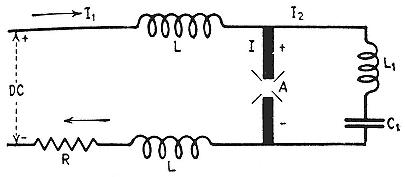
Fig. 3.4
Schematic diagram of the electrical arrangement in the Poulsen arc. I1 , the
charging current; I , the rf current through the resonant circuit when the arc
strikes. The choke coils L keep the rf current from the battery circuit.
Heilbron, Museoscienza, 22 (1983), 16.
near the electrodes. In a word, the field insured that the arc went out without flickering (plate 3.5). The objective was to produce an undamped signal of almost constant frequency rather than the broadband output characteristic of the spark transmitters of early wireless.[76]
We are familiar with Federal's growth under navy contracts, and with the culmination of their relations in the commissioning of four 1,000-kW generators, two for each end of a radio link between the United States and its expeditionary forces in France. Their magnets could deliver 18,000 gauss.[77] The war ended before the huge antenna towers—second only in height to the Eiffel tower—could be completed in France. The navy withdrew, leaving France with half a radio station and Federal with four 80-ton magnets. In 1919 the French government decided to proceed with the Lafayette station, as they called it in memory of the American alliance, in order to communicate with its empire in Southeast Asia. Its signal received in San Francisco was four to eight times stronger than the signals from other major European transmitters. That did not recommend completion of the American end of the
[76] Heilbron, Museoscienza, 22 (1983), 13–24.
[77] Howeth, Communications , 241, 243, 246, 253; Anon., Radio review, 2 (1921), 85–90.
link to the navy, however, which now favored development of vacuum-tube oscillators. That left Federal with two war-surplus magnets. Everyone switched to tubes except the Dutch, who constructed a 3,600-kW Poulsen generator to drive an antenna stretched between two hills in Java, which gave the Dutch East Indies a voice audible in Amsterdam.[78]
Lawrence's big magnet, being a piece of high technology, required professional engineering help in its metamorphosis into a tool of science. Fuller advised about renovating the pole pieces and about windings and power supplies; and he procured the assistance of an employee at Federal, Gilbert W. Cattell, who inquired into all sorts of details: the best sort of paper insulator for the windings, of oil for cooling, of cables for connecting, and so on.[79] Cattell wound and insulated the coils at Federal before the magnet went to Pelton for machining (plate 3.6). Toward the beginning of February 1932, the foreman at Pelton's machine shop, Henry Nelson, carted its handiwork across the Bay and erected it in the Radiation Laboratory. Pelton did an excellent job, the pole faces parallel to four-thousandths of an inch, the field homogeneous up to 18 kG.[80] Lawrence hoped to have the cyclotron itself in operation at the end of February and shortly thereafter to pass "the next milestone," protons with energies above 3 MeV.[81] In March he worked "night and day" with Livingston and a graduate student, James Brady, on the machine. "I have neglected everything else—even my fiancée has suffered."[82] Molly's suffering did not make the machine go. In April they thought that they had cured the leaks that the huge magnetic forces kept springing in the cyclotron tank. Still no results. Lawrence went East in May, to Molly and marriage. Livingston
[78] Ibid., 93, 579; Howeth, Communications , 136, 208–9; Hooper, Electr., 18 (1921), 1112–3.
[79] Correspondence between Lawrence and Cattell, Nov and Dec 1931 (25/2); Fuller, interview, 72, 142–5 (TBL).
[80] Pelton to Lawrence, 14 Sep 1931, 29 and 30 Oct 1931, and Lawrence to Pelton, 2 Feb 1932 (25/2); Lawrence and Livingston, PR, 45 (1934), 608.
[81] Lawrence to Poillon, 9 Jan 1932 (15/16), to Tuve, 13 Jan 1932 (17/34), to Livingood, 18 Feb 1932 (12/11), and to Buffum, 21 Jan 1932 (46/15R); cf. Lawrence to Tuve, 10 Nov 1931 (17/34), expecting to have the machine going before Christmas.
[82] Lawrence to Haupt, 11 Mar 1932, and reply, 15 Mar 1932 (9/2).
labored on; the chairman of the Physics Department, Elmer Hall, alarmed at his appearance, counselled a long rest.[83]
Vacation cured what slavery had not. By mid September Livingston had overcome his various difficulties and produced hydrogen-molecule ions at 1.6 MeV. "When he gets up in the 3,000,000 volt range [Lawrence wrote Cottrell] he intends to stop and bombard various elements with them before going to higher energies." A week later he had reached 3.6 MeV at about one µA, always with

Stopping for physics was perhaps a pleasure. It was certainly a financial necessity. Lawrence had started planning for a larger apparatus long before Livingston had got a beam. He did not plan to carry off the Poulsen arc from Java, but to enlarge the pole pieces and vacuum chamber of the new cyclotron from 27.5 to 37.5 inches. He floated this bubble in April 1932. Poillon indicated that he would incline toward granting the $1,100 needed when asked for it. But Lawrence had overreached. Poillon had the same month pledged $2,500 to the Laboratory to enable it to make much needed detectors, a cloud chamber with cinema camera ($1,500) and a magnet to analyze particle beams ($1,000). Somehow Lawrence thought that the Research Corporation and the Chemical Foundation would provide another $800 for instruments and supplies; but when he asked for it in August, he was told that the University should pay for such things. Lawrence already had spent almost the entire allocation for expenses and power for AY 1932/33. It was only August! He would have to close down the Laboratory, he said, unless his hard-fisted backers allowed him to pay for his electricity from the $1,000 granted for
[83] Lawrence to Poillon, 12 Apr 1932 (3/28, 5/16); Hall to Lawrence, 16 June 1932 (8/8).
[84] Lawrence to Cottrell, 22 Sep 1932 (5/3), and to Cooksey, 29 Sep 1932 (4/9); Livingston, PR, 42 (1933), 441–2 (3 Oct 1932). Parameters: R = 10 inch (25.4 cm), H = 15,250 gauss, f = 11.6 MHz. Cf. Lawrence to Barton, 29 Sep 1932 (2/25), and to Boyce, 1 Oct 1932 (3/8).
the analyzing magnet. As an inducement to Poillon, Lawrence dropped—only temporarily—the unfunded proposal to enlarge the pole pieces and vacuum chamber. Poillon allowed the redirection of funds.[85]