
Free Mining
The California legislature sanctioned "free mining" at the beginning of 1851 In 1850 the alcalde of Marysville, Stephen J. Field—who was destined to become chief justice of the California Supreme Court in 1857 and to serve the longest term in the his-
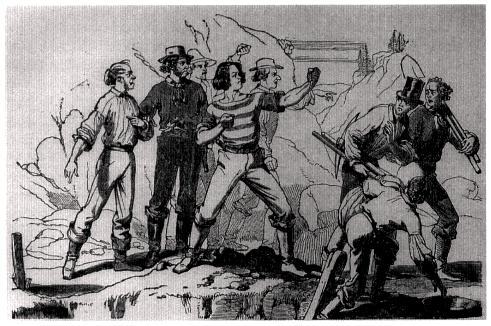
"Bogue Ejecting the Squatters," one of the illustrations by Charles Nahl that enliven the
pages of Old Block's Sketch-Book . This collection of charming and humorous tales of
gold-rush California was published in 1856 by Alonzo Delano, who, like Nahl, had earlier
tried his hand at mining. Although disputes over claims were generally resolved through
arbitration according to the dictates of local custom and code, miners occasionally relied
on direct action to secure their rights. California Historical Society, FN-30963 .
tory of the U.S. Supreme Court, from 1863 to 1897—ran for the legislature from Yuba County, which at that time also contained what would become Nevada and Sierra counties. The immense county was 100 miles long and 50 miles wide, with a scattered population of 25,000. Most miners were far removed from the county seat and institutions of government.
Late in his life, Field recalled that one of his campaign planks in 1850 was "giving greater jurisdiction to the local magistrates, in order that contests of miners respecting their claims might be tried in their vicinity. As things then existed the right to a mule could not be litigated without going to the county seat. . . . I was in favor of legislation which would protect miners in their claims, and exempt their tents, rockers, and utensils used in mining from forced sale [by the federal government]." The 1851 law he sponsored provided that "in actions respecting 'Mining Claims,' proof shall be admitted of the customs, usages, or regulations established and in force at the bar, or diggings, embracing such claim; and such customs, usages, or regulations, when not in conflict with the Constitution and Laws of the State, shall govern the decision of the action." Simple as it was, this law became the foun-
dation for mining on the public domain throughout the American West. Field claimed that mining camp law symbolized "that love of order and system and of fair dealing which are the prominent characteristics of our people." The laws were framed, he insisted, "to secure to all comers, within practicable limits, absolute equality of right and privilege in working the mines." Field, of course, exaggerated. The mining camp codes did not always welcome "all comers" or promote "fair dealing." The California legislature enacted many laws pertaining to the mineral lands, including foreign miners' taxes that permitted some miners to discriminate against others and provided for eviction from the mining districts if not paid.[13]
California's courts quickly adopted the principle of free mining, though not without confusion. Miners could not abridge the rights of the United States, but they limited competition and prevented the monopolization of the mines by the state or private corporations. In 1853, in a bizarre appeal to English precedent, the California Supreme Court proclaimed the state's sovereignty over all mineral lands in California. Those who favored the decision hoped that the mines could be taxed to pay state expenses. The ruling met strong opposition from within the mining districts, where critics charged that the court had been bribed by capitalists who hoped to take from the state what they could not persuade Congress to give them. Critics also feared that since the case would inevitably be overturned by the U.S. Supreme Court—which it was—it would weaken rather than strengthen mineral claims.[14]
In his annual message to Congress in December 1850, President Millard Fillmore echoed President Polk's suggestion that the mineral lands be sold at auction in small parcels. But by the time he addressed Congress a year later, Fillmore feared the consequences of such a policy. Now he recommended that the gold fields of California "be permitted to remain as at present, a common field, open to the enterprise and industry of all our citizens, until further experience shall have developed the best policy to be ultimately adopted."[15]
Congress said little more about the mineral lands during the 1850s, but large hydraulic mining companies proliferated in California during the first half of the 1860s, and friends of corporate mining feared that English and Scots investors would refuse to sink more money into the mines until Congress formally approved free mining. Moreover, at the end of the Civil War, western miners faced several financial threats. Congress might auction off the mineral lands to help pay off the national debt incurred by the war, an alternative favored by the secretary of the treasury. Or it might retain title to these lands, levy a production or transportation tax, or extend the 1861 income tax to miners. (By the end of the war, the income tax produced almost one-fifth of all federal revenue, but given the transient nature of miners the cost of administering such a tax system would have been high.) In 1865, Congressman George Julian of Indiana introduced a new bill to sell the mineral lands. Similar legislation was introduced in the U.S. Senate, but Congress refused to act—in large part
because California's delegation predicted that revolution would result. Miners bombarded Congress with petitions urging the rejection of the Julian bill.[16]
In 1865, the U.S. Supreme Court acknowledged that free mining enjoyed "implied sanction" and had contributed "largely to the prosperity and improvement of the whole country."[17] Nevertheless, since the Constitution explicitly granted Congress the authority to regulate and dispose of the public lands, the high court could not make policy. In 1866, the disposition of the mineral lands again came before Congress. Debate focused on a bill introduced by Senator William Morris Stewart of Nevada, who, along with Senator John Conness of California, had led the opposition to Julian's plan in the previous session of Congress. Stewart spoke for the vast capital that had been poured into the Comstock Lode, but he played on public sympathy for the individual miner: "I assert . . . that the sand plains, alkaline deserts, and dreary monuments of rock and sagebrush of the great interior, would have been as worthless today as when they were marked by geographers as the Great American Desert, but for this system of free mining fostered by our own neglect, and matured and perfected by our generous inaction." Since the principal asset securing the national debt was land, and since increasing the production of gold would drive up the value of that land, Stewart also argued that free mining would do more to reduce the national debt than would selling the mineral claims.[18]
Congress adopted Stewart's bill in 1866, and it became the foundation of mining on the public domain. It confirmed the status quo and extended the rules established in California's gold camps to the rest of the West. It ensured that mineral lands within the public domain would remain open to "all," that the rules governing their use should be dictated by the miners themselves and ratified by the state, territorial, and federal governments, and that miners who wished to secure clear title to their claims could do so for $5 an acre. The 1866 law applied only to shaft mining, but in 1870 Congress extended the opportunity to purchase claims to placer miners, at $2.50 per acre. A third mining law, adopted in 1872, completed the formal process of turning control over precious metals to the miners, counties, and states.[19]