
Replanning al-Jaza'ir
First Interventions
The casbah posed a great challenge to French planners for a variety of reasons: high population densities, concentration and form of the built fabric, topography, and sociocultural texture, as well as their own romantic/Orientalist appreciation of its aesthetic values, accompanied by a growing consciousness of historic preservation. In part due to these reasons, but also to the need to provide new quarters to lodge Europeans, interventions in the casbah remained incremental throughout the French occupation and no grand plans were ventured. While the upper part of the town was left practically untouched, the lower part underwent certain transformations that accentuated the preexisting division during the colonial period. The greatest changes to the lower city, known later as the Marine Quarter or the Quarter of the Ancient Prefecture, took place during the initial phase of colonization, between 1830 and 1846.
A solution that essentially characterized almost all later projects was proposed by Théophile Gautier in 1845: the high casbah should be preserved "in all its original barbary," while the Europeans should stick to the lower part, close to the harbor, because of their penchant for "large streets . . . cartage . . . and commercial movement."[31] This was exactly what had happened in the early years of the occupation, when the main
concerns were militaristic (not yet commercial) and before it became clear that expansion beyond the Ottoman fortifications was a necessity. The documents from the first decade of the French regime reveal an overwhelming obsession with potential offensives from Europe and only a secondary consideration for possible conflicts and confrontations with local people. Military engineering dominated all urban design operations during this period.
The pressing issues of the 1830s consisted of lodging military troops and cutting through the necessary arteries to enable rapid maneuvers. Appropriation of houses, shops, workshops, and even religious buildings was commonplace during the first years of the occupation and often involved modifications in the buildings to accommodate the needs of the army.[32] The abrupt brutality of the first interventions caused an immediate controversy, making the city and its architecture prime actors as contested terrains in the colonial confrontation. Oral literature from the time of the conquest is rich with examples that voice the collective sentiments of local residents. One such song lamented the invasion and appropriation of the city and highlighted the violation of its most revered cultural icons:
O regrets for Algiers, for its houses
And for its so well-kept apartments!
O regrets for the town of cleanliness
Whose marble and porphyry dazzled the eyes!
The Christians inhabit them, their state has changed!
They have degraded everything, spoiled all, the impure ones!
They have broken down the walls of the janissaries' barracks,
They have taken away the marble, the balustrades and the benches;
And the iron grills which adorned the windows
Have been torn away to add insult to our misfortunes.
O regrets for Algiers and for its stores,
Their traces no longer exist!
Such iniquities committed by the accursed ones!
Al-Qaisariya has been named Plaza
And to think that holy books were sold and bound there.
They have rummaged through the tombs of our fathers,
And they have scattered their bones
To allow their wagons to go over them.
O believers, the world has seen with its own eyes.
Their horses tied in our mosques,
And they and their Jews rejoiced because of it
While we wept in our sadness.[33]
Expropriation and demolition were rampant, but on a fragmented and relatively small scale. True French urbanism in Algiers originated with the carving of a Place du Gouvernement and the widening of three main streets off this square that led to the main gates: Rue Bab Azzoun going south, Rue Bab el-Oued going north, and Rue de la Marine east to the harbor.
The idea of a Place du Gouvernement developed immediately after the conquest. Noting right away that the existing town lacked a large, conveniently located space for assembling the troops, the chief army engineers decided to open an "immense" area in front of the Palace of the Dey (Figs. 12 and 13).[34] The initial clearing—which involved the demolition of the minaret of the al-Sayyida Mosque,[35] as well as "many shops in bad shape and several houses," in the words of Lieutenant Colonel Lemercier—was based on practical goals: to shelter the troops, to enable the movement of carriages, and to establish markets. Lemercier added, however, that with later enlargements according to a plan, this square would turn the quarter into "the most beautiful and the most commercial" in town. Successive projects attempted to regularize the square: a pentagonal piazza, planted with trees, dotted with fountains, and surrounded by two-story residential buildings with arcades on the ground level was proposed in 1830.[36] A rectangular proposal by a government architect named Luvini called for the demolition of the al-Jadid and al-Sayyida mosques in 1831, but was opposed by Lemercier out of sympathy for the local population in order "not to hurt the religious sentiments of the Moors" (Fig. 14).[37] Al-Jadid survived the demolition fever, but al-Sayyida was torn down to allow for a building with a regular facade on the square.[38]
Capitalizing on the damage caused by a fire to parts of the Janina Palace in 1844, numerous projects attempted to readjust the plaza's overall shape in the following decades. Over a long period of time it acquired a loosely rectangular shape with arcades on three sides, the irregularity of the east side a result of Lemercier's desire not to tear down the al-Jadid Mosque (Fig. 15).[39]
The enlargement of Bab Azzoun, Bab el-Oued, and Marine streets did not involve such drastic demolitions. Adhering to preexisting patterns, they followed an irregular route but were widened to 8 meters to allow for two carriages to pass (Fig. 16).[40] In 1833 two other streets, Rue de Chartres and Rue des Consuls, were classified with the first three as the main arteries of Algiers, although only Rue de Chartres could be enlarged and that in 1837. Between Bab Azzoun and Rue de Chartres a

Figure 12.
(above) Plan of central Algiers, showing the Place d'Armes (Place du Gouvernement),
1832. Figure 13. (below) View of the Place du Gouvernement, c. 1835. The building
to the left in the foreground is the al-Jadid Mosque.

Figure 14.
Proposal for regularization of the Place du Gouvernement, 1831.
square, Place de Chartres, was carved by demolishing a small mosque and a series of commercial structures (Fig. 17). To compensate for the loss of the latter, the urban administration constructed here a covered market with 250 shops for the exclusive use of indigenous populations. Boulevard de la Victoire, defining the highest boundary of the town,
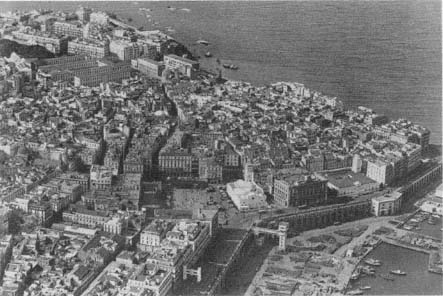
Figure 15.
Aerial view of the Place du Gouvernement, 1934. The al-Jadid Mosque is to the right.
also dates from this period.[41] To facilitate military movements and vehicular circulation in the upper casbah, a plan in 1834 proposed a new gate on the south walls and an artery connecting this gate to the citadel. In addition to serving the army, the new "grande route" would bring life to the residents of the upper town by providing an alternative to the existing "exceptionally narrow" streets; totally inaccessible to vehicles.[42] The project, which also regularized the central square, was not executed.
Regularization, Reduction, and Isolation
Comprehensive urban design projects that targeted the reorganization of the entire settlement were few and far between. Engineer Poirel's 1837 proposal to regularize and widen the street network, bringing the secondary streets to 3 and 5 meters wide, received a great deal of criticism due to its excessive catering to private interests.[43] Later designs focused on the extension of the city and only marginally ad-
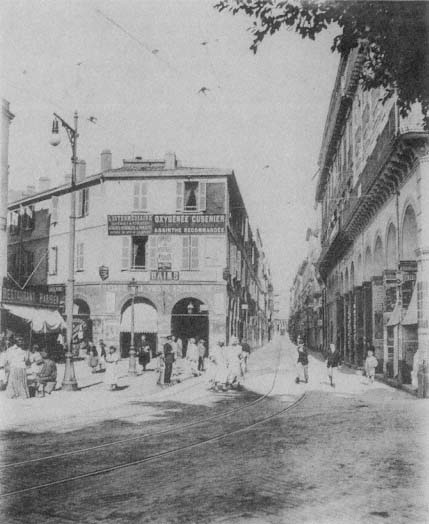
Figure 16.
Rue Bab Azzoun, c. 1990.
dressed the old town. One example is Charles Delaroche's 1848 project, which doubled the size of Algiers by new fortifications and a modern settlement with wide arteries and squares in the European quarter (Fig. 18). Delaroche's unrealized interventions to the casbah consisted of broadening three major streets that cut across the old town and carving a few squares at important intersections.

Figure 17.
Plan of the casbah. (1) Boulevard Gambetta, (2) Boulevard
de la Victoire, (3) Boulevard Vallée, (4) Rues Randon and Marengo,
(5) Rue Bab el-Oued, (6) Rue d'Orléans, (7) Rue de la Marine, (8)
Place du Gouvernement, (9) Place de Chartres, (10) Rue Bab
Azzoun, (11) Rue de Chartres, (12) Rue de la Lyre.
The realization of a main artery on the waterfront, Rue Militaire, first presented in a sketch by Poirel in 1837 and intended to serve the harbor as well as act as a promenade, was delayed until 1860. When construction began, the artery was named Boulevard de l'Impératrice, celebrating the visit of Empress Eugénie and Napoleon III to Algiers the same year. It was completed in 1866 according to Charles-Fréderick Chassériau's plans (Fig. 19). A particularly difficult feat of engineering due to the drastic difference in level between the boulevard and the embankment, the structure was supported by a series of high arches recalling a bridge or an aqueduct. The ramps connecting the Boulevard de l'Impératrice to the harbor level took another eight years to build.[44] The project gave Algiers its memorable waterfront: the continuous high arcade of the lower level, animated by the changing scale of the arches supporting the ramps and in juxtaposition to the more delicate arcades of the Boulevard de l'Impératrice on the upper level—all in white.
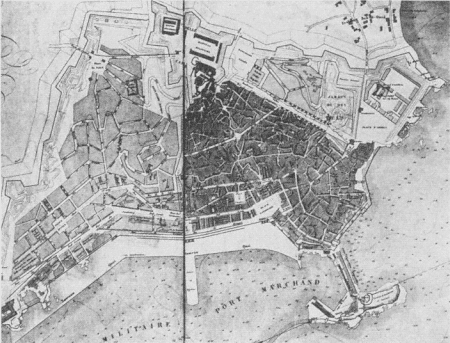
Figure 18.
(above) Plan by Charles Delaroche, 1848.
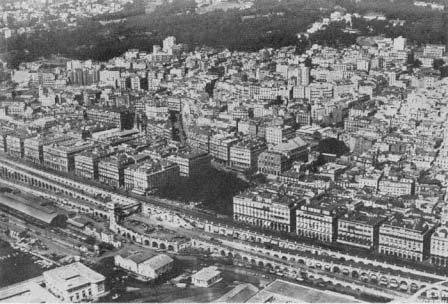
Figure 19.
(below) Aerial view of the arcades and the Boulevard de l'Impératrice, 1933.
While providing a spectacular edge to Algiers, this project also engraved the power relations of the colonial order onto the urban image: the casbah was locked behind the solid rows of French structures.
The obsessive focus on defense generated persistent demands for the enlargement of the fortified areas—a debate that had started in 1840.[45] By 1849, the old fortifications were replaced by new ones, enclosing an area three times larger than the one occupied by the old town. The lower part of the casbah had acquired a more regular street network with two main arteries, Rue de la Marine and Rue d'Orléans, which connected Rue de la Marine to Rue Bab el-Oued (see Fig. 17). The European settlers—French, but also Italian and Spanish—lived here, while the upper casbah became an exclusively indigenous town. The distinction between the two parts was reflected in their new names: the upper casbah became the "casbah" proper and the lower town became the Marine Quarter.[46]
The conjuncture of the casbah and the Marine Quarter was subjected repeatedly to regularization proposals. In 1917, for example, a project devised for the area defined by Chartres, Vialar, and Bab Azzoun streets and Place du Gouvernement, advocated the enlargement of Rue Bab Azzoun by appropriating 6-meter strips from its west side, thereby changing the width from 8 to 14 meters. In addition, Rue de Chartres and Rue de Vialar would be widened to 10 meters, and transversal streets, 8 meters wide, would connect the main arteries running parallel to the waterfront.[47]
Of various plans devised for the Marine Quarter, the one proposed by Eugène de Redon in 1884 has been revived several times, most significantly in revised versions between 1901 and 1914, and in 1922 (Fig. 20). Redon's project was initiated by the municipality's growing concern about public hygiene in the Marine Quarter, in the area between Rue Bab el-Oued and Boulevard de la République on the waterfront (the original Boulevard de l'Impératrice). The municipal authorities agreed to "raze whatever existed" here.[48] Although Redon's project addressed the entire city, its main impact was restricted to the proposals for the Marine Quarter, because it established clear strategies to resolve the chaotic structure of this area. The essence of the proposal involved the displacement of half of the population residing in the quarter, specifically the urban poor, who would be relodged in new housing projects to be built on the hills of the Bab el-Oued Quarter to the northwest of the old town. This depopulation would enable the replacement of narrow streets with large arteries lined with luxurious buildings to attract the wealthy bourgeoisie. A 25-meter-wide main avenue, Avenue de la
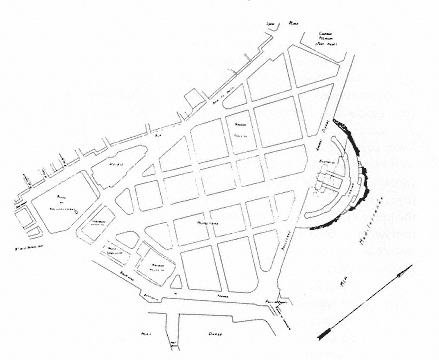
Figure 20.
Eugène de Redon's plan for the Marine Quarter, 1925.
Préfecture, would extend the Boulevard de la République. At the beginning point of the avenue, close to the Place du Gouvernement, placement of the stockmarket and the Tribunal of Commerce expressed the ambition to turn the Marine Quarter into an impressive business center. The reorganization of the area would result in the reorientation of the al-Jadid Mosque and demolition of the al-Kabir Mosque, with plans to rebuild it on the northern flanks of the casbah.[49]
The 1922 version of the Redon plan emphasized once more the quarter's congestion and the necessity for erasing the entire area to accommodate circulation and called for the displacement of twelve to fifteen thousand people. The new buildings would cater above all to the needs of commerce.[50] In this version, however, the two mosques were preserved and a prominent casino was placed where the main avenue met the waterfront in the north.
Interventions to the casbah proper were relatively few. The north-south Rue de la Lyre (present-day Rue Ahmed Bouzrina), parallel to the Rue Bab Azzoun, stood out with its straight layout and continuous colonnades amid the irregular street fabric surrounding it. Projected in
1845 but completed in 1855, it connected the center with the newly planned suburb Bab Azzoun and eased the heavy circulation on the axis of Rue Bab Azzoun and Rue Bab el-Oued.[51] Its architectural qualities made it especially significant to the French as a reminder of the Rue de Rivoli, a cherished urban fragment from Paris now implanted in Algiers. Rue Randon (now Ali la Pointe), its extension Rue Marengo (now Arbaji), and Rue Bruce were also cut through at this time.[52] Other major alterations carried out in the 1840s included two straight boulevards, Boulevard Vallée (present-day Boulevard Abderazak Hadad) on the north and Boulevard Gambetta (present-day Boulevard Ourida Meddad) on the south, both built on the glacis of the Ottoman fortifications.[53] Remaining at the edges of the old town, the major interventions during the early phases of the colonial rule may seem to have had little effect on the core of this introverted settlement. Nevertheless, the boulevards encircled the casbah and signified the surrender of the original residents of Algiers to the French—literally and metaphorically.
French architects early on acknowledged the immense difficulty of cutting through the casbah. A report submitted to the governor general of Algeria in 1858 pointed to the futility of fighting "against nature," against the capricious, "tormented," and "accidental" topography of the casbah. Arguing that the needs of the French were different from those of the indigenous people, the report proposed the construction of a new town, which would cater to European tastes, next to the old one.[54] Napoleon III's "arabizing" policies enhanced the conservation of the casbah further. The new policy of "tolerance" that dominated the 1860s criticized former demolitions and European constructions in the old town, which had pushed the local population to upper slopes and resulted in highly congested living conditions. The report that followed the emperor's research maintained that
the town must conserve its actual physiognomy, that is to say, the high town must stay as it is, because it is appropriate to the customs and habits of the indigenous; cutting through grand arteries may result in causing them great suffering, and all these improvements may impose hardships to the indigenous population, which does not have the same lifestyle as the Europeans. The emperor thinks that the lower town should be reserved for the latter and it is in that part that all works of improvement and beautification should be made.[55]
In the late 1870s Eugène Fromentin summarized the early colonial policies Napoleon III aimed to change and commented on the rationale and extent of the French appropriation of Algiers:
France took from the old town everything that was convenient for her, everything that touched the waterfront or dominated the gates, everything that was more or less level and that could be easily cleared, and readily accessible. She took the Djenina, that she razed, and the ancient palace of the pachas, that she converted into the house of her governors . . . . She created a little Rue de Rivoli with Bab Azzoun and Bab el-Oued streets, and peopled it with counterfeiting Parisians. She made a choice between mosques, leaving some to the Qu'ran, giving others to the Evangelists.[56]
After these initial interventions, the casbah was left on its own. If demolition was no longer the issue, neither was maintenance. Algerian urban sociologist Djaffar Lesbet argues that the implicit menace of destruction to the casbah posed by neglect played a constructive and catalyzing role on the residents and forced them to pool their resources to stop the "natural" demolition of their neighborhoods. The basis for an alternative urban administration was established, operating on two levels: the maintenance of public open spaces by designated officers from the casbah and the maintenance of individual houses by the collaborative and organized labor of renters and owners. The residents of the casbah thus spoke back to colonizers by turning to themselves, consolidating their unity, and establishing their own system. With this move, Lesbet maintains, the casbah was transformed into a "counter space" (espace contre ) that represented the oppositional voice of Algerians to colonial power.[57] The diametric stances of the casbah and the French Algiers, crystallized further by the former's "counter space" character, destroyed any possibility of overall harmony in a situation distinct to French colonial urbanism. In the words of Fanon, "The zone where the natives live is not complementary to the zone inhabited by the settlers. The two zones are opposed, but not in the service of a higher unity. Obedient to the rules of pure Aristotelian logic, they both follow the principle of reciprocal exclusivity. No conciliation is possible."[58]
The Ideology of Preservation
The polarization in the urban form and social structure of Algiers was well in place after a century of French occupation. This did not mean, however, abandoning the casbah and its inhabitants to their own destiny. The attempts to renovate Algiers in celebration of one hundred years of French rule and in preparation for its leadership role in French Africa brought the old city—both the casbah and the
Marine Quarter—into focus. By this time, the first colonial interventions into the old city were subject to widespread criticism among the French in Algeria. The critics focused on two points: demolition of the old fabric and the poor aesthetic quality of the European structures. According to one critic, before the arrival of the French,
The capricious urbanism of Algiers had the great merit of unity; Arab architecture only had buildings that accommodated their goals and that presented an ensemble of haditations all built according to a uniform plan. From the first stroke, we abolished this harmony.
The most beautiful indigenous quarters thus were hollowed out; hundreds of houses were torn down; either the military administration or the entrepreneurs, after demolishing and ravaging, replaced the oriental dwellings with villain structures in the European style for renters.[59]
The foremost scholar of Algiers, René Lespès, also emphasized the "uniformity of the Moorish houses of Algiers," which harmonized with the lifestyles and customs of the residents. Grieving over the destruction of the ancient town, he pointed to the need to understand the particular character of these houses, as well as the intentions and the necessities that dictated their plans against the "stupidity and inelegance . . . of the desire to Europeanize them."[60]
The new directions adopted during the two decades from the 1930s to the 1950s agreed on the preservation of the precolonial heritage of the casbah. In essence, the policies pursued Napoleon III's notion of royaume arabe (arab realm) and, building on decades of French colonial experience, brought a clearly articulated ideological justification to all the design decisions.
Hubert Lyautey, governor general of Morocco from 1912 to 1925, is acknowledged for his development of distinct French colonial urban policies and an ideology of preservation in the colonies. The essence of his urbanism aimed to accommodate a new order, based on diversity, where people of different social and cultural circumstances could coexist.[61]
Lyautey's two main principles, which recall Napoleon III's policies for Algiers—namely, preservation of medinas out of respect for the local culture and building of new, modern cities for European populations—formed the backbone of all later urban planning decisions in Algiers. For Lyautey, the preservation of the Arab town had several meanings, some emotional, some practical. Above all, he savored the aesthetic qualities of the Arab town, its "charm and poetry," which he attributed
to the sophistication of the Arab culture.[62] To understand the difference between this culture and the European one was essential to building a colonial policy that would endure: "The secret . . . is the extended hand, and not the condescending hand, but the loyal handshake between man and man—in order to understand each other . . . . This [Arab] race is not inferior, it is different. Let us learn how to understand their difference just like they will understand it from their side."[63]
This major difference between the two cultures required the separation of the indigenous from the European populations in the city, according to Lyautey:
Large cities, boulevards, tall facades for stores and homes, installations of water and electricity are necessary, [all of] which upset the indigenous city completely, making the customary way of life impossible. You know how jealous the Muslim is of the integrity of his private life; you are familiar with the narrow streets, the facades without opening behind which hides the whole of life, the terraces upon which the life of the family spreads out and which must therefore remain sheltered from indiscreet looks.[64]
Consequently, Lyautey made the conservation of the Moroccan medinas one of his priorities in urban planning. He announced proudly, "Yes, in Morocco, and it is to our honor, we conserve. I would go a step further, we rescue. We wish to conserve in Morocco Beauty—and it is not a negligible thing."[65] Behind these compassionate words, however, lay an economic goal: the medinas were essential for the development of tourism, especially for the romantic traveler and the artist.[66]
The International Congress on Urbanism in the Colonies, held during the 1931 Colonial Exposition in Paris, recorded the powerful influence of Lyautey's ideas and practice on the new rules of planning in French colonies. Among the goals of the congress, as listed by Henri Prost, were "tourism and conservation of old cities" and "protection of landscapes and historic monuments." The "wish list" of the participants included the creation of separate settlements for indigenous and European populations, respecting the beliefs, habits, and traditions of various races. Whenever possible, a greenbelt, sometimes referred to as a cordon sanitaire , would divide the European town from the indigenous one.[67]
In Algiers, these principles were already written into ordinances by the late 1920s, and the "indigenous quarters" were placed under a special regime destined to conserve their character—despite the fact that "they were in opposition to principles of hygiene and urbanism."[68] The
architects in Algiers knew that conservation was not sufficient to preserve the picturesque character of the casbah; given the buildings' fragility, rehabilitation was an important issue. One architect, Jean Bévia, proposed regulations to prohibit changes, to fix the height limits, and to impose "the Arab style." Nevertheless, he advocated demolishing buildings in had condition and using their lots to "ventilate" these congested neighborhoods. Furthermore, a special municipal commission of hygiene had to be established to educate the residents—a most difficult task, Bévia maintained, given that the local people ignored all rules of health and hygiene.[69] A recurring theme in the discussions on the casbah, the "lack" of hygiene (together with the "lack" of order, material civilization, and so on) is a key mechanism in what Ella Shohat and Robert Stam call "the transformational grammar of colonial style racism," which reiterates the hierarchical structure of the colonial society.[70]
A special regulation, dated 13 June 1931, intended to conserve the "character and aesthetics" of the casbah by "imposing on the inhabitants the obligation to restore their houses and to build new ones only in ways that serve to that effect, following the proportions and characteristics of the indigenous architecture of Algiers." A newly created commission of consultants would supervise the casbah. Accordingly, Henri Prost, René Danger, and Maurice Rotival drafted a master plan for Algiers in 1931 that aimed to preserve the casbah.[71]
The abstract notion of the preservation of casbah was further articulated during the following years. Now the upper city itself was divided into two. The efforts of the Commission of Historic Monuments contributed greatly to the regulations concerning the "picturesque physiognomy" of the new "upper" casbah, defined by Rue Randon and Rue Marengo and Boulevard de la Victoire. This quarter would be neither demolished nor rebuilt as pastiche in the manner of "exhibition pavilions," a term used derogatorily. The rules were clearly specified: all new houses would conform to Algerian and Moorish styles; cornices, windows, wood lattices, canopies, doors, polished tiles, and painted or sculpted woodwork would be either preserved or reconstructed according to the original; a few new interpretations could be allowed if the output conformed to the general style; demolished European houses would be replaced by ones in the indigenous style; no building would be higher than three floors, including the ground floor; and all plans had to be submitted to the Technical Services section of the municipality for approval.[72]
While intervention to the upper part of the casbah was minimal and its residential function was maintained, the lower part, between Rue
Marengo and Rue Bab el-Oued, would be turned into a "museum quarter." Here, careful restoration of the few authentic buildings of aesthetic value and the preservation of the "tortuous and vaulted" Rue Emile Maupas and Rue de l'Intendance, considered by Lespès as "the most remarkable in old Algiers," would be undertaken. The archdiocese, the Palais d'Hiver, the headquarters of Indigenous Military Affairs, the old Moorish baths, the Bibliothèque Nationale, and the palace that now sheltered some offices of the secretary general would form an easily accessible ensemble as a museum complex.[73] In addition, schools for the indigenous would encourage the development of local art forms. As an integral part of the greater mission to preserve Algeria's historic heritage, an impressive number of new schools and workshops had already been established by the colonial authorities to develop local crafts—embroidery, leatherwork, copperwork, metalwork, carpentry, pottery, masonry, and decorative arts—with the goal of increasing their commercial value.[74]
Le Corbusier's projects for Algiers (spanning from 1931 to 1942) pursued the prescribed policy of preservation, used the same terminology, and gave the familiar rationale in explaining what to do with the casbah. Le Corbusier's casbah was also "beautiful," "charming," and "adorable," and it "never, no, never must be destroyed." Its historic significance as the "place of European and Muslim life during centuries of picturesque struggles" was held to be of great interest to the entire world. Therefore, its historical and aesthetic values, the vestiges of Arab urbanism and architecture, should be protected to enhance the "gigantic" touristic potential of Algiers. The overpopulation of the casbah, however, posed a difficult problem because it sheltered four to six times more residents than it could contain. If Algiers was to become the capital of French Africa, the misery of its Muslim population had to be addressed, the casbah "purified" and reorganized, its population reduced.[75]
Le Corbusier thus proposed to preserve the upper casbah in its integrity while restricting the densities and intervening in the patterns of use, in accordance with the planning decisions made before him. A number of buildings were to continue to function as residences, but others were to be converted into arts and crafts centers to initiate an indigenous "renaissance." The slums of the lower casbah, in contrast, would be expurgated; only the mansions would be preserved, yet converted into specialized museums for the indigenous arts. Parks and gardens would replace the areas cleared from the slums, but the existing street network
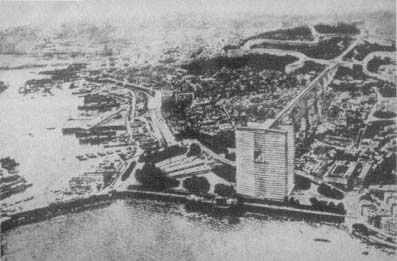
Figure 21.
Le Corbusier, project for Algiers, photomontage, 1933. The business center,
shown in the foreground, is connected to the residential areas on the hills by
means of an elevated structure that forms a bridge over the casbah.
would be maintained to link the high casbah to the Marine Quarter and to the harbor.[76]
Le Corbusier interpreted Lyautey's idea of a greenbelt separating the European city from the casbah. In his 1932 plan, for example, a giant linear structure that connected the hillside residences for Europeans to the cité d'affaires in the Marine Quarter formed a bridge over the casbah, transforming the sanitary greenbelt into an air band and reversing the horizontality of the former into a vertical element (Fig. 21). Repeating the concept in his later plans, Le Corbusier himself emphasized the essential separation of the two settlements: "This artery will be separated entirely from the indigenous town, by means of a level difference."[77] Le Corbusier's project would thus establish constant visual supervision over the local population and clearly mark the hierarchical social order onto the urban image, with the dominating above and the dominated below.
Post-World Way II Realities
The casbah entered a crisis in the late 1930s. Political and economic conflicts and instability stalled all plans for the casbah in the
later part of the decade. World War II shifted the focus of political concerns away from the local populations, pushing the casbah further into the background. The result was an intensification of the problems noted repeatedly in the early 1930s, namely the pace of demographic growth and physical decrepitude.
According to the 1931 census, the population of the upper casbah was about 54,000 people, with nearly 3,000 inhabitants per hectare; as compared to 1,430 in 1881 and 2,028 in 1921. The growth was largely due to immigration from Kabylia. The majority of the casbah's population consisted of indigenous people, Arab or Kabyle, although there was a considerable Jewish contingent; the few Europeans were often married to locals. As indicated by the very high densities, housing conditions were dreadful, with often an entire family crammed into a single room. The majority of the houses did not have electricity or running water, but sometimes a well in the shared courtyard. Remnants of the former lifestyle could be found in a small number of houses that belonged to the Turkish bourgeoisie on Rue de la Grenade (now Kheireddine Zenouda), Rue Kléber (now Rue des Frères Bachara), and Rue Sidi Mohammed Cherif.[78]
By 1949, the population had increased to 64,000 in the 38-hectare area defined by Boulevard Gambetta, Boulevard de la Victoire, Boulevard de Verdun, and Bab el-Oued and Bab Azzoun streets, raising the density in certain locations to 3,500 inhabitants per hectare. Of the 2,250 buildings of the upper casbah, 7 were mosques, 5 synagogues, and 1 a Protestant church; only 15 residences were "classified," that is, in good condition. E. Pasquali, an engineer in charge of the Central Division of Technical Services in the municipality, reported that the rest of the residential fabric, "several centuries old," would be subject to a municipal program. The first step in this program consisted of a survey of all buildings, to be followed by necessary interventions to assure the safety of the inhabitants, and, eventually, by demolition. While the municipal officer regretted the disappearance of these "last witnesses of the barbaresque period," he argued that in the interest of the residents and the quarter itself, there was no other alternative. The demolition of thirty-three houses in 1948 marked the beginning of a new era for the upper casbah: it was now essential to draft a redevelopment plan for the old town.[79]
Two years later, such a plan had not been drafted and Pasquali still advocated the demolition of most of the casbah, pursuing the dominant attitude toward historic cities everywhere at the time. He now proposed that before demolitions, however, a new cité should be built for the resi-
dents who would be displaced. He attributed the unhygienic conditions to overpopulation and the age of the buildings, pointing to physical as well as social diseases that would result from the crowding of eight or ten persons into a single room and two hundred into a single house. Under attacks from the conservationist camp, Pasquali eventually had to "admit, in spite of everything, that tourists did not come to Algiers to contemplate (our) Isly and Michelet streets," and that it was the casbah that made Algiers a tourist attraction due to the originality of the siting of its houses and to its "sympathetic disorder." His solution was to convert the upper casbah in its entirety into a museum and to remove its actual residents.[80]
The loss of old Algiers was an eventuality agreed on by many European observers. The only unchanged section was the heights, the quarter bordered by Rue de la Casbah on the north, Boulevard de la Victoire on the west, Rue Rampart-Médée and Rue du Centaure in the south, and Rue Randon and Rue Marengo in the east. With the goal of limiting historic preservation to this relatively small area, planners argued that here the original street network and the Moorish houses should remain intact. European constructions were negligible and the population exclusively Muslim. Given that the rest of the casbah had been intersected by several arteries and that old age was in the process of destroying whatever was left of the original buildings, the area once occupied by the old town was diminishing rapidly. Already in the first period of colonization the great triangle of old Algiers had lost its base, with the two great mosques left freestanding and isolated from their community of worshipers.[81]
The overcrowding of the casbah began to push the limits of the old settlement with pockets of shantytowns at its borders in the early 1950s. The first bidonvilles appeared to the west and the northwest of the casbah; the construction was made of any available material, including reed, zinc sheets, and large metal containers (bidons ). Here immigrants from the countryside lived in congested conditions, often more than ten people inhabiting a single shack. Carrying the aspect of a "real village of gourbis, " or huts, such settlements maintained a rural lifestyle and contrasted not only with the European parts of Algiers, but also with the urban form and life of the casbah itself. Nevertheless, the casbah had undergone some transformations as the waves of immigration changed its population cross-section to predominantly Kabyle residents, "a truly rural proletariat" that maintained its customs and traditions and resisted the urban culture.[82]
The urban administration proudly announced its success in introduc-
ing some elements of "modernization" to the casbah. By the first years of the 1950s, public fountains, at intervals of 200 or 300 meters, dotted the quarter; because the majority of the houses did not have running water, water carriers provided service for a fixed price. Garbage was collected every morning by small carts pulled by donkeys (regular carriages could not pass through the narrow streets), and the streets were washed by sea water. Electricity had also entered the casbah: not only the major streets, but also many houses were lit electrically.[83]
The debates between those who favored the preservation of the casbah (for historic and touristic reasons) and those who favored radical surgery (for hygienic—later political and militaristic—reasons) continued until the liberation. Even after the Battle of Algiers turned the historic city into a war zone, a romance with the beauty of its site and architecture lingered among many sectors of European society. In 1959, for example, the chief engineer of the Urbanism Section of the Municipal Council of Algiers gave an extensive tour of the casbah to a delegation of European mayors, who, according to newspaper accounts, were seduced by the "cascades of white terraces, diving into the harbor in a dreamlike golden light."[84]
On 3 October 1957, Gen. Charles de Gaulle revealed his extensive development plan for Algeria. The Plan de Constantine, named after the city where de Gaulle's famous speech was delivered, was based, according to its promoters, on "human promotion." Its premise, as outlined by de Gaulle, emphasized the role of France as the bearer of civilization, now a modern civilization: "Algeria in its entirety must have its share of what modern civilization can deliver to men of well-being and dignity." Together with education, decent housing was deemed essential to improve the standard of life of the Algerian people, but also to ensure their "social evolution" and "to modify their life habits and familial needs."[85]
Interpreted by its defenders as "the hope for the renaissance of the casbah," the Plan de Constantine addressed its problems on two levels: socioeconomic promotion and humanization of the daily life of the inhabitants. According to Jean Fabian, the municipal inspector for the casbah, the sociocultural project involved establishing new clinics and schools, and encouraging commercial enterprise. As congestion was the main issue, ventilating the casbah by means of demolition would allow for good traffic circulation and improve the transportation problems, as well as endowing the quarter with a "decent and modern" face, one that would be perceived as "a very great French work." According to the
Plan de Constantine, the residents would be relodged in new housing projects specifically designed for them. Of the three possible solutions—to raze the casbah entirely, to keep it as it was, or to redevelop it—the last was deemed the most productive. The houses in poor condition would be taken down, while others whose salvage was possible would be restored according to an effective technical plan. This option would not only bring down the population densities, but also establish an equilibrium between open space and built form.[86]
Despite regulations and the innumerable debates on how to improve the conditions in the casbah, the administration did not take any action. With the intensification of local resistance against French rule, the casbah became a "high risk" war zone. Ultimately, it was abandoned by the urban administration altogether. As noted by Lesbet, Algiers and the casbah were played against each other during the war, expanding on their oppositional roles established earlier.[87]
Impact of the Decolonization War
The image of the casbah changed fundamentally in 1954, when the region became the site of urban guerrilla warfare. For the Algerians, it became the locus of "the legend and the slum," that is, the legend of the Revolution and the slum of daily life. The National Liberation Front's Committee of Coordination and Execution had reorganized the administration of the casbah by dividing it into zones and establishing a system of planques (hideouts) and caches of resistance.[88] The complex configuration of the casbah, with interlocking terraces and passageways and tortuous dead-end streets, made penetration by French authorities difficult and facilitated defense.
As the site of war, certain locations in the casbah became associated with unforgettable moments for Algerians. The houses where resistance fighters were caught, tortured, and sometimes murdered became engraved into public memory. For example, the Rue Sidi bin Ali was the hiding place and explosives laboratory of Yacef Sadi, who escaped miraculously during the invasion on 6 February 1956; the same night, on Rue de la Grenade, Djamila Bouhired's father and brother were tortured in her presence for hours; two months later, Djamila herself was shot and arrested in the same location. On Rue Caton, Yacef Sadi and Zohra Drif were caught on 24 September 1958; on 3 October 1958 a group of houses was blown up by parachutists, resulting in the death of Ali la Pointe and Hassiba ben Bouali, in addition to thirty others.[89]

Figure 22.
Barricades in the casbah.
From 1956 on, it was common practice for the French security forces to invade the casbah and cut it off from communication with the rest of Algiers (Fig. 22). Even a random selection of news items conveys the change in the daily life of the casbah, now frequently interrupted by unexpected police raids. On 28 March 1956, in an attempt to "decontaminate" the casbah of troublemakers and "to protect the lives and properties of many families . . . whose only desire is to work and live in peace," the police forces blocked unexpectedly the Rue Marengo and Rue Randon, together with adjoining smaller streets, to question more than two thousand people; five hundred were taken to the police headquarters for identity checks. The same evening, a similar operation was carried out in the upper casbah, and still more people were put into custody. Another "giant control operation" imprisoned sixty-five hundred residents in the casbah on 26 May 1956 for twenty-four hours, during which more than four thousand people were interrogated and all contact with the exterior was halted. The casbah was surrounded at midnight, and machine guns and grenade launchers were placed at key locations, such as Boulevard de la Victoire and Rue de la Lyre. Colonial
newspaper accounts commented tongue in cheek on the lack of picturesqueness in the casbah during those twenty-four hours, when the residents were locked inside their houses and allowed to open their doors only to the police. On 8 January 1957, armed forces two thousand strong undertook a search operation in the upper casbah. A secondary objective of this massive action, which had started at 3:00 A.M., was to recruit unemployed people as construction workers. On 23 September 1956, twenty-four smaller streets around Rue Bab el-Oued, Rue Bab Azzoun, and Rue de la Lyre were barred from circulation "for an indeterminate amount of time."[90]
The French considered the defeat of Ali la Pointe the end of the Battle of Algiers, with the paramilitary forces as the victors. From that point military order reigned in the casbah and marked the region with its own symbols of war and occupation. Military and police officers had increased in great numbers, all strategic crossroads were wired, entries and exits from the casbah were controlled, and public spaces were decorated with propaganda posters (which were in turn covered with graffiti expressing themes of resistance and independence).[91] In December 1960, a tract signed by several resistance organizations and published in El Moudjahid , the official journal of the National Liberation Front (FLN), called the casbah the "new ghetto of Warsaw," in reference to the two hundred thousand people besieged here.[92] Yet though the casbah was locked off from the rest of Algiers and under military occupation, it still functioned as a theater for resistance, with parades echoing others elsewhere in the city until the end of French rule.[93]