This website contains archived content made available for reference, research, or recordkeeping purposes. These materials are not actively maintained and may not meet current web accessibility standards, such as WCAG 2.1 Level AA. If you need assistance accessing this content or require an accessible format, please contact us. We are committed to ensuring access for all users and will provide accommodations promptly upon request.
Athenian Democracy in Transition: Attic Letter-Cutters of 340 to 290 B.C.
B. D. Meritt and J. S. Traill, The Athenian Agora , XV: Inscriptions: The Athenian Councillors , Princeton 1974
Agora XIX
G. V. Lalonde, M. K. Langdon, and M. B. Walbank, The Athenian Agora , XIX: Inscriptions: Horoi, Poletae Records, Leases of Public Lands , Princeton 1991
ALC
S. V. Tracy, Attic Letter-Cutters of 229 to 86 B.C ., Berkeley 1990
Bengtson, Staatsverträge
H. Bengtson, Die Staatsverträge des Altertums , II: Die Verträge der griechischrömischen Welt von 700 his 338 v. Chr ., 2d ed., Munich 1975
Billows, Antigonos
R. A. Billows, Antigonos the One-Eyed and the Creation of the Hellenistic State , Berkeley 1990
Bosworth, Conquest and Empire
A. B. Bosworth, Conquest and Empire: The Reign of Alexander the Great , Cambridge 1988
Ferguson, HA
W. S. Ferguson, Hellenistic Athens , London 1911
FGrH
F. Jacoby, Die Fragmente der griechischen Historiker I-III, Berlin 1923-1958
H (used in lists)
Hesperia
Habicht, Studien
Ch. Habicht, Studien zur Geschichte Athens in hellenistischer Zeit , Hypomnemata 73, Göttingen 1982
Habicht, Untersuchungen
Ch. Habicht, Untersuchungen zur politischen Geschichte Athens im 3. Jahrhundert v. Chr ., Vestigia 30, Munich 1979
xii
Heisserer
A. J. Heisserer, Alexander the Great and the Greeks: The Epigraphic Evidence , Norman 1980
HSCP
Harvard Studies in Classical Philology
I (used in lists)
Agora I
ID
F. Durrbach et al., Inscriptions de Délos , Paris 1926-
Kirchner-Klaffenbach, Imagines 2
J. Kirchner, Imagines Inscriptionum Atticarum , 2d ed., ed. G. Klaffenbach, Berlin 1948
LGPN
P. M. Fraser and E. Matthews, A Lexicon of Greek Personal Names , Oxford 1987
Maier, Gr. Mauerbauinschr .
F. G. Maier, Griechische Mauerbauinschriften , Vestigia 1-2, 1959-61
Meyer, Urkundenreliefs
M. Meyer, Die griechischen Urkundenreliefs , MDAIA Beiheft 13, Berlin 1989
Moretti, ISE
L. Moretti, Iscrizioni storiche ellenistiche I-II, Florence 1967-1975
Osborne, Naturalization
M. J. Osborne, Naturalization in Athens I-IV, Brussels 1981-1983
PA
J. Kirchner, Prosopographia Attica , Berlin 1901-1903
Peçirka, Enktesis
J. Peçirka, The Formula for the Grant of Enktesis in Attic Inscriptions , Prague 1966
Pritchett and Meritt, Chronology
W. K. Pritchett and B. D. Meritt, The Chronology of Hellenistic Athens , Cambridge, Mass. 1940
Reinmuth
O. W. Reinmuth, The Ephebic Inscriptions of the Fourth CenturyB.C ., Leiden 1971
Schwenk
C. J. Schwenk, Athens in the Age of Alexander: The Dated Laws & Decrees of 'The Lykourgan Era' 338-322B.C ., Chicago 1985
Sokolowski, LSCG
F. Sokolowski, Lois sacrées des cités grecques , Paris 1969
Tod, GHI
M. N. Tod, Greek Historical Inscriptions II, Oxford 1948
Photo credits . Agora Excavations, American School of Classical Studies at Athens: Figures 4, 6, 13, 14. Epigraphical Museum, Athens: Figures 12, 21. Author's photographs: Figures 1-3, 5, 7-11, 15-20.
The sad news of Professor Sterling Dow's death on 9 January 1995 arrived in the midst of my reading the galley proofs of this study. In tribute to his memory I wish to expand here on the acknowledgment that I wrote a little over ten years ago (in Studies Presented to Sterling Dow on His Eightieth Birthday , Greek, Roman, and Byzantine Monograph 10 [Durham 1984] p. 277). Professor Dow fostered—indeed, it would be more accurate to say, he founded—the systematic study of epigraphical hands in Attic epigraphy. He identified several hands himself (for the publication of one, see AJA 40 [1936] 58-60), inspired H. T. Wade-Gery to study a fifth-century hand (ABSA 33 [1932-33] 122-135), and both introduced me to the subject and supervised my initial work, my 1968 doctoral dissertation, a revision of which was published as The Lettering of an Athenian Mason , Hesperia Suppl. 15 (Princeton 1975). Without him, none of my work on hands would have come into being.
Through unavoidable personal circumstances the present study has had to be undertaken without the opportunity to spend time with the stones in Greece. I have therefore had to rely on the help of friends and colleagues there to answer my queries, particularly Dina Delmouzou and her staff at the Epigraphical Museum and John Camp, Jan Diamant, and the staff of the American excavations in the Athenian Agora. I owe them much thanks.
I have many other debts to acknowledge—the greatest by far is to the Institute for Advanced Study. Through the kind intercession of Professors G. W. Bowersock and Ch. Habicht of the School of Historical Studies of the Institute, I was granted the extraordinary privilege of visitorships in three successive years to work on this study. There I had access to the magnificent collection of squeezes of Attic inscriptions during the summers of 1989 and 1990 and the spring and summer of 1991. Without this opportunity the present study could never have been attempted, much less completed. Thanks are also due to John D. Morgan for many acute observations, particularly on matters related to the calendar.
To the field directors past and present of the Agora excavations, Homer Thompson and T. Leslie Shear, Jr., I am indebted for giving me access to material discovered in their excavations. Ohio State University
xiv
and its College of Humanities granted me a year's research leave to work on this book and were instrumental in the creation of a center to support the study of epigraphy. This center and the Institute for Advanced Study have provided ideal settings for the pursuit of my work on epigraphical hands. Finally the dedication of this slim volume to Christian Habicht is but small recompense for his friendship, his support, and his good advice. Naturally, I take full responsibility for all errors and infelicities.
THE CENTER FOR EPIGRAPHICAL AND PALAEOGRAPHICAL STUDIES
DEPARTMENT OF CLASSICS, THE OHIO STATE UNIVERSITY, MAY 1994
This study is divided into two major parts. The first begins with an historical overview, followed by chapters devoted to the Lamian War, the food supply, and Demetrios of Phaleron. The major findings during the course of the work on this study have dictated these last three subjects. This entire section is written with a focus on the primary evidence, particularly the epigraphical texts. It is, after all, from the epigraphical evidence that we learn not only a great deal about Lykourgos' activities, but also (with virtual certainty) the identity of Leosthenes, the Athenian general, hero of the Lamian War. Although the importance of the Thessalian cavalry in that war is well known, it is from the present study that we can discern the continued concern of the Athenians for their ally even in defeat. Inscriptions also provide much of the detailed evidence for food shortages in Athens. The present study indeed enables better dates to be established for several of these texts. Lastly, a radical redating of an important statue base from Eleusis enables a new assessment of Demetrios of Phaleron and his regime. Pains have been taken in these chapters to highlight those inscriptions which are studied in Part II. This first part, then, provides an essential framework for the second, detailed studies of fourteen individual cutters and one prevalent letter-style.
Part II continues this writer's efforts to arrange, so far as the evidence allows, the inscriptions of Attica by individual letter-cutter. The major goal of the present inquiry has been to examine the inscriptions of the latter part of the fourth century B.C. , inasmuch as they are very numerous and very fragmentary. The study of hands can help materially in the task of dating and sorting out the inscribed evidence. A primary further aim has been to assess the effect that the ten-year control of Athens by Demetrios of Phaleron (317-307) had on the production of inscriptions. Was it in fact the case that very few inscriptions were inscribed during this decade?
For this study, which has taken from its inception more than six years to complete, I have systematically examined squeezes of most Attic de-
2
crees, lists, and inventories datable to the years 340-290.1 The work has not been easy, for many of these cutters inscribed letters which are very much alike. Patient and repeated study has enabled me to isolate a number of cutters, including, I estimate, most of the major ones at work in the period. Because of the brevity of human existence, however, I have not tried to assign all of the inscriptions of the period. That is a longer task than I have time for, and one that towards its end offers ever-diminishing returns. I hope, however, that what I have been able to achieve will be of use to others as they approach the inscriptional evidence that pertains to this fascinating period of Athenian history.
I have been able to assign quite a large number of the known inscriptions to the cutters included in this study. As always I have been conservative in my assignments and hope, in consequence, to have fashioned in the following pages a work of reference that is both trustworthy and helpful. I have stated my method and criteria numerous times, so I do not repeat those statements here.2 The inscriptions of the late fourth century offer some special problems. Though individual idiosyncrasies abound and many cutters are easy to identify, these cutters are, in general, more difficult to distinguish than their counterparts in the third and second centuries. Moreover, the accounts, inventories, and leases which constitute a large percentage of the inscriptions extant from the second half of the fourth century are inscribed in the tiniest letters possible, i.e., 0.003-0.004 m. Such lettering allows very little room for individual variation. Indeed, I do not think that it is possible to discern with accuracy individual hands on most of these texts.3
Obviously there are few periods in history that can be isolated as naturally constituting a closed body of evidence. This is certainly true of the years 340-290. Although these years saw sharp political divisions in Athens, they are primarily marked by the increasing dominance of the
3
rulers of Macedonia and, after Alexander's death, of his successors. The Athenian defeat in the Lamian War in 322 B.C. , particularly the destruction of the fleet, rendered Athens' ability to play an independent role in world affairs virtually nil. However, the breaks in the epigraphical evidence are not clear-cut, except for the apparent dearth of evidence during the rule of Demetrios of Phaleron.
The careers of workmen overlap the primary period of concern at both ends. I therefore have carefully studied the inscriptions for approximately twenty years before and after so as not to miss any odd pieces by the cutters who were the primary focus of my study. In the course of this undertaking I identified two major cutters who in fact did most of their work outside the primary temporal parameters of this study: one, the Cutter of IG II2 105, was at work almost exclusively before 340; and the other, the Cutter of Agora I 4266, largely after 300. I have thought it worth including them in this study.
The dates assigned to each cutter are, for the most part, the archon dates of his earliest and latest inscription. These dates are convenient and not intended in any way as fixed termini . Clearly chance is not likely to have granted us a dated text from a man's first and last year of work. Rather these dates in most cases provide an approximate floruit . In the case of the undated fragments by each cutter, I have tended to assign a date midway between his first and last dated piece. This again should be understood as a convenient shorthand.
In what follows, I have tried to provide up-to-date bibliographic references to the inscriptions and to note the major contributions of others. I have not included every casual reference or minor discussion. Occasionally I have had to disagree with the reading or attribution of a colleague. I have sought, I hope successfully, to do this in a factual way. One colleague in particular I must mention by name here because I have found that I refer rather frequently to his work, often to disagree, in the pages which follow. This is M. B. Walbank, who has regularly included in his studies of particular texts the claim that X inscription or inscriptions is or are by the same hand.4 I regret that I have so often had to register doubt about his assignments. This disagreement should not obscure the fact that I have had little occasion to fault his readings.
In summary, the study of epigraphical hands can be a very useful tool to the epigraphist and historian. It is potentially of particular value in dating fragments and determining whether they can be part of the same
4
inscription. Hands, however, fall into that category of human endeavor known as stylistic attribution and inevitably involve subjectivity. That subjectivity can be controlled and the value realized if studies are founded on sound methodological procedures.5 Casual or sloppy work in this area should not be countenanced, for it produces nothing positive—quite the opposite. Unfortunately it is not possible to mandate good practice. Each interested party must therefore critically examine in each case the basis on which an attribution is made.6Caveat lector must needs be our motto.7
The battle of Chaironeia marked a significant break in the affairs of Greece. The once-powerful city-states now found themselves under the domination of the kingdom of Macedonia.1 Indeed, the league of Corinth had voted to wage war against the Persians with Philip, king of the Macedonians, at its head. Philip's murder in the summer of 336 created no fundamental change in this general situation; rather it solidified Alexander's position by allowing him quickly both to discern his possible enemies and to bring them firmly under his control. Indeed, by late summer he was made general by the congress of the Greek states at Corinth and in his father's place led the Greek invasion against Persia.2 This ascendancy of Macedonia to the leadership of Greece forever changed the political situation and, though most Greeks were naturally unable to see it at the time, made powerful city-states a thing of the past.
In the aftermath of his victory at Chaironeia in 338, Philip treated Athens leniently, perhaps influenced by the intellectual achievements of the Athenians, but more probably out of the realization that Athens still had significant naval power. He refrained from marching on Attica and returned all Athenian prisoners without ransom. In return, the Athenians had to disband their confederacy and make alliance with Philip, thereby recognizing his power. He also agreed to return Oropos to Athenian control but took the Chersonese for Macedonia.3 Under the circumstances, the
8
conditions were remarkably mild. Philip did not even station a garrison in Attica, but rather was satisfied to place one in the Kadmeia at Thebes.
Although Demades, the orator, negotiated these terms, the main leaders of Athens after Chaironeia came to be Lykourgos, an expert in finance, and Phokion, general and statesman.4 They recognized the necessity of accommodating Macedonian wishes.5 In the first few years after the battle, however, they and the anti-Macedonian faction led by Demosthenes clearly retained some hope of regaining influence for Athens. Many Athenians, Demosthenes among them, relied on the Persians for support. In any event, they set about strengthening the defensive walls of the city.6 They clearly also perceived that the democracy as they knew it was threatened, for they passed in the spring of 336, just months before Philip was assassinated, a law against anyone's attempting its overthrow.7 And when
9
Philip died, the Athenians, at Demosthenes' instigation, actually passed a decree in honor of Philip's assassin8 an act of which they quickly repented when Alexander swiftly marched south through Thessaly. They dispatched an embassy to treat with him, which he received kindly.
The Athenians, at least some of them, continued naturally to hope for an escape from their Macedonian hegemon. The next year, when word spread that Alexander had died on his campaign in Illyria, they plotted to free themselves. In particular, Demosthenes, Lykourgos, and other Athenians encouraged the Thebans to rid themselves of the Macedonian garrison on their citadel.9 They provided arms and money and even voted to send an army. Alexander, however, appeared suddenly before Thebes, razed the city, and demanded that the Athenians turn over to him Demosthenes, Lykourgos, and other anti-Macedonian activists.10 This was late summer or early autumn of 335 B.C. Demades once again headed an embassy and succeeded in persuading Alexander to drop his demand.11 Clearly he was able to assure him of complete Athenian acquiescence, even cooperation, with his rule.
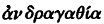
How he did this we are not completely sure. Assuredly Alexander was too hardheaded simply to accept promises from those who had shown themselves to be repeatedly untrustworthy; therefore, it must have been at this time that the Athenians formally committed twenty triremes for Alexander's expedition against Persia.12 They and their crews in essence served as hostages to assure Athenian good behavior.13 Moreover, after his decisive initial victory over the Persians at Granikos, Alexander lost no time in sending to Athens as a dedication to Athena three hundred panoplies with the following inscription:
14 This reminder of his power was surely meant to have special point for his would-be opponents among the Athenians.15
10
Once the Athenians agreed to accept Macedonian hegemony, they were able to prosper in the peace which Alexander's control and absence over the next twelve years made possible. The prosperity of Athens under the financial leadership of Lykourgos during these years was perhaps as great as at any time in its history.16 The source of the revenue was apparently commerce and the silver mines at Laureion, which were actively being worked.17 Important buildings and cult centers were built or refurbished, principally the Panathenaic stadium and the theater of Dionysos.18 The inscriptions reveal that the fleet was well maintained,19 and a new arsenal designed by the architect Philon was completed in Piraeus.20 Complementing this, the training of young men as soldiers, the ephebeia, gained an active new life.21 Clearly Lykourgos, Phokion, Demades, and
11
the others sought to keep Athens in a posture to exercise a role in world affairs if the opportunity presented itself.22
Alongside the building program, Lykourgos promoted the religious institutions which underlay the life of the city.23 For example, in addition to rebuilding the theater, he had official city copies made of the plays of the three great tragedians for the dramatic festivals, primarily the Dionysia.24 We also have a law proposed about the year 336 B.C. to set aside special moneys in a fund to support the annual, or lesser, Panathenaia.25 Clearly this document reveals a concern to set the annual celebration on a firmer financial footing. We may suspect that it had fallen on hard times. The proposer of the measure is not Lykourgos, but Aristonikos of Marathon,26 one of his supporters, who was later condemned and executed by the Macedonians, viz. in 322 after the battle of Krannon.27 In the year 334 Lykourgos himself proposed a long measure for refurbishing the religious sanctuaries of Attica.28 He probably also authored a law requiring liturgists to make a dedication.29 His double interests in public finance and the state religion are also evident in accounts from the sanctuary at Eleusis,
12
where he was closely involved in the details of financing building projects,30 as well as in providing funds to the religious officials.31
The strong example set by Lykourgos of financially supporting and renewing the cults of the city filtered down, it is amply apparent, to the local level, to local organizations and to individuals. We find, for example, the demesmen of Cholargos establishing regulations in 334/3 for the local Thesmophoria,32 those of Eleusis making financial arrangements in 332/1 so that the sacrifice to Herakles in Akris can be as beautiful as possible,33 and those in Piraeus seeing in 324/3 to the theater, one of the primary focal points of the civic and religious life of the deme.34 In general, the comparatively frequent honors granted to persons active in the theater may reflect the heightened emphasis under Lykourgos on the religious festivals.35 In any case, at Aixone in 326/5 the demesmen honored their victorious choregoi and authorized a sacrifice of thanksgiving.36 Likewise, the tribe Pandionis in the same year honored its producer.37 At Acharnai, one of the largest demes, the demesmen passed, most probably during this Lykourgan boom of religious fervor, regulations for financing the construction of altars to Ares and Athena Areia.38 On a more humble level the orgeones of the Heros Iatros leased a garden in 333/2 to a certain Thrasyboulos, presumably one part of their activities financing the worship.39 Individuals too are often singled out for their acts of piety. Around the year 330, for example, the deme members of Melite honored Neoptolemos, son of Antikles, of Melite for his activities with regard to the temple of Artemis;40
13
the genos of the Eumolpids at Eleusis also apparently honored this same [Neopto]lemos for beautifying the sanctuary of Plouton;41 the genos of Krokonidai praised the son of Aristodemos for his careful construction of the shrine of Hestia;42 and the Teithrasioi lauded the piety of their representatives to the council.43 These myriad activities suggest widespread local support for the policies of Lykourgos.
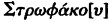
Last, but hardly least, Aristotle returned to Athens from Macedonia about 335 and opened his school in the Lyceum. In this endeavor he clearly had, despite his thoroughgoing Macedonian background, Lykourgos' support, for one of the buildings which we know Lykourgos specifically had a hand in building was the gymnasium in the Lyceum.44 The school flourished, and it was here that many works were produced, including the Athenaion Politeia , a history of the development of the Athenian constitution and description of its organization at the time of Lykourgos. At Oropos there was considerable activity in the sanctuary of the oracle of Amphiaraos which now played a significant role in Athenian religious life. The fountain and waterworks were repaired;45 more significantly provisions were passed under the supervision of the Atthidographer Phanodemos for improvements to the sanctuary and for a quadrennial festival for Amphiaraos.46 The first games were held in 329/8 under the supervision of a distinguished board of ten men that included both Lykourgos and Demades.47 It was, on the whole, a fine time domestically for the city and its people.48
However, in the year 331 King Agis of Sparta with the support of the Persians attempted to rally the mainland Greeks for a revolt against the
14
Macedonians, who were led by Alexander's trusted regent, Antipatros. Agis seems to have persuaded Memnon, Alexander's governor in Thrace, to make a show of opposition coordinated with his own rising in the Peloponnesos with the hope of getting Antipatros to split his forces.49 Although the Athenian leaders must have been sorely tempted at this juncture to abandon both their promises to Alexander and their hostages, they refrained from joining this revolt.50 They were not ready for another military confrontation.51 Still, however prudent their decision may have been, no longer to have the power to lead others, but rather to be forced to sit idle, was a bitter pill.52 Indeed the necessity to heed the will of another amounted for any Greek city to a kind of slavery. Lykourgos certainly realized that it had come to this, for in the summer of the year 330 B.C. he said of the Athenians who fell at Chaironeia
.53 However distasteful the Athenians found it to accept Macedonian domination, accept it they did.54 At the same time, their failure to support the Spartans in resisting the Macedonians was obvious to everyone, and it clearly created a stir. As a result the anti-Macedonian leaders felt impelled, presumably to recover some ground politically at home, to put on a show of independence, even defiance, towards the Macedonians.
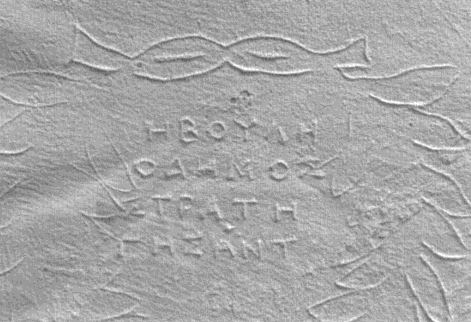
The summer after Agis' defeat, the summer of 330, provided the perfect opportunity. The greater Panathenaia was to take place, and the city, in consequence, will have been crowded with visitors. In June the assembly passed a decree honoring the Thracian Rheboulas, a member of one of
15
the ruling tribes of Thrace that had undoubtedly supported Memnon in his attempt to aid the rebellion of Agis.55 They thus openly honored—on what pretext the fragmentary nature of the text does not allow us to say—a prominent opponent of Alexander. This public measure was underlined by the permanent copy inscribed on a stone stele; it represented a small, but not completely inconsequential, gesture of independence. In July Lykourgos staged the contests in the new Panathenaic stadium, which was finished just before the games.56 We may suppose that he intended to showcase the city as a leader among the Greeks. In any case, the forensic display in the Athenian law courts that followed close upon the festival was certainly contrived to accentuate Athens' opposition to Philip and Alexander.
First Lykourgos himself brought an action against a certain Leokrates, who had, according to Lykourgos, deserted his city, his fatherland, and his gods in their hour of direst need after news had come from Chaironeia of the Athenian defeat.57 Leokrates was a nobody, hardly worth attacking eight years after the fact.58 Surely, this lawsuit was largely a pretext, a means of giving Lykourgos what he really wanted, namely an opportunity to make a resounding appeal to Athenian patriotism. In doing so, he recalled the valiant stand at Chaironeia and gave a show of courageously exhorting his fellow citizens to oppose the Macedonians.59 Moreover, can it be accidental that Ktesiphon's proposal to award Demosthenes a crown
16
for his services to the state, particularly his leadership in fortifying the city after Chaironeia, was renewed before the assembly at this same time?60 This proposal and the challenge to its legality from Aischines likewise gave Demosthenes a platform to speak out. In his ringing speech On the Crown he not only defended himself against Aischines, but reviewed his leadership of Athens against Philip and called upon Athenian patriotism against the Macedonians.
No doubt these speeches broke the spirit of the agreement the Athenian leaders had made with Alexander, but since they dealt primarily with events that happened before Alexander came to power and were delivered in Athenian law courts against Athenians, they constituted no more than provocative puffery that allowed the Athenian leaders to save some face. They did not give grounds for direct Macedonian intervention. Still, the performance was not repeated in Alexander's lifetime, and we may guess that official Macedonian displeasure was made quite clear. These two speeches by Lykourgos and Demosthenes during the summer of 330 B.C. in fact revealed the true impotence of Athens.
Still, as long as Alexander was preoccupied in the East, the Athenians were left on the domestic front pretty much to their own devices. This uneasy alliance began to be openly strained in 324, when Alexander announced through a spokesman at the Olympic games that exiles should be restored to their native cities. The Athenians demurred because this promised to affect adversely their control of the island of Samos.61 At about the same time Harpalos, Alexander's disaffected treasurer,62 appeared off Piraeus with thirty ships and a large sum of money to incite revolt against the king. The Athenians did not receive him at first. They had learned long since that it was better not to oppose Alexander openly.63 Ultimately, how-
17
ever, since Harpalos held Athenian citizenship as a result of his aid to the city in the famine of ca . 329 B.C. ,64 they allowed him into the city, but then seized him and his money, some of which ended up in the pockets of various politicians. Demosthenes and Demades were convicted of receiving bribes and temporarily put out of action.65 Harpalos himself escaped but was murdered soon afterwards.66
When, however, Alexander died on 10 June 323, the Athenians seized the opportunity; they revolted along with a number of other states from northern Greece and fought a war now generally referred to as the Lamian War.67 For a while they had success against Antipatros, but when reinforcements arrived from Asia Minor in late spring or early summer of the year 322, the tide turned. The primarily Athenian fleet was destroyed near Amorgos,68 ending Athenian naval power, and later that same summer, when the Greek forces were unable to defeat the combined armies of Krateros and Antipatros at Krannon, all resistance ended. The settlement imposed by Antipatros and Krateros on Athens was not nearly so lenient as those agreed to by Philip and Alexander. They put in place an oligarchy69 led by Phokion and Demades with a property qualification of 2,000 drach-
18
mas, which in essence disenfranchised more than half of the population.70 They demanded the condemnation of Demosthenes, Hypereides, and other opponents of Macedon.71 Lastly to see that their will was carried out they lost little time in placing a garrison on the fortress Mounychia in Piraeus. It was installed on 20 Boedromion (ca . mid-September), just six weeks, give or take a day or so, after the battle.72
The imposition of the Macedonian garrison and the death of Demosthenes, the most outspoken anti-Macedonian leader, have become benchmark events for many, signalling the end of Athenian democracy.73 What more accurately they underlined was the end of Athens' pretentions of playing an independent role in international politics. But the power to do this had already been lost in Demosthenes' lifetime—the necessity to accommodate Alexander had effectively muzzled his (and Athens') opposition since late 335 B.C. , more than a dozen years before his death. Nevertheless, the internal workings of the Athenian state, the real indicator of the nature of the government, remained essentially intact and democratic. Indeed, the courts, the assembly, the council, the tribal system, and the selection of officials based on it continued with scarcely any detectable interruptions down to the time of Sulla. Generals were elected annually, and the nine traditional archons played their accustomed roles each year.74 In short, whatever the leanings of any particular regime, Athenian democracy in its essentials was remarkably resilient. The power of tradition, the impulse to govern
, or at least to claim to do so, remained dominant.
By reducing drastically the number of citizens, the oligarchy must have been forced to make some changes in the day-to-day running of the state. What actual constitutional changes they made are hard to determine, for there is very little evidence.75 Lack of eligible candidates must have required them to ease the restriction forbidding someone to serve in the boule more than twice (there is as yet no actually attested example).76 They made the anagrapheus an important official, apparently placing him
19
in charge of the assembly?77 At least in one case they rescinded honors and privileges granted to a man who had conspicuously aided Athens against Antipatros.78 There is also some evidence to suggest that they curtailed, if they did not actually abolish, formal military training for young Athenians.79
In addition, the years of the oligarchy saw the loss of the island of Samos and the displacement of at least some, if not all, of the Athenians living there. The determination to retain control of Samos had been one of the chief reasons for Athenian opposition to Alexander's decree about the exiles.80 In the year 321 Perdikkas ruled definitively in favor of the Samians, and they joyfully returned home after more than a generation of exile from their native island.81 On Samos there survives much epigraphical evidence attesting to their return.82 By contrast, almost nothing is heard of the displaced Athenians. Perhaps S. Jaschinski is correct to suggest that most of the cleruchs chose to remain on the island despite the confiscation of half their property and the loss of citizen rights.83 However, given the strife alluded to in the epigraphical record84 and the hard feelings natural on both sides resulting from such a change, it seems very improbable. Moreover, a very fragmentary decree from the Athenian Agora, inventory number I 5626, proposed by Demades early in the year 319 B.C. for a certain Nikostratos, may refer to the displaced cleruchs. It has occasioned discussion primarily about its calendar equation,85 but the reference to women and children in line 14 suggests the possibility that Nikostratos is
20
being honored for his aid in the resettlement of the cleruchs and their families. Otherwise, all is silence.
Demades re-emerged right after Krannon as author of the proposal to send an embassy to Antipatros with full powers to conclude peace.86 Not long afterwards he also moved the measure condemning Demosthenes and the other ringleaders of the opposition to the Macedonians.87 It is not hard to divine his motive; surely he was seeking to nip in the bud any possibility of a direct attack on the city of Athens. In these actions he must have enjoyed the support of his fellow citizens. In any case, he clearly was the leading figure in the assembly once the oligarchy was established; in fact he is known as the proposer of no less than five decrees that date to the years 321-319.88 Given his prominence, it is disappointing that they are not all well enough preserved to allow us to have a sense of what they were about. Two (IG II2 372, 383b) preserve merely the opening lines, with no indication of the contents of the decree. The others deal with matters of real significance. As has been suggested just above, Agora I 5626 probably deals with the resettlement of the cleruchs from Samos; IG II2 380 concerns the market officials in Piraeus, and IG II2 400 honors a certain Eucharistos for his help with the food supply.
The evidence suggests that Phokion and Demades, the leaders of the oligarchy, whatever their willingness to accomodate the Macedonians, sought the best interests of their city.89 Indeed, at the time of his execution in 319 Demades was in Macedonia actually negotiating with the seriously ill Antipatros about the removal of the garrison from Mounychia.90 About five years earlier, moreover, he had joined with the general Leosthenes,
21
who was soon to become the hero of the Lamian War, in paying for the outfitting of a trireme.91
The oligarchy lasted for three years, from 321 to 319, and fell in the political maneuvering following Antipatros' death. Polyperchon, named Antipatros' successor, seized Athens and pronounced her free.92 He was soon forced out by Antipatros' son Kassandros, who had kept control of the garrison in Mounychia. This was when Demetrios of Phaleron came to the fore as a negotiator with the Macedonians, not unlike Demades. He successfully negotiated between Kassandros and the Athenians and was put in charge of the city, but saddled with the garrison in Piraeus. Much like Lykourgos and those who guided Athenian affairs from 335 to 323, Demetrios of Phaleron accepted the necessity of leaving foreign affairs to the Macedonians and concentrated on doing his best for Athens in the situation. He moderated the oligarchic tendencies of his predecessors and even claimed to have strengthened the democracy. His ten-year rule, 317-307, was a time of peace and prosperity.93
The "liberation" of Athens by Demetrios, the son of Antigonos, in 307 soon revealed the fatal weakness of a city that was in reality powerless, but was attempting to chart its own course. The Athenians immediately voted extravagant honors to "the savior gods" Demetrios and his father, Antigonos the One-eyed.94 As part of this adulation they increased the traditional number of the tribes of the city from ten to twelve. Not surprisingly, the two new tribes, Antigonis and Demetrias, were placed first in the official order. Though Demetrios had destroyed the fort at Mounychia, he remained in Athens with his fleet and army. The Athenians were clearly dependent on him. But the son of Antigonos had no leisure to remain long,95 nor could he really when he was absent guarantee the freedom he
22
had proclaimed. As soon as he departed, the Athenians became embroiled in a four-year war against Kassandros, which was brought to an end when Demetrios, now called Poliorketes, relieved them.96 In 302 Demetrios again left Greece to join his father, Antigonos the One-eyed, in Asia Minor for the campaign against Lysimachos and Seleukos. Antigonos' defeat and death at Ipsos in 301 left Kassandros king of Macedon and in control of Greece. Poliorketes was in control of the sea and of several cities.97 The Athenians easily came to an agreement with Kassandros, who had other affairs to deal with.98 On Kassandros' death in 297, the son of Antigonos came to Greece and laid siege to Athens, taking it in 295. His ambitions to rule all of Greece soon led him into conflict with Ptolemy, Lysimachos, and Seleukos.
Athens in the years after 307 was clearly of no major importance and dependent now on this foreign potentate, now on that.99 Indeed, she was caught up in what has come to be known as the struggle for succession. The real change that had occurred was in the external situation, namely the emergence of world, or at least regional, powers that left little role for individual cities.
The Lamian War takes its name from the city in the environs of which the Greeks achieved their major success in the conflict with Antipatros after Alexander's death. It was known by this name to Diodoros1 and Plutarch,2 but contemporary Athenians, viewing it in larger, more optimistic terms, called it the Hellenic War.3 Be that as it may, when Alexander died on 10 June 323, the Athenians did not wait long to begin preparations for war. Relying on money confiscated from Harpalos, the boule authorized the general Leosthenes to muster a large band of veteran mercenaries gathered at Tainaron in Lakonia.4
Despite his obvious importance, Leosthenes remains a somewhat mysterious figure, who rose to prominence as a result of the war.5 Indeed, he was probably the driving force behind Athens' mobilization of opposition to Alexander's successors.6 He also appears to have had some close relationship with Greek mercenary units serving in the East. Indeed, Pausanias reports that he was involved, against Alexander's express wish, in repatriating a very large number of Greek citizens who had served with
24
the Persians.7 His hostility to Alexander is clear,8 and, if his father was (as seems most probable) the Leosthenes convicted of treason after the loss to Alexander of Pherai at Peparethos,9 his leadership at this time may have been his attempt to clear the family name once and for all. In any case, once Alexander's death was confirmed in late summer, the assembly, against Phokion's urging, voted for war. Leosthenes at this time, if not earlier, took an active role in the debate in the assembly.10 Soon afterwards an alliance was concluded with Aitolia,11 and not much later Thessaly and most of the cities of northwest Greece joined the Athenian cause.12
The actions of Leosthenes, particularly his speaking in the assembly and acting as an emissary for the council,13 suggest an individual of some prominence. He is known in our sources, however, merely as Leosthenes or Leosthenes the Athenian. Can he be identified more closely? Perhaps. We do know from Athenian inscriptions of a Leosthenes, son of Leosthenes, of the deme Kephale who was a man of considerable means14
25
and served as general over the Attic countryside.15 Most significantly, the heirs of this Leosthenes assumed the outfitting of the trireme Hebe in Leosthenes' name during 323/2,16 presumably because he had died. We also know that the Athenian commander Leosthenes died during the siege of Lamia in the autumn or early winter of 323/2.17 Unless this is a cruel coincidence, it appears all but certain18 that Leosthenes of Kephale and Leosthenes the hero of the Lamian War are one and the same man.19 Recently, however, S. Jaschinski,20 followed by A. B. Bosworth,21 has argued against the identification of the two. One of the principal arguments is that Leosthenes could not have served as Athenian general over the countryside and also been active with the mercenaries at Tainaron in the year 324/3. This is dearly correct. However, the conclusion that the identification of the two men is impossible does not necessarily follow. It may merely reveal that the date of his service as general over the Attic countryside cannot have been the year 324/3. In point of fact the ephebic inscription and
26
Leosthenes' generalship should in all probability be assigned to the year 329/8.22
The details of Leosthenes' career as we know them then make eminently good sense. After serving as general over the countryside in 329/8, Leosthenes will have been well positioned to carry out his activities with the mercenaries in preparation for opposition to Alexander and also to exercise a leading role in Athenian decision making. Indeed, he was probably the principal general, that is, the hoplite general, during 323/2.23 His activities as activities will belong either to the year 325/4 or to 324/3.24
To return to the Lamian War—for a while the Greeks enjoyed success. Antipatros had only a rather limited number of men available to him in Macedonia and consequently acted slowly. This gave Leosthenes and the allies the opportunity to seize Themopylai and to defeat Boiotian supporters of the Macedonian cause near Plataia. They then defeated Antipatros north of Thermopylai and bottled him up in Lamia.25 The situation was bad enough that Antipatros even sought terms, but he rejected the unconditional surrender demanded by Leosthenes. This initial success buoyed the hopes of the allies. It is very likely that an Athenian thank offering to Agathe Tyche voted by the deme members of Kollytos reflects the opti-
27
mism engendered by this victory.26 Moreover, in late November or early December the city of Sikyon, surely as another consequence of the victory, was the first of the Peloponnesian cities to join the alliance.27
At about this same time (i.e., the autumn of 323) Demosthenes, in exile because of his conviction in the Harpalos affair, now began acting on his own initiative to gain allies for Athens in the Peloponnesos and to thwart Antipatros' agents. Hypereides, the principal democratic leader of the Athenians at this time, also spent some time in southern Greece seeking allies. Despite their falling out over the Harpalos affair,28 the two men were reconciled, and Demosthenes was recalled to Athens in triumph.29 These two, among their city's most influential politicians, now joined in leading the political opposition to the Macedonians. Demades, however, who was also disgraced and briefly in exile as a result of the Harpalos affair,30 remained prudently (as it turned out) in the shadows.
The siege of Lamia lasted through the winter. Unfortunately, Leosthenes, who appears to have been a truly gifted military leader, was killed during one of the many skirmishes that ensued.31 In early spring reinforcements for Antipatros under Leonnatos, satrap of Hellespontine Phrygia, crossed over from Asia Minor. The Greeks under Leosthenes' successor
28
Antiphilos lifted the siege of Lamia in order to intercept the approaching troops. Once again they were victorious and actually killed Leonnatos; Antipatros, however, escaped with some forces to Macedonia. Despite his escape, the Greeks decidedly had had the best of it up to this point.32
The fragmentarily preserved funeral speech of Hypereides for Leosthenes and the dead of the initial campaign seems to have been delivered shortly after this victory over Leonnatos.33 This speech, the last of this genre known to us, was delivered over the fallen in the last military campaign that offered any real hope of keeping Athens and her allies free from Macedonian domination. It, therefore, deserves to be recognized as the swan song of Athenian freedom. On that spring day so long ago, with the victories over Alexander's deputies, Antipatros and Leonnatos, and their seasoned Macedonian troops still fresh in mind and with hope of freedom very much alive, Hypereides' patriotic words of praise over the fallen will have stirred the blood:
.
. (Epitaphios 24)
The end of the bid for independence from Alexander's successors came quickly. The Greek fleet was defeated in the straits of Abydos within weeks of the speech,34 and Krateros reached Macedonia with more troops for Antipatros. The combined armies of Antipatros and Krateros met the Greeks at Krannon in Thessaly on 7 Metageitnion (ca . 5 August) and ended all opposition.35 The Hellenic league broke up when Antipatros refused to deal with it, but consented only to negotiate with the separate cities.36 More importantly, a short time before the battle of Krannon, a fateful naval engagement had occurred near Amorgos in which the largely Athenian fleet was completely defeated.37 That defeat marked the end of
29
Athenian sea power forever and left the city in the aftermath of Krannon with no bargaining power. In consequence, the settlement imposed by Antipatros and Krateros on Athens was not nearly so lenient as those of Philip and Alexander.
As though in compensation for their failure to support King Agis' revolt in the year 331, the Athenians bore the brunt of this war. They led the anti-Macedonian resistance. The Athenian general Leosthenes deserves the credit for a strategy which nearly succeeded; indeed, he may have been the chief architect of the opposition. The Aitolians too provided significant troops in the initial phase that caused much discomfiture to Antipatros. However, it was the Thessalians and their cavalry in the end who proved the staunchest allies to the Athenians.38 Under the command of Menon of Pharsalos, the Thessalian cavalry was at first forced to join Antipatros when he invaded Thessaly at the beginning of the war. During the initial engagement north of Thermopylai, however, they went over to Leosthenes and were instrumental in the defeats of Antipatros and then Leonnatos.39 At Krannon they acquitted themselves well, but could not achieve a clear victory for the Greeks. They must, however, be counted among the most effective cavalry forces in the annals of warfare. Their leader Menon had a reputation among the allies second only to that of Leosthenes.40 Moreover, with the association of the fragmentarily preserved inscriptions IG II2 545 and 2406, we may well now have, in addition to their commander's name, the names of some of these brave men and an invaluable record of Athenian loyalty during the political turmoil following the war to their most important military ally.41
The food supply naturally is an important matter for any large city, particularly one like Athens that could not produce enough food of its own and was, consequently, dependent on imports. A shortage of foodstuffs was a very serious matter; the food supply understandably, therefore, was a regular item on the agenda at every
, i.e., every plenary session of the assembly. Indeed, it is hardly fortuitous that Aristotle mentions it and safeguarding the countryside in the same breath—
.1 hole matter became even more important, of course, at those times when the citizens anticipated that the city might come under siege. It is not surprising then that the Athenians granted honors from time to time to various foreigners who helped feed the populace. It has been the strong tendency of scholars to associate these texts with times of serious shortages. Not every such inscription, however, need imply a major crisis. The food supply was always a matter for real concern.
In the years after the defeat at Chaironeia and down to about the year 320, several crises in the Athenian food supply have been identified.2 The best-documented and most discussed is the undoubtedly severe shortage of the years 330-326.3 It is most clearly attested in the multiple decrees
31
in honor of Herakleides of Salamis on Cyprus published as IG II2 360. He is praised in 325/4, when the crisis appears to have abated, for two actions. He was the first of the importers during the shortage (
, lines 8-9) in 330/29 to bring in grain and sell it at a reasonable price (lines 8-10, 29-31), and in 328/7 he contributed 3,000 drachmas towards the cost of supplying food (lines 11-12, 70). The speech Against Phormio in the Demosthenic corpus describes the rationing of grain in Athens and Piraeus at this time.4 An important inscription from Kyrene in North Africa which dates to the early 320's mentions the same food shortage (
) and records grain distributions to a large number of Greek cities.5 This shortage was clearly serious and widespread. It was also at this time that Alexander's newly appointed treasurer Harpalos sent a large amount of food to Athens and was granted citizenship.6
In the year 329/8, right in the midst of the crisis, the demos at Eleusis, clearly in reaction to the shortage and inflated prices, directed that the surplus wheat and barley from offerings to the sanctuary be sold at six and three drachmas respectively per medimnos.7 The only Athenian honorary inscription other than IG II2 360 that can be associated quite certainly with the shortage of these particular years is IG II2 363. This text honors a certain Dionysios and, since the restoration
in lines 11-12 seems to be correct, reveals that he, like Herakleides of Salamis, did something in the first phase of the crisis (330/29) and is now being praised for having done more. It probably belongs, as Schwenk has argued,8 to the year 326/5. Finally, the naval accounts of 326/5 and the following year, IG II2 1628 and 1629, mention payments to the grain fund that could be deducted from fines levied on certain trierarchs of years past.9 These payments should almost certainly be connected with the
32
organized fund-raising effort
which took place at the height of the crisis in 328/7.10 This must also have been the time that Demosthenes himself contributed a talent for the food supply.11
Instead of one long shortage, Garnsey in his recent study has interpreted the problems in 330/29 and in 328/7 as two separate shortages that were only loosely, if at all, connected.12 This may be correct; but against it is the fact that the terms
and
seem to have been applied only to the difficulties of these years. If that is the case, these shortages were apparently viewed as one connected problem and more than temporary. Indeed this shortage of food was probably caused by widespread crop failures and shortfalls lasting several years.13 That is, it was of a different order from shortages caused by faulty distribution, blockades, or acts of piracy.14 Though serious, shortages of this nature could be remedied fairly quickly.
A few years later there was another shortage, which began perhaps during the Lamian War in 323/2 and lasted for several years.15 The inscriptions that attest to this shortage are:
IG II2 369 + — Osborne, Naturalization no. D25. This inscription dates to early 322 and, although it does not directly mention food in its preserved parts, it honors a Bosporan for services rendered. These services are likely to have included shipment of grain.
33
IG II2 398a —honors someone who had saved many after the sea battle in the Hellespont during the war and had sent grain to Athens a bit later.16
IG II2 400—a decree proposed by Demades shortly before his death (see below 147); it honors a certain Eucharistos for supplying grain and promising more.
IG II2 401—this decree belongs to 321 or 320 and honors a citizen of Kyzikos for helping with the shipment of grain from Asia.
In addition to these two well-attested shortages, we learn from the speech Against Phormio of a crisis in the year in which Alexander demolished Thebes, i.e., 335.17 We have no certain epigraphical testimony for it. We thus have knowledge of three shortages during the years after Chaironeia and down to 320, namely in the years 335, 330-326, and 323-320.18
The following inscriptions that mention the food supply have generally been associated with the period 331-ca . 320. None can be dated precisely enough to specify to which of the two shortages known in this decade they apply, and two of them, IG II2 408 and Agora I 7178, may well date prior to the year 330.
IG II2 342—re-edited with a new fragment by M. B. Walbank in ZPE 59 (1985) 107-111. This is a proxeny decree for two citizens of Tyre.
IG II2 343—Schwenk no. 84. This text honors Apollonides of Sidon.
IG II2 407—honors a Milesian for bringing grain to Athens.19
IG II2 408—honors two Herakleotes. If Kirchner's restorations are
34
correct ad loc ., prosopographical considerations point to a date around 335 B.C.20
IG II2 409—honors two men for importing food from Sinope. See Wilhelm's restoration in "Att. Urktmden V," SB Wien 220.5 (1942) 150-152.
IG II2416b —honors a man from Kos for expediting the shipment of food to Athens and mentions prominently the support activities of the Athenian merchants and cleruchs on Samos.
IG II2 423—if the restoration
in lines 13-14 is correct, this text should be assigned to the crisis at the beginning of the decade.
Agora I 4956—Hesperia 9 (1940) 332-333; honors Pandios the Herakleote.
Agora I 7178 —Hesperia 43 (1974) 322-324; honors Sopatros of Akragas in Sicily. This measure was proposed by Lykourgos; it could therefore also refer to the crisis in 335 and cannot postdate the death of Lykourgos in 324.
Such then is the evidence for the food supply and the shortages during the years 335-320.
We find again in the epigraphical evidence concern for the food supply at the end of the century and continuing into the third century, when lack of food and money became a nearly constant problem. EM 12825 (Hesperia 5 [1936] 201-205) of the year of the archon Euxenippos (305/4) praises an individual for his care for the food supply. IG II2 479 and its counterpart IG II2 480 of late 304 or early 303 honor an Herakleote for, among other things, his monetary contribution towards the purchase of grain in 307/6. IG II2 499 of the year 302/1 recounts in praise of someone that he sold grain at a good price and contributed money for purchase of food.21 These texts probably reflect the extra concern for the food supply caused by unsettled conditions that Athens faced during these years, particularly Kassandros' efforts to retake Athens in the years 307-304.
In 299/8 King Lysimachos donated 10,000 medimnoi of wheat.22 We
35
hear from the literary evidence of a severe shortage during the siege of Athens by Demetrios Poliorketes probably in the spring of 29523 and of Demetrios' gift of 100,000 medimnoi after taking the city.24 In addition, there is a spate of inscriptions of the years 286-284 honoring foreigners for help with the food supply.25 At about this same time, as a result of the diplomacy of Phaidros of Sphettos, King Ptolemy provided both food and money.26 These actions clearly shored up the freedom of the Athenians that had recently been won from Demetrios Poliorketes.27
Finally, Agora I 7360 honors a group of Rhodians for their help with the food supply. It was associated by its initial editor with the severe crisis of the years 330-326,28 but the hand of the cutter reveals that it must be dated later than 320.29 Indeed, most of this man's dated work falls in the years 295 and after. This fragmentary text, therefore, most probably belongs to the years after 287, when the Athenians successfully revolted from Demetrios Poliorketes' control. The Rhodians, who themselves had withstood a harsh siege by Demetrios in the years 305-304 and maintained their independence,30 no doubt were happy to support the Athenians against their former enemy.
One of the most notable facts about the period 317-307, the decade of Demetrios' rule,1 is that almost no decrees of the assembly can be assigned to these years. Indeed there are now only two certain ones, IG II2450 and 453.2 It has generally been deduced from this fact that the assembly met less often and that, whatever his rhetoric may have been,3 Deme-
37
trios' regime was strongly antidemocratic.4 This may well have been so, but the mere absence of inscribed measures does not necessarily lead to this conclusion. It is very possible, for example, that the assembly was quite active and that the only activity much curtailed was the inscribing of decrees.
In this regard, it may be significant that the only preserved dose of a decree datable to the years of his control, namely lines 1-12 of IG II2 450b , contains no provision for payment.5 Perhaps as a means of reducing expenditures for show Demetrios either disbanded or sharply reduced the public funds used for this purpose. In any case, the machinery of government clearly remained intact; archons were chosen each year. The preambles of the two extant decrees of the assembly follow the usual conventions and suggest that the meetings which they record were ordinary. In particular, the proedros appears in the expected place of the prescripts as chairman of the meeting, which in turn reveals that the council and its major subcommittee continued.6 Furthermore, Demetrios gave his laws as an elected official,7 and in 309/8 he held the annual office of archon epony-
38
mous.8 All of this not only points to the retention of the democratic machinery of government, but even suggests some scruple with regard to the appearance, if not the reality, of democracy.
However much the democratic modes remained in place, there is also no question that Demetrios exercised his power under the aegis of Kassandros.9 The Athenians, including Demetrios, were not free to ignore his wishes, especially in the sphere of foreign policy. Moreover, certain measures were put in place in the city at the outset that either curtailed the democracy or promoted aristocratic interests. The citizenship was limited to those who possessed 1,000 drachmas.10 The authority to determine the legality of laws seems to have been transferred from the courts to the nomophylakes .11 Parallel to this, there was, perhaps, no scrutiny of citizenship grants before the law courts.12 This may suggest a vesting of critically important policy-making matters in the hands of the few and, indeed,
39
Aristotle specifically characterizes the nomophylakia as
.13 However, it is important to emphasize, these measures also reveal unmistakably that the courts of law, which along with the assembly constituted the major avenue of citizen control of the government,14 were active and in the hands of the citizenry.15
Inscribing, moreover, did not come to a complete halt under Deme-trios. Several deme decrees,16 quite a few accounts of the treasurers of Athena and the other gods,17 and a number of horoi18 are all attested.19 Most significantly, three of the cutters of this study are attested at work in early 317 or before and again after 307, namely the Cutters of IG II2 1262 (ca . 320-ca . 296), of IG II2 498 (321-302), and of IG II2 650 (317-283/2).20 In addition, a fourth man, the EM 12807 Cutter, was active from the year 334/3 until at least 314/3. There had to have been more inscribing during the ten years of Demetrios' control than appears to us at this far remove in time, for, had there been a nearly complete hiatus, these men—who were specialists —would surely have been forced to turn to another line of work or to relocate. It is thus quite probable that more decrees belonging to these
40
years will eventually turn up and that some of the undatable ones now known belong to the period of Demetrios' control.
Still there is no question that there was less inscribing under Deme-trios.21 There are, for example, no ephebic inscriptions known22 and no inscriptions listing councillors. Yet the ephebeia either continued or, if (as seems likely) it was curtailed under the oligarchy of the years 321-319,23 was renewed under Demetrios, for a single ephebe is attested for the year 312/1.24 The existence of the council too is guaranteed by the appearance of the proedroi in the preambles of IG II2 450 and 453. The cutters who remained active found work where they could, namely inscribing deme decrees, inventories, boundary stones, and undoubtedly simple grave markers. They probably also did some free-lance work on buildings to make ends meet. Whatever the case, there surely was work for them to do.
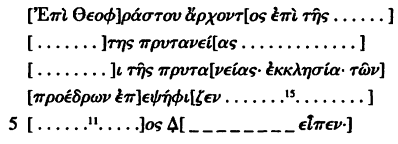
Of the two fragmentary decrees which can be assigned certainly to the years of Demetrios' control one, IG II2 453, preserves only the opening lines, so that we do not know in any precise way what it dealt with. The first line merely reveals that it honored someone whose name began with the letters ANT. The date, however, is certain, January or February of 309, and the speaker
[_ _] is almost certainly Telokles, son of Telegnotos, from Alopeke, who under the oligarchy in early 318 proposed a decree honoring a metic and probably served in 303/2 as a councillor.25IG II2
41
450 fortunately is much better preserved. Enacted in the first month or so of the year 313,26 it honors the Macedonian Asandros, son of Agathon, for long-standing acts of friendship and particularly for making available when he was visiting Athens his own ships and soldiers to the Athenians in a time of need. Although the actual grant is not preserved, it seems beyond doubt that this is a citizenship decree and that Asandros was awarded citizenship, as well as sitesis, proedria , and a bronze equestrian statue.27 These honors are unusually high. Furthermore the measure was proposed by a known oligarch, Thrasykles of Thria, the anagrapheus of 321/0.28
This inscription has generally been connected with a known event, namely the expedition that the Athenians sent against the island of Lemnos at the behest of Kassandros.29 Errington, however, may well be correct to argue for a chronology that places the battle over Lemnos in late 313.30 If he is, it would dissociate this inscription from that particular event. Billows, in adopting the same chronology, points out that Asandros was himself pressed at the time of the Lemnos campaign and would scarcely have had men and ships to spare.31 Whatever the case, it can scarcely be misleading for our political assessment of Demetrios' regime that the single (partially preserved) body of a decree of the assembly from the ten years of his control was proposed by a leading oligarch and honors an important Macedonian military figure, then satrap of Karia, and ally of Kassandros against Antigonos.32
Born about 355 B.C. Demetrios was a student of Theophrastos and
42
quite early earned a reputation for wisdom.33 We know little enough of his career before he came to power in 317. We are told merely that he entered the political arena during the events surrounding Harpalos' flight to Athens in 324 B.C.34 This remains for us a confused affair.35 We have no way of knowing what Demetrios' precise involvement was, but almost certainly he favored a policy of accommodating Alexander. We next hear of him as one of those who was sent to negotiate with Antipatros and Krateros in the aftermath of the Athenian defeat at the battle of Krannon in 322.36 The final terms agreed upon in those negotiations resulted in an oligarchic regime and the imposition of a Macedonian garrison in Piraeus. In addition, the leaders of the anti-Macedonian faction, Demosthenes, Hypereides, and Himeraios, Demetrios' brother, were condemned; they either committed suicide or were seized and killed. Not many years later, when the short-lived democracy backed by Polyperchon came to power in 318, a number of the pro-Macedonian leaders, including Phokion, were also executed.37 Demetrios, though himself condemned at this time, escaped by wisely taking refuge with Nikanor, Kassandros' general in Piraeus.38 He
43
was thus in a position, when Kassandros sailed into Piraeus and Polyperchon withdrew, to negotiate a peace between the warring factions in the city and Piraeus39 and to become Kassandros' agent in Athens.40
Diodoros reports the agreement of the Athenians with Kassandros in accordance with which Demetrios became epimeletes of the city.41 And epimeletes does seem to have been his official title.42 However, line 11 of IG II2 1201, a deme decree from early in his rule, reveals that the title of his office when he gave laws and to which he was elected by the people contained nine letters. Since epimeletes has ten letters, it has generally been supposed that his elected office differed and was either
or
. Each office indeed has its strong proponents. Not only, moreover, did Demetrios gain a lasting reputation for his lawgiving; it was one of the first tasks that he undertook.43 This undoubted fact led Dow and Travis to argue the case for nomothetes persuasively.44 Most, however, have used the evidence of IG II2 2971 to support the notion that the office Demetrios occupied during his rule was that of general.45
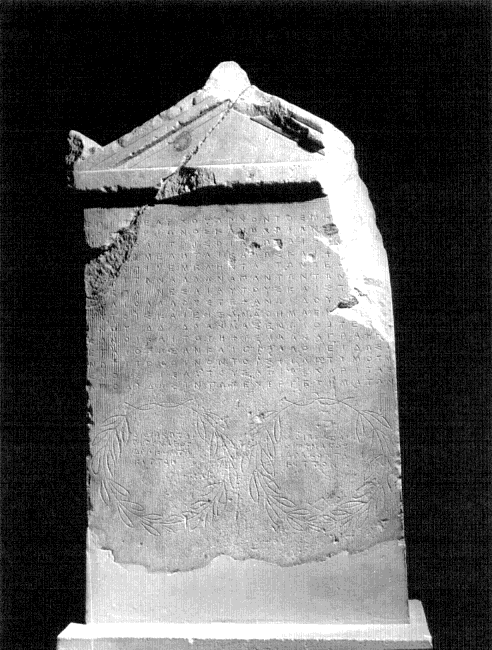
IG II2 2971 is a complete and rather elaborate statue base from Eleusis for the general Demetrios, son of Phanostratos, of Phaleron. The Athenian soldiers stationed in Eleusis, Panakton, and Phyle dedicated it to Demeter and Kore. The twelve inscribed crowns preserved on it commemorate Demetrios' military offices and equestrian victories. Since its discovery in the eighteenth century, it has naturally been taken to refer to the famous De-
44
metrios of Phaleron and dated ca . 314. Indeed, it has been the linchpin in the argument that Demetrios came to prominence early as a general and held that office for much of the time he was in power. However, this inscription cannot be dated to the late fourth century B.C. , on two grounds.
First, the lettering of this base is the work of the Cutter of IG II2 788.46 This man's career extended from about 270 to about 235 B.C. Second, the general on the base, in being honored by the garrisons at Eleusis, Panakton, and Phyle, can be no other than the general over the Eleusinian territory;47 this generalship did not exist ca . 314. At the time of the Aristotelian Athenaion Politeia and down to at least 290 B.C. there was just one general over the entire Attic countryside; this official had the title strategos
.48 Sometime after that and not later than 265, this single office was divided into two positions, a general for the coastal region (
)49 and another for the Eleusinian district, which included Panakton and Phyle (
).50 This inscription then can be dated at the earliest no earlier than 270 B.C. It does not refer to the famous Demetrios of Phaleron, but to his homonymous grandson, who was the agent of Antigonos Gonatas in Athens about 260 in the aftermath of the Chremonidean War.51 With this added information, we may date IG II2 2971 ca. 250.
Once IG II2 2971 has been removed from the dossier of evidence applicable to the famous Demetrios, we possess no reliable evidence that he
45
ever held a generalship or had an active military career.52 Indeed, it is significant in this connection to note that when the son of Antigonos attacked Athens in the spring of 307, Demetrios of Phaleron withdrew without apparently offering anything more than token resistance. Rather, he negotiated on behalf of the city and received a safe-conduct to Thebes.53 Demetrios' title in line 11 of IG II2 1201 was, therefore, almost certainly not strategos. The title nomothetes does suit the space, but it too has little to recommend it, for there were ordinarily many nomothetai , who usually served as members of large boards.54 They were probably chosen by lot in the fourth century. An individual elected to act by himself as nomothetes was, if not on constitutional grounds impossible, at least highly unusual.55 It too, therefore, seems unlikely.
This leaves us with the title epimeletes and the account of Diodoros. In what appears to be an accurate summary of the actual conditions laid down between Kassandros and the Athenians, Diodoros records that they agreed "to install as epimeletes of the city a single Athenian agreeable to Kassandros. And Demetrios of Phaleron was elected."56 Wilhelm long ago realized that this strongly suggested that the title epimeletes once stood in IG II2 1201. He therefore restored lines 11-12: [
. This indeed now appears all along to have been the best choice. As to the objection that the title epimeletes is one letter too long, Wilhelm noted that it could be accommodated by assuming that the inscriber did
46
not give the iota a stoichos of its own, but crowded it in as he did the iota of
in line 6.57 It is not in the end at all improbable that the Athenians "elected" the epimeletes whom Kassandros designated.58
The existence of IG II2 2971 and the supposed active military career of Demetrios of Phaleron have obscured the real nature of the terms imposed on the Athenians by Kassandros in 317. It seems quite clear that he established two poles of power, one in Athens, one in Piraeus, each with different missions. He allowed the Athenians a certain measure of autonomy in their internal affairs by letting them "elect" a distinguished fellow citizen as overseer of the city. At the same time, he retained ultimate control by vesting all military power in his phrourarch stationed in Piraeus. This practice of creating a civil authority separate and distinct from the military was one that Alexander the Great had used to good effect during his campaigns in the East, particularly in Asia Minor.59 The text of Diodoros points to this division:
.60 As epimeletes Demetrios had primary responsibility for governing the city and dealing with its internal affairs; Dionysios, Kassandros' commander at the fortress of Mounychia in Piraeus, and his Macedonian garrison had control over military matters.61 Kassandros wielded his authority through this garrison. He clearly
47
dictated foreign policy to his Athenian subjects.62 Whatever power or influence Demetrios and the Athenians had over their own military affairs was probably in practice slight and dependent on the concurrence of the garrison commander in Piraeus.63
Nevertheless, within this circumscribed arena of action, Demetrios seems to have protected the interests of his fellow citizens.64 The ten years of his control were a time of domestic peace and stability for the Athenians. He revised the law code and perhaps systematized it.65 Most significantly to his credit he appears to have reinstated, no doubt in the face of strong Macedonian intransigence, a year-long course of military training for the youth of Athens.66 He also curbed certain excesses in the areas of entertaining, dress, and burial customs.67 Although these intrusions into
48
the conduct of private affairs opened Demetrios to attacks on his own private life,68 nevertheless the measures may well have been needed in a comparatively small city where everyone who was anyone knew everyone else. The consequent peer pressure had apparently resulted in an unhealthy amount of expenditure of resources for reasons of show. If one considers only domestic affairs, Demetrios appears to have been an enlightened leader, and in some quarters at least his claims of strengthening the democracy were accepted.69 Cicero found him wholly admirable: "qui vero utraque re excelleret, ut et doctrinae studiis et regenda civitate princeps esset, quis facile praeter hunc inveniri potest?"70
What we know of Demetrios' political activities suggests that he was primarily a diplomat and a lawgiver. He was also a prominent student of philosophy and a prolific writer.71 He appears in short to have taken himself seriously as a philosopher and man of letters. During his ten-year regency the Athenians may in fact have had in him a leader whose primary aspiration was to be their philosopher-king. Demetrios was, after all, among Theophrastos' most successful students. Moreover, Theophrastos remained in Athens under Demetrios' regime72 and doubtless acted as an adviser to his protégé, particularly in his role as lawgiver.73 The comic poet
49
Menander, who was another of Theophrastos' students and about a dozen years younger than Demetrios, was also active in Athens at this time. Indeed, it appears likely that he produced the Dyskolos during 317/6, Demetrios' first year at the helm.74 Later, because of his friendship with Demetrios, he was threatened with a lawsuit at the time of Demetrios' expulsion in 307/6.75
Whatever our judgment may be of Demetrios of Phaleron's willingness to allow a foreign power to control Athens' external affairs,76 his abilities and aspirations as lawgiver and man of letters were clearly well regarded by his contemporaries.77 Whether he went to the court of Ptolemy I Soter at Alexandria soon after 30778 or only after Kassandros' death in 297,79 he played an important role in the intellectual life of that city. Indeed, it appears that Soter took him as an adviser when he could not secure the services of Theophrastos, the head of the Peripatos.80 Our sources suggest that he continued doing in Alexandria what he had done in Athens, for, among other activities, Demetrios advised the king on the law
50
code for Alexandria81 and on his plans for what was to become the great library.82
The account in the letter of Aristeas that made Demetrios head of the library charged with collecting all the books in the world,83 even with translating books from the Hebrew,84 is certainly late and fundamentally wrong on some important points. To take but the most obvious—however much the first Ptolemy may have laid the groundwork for it, the library as an actual institution did not apparently come into being until the reign of Ptolemy II Philadelphos. By then Demetrios was out of favor at court; he could not, therefore, have been head of the library. Surely, however, Demetrios was active in some way in the efforts of the first Ptolemy to create a collection. The letter could well, therefore, preserve in exaggerated form a real memory of Demetrios' activities. He clearly was not only a serious writer and man of letters, but was taken as such by his contemporaries. Furthermore, he no doubt put together at least part of the collection that later became the great library.85 Is it not prima facie probable, then, that Demetrios, as part of his literary activities for the first Ptolemy, acquired ca . 295 B.C. copies of many of the works of Aristotle and Theophrastos? One need scarcely point out that, as a distinguished member of the Peripatos, he would have been unusually well positioned to do exactly this.
If this hypothesis is correct (and hypothesis it must remain), the early history of Aristotle's works must be seen in a different light than heretofore. Previous discussion has tended to focus on the activities of one Neleus of Skepsis, to whom Theophrastos left all his books at his death ca . 287 B.C.86 It is reported, I assume correctly, that the books of Aristotle were among Theophrastos' books.87 The ancient sources preserve two conflicting accounts about Neleus' handling of his legacy. One was that he took them to Skepsis, where after his death they lay moldering in a cellar until
51
Apellikon of Teos brought them back to Athens early in the first century B.C.88 The other was that he sold them to Ptolemy H Philadelphos for the library at Alexandria.89 Whatever Neleus' exact role was,90 it is significantly diminished in importance if we believe that, thanks to the activities of Demetrios of Phaleron, copies of many of the major Aristotelian treatises were already in Alexandria before the death of Theophrastos. On account of this they were known in the Hellenistic period. Moreover, their presence will have acted as a catalyst to spur the agents of Ptolemy II to assemble in the library at Alexandria as complete a collection as possible of the works of Aristotle.91 Thus it is quite possible that the very efforts of Demetrios to preserve the writings of his great master and his followers brought it about that they were concentrated at the library in Alexandria at the time of the great fire, and thus many were lost to posterity.
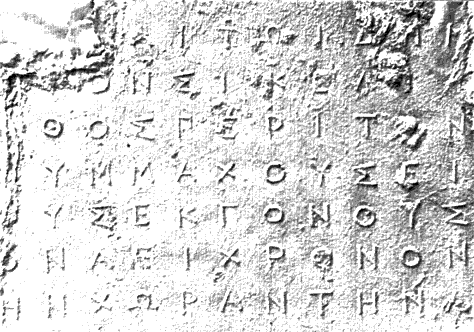
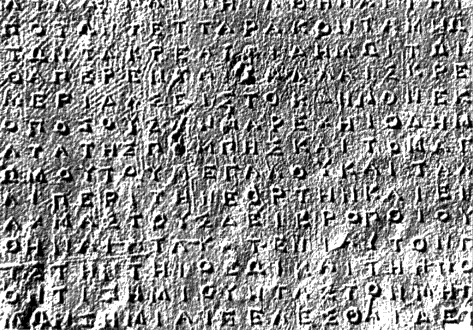
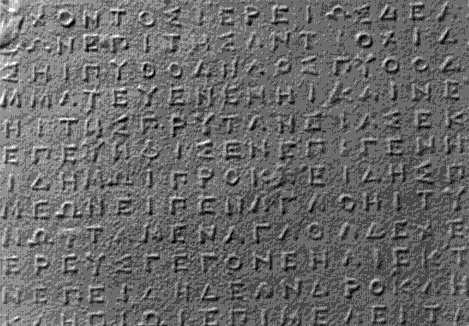
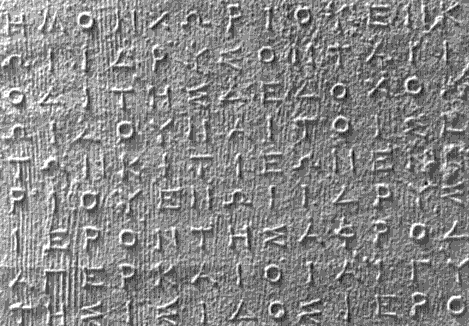
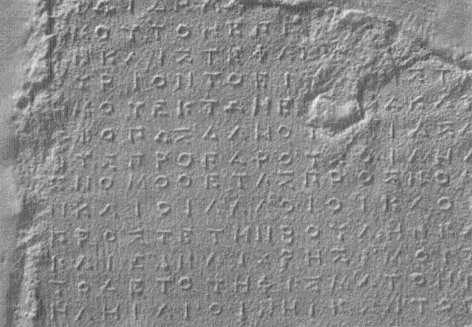
The letter-strokes of this workman are relatively thick and carefully placed in relation to one another. In contrast to other cutters of the time this man does not often thicken perceptibly the ends of strokes. Occasionally a straight hasta was inscribed in such a manner that two parallel (or slightly diverging) lines created by the chisel cuts can be seen to form a stroke. I term this phenomenon "double cutting"; it is quite common in fourth-century lettering down to the year 320 or thereabouts. In all, the lettering of this particular cutter has a solid, neat appearance.
This letter varies in width and is sometimes quite wide; the crossbar is placed slightly below the midpoint. The left slanting stroke sometimes overlaps at the apex a little. This is also true of delta and lambda.
Gamma
This letter is relatively thin.
Epsilon
The central horizontal tends to be a bit shorter than the other two and sometimes does not touch the vertical. Sometimes all three horizontals are about the same length. This is especially true when the lettering is small or the width of the stoichoi relatively narrow.
Kappa
The slanting strokes are usually shorter than the vertical and join it at the middle. Often the lower does not actually make contact with the vertical but rather with the upper slanting hasta .
Mu
The outer strokes are sometimes almost vertical. The strokes which comprise the central v often begin a little below the tops of the outer strokes. The v varies in size—it usually extends down less than half the height
68
Figure 1.
IG IP2 105 lines 7-13.
of the letter, but occasionally it almost reaches the base of the letter.
Nu
The diagonal customarily begins below the top of the first vertical and joins the second at, or close to, the bottom.
Omikron
This letter is quite round and only slightly smaller than the other letters.
Pi
This letter is customarily quite thin; the horizontal does not extend beyond the verticals.
Rho
The loop is oblong and quite wide, filling the width of the stoichos . It also occupies about half the height of the letter.
Sigma
This letter is taller than the others. The top and bottom strokes slant. The central strokes of the letter are shorter usually, so that this part does not extend to the
69
front of the letter. The bottom slanting stroke often stands out because it is longer than the top stroke and more deeply inscribed.
Upsilon
This letter is usually about the same height as the others and composed of three strokes of about the same length.
Omega
This letter is tall and round, open at the bottom, and has prominent strokes extending to right and left.
Archon [Nausigen]es (368/7). E. Schweigert, Hesperia 7 (1938) 627, attributed IG II2 523 to this text. Tod, GHI no. 136; Bengtson, Staatsverträge no. 280; Kirchner-Klaffenbach, Imagines 2 no. 53.
IG II2 107
Archon [Nausi]genes (368/7). Tod, GHI no. 131. See T. A. Tonini, Acme 42 (1989) 47-61, for discussion of the historical circumstances surrounding this text.
The second decree is dated to 355/4. Peçirka, Enktesis 37-38.1
IG II2 143
Archon [Phras]iklei[des] (371/0) or [Char]iklei[des] (363/2). To this stele have been attributed EM 12929 by E. Schweigert (Hesperia 7 [1938] 278-280) and IG II2 2813 by E Roussel (Rev. Arch . 18 [1941] 216-220). For a new reconstruction, see E. Ruschenbusch, ZPE 54 (1984) 247-252 = SEG 34 no. 63.2
IG II2 161
Meyer, Urkundenreliefs no. A120 and plate 48.4 (fragment a only).
70
IG II2 192
+IG II2 221
Archon Lykiskos (344/3). D. M. Lewis, ABSA 49 (1954) 50, reports that the right margin is preserved and occurs 8 letter-spaces to the left of where IG indicates.
IG II2 257
M. B. Walbank (ABSA 85 [1990] 442-443) joins IG II2 300.
+IG II2 272
M. B. Walbank, Hesperia 54 (1985) 312-313 and 58 (1989) 75-78, has attributed to this text three fragments from the Athenian Agora, I 2426, 2580, and 5263.3 These fragments are small, and two are quite worn. The association seems to me without ground.4 Moreover, the lettering on Agora I 2426, particularly the sigma with a curving upper stroke, is not characteristic of this cutter. Note also that Walbank's date, "ca. a . 375 a.," is probably somewhat early.
+ IG II2 274
IG II2 279
Peçirka, Enktesis 53-54.
+ IG II2 280
IG II2 287
Peçirka, Enktesis 56-57.
IG II2 298
IG II2 300
Joins IG II2 257.
+ IG II2 451
Archon [Theoph]rastos (340/39).
IG II2 523
Part of IG II2 105.
IG II2 1158
71
IG II2 1451
Not earlier than 365/4.
IG II2 1496A e
This small fragment, characterized by Kirchner "sedis incertae, " should be dissociated from this inscription, for this cutter's lettering is not otherwise known on this text. The restoration of the archon-date formula in line 158 is almost certainly incorrect.
IG II2 2813
Part of IG II2 143.
Agora 13812
Archon [P]olyzelos (367/6). Agora XV no. 14; photograph in Hesperia 11 (1942) 234.
Agora I 4973
Agora XV no. 29.
EM 12929
Part of IG II2 143.
EM 13354a lines 1-12
Archon Nikophemos (361/0). AE , 1965, 131-136 and pl. 44; Reinmuth no. 1 and pl. 2.
F. W. Mitchel, "The So-Called Earliest Ephebic Inscription," ZPE 19 (1975) 233-243, has convincingly shown that EM 13354 is to be separated from EM 13354a. He dates the second decree of EM 13354a, the ephebic decree, with some probability to 334/3. S. Dow (In Memoriam Otto J. Brendel [Mainz 1976] 81-84) independently arrived at the same date.
These two fragments almost certainly belong together based on the lettering, spacing, and (most of all) textual links. A combined text is as follows:
ca. a . 345 a .
STOICH. 33
IG II2 272
IG II2 274
72
Line 2. Kirchner's restoration of a reference to proxenies seems very probable, though I cannot suggest a wording which suits the line length. A proper name such as Philoxenos is perhaps also possible.
Line 5.
, rather than
, is demanded by the spacing here; yet in lines 8-9 b /[
] appears to be required. This cutter began inscribing in the 360's, if not earlier, so it is not surprising to find him using the somewhat old-fashioned form
.5 An almost exactly contemporary inscription which has both forms is IG II2 229 of the year 341/0. See also IG II2 192, another text by this cutter which had, it seems, both forms.
Line 8. Only part of the loop of dotted rho is visible. Beta is also possible. Omikron (read by Kirchner in line 8 of IG II2 272) is not very likely, for the circular part is too small to be part of this cutter's usual omikron. The remains of rho reveal that Kirchner's suggested restoration in the apparatus of IG II2 274, "fortasse
," was correct.
Line 10. Delta is printed in pointed brackets because alpha was inscribed.
This text clearly belongs to the years 353-338, when Sestos was an Athenian cleruchy. The men honored are singled out for their bravery,
(line 10 in the combined text; line 6 of IG II2 274). This word certainly points to some military action,6 but the exact event cannot be specified. For the few inscriptions known from Sestos, see J. Krauss, Die Inschriften von Sestos und der thrakischen Chersones (Bonn 1980) 14-69. The
73
copy of this text set up in the central square of Sestos (lines 7-8) has not as yet been found.
of IG II2 451 is the archon of 340/39 and not that of 313/2.7 Although it is not possible to restore this preamble in detail,8 it is unlikely that J. Kirchner's restoration [
] in lines 4 and 5 is correct. The symproedroi are first mentioned and listed in a decree of 333/2.9 The end of line 4 and beginning of line 5 will have been filled by the name and demotic of the chairman. The remains in line 5 most probably belong to the name of the speaker. I suggest a conservative reading and restoration of this text as follows:
a . 340/39 a .
STOICH. 33
74
The restoration of the meeting in line 3 is necessary to fill out the line and, I think, inevitable. It gives us the line length. This mention, if the restoration is correct, becomes the earliest indication of a meeting in a preamble of an Attic decree. The next one known occurs in IG II2 330 line 49 of 336/5.10 The apex in line 5 occurs in the middle of the stoichos and is in consequence read as dotted delta; Dow first made this reading.11 It is at least intriguing to note that the secretary in 340/39 was "
;.12 Unless this preamble was exceedingly unorthodox, I do not think he can or should be restored in line 5. For speakers of the years 355-322, see M. H. Hansen, "The Number of Rhetores in the Athenian Ecclesia , 355-322 B.C. ," GRBS 25 (1984) 123-155, especially 132-148. There are a number whose names end in
and whose fathers' names began with alpha, delta, or lambda. In summary, we now have one less decree of the city assignable to the years when Demetrios of Phaleron controlled Athens and one less inscription containing mention of symproedroi .
The names were inscribed in smaller letters (ca . 0.005 m in height) and arranged in two columns. We have only the initial names in the column on the right.
of line 10 remains unknown. There is a line left blank between lines 10 and 11. Omega was the last letter inscribed in line 11; blank stone is preserved to the right for five letter-spaces to the break. The omega falls directly under the first iota in line 10. About 11 letters are lost before it. Line 12 is also vacant, at least in the area below and after the omega of line 11. Enough of the stone survives here that the tops of letters would be visible at this point had any been inscribed.
There are a number of minor corrections to be made to this text. There is a vacant line between lines 3 and 4. At the end of line 4 the stone is broken away and has taken the right part of the final sigma with it. The empty space which IG records here should have square brackets around it. Line 6
75
should read
v . This new reading in turn suggests the possibility of restoring lines 5-6 as follows:
?C?915
[_ _ _ca 12 _ _
13v [vvv ]
There is a vacat of a single space between the demotic and mu in line 7. Before the omikron of line 8 the right tip of the horizontal of a tau is visible. Below line 10 there is another line preserved; it reads _ _ _ _ _ TEA vac . (5). Below this final line the stone is preserved vacant for ca . 0.105 m.14
During the period from approximately 345 to 320 B.C. there flourished in Athens a number of cutters who inscribed letters that are very similar in shape. This common style, which is often associated with the regime of Lykourgos, began somewhat before the Athenian defeat at Chaironeia and continued down to the time of Demetrios of Phaleron, who took control of Athens in 317. It does therefore characterize much of the inscribing done during the Lykourgan period (338-324), but by no means all of it. The practitioners of this style cut in a very similar manner and are very difficult to distinguish from one another. In fact, the fragments inscribed by these cutters are impossible to keep separate, unless a sufficient sample of the writing survives or, in the case of a small or worn fragment, one happens to be dealing with a bit that preserves one of the letters which reveals an individual idiosyncrasy. The close similarity of the lettering of these cutters suggests that they were related in some way; perhaps they were from the same shop or formed a group more or less officially sanctioned by the regime to inscribe decrees.
The characteristics of the style are as follows. The lettering is almost always stoichedon and makes a very solid general impression. This effect is created, I suppose, because the strokes are relatively thick and the lettering is, on the whole, carefully made and consistent in shape. Many of the straight strokes reveal the parallel lines indicative of double cutting. The round letters are carefully made and seem to be inscribed just a bit deeper than the others. Letter-strokes often thicken at the ends. The ends of hastae indeed are sometimes splayed; this is caused by the double cuts, which spread or separate towards the end of a stroke. The height of the letters varies; sigma, upsilon, and phi are taller, while alpha, delta, lambda, and sometimes iota and tau are shorter than letters such as epsilon and rho. Particular letter shapes which characterize this general style are:
Epsilon with a short middle horizontal.
Kappa with long diagonals which meet the vertical at the midpoint or below.
77
Nu with a diagonal which begins down from the top of the first vertical.
Sigma with top and bottom strokes whose angle of slant varies.
Upsilon made from three strokes and with the v extending up into the interline.
A very small chi.
I have managed to isolate three cutters within this style and present them below. These are the Cutters of IG II2 244, 334, and 354. There are in addition a number of inscriptions in this general style which I append here. The asterisked (*) ones have few letters and may indeed be by one of the three cutters studied in detail. It is impossible to say without more evidence. The same is true of those marked "worn." The larger fragments are not by these cutters, but I am not as yet comfortable with assigning them to one or more additional cutters at work in this style. These texts, it appears, all belong to the years 345-320.
The documents which most characterize the 340's and 330's are inventories, accounts, and mining leases incised in very small letters. Many of these too are inscribed in the common style of lettering just described. Some I can attribute (with difficulty and some hesitation) to the individual cutters, but many I cannot. Why is this so? These records are inscribed, many of them, in letters less than 0.005 m high. Such letters, i.e., ca . 0.004 m or a bit less in height, are about as small as it is possible to cut with hammer and chisel into a marble surface. These tiny letters, I suspect, left the cutter less room to maneuver his tools and allowed him less opportunity to do those little things that enable one to differentiate decisively one cutter from another.
In any case, I append here a list of these texts which I judge to be in this general style. As in the case of the list above, an asterisk (*) signals that a fragment has few well-preserved letters.
IG II2 1438, EM 12931 ( Hesperia 7 [1938] 281-289)
Hesperia 52 (1983) 177-189; Agora XIX no. L9; worn.
A general style is never easy to deal with and is often so vague as to be useless. This particular style, however, because it can be precisely defined, does seem to be more satisfactory. It appears, for one thing, to be limited to a fairly definite period of time. It is, however, somewhat frustrating to have a number of cutters who inscribe so many letters in a like manner that many small or worn fragments cannot be assigned accurately to the known workmen within the style. Still, the three principal cutters in this style can be quite readily recognized when the fragments they inscribed are reasonably large and well preserved.
81
The important letters for distinguishing them are alpha, sigma, and omega. To summarize the differences crudely—the IG II2 334 Cutter inscribed a fairly wide alpha which is turned slightly to the left in the stoichos , a sigma which often seems to lean back or at least has the bottom stroke nearly parallel, and omega often with a closed bottom; the IG II2 244 Cutter inscribed a wide alpha which often leans forward, a sigma with a bottom stroke which extends down sharply into the interline, and an omega which is small, raised up, and has wide finials; the IG II2 354 Cutter made a symmetrical alpha, sigma which usually has top and bottom strokes that slant about the same, and omega that is open at the bottom and not unduly wide. It must be stressed that these cutters are each capable of inscribing the odd letter, even these key letters, so much like one of their fellow workmen that it can be deceiving. In the case of these cutters to an unusual degree, it is the combination of peculiarities taken together which allows one to recognize and distinguish them.
This lettering makes a solid appearance, for the strokes are both rather thick and, relatively speaking, deeply inscribed. One can discern not infrequently double cuts. Round letters are quite evenly made and seem to be incised just a shade more deeply than the other letters. Letters sometimes seem to rattle around in the stoichoi a bit, and occasionally some lean to the left, particularly, alpha, eta, sigma, tau, and omega.
This is quite a wide letter and often shorter than the others. The placement of the crossbar varies, but it is usually at the middle or above.
Epsilon
The central horizontal is usually quite short and often does not touch the vertical.
Mu
The outer right hasta tends to be shorter than its counterpart on the left and does not extend down to the bottom of the letter.
Nu
The diagonal regularly begins somewhat down from the top of the first vertical and nicely touches the bottom of the second. This second vertical sometimes has a noticeable lean to the right.
Omikron
This letter varies in size, sometimes being unusally large; it is very often placed up in the letter-space.
Rho
The loop is somewhat flattened and elongated to Fill the width of the stoichos .
Sigma
This letter tends to be taller than the others; the bottom stroke is often nearly horizontal, while the upper curves or slants above the line of letters. Occasionally
83
Figure 2.
IG II2 334 lines 22-35.
the letter leans back or is even tilted with the bottom stroke actually slanting upwards. This letter varies greatly from example to example and is among this cutter's most idiosyncratic letters.
Upsilon
This letter is composed of three strokes. The vertical is just about half the height of the letter. The v tends to extend up above the other letters.
Chi
This letter tends to be very small.
Omega
The letter is fairly large, but not excessively wide; it hangs from the top of the letter-space, and is very often closed at the bottom by the horizontal extenders.
Bengtson, Staatsverträge no. 340. D. Knoepfler has provided new and improved texts of the two parts of this inscription, of fragment a in REG 98 (1985) 259 (SEG 35 no. 59) and of fragment b in BCH 95 (1971) 226-232 (SEG 32 no. 77).
+ IG II2 232
+IG II2 233
Archon Theophra[stos] (340/39). Tod, GHI no. 175. L. Migeotte, L'emprunt public dans les cites grecques (Québec 1984) 23-25, discusses fragment b .
David Lewis associated Agora I 5477 with this (Hesperia 28 [1959] 239-247). Schwenk no. 17; Sokolowski, LSCG no. 33; Agora XIX no. L7 (part only). For a further suggestion about the date and the identification of
, see O. Hansen, "On the Site of Nea," Eranos 87 (1989) 70-72.
+IG II2 338 = IG VII 3499
Archon Nikokrates (333/2). Schwenk no. 28. On the honorand and his office, Ch. Habicht, "Pytheas von Alopeke, Aufseher fiber die Brunnen Attikas," ZPE 77 (1989) 83-87.
IG II2 345
Archon Niketes (332/1). Schwenk no. 36; Meyer, Urkundenreliefs no. A102. See also below 110-111.
IG II2 415
+IG II2 545
A. Wilhelm, "Vier Beschlüsse der Athener," Abh. Berlin , 1939, 17-24, thoroughly treats the restoration of this inscription and suggests 321/0 as the most probable date. See also Peçirka, Enktesis 81-84.
IG II2 1192
The date of this text should be ca . 330 rather than "fin . s. IV " as in IG .
IG II2 1231
The date of this text based on the hand is ca . 330. Note that Wilhelm, "Vier Beschlüsse," Abh. Berlin , 1939, 13-16, suggested the restoration in lines 2 and 3 of
, a man active
85
in the years around 330 and named by Demosthenes (De Corona 114) as
Not earlier than 331/0 (line 137). E. Schweigert attributed Agora I 5605 and placed it in column III in close proximity to fragments f and g (Hesperia 9 [1940] 328-330). It too reveals the hand of this cutter, but only on its obverse face.
IG II2 1496B b,c
IG II2 1498A,B
IG II2 1500A,B
IG II2 1501A
D. Harris, "Bronze Statues on the Acropolis: The Evidence of a Lycurgan Inventory," AJA 96 (1992) 637-652, argues convincingly that IG II2 1498-1501A all belong to the same inscription. I have seen IG II2 1499 only in the (rather good) photograph that she supplies on page 638. It does indeed appear to be by this cutter. She dates the inventory ca . 330.
IG II2 1514
Not earlier than 344/3 (lines 59-60). D. M. Lewis suggested (Hesperia 32 [1963] 186) that IG II2 1523 might be part of this stele.
IG II2 1515
Not earlier than 345/4 (line 26). IG 1525 II2 has the same line length, hand, and subject matter. It is probably part of this stele.
IG II2 1517
Not earlier than 341/0 (line 63).
IG II2 1518B b
A, B a, non vidi
IG II2 1519
IG II2 1520
IG II2 1523
IG II2 1525
Not earlier than 343/2 (line 8).
IG II2 1528
IG II2 1530
86
IG II2 1531
IG II2 1532a
Archon Pythodotos (343/2). S. B. Aleshire, The Athenian Asklepieion: The People, Their Dedications, and the Inventories (Amsterdam 1989) 122-126, provides a new edition and shows that this text must be dissociated from IG II2 1532b .
B non vidi . New edition by J. Coupry, ID 104-126.
IG II2 1668
The arsenal for which this inscription gives the building specifications has recently been discovered in Piraeus. For initial notices see JHS Archaeological Reports , 1988-89, 15; and BCH 113 (1989) 589. This stele is likely, I think, to have been inscribed close to the year 330, when work on the building was almost complete.2
IG II2 1671
+IG II2 1675
IG II2 1684
The date in IG, "fin. s. IV, " should be altered to ca. a . 330 a .
+ IG II2 2406
+Agora I 631a + 939
Hesperia 19 (1950) 263-267; Agora XIX no. P29a lines 1-31.
+Agora I 4133
Hesperia 52 (1983) 103, 105, 107; Agora XIX no. L6.
Agora I 4783
Hesperia 19 (1950) 278; Agora XIX no. P36.
Agora I 4883
Hesperia 19 (1950) 270; Agora XIX no. P27c . This fragment should probably be dissociated from the others, for they are not the work of this cutter.
Agora I 5477
Part of IG II2 334.
Agora I 6354
Hesperia 26 (1957) 15-18; Agora XIX no. P32a . Langdon also attributes (in Agora XIX) to this stele the very small fragment Agora I 6016 (Hesperia 19 [1950] 275). I can neither confirm nor deny the attribution.
87
Agora I 6434
Hesperia 32 (1963) 39-40.
+Agora I 7062
Hesperia 52 (1983) 103, 108; Agora XIX no. L6.
Agora I 7116 face B
Hesperia 52 (1983) 177-191; Agora XIX L9.
+Agora I 7123
Hesperia 52 (1983) 103, 106; Agora XIX L6.
EM 13051
Archon Nikokrates (333/2). SEG 24 no. 203; Schwenk no. 32.
EM 13067
Archon [Euain]etos (335/4). The first seven lines have been published by B. D. Meritt in The Athenian Year (Berkeley 1961) 80 = SEG 21 no. 272. See SEG 39 no. 82 for the name of the orator, Alkimachos of Myrrhinoutta, who is also attested as diaitetes in 330/29 (IG II2 2409 lines 19-20).
Lines 15-19 of IG II2 545 prescribe that the names of the Thessalian exiles be supplied to the secretary in the following terms (as restored by A. Wilhelm):
A list then was compiled, and it is prima facie likely that it was added below the decree in order to specify by name those granted the privileges.
From an initial dossier of inscriptions by this cutter Ch. Habicht recognized IG II2 2406 at once as a list of Thessalians. It seems very probable that these two texts are part of the same stele. Indeed, as Kirchner reports in his commentary on IG II2 2406, "catalogum plebiscito subiectum fuisse suspicatur Koe(hler)." There is no possible join; IG II2 545 comes from the upper right side and II2 2406 from the lower left.
The latter preserves the last nine names from the first column followed by a vacat . These names are inscribed stoichedon and follow the
88
checker pattern of the decree. There were originally two columns, with about twenty-five names in each column (see line 10 of the decree). Since the longest names will have required in excess of 20 letter-spaces, about 44 spaces at a minimum are required to accommodate both columns. Wilhelm's restoration, which assumes a line of 50 stoichoi , works nicely for the list. Each column then had 25 stoichoi , i.e., enough to allow the names to be inscribed (as the surviving fragment shows that they were) stoichedon with some space left blank between columns and at the right margin. Kirchner's restoration of this text in IG II2 with lines of 40 stoichoi does not provide enough room for the names.
Except for
3 (line 2) these personal names are all known in Thessaly and can be found in the index of IG IX.2. '
(line 6) is well attested, namely in Demetrias (IX.2 1127), Larisa (twice, IX.2 517 lines 81, 85), Pherai (Ch. Habicht, in V. Milojcic*
and D. Theocharis, Demetrias I [Bonn 1976] p. 183 line 38 A), Skotoussa (SEG 15 no. 370b line 7), and also in an unpublished inscription of the fourth century B.C. from Pharsalos.4 It is otherwise a very uncommon name, attested twice on Euboia.5
(line 9) too is an unusual name, attested thrice in Thessaly (Lamia, IX.2 68 line 8; Skotoussa, SEG 15 no. 370b line 43; Pherai, Y. Béquignon, Recherches archéol. à Phèes [Paris 1937] p. 95 no. 74) and otherwise popular on the island of Rhodes.6 The patronymic in line 7,
, is apparently Thessalian. The following reflexes are known:
twice from Pharsalos (Thuc. 4.78.1, IG IX.2 234 line 89)7 and
; from Skotoussa (SEG 15 no. 370c line 46). The gravestone of a
is also known from Vergina in Macedonia (SEG 35 no. 798).
The occurrence of these names together on one list strongly suggests that they are all Thessalians. With this information, one can offer an improved text. It is, for example, quite probable that '
, gymnasiarch in Pherai in 292/1,8 is the son of the exile
(line 8).
89
ca. a . 320 a .
STOICH.
Line 2. At the break there is a clear vertical hasta ; it is positioned in the center of the stoichos . Iota alone is possible, for the left part of the horizontal would be visible if the letter had been tau.
is the only known name that suits the remains, and it is attested only in Thessaly (
at IG IX.2 234 line 11).9
Line 3. The names
10 and
(Inscr. de Delphes II no. 9 line 7)11 are known from Perrhaiboi Ereikinion.
Line 5. The possible patronymics known in Thessaly are
(IG IX.2 359c III line 5, 517 line 88, 527 line 19, and 934),
(B. Helly, Gonnoi , II: Les inscriptions [Amsterdam 1973] no. 24 line 5, no. 25 line 6, no. 50 line 2, no. 56 line 5), and
(Arch. Delt . 32 [1977 (1984)] B, 138-139 = SEG 34 no. 476).
Line 9. Of names occurring in Thessaly only
suits the remains; it is known at Larisa (IX.2 517 lines 1, 24), Pherai (Demetrias I p. 182 A line 10), and probably Pharsalos (Fouilles de Delphes III 5 no. 47 line 66 [I]).
Koehler was correct, it appears, in connecting this inscription with the events of the Lamian War (see the commentary in IG on IG II2 545). The
90
Thessalians were allies of the Athenians, and their cavalry fought alongside them at the battle of Krannon in 322. The exiles of this inscription were apparently driven from their homeland near the end of the war or shortly thereafter. Indeed, the emphasis in lines 16-20 of this text on the generals' having an important role in dealing with these exiles suggests that they may have been veterans of the war, perhaps members of the gallant cavalry brigade.12 It is tempting, moreover, to identify
(line 7) with their brave commander, Menon of Pharsalos;13 he is reported to have been killed in battle fighting for his homeland in the year 321.14
The decree belongs then to 322/1 or soon after.15 The occurrence of the demotic Lamptrai (tribal affiliation Erechtheis) in line I of the decree, where it can only be that of the secretary or of the anagrapheus , limits the date which can be assigned to this text. The year 322/1 can be eliminated, for
was secretary in that year. For the next three years, 321/0 to 319/8, the anagrapheis held sway. During this period secretaries held office by prytany; by good fortune we know from IG II2 380 and 388 the secretaries from Erechtheis for 320/19 and 319/8. In each case the deme is Kephisia. By elimination, therefore, IG II2 545 and 2406 must be dated to 321/0 if the official in line 1 is the secretary. If he is the anagrapheus, the date is 320/19, when '
held that office.16 In any case, this measure to harbor these Thessalians was passed at a time when Athens had an oligarchical, i.e., putatively pro-Macedonian, government. This fact, it seems most worthy of note, did not prevent them from openly aiding their staunchest allies against Macedonian forces in the Lamian War.
P. M. Fraser and E. Matthews, LGPN I p. 301, restore the patronymic
. Their grounds for doing this are not clear;
, perhaps
91
'
(see LGPN I s.vv .), and
(Collitz, Sammlung Dialekt-Inschriften no. 2659 line 2)17 also appear possible. However, the semantic affinity of the names
and
makes their suggestion attractive. If it is correct, the oldest son might well have also been named
, i.e., homonymous with his father. This restoration exactly fits the space in line 8. It is perhaps, therefore, worth suggesting the following restoration for lines 7-10:
H. B. Pope, Non-Athenians in Attic Inscriptions (New York 1935) 229, made the suggestion that
, be restored here from line 9 of IG II2 232. If the plural
is correct—and it seems to be18 —this proper name with
exactly fills the 16 spaces required. Read then lines 29-30 as:
Although we still do not know the exact temporal relationship between IG II2 232 and 233, they are clearly closely related, the one a rather short general decree honoring the city of Tenedos and Aratos and his brothers, the other longer, more detailed, and more specific in its honors. If the suggested restoration is correct, this longer decree praised by name Aratos and just one of his brothers , whom we must imagine distinguished himself in rendering the financial support mentioned in the decree.
The first two letters repeat the last two of the previous line. They are clearly a dittography; braces ( { } ) should be placed around them, and the pointed brackets printed by Kirchner should be deleted.
This inscription was found in the Amphiaraion near the temple. It is a decree of the demos of the Athenians and was inscribed by the present workman, one of the most prolific Athenian cutters of the time. It would be interesting to know whether he travelled to the sanctuary to do the work or whether he did it in Athens. Perhaps there is a clue to be had from the other Athenian decrees of the second half of the fourth century found at Oropos.
Following the battle of Chaironeia the Athenians regained control of Oropos and the Amphiaraion; they held it for about a quarter of a century, until the year 312, when Antigonos' general Polemaios invaded and took control.19 This text is part of a dossier of six Athenian inscriptions, all found at Oropos and all dating to the time of Lykourgos. In addition to the present text, from the first prytany of 333/2, which honors Pytheas of Alopeke for repairing the spring and water supply at the sanctuary, four of the texts reveal the Atthidographer Phanodemos of Thymaita as instrumental in promoting the sanctuary. At a plenary session of the assembly in the spring of 331, he proposed a measure praising the god for ensuring the health and safety of the countryside20 and was himself crowned at this same meeting for his legislation that had set up the quadrennial festival and sacrifices and for his contributions for them and for repair of the sanctuary.21 In 329/8 he headed the board of ten epimeletai who supervised what was apparently the first (very elaborate) staging of the festival.22 This
93
board was composed of some of the most important political figures in Athens, including Lykourgos and Demades.23 The next year he and Demades joined others in making a special dedication at the sanctuary.24 Lastly the ephebes of Leontis made a dedication in the sanctuary, probably at the great penteteric games of 329.25
Of these inscriptions only the first, i.e., the present text, is by one of the cutters known from this study, and only the first does not deal exclusively with the sanctuary of Amphiaraos. It also praises Pytheas for constructing a spring at the shrine of Ammon and instructs that two copies be made and set up, one at the shrine of Ammon and one at the Amphiaraion. It appears probable that the two copies were made in Athens by the present cutter and shipped to the separate sites, while the decrees dealing with matters related only to the Amphiaraion were inscribed and set up there by local workmen.
This cutter clearly inscribed a significant number of accounts, inventories, and exetasmoi ; he was particularly active in the creation of the Brauroneion inventories. The present results, however, must be preliminary, for I do not have access to all the material. In short I am not able to affirm that this cutter's hand occurs in only the places listed. I do feel certain about those listed, but for a number of inscriptions or parts of inscriptions either I have had no squeeze, or else the squeezes of them available to me are not good enough to render a useful judgment.
M. Crosby, the initial editor, also published Agora 1 686 as a nonjoining part of this text, and this has been accepted by M. Langdon in the most
94
recent edition in Agora XIX. This fragment is P29b . This association is unlikely, for I 686 was inscribed by a different workman, the Cutter of IG II2 354.
M. B. Walbank published elaborately these three fragments and associated them with three others, IG II2 1590, 1591, and Agora I 7117 (Hesperia 52 [1983] 100-135).26 Although the subject matter on all of these fragments is obviously similar, there are no compelling textual arguments, as Walbank himself acknowledges (pp. 110-111), that relate the pieces. Moreover, despite the technical discussion of "foliation, weathering, and cleavage" (p. 110), the author offers no convincing argument for his placement of the pieces in relation to one another.
Furthermore, Walbank's report of the thickness of these fragments, which all apparently preserve their original backs, raises serious doubts about his reconstruction of the stele. See page 103 for his descriptions and measurements. To give one example: he places Agora I 4133 (fragment F) directly below Agora I 7117 (fragment E); see figure 1 on page 102. How can this be possible, given that I 4133 is—these are all Walbank's measurements—0.120 m thick at its top, while I 7117 is 0.121 m thick at its bottom? To come directly below I 7117 any fragment would have to be at least 0.121 m thick or thicker over its entirety.
"There is little variation in script or spacing" (p. 110). This is true. The lettering is all in the same general style—a style that is apparent on many accounts of the second half of the fourth century. However, the three fragments listed above are by this cutter; the others reveal a consistent difference in the shape of certain key letters, which suggests that they are not by the same man. To be specific, sigma is quite uniform and symmetrical, with slanting top and bottom strokes. Epsilon has a long central horizontal which touches the vertical. Omega is usually round and open at the bottom; the horizontal strokes at the bottom extend out to make it quite a wide letter. For the way the present cutter makes these letters, see the description above. There are thus at least two hands present on these six fragments. The conclusion must be that they do not go together, at least not as Walbank presents them. To elaborate, he places Agora I 7117 (fragment E) between the fragments inscribed by this cutter. This large fragment preserves parts of three different columns and should reveal the lettering of this cutter in column II and very probably also in column III, if
95
the editor of the editio princeps was correct in his association and placement of these fragments. It does not; his work does not appear on this fragment. Judging, however, from the published measurements and descriptions, these six fragments do appear to derive from at least two closely similar stelai.
This cutter varies the height of his letters a good deal—alpha, delta, lambda, omikron, chi, and omega tend to be shorter, while beta, sigma, and sometimes phi are taller than letters such as epsilon and kappa. Where his lettering is well preserved, double cutting is often in evidence. He tends to thicken the ends of strokes, particularly of epsilon, sigma, upsilon, and omega.
This letter is quite wide and often, though not always, is made in a most idiosyncratic fashion, viz. the left slanting hasta is a trifle longer than the right and is raised up from the baseline. The right does not slant out as much and reaches down to the base of the letter. The letter thus seems to lean forward.
Kappa
This is a wide letter. Only this cutter's mu and omega are wider.
Mu
The strokes which make the central v usually do not meet precisely and usually do not extend down to the bottom of the letter. The right half of the letter is usually wider than the left, sometimes markedly so. The slanting stroke at the right side often begins just down from the top of the stroke which it joins.
Nu
The slanting stroke begins below the top of the first vertical; the second vertical usually begins at the slanting stroke and sometimes extends up a bit higher than the first vertical.
97
Figure 3. IG II2 244 lines 37-48.
Omikron
This letter is often quite small, usually slightly misshapen, and placed up in the space.
Rho
The loop is fairly round and often rather small.
Sigma
The top and bottom strokes always slant; the lower half of the letter is usually wider than the upper. The lowest stroke dips down into the interline and thickens at the end perceptibly more than the top hasta . This letter is quite idiosyncratic.
Omega
This letter is often quite short and almost always very wide. Sometimes it sits on the baseline and sometimes it hangs from the top of the letter-space. About half the time it is open at the bottom. Prominent horizontal strokes, thickened at the ends and double-cut, extend out, making the letter as wide as mu. The stroke on the left is often bigger.
Archon Phrynich[o]s (337/6). M. B. Walbank, ZPE 86 (1991) 199-202, has joined these two and offered some new readings.1 For IG II2 242 see Schwenk no. 10 and Meyer, Urkundenreliefs no. A98 and pl. 50.1 (top only); concerning II2 373 see Peçirka, Enktesis 72-74; Schwenk no. 88. The second decree on II2 373 (lines 16-33) of the year 322/1 has different writing; this lettering is by no cutter as yet known to me.
IG II2 244
Maier, Gr. Mauerbauinschriften no. 10; Schwenk no. 3; Kirchner-Klaffenbach, Imagines 2 no. 62. Nor discussion and restoration of lines 31-36 see G. Thör, Lebendige Altertumswissenschaft: Festgabe H. Vetters (Vienna 1985) 66-69. For the discussion surrounding the date of this text, namely either in the second half of 338/7 or in 337/6, see Schwenk ad loc .
Osborne, Naturalization no. D31. The join was made by Chara Karapa, Arch. Delt . 29 (1974) 158-164.
IG II2 402 + Agora I 4900
For the join and discussion of the date, see S. V. Tracy in Hesperia 62 (1993) 249-251. For a better assessment of the date, E. Badian, "A Reply to Professor Hammond's Article," ZPE 100 (1994) 389-390; and A. B. Bosworth, "Perdiccas and the Kings," CQ 43 (1993) 420-427. On the speaker, Archedikos of Lamptrai, Ch. Habicht, "The Comic Poet Archedikos," Hesperia 62 (1993) 253-256.
IG II2 429
IG II2 437
99
+ IG II2 449
This text cannot be dated precisely. The date recorded in IG, "a . 318/7," is overly precise and probably not correct. The hand reveals that it should not be placed much after 320; Dow's study of the preambles of Athenian decrees which list symproedroi (Hesperia 32 [1963] 335-365) showed that the first one thus far known (IG II2 336 III) dates to the year 333/2. The present text could easily be a bit earlier.2 For a small improvement in the reading of line 12, see Hesperia 32 (1963) 348.
IG II2 539
Osborne, Naturalization III p. 120.
IG II2 549
See my comments below on IG II2 306. Koehler associated this text honoring a Kythnian general with the action of the Athenians when they liberated the island from pirates in 315/4.3 Robert summarizes what is known of the history of the island and finds the association of this text with the events of 315/4 "séduis- ant."4 The hand suggests, however, that this date is probably too late. It appears likely that the Kythnians and their general, the son of Parmenon, aided the Athenians in the years 338-320.
IG II2 1155b
Archon Lysimachides (339/8). Although the lettering of fragment a was done in large letters by a different cutter, Koehler seems to have been correct to associate these fragments. The heading for this dedication by the taxiarch and soldiers of Kekropis to Athena was in- scribed by one man, and then the other cutter, the subject of the present study, added the short decrees and the wreaths.
IG II2 1202
Archon Theophrastos (340/39). E Ghiron-Bistagne, Recherches sur les acteurs dans la Grèce antique (Paris 1976) 88-90; Meyer, Urkundenreliefs no. A140 and pl. 44.1. The date of this text has been a matter of dispute. W. Peek, MDAIA 66 (1941) 219; Ghiron-Bistagne; D. Whitehead, The Demes of Attica (Princeton 1986)
100
218-219 n. 251; and Meyer all choose the year 313/2; only T. B. L. Webster (without discussion or giving his reasons), Monuments Illustrating Tragedy and Satyr Play2 (London 1967) 34 no. AS7, opts for 340/39. Although 313/2 is possible, the known dates of this cutter point toward the earlier date.5
IG II2 1238
Meyer, Urkundenreliefs no. A160. See C. W. Hedrick, "An Honorific Phratry Inscription," AJP 109 (1988) 111-117, for a new text and discussion of this inscription. His date, "earlier in the fourth century rather than later" (p. 113), is based on o for ov in line 13; but this is at best a rough criterion. See IG II2 229 for the occurrence of o for ov after midcentury. The date of this inscription should be ca. a . 330 a .
IG II2 1257
Archon Hegesi[as] (324/3). Schwenk no. 77.
IG II2 1543
This account is dated to the year 336.
IG II2 1571
IG II2 1574
D. M. Lewis, Hesperia 28 (1959) 233-238, comments on this class of inscription and rightly, it appears from the hand, associated this text and IG II2 1571 (pp. 234-235). Together with these he also groups IG II2 1575 and 1573. The latter I have not seen; the former is not the work of this cutter.
IG II2 1582
Not earlier than 343/2 (Agora XIX no. P26 line 471). Agora I 817, 1749 (Hesperia 5 [1936] 393-413), 1664, 1782, and 1816 (Hesperia 19 [1950] 251-254) belong to this stele, which has been re-edited as Agora XIX no. P26.
IG II2 1599
W. Peek offers some improved readings in MDAIA 67 (1942) 20 = SEG 21 no. 574.
IG II2 2402
+ IG II2 2408
Agora I 58
Archon [Chairondas] (338/7). Hesperia 3 (1934) 51, with corrections in Hesperia 13 (1944) 266.
Agora I 1851
Hesperia 19 (1950) 210-218; Agora XIX no. P13. Mar-
101
garet Crosby, the initial editor, assigned a date "near the middle of the fourth century" (p. 215), and Merle Langdon, the editor of these texts in Agora XIX, retains this date. It appears to be somewhat early.
Agora 1 631d, f , 679, 810, and 1570 + 2738 are published as belonging to Agora I 1851; they are all by this cutter, but whether they all are parts of this stele is doubtful. Some may belong, for example, with IG II2 1582.
Agora I 2719
Hesperia 29 (1960) 51.
Agora I 3023
Unpublished.
Agora I 4990
Joins IG II2 402, q.v .
Agora I 5093
Published below.
+Agora I 6496
Archon [Archipp]os (321/0). Hesperia 30 (1961) 289- 292; Meyer, Urkundenreliefs no. A127. Dow suggested a possible restoration of the secretary's name in HSCP 67 (1963) 44-45.
Agora I 7063
Hesperia Suppl. 19 (1982) 173-182; above, 11 n. 25.
D. M. Lewis (ABSA 49 [1954] 50) observes that the left side is preserved and that there are about two letters less at the left than reported in IG. In addition it is perhaps the case that this text is to be associated with IG II2 549. However, the letters are a little more widely spaced horizontally than those on IG II2 549. This cutter is uneven in his spacing, so this is not in itself fatal to the proposed association. Study of the stones in Athens should enable a determination of this matter.
Line 1. The inscribed surface is preserved blank above this line for a space of 0.038 m. There was, thus, above the present line 1 either an area of decoration, carved or painted, or, as Koehler thought probable (quoted by Kirchner in IG ), another decree of the same year. Whichever the case, the formula containing the archon date came at the beginning in the part now lost.
Line 5 . At the right edge of the stoichos before the initial sigma, there appears the upper part of a vertical stroke which can only be part of nu or eta. The name of the chairman was thus [. . . . . . ]
This lettering conveys a solid, well-made impression; the hastae are relatively thick and often double-struck. Only the crossbars of alpha and eta, the central horizontal of epsilon, the central strokes of mu and sigma, and the diagonal of nu are usually thinner and more lightly inscribed. This cutter tended to thicken the ends of strokes and in some cases to make what look like real serifs, e.g., at the bottom of upsilon. His lettering is very uniform.
This letter is usually relatively wide and short. The crossbar is sometimes omitted; if present, it tends to be lightly inscribed, to be placed below the midpoint, and to slant.
Epsilon
The central horizontal varies in length but is almost invariably shorter than the other two.
Kappa
The diagonals usually meet the vertical stroke below the midpoint and are as long as or longer than it is.
Mu
This letter is carefully made and usually nearly symmetrical. The central v does not quite extend down to the bottom of the letter.
Nu
The diagonal not infrequently, in contrast to the practice of many other cutters at the time, begins at the top of the first vertical and ends at the bottom of the second. The second vertical sometimes slants to the right.
Omikron
This letter is quite round and uniform in size; it is usually slightly smaller than the other letters.
Rho
The loop is oblong and often relatively large.
105
Figure 5.
IG II2 354 lines 2-13.
Sigma
This letter is taller than the others; the top and bottom strokes slant. The lower central diagonal often meets the upper in from its end.
Upsilon
This letter begins at the baseline and extends up into the interline. It is made with three strokes—the vertical is at least half the height of the letter and usually more; the surmounting v is large.
Phi
The central oval is often placed quite low in the letter- space. The vertical is made in two parts and does not usually pass through the oval; the lower part extends down into the interline.
Omega
This letter is often open at the bottom, quite round, and placed up in the space. The finials are either rather short or of moderate length.
Archon [Hegemon] (327/6). Schwenk no. 60; M. B. Walbank, ZPE 76 (1989) 257-261, has attributed, it appears correctly, EM 12918 (Hesperia 7 [1938] 296) to this text.1
IG II2 241
Archon [Phrynichos] (337/6). Schwenk no. 8.
+IG II2 339a
Archon [Ni]kokrate[s] (333/2). Schwenk no. 29; Meyer, Urkundenreliefs no. A100. Photograph in B. D. Meritt, The Athenian Year (Berkeley 1961) fig. 1 (opposite p. 49).
IG II2 339b
IG II2 354
Archon [Euthykritos] (328/7). Schwenk no. 54.
IG II2 359
Archon Chreme[s] (326/5). Schwenk no. 63.
IG II2 426
Peçirka, Enktesis 77-78.
IG II2 1196B
Face A of this text is very worn; it too seems to be by this cutter. D. Whitehead, ZPE 47 (1982) 38-39, argues, following Lolling, that this text belongs to the archon- ship of Chremes (326/5) and that the demarch in line 4 is Dor[otheos]. The restoration and the date are drawn from IG II2 1198, also inscribed by this cutter. It does seem probable that the deme officials of Aixone commissioned this man to inscribe these two texts on the same occasion.
+ IG II2 1198
Archon Chremes (326/5). Schwenk no. 66.
IG II2 1493
Archon [Ktesikles] (334/3).
IG II2 1494
IG II2 1495
IG II2 1493 and 1494 have been attributed by Koehler and Kirchner in IG , it seems correctly, to this inscription. See E W. Mitchel, TAPA 93 (1962) 218-219, for a new text of IG II2 1493. Mitchel's discussion of the relative placement of the fragments based on their thick- nesses (pp. 216-217) is vitiated by the apparent fact that none of the fragments preserves the original back.
107
IG II2 1496A h
Not earlier than 338/7 (line 18). This cutter's work appears only in columns I and II on face A.
IG II2 1497
Archon Hegemon (327/6).
IG II2 1544
Archon Niketes (332/1).
IG II2 1583
Hesperia 19 (1950) 220-221; Agora XIX no. P14. M. Langdon, the editor in Agora XIX, suggests "ca. a . 350/49 a ."; a better date is ca. a . 330 a
IG II2 1584
Agora XIX no. P15. The date "ca. a . 350/49 a ." is at least a decade too early.
IG II2 1593
The date given in IG , "med. s. IV ," is somewhat early.
The date of this text is ca. a . 330 a. rather than "fin. s. IV " (IG ).
Agora I 686
Hesperia 19 (1950) 263-267; Agora XIX no. P29, frag. b , lines 32-58. This fragment most probably should be dissociated from fragment a , lines 1-31 (Agora 1631 + 939), for the hands differ. Fragment a was inscribed by the Cutter of IG II2 334.
Agora I 2205
Hesperia 19 (1950) 260-262; Agora XIX no. P28.
Agora I 2260
Not earlier than 346/5 (line 31). Hesperia 25 (1956) 101-109.
Hesperia 19 (1950) 222-223; Agora XIX no. P16. The date assigned, "ca. a . 350/49 a.," seems a trifle early.
Agora I 6421
Hesperia 37 (1968) 267-268. For an improved text, see Sokolowski, LSCG no. 179. The date of this text is ca . 330.
Agora I 7178
Hesperia 43 (1974) 322-324.
108
EM 12918
Probably part of IG II2 113. Hesperia 7 (1938) 296-297.
REG 91 (1978) 289-306 lines 1-17
Archon Niketes (332/1). Schwenk no. 43. The second decree on this stele is in this general style but appears to be by a different hand. The worn surface renders it difficult to be certain.
Fragment of white marble, left side (finely claw-chiselled) preserved, found in modern house walls over the southwestern part of the Eleusinion (S-T 20) on 18 December 1936.
H 0.155 m; W 0.075 m; Th 0.08 m; LH 0.005 m
Checker ca . 0.01 x 0.01 m
Inv. no. I 4355
ca. a . 332 a .
STOICH. IT
1 T _ _ _ _ _ _
_ _ _ _ _ _ _
_ _ _ _ _ _ _
4 _ _ _ _ _ _ _
K_ _ _ _ _ _
OI _ _ _ _ _
7
_ _ _ _
S
_ _ _
S XION _ _ _
10 P THN _ _ _
W TTH _ _ _
MET _ _ _ _
OIY _ _ _ _
14 WS _ _ _ _ _
Line 6 . Merely the bottom of dotted iota is legible; upsilon is also possible.
Line 13 . Of dotted upsilon only the tip of the left slanting stroke is visible; chi is also possible.
This fragment puzzles. One might restore
in lines 8-9. The only nouns known which would suit the remains in line 11 are
(in
109
Figure 6.
Agora I 4355.
110
koine form) and
, a word apparently meaning "taskmaster" or "overseer." But these are not otherwise attested in Attic inscriptions.
The last letter is rho, for the curving bottom of the loop as it touches the vertical is just visible at the break. This letter occurs over upsilon in line 2, i.e., exactly in the center. This line should therefore be read as follows:
The reading of the numeral is problematic. Schwenk, the latest editor reads II[III]:, which in essence follows Kirchner's adoption of Premerstein's reading. This amount, 8 drachmas, is ridiculously small,2 and the reading highly suspect. Moreover, I cannot confirm the reading of the pi. Indeed, this cutter normally places two dots on each side of numerals, and that is what he appears to have done in this case. On the squeeze available to me in Princeton, I can discern with certainty the two dots of punctuation on each side of the space where the numeral was originally inscribed. They are centered in stoichoi 11 and 13. The left half of the space in between them is abraded, and I can in consequence read nothing there. In the right half, as improbable as it seems, there appears an upsilon; it is located in the space between stoichoi 12 and 13. It was preceded by another letter now lost. We must read therefore:
:. The use of an alphabetic numeral in an Attic inscription before the second century B.C. is almost unparalleled.3 The occurrence, however, does not seem surprising, especially in a deme decree. The numeral was perhaps:
:, i.e., 1,400 drachmas, a very generous amount.
This text and three others (IG II2 345, 346, 347) were passed at the same meeting. It seems noteworthy that three of the four were inscribed by dif-
111
ferent cutters. IG II2 345 is the work of the Cutter of IG II2 334; IG II2 347 was done by the Cutter of IG II2 337. It is impossible to speak with certainty about IG II2 346; it is in the general style of the Cutters of IG II2 334 and 354 but very worn. Given what we know about later inscribing patterns, it is probably the work of another cutter. Indeed, during the period 229-86 there is no case known of two decrees passed on the same day being inscribed by the same cutter.4 Apparently there was felt a need, at least in later times, to have inscribed copies of decrees finished in a timely fashion. There is no reason why this should not also have been the case in Lykourgan Athens. There are, however, several cases known from this study in which decrees passed on the same day were inscribed by the same workman; see pages 126-127, 145, 156, 162-163 below. It is noteworthy that they all appear to have been relatively short, i.e., able to be finished within a few days. Thus they could be assigned to a single cutter.
This workman inscribed lettering which conveys a rather elegant appearance. The letter-strokes thicken at the ends, and sometimes there is the definite suggestion of a serif. The hastae of the letters are thin and tend to curve slightly, especially the horizontals of gamma, pi, and tau, the upper slanting stroke of sigma, and the verticals of gamma, epsilon, eta, kappa, nu, pi, and rho.
This is a relatively wide letter. The slanting strokes which compose it often curve slightly; the crossbar occurs at approximately the midpoint, sometimes crosses one of the slanting strokes, and often slants.
Delta
This letter has a squat appearance because it is quite wide and does not extend to the bottom of the letterspace; the crossbar is often placed slightly up from the bottom.
Epsilon
The top and bottom horizontals are longer than the vertical and tend to be placed just slightly in from the ends of the vertical. The central horizontal is shorter.
Mu
The outer strokes of this letter slant rather sharply, with the result that the central v (which reaches to the baseline) is unusually narrow, almost awkward in appearance.
Omikron
This letter is quite round, small, and placed somewhat up in the space.
Pi
The horizontal usually bows downward perceptibly; it begins at the first vertical and either ends at the second or extends just a small bit beyond it. This is one of this cutter's most idiosyncratic letters.
113
Figure 7.
IG II2 337 lines 36-44.
Sigma
The top and bottom strokes always slant; the lower half is often slightly wider and extends into the interline.
Tau
The horizontal tends to be slightly shorter than the vertical and curves markedly. At times this letter could be taken for upsilon made with an extremely shallow v.
Upsilon
This letter is made with three strokes. The vertical is normally just slightly more than half the height of the letter. The v is large and symmetrical.
Phi
This letter is taller than the others. The central part is a small oval placed above the midpoint of the letter-space. About half of the time the oval seems to have been inscribed first, with a short vertical then added at top and bottom; that is to say, the vertical in this case does not continue through the oval.
Omega
This is a relatively short letter which is placed up from the baseline in the middle of the letter-space. Short hor-
114
izontals extend to the right and left, one usually slightly longer than the other; there is no consistency as to which one. In contrast to the dominant tendency of his contemporaries, this cutter does not extend the horizontals much into the letter.
Archon Nikokrates (333/2). Schwenk no. 27; Sokolowski, LSCG no. 34; Tod, GHI no. 189. For an assessment of Lykourgos' reasons (primarily economic) for proposing to grant to the Kitians the right to build a temple in Piraeus, see R. R. Simms, "Isis in Classical Athens," CJ 84 (1988/9) 216-221.
+IG II2 347
Archon [N]iketes (332/1). Schwenk no. 38; Meyer, Urkundenreliefs no. A103 and pl. 50.2 (relief only). See also SEG 39 no. 86 and, on the other decrees passed at this session, above 110-111.
IG II2 348
Archon [Aristophanes] (331/0). Schwenk no. 44.
IG II2 434
+IG II2 547
Archon [Hegesias] (324/3). Schwenk no. 74.
+IG II2 1189
Archon Ktesikl[es] (334/3). Reinmuth no. 3. An improved text with photographs is offered by E W. Mitchel in Ancient World 9 (1984) 114-118.
IG II2 1229
The date to be assigned to this text is ca. a . 330 a .
IG II2 1244
The date offered for this text in IG ("fin. s. IV ?") is somewhat late. R. Schlaifer (CP 39 [1944] 25) improved the restoration of line 7 by suggesting
In letter-space 22 and directly above omikron in the next line appears N. I can discern no trace of Schwenk's lower part of a vertical in the next letter-space.
There is an erasure in this line that has not been noted by any previous editor. It begins after the first Kaí and continues as far as the stone is preserved. One can see it quite dearly in the photographs published by Reinmuth (plate IV) and Mitchel (p. 114). Indeed, the words
(read by D. Philios, the first editor [AE , 1890, 91-93], and repeated by subsequent editors) are, if correctly deciphered, not only quite carefully erased, but unparalleled in the language of Attic inscriptions.1 The precise nature of the error is unclear. However, given that haplography and dittography are the most common copying errors,2 the occurrence in successive lines of the phrase
doubtless contributed to the problem. In any case, the erased section of line 5 was not reinscribed. Perhaps this was the extent of the erasure, for with this space left blank the suggested restorations make good sense. See IG II2 1156 of the same year for a similarly worded decree.
The second letter cannot be mu, which this cutter makes with slanting strokes, for the preserved stroke at the beginning of the stoichos is vertical. Kappa (which should be dotted) seems to be the letter preserved.
Without stating his criteria, M. B. Walbank in his editio princeps of Agora 1 7134 (Hesperia 51 [1982] 45-46) tentatively suggests that Agora I 5464 (Hesperia 30 [1961] 208-210), 16421 (Hesperia 37 [1968] 267-268), and IG IF 229 are by the same hand as that on 1 7134 (p. 46). By the method and criteria which I employ3 I judge none of these to be by this cutter and only the last as in the same general style.
116
The extant texts of this cutter are all relatively short decrees; all but one (Agora 1 7134) are inscribed on white marble, and all are stoichedon . With the exception of IG II2 1189, the number of letters per line varies from 20 to 29; II2 1189, a dedicatory base, probably had in the body of the decree 62 letters per line. These are all honorary decrees, six of the city, one of the deme of Eleusis, and two passed by gene .
The lettering of this cutter is quite uniform. There tends to be a slight thickening at the ends of strokes, apparently deliberate and a precursor to the serif.
This letter is quite wide. The crossbar is frequently omitted when the letter-height is 0.006 m or less, with the result that it is indistinguishable from lambda. Not infrequently the left slanting hasta extends at the apex beyond the right one.
Delta
Sometimes the crossbar is not placed exactly at the bottom, with the result that this letter can be mistaken for alpha.
Epsilon
The vertical usually extends down just slightly below the lowest horizontal. The central horizontal is often quite short.
Mu
This is a wide letter; the first and third slanting strokes often extend up above the strokes which join them. The central v tends to reach down to or near the base of the letter.
Nu
The slanting stroke very often begins below the top of the letter and ends above the bottom.
Omikron
This letter varies in size but is usually slightly smaller than the surrounding letters. It is quite round and appears to have been inscribed in two semicircles in such a way that a small gap often appears on the left side. It tends to hang from the top of the letter-space.
118
Figure 8.
IG II2 330 lines 13-25.
Pi
The crossbar slants down a bit and usually crosses the second vertical.
Sigma
The top and bottom strokes usually slant, although the top is more nearly horizontal. Occasionally it is horizontal. The bottom is usually rendered by a short slanting stroke which extends down from the lower central stroke at about its midpoint.
Upsilon
The v at the top is very shallow and asymmetrical. The left stroke is longer and more horizontal than the right.
Osborne's date, "(?) 304/3, prytany 7," is not impossible, but I suspect that a much earlier date is more likely. Given the strategic importance of Eleusis to the city, the upheavals after 338 or those in 323/2 may well offer the proper context for this inscription. It is perhaps worth adding that the only general known in this period who might be restored in line 5 is
; (PA 14187).1 He served twice in our evidence. He was crowned by his troops in an inscription from Rhamnous dated ca . 333 (IG II2 2968 = Pouilloux, La forteresse de Rhamnonte [Paris 1954] 114 no. 4) and about four years later by the ephebes of Leontis for his service as
(Reinmuth no. 15 dextra lines 4-6 [II]).2
In view of this cutter's habit of omitting the crossbar of alpha, the letters at the end of line 8, which Meritt read as l o, are almost certainly aq . One should restore at the end of line 7 and beginning of 8 the standard phrase [
The letter-strokes of this prolific cutter are relatively thin and straight. There is little evidence of double cutting. There is often a slight thickening at the ends of strokes and even sometimes the suggestion of a serif. The cutter is not consistent in this matter; otherwise, his lettering is quite uniform.
This letter is of average width; the left slanting stroke often overlaps the right a small amount at the apex. The crossbar is placed at the midpoint or below, slants, and often cuts through the left slanting hasta .
Epsilon
The top and bottom horizontals are just a bit longer than the vertical. The central horizontal is a little more than half as long as the others.
Mu
The outer strokes slant; the central v extends down to, or almost to, the bottom of the letter. The outer slanting stroke on the right often begins decidedly down from the top of the stroke which it meets.
Nu
This letter is relatively wide. The second vertical sometimes extends up higher than the first. The slanting stroke often begins markedly below the top of the first vertical and meets the second above its bottom. It slants at a gentle, mild angle.
Omikron
This letter ranges in size from medium to large and is placed near the top of the letter-space. Though quite round, it was incised by hand, and one can see that it was made in a series of arcs.
121
Figure 9.
EM 12807 lines 6-14 (left part).
Pi
The horizontal usually extends beyond the second vertical just a bit.
Rho
The loop is relatively large and wide.
Sigma
This letter is made with four long slanting strokes. The upper stroke occasionally is almost horizontal. It tends to be thickened slightly at the end or to have a pointlike serif. Moreover, it not infrequently begins in from the end of the stroke which it joins.
Upsilon
This letter is composed of three strokes; the vertical is at least half as tall as the letter and often more.
Phi
The vertical is often made in two parts on each side of the flattened oval. The letter is somewhat taller than the others.
Omega
This letter is quite round and large. The finials at the bottom are large and sometimes extend into the letter, but rarely close it. One of them often has a serif.
The date in IG , "ante a . 336/5," appears to be some what early.
IG II2 292
Based on the lettering, J. Kirchner in IG dated this inscription to the period before 336/5.
+IG II2 335
Archon Ktesik[les] (334/3). Schwenk no. 23; photograph in Hesperia 9 (1940) 339. E. Schweigert, Hesperia 9 (1940) 339, attributed EM 12773 (Hesperia 4 [1935] 169-170) to this text. The lettering—what little survives on this fragment—is very similar to this hand, but I cannot confirm that it is by this cutter. In any case, I do not find the association convincing. EM 12773 could also be part of IG II2 405 (so also M. B. Walbank, ABSA 85 [1990] 443 no. 14) or conceivably a number of other stelai.
+IG II2 369
Archon Ke[phisod]oros (323/2). E. Schweigert, Hesperia 9 (1940) 335-338, attributed to this inscription IG II2 414b, c , Agora I 2752, 4935a-f , and 5496. Osborne, Naturalization no. D25. Photographs of the fragments appear in Hesperia 8 (1939) 28 and 9 (1940) 337. These fragments are, with the exception of Agora I 5496, by this cutter and most probably do belong to this text.1 The sigma of Agora I 5496 has an elongated bottom slanting stroke, and I suspect it is not by this cutter. It is closer in style to the lettering of the Cutter of IG II2 105.
Because of differences in the marble, fragment a was separated from this text by M. B. Walbank (as reported in JHS 97 [1977] 157 n. 31). One may add in confirmation that the writing differs in character from b . Fragment a , moreover, has been misread; there is a clearly preserved iota after the third alpha in line 2. This line reads:
With the new reading, there is no longer the possibility of a coincidence of name between the two fragments.4 In addition, Ch. Habicht points out to me, Praxias is a name characteristic of Delphi5 and plausibly suggests the restoration
Archon Nikodoros (314/3). Osborne, Naturalization no. D42. See the discussion of this text, pages 40-41 above.
IG II2 601
The date of this text is ca. a . 325 a . rather than "fin. s. IV " (IG ).
Agora I 1000 + 4448
Hesperia 63 (1994) 186-187. M. B. Walbank, the initial editor, associates Agora I 1627 with these fragments. His date, "ante reed. saec . III a .," should rather be ca. a . 325 a .
Agora I 2752
Part of IG II2 369.
+Agora I 4224
Archon Hegesias (324/3). Schwenk no. 72, who repeats B. D. Meritt's text published in Hesperia 10 (1941) 50-52; Meyer, Urkundenreliefs no. A124.
Agora I 4448
Joins Agora I 1000.
Agora I 4902b
Hesperia 9 (1940) 334-335.
Agora 14935a-f
Part of IG II2 369.
Agora 15250
Reinmuth no. 12 and pl. XIII.
Agora I 5824
Hesperia 13 (1944) 243-246. B. D. Meritt, the editor of the editio princeps , compared the lettering of this text to that of IG II2 472 (to which it bears only a very general resemblance) and dated it ca . 300. The date should be ca . 325.
Agora I 7050
Hesperia 51 (1982) 47-48.6 The mention of the anagrapheus in line 5 dates this text to the years 321/0-319/8. M. Walbank, ZPE 67 (1987) 165-166, has tentatively associated this with IG II2 407.
EM 5181
Unpublished.
+EM 12807
A. A. Palaios, Polemon 1 (1929) [1933] 227-232; P. D. Stavropoullos, AE , 1932, Chronika , 30-32. Palaios suggests 375-350 as the date, while Stavropoullos places it a little after 350 and before 325. Whitehead, The Demes of Attica 508/7-ca . 250 B.C . (Princeton 1986) 381, gives the date as mid-fourth century. These dates are all somewhat early.
125
EM 13336
Archon Arist[ophanes] (331/0) or Arist[ophon] (330/29). Agora XV no. 45; Schwenk no. 47; photograph in Hesperia 31 (1962) pl. 118 no. 3.
Hesperia 31 (1962) 54-56
D. Behrend, Attische Pachturkunden , Vestigia 12 (Munich 1970) no. 28; photograph in Hesperia pl. 23 no. 138. The original editors opined "second half of IV cent. B.C .," while Behrend suggested "etwas nach 300 a.C." Around the year 325 appears to be as accurate a date as possible.
It seems notable that the language of the lease at lines 11-14 (
) actively anticipates the possibility of an invasion of Attica.7 There are two periods coinciding with the working career of this cutter when the external situation would certainly have warranted this expectation, namely after Chaironeia (338-335 B.C .) and during and just after the Lamian War (323-320). One should probably also add the confused period in 318 when Polyperchon and Kassandros were contesting for control of Athens.
L. Robert, Études épigraphiques et philologiques (Paris 1938) 293-296 and pl. I
G. Daux,
I (Athens 1964) 87-90, with a photograph; Meyer, Urkundenreliefs no. A137 and pl. 41.2; good photograph also in BCH 96 (1972) 77.
Robert (p. 294) suggested that the speaker might be identical with a councillor of the year 360/59; he did not otherwise commit himself on the date. Daux discusses the date on pages 89-90 and places this text about midcentury and certainly before 337/6. B. Holtzmann, BCH 96 (1972) 73-79, based on the style of the relief dates it to the years 340 to 335. Meyer, also using
126
stylistic arguments (pp. 69-70), arrives at what must be fairly close to the correct general date, i.e., ca . 320. The known dates for the cutter's career, 334/3-314/3, support such a date, perhaps indeed during the time of Lykourgos. The construction of altars to Ares and Athena Areia in Acharnai, one of the most populous demes of Attica, certainly suits what we know of Lykourgos' interest in promoting the cults of Athens and Attica.8
The last letter of this line is delta, not alpha. The general's name is
are perhaps the most probable names. Since the final lines of the inscription instruct the general to look after the safe passage of the ambassador to Iatrokles, we should perhaps conceive of a voyage by sea and danger from pirates. A possible candidate for the general is the general Diotimos who is known from IG II2 1623B lines 276-285 to have led an expedition against pirates in 335/4.9
, who was general over the countryside in 319/8 (Plutarch Phokion 32.3), is another very likely candidate.10 By the same token, it is unlikely that Iatrokles, son of Pasiphon, the Athenian (PA 7442), who was taken prisoner by the Macedonians at Olynthos in 348, was then freed, and acted as an ambassador to Philip, is the Iatrokles mentioned in this inscription. The present Iatrokles seems to have been a foreigner.
E. Schweigert, Hesperia 9 (1940) 339-341, noted that these texts were inscribed by the same man and demonstrated that they were passed at the same meeting of the assembly. The first two were proposed by Demades, and the last by Lykourgos. Only the preamble of the first survives; the second preserves a grant of citizenship for Amyntor, son of Demetrios,
127
otherwise unidentifiable; the third may well honor the Athenian general Diotimos. It is somewhat surprising to find three decrees passed on the same day inscribed by the same cutter, for in the years 229-86 there is no attested case of two decrees passed at the same meeting being cut by the same man (above 111). However, the decrees under discussion here are all relatively short. The best-preserved, IG II2 405, had at least 22 lines of 19 letters, i.e., 418 letters, and probably no more than 30 lines, or around 570 letters. The other two were probably about the same length. None will have taken more than two or three days to inscribe. Thus all three could be inscribed by the same man in a relatively short time. In the later period, when longer decrees were the norm, it became necessary to assign the decrees passed at the same meeting to different cutters.
Osborne's text and study of these fragments is the most recent and likely to be primary for many students. I offer these comments on his text because it is defective in several places.
Line 19. The dotted epsilon goes back to Schweigert's reading. I suspect that it is wrong, for the top of the letter-space seems to be preserved, and there is no trace of a horizontal. Dotted kappa or eta would appear to be preferable.
Line 36. Omega was Schweigert's reading; it is incorrect. There is a completely preserved vertical on the right side of the stoichos , with just a trace of a horizontal at midpoint. Eta is an all-but-certain reading.
Line 43a . Osborne has completely omitted this line, which is line 41 in Schweigert's publication.
Line 54a . Osborne omitted this line, line 53 in Schweigert.
has been incorrectly restored here, as discussed above. Indeed this name is not attested for Kos in W. R. Paton and E. L. Hicks, The Inscriptions of Cos (Oxford 1891); nor in R. Herzog, Koische Forschungen und Funde (Leipzig 1899).11 However, names ending in
are quite common on Kos. As examples, the following appear in Paton and Hicks and are the correct length for this text:
This inscription be-
128
longs in the dossier of evidence relating to the severe grain shortages in Athens in the years 331-ca . 320.12
with a mark of interrogation. This seems to be correct, for I can read from the squeeze in Princeton
. The dotted lambda is read based on a worn apex. The bottom of dotted iota alone appears.
It represents a small, but not completely inconsequential, gain to be able now to affirm that this very fragmentary inscription conferred honors on a Thessalian from Pharsalos for his good will and good deeds toward the people of Athens. The Thessalians maintained good relations with the Athenians and were their steadfast ally during the Lamian War (above 29). It is obviously not possible to specify the exact occasion on which the present honors were conferred.
Line 6. The second letter has only a vertical and a downward-slanting stroke that begins below the top of the vertical. Meritt, followed by Schwenk, interpreted this as kappa, which they print with a dot. If they are correct, the kappa should be printed in pointed brackets, because the upper slanting stroke was never inscribed. However, I think that this letter is this cutter's rather idiosyncratic nu. He often begins the slanting stroke quite low. The second vertical is lost. Given the mannerisms of this cutter I would print this letter as nu with no dot.
Line 7. Both Meritt and Schwenk print a shading after the epsilon. But there appears three-quarters of a clear vertical at the left edge of the stoichos . There is no trace of a central crossbar; hence nu and pi are alone possible.
The work of this cutter is characterized by the facts that his known inscriptions are not stoichedon and the letters of his texts are crowded together. These habits set him apart from most of his contemporaries. His letters vary in height, with rho, upsilon, and phi usually being taller, and omikron and omega smaller, than the other letters. He tends to thicken the ends of his strokes and cuts his round letters deeper.
The horizontal begins just below the top of the vertical and is almost as long as the vertical, making this letter quite wide.
Epsilon
The central horizontal is normally shorter and sometimes placed nearer the topmost horizontal.
Kappa
The angle and placement of the slanting strokes vary. These hastae are as long as or longer than the vertical, thus rendering this letter unusually wide.
Nu
This letter varies in width from thin to average. The second vertical at times rises above the first. The diagonal rarely connects the two verticals with precision. It usually begins at or just below the top of the first vertical and often cuts through the second at or near the bottom.
Omikron
This letter is made with upper and lower arcs which sometimes do not perfectly join. The letter is slightly oblong and has at times the appearance of a rugby ball viewed from the side.
Rho
The loop varies in size. Like omikron it is made in two segments. The top one curves; the lower one some-
130
Figure 10. IG II2 1176 lines 28-40.
times curves and sometimes is straight. The shape is a rather flattened small oval and is highly idiosyncratic.
Upsilon
This letter varies in height. The vertical is usually more than half the height of the letter and is surmounted by a fairly large and slightly asymmetrical v.
Omega
This letter varies in size and is usually placed up in the letter-space. The straight-line finials on each side can be quite large, and not infrequently they close the letter at the bottom.
Archon Hegesias (324/3). R. S. Stroud joined a fragment and provided a new edition of the whole in CSCA 7 (1974) 290-298. Schwenk no. 76; Agora XIX no. L13; photograph in CSCA 7 (1974) plate 4.
131
IG II2 1361
Sokolowski, LSCG no. 45.
IG II2 1751
Agora XV no. 32.
IG II2 1752
Agora XV no. 52.
Agora I 2440
Joins IG II2 1176.
Agora I 6439
Joins IG II2 1176.
The prosopographical discussions of the councillors known from IG II2 1751 and IG II2 1752 by Meritt and Traill in Agora XV and by Kirchner in IG II2 suggest that these texts should be dated ca . 330-325. This evidence adds to our one dated text to reveal that this workman flourished in the decade before Demetrios of Phaleron came to power.
This lettering is plain, and the individual hastae of letters tend to be quite thin. Strokes often do not meet precisely or overlap. Round letters in particular are made in definite segments, which frequently are awkwardly shaped and do not join precisely. The lettering makes a somewhat careless impression.
This letter tends to be relatively wide; the left slanting hasta is often longer than the right and slants more. The crossbar is placed at the midpoint or below and slants, usually downwards from right to left. It frequently bisects the right slanting stroke.
Epsilon
The vertical usually extends up above the topmost horizontal. The central horizontal is shorter, does not touch the vertical, and tends to slant downwards.
Eta
The horizontal often occurs below the midpoint of the letter.
Omikron
This letter varies in size and is normally placed up in the letter-space. The letter is made in two segments with small gaps left on each side., i.e., left and right.
Pi
The first vertical frequently extends up above the horizontal; the second vertical varies in length but is at times quite long.
Sigma
This letter is made with four long slanting hastae ; the top and bottom ones always slant. The letter varies in height; it is usually taller but occasionally it is
133
Figure 11.
IG II2 1187 lines 3-12.
squashed down so that it is shorter than the other letters.
Tau
The crossbar is as long as the vertical and sometimes off-center to the left to such a degree that the letter has the appearance of a backward gamma.
Upsilon
This letter tends to be taller than the others. Often it is rendered by two strokes, with a vertical which continues and bends or curves into the right part of the v. The left, somewhat longer, meets it near the middle or sometimes lower.
Phi
This letter is the same height as the other letters; the central part is a flattened oval which tends to be open on the left.
Omega
Shorter than the other letters, this letter is sometimes up in the space and sometimes at the bottom. It varies
134
in size but is usually quite small in height and fairly wide. The finial at the bottom on the right tends to be decidedly longer than the one on the left.
Kirchner observed: "Litt. leviter ac parum accurate incisae ; IIY et V. Indicant eandem manure atque t. 381. " On the date (320) and the phraseology in lines 7-10, Ch. Habicht, Vestigia 17 (1973) 373.
Meyer, Urkundenreliefs no. A133 and pl. 38.2 (relief only). The hand confirms E W. Mitchel's arguments ("Derkylos of Hagnous and the Date of I.G., II2 , 1187," Hesperia 33 [1964] 337-351) that this text should be dated in 319/8. Kirchner in IG , following Foucart and Koehler, indicated the date as "reed. s. IV. "
IG II2 1195 (W)
Sokolowski, LSCG no. 38. For the join of Agora I 5825 and association of I 6630, see M. B. Walbank in Hesperia 63 (1994) 233-239.4
+ IG II2 1266 (W)
The date of this text is ca. a . 322 a . and not "fin. s. IV? " (IG ). For an improved text and restoration, A. Wilhelm, "Attische Urkunden V," SB Wien 220 (1942) 186-188.
135
Agora I 3878 (W)
Archon [Apo]llod[or]os (319/8). Hesperia 7 (1938) 476-479; Moretti, ISE no. 4. For small improvements in the readings, see S. Dow, HSCP 67 (1963) 49.
This lettering is plain and somewhat sloppy in appearance, for the strokes often do not meet precisely, and horizontals tend to slant haphazardly. Round letters too are not round but are rendered, wholly or in part, by straight strokes. This cutter tends to leave ample space between letters.
The crossbar varies in placement, though it is often approximately in the middle; it is frequently thicker and deeper at the right and does not quite touch the left hasta .
Epsilon
The horizontals tend to be about the same length; the central one is sometimes placed near the bottom and has a decided upward slant.
Kappa
The slanting strokes vary in length; the lower tends toward the horizontal.
Mu
This letter is rendered by two thin lambdas placed side by side.
Omikron
This letter varies quite a bit in size, occurs in the upper part of the letter-space, and is often smaller than the others. Made as it is with some straight strokes, it is at times rendered in a most awkward manner, with one or more segments which do not quite join.
Rho
The loop is usually one-third to one-half the height of the vertical and is composed of one or more straight segments. It is often awkwardly pennant-shaped.
Sigma
This letter is both wider and taller than the other letters. It is made with four very long slanting strokes.
137
Figure 12. IG II2 1262.
138
The lower half is often larger than the upper and extends back a bit farther. Occasionally the two halves do not quite join at the midpoint of the letter.
Phi
This letter is the same height as the others; the central part consists of a straight line or a thin flattened oval. Very occasionally, the cutter varies the straight line with an arc.
Chi
In contrast to most of his contemporaries, this workman makes chi quite large.
Omega
This letter is less tall than the others, relatively thin, open at the bottom, and hangs from the top of the letter-space. The left side is often rendered by a straight stroke. Small strokes of approximately the same size extend to right and left at the bottom. One side of the letter frequently extends down below the other; sometimes it is the right, and sometimes the left.
The date given in IG, "ante a . 336/5," is too early. Fragment b is so worn that I can read nothing with certainty and, therefore, can draw no conclusion about the hand.
S. Dow provided a new text and suggested a date of ca. 330-308/7 (Hesperia 32 [1963] 356-357); B. D. Meritt (ibid . 439) thought a date in the third century, scil . in the period of twelve tribes, was possible. If Meritt is to be correct, the tribe in prytany will have to have been Antigonis (I), for the chairman is from Demetrias (II) and the first symproedros from Erechtheis (III). The chances of that are 1 in 10. It appears much more probable that this decree belongs to the period of ten tribes, i.e., before 308/7.3 This probable fact and the dates of the cutter point to a date ca . 320-308/7 for this text.
+ IG II2 733
IG II2 1194 + 1274 + Eleusis inv. no. 714
Hesperia 8 (1939) 177-180.
IG II2 1230
IG II2 1241
Archon Hegemachos (300/299).
+ IG II2 1260
Maier, Gr. Mauerbauinschriften no. 23.
+IG II2 1262
Archon [Kl]earchos (301/0).
+IG II2 1264
Archon Hegemachos (300/299).
140
IG II2 1265
IG II2 1487a A (W)
Line 31 has larger letters and appears to be the work of a different cutter.
IG II2 1491A, B (W)
Archon [Koroi]bos (306/5). On this text and related inventories, see D. M. Lewis, "The Last Inventories of Athena," in Comptes et inventaires dans la cité grecque (en l'honneur de J. Tréheux ), ed. D. Knoepfler (Geneva 1988), 297-308, esp. 299-300.
Agora I 1541 (W)
Osborne, Naturalization no. D63.
Agora I 1947
Published below.
+ Agora I 2636 (W)
Hesperia 8 (1939) 35-41; H. H. Schmitt, Die Staatsverträge des Altertums III (Munich 1969) no. 445.
Agora I 2995
Hesperia 29 (1960) 5-6. The date "post med. saec. IV a. " should be changed to ca. a . 310 a .
Agora I 3293
Unpublished.
Agora I 3661
Published below.
Agora I 5251
Hesperia 29 (1960) 80-81.
Agora I 5361
Unpublished.
Agora I 5439 (W)
Hesperia 11 (1942) 278-280. Habicht, Untersuchungen 20-21, dates this text to the first half of the year 298/7.
Agora I 5444
Part of Agora I 5709, q.v .
Agora I 5491
Unpublished.
Agora I 5709 (W)
Hesperia 9 (1940) 348-351. M. B. Walbank has joined Agora I 5444 (Hesperia 58 [1989] 89-90). For a discussion of Adeimantos and this text see L. Robert, Hellenica II (Paris 1946) 15-32. On the league of Corinth, see E. Badian and T. Martin, "Athenians, Other Allies, and the Hellenes in the Athenian Honorary Decree for Adeimantos of Lampsakos," ZPE 61 (1985) 167-172.
Agora I 5723
Hesperia 30 (1961) 211-212, where the date assigned by B. D. Meritt, "ca. a . 285/4-283/2 a .," is somewhat late. Meritt connected the reference to Piraeus in line 5 with the attempts to recover it from Macedonian control in these particular years. But one can scarcely be this specific. The strategic importance of Piraeus to the city throughout the last years of the fourth century and the first years of the third make any number of dates dur-
141
ing this man's working career (ca . 320-ca. 296) possible. Indeed, the upheavals after 307 seem to offer a very probable time for this text.
Agora I 5772
Hesperia 13 (1944) 242-243; Peçirka, Enktesis 132-133. On account of the fact that the trittyarchoi and the exe-tastes paid for the stele, its date can be narrowed to the years 301/0-295/4; indeed Habicht (Untersuchungen 15) has argued that it belongs to the time of Lachares, whose dates he establishes as 298/7-295/4 (ibid . 16-21).
Agora 15836 (W)
Hesperia 30 (1961) 258-259.
+ Agora I 5884
Archon [Anaxikrates] (307/6). Pritchett and Meritt, Chronology 8.
Agora I 6314 (W)
Hesperia 30 (1961) 257-258.
Acropolis Museum inv. no. 7010
Archon Leostrato[s] (303/2). AE , 1971, B 26 no. 16 (= SEG 30 no. 70).
1 (fig. 13). Fragment of white marble, back (rough-picked) preserved, found built into the wall of a late pit in the Bouleuterion plateia (F 11) on 10 May 1934.
H 0.135 m; W 0.14 m; Th 0.095 m; LH 0.005 m
Checker ca . 0.01 m × 0.01 m
Inv. no. I 1947
142
Figure 13.
Agora I 1947.
ca. a . 310 a. .
STOICH.
[............]T[_ _ _ _]
[...........]OTE[_ _ _]
143
6 [..........]OY[.]E[ _ _]
[............]ND [_ _ _ _]
[....]TO[.]NTIKAq E[_ _ _]
12 [....]YN[_ _ _ _ _ _ _ _ _ _]
This fragment is heavily scratched and worn smooth on the left side. As a result it is quite difficult to read.
Line 1. Only the vertical of dotted tau remains.
Line 2. Merely a small segment from the bottom of omikron is visible.
The possible names in line 9 are
and
. This is part of an honorary inscription. The reference in line 10 is most probably either to a gift (
) or to citizenship (
) previously granted. No exact parallel exists. For the former, see Vitae X Oratorum 851f (
); and, for the latter restored in a citizenship decree, see IG II2 734 lines 10-11 (= Osborne, Naturalization no. D46), [
].
2 (fig. 14). Fragment of gray marble, face only preserved, found in the foundations of the Church of Christ, outside the market square to the southeast (T 17), on 2 March 1936.
H 0.095 m; W 0.10 m; Th 0.032 m; LH 0.006 m
Checker ca . 0.013 m × 0.013 m
Inv. no. I 3661
ca. a . 310 a .
STOICH.
1 ...... H
..... PO
3 .... ID H
.. HSf ..
NKIAN ..
6 NOS T...
q HN ....
Line 4 . Of dotted eta the bottom third of the right vertical hasta is legible.
144
Figure 14.
Agora I 3661.
Lines 5, 7 . Of the dotted nus just the top of the left vertical can be made out. Line 5 should perhaps be restored [--
--]. This city in Bithynia, if this restoration is correct, here receives its first mention in Attic epigraphy.5
These lines are inscribed in rasura . Numerous traces of the originally inscribed text reveal that the first text was displaced to the left one letter-space. This in turn shows that the mason originally omitted one letter at
145
the beginning of line 7. It is of some technical interest to note that the stoichedon order was apparently important enough to him that he was willing to erase and reinscribe quite a large number of letters rather than simply crowd in the single omitted letter.
The first two decrees were passed at the same meeting at the dose of the year 303/2; IG II2 495 was also passed at this same session.6 The second two were enacted at meetings held on successive days near the dose of 302/1. For examples of decrees passed on the same or successive days inscribed by the same cutter, see 110-111, 126-127, 162-163.
Line la . Above the second epsilon in line 1 appears omega.
Line 6 . Under the lambda in line 5 appears the top of a round letter, most probably omikron, and before it the top part of what appears to be nu, though mu could also be read. I can discern no other sure remains of letters in this line.
, not
(IG ).
is clearly a transliteration of a foreign word; it is not, so far as I can determine, attested elsewhere. The closest reflex I can discover is
, the name of a place on the west side of Thebes in Egypt that is known from papyri of the mid-second century B.C.7 According to Wilcken the word transcribes an Egyptian phrase meaning "the grave of Nbunn " and may be a reference to the grave of the high priest Nb-wnnf of Rameses II (1290-1224 B.C. ). Given the existence in Attica before 333/2 of shrines of Isis (IG II2 337 lines 43-45) and Ammon (IG II2 338 line 14),8 it is
146
not impossible that there was an association of devotees of an ancient Theban (Egyptian) cult in Piraeus in the late fourth century B.C.
The first reported letter seems to have a central bar or very flattened oval; phi (dotted) should be read rather than iota. In the letter-space before it occurs a centered vertical. ['
is the almost certain restoration. He is perhaps identical with, and surely related to, Antiphon of Teithras who was the father of Euthios (Hesperia 7 [1938] 102 line 24). Euthios served as archon in 283/2.
E. Schweigert in the editio princeps in Hesperia dated this alliance between Athens and Sikyon to the year 303/2. W. S. Ferguson, however, doubted that this date was correct, for in 303 Sikyon was renamed Demetrias.9 H. Taeuber has argued that this renaming lasted scarcely beyond the year 300.10 The alliance has therefore been redated to soon after 300.11 However, I am informed, thanks to the kindness of J. McK. Camp II, that a new fragment of this alliance has been discovered which shows that Schweigert's date was correct. We await publication of the new fragment.
A nu is preserved in line 10 after the omikron; the only name attested in Attic epigraphy that suits the remains is '
. Before the first alpha in line 14 a kappa can be discerned.
The inscriptions of this cutter that are dated by archon cluster in the years of Anaxikrates to Euktemon, that is, from 307/6 to 299/8. He was dearly very busy in these years and was one of the leading inscribers of decrees. That he began work about 320 is revealed by two inscriptions, IG II2 394 and II2 400. The mention in the former of the anagrapheus (line 18) as responsible for the writing-up and erection of the stele places it in the first period of the anagrapheus (321/0-319/8). The speaker of the second
147
was almost certainly Demades the eider, who was executed in 319, probably in the late spring or summer.12 It therefore belongs to the first half of the year 319 or before. See page 33 above for the relevance of this text to the grain supply. The probable date of IG II2 727, ca . 320-308/7, suggests that this cutter may well have done some inscribing during the years of Demetrios of Phaleron's control.
Recently M. B. Walbank, "Two Attic Masons of the Late 4TH Century B.C., " ABSA 84 (1989) 395-405, has published an article that overlaps with the study of the present cutters. My primary work on these hands was done in the summer of 1989, independent of Walbank's work and with no knowledge of it. I completed my study and final dossiers of the inscriptions that are in my opinion attributable to these cutters before seeing Walbank's article.
Walbank's second workman ("The Mason of IG ii2 . 497") is the same for the most part as the Cutter of IG II2 1262. There is, indeed, a good deal of overlap between his list and mine1 —this much is encouraging. However, his study has serious methodological shortcomings. Most notably, it is my opinion that IG II2 497 does not have a large enough sample of lettering-it has 52 well-preserved letters—to enable one to establish reliably the peculiarities of the hand.2 Using this inadequate base, Walbank attributed to this cutter a form of phi, viz. a double cruciform, which he never to my knowledge made.3 This led to the erroneous assignment of IG II2 541, II2 542, and Agora I 5972 and 1441 (SEG 30 no. 69) to this hand. These three texts also share a "bobby-pin"-shaped omega, another shape unknown in this cutter's lettering. Walbank also assigned to this hand IG II2 1492A (non vidi ), IG II2 2414, a very worn text,4 and Agora I 1997 (Agora XV no. 58). The last has a horseshoe-shaped omega and, though close in style, is not, I think, by this cutter.
Walbank's first mason ("The Mason of IG ii2 . 1195") is largely identi-
149
cal with the Cutter of IG II2 11875 —again the overlap in assignments is notable—but this presentation also strikes me as flawed. It is, in the first place, contaminated with three texts by the Cutter of IG II2 1262, namely IG II2 273,6 II2 394, and Agora I 2995. Second, IG II2 1195, the inscription chosen as the exemplar, has about 170 well-preserved letters. This is about the minimum needed to establish accurately the writing of a cutter. In addition, the photograph on page 396 is not legible and does not, therefore, allow one to see the writing for oneself and thus potentially to be in a position to accept or reject proposed assignments to the hand.7 Unless one studies these hands as the present writer does, the reader is simply left to take the author's word for it. Walbank in this article also assigned to this "mason" IG II2 362, 382, 428 + 277, 1462, 1467, and Agora I 4071. Of these, IG II2 382 and 1462 are close in style, though I would not include either in the dossier of this cutter. The letter-shapes of the others are not in my opinion characteristic of this cutter.
In conclusion, Walbank's criteria and methods remain rather unclear. This much can be said: I am a minimalist and very conservative in my assignments. In addition, I adhere as strictly as possible to writing as the sole criterion for attribution. If anything about the writing of a fragment strikes me as uncharacteristic, I exclude it. Walbank is, I think it fair to say, a maximalist. Whatever his criteria, they are fairly elastic. He obviously allows criteria other than the writing to influence his assignments; it is, of course, difficult to do otherwise. Supposed dates or historical arguments clearly become at times a controlling factor in his assignments.8 To risk prejudicing one's eye in this manner is, in my opinion, no way to proceed in a study which is subjective by nature and requires precise, not to say very difficult, stylistic judgments.
This cutter inscribes lettering which has a neat and regular appearance. With the exception of omikron and omega, which are smaller than the other letters, the lettering is quite uniform in height. Round letters are quite round, and the individual strokes are placed carefully. The exceptions to this are the horizontals of epsilon, which often cut through the vertical, and the central strokes of sigma, which not infrequently cross.
This letter is of medium width; the crossbar is straight and occurs at about the middle of the letter or a bit lower.
Epsilon
The vertical tends to extend above and below the horizontals just a bit. The central horizontal varies in length; sometimes it is quite long, i.e., as long as the other two, and at other times it is clearly shorter. It tends to thicken at the end more than the other two.
Eta
The horizontal has a tendency to cut through the left vertical.
Kappa
This is a wide letter. The slanting strokes do not usually reach the top and bottom of the letter; the lower tends to be a bit longer than the upper.
Mu
This letter appears to be two thin lambdas placed contiguously.
Nu
This letter is quite tall and thin; the diagonal connects the two verticals rather precisely.
Omikron
This letter is round and quite carefully inscribed. It is slightly smaller than the other letters and placed in the center of the stoichos .
151
Figure 15. IG II2 498 lines 9-16 (right part).
Pi
The horizontal extends just slightly past the verticals.
Upsilon
This letter consists of three strokes; the vertical is usually half the height of the letter or less .
Phi
This letter is the same height as the others, with a flattened oval which fills the width of the letter; it is placed at the midpoint or slightly below.
Omega
This letter tends to sit on the baseline; it is quite round and usually was inscribed so that initially a space was left open at the bottom. Straight strokes were then added to right and left which extend out and into the letter, often closing it. The extension on the left is usually longer than that on the right.
R. O. Hubbe, "Decrees from the Precinct of Asklepios at Athens," Hesperia 28 (1959) 169-171; Schwenk no. 14; photographs in Hesperia 28 (1959) pl. 35.
IG II2 358
Archon [Anaxikrate]s (307/6). Dow's establishment of the date as 307/6 (archon Anaxikrates) depended on the calculation that only the archon and secretary of that year suited the spatial requirements. By moving this text to the period of twelve tribes he also removed the troubling problem of the calendar date1 —for it, see Kirchner ad loc . in IG II2 . Schwenk, although she accepts the restoration of Anaxikrates as archon, includes this text as no. 62 in her collection.
These lines are by a different hand. Hubbe interpreted them, I think correctly, as a dating formula by the name of the priest and accepted Kirchner's restoration of Theopha[nes] of Ach[arnai]. The restoration is very probable, but hardly certain. Hubbe then used Kirchner's date ("decreta propter scripturae rationem a. 352/1-337/6 tribuenda ") and the tribal cycle for the priests of Asklepios to establish 337/6 as the date for this text. Schwenk follows him in this. If the present attribution is correct, this date is probably too early. We may note that a priest from Acharnai, if that is in fact the correct restoration of line 19, can be accomodated in quite a number of years from 327 to 300 and later.4 Schwenk's suggestion (p. 71) that this text refers to honors conferred for the treatment of wounded after Chaironeia must therefore be abandoned.
On the squeeze in Princeton I can read the beginning of this line as [ . . .. ] D HS [.]KPATHSSW KP. Kirchner read an undotted upsilon in stoichos 8. There is no trace of it, and, in view of the present evidence, the reading should be disregarded as a mistake. The demotic of the speaker in line 8 is now known to be Sphettios .5 Lines 8 and 9 may therefore be restored as follows:
This workman makes tidy lettering, with strokes that are rather thin. Occasionally the ends of strokes thicken or even have a tiny serif. He tends to curve slightly some verticals or vertically slanting strokes, particularly those of mu, nu, and pi. His round letters are quite round and appear to be inscribed just a shade deeper than the other letters. He generally inscribes his texts stoichedon , but sometimes confines iota with the letter following it to a single stoichos .
This letter varies in width from average to quite wide. The crossbar comes at about the middle or a bit above.
Epsilon
This can be quite a wide letter. The central horizontal is shorter than the other two. Not infrequently the bottom horizontal is a bit longer; occasionally it curves slightly.
Kappa
The upper slanting stroke reaches almost to the top of the letter, while the lower does not ordinarily approach the base.
Mu
This letter tends to be asymmetrical, with the left side often slightly smaller than the right. The central v usually extends down no more than halfway, and often much less. The outer strokes tend to curve.
Nu
The initial vertical sometimes leans in slightly. The diagonal joins the verticals quite neatly. The second vertical is occasionally taller than the first and/or curves out a bit.
Omikron
The cutter varies the size of this letter and its position. It is usually quite large and can be in the upper part of the space or sit on the baseline.
155
Figure 16. IG II2 650 lines 6-14.
Pi
The second vertical varies in length; it is always shorter than the first and sometimes very short.
Rho
The loop is often relatively small, particularly in width.
Sigma
The top and bottom strokes slant. The upper sometimes extends out beyond the lower and imparts to the letter the impression of leaning forward.
Phi
The oval is relatively small and centered.
Omega
This letter is large and round, open at the bottom and with fairly small finials, of which the one on the right tends to be larger.
Ch. Habicht, Studien 200-201, proposes a line length of 37 letters and restores the speaker as
156
. His son [Aris]teides is known as a general in 290/891 and as an ambassador honored in Arcadian Orchomenos at the start of the Chremonidean War.2 The father, then, is likely to have been active well before 300 B.C. , and this inscription is probably to be dated before 300. It may even belong to the years of Demetrios of Phaleron.
+IG II2 646
Archon [Nikostrat]os (295/4). Osborne, Naturalization no. D68; Meyer, Urkundenreliefs no. A169 and plate 45.2 (upper part only); Kirchner-Klaffenbach, Imagines2 no. 74. On Herodoros, see Habicht, Untersuchungen 4-8; and Billows, Antigonos 389-390.
+IG II2 649
Archon O[lym]pi[o]doro[s] (293/2). The right half of this inscription was found in 1928, and a new text was published by W. B. Dinsmoor, The Archons of Athens (Cambridge, Mass. 1931) 3-15.
+ IG II2 650
Archon Diokles (286/5). Kirchner-Klaffenbach, Imagines2 no. 75. For discussion of Zenon's actions regarding the grain supply, see T. L. Shear, Jr., Hesperia Suppl. 17 (1978) 20-21, 63, 92-93; and, contra , Habicht, Untersuchungen 48; and M. J. Osborne, "Kallias, Phaidros and the Revolt of Athens in 287 B.C. ," ZPE 35 (1979) 189-190.
Archon Euthios (283/2). For an improved text, see Sokolowski, LSCG 73-74.
IG II2 692
IG II2 723
Peçirka, Enktesis 100-101.
IG II2 753
+Agora 1559
Archon Archippos (318/7). Hesperia 4 (1935) 35-37; and B. D. Meritt, The Athenian Year (Berkeley 1961) 127.
Agora I 2841
Archon [Diokles] (286/5). Hesperia 8 (1939) 42 and photograph. Schweigert, the first editor, seems to have been correct in concluding that this fragment and IG II2 651 were passed at the same meeting. For other exam-
157
pies of texts passed at the same meeting being inscribed by the same cutter, see 126-127, 145, 162-163.
Agora 15415
Agora XV no. 66.
Agora 15760
Hesperia 30 (1961) 258.
+Agora 15886
Hesperia 11 (1942) 281 and photograph.
Agora 17360
Hesperia 49 (1980) 251-255. The initial editor, M. B. Walbank, sought to connect this inscription to "the grain shortage of the Lykourgan era" (p. 252) and dated it with a mark of interrogation ca. a . 331-324 a . This date is too early; this inscription belongs ca . 285 (see p. xxx).
Small improvements can be made in the readings of this text, as follows.
Line 5 . In the center of the stoichos before theta appears the lower half of a vertical stroke that can only be part of an iota or a tau.
Line 7 . After the second iota appears the top of an apex; it is centered in the letter-space and is directly under the omikron in line 6. Only alpha, delta, and lambda are possible. The restoration
immediately comes to mind. However, I see no obvious way to fill out the letters OI at the beginning of this line.
Line 8 . The top half of a sigma can be discerned before omikron.
, occurs an eta. We thus have the following sequence of letters at the end of line 38 and in line 39:
. This reading reveals that both Dinsmoor's restoration of the line after
as
and E Roussel's (in REA , 1932, 196 n. 1) as
are impossible. I can cite no exact parallel, but perhaps
is not impossible.
The last preserved letter in line 4 as well as the second preserved letter in line 5 is omega. P. Roussel noted these readings and suggested some restorations in Rev. Arch . 18 (1941) 220-222.
Line 1 . B. D. Meritt, the editor of the editio princeps , read the fourth letter as dotted nu and restored Nikias the archon of 296/5. All that remains for certain, however, of this letter is the lower half of a vertical. There may be a trace of a horizontal at the top. Gamma or pi appears to be a more likely reading on purely epigraphical grounds. However, if Meritt's reconstruction is wrong, the name of the archon must have been very long. I have no probable alternative to suggest.
Line 6 . The stone is preserved blank where Meritt prints rho in square brackets. The top of the rho ought to be preserved, if it had been inscribed here. The basis for dotted alpha is an apexlike gouge under epsilon. If indeed there was a letter inscribed here, and this space was not blank, then it was alpha, delta, or lambda.
The temporal distribution of this cutter's known work is curious. His earliest known inscription, Agora I 559, was passed very early in the year 317, probably before Demetrios of Phaleron came to power. His next inscription that can be dated precisely is from some twenty-two years later, IG II2 646 of the year 295/4. However, both IG II2 487 and 592, as indicated above, could date to the period before 300 B.C. Still, it appears unlikely that this workman did much inscribing before 300, for none of the numerous inscriptions known from the years 307-300 came from his hand. Per-
159
haps he was very young, just at the start of his trade in 317. With the demand for the work of cutters sharply curtailed under Demetrios, he may have had to give up inscribing for some years. If this is indeed what happened, it took him some time to get back his trade. By the mid-290's in any case he had become one of the major cutters of the city.
When one considers the letters individually, this lettering is plain and solid enough. There is, however, a tendency for strokes to overlap slightly and for horizontals to be not quite horizontal. When, moreover, one considers the lettering as a whole, one becomes aware that the letters vary greatly in shape. Just as the hastae are placed imprecisely, so the letters seem to float both vertically and horizontally in the stoichoi . Although the texts of this cutter are stoichedon , the vertical alignment is not precise, with the result that the vertical lines meander some. This cutter had particular problems with iota, which he often places on the left side of the letter-space instead of in the center. In summary, while I would not characterize this lettering as sloppy, it is hardly careful.
This letter is relatively wide. The crossbar usually is placed in the middle-to-upper part of the letter; it often slants and is thicker and deeper on the right side.
Gamma
The horizontal is often longer than the vertical.
Epsilon
This letter is very idiosyncratic. The three horizontals tend to be nearly the same length and longer than the vertical. Occasionally the central stroke is somewhat shorter than the other two.
Kappa
The slanting strokes usually meet the vertical at the midpoint or below.
Mu
This is a wide letter, with a central v which reaches to the base of the letter. The outer slanting strokes often join the inner strokes below the tops.
161
Figure 17. IG II2 495 lines 15-23 (left part).
Nu
This letter is quite wide. The diagonal usually is placed below the top of the first vertical and often crosses the second. The second vertical often does not extend down to the base of the letter.
Omikron
This letter varies in size but is usually quite a bit smaller than the other letters and placed in the upper part of the letter-space.
Rho
This letter tends to be taller than the others; the loop varies in size and is often quite small.
Sigma
The top and bottom strokes often slant, but sometimes they are virtually parallel to one another. The two strokes which make up the lower half of the letter are each usually positioned in from the ends of the strokes to which they are attached. The variety of this letter is one of the hallmarks of this cutter.
162
Upsilon
The three strokes which compose this letter are of about equal length and thicken at the ends. This letter tends to be slightly taller than the others.
These two decrees were passed at the end of the year at the same meeting as two others, viz. IG II2 597 (+ add. p. 662)2 and Hesperia 7 (1938)
163
297.3 All but IG II2 597 are well enough preserved to reveal that Stratokles of Diomeia proposed, at Demetrios Poliorketes' specific request, these honorary decrees for his followers. The two inscriptions which are the work of the present cutter are both relatively short decrees granting citizenship and could therefore have been inscribed by him in a timely fashion. The other two are not the work of this cutter, nor of any other known to me.
These decrees were passed on successive days at the dose of the year 303/ 2, the former on the thirty-first day of the prytany, the latter on the thirty-second. Both have a line length of 29 stoichoi and could, like the pair above, have been inscribed in a relatively short time. Two further decrees passed at the same session as IG II2 495, viz. IG II2 496 and 497, were inscribed by the IG II2 1262 Cutter (above 145).
This lettering is, generally speaking, tidy and plain. Double cutting is not infrequently in evidence on long strokes. This cutter's round letters, i.e., beta, omikron, rho, phi, omega, tend to be rather small.
This letter tends to be quite wide. The left slanting stroke is often longer and less vertical than the right. When this is the case, it joins the right hasta just below the top. This is also true of delta and lambda.
Beta
This letter is normally very thin.
Epsilon
The top and bottom horizontals tend to be longer than the vertical and to curve slightly. The central stroke is usually quite short, lightly inscribed, and often does not quite touch the vertical.
Eta
This letter is of average width or a bit more; the crossbar is placed a little above the midpoint.
Kappa
The slanting strokes do not usually approach closely the top and bottom of the letter-space.
Mu
This letter is made with slanting outer hastae and tends to be quite symmetrical. The depth of the central v varies from about half to two-thirds or extends down to the base of the letter.
Nu
This is a wide letter.
Rho
The loop tends to be small, sometimes very small. It usually curves nicely, but sometimes it sags.
Upsilon
The vertical is often quite short and is surmounted by a wide v.
165
Figure 18.
Agora I 4266 lines 2-12.
Phi
This letter is the same height as the others. The central part is small, being in shape a rather flattened oval, an arc placed on a small horizontal, or (less often) simply an arc.
Omega
This letter is open at the bottom, raised a bit in the letter-space, and has finials of moderate size. The round part sometimes has a segment which is straight. One side of the letter can extend lower than the other. The letter at times has a rather awkward appearance.
Not before 305/4 (line 12). For a complete restoration of this text and its counterpart, IG II2 480, A. Wilhelm, "Beschluss der Athener zu Ehren eines Herakleoten,"
166
Anz. Wien , 1942, 65-72.1IG II2 480 is not the work of this cutter, nor of any other cutter as yet known to me.
IG II2 571
+IG II2 652
Not before 286/5 (line 7). Osborne, Naturalization no. D75.
IG II2 653
Archon [D]iotimos (285/4). For discussion of the family of Spartokos and their relations with Athens, see Osborne, Naturalization no. T21; and S. M. Burstein, "I.G . II2 653, Demosthenes and Athenian Relations with Bosporus in the Fourth Century B.C. ," Historia 27 (1978) 428-436.
IG II2 663
Archon [Diokles] (286/5). Osborne, Naturalization no. D74 B. IG II2 662, the companion of this text, was inscribed by the Cutter of Agora I 3238 (Hesperia 57 [1988] 304).
+IG II2 684 and 752b
Archon [Philokrates] (276/5). A. Wilhelm, "Attische Urkunden III," SB Wien 202.5 (1925) 47-49 (= SEG 3 no. 94), associated these two texts and restored them. IG II2 752a is also part of this text; see below.
IG II2 704
Archon [Lysitheides] (272/1). B. D. Meritt provides a new text and photograph in Hesperia 26 (1957) 56-57 and pl. 10. On the reading in lines 2-3, see S. Dow, "Three Athenian Decrees," HSCP 67 (1963) 62-63.
IG II2 716 and 1226.
Osborne, Naturalization no. D86. I have not seen IG II2 1226.
+ IG II2 752a
IG II2 752b
Part of IG II2 684.
+IG II2 1263
Archon Hegemachos (300/299).
+ IG II2 2390
If the present attribution is correct, the date in the corpus, "med. s. IV a., " should be changed to ca . 290.
Agora I 4266
Archon Nikias (282/1). Hesperia 7 (1938) 100-105; Moretti, ISE no.14.
Agora I 4424
Archon Euthios (283/2). Agora XV no. 71; photograph in Hesperia 9 (1940) 84.
Agora I 5039
Osborne, Naturalization no. D77; photograph in Hesperia 9 (1940) 354.
The hand, marble, and text all suggest that IG II2 752a is part of the same inscription as IG II2 684. Its first line forms part of line 9 of IG II2 684 and reveals that Wilhelm's restoration ("Attische Urkunden III," SB Wien 202.5 [1925] 48) was correct. The combined text is as follows:
a . 276/5 a .
STOICH. 34
IG II2 752a
IG II2 684
uncertain number of lines lost
The underlined letters in lines 14 and 16 are not legible on the squeezes available to me.
Just as they had come to the aid of the Athenians in 340/39,2 the people of Tenedos have now sent ambassadors and rendered signal service to Athens and to the sanctuary at Eleusis for which they are praised during the year 276/5. The chairman of the meeting in line 6, Kalliades, is not attested elsewhere. The number of lines missing between IG II2 684 + 752a and IF 752b is uncertain, but enough so that on the latter the cutter had increased the line length to 35 stoichoi . He was influenced to do this
168
no doubt by the increased surface width created by the tapering sides of the stele. For the text of b see Wilhelm, "Attische Urkunden III," SB Wien 202.5 (1925) 47-48.
If this attribution is correct, the date of this text must be ca . 290. It honors a former military man and recounts some of his previous good deeds. The reading and restoration of the archon's name in line 12 as '
, the archon of 321/0 or 318/7, seems correct. The chi, however, is far from certain and should at least be dotted. I can make out no sure trace of it, though there is a rough chi shape in the worn area at the edge. The inscribed surface in fact may be gone at this point. There is, however, no other archon name known during the period when this cutter was active which will fit the space.
W. K. Pritchett, Hesperia 9 (1940) 112, has restored
for
? in line 3; and J. H. Kent, Hesperia 10 (1941) 349 and note 14, questioned the restoration of
in line 11. He prefers
.3 If Kent is correct, the cutter will have left two spaces blank at the end of this line (as he did in line 4) so as to begin the next line with a word of one syllable.
This is a carefully inscribed complete text; nevertheless, three incorrect letters stand on the stone. Those in lines 8 and 38 are noted by Kirchner. In line 32, pi has been inscribed as the second letter of the archon's name.
169
Presumably these incorrect letters were corrected with paint. The final line is spaced out slightly in a rasura . It is probable that the cutter first inscribed the patronymic and then erased it and put in the ethnic.
The first part of this line is preserved, and it is uninscribed.
This cutter shows a marked preference for dark gray or gray marble. Of the fourteen texts assignable to him, only the citizenship decree, IG II2 716, and the decree of the thiasotai, IG II2 1263, are inscribed on white marble.
As mentioned on page 44 above, it is my opinion that the lettering of IG II2 2971, the very important statue base at Eleusis for the general Demetrios, son of Phanostratos, of Phaleron, was done by the same workman who inscribed IG II2 788, an inscription of the year of Lysanias (235/4) that honors the priest Antidoros of Pergase.1 The Cutter of IG II2 788 was one of the most prolific workmen of the third century B.C.2 His floruit may be placed ca . 250. Indeed, his dated work is now known to span the period ca . 262-235/4.3
The basis for the attribution is the exact correspondence of letter-shapes between the lettering in the crowns of IG II2 2971 (figs. 19, 20) and the lettering of IG II2 788 (fig. 21).4 These letters are almost precisely the same height, viz. 0.005-0.006 m.5 This cutter has two very marked idiosyncrasies. First, he often makes alpha, delta, and lambda with the apex open and left slanting stroke shorter and more angled. Compare, for example,
172
Figure 19. IG II2 2971 crown b .
Figure 20. IG II2 2971 crown e .
173
Figure 21. IG II2 788 lines 4-18 (right part).
the alphas in lines 5 and 8 of crown b with those in line 10 of IG II2 788. He inscribes sigmas which characteristically have a lower segment that is larger than the upper and with central strokes that tend to overlap. Compare the sigmas of crown e with those of II2 788 line 10.
Other characteristic peculiarities also appear: the crossbar of delta slants and is not precisely positioned at the bottom of the letter (crown e line 10, II2 788 line 7); the bottom horizontal of epsilon is sometimes longer than the top one (crown b line 6, II2 788 line 11); the left vertical of eta at times is clearly shorter than the right (the second eta of line 9 in crown e , the final eta of line 18 in II2 788); the left slanting hasta of upsilon is usually longer than the right (crown e line 9, II2 788 line 5 and elsewhere). In short, these similarities can leave little doubt that IG II2 2971 was inscribed around the middle of the third century B.C. by the Cutter of IG II2 788. It,
174
therefore, has no bearing on the career of the famous Demetrios of Phaleron but rather throws welcome light on the activities of his homonymous grandson.6
Because of circumstances beyond this writer's control, it has not been possible to have the repeated access necessary to all the inscriptions in order to claim completeness. I list below those decrees datable to the period 340-290 B.C. of which I did not have a good squeeze or adequate photograph available for study.
This concordance does not list every reference to a particular inscription in SEG ; rather, an attempt is made to give a reference to the most recent substantive treatment of the inscription. That entry will in turn provide references to earlier treatments in SEG . I here record a debt of gratitude to S. B. Aleshire, assistant editor of SEG , for providing me with a very helpful concordance between the Agora blue volumes (XV, XVII, and XIX), the volumes of Hesperia, and SEG . This aided my task immensely in compiling the Agora entries in this comparatio numerorum .