
XV
One Man's Library, Manila, 1583
At the height of philip ii's reign the physical dimensions of the spanish empire dwarfed those of any other that the world had known, including ancient Rome. When the Duke of Alba made Portugal a vassal of the Castilian monarch in 1580, Spain not only added Brazil to its New World dominions, thus bringing all South America under its aegis, but acquired rich islands and strategic footholds in the Far East which supplemented its own holdings in that remote part of the globe. The Crown claimed as its own not merely the entire Western Hemisphere, but also the Pacific Ocean, the latter as a new and grander mare nostrum —a Spanish lake. Philip II vainly sought to seal off the entrance to it from the east with an ill-fated colonizing expedition to the Strait of Magellan, while his new ownership of a similar waterway at Malacca, of the Molucca islands, and of ports on the Asiastic mainland gave him control of the approaches from the West. Previously a series of maritime explorations, beginning with Magellan's famous voyage and culminating with that of Legaspi in 1564, had annexed to the swollen empire of Spain the strategically located archipelago of the Philippines, named for the reigning king. Just as the Spaniards had pioneered the first freight and passenger line across the Atlantic, so did they also establish the first regular service of this sort across the Pacific. As the fleet sailed yearly out of Seville, the single "Manila galleon," beginning in 1565, made its vastly longer voyage annually, navigating between Acapulco in Mexico and Manila on Luzon.[1] Considering the slow and clumsy means of transportation of the age, the effectiveness of the system of trade and communications that the Spanish government set up between
its far-flung possessions is little short of amazing. A rudimentary maritime commerce was already operating in the Pacific with Manila as an entrepôt, and it was bringing such distant regions as China and Peru in touch with each other. While head of the South American viceroyalty, Don Martín Enríquez reported the safe arrival at Callao of a vessel which the Governor of the Philippines, Don Gonzalo Ronquillo, had dispatched with a cargo of chinaware, silks, iron, blankets, wax, spices, and even some badly needed artillery. The viceroy of Peru indicated that these goods from the Asiatic mainland and islands had sold very well in the local market, all of them, in fact, "except the cinnamon which has a poor sale because it isn't good." This movement of commodities to and fro across the endless wastes of the Pacific did not fail to include such items of a settled existence as the products of European printing presses, a fact which is confirmed by a surviving book list of 1583,
About a quarter of the way through a volume of yellowed Inquisition papers preserved in the General Archive of the Nation at Mexico City are seven thin, brownish folios, possibly of Chinese rice paper.[2] In quality and appearance these sheets differ considerably from the other manuscript pages bound with them, of which practically all relate to matters in New Spain. Caught in the binding before the first of these folios of contrasting texture and color is a scrap of white paper with the brief legend:
January 1583. Documents on various matters sent by the Commissioner of Manila to the Inquisitors at Mexico City.[3]
On both sides of the first sheet are listed in rapid but legible hand some fifty-four short titles of books. All but one of the first eleven names are preceded by the Spanish articles un or unos; the rest, except for the plural "books for children" and "primers," appear without any indication of quantity. It seems likely, therefore, that this collection was a small, personal library, mainly of single copies, which fact soon moved the listing clerk to omit further numerical designations with the remaining items. Surmounting the first page of this document is the customary sign of the Cross, under which appears the cryptic caption:
Memoria de los libros sigtes q traygo yo trebiña—1583.
No other notation appears on either side of the sheet, and the documents following offer no clue to the identity of "trebiña" (or possibly treviño),[4] or to the circumstances attending the compilation of this interesting list of printed works. It seems safe to deduce, however, that this particular document relates to a collection of books brought half around the world to Spain's most distant possessions less than two decades after the effective occupation of the Philippine Islands by the Adelantado Legaspi, and barely a dozen years after the bold capture of Manila from Mohammedan hands by Spanish conquistadors.
For the study of the diffusion of literary culture in the sixteenth century this relatively short list of books is one of the most interesting that Spanish colonial archives have yielded. Its exceptional character lies chiefly in the high percentage of fictional and secular writings, contrasting with the purely religious works dominating most early book lists. If one adopts again the convenient though somewhat unreliable distribution of titles under the headings: (1) belles-lettres, (2) secular nonfiction, and (3) religious writings, the proportion of 60 to 70 per cent or higher usually found for the last named group passes over to the first two categories of this Manila inventory. To be more specific, belles-lettres are represented by some twenty-three titles, or 43 per cent of the total, a remarkably high percentage; there are eleven different works classified as secular nonfiction, or about 21 per cent of the whole, leaving only about nineteen titles to the usually predominant religious writings, or 36 per cent, hardly more than half the proportion normally noted on colonial book lists. But of greater interest than these statistics are the books themselves.
Taken as a whole this selection of literature is a valid reflection of contemporary tastes and, save for a few lapses, suggests that the unknown Trebiña was a gentleman of considerable discrimination. Particularly interesting is his choice of belles-lettres, the largest single group, in which he maintains a fairly even balance between prose and poetry. Some four or five titles include the now shopworn but still popular romances of chivalry, but they are hardly representative of this literary fashion at its prime. La historia de los nobles cavalleros Oliveros de Castilla y Artus d'Algarbe and the
Historia del emperador Carlomagno y de los doze pares de Francia are mere novelettes or long short stories which, however, claimed readers to the end of the colonial period. The remaining works of this character on the Manila list of 1583 are in verse and hence less typical. The Caballero determinado is presumably the version of Olivier de la Marche's work Chevalier délibéré so often noted on contemporary lists. Another verse rendition of this French novel of chivalry was made by Jerónimo de Urrea, who prepared a translation of Ariosto's Orlando furioso, also present on the Trebiña list. Of similar metrical form was the Caballero de la clara Estrella composed in royal octaves by Andrés de Losa.
But the prose accounts of the glamorous exploits of Amadís de Gaula, Palmerín de Inglaterra, and the innumerable progeny of these heroes are notably absent from the personal library of this traveler to the Philippines, a fact that suggests the possibility that the vogue of this fiction was waning in 1583, but that contrasts with the book order sent that year from Lima. By then, however, the adventurous knights had already yielded much ground to their unarmed and even less realistic rivals, the love-stricken shepherds of the current pastoral novels. Such false idealization of rural life as is offered by these narratives of bucolic amours in a mixture of delicate verse and refined prose made them even more escapist than the earlier romances of chivalry, but this circumstance did not lessen their hold upon the reading public toward the close of the sixteenth century. The copy of the tender and tearful Arcadia by the Italian Sannazaro, which had appeared in Spanish translation in 1549, indicates that the unidentified Trebiña shared this taste with his generation. Even before Sannazaro's work was available in Castilian its best qualities had been incorporated into the eclogues of that refined poet of Spain, Garcilaso de la Vega, whose name appears twice on the Manila book list, and the success of both these writers, particularly in the aristocratic circles of the Peninsula, created a demand for the Spanish pastoral novel. The first to meet it, as already stated, was Portugal-born Jorge de Montemayor with his celebrated Siete libros de la Diana, published about 1559. On the Trebiña list appears the item "Diana, Prima, 2a, 3a, 4a", which doubtless refers to this famous work and its continuations. In 1564 Alonso Pérez, a physician and also a friend of Montemayor, by then
deceased, brought out a second part of the Diana, a prolix and pedantic narrative with obvious borrowings from Sannazaro and Ovid. Less certain, however, is the identity of the remaining parts, though the third is possibly the more readable Diana enamorada by Gaspar Gil Polo, published in Valencia the same year as the Segunda parte . In the famous scrutiny of Don Quixote's library, it will be recalled, the parish priest recommended that Montemayor's Diana be spared from the flames because of its excellent prose "and because it had the honor of being the first of such books," though he urged the excision of certain magic elements and most of the verse that it contained. Regarding the sequels by Pérez and Gil Polo his convictions were clear. "Let the Diana of the Salamancan," he said, "accompany and increase the number of the condemned volumes in the yard, but keep Gil Polo's Diana as if it were by Apollo himself!" The fourth part indicated on the Manila list of 1583 is possibly the Clara Diana a lo divino of Bartolomé Ponce, just published the year before. In this work the author sought to achieve what was attempted with respect to the reading of chivalric romances, that is, to elevate public taste by a pious imitation of the fiction which had attained such formidable popularity. But the evidence is slight that these religious substitutes counteracted the influence of the pastoral best sellers of the time.
Despite the unabating attacks of the moralists, which were shifting from the Amadises to the Dianas, the demand for unadulterated sentimentality grew, a trend that the Manila list clearly reflects. The Teagenes y Clariclea from the Historia Etiopica of the Greek novelist, Heliodorus, the Spanish version of which was made in 1554 from a French translation of the original, thus enjoyed a revival; it was represented probably by the Salamanca edition of 1581 in the Trebiña collection. Another work by an ancient writer on this list was the Asno de oro of the Numidian philosopher, Lucas Applies. Similarly episodic, it offered an entertaining potpourri of the miraculous, the ludicrous, the voluptuous, and the horrible along with the charmingly sentimental story of Cupid and Psyche. Incidentally, it was about to supply Cervantes with inspiration for Don Quixote's furious combat with the wineskins at the inn. To be noted is the recurrence of the highly moral Selva de
aventuras of Jerónimo Contreras, later to adorn the Index of prohibited books .
Hardly less acceptable to the public than the foregoing were the collections of apothegms, anecdotes, and short stories which offered their readers between the covers of a single book a wide variety of diversion and instruction. Trebiña's list included several works of this type, the best representative being that gem of fourteenth-century Castilian letters, the Conde Lucanor o libro de Patronio by Juan Manuel, whose fifty interesting tales furnished sources to such literary geniuses as Cervantes, Calderón, and Shakespeare. The less valuable but widely read Floresta española, a somewhat similar aggregation of anecdotes and stories, also finds a place on the Manila list. And the gracefully written but rather absurd collection of brief tales, incidents, and dialogues, Antonio Torquemada's Jardín de flores, which won unmerited success, was also carried to the Philippines in 1583.
In poetry the Trebiña of the book list displays more discriminating taste, barring perhaps the versified romances of chivalry. In transporting this small library to the ends of the earth, presumably for his own solace and refreshment, he had chosen the writings of some of the best poets of his own century and earlier. While enjoying the innovations of the so-called Italianate school he still appreciated the old Castilian meters, judging by the copy of a Romancero, probably a collection of old ballads, and particularly by the moving Coplas de Jorge Manrique a la muerte de su padre . Another fifteenth-century poet, the Valencian Ausías March, likewise inspired by the subject of death, is also represented in this Manila library, presumably in the Castilian translation of Jorge de Montemayor, published only a few years before, in 1579. The old metric forms are also preserved in the Inventario of Antonio de Villegas, a follower of Cristóbal de Castillejo, the worldly cleric who championed the traditional meters against those introduced from Italy. But the real renown of the Inventario rests on the appended part that its author did not write, the charming prose tale of the Moorish lovers, Abindarráez and Jarifa, and their generous treatment by the high-minded Spaniard, Rodrigo de Narváez. Though less mawkishly sentimental than the contemporary pastoral
novels (the tale had also appeared with Montemayor's Diana ), its popularity doubtless owed much to the current vogue. Though it was widely read in the sixteenth century, the inclusion of the Inventario in the Manila list is one of the few instances noted in colonial records.
In 1583 the popular drama of Spain was about to enter its great period, but the prolific genius of Lope de Vega had not yet fully fashioned the most typical product of the Golden Age—the Spanish comedia . By then, however, his acknowledged forerunner, the goldbeater of Seville turned playwright and barnstormer, Lope de Rueda, had already played his part and passed from the boards. Subsequently, an enterprising bookseller of Valencia, Juan de Timoneda, to whom Spanish letters owe much, had brought out an edition of these early plays in prose and verse, a copy of which was transported to the Philippines by the Trebiña of the document. Thus, as early as 1583, the works of Lope de Rueda, who had brought the theater to the common people of Spain, had reached the antipodes as well as Mexico and Peru.
For once Antonio de Guevara's Libro áureo de Marco Aurelio does not appear on a list, but this popular writer is represented by his Epístolas familiares, which were eighty-five in number and dealt with a wide diversity of subjects in scarcely simple or "familiar" language. The owner of the Manila collection seems to have chosen this work, as he did so many others in his library, with a view to having the widest variety of themes and materials in the limited number of books that he could carry on his far journey. Another omnibus volume of light and varied character, El honesto y agradable entretenimiento de damas y galanes (The proper and agreeable entertainment for young ladies and gentlemen), was not quite so "proper" as its name proclaims. Its first edition appeared in 1583 at Granada, and its presence in this Philippine collection in the very same year is a startling indication of the rapidity with which books hot off the press reached the farthest limits of the contemporary Spanish-speaking world.
Turning to the small group of secular nonfiction, the titles present show no marked predilections of the possessor, though the majority may be vaguely classified as philosophic and scientific works. Two well-established treatises on medicine and surgery sug-
gest that they were included as practical references for one residing at a remote outpost where professional medical assistance could hardly be expected. The Cronología o repertorio de los tiempos by a former cosmographer of the House of Trade at Seville indicates that the traveler to the Philippines shared the universal respect in which this work was held in sixteenth-century Spain. But of greater significance than the works just mentioned was the Examen de ingenios para las ciencias of Huarte de San Juan, noted, it will be recalled, in the Lima order and certainly one of the most influential books of its time. The author was the first to set forth the theory of the interrelation of psychology and experimental physiology. As a pioneer work, first published in 1575, it aroused in translation profound interest throughout Europe and had a serious effect on contemporary thought. The inclusion of a copy of this work in a private library at Manila only eight years after its publication is interesting evidence of the intellectual caliber of some of the Spaniards who followed hard upon the heels of the conquistadors. The quality of the owner's mind, is, perhaps, further revealed by what appears to be a Spanish translation of Della instituzzone de tutta la vita de l'uomo nato nobile by the contemporary Italian philosopher, Alexander Piccolomini, one of the first to treat Aristotelian philosophy in a romance language. This effort to democratize philosophic discussion brought down upon the author's head the condemnation of critics, lay and ecclesiastical, and he was denounced as a heretic. Another indication of the unknown Trebiña's broad interests and appreciation of fine writing is offered in the De la diferencia de los libros que hay en el universo (On the differences in the books that there are in the world) of the learned Alejo Vanegas. Less convincing testimony of this sort, perhaps, is the Coloquios matrimoniales, a fictional guide prepared by Pedro Luján, who had earlier written some of the dullest and most absurd of the novels of chivalry.
History in its broader aspects find no place in this assortment of books, and the only representative of this discipline is an account of an isolated event which shook Christian Europe, the surrender of the Isle of Rhodes to the Mohammedans under Soleiman in 1522. Both Garcilaso de la Vega and Boscán, the Spanish poets for whom the Trebiña of the book list shows partiality, took part in the futile
effort to relieve the siege of the Christian Knights by the Turks, and possibly this fact explains the presence of the lone volume of history in the Manila collection. The remaining miscellany of secular nonfiction is composed of an Arte de canto llano, revealing the owner's concern for one aspect of music, some unnamed "books for children," and primers.
Regarding the purely religious works included little need be said, since this type of literature is of slight general interest today. As already suggested, the proportion of works in this category on the Manila list is one of the smallest encountered on the book lists of the period; moreover, few of those present are strictly theological or exegetical in character. The majority are devotional writings such as the Meditations of St. Augustine, the Contemptus mundi of Thomas a Kempis, and the Tratado de la oración y meditación of San Pedro de Alcántara. The mystical Audi, filia, et vide of Juan de Ávila is present, which fact is of some interest because its earlier editions had been gathered up by the Inquisition.[5] Occasional works of piety in verse also form a part of this Manila library, such as the Parto de la Virgen, translated into royal octaves from the Italian of Sannazaro, the author of the lachrymose Arcadia .
An over-all view of this compact library taken to the Philippines in 1583 leaves an impression that the owner sought to assemble a group of books small enough to be included among his personal baggage on a long journey, and sufficiently diversified in character to meet the needs of his body, mind, and spirit during a prolonged residence at a place far removed from his cultural sources of supply. The episodic nature of much of the creative literature selected and the variety offered by the contents of the nonfictional works both suggest the desire of a gentleman of some culture to provide himself with reading material for every mood. It is true, of course, that the omnibus character of many of these selections, as well as the apparent partiality for writings of Italian influence, faithfully reflect the literary preferences of the closing decades of the sixteenth century in Spain and elsewhere, but the special choices recorded on this Manila book list betray a certain deliberateness in bringing together the maximum variety of literary staples in a small larder.
But who was the owner of this curious collection of volumes, and in what capacity did he find himself in the far-off Philippines
so soon after their conquest? The answers to these questions are not apparent. A search among records thus far available has failed to cast any light on the identity of the "trebiña" of the book list, or even reveal anyone bearing that name at that time in the Philippine islands. What the owner's position in this remote archipelago was is equally obscure. The predominance of secular writings on the list and the devotional, rather than the theological, character of the religious books included may indicate that he was a layman and not a member of the clergy. Neither the quantity nor the quality of the volumes reported suggests that he was a dealer or a merchant; practically all titles are represented by one copy only, and the choice of literature strengthens the conviction that this collection of books was the property of a person of considerable taste and discrimination. Possibly the owner was an official of the Crown in Manila who had brought his family with him, a conjecture which might explain the presence of children's books and primers on the list—and perhaps of the Coloquios matrimoniales as well. Whatever "trebiña's" identity, the survival of the document recording the literary works which he had brought with him offers clear proof that, despite the oft-cited prohibitory legislation against libros profanos, at least as early as 1583 some of the best and most representative of Castilian literature found its way into the most distant lands on which the conquistadors unfurled the banner of Spain, the Philippine islands.
What was the character of the Manila of 1583, from which its Commissioner of the Inquisition dispatched this curious book list to his superiors at Mexico City? To what sort of outpost of empire had Spanish literary culture thus penetrated? In a few brief years the Adelantado Legaspi and his lieutenants, Goiti and the youthful Salcedo, as dauntless as any of the conquerors who had earlier served Cortés and Pizarro, had achieved one of the most swift and complete conquests in Spain's stirring annals. Within seven years of Legaspi's arrival in 1565 Spanish soldiers had overrun almost the entire archipelago of the Philippines and added it to the possessions of the Crown, and subsequently the process of consolidation had continued, with these remote islands forming a part of the vice-royalty of Mexico.[6] By 1583 practically all the territory there ef-
fectively occupied by Spain during the next three centuries was already pacified, though some incidental mopping-up activities were in progress, such as the elimination of the Japanese invaders from the neighborhood of Cagayán on the northern tip of the island of Luzón, and the planting of new townships.[7] Already Spanish authorities, both secular and ecclesiastic, were thinking of the archipelago, particularly the strategically located city of Manila, as a bridgehead for the immeasurably vaster conquest of China and the Far East. The union of the kingdoms of Spain and Portugal in 1580 under Philip II had made Manila in fact the capital of an enormous empire in the East Indies stretching from Goa in India to Macao in China, and a powerful control center of a potentially fabulous oriental trade.
In that very year of 1583 the Governor of the Philippines and, even more significantly, the Bishop of Manila, had addressed earnest pleas to their monarch at Madrid urging him to drop his multifarious projects in Europe in favor of the immensely greater opportunities offered by his newly acquired title and rights to the Portuguese possessions. Bishop Salazar, known as "the Las Casas of the Philippines" because of his defense of the natives against the ruthless conquistadors, betrayed his imperialistic leanings when he declared in a special letter of entreaty dated June 18, 1583, that, although for twenty-three years he
... had supported the contention of nearly all learned men in Spain, and even in the Indies itself, who condemned the conquering of the Indian peoples, since his arrival in the Philippines where he had consulted with well-informed and God-fearing persons, he had changed his mind.[8]
He then outlined an ambitious plan by which China might be won for Christendom—and for Spanish trade. This project was one of the rare subjects with which he was in agreement with the secular governor, who also sent a letter two days later stating that 8,000 Spaniards and a fleet of twelve or thirteen galleons would suffice to take over the entire Chinese empire.[9] Prudent Philip II apparently did not share this optimism, though it was evident to him that Manila was becoming a rich entrepôt for the lucrative commerce of the Far East. The governor at Manila had dispatched a well-laden
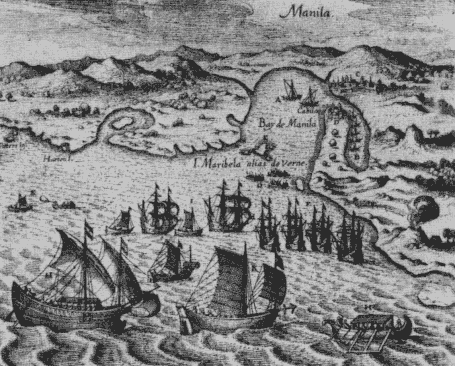
A Sixteenth-Century Map of Manila Bay
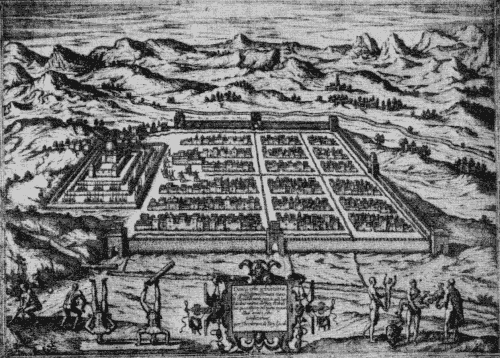
Early Seventeenth-Century Cuzco
ship to Peru, with a view to opening trade with that viceroyalty, and already the traffic with Mexico was proving so profitable that rival merchants there and in Spain were beginning to bring pressure on the Crown to impose strict limitations on the volume of goods permitted on the cumbrous Manila galleon which plowed its lonely course across the vast reaches of the Pacific Ocean.
In 1583, however, this prosperity had not fully developed, and the affairs of the Philippines and their capital were momentarily in a precarious state. Some seven hundred Spaniards lived in Manila amidst an undetermined number of natives,[10] but these European elements were, for the most part, restless and unprincipled adventurers seeking quick wealth at the expense of the conquered. Those who held encomiendas of Filipinos were taking their luckless tributaries out of the fields and putting them to work in the mines and galleys, thus creating a food scarcity which threatened the existence of Spanish overlord and native serf alike. The spirit of revolt was smoldering, and some of the Filipino chieftains were conspiring with the Datu of Borneo to oust the Spaniards from the islands. Governor Ronquillo was aiding and abetting this shortsighted exploitation by the encomenderos while at the same time imposing prohibitive taxes on the local trade with Mexico and with the Chinese merchants called sangleyes . When the latter arrived in their junks, they were herded together in a single dwelling, separated from the other residents of the city, and placed under a special warden with arbitrary powers. This official often obliged the hapless Chinese to sell their goods far below value, or even robbed them of their wares entirely, subsequently shanghaiing the Orientals for service on the Spanish galleys. This shameless treatment was discouraging the very trade which held so great a promise of profit for the Spaniards themselves.[11] To the correction of these and other abuses the recently arrived missionaries, headed by Bishop Salazar, vigorously addressed themselves, thus initiating the friction between secular and ecclesiastical authorities destined to vex so much of Philippine history during the long centuries of Spanish rule.
This conflict between the representatives of Church and State half the world away from the centralized control of Madrid was disadvantageous to the Bishop, who was outnumbered by acquisitive laymen, but his repeated complaints to Philip II resulted in some
measures which made the year 1583 important in the annals of the Philippines. To curb the arbitrary power of the Governor and the excesses of the encomenderos a royal decree of May 5, 1583 established the Royal Audiencia of Manila with jurisdiction not only over the entire archipelago but extending to "the mainland of China, whether discovered or yet to be discovered,"[12] thus preparing for the possible expansion to continental Asia that the worthy Bishop was recommending. The following year the appointed officials arrived and this judicial agency began to function.
Even earlier in 1583 another institution was authorized, possibly to strengthen the hand of Bishop Salazar. This was a branch at Manila of the Inquisition of New Spain, and to the newly designated Commissioner instructions were issued under date of March 1, 1583.[13] Possibly the Trebiña book list represents one of the first acts of this official of the Holy Office on assuming his duties in the Philippines. Thus in this historic year important institutions of the Spanish governmental system were formally authorized or set up in the fringe of islands lying off the coast of Asia.
But more unexpected incidents were taking place at the Philippine capital in 1583. Governor Ronquillo died on February 14, after serving less than three years in office.[14] Poor health and personal difficulties had beset him constantly during his brief term and doubtless hastened his end. His passing brought destruction to the city whose affairs he had administered so arbitrarily. While the funeral services were in progress at the St. Augustine monastery, wax tapers placed on the huge catafalque, which reached nearly to the ceiling, ignited the timbered roof of the structure and the flames, fanned by a strong wind, quickly consumed the entire building, from which only the Holy Sacrament was rescued. The conflagration spread to the nearby bamboo huts thatched with the tinderlike nipa leaf, and in the space of two hours most of the city was reduced to a mass of charred and smoking ruins. All public buildings were destroyed, including the main church and its precious organ, the hospital, the bishop's residence, the warehouse stocked with goods for transport to Mexico, the fort, the armory and its magazines with all the powder and munitions on hand. So intense and voracious were the flames that they even melted most of the cannon and artillery that the Spaniards sorely needed for the de-
fense of the city.[15] Thus, in addition to being threatened with starvation, most of the population was suddenly homeless, and the capital was nearly helpless to resist attack.
Prompt action, both by the new governor, Diego de Ronquillo, nephew of the deceased executive, and by the clergy, brought fairly rapid recovery from the disaster. Conspicuous in the pressing task of reconstruction, which occupied the rest of 1583 and succeeding months, was the energetic Jesuit, Antonio de Sedeño, who first taught the Filipinos to quarry and shape building stone, to mix mortar and lay these blocks; similarly, he taught them to manufacture the first tiles and bricks used in the old city of Intramuros,[16] and it was he who built the first limekiln. His talents as a contractor and builder were not limited to ecclesiastical structures but extended to drawing the plans and laying the foundations of the first stone fortress on the shore front for the protection of the city.[17] In these endeavors church and secular officials collaborated effectively, and in 1583 many of the buildings which were to constitute early colonial Manila rapidly took shape. This coöperation did not, unfortunately, extend to other spheres, and the difficulties which kept the governor and bishop at odds continued until the arrival of the Royal Audiencia.
In such a remote outpost, where living conditions were still rude and harsh, where security from the hazards of nature was slight, where the threats of Japanese and Chinese pirates were constant, where natives sullenly plotted revolt, and where a handful of Europeans sought to implant an occidental civilization in a widely scattered archipelago, meanwhile extracting the maximum material gain from the process, it seems almost incredible that there was any place or time for books, whether of light or solid literature. Yet fragmentary evidence, of which the Trebiña document is a small part, clearly points to their presence in Manila at this early date. The records of the House of Trade at Seville indicate that substantial sums were allotted to Bishop Salazar and the clergy accompanying him to the Philippines to pay the costs of transportation of a large number of books.[18] That these volumes actually reached Manila is apparent from the reference contained in the bishop's letter to Philip II of June 18, 1583 regarding the destruction of "a very good library" in the fire which consumed his living
quarters.[19] Doubtless many other printed volumes had arrived by that year and continued to do so. One clause of the Chief Inquisitor's instructions written in Mexico City for the new Commissioner at Manila suggests that books were a regular part of the cargo of ships reaching the far-off Philippines. It read as follows:
One of the most important reasons for inspecting the ships is the books, especially the boxes which come as cargo. The royal officials and magistrates of his Majesty who reside in those ports shall send the said boxes to the Commissioner of the Inquisition without opening or taking out any books from them. The Commissioner shall open them and examine the books, comparing the titles with the General Catalogue [of prohibited works]. And after seizing such as he finds are prohibited, he will give the rest to the owners. To this end the Commissioner shall make known to the royal officials of the city and to those who reside in the ports the ordinance which accompanies this document; and this applies even when the said boxes of books have previously been examined by another inquisitor."[20]
Though the book list here studied leaves many questions unanswered, and its almost complete lack of detail is tantalizing, the survival of this short document through more than three and a half centuries adds small but eloquent testimony to the wide diffusion of Spanish literary culture throughout the expanding world of the sixteenth century. Even more clearly does it show that, however far from the homeland the conquistadors' swords might take them, and into whatever vicissitudes their destiny might lead them, close upon the heels of these conquerors, even to the very antipodes, followed the creative spirits of Spain, great and small, through the medium of those silent disseminators of ideas—printed books. When the tremendous expansive power of sixteenth-century Castile reached out to the distant Philippines, Spanish law and Spanish letters, as the vanguard of European civilization, had completely encircled the terrestrial globe.