
Rivals
Other signs in the German art world were bound to heighten Corinth's concern about resuming his professional life. For as he struggled to recapture the momentum of his career, younger artists, expounding aesthetic principles at variance with his own, were gaining broader public support. The opening exhibition of the New Secession in May 1910 had marked the beginning of a
process that would eventually dislodge the Berlin Secession from the center of modern art in Germany. In 1911 exhibitions of paintings and graphics by the artists of Die Brücke were held at the Berlin gallery of Fritz Gurlitt as well as at galleries in Danzig, Schwerin, Lübeck, Düren, München-Gladbach, and Dresden. The same year the New Secession organized two exhibitions in Berlin, with works by Heckel, Otto Mueller, Pechstein, Schmidt-Rottluff, Kandinsky, Jawlensky, and Nolde. The Brücke painters continued their association with the New Secession until the fall of 1911, when they withdrew, pledging to exhibit henceforth only as a group. By the end of the year they had all settled in Berlin and in the spring of 1912 were again featured at the gallery of Fritz Gurlitt. The Gurlitt exhibition was soon followed by a show at the Commeter Gallery in Hamburg. In Munich, meanwhile, the first Blaue Reiter exhibition opened at the Neue Galerie Thannhauser in December 1911 and subsequently traveled to Berlin and Cologne, while in the Bavarian capital the group mounted a second show at the gallery of Hans Goltz.
In 1910 the Expressionists had found an enterprising champion in the Berlin publisher Herwarth Walden, who featured their drawings and prints in the avant-garde literary weekly Der Sturm and from 1912 on organized at the galleries of Der Sturm a series of pioneering exhibitions that included works by the members of Der Blaue Reiter, Kokoschka, Fauves like Derain and Vlaminck, and leading Cubists and Futurists. In 1912 Walden also published Filippo Tommaso Marinetti's "Manifesto of Futurism" and the more specific "Futurist Painting: Technical Manifesto" as well as an essay by Kandinsky, "The Language of Form and Color," the sixth chapter of the Russian painter's book Concerning the Spiritual in Art . In Cologne Karl Osthaus organized the monumental fourth exhibition of the Düsseldorf Sonderbund, open from May to September 1912. This, the most important German exhibition of modern art ever held, was international in scope and served as a prelude to Herwarth Walden's First German Autumn Salon of the following year, which brought together an impressive collection of paintings and works of sculpture by some ninety artists from fifteen different countries.[11]
The Berlin Secession had never mounted exhibitions of such magnitude and importance. The annual exhibition of 1912 in particular was a lackluster affair. Faced with an unexpected responsibility, Cassirer and Liebermann—who had hardly concerned themselves with the administrative affairs of the association since the debacle of 1910—had too little time to prepare a competitive show. One of their more memorable efforts on behalf of the Secession, however, resulted in Max Pechstein's return to the association. For this Pechstein was expelled from Die Brücke, since he had defied the group's decision to exhibit only jointly.
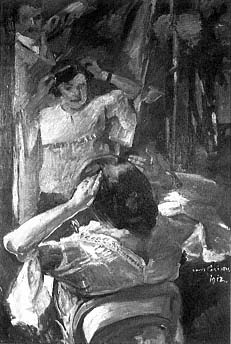
Figure 123
Lovis Corinth, Before the Mirror , 1912.
Oil on canvas, 140 × 93 cm, B.-C. 533.
Private collection.
Photo: John D. Schiff.
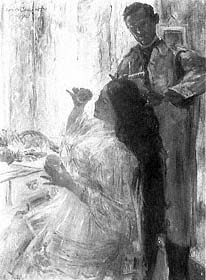
Figure 124
Lovis Corinth, At the Toilet Table ,
1911. Oil on canvas, 120 × 90 cm,
B.-C. 502. Hamburger Kunsthalle,
Hamburg (1857).
Photo: Ralph Kleinhempel.