
6—
"I am resolved not to interfere, but permit all to work freely":
The Gold Rush and American Resource Law
Donald J. Pisani
The California Gold Rush profoundly influenced the evolution of property law in the American West. In theory, Congress held the public domain in trust for the benefit of all citizens of the United States. In practice, the public lands bought or taken from Indians or other nations now belonged to those Euro-Americans with sufficient wit, energy, zeal, and capital to exploit them. California was the first state admitted to the Union that contained large deposits of precious metals, and its experience set an important precedent: mining on the public domain would be open to all. The national government imposed neither charges nor regulations on the Argonauts who swarmed into California during the late 1840s and 1850s. The miners were trespassers on government land, yet they decided who would be granted access to the gold and under what conditions. They also decided who would be allowed to use the water needed to work the mineral claims, laying the foundation for the legal doctrine of "prior appropriation," which eventually spread to agriculture with enormous implications for the history of the arid and semi-arid American West.
Mining and American Resource Law before the Gold Rush
In the United States, mineral law grew out of the same assumptions and values that shaped land law. In medieval Europe, land ownership imposed a set of obligations and relationships that defined and ordered society. With the Enlightenment, theories of the English philosopher John Locke, among others, freed property from class and state, making it the bedrock of individual freedom and autonomy. In the second of Locke's Two Treatises on Government (1690), property became a God-
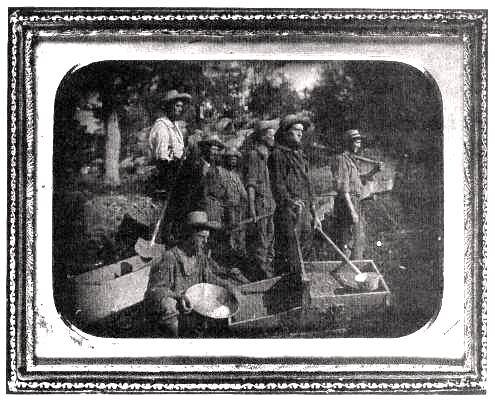
Miners with Rocker and Blue Shirts , a handsome and striking hand-tinted daguerreotype
made about 1852, probably by George H. Johnson. In theory the federal government held
the public domain in trust for all citizens of the republic. But in practice the Argonauts seized
it for their own enrichment, controlling its use through a self-administered system of mining
codes that prevailed far in advance of any constitutionally authorized body of laws.
Collection of W. Bruce Lundberg .
given, transcendent natural right that preceded human society and the social contract; it was no longer the gift of kings, queens, nobles, or even Parliament. The concept of property derived from a set of interlocking assumptions: God had given the earth to human beings in common, but had created it for the rational and industrious, not for the slothful and impecunious. Human beings had a right to life or self-preservation, which, in turn, dictated the right to a subsistence. To make the earth useful, there had to be a method of appropriation. Since human beings "owned" themselves, by extension they also had a right to their own labor. Therefore, the primary value of land derived from the labor that went into fencing, plowing, planting, or draining it. Property was created only when human beings produced something from the raw materials God had provided.[1]
In the United States of the late eighteenth and nineteenth centuries, law, politics,
economics, and anthropology reinforced Lockean thinking. In his Commentaries , published in the United States in 1772, the English jurist William Blackstone noted that "so great is the regard of the law for private property, that it will not authorize the least violation of it; no not even for the general good of the whole community."[2] Adam Smith bolstered Lockean thought by emphasizing the virtue and wisdom of rational self-interest. He also anticipated Frederick Jackson Turner's frontier thesis by arguing that human societies evolved through distinct stages that corresponded to modes of subsistence: hunting, grazing, agriculture, and, ultimately, commerce. Later, the marriage between anthropology and Social Darwinism added a new element to the American concept of property. Most anthropologists regarded property held in common, or by the state, as more "primitive" than individual rights—which were widely assumed to be more efficient and less wasteful. The monopolization of natural resources by private corporations or the state stifled economic opportunity, undermined civic virtue, and promoted the growth of bureaucracies that threatened liberty.
Those who settled on the public lands of the United States carried Lockean ideas to the vast frontier of the American West. Usually ignoring all prior Indian land use and property rights, the first Euro-Americans to enter a region assumed a paramount right defined by chronological priority and continuous, "beneficial" use. Then, as now, priority was used to ration scarce items. Yet the public domain was so large that it simultaneously encouraged monopoly as well as equal access. "There was room enough for all," the historian Ernest Osgood wrote decades ago, "and when a cattleman rode up some likely valley or across some well-grassed divide and found cattle thereon, he looked elsewhere for range." In eastern Montana and central Wyoming, cattlemen even advertised their claims in newspapers. "I, the undersigned," one announcement read, "do hereby notify the public that I claim the valley, branching off the Glendive Creek, four miles east of Allard, and extending to its source on the South side of the Northern Pacific Railroad as a stock range.—Charles S. Johnson." In theory, only Congress could dispose of the "open range," but many territories and states enacted laws upholding the exclusive usufructuary rights (to use and the profits from that use) of the first stockmen on the scene.[3]
Squatter clubs, commonly called "claims' associations," reinforced the assumption that unimproved government land—again, usually ignoring prior Indian settlement—was not property. Where government land had not been surveyed—and surveys rarely kept pace with settlement—federal preemption laws gave actual set-tiers a claim to their homestead. But even the general Preemption Act of 1841 did not eliminate the need for such associations. In theory, the claimants had to be beyond the reach of formal legal institutions. Trespassers drafted constitutions, elected governing councils, established arbitration procedures to prevent or mitigate disputes, and pledged to prevent bidding by those who did not belong to their club. The
first residents, it was argued, should have the right to purchase government land at the minimum price of $1.25 per acre once the surveyors caught up with them—without interference from "claim jumpers" or those who came later. The claims clubs assumed that the public domain existed to aid individual opportunity and the economic development of the frontier rather than the economy of the nation or the financial needs of the central government. Most clubs also welcomed small-fry land speculators by permitting the first settlers to purchase an additional 80 to 160 acres and to sell all or part of their "occupancy right."[4]
The values that drove American land policy also dictated mineral policy. Most of the states' old colonial charters had contained outright grants of minerals, but they also reserved a share to the English Crown (usually 20 percent of all precious metals). During the American Revolution, mining was seen as a way to help pay off the war debt, and the Land Ordinance of 1785 reserved to the federal government one-third of all gold, silver, lead, and copper taken from the public lands. The major land acts of the first half of the nineteenth century excluded mineral lands from entry. In 1807 Congress authorized leasing the lead mines in Indiana Territory—the site of the only extensive mining undertaken in the United States before the California Gold Rush—for terms of up to five years. Military needs dictated this decision, and the leases were administered by the War Department, which began collecting a 10 percent royalty in 1822. Many miners refused to secure a permit, and the actual production of lead was four times that reported to the War Department. Nearly one million acres of mineral lands had been reserved by the 1840s, but the public lands had not been classified and plenty of mineral land became private property before it was subjected to leasing. Beginning in 1834, and especially after the Panic of 1837, the price of lead plummeted and rental fees dried up. The War Department, moreover, lacked a sufficient number of agents to police the frontier. Even so, the cost of administration and litigation far exceeded the revenue returned to the central government.[5]
In the mid-1840s, the commissioner of the Land Office and President James K. Polk called for an end to leasing, a practice that had prompted extensive litigation and was highly unpopular on the frontier. To add insult to injury, in the years from 1841 to 1844 leasing returned only about 25 percent of the cost of administering the system. Polk wanted to sell the mineral lands and require purchasers to pay a small royalty to the government. "It was better to realize something on these lands [through outright sale]," historian Roy Robbins has written, "than to have them appropriated illegally by settlers, or to have them plundered by trespassers and thus rendered unfit for sale. Undoubtedly the pressure of western protest against continuing the leasing system also influenced the government to recommend the change. The State of Michigan in 1846 took a firm stand against the perpetuation of a system of 'patroonery' on her territory, and insisted that all mineral lands be sold and rendered taxable by her." The lead-bearing lands in Illinois, Wisconsin, Michigan,
and Arkansas went on sale in 1846 and the copper and lead mines in the Lake Superior District of Wisconsin and Michigan in 1847.[6]
Gold in California
Those who flocked to California at the end of the 1840s carried with them strong ideas about the nature of property, the right of American citizens beyond the pale of law to govern themselves, and the power of American citizens to make their own rules concerning the acquisition and use of public lands—including those containing mineral deposits. Nevertheless, Congress had authorized the sale of lead and copper lands. Would it now authorize the sale of gold-bearing land to the highest bidders?
This was the question that faced the U.S. Army in California when gold was discovered in January 1848. In February 1848, Colonel Richard Mason, the military governor of California from 1847 to 1849, abolished all Mexican mining laws and customs. In July, he visited the gold camps and considered selling the mineral land in twenty- to forty-acre plots, or charging miners a license fee of $100 to $1,000 for the privilege of working claims. But Mason had only 660 soldiers under his command, and martial law would have been intolerable to the Argonauts. If used to govern the mineral region, Mason fretted, his troops might desert and turn to mining themselves. Nor could he be sure that his system would prevent a handful of capitalists from monopolizing the best land. "It was a matter of serious reflection with me," Mason wrote, "how I could secure to the government certain rents or fees for the privilege of procuring this gold; but upon considering the large extent of the country, the character of the people engaged, and the small scattered force at my command, I am resolved not to interfere, but permit all to work freely."[7]
California was technically not even a part of the United States when the Gold Rush began. Initially, alcaldes (mayors) ruled over most settlements, including some mining camps, but the miners soon took matters into their own hands. The principles of equal opportunity, home rule, antimonopoly, preemption, and priority rights were customs of the American frontier with deep roots in logic and experience. Mexican institutions and values emphasized conciliation and accommodation to the detriment of contract, and they regarded community stability as a higher good than individual property rights. Mining camp codes, by contrast, were more concerned with the allocation of natural resources to individuals than with creating a moral society.[8]
The miners made great use of the essential premise of the English common law: that universal custom had as much legal sanction as formal statutes. Two common-law principles were particularly important. First, when two or more people trespassed on land owned by a third, the first to enter and use the land had a superior
claim to all others (except the legal owner); second, all trespassers were limited to "reasonable use." These principles helped lay the foundation for priority fights on the public domain.[9]
Mining camp codes did not originate in California,[10] but within the United States no previously discovered mineral regions were as extensive as those in California, which by the 1860s contained about five hundred mining districts. Regulations varied from camp to camp, but they had much in common. Those miners who were the first to locate the precious metals had spent money and energy demonstrating that gold was available; all subsequent work depended on their efforts and ingenuity. Much of mining was trial and error, so the second or third wave of Argonauts to enter a mining district did not face the same economic risks or obstacles. Those first on the scene also founded towns and built roads, creating the economic context in which profitable mining could take place. Therefore, they were granted a "right of discovery"—usually a larger claim or two claims—as well as chronological priority.
The mining codes regulated the size of claims, the process of filing and marking them, and the necessity for continuous work for the claim to remain valid. Since the land was owned by the federal government, claims conferred usufruct rights rather than absolute ownership. Depending on the richness of the gold deposits, they could be as small as one hundred square feet or several times that large, but they were generally limited to the amount of land one man could work. The land laws of the United States permitted farmers to acquire far more land than they could work; the mining laws did not. The codes also provided a process for arbitrating disputes by an alcalde, council, or jury—often with a right of appeal from the arbitrator or arbitrators to the entire mass of miners within a district—and proclaimed that no compensation need be paid for the privilege of mining to either the state or federal governments. Many miners expressed disdain for formal law, and thus some districts banned lawyers—or at least prohibited them from practicing their trade.[11] In February 1850, the California Senate's Committee on the Judiciary noted that it was a "popular doctrine" that common sense was "entitled to higher consideration than the reflection and ripe experience of the most profound jurist. . . . In short, reduced to its simplest terms . . . the proposition is, that the man who is entirely ignorant of a multifarious subject, is more competent to form a just and correct judgment concerning it, than the man who has made it the business of his life to comprehend it in theory and understand it in its minute and practical details."[12]
Free Mining
The California legislature sanctioned "free mining" at the beginning of 1851 In 1850 the alcalde of Marysville, Stephen J. Field—who was destined to become chief justice of the California Supreme Court in 1857 and to serve the longest term in the his-
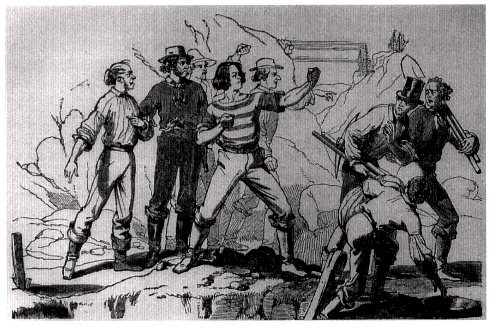
"Bogue Ejecting the Squatters," one of the illustrations by Charles Nahl that enliven the
pages of Old Block's Sketch-Book . This collection of charming and humorous tales of
gold-rush California was published in 1856 by Alonzo Delano, who, like Nahl, had earlier
tried his hand at mining. Although disputes over claims were generally resolved through
arbitration according to the dictates of local custom and code, miners occasionally relied
on direct action to secure their rights. California Historical Society, FN-30963 .
tory of the U.S. Supreme Court, from 1863 to 1897—ran for the legislature from Yuba County, which at that time also contained what would become Nevada and Sierra counties. The immense county was 100 miles long and 50 miles wide, with a scattered population of 25,000. Most miners were far removed from the county seat and institutions of government.
Late in his life, Field recalled that one of his campaign planks in 1850 was "giving greater jurisdiction to the local magistrates, in order that contests of miners respecting their claims might be tried in their vicinity. As things then existed the right to a mule could not be litigated without going to the county seat. . . . I was in favor of legislation which would protect miners in their claims, and exempt their tents, rockers, and utensils used in mining from forced sale [by the federal government]." The 1851 law he sponsored provided that "in actions respecting 'Mining Claims,' proof shall be admitted of the customs, usages, or regulations established and in force at the bar, or diggings, embracing such claim; and such customs, usages, or regulations, when not in conflict with the Constitution and Laws of the State, shall govern the decision of the action." Simple as it was, this law became the foun-
dation for mining on the public domain throughout the American West. Field claimed that mining camp law symbolized "that love of order and system and of fair dealing which are the prominent characteristics of our people." The laws were framed, he insisted, "to secure to all comers, within practicable limits, absolute equality of right and privilege in working the mines." Field, of course, exaggerated. The mining camp codes did not always welcome "all comers" or promote "fair dealing." The California legislature enacted many laws pertaining to the mineral lands, including foreign miners' taxes that permitted some miners to discriminate against others and provided for eviction from the mining districts if not paid.[13]
California's courts quickly adopted the principle of free mining, though not without confusion. Miners could not abridge the rights of the United States, but they limited competition and prevented the monopolization of the mines by the state or private corporations. In 1853, in a bizarre appeal to English precedent, the California Supreme Court proclaimed the state's sovereignty over all mineral lands in California. Those who favored the decision hoped that the mines could be taxed to pay state expenses. The ruling met strong opposition from within the mining districts, where critics charged that the court had been bribed by capitalists who hoped to take from the state what they could not persuade Congress to give them. Critics also feared that since the case would inevitably be overturned by the U.S. Supreme Court—which it was—it would weaken rather than strengthen mineral claims.[14]
In his annual message to Congress in December 1850, President Millard Fillmore echoed President Polk's suggestion that the mineral lands be sold at auction in small parcels. But by the time he addressed Congress a year later, Fillmore feared the consequences of such a policy. Now he recommended that the gold fields of California "be permitted to remain as at present, a common field, open to the enterprise and industry of all our citizens, until further experience shall have developed the best policy to be ultimately adopted."[15]
Congress said little more about the mineral lands during the 1850s, but large hydraulic mining companies proliferated in California during the first half of the 1860s, and friends of corporate mining feared that English and Scots investors would refuse to sink more money into the mines until Congress formally approved free mining. Moreover, at the end of the Civil War, western miners faced several financial threats. Congress might auction off the mineral lands to help pay off the national debt incurred by the war, an alternative favored by the secretary of the treasury. Or it might retain title to these lands, levy a production or transportation tax, or extend the 1861 income tax to miners. (By the end of the war, the income tax produced almost one-fifth of all federal revenue, but given the transient nature of miners the cost of administering such a tax system would have been high.) In 1865, Congressman George Julian of Indiana introduced a new bill to sell the mineral lands. Similar legislation was introduced in the U.S. Senate, but Congress refused to act—in large part
because California's delegation predicted that revolution would result. Miners bombarded Congress with petitions urging the rejection of the Julian bill.[16]
In 1865, the U.S. Supreme Court acknowledged that free mining enjoyed "implied sanction" and had contributed "largely to the prosperity and improvement of the whole country."[17] Nevertheless, since the Constitution explicitly granted Congress the authority to regulate and dispose of the public lands, the high court could not make policy. In 1866, the disposition of the mineral lands again came before Congress. Debate focused on a bill introduced by Senator William Morris Stewart of Nevada, who, along with Senator John Conness of California, had led the opposition to Julian's plan in the previous session of Congress. Stewart spoke for the vast capital that had been poured into the Comstock Lode, but he played on public sympathy for the individual miner: "I assert . . . that the sand plains, alkaline deserts, and dreary monuments of rock and sagebrush of the great interior, would have been as worthless today as when they were marked by geographers as the Great American Desert, but for this system of free mining fostered by our own neglect, and matured and perfected by our generous inaction." Since the principal asset securing the national debt was land, and since increasing the production of gold would drive up the value of that land, Stewart also argued that free mining would do more to reduce the national debt than would selling the mineral claims.[18]
Congress adopted Stewart's bill in 1866, and it became the foundation of mining on the public domain. It confirmed the status quo and extended the rules established in California's gold camps to the rest of the West. It ensured that mineral lands within the public domain would remain open to "all," that the rules governing their use should be dictated by the miners themselves and ratified by the state, territorial, and federal governments, and that miners who wished to secure clear title to their claims could do so for $5 an acre. The 1866 law applied only to shaft mining, but in 1870 Congress extended the opportunity to purchase claims to placer miners, at $2.50 per acre. A third mining law, adopted in 1872, completed the formal process of turning control over precious metals to the miners, counties, and states.[19]
Hydraulic Mining
The extent to which these laws contributed to the growth of hydraulic mining is uncertain, but they did nothing to restrain that growth. Hydraulic mining flourished only in those parts of California blessed with abundant surface water. The Argonauts could not have washed away mountains of topsoil to get at ancient stream beds except on California's remote and mountainous public domain, where no substantial industries competed with mining and no traditional riparian water rights prevented diverting water from natural channels. North of the Feather River, thick volcanic deposits covered rich Tertiary gravels, but in the Southern Mines the Ter-
tiary deposits were far smaller. The most profitable hydraulic mines were located on the ridge running between the South and Middle forks of the Yuba River, ten to twenty miles northeast of Nevada City. There, the mining communities of French Corral, Birchville, Sweetland, North San Juan, Columbia Hill, Lake City, North Bloomfield, Relief Hill, and Moore's Flat flourished. By the 1860s, Nevada was the leading mining county in California. As early as 1864, one observer reported that "so great has been the quantity of ground washed away, that many of the ravines are covered with a depth of twenty feet and upwards of tailings from the sluices." Nevada County's gaping hydraulic mines were as much as a mile long and exposed walls of earth five hundred feet high.[20]
In 1861, a thicker canvas hose, reinforced with iron hoops, tripled the velocity of water that miners could direct against the earth. Eight-inch nozzles produced a force great enough to kill the hapless miner who ventured into the water's path.[21] After the drought of 1862-1864, corporations consolidated most of the smaller companies. English capital poured into hydraulic mines, in part because of high profits, in part because of the promises of geologists like Benjamin Silliman of Yale, who reassured potential investors: "It is proven by the most ample testimony that the ancient gold bearing gravel of California contains an inexhaustible store of gold diffused with wonderful uniformity throughout the mass, and, in the aggregate, far exceeding the entire product which the golden State has yet sent into the commerce of the world." This, coupled with Silliman's promise that investors could expect a 20- to 25-percent annual return for an "indefinite time to come," won plenty of financial support.[22]
The hydraulic mines of Nevada, Sierra, and adjoining counties produced great wealth for decades after the Gold Rush, but the mining industry became more and more localized. In the 1860s and 1870s, it faced a serious challenge from the expansion of wheat farming in California's Central Valley. The flood of 1862 washed huge quantities of debris into the Yuba River, and thence into the valley. Marysville, at the confluence of the Feather and Yuba rivers, became a walled city, surrounded by levees as high as chimney tops. As the years passed, the Sacramento, Feather, and Bear rivers, as well as the Yuba, filled with silt, which affected navigation and commerce as far away as Suisun, San Pablo, and San Francisco bays. Thirty thousand acres of prime alluvial farmland became choked with mud from mining sites in the foothills. Once mining had been supreme, but by the 1870s, agriculture played an increasingly prominent role in California's economy.[23]
The mining debris controversy became a prominent issue in California politics, prompting the first debates over flood control in the Sacramento Valley.[24] In 1884, Judge Lorenzo Sawyer of the U.S. Circuit Court permanently enjoined the mining companies from damaging the property of Central Valley residents. Ironically, he used the same argument for equality of opportunity that had once justified free mining. "It
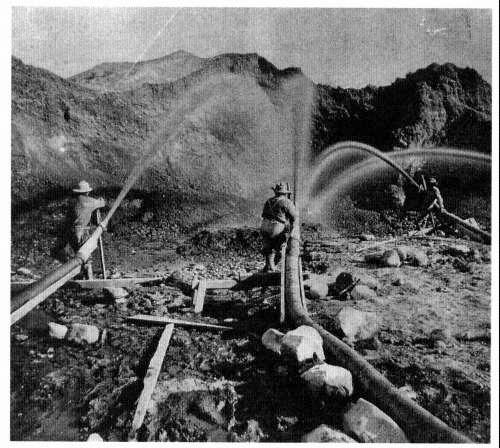
"Piping the bank" near the community of French Corral, hard by the South Fork of the Yuba
River in the richest of all the hydraulic mining districts of California, about 1865. Despite the
compelling aesthetic of the photographer's powerful composition, hydraulicking was a terribly
destructive technology, laying waste to rolling hills, devastating streams, and covering down
stream farmland with "slickens." "It is impossible," wrote an observer, "to conceive of anything
more desolate, more utterly forbidding, than a region which has been subjected to this hydraulic
mining treatment." Courtesy Society of California Pioneers .
is by protecting the most humble in his small estate against the encroachments of large capital and large interests," Sawyer proclaimed, "that the poor man is ultimately able to become a capitalist himself. If the smaller interest must yield to the larger . . . all smaller and less important enterprises, industries, and pursuits would sooner or later be absorbed by the large, more powerful few; and their development to a condition of great value and importance, both to the individual and the public, would be arrested in its incipiency."[25] Shaft, or hardrock, mining survived, but never again would the mining industry exercise the political clout it enjoyed in the 1850s and 1860s.[26]
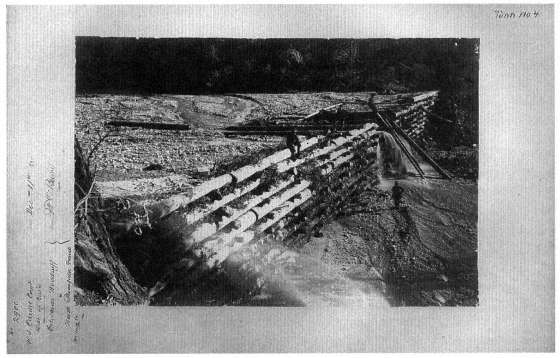
An impoundment dam choked with hydraulic mining debris forms the subject of one of a series of
photographs by John A. Todd that were introduced as evidence in the celebrated case of Woodruff
v. North Bloomfield Gravel Mining Co . Ruling for the plaintiff in 1884, U.S. Circuit Court Judge
Lorenzo Sawyer effectively brought an end to hydraulicking in the Golden State—a landmark
decision in the first environmental pollution battle in the American West. California Historical
Society, FN-29933 .
Resource Law and the Corporation
The future was on the side of agriculture, but it was not on the side of "the most humble in his small estate." In the late 1840s and early 1850s, free mining provided reasonably equal access to wealth—except to certain groups of "foreign" miners. But during the 1850s, as corporations increasingly dominated mining, the law changed from encouraging economic democracy to protecting capital. Perhaps the best example was the legal permission to "follow the vein." In Mexico, England, and other European countries, miners could only dig within the boundaries of their claims, and initially California's mining camp codes limited hardrock miners to part of a vein, often one hundred feet. As early as 1852, however, Nevada County modified its laws to encourage miners to follow a vein downward to any depth and in any direction, even if they tunneled under an adjoining claim. The new laws were designed to protect investors from financial loss when only the tail end of an out-
cropping was located within their claim. Not surprisingly, this innovation spawned many lawsuits. In an attempt to reduce litigation, the 1872 Congress specified that only those miners who located the highest point of a lode—the "apex"—should be allowed to follow the lode under adjoining claims.[27]
The 1872 law promoted rather than quieted legal conflict. Locating the apex of a vein that snaked through the earth was difficult, and the fact that many veins are not continuous made the problem even more complicated. Was a discontinuous vein part of the original vein or an entirely new mineral deposit? The historian Otis Young has explained how this law opened the door to legal blackmail: "At its rock-bottom worst, apex litigation began when a would-be plaintiff had, or arranged to obtain, title to property adjacent to that of a prosperous mine. He next hired a geologist to 'discover' that a shoot of the high-grade lode cropped out on his own property and to theorize somehow that the tail of the shoot wagged the dog of the lode. The next step was to retain a high-powered attorney, one who specialized in apex litigation on a contingency-fee basis, to bring suit against the prosperous mine. The attorney then filed a brief on the law side of the appropriate court, swearing that the plaintiff either had priority of discovery (thus entitling him to the whole) or at worst was entitled to receive lucrative remedies for the damages he was suffering from the depredations of a soulless corporation. The hope, of course, was that the defendant mining company would settle out of court for a substantial sum, irrespective of the facts, in order to be rid of a dangerous nuisance."[28]
Both sides in such a contest hired as many expert witnesses as they could find and afford, so more than a few geologists spent their entire careers as expert witnesses. In one five-year period, lawsuits in Nevada courts cost about 20 percent of the entire output of the Comstock mines. "No industry in any country," Clark Spence has wisely concluded, "was ever subject to as much or as complicated legal activity as mining in western America."[29]
Water Law
The prior appropriation principle of water rights was to placer mining what the apex law was to lode mining. As enforced in courts within the eastern United States, riparian rights granted those who owned land bordering a stream the exclusive right to use water from that stream on their property. Such rights were "correlative" rather than absolute. They could be defined only in relationship to each other, not as absolute grants of specific quantities of water. Riparian owners could divert water to meet domestic needs or to water livestock. They could even reduce the flow of a stream, if their diversions were "reasonable." However, no commercial use of water, such as irrigation, could materially reduce the flow of a stream—at least not if the other riparian owners complained.[30]
Prior appropriation granted the first to use water the right to carry it anywhere, and use it for any purpose, as long as that use was "beneficial." The principle was simple, but the law took shape gradually. During the 1850s, many mining camps prohibited water diversions that injured one group of miners at the expense of another. They demanded the consent of those working placer deposits adjoining a stream before water could be turned from its natural channel. In addition, mining camp codes often prohibited the construction of diversion dams that backed up water onto claims above the dam, reserved the use of water in a creek or ravine exclusively to miners within that watershed, and prohibited miners from claiming surplus water for speculative purposes. Not all mining camps adopted formal rules related to water use because most preferred the arbitration of disputes to cut-and-dried edicts. Nevertheless, when the arbitration process broke down, miners dynamited ditches, chopped down wooden diversion dams, and tore down or burned flumes. Most often, lawyers, and later historians, ignored these conflicts, preferring to portray the mining districts as models of grassroots democracy rather than communities torn between individual and corporate enterprise. Only after mining passed from an activity engaged in by individual miners or miners organized in small groups to large hydraulic mining corporations—for which the miners worked as hired hands—did prior appropriation calcify into doctrine. Its triumph was due more to changing technology and capital requirements than to the fact that it made more sense in arid or semi-arid climates.[31]
It was one thing for miners to claim water by prior appropriation for their own use, quite another for entrepreneurs who did not engage directly in mining to claim water and form companies to sell it. Monopoly and outside control were two of the deepest fears in the mining camps. At first, priority rights applied to the age of claims, not to the age of water rights; water use was incidental. Eventually, however, the cost of carrying water farther and farther from existing streams proved overwhelming, and once the miners permitted the creation of autonomous water companies, the genie could not be stuffed back into the bottle. Heavily capitalized, the companies demanded an exclusive market. In October 1853, a group of miners at Yankee Jim's in Placer County wrote to the Placer Herald warning that the new ditch companies would soon destroy the rights" of actual miners: "They [the water companies] tell us that we are to be harassed and embarrassed with endless and perplexing law suits, that will cost more than all the claims are worth, and they further tell us, that the price of water will not be reduced. . . . Thus has crept into our midst a tyrant in the form of a lamb, and has gradually assumed the form of a two horned beast, whose right horn is bread, and the left horn water, and the community [sic] are gored into surfdom [sic]."[32] The miners were caught in a dilemma: without water, they could not find gold; with it, they became the subjects of powerful corporations whose headquarters were scattered from San Francisco to Scotland.
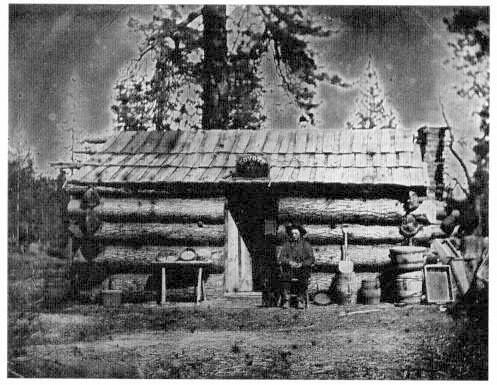
The office of the Coyote and Deer Creek Water Company near Nevada City in 1852, the
year following completion of its ditch, which brought water to the dry diggings of the
district. Among the earliest water companies in California, it was later one of hundreds
that became part of the Pacific Gas and Electric hydroelectric system. Courtesy California
State Library .
Contradictory decisions issued by the California Supreme Court from 1853 through 1858 or 1859 reflected the diversity of mining. In the hydraulic mining districts, prior appropriation quickly predominated. But in some camps, small-scale placer mining survived throughout the 1850s, and there a species of riparian rights persisted. Other camps tried to balance both legal principles. District judges were elected, and they responded to local opinion. Personal safety and the widespread hostility to formal institutions of law left them little choice. In addition, mining communities paid far more attention to their own regulations than to court judgments. The state supreme court had little power to enforce its decisions during the 1850s, and judges worried that Congress might overturn any decision that did not fairly represent the aspirations and needs of the miners.[33]
The success of prior appropriation was cultural as well as economic. In the California of the 1850s, fear of concentrated power and the demand for home rule reinforced the traditional American disdain for bureaucracy and centralized planning.
Prior appropriation did not require an expensive government bureaucracy to administer, nor did it require the legislature to pass elaborate statutes. It let the economic actors themselves set public policy, as they had dictated the land policy of the United States since the 1780s. It was based on thoroughly familiar principles, and no institution of government had to decide who would have access to water, where it would be used, or for what purpose. Prior appropriation assumed that when disputes arose they were better left to the courts, which, of course, represented the interests of litigants rather than the public as a whole. Only in the second half of the nineteenth century would the private corporation replace government as the chief instrument of tyranny in the minds of most Americans. It took nearly a decade for prior appropriation to triumph in the mining districts and even longer to take hold in agriculture. In the 1850s and 1860s, irrigation was largely confined to southern California. In that part of the state, the principle of community control over water, inherited from the Mexican period, prevailed. That system recognized a right to irrigate certain tracts of land, but no absolute grants to specific quantities of water. Then, in the 1870s, the Southern Pacific Railroad built through the San Joaquin Valley and over the Tehachapi Mountains into Los Angeles, and land and water companies proliferated. In the 1850s and 1860s, the valley had been devoted to cattle ranching and dry farming, but now irrigation communities grew up around Fresno, Modesto, and Bakersfield. Parts of the valley had been included in Mexican land grants and had never been part of the public domain. Therefore, passage of the Desert Land Act in 1877—which mandated prior appropriation on government lands and excluded all other water rights—had no effect in much of California. The increase in irrigation and a drought at the end of the 1870s resulted in conflict between those who held traditional riparian rights and those who claimed the right to divert water under prior appropriation. Simultaneously, the region south of the Tehachapis experienced a population boom and the systems of community control—which held water in common for the community—came to be seen as impediments to speculation in land and to economic growth.[34]
Prior appropriation was no more rational or efficient than riparian rights, nor was it better suited to all parts of the arid and semi-arid West. In California, the courts allowed riparian owners to irrigate, and riparian rights were well suited to California in the years before large storage reservoirs made massive diversions possible. In the 1870s and 1880s, technology restricted irrigation to the land adjoining streams. That land was alluvial and highly productive. It was also the cheapest to irrigate and allowed the maximum amount of water to seep back into the stream. Moreover, since riparian rights were correlative—with no existence apart from each other—they could be expanded or contracted according to fluctuations in the water supply. The major "weakness" of the riparian right was that it did not promise an absolute quantity of water. As capital looked for new investment opportunities in the
1870s and 1880s, as it poured into speculative land and water companies, it demanded that prior appropriation be extended to irrigation.
At the end of the 1870s, several contests over agricultural water rights reached the California Supreme Court. The court consistently ruled that riparian rights took precedence outside the public domain.[35] The land and water companies hoped to persuade the legislature or state supreme court to abandon riparian rights, as the courts had in other western states. In 1886, a special session of the legislature accomplished little, but the biggest battle came from 1881 to 1886, after Henry Miller, Charles Lux, and other riparian claimants in Buena Vista Slough at the end of the Kern River filed suit against James B. Haggin and his associates in the Kern County Land and Water Company to block diversions under prior appropriation near present-day Bakersfield. The plaintiffs argued that nature intended the Kern River to stay in its natural channel and that the value of their land depended on the water remaining there. No one, they insisted, had the right to claim water for nothing and carry it a great distance to dry land when doing so destroyed the property rights of downstream riparian owners. The court decided that abolishing riparian rights would replace one monopoly with another, forcing those whose water rights had been confiscated to purchase water from those who had taken it away, but there was surprisingly little enthusiasm for state ownership or regulation of water rights.[36]
Ultimately, the "California Doctrine," which embraced both riparian and appropriative rights, stood in stark contrast to the "Colorado Doctrine," which recognized prior appropriation exclusively.[37] Kansas, Montana, Nebraska, the Dakotas, Oregon, Texas, Washington, and Oklahoma followed California, and Utah, Wyoming, Arizona, New Mexico, and Idaho followed Colorado. With the exception of Montana, all states that accepted the California Doctrine contained both humid and arid sections. Diverse climates and economies help explain how water rights evolved in the West. Still, whether the evolution of western water law would have followed the same course had mining not preceded agriculture is a tantalizing and enormously significant question.
Most legal scholars and historians have lauded prior appropriation as a fair and equitable way to distribute a scarce water supply. Walter Prescott Webb proclaimed that "history . . . makes clear the necessity of . . . prior appropriation." In 1935, Carey McWilliams lauded appropriation as "the fairest and most economical and the fullest use of an inadequate water supply," and in 1953 Wallace Stegner declared it "an essential criterion" in an "irrigating country."[38] With most of California's best water lawyers enlisted on the side of prior appropriation, the possibility that the riparian doctrine or the system of community control in southern California had anything to offer Californians eager to build stable communities of small farmers was all but forgotten by the end of the nineteenth century. Yet, there was a dark side to prior appropriation. In large parts of the Central Valley, it permitted a handful of agricultural
corporations to dominate the water supply. Instead of efficiency, it promoted waste, as each claimant used as much water as possible to "stockpile" the largest future supply. It also led to expensive and protracted litigation, as the earliest water users claimed far more water than they could use. Finally, because rights acquired under prior appropriation could be condemned only at great cost, it prompted the construction of expensive new water projects in the twentieth century. The easiest answer to water shortages was to augment the existing supply, not to reallocate it or place restrictions on its use.
Conclusion
When the Public Lands Commission surveyed western mining in 1880, it observed that the "California common law," to use the commission's phrase, had become the law of mining west of the Missouri River. California miners had scattered throughout the West, carrying with them the legal principles worked out in the 1840s and 1850s.[39]
Some historians have argued that free mining resulted more from congressional neglect than from a positive policy choice. California was far removed from the rest of the nation, and slavery and sectional issues preoccupied the central government during the 1850s. Since the public domain still contained plenty of good agricultural land in the Midwest, and since California's arid and semi-arid climate initially seemed unsuited to agriculture, mining represented the state's only hope for economic development.
Nevertheless, the public domain belonged to all the people of the United States, and Congress had good reason to regulate mining on government land. California's mines produced more than $300 million from 1849 to 1854. In each of those years, the gold output matched the federal currency in circulation during the mid-1830s. The dramatic increase in the money supply had far-reaching implications for the American economy. "An era of inflation was thus inaugurated," historian Roy Robbins has written, "which was to have a tremendous effect on the whole country. For every addition of a million dollars in gold three or four million dollars in paper would be issued by existing banks, and it was expected [in the mid 1850s] that a new crop of banks would appear." The massive increase in precious metals inflated the prices of real estate, stocks, and commodities. This was reason enough for Congress to pay close attention to mining developments in California.[40]
Instead, Congress ignored the Gold Rush's financial implications and deferred to the customs of the country. The mining camps have long fascinated students of American history, in part because they can be viewed in two very different ways. On the one hand, they represent the mythical "state of nature." More than a new beginning, they could be seen as a perfect or idyllic state where the essential goodness
and rationality of human beings flowered unrestrained by the weight of history, the corruption of flawed institutions, the power of established elites, and the iniquities of laws designed to protect vested interests rather than to ensure equal opportunity. It was a world that permitted a return to "first principles" and the purest form of self-government. Charles H. Shinn, one of the foremost nineteenth-century champions of mining camp law, described the codes as "the only original contribution of the frontiersmen of America to the art of self-government."[41] Here was "popular sovereignty" in action.
The idyllic portrayal of mining camp law came to dominate California history, but not without protest. For example, Josiah Royce thought that the mining camp was closer to Thomas Hobbes's state of nature: a cruel, brutal, and "lawless" place bereft of civilization and beyond the institutions and constraints that tamed the worst impulses in human nature. Royce saw the miner as a squatter who created a smoke-screen of "natural rights" to obscure predatory self-interest. The mining camps stimulated the endemic fear of law, judges, and lawyers rooted deep in American culture. Not only did the mining codes encourage ethnic and racial hatreds and "Judge Lynch," they further undermined faith in formal institutions of government, which for decades after the Gold Rush remained weak throughout California and the West.[42]
Long after the formal legal structure had been erected, miners were loath to accept direction from either the courts or legislature. For example, beginning in 1851, fledgling mining companies began to hold conventions to discuss uniform codes. The need for standardization was particularly great in the quartz or shaft mining districts. As litigation over the boundaries, sale, and speculation in claims increased—to name but a few sources of legal action—formal legal institutions began to take precedence. As a result, the state legislature heard shrill protests from the mining districts. Therefore, it refused to authorize a convention to draft a uniform mineral law, believing that no such code could meet the varied conditions in different parts of the state. Laws should come from the bottom up rather than the top down, the lawmakers concluded, and while Nevada, Sierra, and Tuolumne counties adopted uniform quartz mining laws in the late 1850s, the counties that relied on placer mining resisted them.[43]
Mining towns were not so much settlements as temporary encampments, and people who invested nothing more than their labor in a place were likely to treat it with contempt—particularly because they were more often than not disappointed in the search for wealth. The miners denied the right of local governments to tax either mineral claims or the product of the mines to help pay for public services, and when they moved to cities, towns, and farms, they carried with them their suspicions of government and their resistance to any limitation on economic freedom.
Free mining led to the rapid exploitation of easily accessible placer deposits and
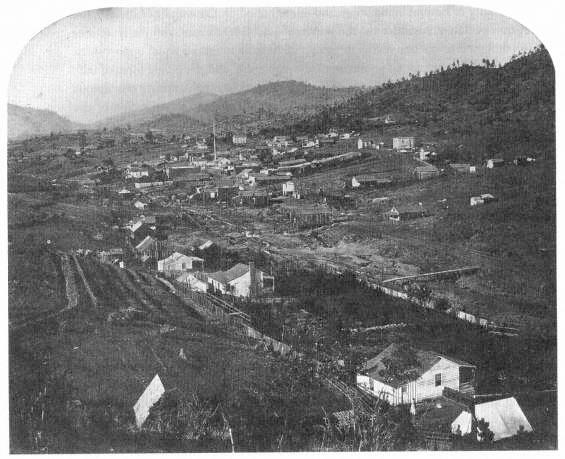
When the photographer Carleton Watkins visited the town of Mariposa in 1859, it had a population
of perhaps five hundred souls, chiefly miners. Though most Argonauts returned home after the most
virulent symptoms of the gold fever had passed, some stayed on—sojourners become settlers—and
contributed to the growth of stable communities in the Mother Lode country. In the distance, left of
center , outlined against the chaparral-clad hills is the Greek Revival county courthouse constructed
in 1854. Still in use today, it is the oldest in the state. California Historical Society, FN-24676 .
a highly transient population. The discovery of the Comstock Lode in western Nevada at the end of the 1850s, and mining strikes in other parts of the West during the Civil War, depopulated large parts of California. John S. Hittell, one of California's most prominent writers in the 1860s, suggested that the state's future depended on the sale of mineral lands. "Ownership makes the people permanent," he observed, "and induces men to get wives and comfortable homes; and permanence and the possession of families and homes make them temperate, economical, industrious and careful of their reputations. Without homes, families and permanent
residence, they must be intemperate, idle, wasteful of their money, regardless of their reputations, and without hope of improvement in the future. This is unfortunately the condition of many of the miners of California at the present time." If the mineral lands were sold, Hittell reasoned, California would attract permanent set-tiers, not vagabonds. Its institutions of government would become more stable, and its wealth would be systematically and efficiently developed. Moreover, until the mineral lands passed into private ownership, California agriculture—the state's true hope for future growth—would languish.[44]
Most miners did not agree with Hittell, but the attitudes and values of the mining camp had a profound effect on agriculture. During the 1850s, the state's best arable land was contained in large Mexican grants. It took a special commission and the courts many years to confirm or deny those grants. Meanwhile, state law favored mining over farming. "The Legislature of our State in the wise exercise of its discretion has seen proper to foster and protect the mining interest as paramount to all others," the California Supreme Court observed in 1855.[45] The logical place to create farms was near markets, and the mining camps provided the largest markets outside the state's cities. Yet a long-established principle of American land law held that preemption did not apply to mineral lands. Those "farmers" who staked out 160-acre farms on government land within the mineral districts were often suspected of using preemption to secure larger mineral claims. Miners routinely invaded farms and destroyed crops, and initially the law required no indemnification.[46]
The extent to which agriculture in the Sacramento Valley was structured by the dominance of free mining is uncertain. Until the court decision against hydraulic mining in 1884, the state's laws did more to encourage the rapid exploitation of mineral wealth than the sustained exploitation of farmland. Not surprisingly, the type of agriculture that grew up closest to the mines was wheat, rather than fruit, nuts, or vegetables—all of which required skill, labor, and a commitment to the land.
Long before Frank Norris published The Octopus (1901)—which characterized wheat farming as another form of mining—California agriculture had taken on a distinctively speculative appearance. In 1872, the Overland Monthly published an article that compared farming in California and the rest of the nation. In the Golden State, it found, farmers did not work their land steadily; most simply sowed and reaped wheat. They seldom planted trees, leaving their farms with a desolate look. With the exception of wheat and pork, everything eaten on these farms was imported, often from outside California; there were no gardens. No quarters were built for farm laborers, and villages were rare; indeed, many wheat farmers lived in the city and had little or no association with the land. These agriculturalists made no effort to diversify crops and raise rice, oranges, and grapes—which would have permitted them to use the land more intensively and live on it all year around. The article did
not mention that free mining had conditioned Californians to look at all land solely in terms of quick wealth. The same lack of attachment to place, the same lack of community, the same shortsightedness, and the same obsession with profit characterized both mining and agriculture, at least until horticulture gained in popularity during the 1870s and 1880s. The family farm never had a chance in California, and the persistent legal and cultural power of the mining industry helps explain why.[47]
Free mining also had a profound effect on California politics. California was a huge state that would have been difficult to govern under any circumstances. But the dominance of mining exacerbated sectional tensions. Conflicts erupted between northern and southern California, between mining and agricultural counties, and between San Francisco—where much of the capital for mining was raised—and flood-prone interior communities, such as Sacramento and Marysville, along the state's major rivers. In the United States, a fundamental constitutional principle was that those who paid taxes should share the burden and benefits equally. But ranchers and farmers in the southern counties—where most land was privately owned—paid relatively heavy taxes while residents of the mining districts paid little. The mining counties had the strongest representation in the state legislature while the counties dominated by agriculture and grazing paid most of the bills—such as the cost of maintaining a judicial system concerned mainly with conflicts over mineral claims.
In 1852 and 1853, the legislature debated the creation of a new state from southern California. In 1859, it actually approved division, and residents of Los Angeles, San Bernardino, San Diego, Santa Barbara, San Luis Obispo, and Tulare counties ratified that decision by a three-to-one margin. Congress refused to ratify the plebiscite, however, and the Civil War made the decision a dead letter. Still, for decades after the golden years of the mining industry had passed, the mining counties enjoyed disproportionate power in the legislature. For example, the 1880 legislature imposed a statewide tax to build restraining dams to capture hydraulic mining debris that washed down into the Sacramento Valley. Southern California claimed that this was yet another scheme to transfer the tax burden from mining to ranching and agriculture.[48]
Even more important, the Gold Rush and free mining strengthened the assumption that nature existed solely for profit. Never had the land been used so ruthlessly, with so little heed of tomorrow. As one observer of hydraulic mining in Montana wrote in 1881, "hydraulic, or even sluice mining is not an aesthetic pursuit; the regions where it is practised may be, before the miner's advent, like the garden of the Lord for beauty; but after his work is completed, they bear no resemblance to anything, except the chaos which greeted the eye of the seer at the dawn of the Mosaic record of the rehabilitation of the earth for the use of man. . . . It is impossible to conceive of anything more desolate, more utterly forbidding, than a region which has been subjected to this hydraulic mining treatment." Historian Duane Smith has written
that "all this development did not take place without disturbance—environmental, personal, economic, political, and social. Mining left behind gutted mountains, dredged-out streams, despoiled vegetation, open pits, polluted creeks, barren hillsides and meadows, a littered landscape, abandoned camps, and burned-out miners and the entrepreneurs who came to mine the miners." Only direct injuries to property owners restrained mining. The contamination of water supplies and destruction of fisheries attracted little attention. Free mining produced great wealth, but it came at a high price.[49]