
Chapter Twenty-five—
North Coast Salmon and Steelhead and Their Habitat (2)
Scott Downie
During the early 1970s northern Californians became aware that their salmon and steelhead stocks were in jeopardy. At this time the legislature's first Citizen's Advisory Committee on Salmon and Steelhead produced three reports that publicly and graphically documented the depressed status of the fishery. Many policy recommendations and legislative actions resulted from those investigations and reports.
On the North Coast they spurred a fledgling interest in trying to do something tangible to revive, or at least stabilize, the dwindling salmonid populations. In Fort Bragg, the Salmon Restoration Association, made up of salmon trollers, sportfishermen, timber interests, and local community members, instituted a program to deal directly with local restoration problems that were underfunded by the legislature and the Department of Fish and Game. They founded the annual "World's Largest Salmon Barbecue" to generate cash to augment volunteer and in-kind restoration efforts. The association and its barbecue continue to this day.
The program has grown from relatively small-scale fry rearing and egg hatchbox ventures on selected coastal streams to the current operation that includes the Hollow Tree Creek egg-taking station on that South Fork Eel River tributary. It now produces up to two hundred thousand smolts annually for the Eel River system. Early citizen efforts also emerged in Ukiah and Eureka and along
the Mattole River, among others, at about this time. All were responding to what was perceived as an overwhelming and critical situation for both depressed fish stocks and a Fish and Game Department short of manpower and funds.
By 1982 a new alliance had developed to try to save North Coast fisheries. With guidance and supervision from the department, private fishery contractors became actively engaged in salmon and steelhead restoration projects throughout northern California. The legislature designated specific funds to support these largely volunteer programs. The commercial salmon trollers self-imposed a landing tax (the Salmon Stamp Program) that has generated up to $1.25 million annually to operate or augment salmon enhancement programs.
In 1983 at Bodega Bay a conference of interested citizens, representatives of public agencies, and salmon restoration workers led to formation of the California Salmon, Steelhead, and Trout Restoration Federation. The federation has since become a major source of energy and expansion for regional fishery improvement programs. Projects now exist in nearly every watershed in northern California. This growth has occurred largely due to cooperation and training from a Department of Fish and Game that increasingly recognizes the power and potential of a citizenry involved actively in constructive watershed and land use management. For example, in watersheds checkered with both public and private ownership, and therefore often varying management priorities, cooperative resource management programs are needed to achieve wise watershed management. These CRMP programs are now becoming more common and can deal with the cumulative effects of overall watershed land use.
The various projects, whether conducted by private groups, landowners, or public agencies, are still hard pressed to meet the decline experienced by the fisheries. Their efforts usually take form in three general techniques: artificial propagation, habitat restoration, and educational programs. The first, hatchery production, is commonly viewed as a panacea or quick fix. Results are often dramatic and highly visible: large numbers of fish are released into streams where natural populations long ago disappeared. We have learned, however, that unless the underlying factors responsible for the absence of stocks in a watershed are also dealt with, we are merely engaging
in an artificial "put-and-take" fishery program that cannot endure over time. On the North Coast, coordinated habitat improvement programs can usually be designed in conjunction with bioenhancement schemes, ideally using surviving natural stocks as a brood-stock. This approach ensures that the increased populations will have a good chance to establish themselves as a self-perpetuating run. Some current projects have demonstrated the validity of this approach.
These coordinated habitat programs are conducted in many forms. For example, many streams are devoid of habitat diversity: two few pools, "cemented" spawning riffles, and a general dearth of streamside vegetation and large instream structural elements. These instream logs and boulders are particularly important to provide shade and cool water, create pools, and supply protection from predators. Typical techniques for treating these habitat problems include riparian planting, streambank stabilization, and direct placement of boulders or log weirs. In addition to the many completed projects, an important outcome of these activities has been to increase the ability of citizen restoration teams to diagnose and treat habitat problems throughout watersheds.
Upper slope erosion and drainage control problems are also critical to the streams and their fish populations. These areas often require the cooperation of many basin landowners and land users. Here again revegetation is a powerful treatment. But usually on the North Coast, road systems with their associated drainage systems serve to intensify, accelerate, and concentrate runoff during freshets. Therefore, they often must be modified to achieve meaningful soil conservation. A related and growing problem, as human population increases, is domestic and agricultural water consumption. More and more straws are constantly being thrust into regional watersheds that seem to have ever dwindling storage capabilities. Education in wiser land and water usage is required to address these concerns.
Public and formal environmental education is increasingly focusing on our local North Coast salmon and steelhead situation. These fish are the sensitive barometers of a watershed's health and demonstrate to us major potential problems that can affect people as well as fish and wildlife. In some areas, for example, creeks that formerly had strong year-round flows and fish in them have been
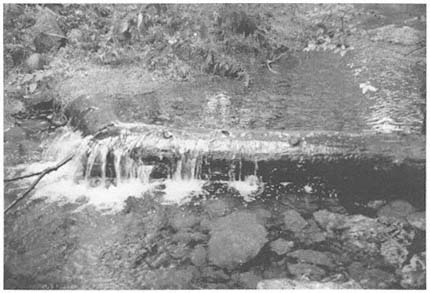
Small structure, big effect. Headwater stream restoration by artificial
placement of stone or log deflectors adds oxygen to the water and provides
protective rearing habitat for juvenile salmonids. Thousands of such
structures are being built on California river tributaries.
(Andy Kier)
reduced to low and intermittent streams during the past twenty-five years because of poor basin conditions. For many years they have been unable to support summering coho salmon or juvenile steelhead.
Despite shrinking water resources, signaled by vanishing fish stocks, basins have been subdivided, developed, and populated without concern for fish and wildlife needs. Increasingly people are being affected: hauling water to homesteaders in these tapped-out basins is now a flourishing summer business.
Although the technology, and to a large degree the will, now exist to reverse the demise of the North Coast's salmonids, the task has only begun and the opposing forces are very active. Land subdivision and poor road construction abound. Competition for water increases daily in the name of progress. The day of conifer forests composed of large second-growth or old-growth trees, vital to the stability of the steep mountainous terrain of northern Califor-
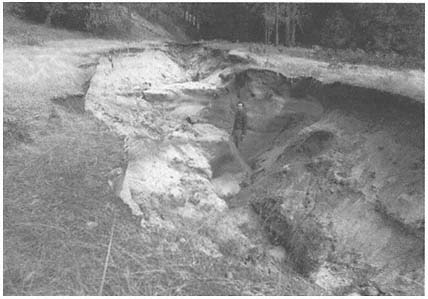
Gullying is unmitigated waste. Loss of highly erodible soil in the Trinity
River watershed destroys usable land and chokes salmon
spawning habitat with blankets of silt.
(Bureau of Reclamation)
nia, is probably gone forever: a sacrifice to short-term, intensive forestry practices intended to maximize immediate profit. Although modern timber harvest practices incorporate vastly improved and far less destructive technology than in the "bad old days," the timber industry in general demonstrates little interest in repairing the fisheries devastated by its first cut. That first cut, made years ago, is still physically harming our fish and streams, along with its legacy of marginal timber production at the expense of natural and healthy fish production.
Given a chance, these fish have proved to be hardy and "renewable" natural resources on a much faster turnaround than timber. Ironically, timber and fish production are both dependent on healthy environmental conditions that are complementary rather than at odds: good water and good soil, both in their correct and natural places, ensure good survival and production of trees and fish. Neither can exist in the long term by relying on hatchery
clones or nursery hybrids to compensate for loss of soil, water, or crucial vegetative cover.
On one affected North Coast stream, the East Branch of the South Fork Eel, Edith Thomas's grandson operates a downstream migrant trap to compare its relative salmon and steelhead populations with similar streams in southern Humboldt County. From mid-April to mid-May 1988 he caught a total of only thirteen chinook fry, one coho fry, and nine newly emerged steelhead. (On control streams, overnight numbers trapped at that time were typically in the hundreds or thousands.) The East Branch, with twenty-seven miles of streambed, is the largest tributary of the South Fork. It is also one of the most severely impacted: by late May water temperatures are lethal to salmonids, and by July the stream is essentially dewatered.
These are the conditions that exist now—sixty years and one mile from where Edith Thomas exulted in her triumph over Elmer Hurlbutt after she had successfully enticed an eighteen-inch mid-summer rainbow to accept her hand-tied grub larva fly. When you understand that, you will begin to comprehend the magnitude of what has been lost on the North Coast.