
8
The Authorities Respond
A protest by its very nature forces a response, even if initially that response is, in effect, a nonresponse. If despite the authorities' best first efforts the protest escalates, the pressure builds for them to reach into their own "bag of tricks"—the collected methods, shaped by history and culture, that are available in any particular setting to counter a protest groups' repertoire of collective action. To talk of authorities "choosing" or "devising" strategies, of course, ignores the complexity of people's motives and means for doing what they do. Machiavelli emerges from his work of long ago as the ultimate strategist, concocting schemes (now considered timeless) for turning situations to the advantage of his Prince—in short, for staying on top. Yet as Charles Tilly and others have shown, and as Machiavelli would undoubtedly have agreed, the arsenal of methods available to protesters is culturally bounded.[1] The same holds with respect to the authorities: they have room to choose, to maneuver, but the range of responses is not open-ended. Indeed, much conflict behavior is "unconscious," the impulse behind it coming to the individual spontaneously as the situation warrants. The driver whose way is suddenly blocked at an intersection, for example, may direct an obscene gesture at the obstacle "without thinking." But this seemingly "natural" response is culturally shaped—Italians might make one gesture, Americans another, whereas Japanese, who are not culturally cued to respond to that particular situation in that way, simply will not
[1] Tilly, "Repertoires of Contention"; K. M. Jamieson, "Generic Constraints and the Rhetorical Situation," Philosophy and Rhetoric 6 (1973): 162–170; and K. M. Jamieson, "Antecedent Genre as Rhetorical Constraint," Quarterly Journal of Speech 61(1975): 406–415.
think of gesturing at all. In Japan, then, authorities faced with a conflict choose methods of social control, whether consciously or unconsciously, from a circumscribed array of available resources.
The methods themselves may be spontaneous or studied, direct or indirect, formal or informal, "soft" or "hard."[2] Responses to a conflict range from the flicker of an eyebrow to a declaration of war, depending on who is mounting the challenge, who the responding authority is, and the circumstances. David H. Bayley, writing about India, holds that the "role of protest, and by extension its effects, must be understood in terms of the requirements, structures, and habits of particular systems." The same may be said of the methods of social control used by authorities. Bayley argues that in India, where at the time of his research three-fifths of the police were armed and living in barracks rather than mingling among the public as civil constables, coercion is a major mechanism for maintaining social order.[3] In this regard, however, postwar Japan has seen a dramatic reversal, for today coercive methods are used infrequently as compared to the past and, in fact, as compared to many other industrial democracies. For our purposes, coercive control may be defined as the opposite of social control. Whereas coercive control—the legitimate use of which resides largely with formal authority figures (public officials, the police, the military)—involves the threat or use of force, social control consists of all non-coercive methods, from subtle persuasion and manipulation to the use of legal mechanisms, and is used routinely by authorities at all levels, from public officials to superiors in social relations.[4]
The chief determinants of the particular mechanisms of social control available in a given culture are to be found in established patterns of social relations, whether between individuals, within groups and organizations, between organizations, or in larger contexts such as structured socioeconomic relations between class or status groups.[5] Likewise, the methods used vary from situation to situation. An adult male, for example, may use one method to dissuade his adored aging mother from pursuing what he
[2] On the concept of "soft" methods of social control in the Japanese context, see Jeffrey Broadbent, "Environmental Movements in Japan: Citizen Versus State Mobilization," paper presented at the annual meeting of the American Sociological Association, 1983.
[3] David H. Bayley, "Public Protest and the Political Process in India," in Protest, Reform, and Revolt, ed. Joseph R. Gusfield (New York: John Wiley, 1970), 306–308; quote p. 308.
[4] Janowitz, "Sociological Theory and Social Control," esp. 84–87.
[5] Zald and McCarthy, Dynamics of Social Movements, 238–241.
| ||||
sees as an undesirable course of action, and quite another to rein in a whining and rebellious child. In both cases he is exercising power, but the social structural nature of the relationship itself finally dictates which methods from a range of acceptable options will be used.
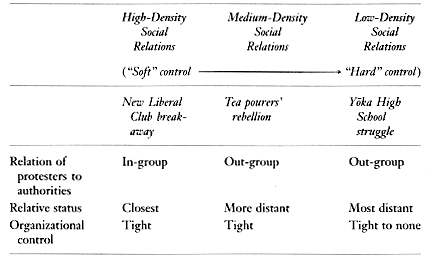
In status-based protests in Japan, the exercise of social control appears to be guided by three central factors (see table 7). First is the social rank of the protesters relative to the authorities in question, ranging from similar to distant. The second factor, one crucial in considering conflicts in daily life, is the degree of intimacy that obtains between the two sides. In Japanese bureaucratic or organizational contexts this may be judged by the protesters' standing as "in-group" (uchi ) or "out-group" (soto )—that is, by their relations with the primary face-to-face groups (the faction, the work group) to which the authorities belong.[6] The third factor is the extent of organizational, bureaucratic, or other structural control that the authorities exercise over the protesters, which can range from strong to none. In general, if social relations are "dense" (the protesters and authorities are close in rank, the protesters are in-group, and organizational control is
[6] See Takeshi Ishida, "Conflict and Its Accommodation: Omote-Ura and Uchi-Soto Relations," in Conflict in Japan, ed. Ellis S. Krauss, Thomas P. Rohlen, and Patricia G. Steinhoff, 16–38 (Honolulu: University of Hawaii Press, 1984).
strong), the full range of methods of social control may be brought into play; nevertheless, "soft" backstage methods (such as persuasion and psychological pressure), which traditionally prove quite effective in such relationships, are likely to figure prominently.[7] Conversely, if social relations are not dense, authorities will tend to select "harder" rather than softer methods of social control.[8]
These factors allow our three cases of status-based conflict to be lined up along a continuum. The densest social relations between the dissidents and the authority figures can be found in the case of the New Liberal Club breakaway, where both groups belonged to a single political party—and the ruling party at that. The least dense relations were to be found in the Yoka High School incident, where no organizational context or bonds of affiliation bound the Buraku Liberation League members and the teachers together.[9] As for the tea pourers, as "permanent" office employees they were nominally in-group, but as women they were treated so differently from their male peers that, practically speaking, their status was marginal relative to the male-dominated core in-group.
When social relations are dense, the authority exercised by status superiors is more complete and initial constraints on the emergence of conflict more powerful. Once a conflict begins to surface, however, a full range of methods of social control present themselves, from subtle "soft" methods to overt pressure. Where social relationships are least dense, as in the Yoka case, the resources available to status superiors are fewer and the range of acceptable "hard" methods—stonewalling, direct verbal insults, physical confrontation, and so on—narrower. In an important way, dense social relations guarantee a bridge between the two parties in a conflict, over which may pass a wide array of weapons to be used in the struggle for social control. But where no pattern of social relations binds the two opposing sides, a great many forms of social control, especially those of the "soft" variety, simply will not work.
[7] The existence of works such as Masaaki Imai, Never Take Yes for an Answer: An Inside Look at Japanese Business for Foreign Businessmen (Tokyo: Simul Press, 1975), suggest the extensiveness of the Japanese inventory of soft, indirect methods for registering negative reactions.
[8] See Broadbent, "Environmental Movements"; and Ishida, "Conflict and Its Accommodation."
[9] In the case of the Yoka struggle, league-affiliated students were, of course, tied to teachers by a social relationship, but the league itself, which the teachers saw as their real adversary in the conflict, was neither under the teachers' authority nor bound to them in a preexisting social relationship.
The Japanese Formula
The Japanese "formula" for handling status-based protest is suggested below:
Goals
• conflict containment
• isolation of protesters
• marginalization of the protest
Early Stages
• conflict avoidance
• making of minor concessions when avoidance fails
• use of soft, backstage methods of social control
Escalation
In the presence of dense social relations:
• use of soft, backstage methods of social control
When indirect methods fail, or in the absence of dense social relations:
• stonewalling
• undercutting
• baiting
Termination Stage
• delay
• preemptive concessions to head off future protests
In Japan, the first response of authorities is generally conflict avoidance behavior, which may be followed by minor concession-making. As the conflict progresses, especially when social relations between authorities and protesters are dense, soft, backstage methods centering on persuasion come into play. With particularly dense social relations, soft efforts will continue even after escalation has occurred, but often with increased reliance on go-betweens as relations between the two groups grow more strained. Because the countermobilization process tends naturally to distance authorities from protesters and to harden the lines of the struggle, however, if these tactics fail to produce the desired results, other "harder" methods may be used, such as stonewalling, undercutting, and baiting. The major goals underlying these hard strategies, if we are to judge by their effects, involve isolating the protesters from the resources that would
increase their chances of success, thus marginalizing them, and containing the conflict, even if containment means assigning a lower priority to many other goals (such as appearing responsive) that authorities may value. Unless they are under time pressure of some kind, authorities may be quite prepared to wait out a conflict rather than force a termination that might involve major concessions. To the extent that they do address the social problems that gave rise to the protest, a pattern of preemptive concessions aimed at heading off future conflicts is the typical response.
While strategies that make up this "Japanese formula" for social conflict management are certainly not unique to Japan, they do seem to be heavily relied on and to work especially well in that country. In fact, an examination of a wide range of social, economic, and political disputes in Japan suggests that these strategies and tactics are not used only in status-based protests, or even just in social protests more generally. Rather, they crop up in numerous and diverse conflict situations, ranging from protests over environmental pollution to U.S.-Japanese trade negotiations. Obviously, if a conflict is easily contained early on or authorities are fully prepared to make concessions, there is no need to bring the full arsenal into play; but when a dispute proves intractable and steadily escalates, the combined strategies and tactics of the "Japanese formula" provide a rich array of possibilities for its resolution.
Protests over equality issues often place on view the full contents of Japanese authorities' "bag of tricks," for in these conflicts major concessions are generally granted only with the greatest reluctance. The reasons are many: the protesters' demands involve assertions of self and rights that fly in the face of the "ideal model of protest" and thus evoke little sympathy from social superiors; the ideology guiding the protests, despite its "official" status, involves "Western" democratic values that are not fully accepted; and, quite fundamentally, status-based protests constitute an outright challenge to the basic terms of social relationships in Japanese life. Thus, the uppermost objective is to contain these protests using all available means, a situation that causes a full battery of conflict management methods to be brought into play—ultimately with considerable success, if the cases of status-based protest examined here are any guide. Certainly, the authorities' score in handling even these "worst-case" protests helps to explain, at least in part, why the overall level of conflict in Japan has remained more manageable than in most other advanced industrial nations.
One point of clarification is in order. In discussing the "success" of the Japanese formula, the perspective in this chapter, as hinted at earlier, is Machiavellian. Judgment on moral rights and wrongs is suspended; instead, the analysis here looks simply at how elites deal with protest, with
other perspectives on success being left for the chapters that follow. With that caveat, let us now explore each of the major strategies of conflict management.
The Early Stages
Avoidance Behavior
The most common Japanese response to an emerging conflict takes the form of avoidance behavior. Obviously, it is not unusual for a targeted group to engage in avoidance behavior, no matter where the protest is staged. Yet in Japan, from among the array of possible responses to early signs of trouble—which can range from admonition to active intervention to actual repression—avoidance is resorted to with great frequency. One book called Never Take Yes for an Answer posits at least sixteen ways of saying no without actually speaking the word—a telling reminder of how prevalent conflict avoidance behavior is in the general culture.[10] Indeed, the lengths to which Japanese will go to avoid facing or talking directly about an unpleasant situation can be extraordinary. Even when Japan's major cities lay in ruins at the end of a war in which three million Japanese died, the late Emperor Hirohito, in his famous radio broadcast that ended the war, would say only that the war had "developed not necessarily to Japan's advantage."[11] The dominance of this mode of response is readily comprehensible in light of the political culture surrounding protest, with its emphasis on social harmony. In essence, given the negative connotations attached to conflict, a status superior may lose face simply because a conflict surfaces. As Goffman has noted in his writings on "face-work," the "surest way for a person to prevent threats to his face is to avoid contacts in which these threats are likely to occur." Goffman's use of "face" corresponds to the Japanese use: "the positive social value a person effectively claims for himself . . . an image of self delineated in terms of approved social attributes."[12]
The earliest stages of both the tea pourers' rebellion and the New Liberal Club breakaway were characterized by long delays as status superiors avoided responding to the protesters. In the first case, because the women civil servants had been meeting for over a year to discuss their problems, their superiors were aware that something was wrong; and yet nothing was done to engage the women in a dialogue over their grievances. Similarly,
[10] Imai, Never Take Yes for an Answer .
[11] Cited in the Washington Post, 3 September 1984.
[12] Goffman, Interaction Ritual, 15, 5.
in the case of Kono and his group, the LDP party seniors evidently never attempted to address the junior men's concerns about party decision-making practices directly.
The case of the Yoka struggle is even clearer, because there the lines of conflict were apparent from the outset owing not only to the league's educational campaign regionally but also to its extensive use of denunciation sessions elsewhere. Administrators and faculty at Yoka High could have had little doubt that the school would be the target of the league's education campaign; nevertheless, they were totally unprepared and uncoordinated when in May 1974 a league-organized study group was requested. In this case conflict avoidance behavior extended beyond the immediate situation with the league to include relations within the school itself, for with teachers and administrators sitting on different sides of an ideological fence (because of respective ties to a JCP-affiliated union and a JSP-led local administration), any attempt to develop a school position would itself have been conflictual. Thus, when the request came, the principal and vice principal, without consulting the faculty, went ahead and approved the idea. When the teachers failed to back this decision, however, the administrators simply reversed their position and denied the request. Finally, after the initial period of vacillation, a long period of avoidance behavior followed: over the summer prior to the ultimate confrontation in November, the students repeatedly sought meetings with school representatives to discuss the matter, but their requests were met with excuses and evasions.
Minor Concessions
Together with avoidance behavior, however, may come modest concessions. Both strategies are seen as ways of keeping the level of conflict down, either by ignoring it and hoping it will go away or by attempting to head it off indirectly. Noticeably, the one strategy that is missing in all three of our cases is that of open discussion between the protesters and the targets of their protests in an attempt to dispel the mounting bad feeling. Whereas in American culture such expressions as "clearing the air," "laying the cards out on the table," and "seeing where we all stand" suggest a view of conflict in which open discussion has positive functions and an airing of differing views can provide a basis for moving forward, this is not the view of conflict in Japan. There, conflict is seen as painful, unpleasant, and almost invariably undesirable.
The concessions that are made, however, can be quite modest. In the early to mid 1970s, for example, the Liberal Democratic party was under regular attack from the media, the public, and many junior members over its handling of the Lockheed scandal and the tight control exercised by the
senior leadership over internal party matters. At that stage (as evidenced by the "Shiina decision," by which a few party elders put Miki in power in 1974), the party's senior leaders were determined to keep tight control over how decisions were made. Their only major concession may have been to tolerate the emergence in the early 1970s of numerous intraparty clubs or study groups composed of junior men. These clubs offered juniors a way to distance themselves from a party coming under mounting criticism in the wake of the Lockheed scandal and, in the case of Kono's group, to call for party reform. In effect, the study groups provided junior members an outlet for self-expression even while decision making regarding the corruption issue and other internal matters remained firmly under the control of senior men. In the case of the tea pourers' rebellion, agreeing to the women's first two requests (for a changing room and for revised leave requirements) may also be seen as minor concessions. In effect, neither response represented any attempt to deal with or initiate a dialogue on the broader issues underlying the women's requests or the party juniors' concerns.
In the Yoka struggle, because the lines between the protesters and the teachers were drawn from the outset, nothing would have been gained from concessions. Here, however, the "density" of social relations has a definite bearing on the hard line the teachers took. Where social relations are close and the authority exercised by seniors extensive, the full range of conflict behavior comes into play as seniors strive to preserve the existing relationship. The participants in the Yoka High School struggle, in contrast, had few ties with each other, other than through the small number of league-affiliated students involved in the protest. Thus, the incentives for concessions were few.
"Soft" Backstage Methods of Social Control
Authorities' final response in the early stages of conflict includes various "soft" backstage methods by which they seek either to persuade protesters to end the conflict or to explain their own position in it. These methods range from direct persuasion, both forceful and mild, to far more subtle verbal and nonverbal approaches that put psychological pressure on the protesters to desist. Such techniques play on the social power that authorities exercise over subordinates, reminding inferiors of their prerogatives; in that sense, they mirror the protesters' own strategy of failing to display expected behavior.
Direct persuasion appears most frequently in the case of the New Liberal Club breakaway—as would be expected, given the dense social relations of party politics. In interviews, both LDP and NLC members
were quite open in saying that the factions had applied much informal pressure to the Kono group in an attempt to deter the breakaway. When Kono was launching his plan to run for party president, for example, although Nakasone's message (as reported by sources sympathetic to Kono; see chapter 7) was complimentary and solicitous, it also bore pointed warnings: "I expect you to behave prudently and to cooperate. . . . You ought to take care of yourself." Whereas Nakasone's tone, remarks, and unsolicited advice assert his status as superior quite clearly, Kono's response was in essence to renounce the older man's authority over him by stating that he would "consult with friends" about what to do.
The astonishing effectiveness of soft methods of social control may be seen clearly in the tea pourers' rebellion, even after the conflict had escalated and the protest was in full swing. According to Makino, when the women stopped pouring tea the men in the office "didn't say anything," "didn't do anything"—and yet before long several women were pouring and carrying tea to the men as before. What occurred was a type of psychological warfare in which the men, through nonverbal behavior embodied in expressions of anger and of pain and hurt, both made it clear that the women had failed to live up to expectations and communicated their sense of loss at being denied an expected service. Had the superiors acted overbearing and demanded that the women return to their duties, the conflict would likely have escalated yet further.
The response of university faculty to student activists in the 1960s provides another example. In mass negotiation sessions, as noted earlier, students often engaged in role-reversal behavior by adopting the manner of overbearing, arrogant superiors; the targeted faculty in turn responded with expressions of hurt, passivity, and resignation.[13] By using polite language in the face of insulting language they in effect maintained their authority, but by behaving passively as victims they—like angry parents who grow painfully quiet when met with criticism from their children—point up the tragically regrettable, inappropriate, and wrongful nature of the behavior to which they have been subjected. Such exchanges constitute yet another round in the battle over who is to be the victim (see chapter 7). The students assert their claim by expressing outrage at the way they, the weaker party, have been treated and call on seniors to feel "grossly guilty of complacency" for failing to meet their needs.[14] The professors reciprocate by turning the tables, charging the students with lack of respect and claiming the victim role for themselves.
[13] T. Lebra, Japanese Patterns of Behavior, 76; and Doi, "Higaisha-ishiki," 450–457.
[14] Doi, "Higaisha-ishiki," 452.
It is important to recognize the complexity of what, on the surface, might seem to be merely manipulative behavior on the part of status superiors. When protesters use conflict strategies that challenge the terms of status relations, many superiors probably do see themselves as victims, for by withholding deference behavior the dissenter denies a form of gratification that the senior has come to expect. As Goffman puts it, when "a putative recipient fails to receive anticipated acts of deference, or when an actor makes clear that he is giving homage with bad grace, the recipient may feel that the state of affairs which he has been taking for granted has become unstable." In Goffman's terms, such violations disturb "face," that "image of self delineated in terms of approved social attributes."[15] In other words, such strategies work.
Doi argues that in relationships based on amae, or dependency ties, the persons on the receiving end suffer when their dependency needs are not met. By the same token, however, the givers' egos may suffer when the terms of the relationship are in disrepair. The parental response in the face of a child's defiance or disobedience—"After all I've done for you!"—captures in kind, if not necessarily degree, the pain, bitterness, and anger that can result when the terms of a relationship based on hierarchy and dependency are violated by those at the bottom. Doi has gone so far as to argue that superiors may experience a feeling close to paranoia when something goes amiss in a dependency relationship.[16] Their self-perception as the victims of protests may arise as well from the fact that conflict in Japan tends to discredit all those it touches. Thus, even those superiors who do not suffer "ego chill" or other psychological whiplash as the targets of a status-based protest are likely to experience a certain threat to "face" because the protest, simply by embroiling them in a conflict, has led to humiliation in the eyes of their peers, their own superiors, and other observers.
Counterattack for the Conquest of Ideas and Symbols
When superiors assert their prerogatives through backstage maneuvering, they are also engaged in ideological warfare, for by reasserting the traditional ideology of status relations they are effectively challenging the protesters' use, whether explicitly or implicitly, of the ideology of equality and
[15] Goffman, Interaction Ritual, 61, 5.
[16] See Doi's discussion of the paranoid reaction as provoked by the frustration of dependency wishes, which, he makes clear, can occur in either the superior or inferior, depending on whose dependency needs are not being met; Doi, "Higaisha-ishiki," 454–455.
democracy. Yet superiors may use these same egalitarian and democratic principles in their own defense as well. In the earliest stages of the tea pourers' rebellion, it may be recalled, the women's complaints that tea-serving duties kept them from their "official" duties were met with the reminder that Japan was a democracy and that women must accept equal responsibilities in exchange for their rights; since tea-serving duties were not official, they should not interfere with women's taking up their fair share of the normal workload. Similarly, in the Yoka struggle it was not uncommon for teachers to use democratic ideology in an effort to strengthen their position vis-à-vis the league-affiliated students. For example, in one explanation for their denial of a burakumin study group the teachers stated that such a group, if approved, "would step outside the basic democratic rules" of the school—to which the league responded: "They [the teachers] have no right to talk about democracy, since they are fascists."[17] These uses on both sides of democratic principles as weapons suggest the great cultural power of this ideology, despite disagreement over how such principles should apply in practice in superior-inferior social relations.
Countermobilization
Faced with a conflict that will not go away, even with modest concessions and soft methods of social control being brought into play, authorities must mobilize their own resources if they are to be in a position to respond as the conflict escalates. In cases where the authority in question routinely deals with such challenges—such as those involving the police, local government in areas where social unrest is common, upper management in heavily unionized industries, and university administrations—this effort may involve no more than activating an existing structure to address a new round of conflict. In many contexts of daily life, however, the authority figures who become the targets of a protest may be relatively unprepared, both organizationally and strategically, to respond, and in these cases countermobilization often requires substantial effort.
In conflicts occurring in organizational contexts, however, even authorities who are caught by surprise operate from a position of strength, for they have an impressive range of resources at their disposal, including bu-
[17] "Yoka Koko no konran no genkyo wa Nikkyo sabetsusha shudan Miyamoto ippa da!" Sayama Sabetsu Saiban 14 (September 1974): 7, 8. By their statement the teachers meant that the proponents of the study group would not abide by school rules for putting up posters and so on. The handbill in which this explanation was printed represented a bid for the support of majority students in the school.
reaucratic authority over the protesters, command of organizational facilities and staff, access to information, and, in most cases, links to higher tiers of authority, both public and private. It is thus generally much easier for authorities to countermobilize than for protesters to mobilize. Nevertheless, the two endeavors use many of the same techniques, including solidarity building, alliance forging, and distancing.
Authorities' countermobilization efforts can be best seen in the Yoka struggle. The teachers routinely used faculty meetings to develop their response to the protest; likewise, the various faculty offices in the school served both as informal meeting places and as points of refuge when student protesters accosted teachers in the corridors to press their case. Faculty alliance efforts were directed at one of several command structures of which they were a part: the local and prefectural offices of the teachers' union, of which most were members, and the local, prefectural, and national offices of the Japan Communist party, to which the regional teachers' union was linked. If the teachers had been in accord with the school authorities on how to respond to the league, of course, the conflict would have been played out quite differently. Indeed, in the end the protest group's greatest resource proved to be the links between the league on the one hand and the town's Socialist administration (and through it, the principal and deputy principal) on the other.
Given the alliance possibilities available, the degree of solidarity that the teachers achieved is quite striking. Using facilities of both the school and the local branch of the teachers' union, they were able to distribute handbills to make their positions known. According to the league, the teachers maintained steady contact with the Hyogo prefectural union office, which dispatched an official from a nearby town to meet regularly with the teachers. A delegation from Tokyo that included a representative from the national teachers' union office and JCP Diet member Yasutake Hiroko of the House of Councillors also came to the region at one juncture to provide moral support as the conflict mounted.[18]
Once the conflict began its rapid escalation in November, the teachers were in every sense a team. Although several teachers reportedly had some sympathy for the league's position, or at least seemed to prefer a more accommodationist solution to the problem, they played no open role in the conflict and rejected the league-affiliated students' efforts to enlist them as allies. By the time of the teachers' overnight stay at the hot springs hotel just prior to the confrontation outside the school gates, the teachers were moving as a unit, in a bus provided by the teachers' union. On the day of
[18] Ibid., 12.
the actual clash, they left the school shoulder to shoulder; when confronted by league members gathered outside the gates, they sat down in the street en masse and maintained collective silence, even as the protesters began to try to carry them back into the school by force. Almost four years after the struggle, nine teachers from the school agreed to an interview; their accounts of the events of the Yoka incidents jibed completely. They continued, in other words, to stand as one, at least as far as the leadership core was concerned.
In the other two conflicts, countermobilization on the part of authorities is reflected in the results. Kono's dissent, for example, elicited an orchestrated response from the party's leaders when they sought to persuade members of his group through their respective factions not to mount Kono as a candidate for the party presidency in 1974 and not to leave the party. Similarly, in the tea pourers' rebellion, the non -response of the men in the division ("they didn't say anything, they didn't do anything") when the women failed to serve tea as usual suggests that some type of coordination had occurred, even if only informally.
One remaining feature of countermobilization stands out, and that is distancing. In status politics protests, the involved parties are linked in interactive, asymmetrical relationships involving dependency; thus each side needs somehow to back away as a basis for action. One means for establishing distance is negative labeling. While this device may be used by authorities to denigrate protesters and their motives in the eyes of potential allies and the public, it also serves an internal function in relation to solidarity building: by assigning negative labels to protesters or to their behavior, a relationship that may in the past have been infused with good feeling is drained of its affect and objectified; individual faces merge into a conception of a depersonalized "enemy" that, in the mind's eye of authorities, is charged with negative associations. Just as nineteenth-century European elites often used terms such as mob and rabble to refer to strikers or other protesters, all the targeted authorities in the conflicts discussed here referred to protesters using epithets, which operated in a distancing fashion.
Another method of achieving distance involves the creation of myths. As the Yoka conflict progressed, the teachers often portrayed league-affiliated burakumin students alternately as either hapless pawns of the league or initiates who had been so indoctrinated into the league's views that they were beyond human feeling. Whatever else it accomplishes, the objectification reflected in pejorative labeling and dehumanizing explanations of "the enemy's" behavior brings authorities close together and facilitates their ability to respond. Seemingly in the burakumin protest,
it enabled teachers to walk out of school leaving behind their own hunger-striking students—just as a similar process among the protesters freed the dissident students to call their teachers "assholes" to their face.
One feature in particular of countermobilization in Japan stands out. Considering the strong consensus on basic values that most writers agree characterizes Japan, one would expect authorities to obtain the support of other elites with relative ease as countermobilization proceeded. Such is not necessarily the case, however. Because social harmony is so highly valued and because conflict itself, no matter who is responsible for it, is met generally with such aversion, authorities may find themselves quite isolated, particularly in a moral sense. Even if others in positions of power officially and publicly back status superiors who have been targeted by a protest movement, "backstage" displays of support may not be forthcoming. This is true largely because of the principle of verticality, which traditionally has held superiors responsible for maintaining harmony among those below them. For an authority figure to report dissatisfaction among inferiors to higher-ups is, in many cases, tantamount to admitting failure. Even if the superior is backed to the hilt materially speaking, he may incur various long-term costs by involving higher-ranking persons in the unpleasantness of a conflict.
The lack of support that the teachers received, even from officials in their own union, in the wake of the Yoka struggle—a conflict that they had ostensibly "won"—is one example of this phenomenon. Although the union stood behind them during the struggle itself, afterward leaders among the teachers reported feeling quite isolated and widely criticized within the local community, despite their status as "martyrs." This pattern is also evident in the aftermath of Japan's longest and most volatile postwar conflict, the anti-United States-Japan Mutual Security Treaty struggle of 1960. In the midst of this struggle, leadership circles within both the Liberal Democratic party and the business community gave their full backing to Prime Minister Kishi as he strove to resolve the conflict; yet when the treaty at last went into effect, over the objections of the protesters, and the "danger" (as the authorities viewed it) had passed, Kishi soon found himself ousted as party president, and hence as prime minister.[19]
Given the negative associations that attach to open conflict in Japan, and the intense pressure that is placed on authorities not only to contain protest actions but also to prevent future recurrences, an effective formula for response often proves elusive. The tentativeness or conditionality of
[19] George R. Packard III, Protest in Tokyo (Princeton: Princeton University Press, 1966), 301–304.
moral support from other elites who are outsiders to the conflict helps explain why status superiors so frequently portray themselves as victims in status-based struggles and go on the defensive afterward, despite their seeming victory.
When Conflicts Escalate
Having mobilized their forces, authorities then launch their own conflict strategies, either in retaliation against the moves made by protesters or preemptively. Many of the same strategies that typify the earliest stages enter here as well, but they may be pursued in new ways as the conflict escalates. For one thing, the use of backstage methods of social control intensifies as superiors try to bring inferiors in line. In the LDP conflict, for example, pressure on Kono and his group increased—yet now contact between the two groups was accomplished primarily by means of go-betweens.[20]
Similarly, with escalation the struggle to be the victim continues, even as the situation becomes more confrontational. In denunciation sessions, for example, the targeted authorities typically display humility and, in some cases, exaggerated politeness toward the complainants, since other responses, such as anger or, alternatively, silence, would merely escalate the conflict and thus be at cross-purposes with the goal of containment.[21] Once the conflict is in the open and cannot be denied or simply dismissed, both persuasion and the playing of the victim may be aimed less at the protesters themselves and more at their potential allies and the public: the steady application of pressure makes clear to potential joiners what will happen to them if they take up the protesters' cause. The influence of go-betweens on Kono's group almost certainly had such a discouraging effect, as evidenced by the large number of original members who chose to stay within the ruling party.
At the same time that pressure is applied to the dissidents, moreover, selective rewards may be granted to vacillating potential allies of the protesters. The career success of Fujinami Takao, a close associate of Kono who decided on the eve of the breakaway to remain in the LDP, suggests that backstage methods may have included overt incentives to stay, or at least indirect reassurances that protesters would not be negatively sanctioned if they chose not to defect.[22]
Finally, in all countries authorities' behavior in conflict situations (much
[20] Tagawa Seiichi, Dokyumento Jimin datto (Tokyo: Tokuma Shoten, 1983).
[21] Doi, "Higaisha-ishiki."
[22] Fujinami was appointed minister of labor in November 1979 when he was forty-six years old and in his fifth term. Since then he has served as deputy chief cabinet secretary (November 1982) and chief cabinet secretary (December 1983) and is considered to be a leading candidate to take over the Nakasone faction.
as in meting out punishment for crimes) may be aimed at the public as much as at the protesters proper.[23] But this is especially true of Japan. There, the concern of authorities is not only with the deterrence of future opposition, but also with absolving themselves of any responsibility for the unpleasant state of affairs represented by a conflict.
Stonewalling
When conflicts escalate, the lines become more rigid. One important "hard" method of social control that appears at this juncture is stonewalling: avoidance behavior that persists after the conflict has become manifest and after the terms of the protesters' demands have become known—in short, an across-the-board refusal to yield. In the Yoka struggle, for example, early faculty rejection of a meeting to discuss a burakumin study group took the form of excuses and evasions; by the fall, however, equivocation had given way to point-blank refusals.
Stonewalling as a strategy has various consequences. Almost certainly it forecloses the possibility of opening a dialogue that might lead to resolution. In the Yoka struggle, by declining to negotiate the teachers signaled a point of no return, and from then on the conflict escalated. The teachers, of course, maintained that that point had been reached anyway, since a denunciation session, and probably a violent one at that, was in the cards from the beginning. To the extent that authorities feel the conflict cannot be contained anyway, stonewalling may appear to be a reasonable recourse. The strategy can, however, be risky, for it may at least temporarily discredit authorities in the eyes of onlookers, and it is likely to anger protesters. Yet it also offers a certain advantage, in that the very rage of status inferiors may lead the protesters to so escalate the conflict that they bring about their own defeat.
Undercutting
As a status-based conflict proceeds, authorities engage in various actions, both verbal and nonverbal, that work to demean or dismiss the protesters and that demonstrate disapproval of the protest itself. One such method is the display (sometimes directly to the protesters, sometimes indirectly to the media or other third parties) of open contempt; another is the "silent treatment," in which authorities act as though the protesters are unworthy of response. The silent treatment, of course, is akin to avoidance behavior
[23] I am grateful to Ezra F. Vogel of Harvard University for this observation.
in form, but its specific meaning and effect are different: if at the onset of protest the goal is to escape the problem, the silent treatment once the protest is in progress undercuts the protesters by treating their behavior as illegitimate. In effect, undercutting strategies push status inferiors back into the terms of their original position of inferiority. By reminding the protesters of "their place," superiors reassert the traditional norms governing superior-inferior relations in Japan, according to which any adjustment is granted at the discretion and initiative of those above, not in response to demands from those below.
The typical working of these undercutting strategies may be seen in the tea pourers' rebellion, where, according to the women involved, the men both invoked the silent treatment and assumed various facial expressions that communicated disapproval. In the case of the Yoka High School protest, undercutting behavior surfaced at various stages of the conflict, particularly toward the end—as, for example, in the last week of the struggle, when teachers reportedly responded to demonstrative verbal pleas by students and parents for an end to the sit-in with cigarettes in their mouths or their backs partly turned on those addressing them, behavior that is extra-ordinarily degrading in the Japanese context.[24]
Authorities achieve a similar effect through the use of demeaning language. As already noted, negative labeling is apparently part of the distancing process that in turn makes action, particularly in close interstatus relations, possible. Yet it is in addition a conflict strategy, for it may affect not only the protesters and potential allies, but also the watching public.
Liberal Democratic party members, for example, frequently referred to Kono Yohei (in particular), as well as his two chief lieutenants, as obotchan, or "spoiled brat"—a pejorative reference to their independent financial bases as second-generation politicians, but also suggestive of the character failings of immaturity, selfishness, and egotism. Party elders in comments to the media also referred to Kono and his key followers as "runaway girls" and "incubator babies."[25] An excerpt from a song purportedly written in 1979 by Kono's uncle, Kono Kenzo, a senior LDP member, poking fun at his nephew plays on the same theme:
[24] Interviews with league officials who observed the conflict during the hunger strike, Kyoto branch office, Buraku Liberation League, July 1978.
[25] Nakasone Yasuhiro, for example, was quoted in the press as having referred to the group as "runaway girls" (iede musume ) when they left the LDP (Shukan Posuto, 14 December 1979, 24). The term obotchan (spoiled baby or brat) was used by any number of LDP members in interviews conducted in 1978 for this study, as well as in comments to the press, to refer to the group's leader, Kono Yohei, and other New Liberal Club members.
When the LDP was in an ugly mess,
We heard of the birth of the NLC.
In less than a week Yohei and his chums came up,
Up with a party platform—
"Down with plutocracy!"
"Rehaul the conservatives!"—
For his newborn party.
Though they frolicked about [hashagi mawatta ],
Blowing their trumpets,
I, his uncle, wondered where it would all lead.[26]
Even opposition Diet members joined in the hazing of the junior men. When the NLC abruptly switched policies on the budget bill then before the Diet, one opposition member reportedly commented, "'Our Gang' ought to go to a playground [instead of the Diet building] to play."[27] The mood is light in much of this name-calling, as might be expected in a conflict involving dense social relations, but the tone is unmistakably derogatory; it trivializes both the protest and the protesters, drawing heavily on their junior status for source material.
In a similar vein, the women office workers' initiative to end tea pouring came generally to be called an "ochakumi struggle" among co-workers—in what must be considered another victory for the male bureaucrats. The term ochakumi refers to women (and the duties they perform) who pour tea for office guests and do other menial tasks. Because the status of these women is far below that of women bureaucrats, the term, when used for the protesters and their struggle, is one of denigration. Likewise, in the Yoka High School incident the teachers routinely referred to the league not by its official name, but as the "Asada group," after its leader, Asada Zennosuke. Use of the term thus not only denied the legitimacy of the organization's leadership but also rejected the league's claim that it spoke for burakumin generally. In this protest, moreover, demeaning language aimed at accentuating the group's inferiority took on a much harsher form—as, for example, in the description of the protesters as "blood-thirsty wild beasts."[28]
The effect of undercutting in Japan is quite specific. Within the traditional norms governing relations between persons of unequal status, status
[26] From the "Black Joke" column by Shito Kineo, Shukan Posuto, 14 December 1979, 44.
[27] From "Notes Around the Political World," Yomiuri Shinbun, 8 March 1979; reference is to the vintage U.S. movie series, popular in Japan, featuring a mischievous group of children.
[28] Ima . . . Tajima de okotte iru koto, 7.
inferiors ideally do not complain directly about those relations or put demands to their superiors. Similarly, superiors in relations guided by benevolent paternalism are supposedly in tune with the unstated needs of their inferiors and grant unilaterally whatever concessions they deem appropriate.[29] By demeaning status inferiors, then, those in authority in effect invalidate the protest itself; they deny the legitimacy of the movement and reassert their authority over status inferiors, exposing the protesters to ridicule through use of labels evocative of the latter's junior and dependent status.
Undercutting is a particularly powerful strategy of the strong against the weak in Japan for the very reason that the legitimacy of status-based protests (as compared to the other major types of protest) is still not well established. Undercutting can stir strong feelings of self-doubt among the protesters, particularly when their cause is trivialized and they suffer ridicule. Those activists with weak resolve may drop away altogether, and even the more confident protesters may have to overcome pangs of doubt and uncertainty. The high dropout rate from Kono's group and from the ranks of the tea pourers once they ceased pouring suggests how effective such methods are. Most essential of all, labeling serves to lessen the protesters in the eyes of potential supporters, isolating them still further.
Baiting
A related strategy is baiting, the essence of which is to make opponents look bad by forcing them to extremes. A cardinal rule in Japanese martial arts is to "stay cool" and thereby force an overreaction in one's opponent. Similarly, goading causes protesters to lose control and engage in behavior ultimately damaging to their cause; to succeed, the baiters must keep a tighter control over their own ranks than the opponents do over theirs.
A paramount example of this strategy may be seen in the burakumin protest case. On the eve of the confrontation between the teachers and the league, tension had reached an upper limit. Yet despite this highly charged atmosphere, the teachers left the school by bus and proceeded to a local resort to relax and prepare for the next day. From the standpoint of league
[29] For a discussion of traditional expectations for attributes in a superior, see John Bennett and Iwao Ishino, Paternalism in the Japanese Economy: Anthropological Studies of Oyabun-Kobun Patterns (Minneapolis: University of Minnesota Press, 1963); and Austin, Saints and Samurai, 23–27. This point is also well made in Shigeki Nishihira, "Political Opinion Polling in Japan," in Political Opinion Polling: An International Review, ed. Robert M. Worcester (New York: St. Martin's Press, 1983), 166.
members, more inflammatory behavior on the part of authorities is hard to imagine. For the teachers to be off relaxing in the convivial setting of a hot springs inn while burakumin children went without food—and on the eve of an eleven-day school break that left the fate of the hunger strikers in doubt—added insult to injury. Thus, although many factors were already at work to speed the conflict toward its violent conclusion, the teachers' actions had the effect of pushing the protesters toward overreacting the next day.
The Final Stages
Making Termination Interminable
When it appears that, despite the use of all previous strategies, the protest will continue, authorities who are firm in their determination not to compromise are likely to wait out the protest, even to the point of allowing it to continue indefinitely. This strategy, if it can be judged by its results, plays on the assumption that eventually the participants may tire of the affair and the watching public will lose interest in the outcome. One example of this delay tactic occurred in the protest over tea pouring: rather than retaliating directly, superiors and male officials opposed to the women's stance merely waited for the leaders of the protest to marry and leave the office or to be transferred to other divisions. Long delays in the courts provide another, more formal example. Only in 1988, fourteen years after the fact, did the court case resulting from the Yoka incident reach a partial resolution when the Osaka High Court upheld the conviction of the league activists charged in the disturbance; with a Supreme Court appeal now being made, still more delay is inevitable.
Numerous examples of the use of this strategy may be cited for many protests in Japan other than the three set out here. For example, the famous Narita Airport struggle, in which farmers and their radical student allies protested the confiscation of land to build a major new airport serving Tokyo, persisted into the late 1980s as authorities continued to tolerate the existence of protester-occupied "fortresses" and huts near the airport. The fight against the airport—and, in a larger sense, against the state itself—has thus dragged on for some two decades.[30] The November 1975 railway strike provides another example. With much of the country paralyzed, the government allowed the strike to continue for several days as
[30] For an account of the struggle, see Apter and Sawa, Against the State .
newspapers ran pictures of businessmen, briefcases in hand, walking the Yamanote track lines to work.
Consider also the authorities' response to the extended occupation by student radicals of university campuses in 1968–1969: after setting up operations around the perimeter of barricaded campuses, riot police then simply waited out the protest. Contrast this response with the authorities' actions in similar incidents in the United States—the almost immediate removal by police of student demonstrators from university administration buildings, for instance, or the bombing of two city blocks by Philadelphia police to flush out a handful of radicals in May 1985.
Violent confrontations between authorities and protesters have been relatively rare in postwar Japan. When they do occur, it is usually because the particular circumstances or the nature of the issue impose a deadline on resolution. Thus, during the 1960 treaty crisis, when opposition-party politicians and their staffs were engaging in sit-ins in the Diet to prevent passage of the Japan-U.S. Security Treaty, the government felt itself under a deadline because it wanted the treaty to be passed and in effect before President Eisenhower's scheduled visit to Japan. Some five hundred police were therefore called in to drag protesting Diet members off the floor so that a vote on the issue could be forced and the protest broken up. The treaty passed, but the government's action created public sympathy and support for those in opposition and added to the size and intensity of the mass demonstrations taking place outside the Diet.[31]
A great many social protests, of course, have no such deadlines. When a time limit is not at issue, Japanese authorities appear to prefer to wait out the conflict rather than bring about a resolution through sudden, forceful action.
Why the Japanese Formula Succeeds
In surveying the various strategies that the targets of a status-political struggle use, we might ask what their methods achieve. Three overarching and related results in particular stand out: isolation of the protesters, marginalization of the protest, and containment of the conflict.
Resource mobilization theory argues that the success of social protest activity depends as much on the protesters' efforts to mobilize resources, forge links with other groups, and win support from third parties as it does on such factors as the force of specific grievances, the nature of the social
[31] Scalapino, Parties and Politics, 135–136.
structure, and the role of ideology.[32] Thus, if authorities can isolate the original group of protesters, they effectively cut off all access to resources and so significantly diminish the movement's chances of ultimate success. Baiting or undercutting opponents has precisely such an effect. In social action over equality issues, the pool of potential supporters of a cause may be vast, particularly in the case of protests by juniors or women. The way the protest is perceived by onlookers is thus very important. The strategy of demeaning status inferiors and trivializing their protest not only has the effect of potentially delegitimizing the protest in the eyes of all but the most committed activists, but it also raises questions about the appropriateness of the protest among both potential supporters and the public at large—a quite likely outcome, in fact, given that protest by status inferiors still enjoys only partial legitimacy in Japan. When authorities admonish or dismiss protesters, they in effect are reasserting traditional norms: onlookers may for this reason alone find themselves persuaded. Delay isolates protesters as well; as the less committed drop away, potential supporters lose interest and the protest fades from the public view.
The confrontation between Buraku Liberation League members and Yoka High School teachers illustrates vividly how isolation operates. Prior to the incident, the community had been divided on the issues involved in this heated controversy at the region's largest senior high school. Once the violence occurred, however, public support swung quickly away from the local branch of the Liberation League, leaving it cut off and incapable of mobilizing a broader circle of backers. Indeed, as noted earlier, the Socialist party, which had backed the league, was voted out of office the following February; and even other league chapters, though they officially defended the local chapter's actions, were privately critical. Thus, even though several years later participants continued to debate whether the teachers had deliberately provoked the confrontation, there is no question that waiting for the protesters to make the decisive move served the teachers' long-term interests.
As status-based conflicts unfold, numerous strategies may serve to isolate the opposition. It is striking, for example, that once the New Liberal Club announced its intention to leave the LDP party, elders began to treat the group as renegades. Rather than to withhold criticism, attempt to work out their differences, and concentrate on keeping the younger men in the party, the LDP effectively closed ranks on the seceders. The use of undercutting language to describe Kono and his followers ("incubator
[32] See Zald and McCarthy, Dynamics of Social Movements .
babies," "runaway girls") drove a further wedge between the breakaway group and junior members who had stayed in the party. As one younger man who remained behind put it, "Leaving the LDP was like leaving the mainland to go to an island"—a comment that captures the sense of exile associated with the dissident group.[33]
The larger goal of such strategies, seemingly, is to contain the conflict and to marginalize the protesters and their cause. Whereas in virtually all industrial societies authorities see the containment of social protest to be a critical concern, other objectives may be equally important, such as preserving a principle or demonstrating responsiveness to protesters. In Japan, however, containment appears to take precedence over other goals.
Privatizing Conflict
All industrial countries offer similar formal channels for the resolution of social, political, and economic conflicts, such as the courts, institutions for labor-management conflict resolution, and, in the case of political conflicts, elections, committee votes, and party caucuses. Yet while these channels are all available in Japan, and are certainly used, a great many conflicts nevertheless unfold, and stay, outside the formal venues of resolution. The strong preference in Japan, in short, is—wherever possible—to handle each conflict on a case-by-case basis. Even when disputes find their way into established channels, the tendency is to avoid resolutions that might have broad application to other situations. Ultimately, then, the Japanese tend to privatize conflict—and status-based conflicts provide excellent illustrations of this phenomenon.
In the case of the New Liberal Club breakaway, for example, the specific grievances of Kono's group were at no time taken up by decision-making bodies within the party, nor were they (according to NLC members) ever discussed, either formally or informally, at faction meetings. As for the tea pourers' rebellion, the dispute never spread beyond one division of the public bureaucracy—even though one-quarter of the eight thousand employees in the municipal office where the protest occurred were women and complaints over tea-serving duties were reportedly widespread[34] —because leaders of the employees' union (all of whom are male bureaucrats) turned down the protesting women's request to take up the issue unionwide. In the case of the Yoka struggle, the conflict found its way into the courts only in the wake of a violent confrontation that re-
[33] Fujinami Takao, interview with author, LDP headquarters, Tokyo, 31 May 1978.
[34] Interviews with union officials of the Kyoto city office, June 1978.
sulted in numerous injuries; the courts' role in the dispute has been ultimately to punish the protesters for excesses, not to find a resolution for the issues raised.
Privatizing social conflict and keeping key social issues—such as equality—out of the various channels that would generate principles for their future resolution is the essence of the Japanese formula. Although such an approach involves numerous costs, both to protest itself and to Japan as a Democracy, from the authorities' standpoint the formula does achieve certain useful ends. For one thing, by privatizing a status-based conflict authorities may be positively seen to be limiting its overall social impact. For another, containment serves to protect, at least in the short term, the legitimacy of status superiors' authority in social relationships from fundamental challenges.
Preemptive Concessions
If we step back from these specific episodes of conflict, what stands out is the fact that elites, independent of the protests themselves, often do finally address at least some of the particular grievances raised. The aftermath of each of our three cases will be explored in the next chapter; thus, a few examples here should suffice to illustrate this point. Within the LDP after the 1976 breakaway of the New Liberal Club, several reforms, directly or indirectly, responded to the criticisms leveled by disgruntled party juniors at senior party members. Restrictions on campaign funding introduced in 1976 answered their calls for a tough response to the Lockheed scandal. The introduction in 1977 of the party primary for narrowing the slate of candidates for party president was another notable reform; although the system has rarely been used since its institution, it at least provides a mechanism for broadening participation in party decision-making. In the aftermath of the tea pourers' struggle, tea-making equipment has been upgraded in the municipal office where the conflict occurred. And although it is hard to point to specific concessions granted to burakumin in Hyogo Prefecture itself, the general government response to burakumin grievances in the postwar era has been to pass legislation aimed at improving their living conditions. In each case, although the concessions amount to less than what protesters have wanted, nevertheless they do constitute an active response to the issues raised (see chapter 9).
Authorities take such steps quite independently of a specific protest incident in a pattern of what might be called preemptive concession-making. This strategy, of course, is far from uniquely "Japanese." Gamson, in his 1975 study of social protest in the United States, concluded that preemptive concessions are but one of four possible outcomes to social con-
flicts; significantly, however, this solution characterized only 11 percent of his cases.[35] Close study of Japanese responses to social conflict, in contrast, suggests that reliance on preemptive concessions is particularly strong in that country.
Granting concessions independently of a protest serves a number of purposes at once in Japan. First and foremost, it represents an attempt to ward off future protests. Second, by making concessions unilaterally and without reference to the protest proper, authorities reaffirm the traditional patterns of status relations in which superiors magnanimously grant favors to inferiors based not on the articulated needs of inferiors but on their own sense of what is appropriate and deserved. Finally, preemptive unilateral concessions offer a way of addressing the issues raised by protesters while simultaneously denying the legitimacy of open protest itself.
In Machiavellian terms, the Japanese formula for dealing with social protest succeeds admirably. A "successful" outcome of a status-based conflict, from the authorities' perspective, is one in which (1) elites stay in power, (2) the basic pattern of status relations is not fundamentally altered, and (3) protest as a strategy is not legitimized. All three ends were met in the outcomes of the conflicts studied. In the LDP's case, even though the institution of a party primary system has opened up the decision-making process (at least nominally), seniors continue to make key party decisions; indeed, basic patterns of junior-senior relations within the party and the behavioral expectations associated with them are little changed. The fundamental division of work within the Kyoto city office that gave rise to the tea pourers' rebellion likewise, as of the mid 1980s, remained unchanged, despite sporadic outbreaks of similar protests: women bureaucrats still make and pour the tea. As for the burakumin protest, status relations between burakumin and majority Japanese at Yoka High School have undergone no fundamental improvement; in some respects, in fact, the situation of burakumin in that region worsened as a result of the conflict.
In a larger sense, strategies used by Japanese authorities to handle social conflict have two major advantages over other possible formulas. First, they achieve the authorities' ends without the use of force. Indeed, in the case of the burakumin protest the protesters essentially brought about their own defeat: their leader and twelve other league members ended up in jail, for reasons that the general public regarded as justifiable; and the alliance with the Japan Socialist party broke down, with the party most sympathetic to the Buraku Liberation League ultimately being voted out of power. Certainly coercion on the authorities' part (which in the
[35] Gamson, Strategy of Social Protest, 37.
United States is used in so many conflicts involving comparable levels of disorder and provocation) could not have accomplished half as much.
Second, this formula allows the authorities to control the pace of social change. Undercutting, baiting, and persuasion undermine the protesters' will to dissent; at the same time, such methods make it difficult for protesters to mobilize broader support for their cause. Keeping the protest outside the established channels for resolving conflict also means that any particular incident of status-based conflict has little chance of affecting social change in a significant way. In a context where social protest still does not enjoy full legitimacy, the formula, in particular the component involving ameliorative concessions, enables authorities to avert future conflicts while maintaining a manageable threshold for social conflict in general.