
Thematic Style and Structure
Verklärte Nacht can more accurately be said to be shaped by thematic processes and large-scale harmonic procedures lying largely outside the sonata tradition. The thematic material in Verklärte Nacht is unfolded by continuous transformation that is more malleable and subtle than anything we have seen in Schoenberg's earlier works. Example 5.1 presents the basic thematic ideas; the numbering bears
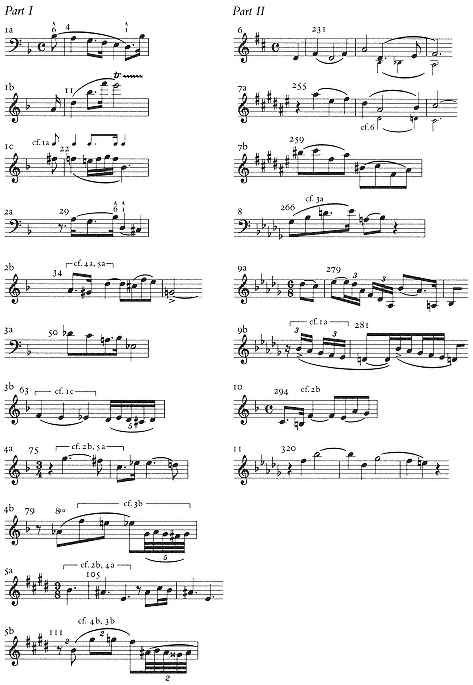
Example 5.1
Verklärte Nacht, op. 4, principal themes.
no relation to sonata-form "groups," but attempts to reflect the way themes are clustered in the sextet, where sections tend to be separated off from one another by such articulative features as distinct ritardandos (as at m. 28, before 2a), fermatas (as at m. 49, before 3a), changes of meter (as at mm. 74—75, before 4a), or modulation and dominant preparation (mm. 100–4, before 5a). For ease of reference I shall refer to the section of the sextet that extends up to the arrival in D major in m. 229 as part I and to everything thereafter as part II. It is hoped this broad partitioning will be as uncontroversial as possible, so as to allow the thematic connections and processes to "speak for themselves." In ex. 5.1 the themes of each part of the sextet are aligned vertically to show relationships and derivations as clearly as possible. Relationships not easily or conveniently demonstrable in the example are suggested by "cf." and are explained more fully in the prose commentary that follows below. The example makes no attempt to show an entire thematic statement (or the harmonic context), but only the basic unit from which Schoenberg works.
It is one of the distinctive features of Verklärte Nacht that the basic thematic kernels tend to be very brief, usually only a measure long. A frequent pattern (as in themes 2a, 3a, and 5a) is a twofold presentation of the one-measure unit, which is then extended by means of sequence or variation. This practice represents a kind of compression and modification of the classical-romantic thematic structure that Schoenberg was to call a "sentence," in which a unit (usually of two measures) is first presented on the tonic, then on the dominant, and then "developed" and "liquidated" in a continuation (usually in four measures). The overall proportion is thus 1:1:2, or 2:2:4 (see Schoenberg 1967, 58–59). The themes of Verklärte Nacht differ significantly from this model in that the repetition is normally not on the dominant, but at the original pitch level; harmonic motion takes place in the continuation. The short thematic units of Verklärte Nacht serve to give part I of the piece a somewhat breathless, urgent quality unlike anything in Schoenberg's earlier instrumental work, but rather like the motivically intense Dehmel songs of 1899, especially Warnung.
Two other features are particularly characteristic of part I of the sextet: the themes tend to appear in pairs (indicated as "a" and "b" in the example), and the initial theme of each of the first three groups (1a, 2a, and 3a) is in the lower register, from which the range tends to rise during the unfolding of a section. Theme Ia is clearly intended to be somewhat "neutral" and introductory. It is characterized by the stepwise descent from the sixth to the first degree of the D-minor scale and by the dotted rhythms of the second and fourth beats. The dotted rhythm continues through mm. 9–10, then forms part of theme Ib, which can be heard as an elaboration of Ia; like la it has an upbeat, followed by a quarter note on the downbeat, then a dotted rhythm, then a longer note value. Theme Ib also prominently features the first and sixth degrees, now heard in disjunct
form rather than connected by a stepwise scale. Theme IC shares with Ia the upbeat moving down a half-step to a quarter note on the downbeat. As in both Ia and Ib, the second beat involves some kind of diminution—the dotted rhythm has now been fleshed out to four sixteenths—and the third beat has a longer note value.
Theme 2a, the woman's agitated first theme, is distinctly (and appropriately) different in mood from the theme I family, but the relationships are still strong. The theme returns to the low register of Ia, whose


In the third measure of 2a, the


Theme 3a, presented in


3a, mm. 50–62
3b, mm. 63–68
3a', mm. 69–74
4a, mm. 75–78
4b, mm. 79–82
4a', mm. 83–86
4b', mm. 87–90
Sequential development of 4a, mm. 91–99
Transition / introduction to 5a, mm. 100–104
5a, mm. 105–10
5b, mm. 111–14
5a', mm. 115–20
5b', mm. 121–23
Sequential development of 4a and 5b, mm. 124–32
What is perhaps most striking about this segment is the close relationship among the "b" themes. Theme 3b consists of descending semitones culminating in a turn figure; 4b keeps the semitone descent

The unfolding of the paired theme groups 3 and 4 seems so logical and persuasive that it is hard to imagine any other possible ordering. But the autograph manuscript of Verklärte Nacht (at the Library of Congress) reveals that Schoenberg originally set down the themes in a different arrangement:
3a (the present mm. 50–60)
3b (mm. 63–68)
4a (mm. 75–78)
4b (mm. 79–82)
4a' (mm. 83–86)
4b' (mm. 87–90)
3a' (mm. 69–74)
Sequential development of 4a, mm. 91–99
In this ordering, 3a' is separated off from 3a and 3b and inserted before the sequential development of 4a. It seems clear that Schoenberg conceived both 3a' and the sequential development of 4a as passages that would together form a kind of continuous development or developmental transition leading up to theme 5a. But he reconsidered this scheme, perhaps deciding that despite the close thematic relationship between 3a and 4a, 3a' would remain too isolated amidst all the material from the theme 4 group; or, to look at it the other way around, that 3a' would interrupt the continuous flow of theme 4 material.[9]
By moving 3a' back to just after 3b (and by adding the present mm. 60–62 between 3a and 3b), Schoenberg thus created a rounded ternary structure for the theme 3 group and a more plausible sequence from two presentations of the 4a–4b pair into a sequential development based on 4a. It could be said that the final arrangement "de-sonatifies" the passage. Where the original ordering tends to group developmental or transitional gestures together, the revision spreads them out so that each theme group has its own developmental segment and is more self-contained.
To return to the final version: given the constant and fluid evolution of thematic shapes and the relative lack of exact repetition up to this point in Verklärte Nacht, the presentation of 3b, 4b, and 5b—especially the identity between the latter two—has a powerful effect. It is almost as if the thematic discourse of the sextet is beginning to collapse, to double back on itself. And, indeed, the discourse does in a sense break down here with the collapse onto to the octave Ds at m. 132, followed by the awesome drop to the low unison E. This is the moment that marks the start of what is often called the "development."
Schoenberg introduces relatively few new themes in part II of Verklärte Nacht, largely because there is considerable recapitulation or reappearance of themes from part I. There is also less of an emphasis on paired or multiple theme groups. In general, the new themes of part II are broader and less chromatic than those of part I, although several of them still show a preoccupation with semitone movement. Themes 6 and 7a, both distinctly associated with the man, are closely
[9] The reshuffling of material in this section of Verkärte Nacht is discussed briefly in Stephan 1974, 270.
related. Theme 6 is so limpidly diatonic that the chromatic passing note in the accompanying voice in m. 232 (


Theme 7a relates not only to its immediate predecessor, but also to the numerous themes in part I that juxtapose a dissonant leap (here


The theme in


Schoenberg's basic strategy in part II of the sextet appears to be to increase the associations with part I across themes 7a–10, then to pull back for one especially distinctive final theme (11). The "recapitulation" continues with the return of the first theme of part II, theme 6, which in turn ushers in the actual return of theme 1a, in combination with 7a and 10, at m. 370. While some of these compositional procedures can be seen clearly to relate to traditional instrumental forms, the actual thematic-formal structure of both parts of Verklärte Nacht is sui generis.