
My Heart Belongs to Mama: Stella Dallas and the Politics of Class
In many ways, Stella Dallas signifies an end not only to a certain kind of representation of mothering and the mother/daughter relationship and an end to a kind of genre, which became increasingly unpopular as the years progressed, but also an end to a social representation of family relationships. Instead, what we increasingly see as the years progressed is the personalization and psychologization of the mother/daughter relationship, removing that interaction from the larger field of social and class relations, which continued to shape cultural production as late as the 1937 "weepie" Stella Dallas .[2]
In this film, Stella (played by Barbara Stanwyck), a fast-talking, upwardly mobile (she's taking night business courses to "improve" herself), working-class girl from a small New England mill town, hooks the upper-class and correct Steven Dallas. From the beginning, Stella is depicted as different from her family, particularly from her mother, a hunched over, beaten down wife and mother whose visual resemblance to a depression era Dorothea Lange photo is striking.
The birth of their baby girl, Laurel, signifies the real beginning of this narrative. Stella's husband quickly moves to New York in exasperation over her refusal to become appropriately upper class, and the girl is brought up by her mother, although the father remains very much in the picture. Steven Dallas's initial move away from his wife—his frustration with her working-class ways—is in direct contradiction to his earlier claims of wanting her to remain
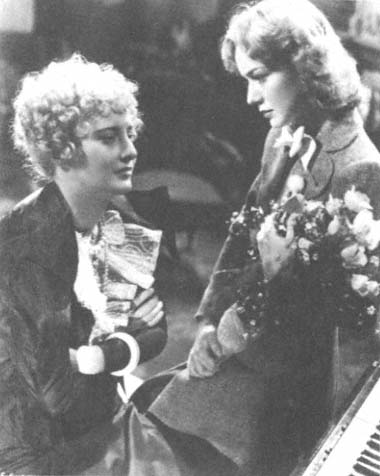
Fig. 1.
Barbara Stanwyck and Ann Shirley as the loving mother and daughter in the
heartrending tale of a sacrificial working-class mother who gives up her daughter
in the melodrama Stella Dallas . (Samuel Goldwyn, 1937: photo
courtesy of Museum of Modern Art Film Stills Archive)
"just as you are." Stella's desire to ascend is never masked: she is clear with Steven about her wish to learn from him the ways of the bourgeoisie, tellingly described as being "like the people in the movie." Yet he changes his tune as soon as her incorrigible working-class ways begin to impinge on his life-style.
Through a series of humiliating and poignant events, Stella rec-
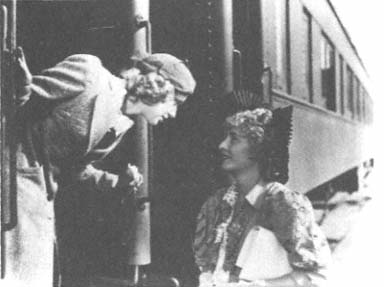
Fig. 2.
Stella bids farewell—for the last time—to her devoted daughter as she
gives her up to high-class society and nuclear family bliss. (Samuel
Goldwyn, 1937; photo courtesy of Museum of Modern Art Film Stills Archive)
ognizes that she is inadequate to bring up a "proper" girl and concocts an elaborate scheme to place Laurel in the bourgeois family of Steven and his new wife. In the final scene, which many spectators remember as both compelling and disconcerting, Stella stands in the rain outside the house where her daughter is being married, looking in on the scene of wedded bliss.
The mother/daughter theme in Stella Dallas is worked through or intersects with a pronounced class theme, something that should not be surprising given the depression era in which it was filmed, when questions of equality, class mobility, and governmental responsibility came to the fore. Indeed, a whole genre of class-conscious films was produced in the thirties, many of which focused on women and their families.[3] Questions of maternity and social class are intimately linked in many of the early maternal melodramas. In a time of deprivation and hardship—of sacrifice—a powerful narrative of social ascendancy asserts itself strongly and often depends on some sort of parental sacrifice, typically of the mother.
This linking of class and motherhood has disappeared in more recent films as the mother/daughter relationship has increasingly come under the master discourse of popular psychology.
Stella is first and foremost a working-class woman motivated by her desire to move up in the world. In depression era America, the message is that the mother's (Stella's) generation cannot transcend their class origins, but they can enable their children to ascend. It is through her father that Laurel accesses bourgeois values and moves away from her (depression) mother. E. Ann Kaplan thus rightly argues that Stella is doubly punished—as a mother and as a working-class person: "The film punishes her first by turning Stella into a 'spectacle' produced by the upper-class, disapproving gaze (a gaze that the audience is made to share through camera work and editing), but secondly, and most devastatingly, by bringing Stella to the recognition that she is an unfit Mother for her daughter."[4]
In this reading, Stella Dallas is understood as a virtually seamless representation of the mother/woman dichotomy that is such a mainstay of patriarchal thought and culture. Other feminist film critics, like Linda Williams, argue for a more contradictory reading of Stella that centers on the positive aspects of the mother/daughter love depicted in the film and the strangely triumphant look Stella walks away with at the end of the film: "We see instead the contradictions between what the patriarchal resolution of the film asks us to see—the mother 'in her place' as spectator, abdicating her former position in the scene—and what we feel as empathic identifying female spectators can't help but feel—the loss of mother to daughter and daughter to mother."[5]
Both analyses center on the mother/woman dichotomy as the central problem in the film, making this film one more example of a representation supporting and constructing the belief that to be a mother is to be asexual. Many critics, such as Kaplan, have therefore understood Stella as "resisting"—albeit unsuccessfully—both her role as mother and the narrative's repression of her sexuality: "Stella's resistance takes the form, first, of literally objecting to Mothering because of the personal sacrifices involved (mainly sensual pleasures); second, of expressing herself freely in her eccentric style of dress and being unabashedly sexual; finally, in growing too attached and needful of her daughter."[6] Although this mother/woman dichotomy is a significant issue for all "maternal sacrifice"
films—indeed, for almost all popular representations of women—the relationship between class and ideologies of motherhood is perhaps more significant here.
Stella doesn't object to mothering. After showing her initial desire to get out and have some fun following the birth of her daughter, the film details her devotion to mothering and her daughter at the expense of any other kind of life. Second, her ways of dress and self-expression are signifiers here of class , not of sexuality. For example, when we see her "decked out" and making a spectacle of herself—being made a spectacle of—it is in the context of a rich resort to which she has taken Laurel for a vacation. It is not in the context of trying to express her own sexuality in a coherent way. Her dress reveals her to the rich patrons as "other," as lower class. The audience here seems to be put in a strange position. On the one hand, we are invited to participate in the process of making a spectacle of Stella: she is laughable. Yet we also see those who are ridiculing her as mean and vicious: these children of privilege do not compare to the simple and honest Laurel. Laurel's boyfriend is kept out of the ridiculing, signifying that he is one of the decent upper class, unlike the snobs in his midst.
Most significantly, we witness the daughter's concern for her mother and her desire to shield her from the slings and arrows of upper-class elitism. As Mary Ann Doane points out in her trenchant analysis of Stella Dallas, Laurel witnesses her mother's "otherness," her unsuitability, through the mediation of both an upper-class gaze (the rich kids in the soda fountain) and through the image of her mother reflected in the fountain mirror: "Her gaze mediated via the gazes of others and the mirror, Laurel finally recognizes an accurate or 'proper' reflection of her mother's disproportion. It is as though the closeness of the mother/daughter relation necessitated the deflection of the gaze, its indirection, as a precondition for the establishment of difference."[7]
The central conflict is thus not so much between Stella's wanting to be a "woman" (defined as sexual, active, free, etc.) and her duties as a mother as between two different sensibilities about mothering itself. In fact, Stella sees her identity solely in terms of mothering, as she tells her pal Ed Munn when he once again implores her to be with him: "I don't think there's a man living that could get me going anymore. I don't know, I guess Lolly just uses up all the feel-
ings I got and I don't seem to have any left for anybody else." Stella throughout is explicitly nonsexual . She even treats her potential lover, Munn, as yet another object of her maternal affection: he is alternately a "bad boy," in need of maternal admonishment, and a "sad boy," in need of care and nurture. In that sense, she remains a "good" mother.
Yet she explicitly resists the kind of "appropriate mothering" that her husband and the medical establishment try to force her into, as she expresses in an early scene when she returns from the hospital. There, she refuses to allow her maternity to be pathologized, and it is in taking control of her own maternity that Stella's real transgression can be seen: "Why is it that doctors and nurses and husbands always seem to think they know more about this maternity business? Don't you think a mother learns anything in that little room they wheel her into? Or is that just a kindergarten class? Let me tell ya something, I picked up quite a little experience in that room, and it wasn't out of books either. Experience." Here Stella, as her daughter does later in the film, valorizes her own experience of birth and mothering over the upper-class learning and establishment ways. So the first conflict we have in the film is between Stella's version of "correct" mothering ("experience," she tells us) and the version promoted by the nurse and her husband (an interesting alliance of male interests and the pathologizing medical establishment). But this scene, which includes a full close-up of Stella and is clearly from her point of view (we don't get a full shot, but only a glance, of the nurse who attempts to boss her, and the nurse's voice is almost disembodied), is immediately followed by another in which Stella's way of mothering is called into question.
Stella is obviously weary of being cooped up and domestic and insists on going out to a dance right after the baby is brought home from the hospital. As she complains to Steven about her boredom, he protests, and she expresses fervently the desire to be "other than a mother" ("Gee, I just want to get a wave and a manicure and get all dressed up again and go hear some music and forget all about doctors and hospitals and nurses"). He asks pointedly, "And babies?" looking over at their newborn infant in the crib. Stella's ambivalence, which disappears after this point, is expressed as she looks over at the baby with Steven, says, "No," and then follows this with a plaintive plea, "Oh Steven, please. . . ." The next shot opens
at the club: Stella has gotten her way, but it will be the last time. If Stella ever thought she would get out of mothering, she now realizes her destiny is sealed. And, importantly, the destiny to be "only a mother" is tied up with the destiny not to ascend the class ladder, to be "only working class."
Laurel mirrors Stella's emphasis on everyday (coded here as both maternal and working-class) experience when she rushes home to her mother after she hears of her sacrificial plan to "give her up" to Mrs. Morrison, the soon-to-be new wife of Steven: "But good times oh they aren't what make you belong, it's other kinds of times, it's when you've cried together and lived through things together, that's when you seem to love the most . . . it's different." Laurel here validates the routine, commonplace events in domestic life she shares with her mother. Yet "everyday life," familiarity, and continuity lose out to social ascendancy and the newness of Mrs. Morrison and all that her world has to offer. By discrediting that everydayness, which is, after all, the stuff of most women's lives, and was particularly so in the trying times of the thirties, the film thus further invalidates women's social reality. Experience loses out to progress, familiarity to newness, the prosaic to the novel.
Nevertheless, we are invited to empathize with Stella's anguish and pain when she realizes that it was her "lower-class" qualities (Stella as an embarrassment) that led Laurel to insist on leaving the resort. In fact, one of the most poignant moments between mother and daughter occurs during the train ride home, one of the few moments of mutuality, of a glimpse at the shared love between mother and daughter, but a love that is nevertheless doomed as Stella begins to see herself through her daughter's eyes and sees the social situation more clearly: "It is this vision, through the daughter's sympathetic, mothering eyes—eyes that perceive, understand, and forgive the social graces Stella lacks—that determines her to perform the masquerade that will alienate Laurel forever by proving to her what the patriarchy has claimed to know all along: that it is not possible to combine womanly desire with motherly duty."[8] More to the point is that it is not possible to combine a strong class identity with (appropriate, bourgeois) motherly duty.
The daughter feels the mother's hurt; the mother translates her own hurt into the implications for her daughter: the sacrifice theme is initiated. At this moment of their greatest shared pain (for
themselves, for each other), they also seem most intimate, most deeply connected. The kind of image seen here—the soft music, the daughter lovingly stroking her mother's head, the daughter's head on the mother's shoulder as they sleep together on the train bunk—creates a mise-en-scène usually reserved for lovers. One wonders if the audience would sense this, feel slightly uncomfortable (both at the prospect of such intense female intimacy and at the incestuous implications), and then begin to construct in their consciousness the paramount need for separation: something is wrong with this picture; they must be torn asunder.
Not coincidentally, the mother launches her attempt to propel the daughter into the father's world following this intimate love scene between them. Stella must try several times; her daughter will not leave willingly. To do so would render the daughter less likable and the relationship itself more conflictual, thus deemphasizing the sacrifice theme and replacing it with a more tortured, psychodrama motif (as in Mildred Pierce ). When Stella goes to visit Mrs. Morrison to arrange her "gift" of her daughter, we have a repetition of the previous love scene between Stella and Laurel.[9] Mrs. Morrison is caring, concerned, overwhelmed, and very moved by Stella's sacrifice. As the scene progresses, she moves closer and closer to Stella on the couch. By the end, she is almost in Stella's lap, stroking her hand, and gazing lovingly at Stella, as Stella's daughter did to her on the train. In this world, the work of relationships is clearly women's work: they are both mothers, they understand each other, they empathize with each other, and they know what is best. Indeed, Mrs. Morrison has to explain to Steven Dallas why Stella is behaving the way she is (pretending to be having an affair to drive the daughter off). This sisterhood, this "mother knows best," is in marked contrast to what we will see in depictions of the relationship in the late forties and fifties, when maternal decision making is likened more to the opening of Pandora's box than the knowing looks of two mothers.
The mother in Stella Dallas can't win: she is bad because she wanted more (be it some form of sexuality, as Williams and Kaplan argue, to retain her class identity, or merely to have an intimate and passionate life with her daughter), but good because she didn't get it. "She proves her very worthiness to be a mother (the desire for her daughter's material and social welfare) by acting out a pat-
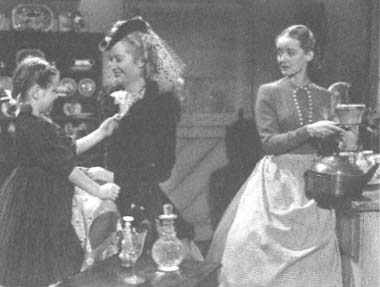
Fig. 3.
Bette Davis plays the buttoned-up and bitter unwed mother in The Old Maid ,
pitted against the maternal ambitions of her rich and glamorous cousin,
played by Miriam Hopkins. (Warners, 1939; photo courtesy of Photofest)
ently false scenario of narcissistic self-absorption."[10] The triumph in her eyes in the last scene is the triumph of sacrifice, a dubious triumph indeed.[11]
Another film of the 1930s, The Old Maid , also portrays a sacrificing mother whose sacrifice, like Stella's, benefits her ascending (illegitimate) daughter.[12] Here again issues of maternal sacrifice are linked with those of class ascendancy. This film too is set in the past, during the Civil War. Just as Stella must concoct an elaborate ruse to push her daughter from the maternal home and into upper-class society, Charlotte (Bette Davis) must construct herself as an "old maid" (replete with rigid posture, severely pulled back hair, and high-buttoned dowdy clothes) to conceal her daughter's true identity and allow her to be adopted (both literally and figuratively) by her well-connected cousin Delia (Miriam Hopkins). The final scene mirrors the classic closing image of Stella . As the daughter marries into the wealthy aristocracy, Delia (cousin to mother Charlotte and
beloved adoptive mother to Tina) has asked her to give the last kiss to "Aunt Charlotte" as her carriage pulls away. Charlotte's look of amazed gratitude, hand on cheek, eyes misty, is almost as (melodramatically) heartbreaking as Stella's handkerchief-in-mouth, teary, sacrificial bliss.
Three years before Stella Dallas , another famous mother/daughter film hit the theaters. The 1934 melodrama Imitation of Life starred Claudette Colbert and Louise Beavers in a dual narrative of two mother/daughter couples, one black and one white, who make good on Beavers's pancake recipe and move into high society. I will discuss this film in greater detail in the next chapter, where I examine the 1959 remake. But suffice it here to say that, like Stella Dallas (and unlike the 1959 remake with Lana Turner and Juanita Moore), Imitation of Life refuses to indict mothering and instead foregrounds the narratives of class and race through which the mother/daughter narratives emerge.