
Revelations of Character
Although the funerary portraits discussed above were not intended to be exemplary, we know that such portraits existed in the Western
Han. Indeed, the majority of references to paintings in both dynastic histories of the Han period note their explicitly didactic intent, the extolling of exemplary conduct or achievement. Of those individuals deemed worthy of depiction, the Han shu primarily mentions virtuous ministers, ladies of the court, heroes and generals of the dynasty, such sages and worthies of the past as the Duke of Zhou and Confucius. For the latter, the bibliography section even cites a work in two chapters, The Method for Picturing Confucius and His Disciples.[21]
The History of the Latter Han lists similar exemplars, depicted, like their predecessors, on palace walls and furnishings, but adds important new models, patrons, and locations. The governor of Yuzhou, for example, commended Chen Ji for his filial conduct and "ordered the [local official] to paint his image (xiang ) in a hundred towns [in order to] regulate popular customs."[22] When Yan Du died, his native village had his form (xing ) painted in the local Temple of Qu Yuan.[23]
Thus, from the texts alone we can wring a surprising amount of general information about subject, patron, audience, and purpose. What we cannot gain from these texts, as commentators have noted, is a sense of what these "portraits" looked like. The term so often translated as "to portray" (for example, by Drake) is usually the undifferentiated hua or tu, whereas the graphs translated as "portrait" are most frequently xiang or xing, which are more accurately translated as, respectively, "image" and "form" ("shape" or "contour").
Yet verbal description of the human figure occurs. Describing himself, for example, Dongfang Shuo announces that he is twenty-two years old, "measure(s) nine feet three inches, [has] eyes like pendant pearls, teeth like ranged shells."[24] As for descriptions of paintings, Wang Yanshou (ca. A.D. 124–ca. 148), recounting the paintings of the Lingguang Palace, mentions (among others) Fuxi's scaly body and Nuwa's snake-form. Yet, in his long list of rulers and other exemplars depicted, he supplies no description and notes only their admonitory function.[25]
In his list, however, Wang Yanshou makes one point that deserves our attention: clothing distinguishes officials (i.e., those with carriages and high caps) from commoners.[26] I know of only one other reference in which costume is specified. Concerning Qu, Prince Hui of Guangquan, Ban Gu remarks that his palace gate bore a painting of Cheng Qing (Jing Ke) wearing a short coat, huge breeches, and a long sword. Qu admired these accoutrements to the point of emulation.[27]
Changing mortuary customs and political conflicts alike affected
developments in finerary art of the Eastern Han.[28] Wall paintings and reliefs adorned brick and stone tomb walls and offering shrines; from the welter of remains, what impresses most are the regional varieties of subject matter, technique, and style.
Equally impressive, however, is the continued reliance on earlier pictorial devices to depict the human figure, including those representations intended to be like specific individuals. The Sage Kings of the Wu shrines, for example, are distinguished only by headdresses, postures, and attributes—but above all, it is the inscription accompanying each image that enables us to identify them.[29] Although each posture and gesture suggests general movement, only the bend of Shen Nong conveys a more specific action, that of plowing. Headdresses vary somewhat, but if the artist had interchanged them, we would not doubt their appropriateness. Similarly, the postures of the disciples of Confilcius depicted on stones from the same shrines are virtually interchangeable, as are costumes and caps. Only the Master's favorite, Zi Lu, is allowed the individuality of a distinctive headdress and an inscription of his own.
If, as all agree, Han portraiture was most often exemplary, one special set of portraits is especially helpful in delineating the character of the models and the lessons viewers might be expected to learn from them. A scene that appears in several regions during the Latter Han period, on the walls of offering shrines and tombs as well as on coffers, is that of the meeting between Confucius and Laozi. In his Shi ji, Sima Qian twice relates this encounter between the two great sages. In both cases Laozi warns Confucius of the futility, even the foolhardiness, of his behavior.[30] To meddle in politics—to criticize the ruler in an effort to modify his conduct—is a waste of time and can be dangerous. The pictorial representation occurs, painted or in relief and with the two sages named by inscription, in Sichuan, Shandong, and Jiangsu provinces and at Helingeer in Inner Mongolia (figs. 9–11).[31] On the basis of these, several uninscribed reliefs from Shandong are identified as depicting this scene, along with a stone from Shaanxi and perhaps two others from Henan.[32] None bears a secure date, although the stone from the Wu shrines in Shandong must have been made between A.D. 147 and 167, whereas two—from the brick tomb at Helingeer and the stone tomb at Yinan in Shandong—probably date from the end of the Han dynasty. The majority of depictions, however, were not found in situ.
In juan 17 Sima Qian is specific about this encounter. We learn that
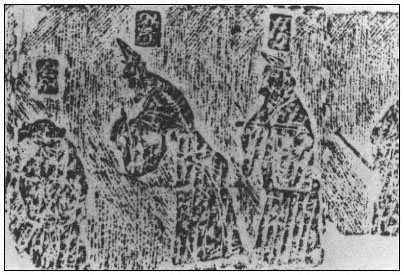
9.
Confucius Visits Laozi.
Detail, rubbing of a stone relief, Sichuan province. Eastern
Han (A.D. 25–220). (From Wen You, Sichuan Handai huaxiang xuanji. )
Confucius went to Zhou to study the rites (juan 63 states that he went to study the rites with Laozi), that he traveled in a carriage, and that two disciples accompanied him.
The Grand Historian also tells us, immediately prior to relating this account, that Confucius was exceptionally tall. From another Han text we learn that Confucius had a mouth as big as the ocean, the back of a tortoise, the hands of a tiger.[33] The Laoziming, an inscription composed in A.D. 165 by Bian Shao at the command of Emperor Huan, says that at the time of the meeting between the two sages, Confucius was sixteen years old; Laozi was over two hundred years old and looked like an old man with long ears.[34] When we examine the scenes of this meeting, we find that no two stones are exactly alike, with the exception of two identical stones from Sichuan (one inscribed, the other not). One stone, from Shandong, is the most detailed, providing the two sages with carriages and attendants or disciples, while an unidentified child stands between them (fig. 10).[35] The Fengs described the boy as holding a broom and sweeping the ground as a sign of respect for Confucius. More recently, however, Michel
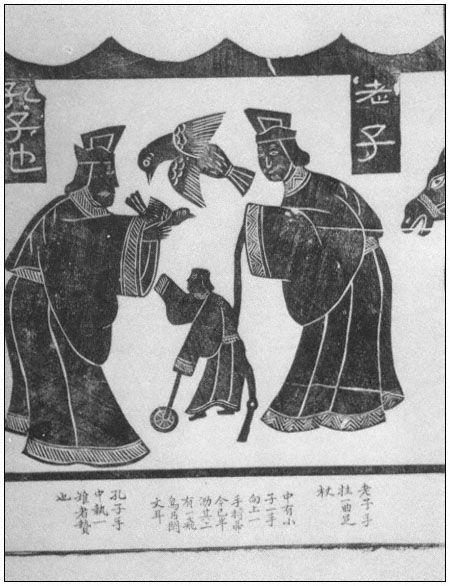
10.
Confucius Visits Laozi.
Detail of a nineteenth-century woodblock copy of a stone relief from the
Wu shrines in Jiaxiang county, Shandong province. Second century A.D.
(From Feng and Feng, Jinshi suo: shi suo 4.)
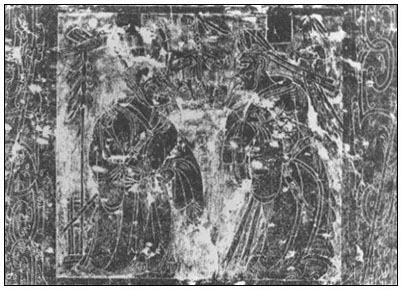
11.
Confucius Visits Laozi.
Rubbing of a stone relief, tomb in Yinan county,
Shandong province. Eastern Han (A.D. 25–220). (From Zeng et al., Yinan. )
Soymié has argued that the child is Xiang To, who, according to the Han texts, at the age of seven was a teacher of Confucius.[36] On some of the depictions the two stories would seem to have been conflated.
Many depictions, however, are abbreviated. The Sichuan relief, for example, shows only Laozi and Confucius accompanied by a third figure, whose inscription cannot be read, but whom Wen You identifies as a disciple (fig. 9). The Shaanxi relief (as well as several of the Shandong stones) shows only two adult figures, with the child standing between them. The relief from Yinan, uninscribed, shows only two figures (fig. 111).
Regularities among these depictions are few. Scholars most frequently identify uninscribed scenes by the presence of the small child with the pull-toy, found on the stone from Jiaxiang (Shandong), where inscriptions identify both Confucius and Laozi. The Yinan depiction, however, lacks the figure of the child; its identification is based on the resemblance between its two figures and those on the Wu family stone.[37] In some scenes—for example, in Helingeer and Sichuan—the figure of Confucius is much taller than that of Laozi, a
reminder of the Shi ji description; in others they are the same height. In most scenes they are dressed alike, often wearing similar headdresses. In most, but not all, scenes, Confucius holds a small fowl, presumably as an offering. Confucius does not always stand to the right of Laozi, the child does not always face the same sage, and so forth. On the inscribed Yeshang (Jiangsu) rubbing, all three figures—Confucius, Laozi, and disciple—are exactly the same in every respect except for the volume held by the disciple.
In no scene are the two figures distinguished by all the physical characteristics affirmed by the texts. The Jinshi suo copy of the Jiaxiang relief, the most faithful to Sima Qian's account while adding the image of Xiang To to the scene, depicts the two sages as almost identical in physical appearance and clothing.
What marks, then, distinguish these two important figures from each other or, for that matter, from the countless other decorously garbed images of Latter Han? I can find only two. In most cases, the figure of Laozi holds a twisted staff, in this case the sign of age. And the figure of Confucius almost always makes the sign of submission, a slight bow with hands clasped to the chest and muffled by sleeves. Often, even the bow is not readily apparent; in the Yinan scene, for example, only the loose hump of collar and robe suggests a slight inclination of neck and waist. Laozi's hands are muffled when both hold the staff, otherwise one hand is raised in a gesture of welcome.
The two figures, in all cases, stand still, any sense of motion being conveyed solely by the arm of Laozi raised in greeting. Feet are together; arms are usually close to the body; robes show straight interior folds; hems and sleeves hang straight down as if weighted. Static, formal, tense—these figures are models of decorum. We see the same proper conduct in the postures of other Han representations—the Duke of Zhou or the disciples of Confucius, for example.
The version of the encounter related by Sima Qian, as well as that of the Laoziming, suggests more than strongly that one of China's greatest exemplars had to submit to another, often competing, exemplar for instruction—and, of all things, in the rites! Although it has been disputed, the Daoist bias of Sima Qian, at least in this story, seems to me undeniable.[38] Are we, then, to infer that these many depictions of the meeting are intended as a victory of the Daoists over the Confucians, and that the real hero of the scene is Laozi?
Perhaps some Eastern Han depictions were meant to signal just that. But for most of them, I think not. On the contrary, the por-
trayals emphasize Confucian values important in Han social and political life, as exemplified by the conduct of Confucius toward Laozi. Moreover, given the historical context for the production of these scenes, they may also be interpreted as a rallying cry, not necessarily for the historical Confucius, but for the standard-bearers of Han Confucianism.[39]
Some of the issues of the complex and often turbulent history of the Han dynasty bear upon this interpretation. The Han imperium accepted Confucianism as state orthodoxy in about 135 B.C. Perhaps even more important for understanding these scenes is the fact that by the Eastern Han the display of Confucian behavior characterized as "filially pious and incorrupt" (xiao lian ) had become an important qualification for holding public office.[40] "Virtuous and wise" and "upright" were other, related standards of behavior a man was expected, by imperial decree, to exemplify if he wished to carve out a bureaucratic career. Hence we must view the many mortuary depictions of such filial sons as Ding Lan consulting the statue of his deceased father, or Xing Qu feeding his aged father, in a social context broader than that of personal predilection, whether of the deceased or of his family. The placement in the Helingeer tomb—the tomb of a high official—of the encounter between Confucius and Laozi in the company of the former's disciples, as well as of an endless stream of men and women famed for their filial piety or their upright behavior, can leave no doubt about some association of the encounter with these other depictions, all of which extol Confucian Virtue.
Other historical developments are pertinent. The commentary to the Sanguo zhi, citing the Kongshi pu, states that the emperor Huan (r. A.D. 147–168) set up a temple to Laozi with an image (xiang ) of Confucius painted on the wall. No description of the painting survives, and I refrain from speculation. The commentary then states that a descendant of the sage, Kong Shou, when he was minister in Chen, erected a stele to his great ancestor in front of the image.[41] It adds that the stele was still in existence. The Shuijing zhu not only confirms that fact but also gives the date for the stele—the third year of Jianhe, A.D. 149.[42]
The possible motivations for the emperor's decision (actually, the decision of those who ruled in his name) to paint an image of Confucius on the wall of a temple dedicated to Laozi are, it seems to me, rather limited. Either it was intended as a sign of Confucius's subordination to Laozi, or it was an effort to placate everyone and link the two in harmony. The latter possibility is by no means unlikely, for by
this time many Confucian scholar-officials had come to tolerate—had even adopted—at least some Daoist doctrines.[43]
Kong Shou's behavior, however, is less ambiguous. The Kong family register notes the erection of the stele but makes no mention of a similar stele to Laozi. It was, at the least, a personal act designed to honor an ancestor. The ancestor, however, happened to be an exceptionally famous one, and it was a public act. Given the political struggles of the t:imes, and the shibboleths of the partisans, Kong Shou's piety must be interpreted as a political statement as well.
In the power struggles that grew ever stronger in this last century of the Han dynasty and that led to its ultimate downfall, the beliefs and ideas categorized as "Huang-Lao" and "Confucian" were joined to the battles. The "Daoism" sometimes espoused by the faction led by imperial consorts and their families, or by the faction headed by palace eunuchs, and the "Confucianism" upheld by the official-scholar faction had become, in addition to genuinely held beliefs, political stratagems.[44]
Returning to the mortuary depictions, we find that we cannot establish with any certainty either the status or the political affiliation of most of the occupants whose tombs they decorated. We know, however, that the Helingeer tomb belonged to a high-ranking official, and that the Jiaxiang relief was made for the scholar-official Wu family. The pictorial complexes from both sites provide compendia of Han themes that tell us much about the status, or would-be status, and the beliefs, or putative beliefs, of the respective occupants.
We might be surprised to see Laozi so decorous—in some cases looking exactly like his "rival" in posture, gesture, and clothing. But we should note that both Sima Qian and Bian Shao say that Laozi was an official, Keeper of the Archives, and that Confucius came to him to study the rites. Moreover, in his Han development as a savior, he appears to have incorporated a Confucian value or two. For example, in the Laozi bianhua jing, probably composed not long after A.D. 185, Laozi, promising eventual salvation, says: "In this present age I will choose the good people. / You must not select yourself; By [your] upright behavior and self control / I will recognize you."[45] It should therefore not surprise us that artisans depicted Laozi formally posed and formally clothed, for such posture and garb are signs of upright behavior. Thus, on the Wu family stone the Keeper of the Archive appears as a model of upright behavior and control. He looks, in fact, exactly like Confucius.
If both sages are posed and clothed alike, how do we distinguish
them? On some scenes, only by inscription; on others, by attribute and gesture. The staff of Laozi, as I have noted, signifies age. In the context of the times, Confucius's gesture of submission is not the gesture of an inferior to a superior sage—as we would infer if we noted only the accounts of Sima Qian or Bian Shao—but the gesture of virtue, the action of a younger man toward an older one. "Why," asks the Bohutong, "do people salute each other? To manifest their emotions, to show their intentions, to humble themselves, and to incline their bodies reverently to be at the disposal of others. Pai [bai ] 'to salute' means fu 'to submit to.'"[46] To those who would see these depictions, and there were many, of all classes, the most important message was precisely that of the virtue required of high and low for the ordering of the empire. Indeed, how else can one interpret Sima Qian's curious remark that following the return of Confucius from his visit to Laozi his disciples grew in number, except as the consequence of his act of virtue?[47]
The presence of the small child, Xiang To, in many of these scenes does not readily lend itself to interpretation. For the early textual references assembled by Michel Soymi—Huainanzi, for example—are vague and merely assert that one Xiang To, at the precocious age of seven, was the teacher of Confucius.[48] Only later texts offer further identification and explicit affirmation of his thoroughly Confucian teachings.[49]
One early Han reference, however, may refer to Xiang To and therefore shed light on the popularity of the small-child image in Latter Han. Ban Gu quotes Dong Zhongshu, who welded such a mélange of ideas into that system known as Han Confucianism, on the realization of virtue (de ). The most exquisite jade, he notes, requires no embellishment, for its beauty resides in the material itself. Similarly, Xiang To required no education, for his knowledge was innate. However, an ordinary piece of jade, if not ornamented, will not achieve distinction or brilliance (wen zhang ). Similarly, a (mere) gentleman who does not receive education will not achieve virtue.[50]
Dong Zhongshu understood the exceptional Xiang To's knowledge to be an innate understanding of correct behavior, for it was Confucian education of which he spoke. In the same vein, we may interpret a relief inscription cited by Soymié from Shandong province. In A.D. 179 a son of the family Feng died prematurely. The inscription recounts the abilities of this extraordinary child. He knew by heart, for example, the Shi jing and the rites. Indeed, so great were his abilities, he was a second Xiang To, who had been his model. Soymié
points to this inscription as evidence that Xiang To was a model for children, even for those who knew by heart the Confucian Classics.[51]
Soymié assumes that any teacher of Confucius, like Sima Qian's Laozi, must be seen as superior to the Master. Dong Zhongshu's reference to the child prodigy, however, surely cannot be interpreted that way. On the scenes where the child appears, he is most frequently, but not always, shown facing Confucius, and often with one hand raised in the gesture of welcome. In some cases, as on one of the recently found Jiaxiang reliefs, both elder sages are gazing at him rather than evincing any interest in each other.[52] The child is meant to be seen, not as an opponent, but as a Confucian prodigy, ready to discourse on the highest subjects.[53]
As such, Xiang To provided a model, not only for young master Feng but for all children. Perhaps the occupants of the tombs decorated with these scenes had themselves been prodigies, as talented and diligent as the Feng child. Perhaps, too, they were partisans of the Confucian-scholar faction, in which case the image of Xiang To in these scenes takes its place on the political agenda: Even the great sage listens to him—not because he is a child, but because he knows the texts and therefore understands correct behavior, as only the Confucian scholars could. One who understands correct behavior, though but a child, has the right, even the duty, to speak out fearlessly. And pace Laozi and his advice, he should be listened to.[54]
Physical likeness is irrelevant to the depiction of these figures. It is, of course, their behavior that the viewer is expected to recall, those acts that we may sum up as Virtue Triumphant. That evocation of behavior permits us to move from the most general definition of a portrait, one intended to be like a specific individual, to a narrower definition, for it is intended to be like only in certain ways, in terms of specific qualities. It is the moral nature of the individual, his character, that counts, and that nature is revealed by action. His gesture of submission to Laozi and his attention to the child are the acts that reveal the moral nature of Confucius. "The Master said, 'I have talked with Hui for a whole day, and he has not made any objection to anything I said;—as if he were stupid. He has retired, and I have examined his conduct when away from me, and found him able to illustrate my teachings. Hui!—He is not stupid.'"[55] The pictorial representation is also a lesson to be heeded and acted upon. Conduct reveals the man.
The depiction of such a portrait inside the tomb or on the wall of an offering shrine was, in effect, a statement that the deceased and his family identified themselves with such virtuous behavior. The accom-
panying scenes of emoluments and homage are the consequences of that virtue—and the proof that virtue was by no means its own reward. In the context of Eastern Han history the conspicuous display and honoring of virtue was both a moral and a social statement. It was also a political statement.
Returning briefly to the texts on portraiture, I suggest, on the basis of the extant portraits themselves, that the texts fail to supply descriptions because none were necessary. The names of the exemplars sufficed to remind viewers of their actions. The schemata were known to all.
Wang Yanshou's remark (referring to palace paintings) that officials were distinguished from commoners by their clothing is a most important comment. "Why did the Sages institute [the wearing of] robes?" asks the Bohutong. "In order that by the cloth . . . the spiritual power [of the wearer] be displayed; it is to encourage the capable, and to distinguish between the high and the lowly."[56] If I interpret Wang Yanshou correctly, the wearer's clothing, which signified his social status, was most important in distinguishing the images. But the Bohutong tells us that clothing also signifies "spiritual" (read "moral") status—from which we may infer that official rank equals moral status. If we consider that the Oxford English Dictionary (OED ) offers as one of many definitions of character "recognized official rank; status; position," then clothing defines the man. Bundled decorously in their robes, with bands of trim and peaked caps to signify their scholar status, the disciples of Confucius make known their virtuous character. If they all look alike, it is because they are all alike, in the only way that counts.