
6
Contrasting Representations of Gender
My husband is good at cruising around, but lazy when it comes to working. When he goes here and there, I don't get angry. If he wants to work, okay; if not, that's okay too.... Men aren't as responsible as women.
Mak Nisah, a female elder from Bogang
Women are more straight forward/honest, they aren't hot-tempered and they don't lie [as much as men].... Men are responsible for most of the problems in marriage and are at fault in most cases of divorce. The basic problem is that too many men like "the good life" and basically expect to "eat for free."
Pak Haji Adam, a male elder from Bogang
Men, they all lie; you can only believe about one out of ten of them. That's what you see all the time at the kadi's office.
Mak Su, a female elder from Bogang
Chapter 5 focused on the symbols and meanings of "reason," "passion," and "shame," and the ways they figure into official/hegemonic discourse on gender. This chapter examines official/hegemonic discourse as well, but is more concerned with the fissures, contradictions, and silences in the hegemony, and the ways in which these and other factors have allowed for the development of an alternative (practical) discourse, many features of which constitute an explicitly subversive challenge to (inversion of) the official discourse, and are therefore appropriately characterized as counter-hegemonic.
This chapter is composed primarily of (edited) material obtained from twenty open-ended interviews that were designed to elicit local understandings and representations of similarities and differences between males and females. The interviews were devised and conducted toward the end of the second period of research, after I had already spent some two years in the field. I mention the timing of the interviews partly to underscore that most of the interview questions were framed in terms of concepts and categories that I had long since identified as culturally salient:
"reason," "passion," "shame," livers, and "life forces," or semangat . Many of the questions took the following form: "Overall, are males and females basically the same or different with respect to their livers, personalities, and temperaments?" "What about 'reason,' 'passion,' and 'shame'?" "Are these commonalities and contrasts the result of 'natural endowment' or child rearing/socialization?" I also asked about similarities and differences in the roles, responsibilities, and overall statuses of males and females, as well as about various aspects of kinship, social organization, and religion (especially ritual prerogatives and restrictions). Some of these lines of inquiry yielded little of value and, as such, are not pursued here. Others met with looks of bewilderment or the shrugs that often accompanied rejoinders such as "Who knows? That's just the way it is; that's the way it should be according to adat and Islam." I should emphasize, in any event, that most of the material presented here is at the level of explicit consciousness, and does not tap into implicit, subconscious, or unconscious meanings or associations. Even so—and despite all the potential problems associated with collecting data via the rather artificial medium of the interview (see, e.g., Femia 1975:44–47; Willis 1977:122; Barth 1987; and Martin 1987:5–9)—the material obtained from interviews is of considerable significance. It not only provides the reader with a sense of the nature of "local voices" (though the questions and underlying research interests were of course mine); it also sheds valuable light on some of the paradoxical and contradictory ways in which particular individuals experience, understand, and represent masculinity and femininity.
The first section of the chapter presents data gathered from the ten men I interviewed. The second presents material collected from ten women. The third section analyzes some of the similarities and differences between men's and women's perspectives on gender(ed) difference and sameness, though my primary concerns are the scope, force, and reproduction of practical representations of masculinity; issues of class; and the variables that have constrained the elaboration of oppositional discourses as a whole. We will see that with respect to a good many issues the men and women interviewed are in strong agreement as to the basic commonalities and differences between males and females, and that the women interviewed appear to accept as accurate and valid much of the official/hegemonic view of gender, including many features of the hegemony that depict women (and females generally) in predominantly negative terms. We will also see that some men espouse various features of the practical discourse that tends to portray all men in largely negative terms; that this discourse reveals some of the ways in which local perspectives on class are
more or less unmarked in discourse concerning gender and social relations; and that the articulation of variables of gender and class has long been informed by state policies as well as nationalist and transnational discourse bearing on the Malay social body and the Malaysian body politic. In sum, gender ideologies are not intelligible as isolates, and are in fact best understood in light of theoretical perspectives which are conducive to describing and analyzing gender in relation to other forms of difference and inequality as well as everyday social process and the broader realities of prestige, political economy, and historical change.
Male Perspectives on Gender(ed) Difference and Sameness
The first five interviews presented here provide good examples of the official/hegemonic view that men have more "reason" and less "passion" and "shame" than women. They also illustrate that males and females (masculinity and femininity) alike are conceptualized in relational terms, and that the most salient components of men's and women's identities are husband and father, and wife and mother. At the same time, these interviews indicate quite clearly that men do not agree among themselves on all aspects of gender. That men do not speak with a single voice on matters related to gender (or anything else) will be even more clear when we examine the remaining five interviews conducted with men.
(1) Kamaruddin
Twenty-five years of age; single (never married); taps rubber and assisted me in my research while waiting for the results of an examination taken upon his completion of two years of training at a technical college in Kuala Lumpur;[1] comes from one of the poorer households in the village.
"The livers of males and females are more or less the same, but the behavior of males and females is quite different." Women are gentler (more lembut ); males display greater aggressiveness, "like when they hand something to someone, they do it much less subtly." And women are more likely than men to resolve the differences that crop up between them. This may be because they depend on one another more and cannot let this interdependence be undermined by misunderstandings. Women's livers are like kerak nasi , the hard, crusty rice that forms on the bottom of the pot that rice is cooked in: "When it comes into contact with water, it immediately softens up. In other words, though women's livers may at times be tough, hard, or brittle, they become soft and melt when they hit
water, all of which is to say that women are more easily influenced and more flexible than men."
As for "reason": Males have "broader" (more luas ) "reason" than females. This is because of training (socialization) as well as natural character (semula jadi ). Both males and females are born with "reason" and this is among the most important features that distinguish them from the other animal species. It develops as they grow up. To illustrate, Kamaruddin spoke of a mother teaching her daughter not to ask so many questions of her older brother; for example, about where he is going when he leaves the house. He seemed to be saying that mothers (and other socializing agents) constrain young girls, and that this constraint results in their having less "reason" than would otherwise be the case.
As for "passion": "Females have more; for example, they are much more eager than men to become models, singers, and film stars; to wear nice clothes; and to be seen by lots of people [e.g., an audience]. They also have more 'shame.' 'Shame' is what keeps 'passion' in check."
When I asked Kamaruddin how these latter views squared with the local perception that men are more likely than women to squander money and gamble—which behavior might be taken as a sign of their having more "passion" than women—he responded that women, if given the chance, would perhaps be at least as likely as men to spend money, though they would use the money to purchase refrigerators, gas stoves, washing machines, and the like. He didn't make the point (though it did occur to me) that these items would be of benefit to the whole household, whereas this is not necessarily the case with men spending money at coffee shops or in gambling.
As for why women can't become (Islamic) magistrates or mosque officials: Islam gives leadership positions to men; this is because of their natural characteristics, the natural differences between men and women. In response to my questions about menstruation and the restrictions imposed on menstrual women (e.g., why they shouldn't go into the graveyard and so on), Kamaruddin laughed nervously, made a passing, oblique reference to highly syncretic, largely pre-Islamic rituals such as bayar niat ("the repayment of vows"), and said that he really didn't know why these rules and taboos exist. He also informed me that people are not supposed to think about or question such things, and that was the end of that.
Kamaruddin went on to remark that children are fonder of and closer to their mothers because mothers are willing to make greater sacrifices for them than are fathers. In response to my question on the subject, he
said that he wasn't sure if this is why children are more inclined to give money to their mothers than their fathers. In fact, he wasn't even sure if this is a pattern. (It is.) If it is, it may be because fathers don't need the money as much; perhaps mothers need it more because "they don't work."
I asked Kamaruddin about the origins of the universe, telling him that I had heard the story of Adam and Hawah but forgot the details and wanted him to fill me in. His version was much as others have described it, with God creating Adam and then fashioning Hawah from one of Adam's ribs. They were in heaven, ate the forbidden fruit, and were then sent down to earth for their transgression(s). The forbidden fruit appears as the Adam's apple of men, and as the breasts of women. Kamaruddin also said, in response to my question on the subject, that in one version of the Genesis story Hawah tempted Adam to eat the forbidden fruit; he went on to make clear that he didn't believe this particular version of the story.
On a more general note, Kamaruddin feels that the roles of men and women are equal, though clearly different. He does not feel that these contrasting roles translate into or entail differences in status. They are simply different.
(2) Dato Suleiman
Fifty to fifty-five years of age; married; recently elected to a high-ranking post in the indigenous clan-based polity; served in the armed services for about twenty years (beginning in 1956), much of it in an administrative capacity; currently lives in Lubok Cina (about thirty miles from Bogang) and is probably one of the wealthiest (or at least wealthier) members of that community.
Men certainly have more "reason" than women. They are better at making firm—and correct—decisions, and they are more patient. Women have less "reason"—they vacillate, change their minds, and worry more—and they have more "passion" and "shame." Women are never satisfied, Dato explained, referring to nice dishes and clothes, household conveniences, and the like. And they are all the time insisting that their husbands buy this and that. Husbands are often under tremendous pressure to purchase what their wives and mothers-in-law demand of them, and it is this pressure, stemming from women's "passion," that leads men into corruption. Dato was very firm on this point and reiterated it a few times. He implied as well that petty comparisons and status and prestige games
among women are a large part of the problem; for example, "a woman sees her relatives or neighbors with something nice, like an automobile, and she wants her husband to get one, even though he might have barely enough money for a bicycle or a motorcycle. This is 'passion,' and it creates all sorts of problems."
Dato added, in response to my question about "passion" of a sexual nature, that while women also have stronger sexual "passion," they keep it under wraps most of the time because they have more "shame." "When do women approach men and ask them for sex?" he asked rhetorically. "Of course it is men who ask the women, who sometimes whistle at women, not vice versa. If women didn't have more shame,' they would be like dogs, and the world would come to an end [habis dunia ]."
As for the causes of divorce, a major problem is interference from in-laws. It is not the fathers-in-law, however; the problem is mothers-in-law. This is why he advises his junior kin (anak buah ) to go off and live by themselves when they get married. The recent trend involving couples living on their own has contributed to the decline in the divorce rate because it eliminates some of the problems in marriage. "Not that problems don't arise, but if they do come up, they don't necessarily get much worse, as happens when in-laws begin getting involved." Government servants are less likely to have difficulties on this account since they often live in Kuala Lumpur or elsewhere, away from meddling kin.
We also spoke about managing money and other household resources. In his household, he handles, or, as he put it, "administers" the money, but in most households it is the wife who does so. This is partly because men don't want to be "bothered" all the time with women's requests for money for this or that expense, so they just turn their money over to their wives. I raised the issue of "queen control" (kwin kontrol ),[2] which refers to women who either dominate their husbands or exert undue influence over them. According to Dato, "queen control" prevails in 20 to 30 percent of all households and typically involves women forcing their husbands to go out and buy things they can't really afford. "This is wrong in terms of Islam. Islam says—indeed, it is stated in the Koran—that men are supposed to be the leaders of the household."
(3) Pakcik Alias
Fifty-five years old; married (never divorced or widowed); has held a clan title since childhood; served in the army for about five years; and currently taps rubber. In terms of income and overall socioeconomic stand-
ing, his household is far above the village median[3] and quite wealthy by local standards.
The personalities of males and females "are different, not the same." When men get mad, they really get mad; but with women, the anger doesn't "reach their livers" (sampai hati ). Men are "harder" (lebih keras ), more stubborn. And their livers are like stones, whereas women's livers are like the hard crust of rice which forms on the bottom of the cooking pot (kerak nasi ), but which dissolves when it comes into contact with water. Women's livers, moreover, are cool, while men's are hot. These differences are mainly the result of natural endowment, though the teachings of parents are also relevant.
Men have a bit more "reason" than women; in other words, "if men have ninety, then women have about eighty-five." Women can't calculate as well as men, but, on the other hand, men can't concentrate as well as women. This, too, is because of natural endowment, though teaching is also relevant.
As for "passion": Women have more than men, though of course women feel and say that men have more. The ratio of women's to men's "passion" is "seven to three." Pakcik Alias explained that he was referring not only to sex (sexual "passion"), but also to "passion" in the broadest sense: desires for food, clothes, comfort, and the like. As for women having more sexual "passion" than men: "A woman can have sex with five or six men in one evening; a man could never do that."
Women also have more "shame" than men. "If they didn't, then we men wouldn't be able to walk around; they'd be grabbing us all the time. It is only because of 'shame' and 'laws' that this does not happen." One's "passion" does recede with age, however. In the case of women, it is with menopause. "But if they are still healthy at seventy, then they still like it once or twice a week, and they'll still give in to their husbands if their husbands want it."
On the subject of female roles and responsibilities, Pakcik Alias referred to women as Ministers of the Interior (Menteri Dalam ), though he clearly meant women in their roles as wives. They are responsible for preparing things brought into the house by the father/husband; for example, taking uncooked rice and turning it into rice that is ready to be eaten. To give a sense of their more general responsibilities, Pakcik Alias recited a perbilangan: The mother instills values, teaches right from wrong, the father gives ilmu /knowledge (Buruk baik peribadi anak, tanggung jawab ibu; tinggi rendah pelajaran anak, tanggung jawab bapak ).
Men, in contrast, are the Ministers of Foreign Affairs (Menteri Luar ).
Their job (by which he meant the job of men in their roles as husbands/fathers) is to find things that aren't in the house, and to help and support their wives and children. Men are stronger and have "higher thoughts" (tinggi pikiran ), which is why this particular division of labor exists. It is nonetheless true that women usually look after the money of the household (jaga duit ). But this doesn't necessarily mean "queen control." It is wrong to jump to the conclusion of "queen control" simply because women keep the money. "There are very good reasons for this: Men burn up money quickly; in the morning they might have M$10 or M$100 in their pocket, and by the end of the day it will be spent if they have gone out. And sometimes men buy things that look interesting or attractive, and then get back to the house and realize that what they bought has no use or value. So it makes sense to let women keep the money at home."
Despite his earlier remarks emphasizing the complementarity, as opposed to the asymmetry, of male and female (kinship) roles, Pakcik Alias underscored that men have more or higher status (pangkat ) than women. For example, men get food and drink first, only then do women eat. And women must follow what men say, assuming it's true or appropriate, though, granted, there are two women who serve as ministers in the national government and more than a few women serving as local representatives in parliament (wakil rayat ). "Overall, women are not satisfied with their status or situation in society; but what can they do?"
I asked Pakcik Alias whether male-female differences of the sort at issue here have always existed, and his response was "Yes, ever since Adam and Hawah, who was made from one of Adam's left ribs." This led into a discussion of the story of Adam and Hawah: for example, their having been told not to eat the buah kheldi in heaven, their consumption of the fruit, the subsequent emergence of sexual "passion," and their being thrown out of heaven. When I raised the issue of Adam seeing the two doves and wanting to have a companion or mate, who later became Hawah, he (Pakcik Alias) said that this wasn't for sex, just for companionship. The "passion" didn't come until after they'd eaten the forbidden fruit.
We also spoke of menstruation and the restrictions imposed on menstruating women. The latter, according to Pakcik Alias, exist because menstruating women are dirty. "Are there similar restrictions bearing on men?" I asked. "No, men can clean themselves." A bit later Pakcik Alias remarked that the wearing of headgear such as kain tedung and other clothes that "cover women up" serve to protect them from kidnap and rape. Women's beauty should only be known to their family.
As for women being in the mosque: "They shouldn't really be allowed in the mosque at all. This is wrong, and if they are let in, then they should be separated from men by walls, not just by the cloth that separates them from men in our village mosque. In Bogang, women are let into the mosque because of the limited space [the interior of the mosque isn't large enough to accommodate a partitioning wall]." Such provisions bearing on women's presence in the mosque exist because of fear of fitnah (slander, libel, scandal).
(4) Zaharuddin
Twenty-six years old; single (never married); currently taps rubber and does other odd jobs; comes from one of the poorer households in the village.
The personalities and livers of males and females are basically the same. However, women are more responsible in the performance of their roles/duties (tugas ), and they are better able to endure life's problems (masalah hidup ) and make do in difficult life circumstances, such as being married to someone who is poor. These similarities and differences between males and females exist largely because of natural endowment, but one's surroundings and overall environment can be influential as well. Women are more easily influenced by their surroundings.
As for "reason" and "passion": Much depends on one's faith, resoluteness, sincerity (keimanan ). Women are better at viewing complicated things; men simply make decisions. Overall, though, women have more "passion," men more "reason." Such being the case, though also because of religious law, women are not allowed to serve as Islamic magistrates or mosque officials. More generally, the roles, responsibilities, and overall statuses of men and women are "more or less the same, even though men and women differ in their approaches to life."
(5) Zainal
Forty-two years old; married (never divorced or widowed?); perhaps best known in Bogang for being a bridal attendant and gender crosser (mak andam and pondan , respectively [see chap. 3]); works in a government office in the state capital and is, by village standards, very well off.
Men's and women's personalities are different, very different: "Women are gentle [lembah lembut ], loving and quiet; men anger more easily and are more ferocious [garang ]." These differences exist because of natural endowment. "Boys are rougher, coarser, they jump here and
there, and shout. Girls listen. But mothers have more morning sickness with girls, at least this was how it was with my wife."
Concerning "reason" and "passion": Women have more "passion" than men, at least potentially, but it isn't shown or displayed in daily behavior. In day-to-day behavior, men's is more pronounced than women's. And women are much more clever than men when it comes to placing importance on the household. "Women watch over and guard [jaga ] the money of the household, whereas men squander money, especially if they have high status [pangkat besar ], for then they have to spend a lot on friends. Despite this, and despite the fact that women think ahead more, men have more 'reason.' All of this is natural endowment, God's will."
Women are also more full of shame, less confident, and of lower status then men. "If women didn't have more 'shame' than men, there would be no peace and families would suffer. They would be out until all hours of the night, walking around like men." God made women weak (lemah ) and ashamed, hence even if they have lots of education, they can't surpass men.
It is women not men who are possessed by spirits (kena hantu ) because women have weak natures (sifat ), unlike men, who are strong, brave, and fearless (kuat, berani, tak takut ). The fact that it is also women who experience latah shows that women are more easily startled, which is a weakness.
The interview material presented thus far suggests that there are many key issues about which men are in basic agreement; most obviously, that men have more "reason" and less "passion" (and "shame") than women. Note, however, that some of the men who espouse these views (e.g., Pakcik Alias, Zaharuddin) also feel that men are quicker to anger than women or, generally speaking, are less responsible than women (especially about managing money and other household resources), or both. Recall, also, Zainal's remark to the effect that while women's "passion" is "innately" stronger than men's "passion," it is less evident than men's on a daily basis. These negative representations of men are particularly noteworthy insofar as they are in many respects out of keeping with official/hegemonic representations of "reason" and "passion" (and masculinity and femininity), but are nonetheless encompassed within or segregated from the hegemonic framework of "reason" and "passion" in such a way as to
fail to call it into question. Other evidence of such patterns appears both in the remaining interviews conducted with men, each of which is anomalous with regard to official representations of "reason" and "passion," and in some of the interview material obtained from women, which we will examine in the second section of the chapter.
(6) Pakcik Hamid
Sixty years old; married (never divorced or widowed); served as a member of the Singapore police force for some twenty-five years and currently lives off a moderate pension and income from the rubber land he owns, which is worked (sharecropped) by a fellow villager; belongs to one of the wealthiest households in the community.
Males and females do not really have similar personalities. Women are soft, gentle, not coarse or crass (lembah, lembut, tak kasar ). "Women's capital is the mouth; this is how they operate and get by, whereas men think before they talk. Also, women like possessions, comfort, conveniences, gold and other jewelry more than men; men are only interested in food and clothes."
Males and females also differ in terms of their livers: Women's livers are gentle, whereas men's are hard/coarse (keras ). Women can't overcome (mengatasi ) men; their strength, their semangat , is weaker, and they are more easily swayed by sweet talk, kind/refined words (cakapan baik/halus ), and good manners (budi bahasa ). Sweet talk is more effective with women, especially as regards inducing them to relinquish their anger.
These differences between males and females are inborn. They don't exist due to external influence. "Women can't surpass/overcome men from any angle; that is why women are underneath when people have sex. Their place is really in the home, but nowadays they compete with men.... They also cry more easily, which is a sign of their weakness."
As for "reason" and "passion": Males and females have about the same amount of "reason," there is no real difference here. For instance, there are some things, like sewing, that females just do better than males. This shows that they must have "reason" as well. But females have more "passion," even though men's behavior—their cruising around and spending money—suggests that they have more. Pakcik Hamid had difficulty giving me an example of females' stronger "passion," but finally after I assured him that he needn't be embarrassed, he said, "Okay, like a woman might want to make love two or three times in a single evening, whereas
men would only want to once." In general, females also have more "shame." God made it that way. "If they didn't have more 'shame' than men, maybe they'd be like wild animals [haiwan ]."
The role of females, particularly as wives, is to care for the household and the children, take care of the food, drinks, and clothes, and be the husband's sexual partner. Pakcik Hamid conceded that women often plant rice, but he said, "This is different; this has to do with 'finding food,' making a living." In any case, the husband's role is heavier (lebih berat ), because he is the one who has to find money, and teach the children, especially religion. Pakcik Hamid acknowledged that, in reality, women do much of the teaching, though he added that ultimately, for example when it comes to religious instruction, it is the father's responsibility.
We also spoke of women wearing veils and other headgear, and I asked Pakcik Hamid why they do. His response: "Some women do, some don't; it's just habit. Actually all women should cover themselves up this way, but many don't. According to Islam, men need only cover themselves from roughly the knees to the navel, but local custom dictates that men should wear shirts if they go out of their compounds. Otherwise, people will think they have no self-respect." He added that the point of covering women up is so that men's "passion" won't be provoked, so that women will be protected from rape. If women are covered up, men won't know if they are attractive or ugly and will thus be less likely to "bother" them.
The subject of men being able to have as many as four wives came up, as did the fact that women can have only one husband. Pakcik Hamid's comment: "Think of the problems that would exist if women could have more than one husband, of how the first husband might react: He might slit his wife's throat. However, if a woman finds out her husband has taken a second wife, she's just mad, 'noisy' [bising ]."
(7) Pakcik Rashid
Fifty years old; married (never divorced or widowed?); currently works as a security guard in Kuala Lumpur and typically returns home only on weekends and holidays. Pakcik Rashid's household is one of the wealthiest in the village. I might add that Pakcik Rashid is very articulate, clearly enjoys conversation, and is, overall, an excellent informant, especially since, compared to most other Malays, he isn't bashful talking about sexual matters.
In terms of personality, men and women are different. Women are gentle; they are more affectionate and loving toward their children. The
way women move, the way they close their eyes, is milder, gentler. Men are tougher, stronger, taller/higher (tinggi ). Their livers are also different: Women are more sensitive and more easily have their feelings hurt (singgung, merajjung ).
As for "reason" and "passion": Sometimes twelve-year-old girls have more "reason," more mature "reason," than boys of the same age. In general, however, males and females have the same amount or type of "reason," though much depends on school and "mixing." Women's "passion," however, is "much stronger than men's," in a ratio of "nine to one." (Pakcik Rashid didn't explain where this particular ratio came from, but he was insistent on these numbers.) "Women in hotels [prostitutes], for example, can have sex ten or twenty times in a single night; men could never do this. Even women who aren't in hotels want more sex than their husbands." Pakcik Rashid acknowledged, in response to my question on the subject, that perhaps their husbands don't know how to satisfy them. He went on to say, though, that if you are clever, your wife will be satisfied.
It is because of women's much stronger "passion" that they have much more "shame." "This is written in the Koran. If women didn't have more 'shame' than men, they'd [all] be in hotels, like wild animals."
On female roles and responsibilities: One is to serve their husbands food and drink; the other is sexual intercourse (hubungan seks ). In theory, if the husband can afford it, he should hire someone to do all of the other work around the house. A wife should get her husband's permission every time she goes out of the house, even if it is to defecate. "I don't make my wife ask my permission each time she goes out, however, for when we got married I told her that she was free to go out whenever she had a legitimate reason to do so; that is, I gave her blanket permission, a 'permanent pass.'" Pakcik Rashid proceeded to recite a short legend, much of which was lost on me, about a woman with a very sick father. The father went to heaven after he died because his daughter had been obedient to her husband.
Pakcik Rashid's comments on female roles and responsibilities centered on the roles and responsibilities of married women. In much the same fashion, his comments on male roles and responsibilities focused on married men: The man's responsibility is to satisfy the basic subsistence and related needs of his wife and family—food, drink, sex, housing, and clothes—and to teach them about religion, the world, and the Afterlife.
On the status (pangkat ) of men and women: From the point of view of religion, women can't become leaders of men. God made them a little
lower in terms of their pangkat or martabak (rung on ladder, grade in a scale of rank).
As for why women can't pray, among other ritual restrictions, when they are menstruating: This is because they are dirty (kotor ), in a state of ritual impurity (berjunub ). There are corresponding restrictions on men, Pakcik Rashid explained, in response to my bringing up the subject and asking about ejaculation. "If you ejaculate and know that you have done so, you must bathe before praying. And if the head of the penis penetrates fully during the sex act, then ablutions are necessary before prayer, even if no ejaculation occurs."
With respect to women wearing veils and other headgear: In theory women should be completely covered up except for the face and the palms of the hands. Men only need to be covered up from just below the knees to the navel. Women must be (more) covered up "because they are like flowers, are a source of maksiat " (sin; perhaps temptation in this context). If they aren't covered up, they will arouse men's "passion." To help me understand what he was getting at, Pakcik Rashid pointed with his forefinger to his eyes, and proceeded to gesture from his eyes, to the back of his head, and down his trunk; he then flipped his hand around such that the forefinger stuck straight out, thus indicating an erect penis.
As an aside, I might mention an earlier conversation in which Pakcik Rashid confided to me that most divorce occurs because men masturbate too much prior to marriage; as a result of such activities, their penises become flaccid ("don't work anymore"), and they are thus unable to satisfy their wives' sexual desires. (He also indicated that excessive masturbation changes the hormonal makeup and leads some men to become mak nyah , or transvestites.) This explanation of why divorce occurs constitutes a minority view, but it resonates deeply with men's frequently voiced contention that women are insatiable both with respect to sexual gratification and in terms of needs and desires of a nonsexual nature (e.g., creature comforts, consumer goods, and other emblems of modernity and prestige).
(8) Pak Haji Adam
Sixty-six years old; married (never divorced or widowed); has held the highest ranking clan title in the village for over twenty years; has made the pilgrimage to Mecca twice; worked for twenty-five years as a clerk in the local Islamic court and currently lives off his pension and earnings
from a number of highly lucrative business ventures with Chinese entrepreneurs; and belongs to one of the wealthiest households in the community.
Men's and women's livers are "different, not the same." Women are "shameful" (his word), weak, have weak thoughts ( pikiran lemah ), and, in response to my question on the subject, are weak with respect to physical strength, as well. If women weren't more "shameful" than men, "that would be the end for men, and this world, I just don't know ... [habis kaum laki-laki, ini dunia, tak tahu ... ]." Women's "reason," moreover, is not as "broad" as men's; this is probably because of education and "mixing," as opposed to inborn differences.
At the same time, women are more lurus (straightforward, honest), aren't hot tempered, and don't lie (as much as men). And, while there are many different kinds of "passion," women's "passion" isn't as bad or evil (jehat ) as men's. Men are "itchier" (more gatal ) and more flirtatious.
The subject of money came up and Pak Haji mentioned that his wife helped save money and didn't make all sorts of difficult financial demands on him. I used this as an opportunity to ask him if it is usually men or women who "administer" household money; he said that it depends, but that usually it is women. Sometimes men don't even know where in their houses their wives hide the money.
These differences between males and females are due to natural endowment. Men and women are born this way. The differences don't reflect the way they are taught or brought up, although habits can and sometimes do change. The Koran says this.
I should add that in earlier conversations about marriage and divorce, Pak Haji voiced the view that men (as husbands) are not only responsible for most of the problems that couples experience in marriage, but are also at fault in most cases of divorce. The basic problem is that too many men like "the good life," enjoy gambling and alcohol, and basically expect to "eat for free." Pak Haji's views on such matters come from the twenty-five years he spent working as a clerk in the office of the Islamic magistrate, a point to which I will return.
(9) Pakcik Othman
About sixty-seven years old; married (previously divorced?); taps rubber and belongs to one of the poorer households in the village.
Men's and women's livers are different: Women can't assume respon-
sibility, they're weak, not strong, and their husbands take care of them. It is wrong to do otherwise. Indeed, it is forbidden in religion for a man to stay at home and let his wife go out and "find money" (cari duit ), unless of course he is disabled or sick, or too old to work. This is definitely forbidden from the perspective of religious law.
These differences are due to natural endowment; they are given. And they are already present when the child is in the mother's womb. For example, males (male fetuses) are rougher in the womb, and if a woman is pregnant with a boy, she will always work (sentiasa kerja ). If she is pregnant with a female, she will want to sleep more and will have less strength.
With respect to "reason" and "passion": Men have more "reason," but they also have more "passion" and can't cover it up, whereas women can conceal theirs. "Passion" doesn't really appear until the age of twelve. It is actually there before that, but it is not born (lahir ). Women's "passion" recedes with menopause, but there is no such trend with men.
As for "shame": Women have more, and this is because of natural endowment. "If women didn't have more shame, the world would be destroyed [dunia hangus ]. They would do whatever they want, like water buffalo, wild animals. They'd grab this and grab that; like animals, they would just eat and mate."
We also spoke of the ritual restrictions pertaining to menstruating women and Pakcik Othman mentioned, in response to my question on the subject, that there are similar types of restrictions pertaining to men after they have had sex and/or ejaculated. He noted, too, that men do not have sex with ("eat") their wives while they are menstruating because if they do, their children will be born with "ruined eyes." He related this point partly because I had brought up the issue of sexual restrictions, but also as a warning, a bit of friendly advice, since he wasn't sure if I knew about such things, "being of a different religion and all."
(10) Mustapha
About thirty-two years old; married (never divorced or widowed); works as an electrician in the state capital (and plies his trade in the village as well), and is relatively well off by local standards. Mustapha is also extremely garrulous and has an excellent sense of humor. He speaks on many matters quite freely, and does so with much dramatic flair and intensity. Compared to most other villagers, Mustapha also has a more developed awareness of the dynamics and tensions in local society and cul-
ture. For these and other reasons, the interview with Mustapha was very broad ranging and is presented here in some detail.
Toward the very beginning of the interview, Mustapha launched into a discussion of how difficult it is to be married to a Negeri Sembilan, especially a Rembau, woman. My response: "So why did you marry someone from Rembau?" His answer was that he hadn't intended to but that his mother effectively forced him to. He had been engaged to someone from another state and had planned to marry her. But when his mother heard about his plan, she informed him that she didn't want him to bring the girl to the house to meet her, and then hurried down to Rembau (perhaps Bogang specifically) to make arrangements for him to marry a local girl. Mustapha couldn't go against his mother's wishes, for this, according to Islam, would be treason (derhaka ). He added, in response to my question on the subject, that it is usually women who do the matchmaking and attend to most of the other arrangements for marriage. That his mother did so in this case had nothing to do with the fact that his father had died some years earlier. Even if his father had been alive, he assured me, it would have been his mother who would have made the arrangements. In any case, once the negotiations and preparations had been taken care of, he couldn't go against his mother's wishes; so now he is married to a Rembau woman.
Mustapha expressed intense disdain for local adat and said that men lose (rugi ), they get no property. "What would happen if my wife and I were to argue? Where would I go?" he asked rhetorically. "Back to your sister's house," I suggested. "Hah, but she's married and her husband isn't going to want me there. I could sleep at the mosque for a while, but after a month or so people would want me out. And then what? This is why men married to Rembau women lose out."
In expanding on these views, Mustapha maintained that a great many men here have been made "stupid" (bodoh ), "like slaves" (macam hambah ) by their wives. Women do this through ilmu , a point he underscored by blowing and chanting like someone practicing sorcery. (These comments were similar to those he made on a previous occasion, when he recounted the story of one of his friends who had tried to hang himself from a coconut tree because of his distressing domestic situation.) Mustapha continued with the following elaboration:
It is especially bad in Sepri [a parish a few miles away]: All the men who have married there have been rendered stupid and have been made into slaves. Like cows with rings through their noses, they are led here and there by their wives. In some ways it is not so bad when you are young
and able to work, but once you get old, don't have a regular job, or get sick, then you are treated just like trash, kicked about, pushed aside, and made to feel worthless. I've seen this happen many times.
This is why it is important to save up your money and build a house for your family to live in. But it is unwise to build a house on your wife's property, even though many women try to convince their husbands to do so. Because what happens if you get in a quarrel? Then what? Where are you going to go?
This is why I bought a house in Kuala Lumpur for M$30,000. I saved up all my money and put the house in my name. I plan to move there within a few months; then, if my wife and I quarrel, she will be the one who will have to move. At this point I am in the process of discussing all this with my wife; my mother-in-law doesn't know about it yet. Once my wife and I have talked it over and decided that we are going to move, then we will let my mother-in-law know our plans. And if she wants to come visit her grandchildren, that's fine, but it will be on my grounds. And if she has a problem, she can just go back home.
It was about this time that we began discussing divorce. In response to my question on the subject, Mustapha opined that the primary cause of divorce is that "men don't have enough money," and that their wives and mothers-in-law are dissatisfied on that account. He added that the interference of in-laws (especially mothers-in-law) is also a critical factor:
It is always the mother-in-law [who interferes], and rarely the father-in-law, who, in any case, is always a stranger here, having moved in from another village and so on. All of this goes back to the fact that women have more kuasa [authority/power] in local affairs to begin with.
Things are backwards here, the reverse of what they should be; for according to Islam, men should be the ones to rule, the ones with the kuasa . But here it's not that way. In my own house, my wife has more kuasa . [In this connection he referred to the ownership/control of the house, property, etc., and his marginal standing as in-marrying male.] I know many people would be angry with me if they heard me talking this way, but this is the way it is, and I am simply speaking frankly. All of this adat rigmarole; what's it for anyway? It is for the women; they are the ones who make everyone do it; the dodol [special cakes], being carried around in sedan chairs, circling the house four times, the menyelang . This is all a big waste of time, and a big waste of money.
Mustapha implied that if it comes down to it, he will be forced to give his wife an ultimatum: "Do you want your property here or do you want me?" "Do you want your mother or me?" These were phrased as two different (though related) sets of ultimatums (they came up at two different points in the conversation), but they are keyed to the same sets of
issues: the choice he may force upon his wife, if he feels it necessary to do so, due to the unbearable pressures and tensions within his household.
On the subject of "reason" and "passion," Mustapha made the point that women have more "reason," an example of which is their having a greater capacity to look at things from afar, to be objective. But don't get them upset, he warned. Here he seemed to have in mind the different sorts of ilmu that women use against men when men have jilted them, or tricked, cheated, or otherwise upset them.
He went on to say, in response to my question, that women also have more "passion" and "shame" than men. If they didn't have more "shame" than men, this world would be all over, destroyed (habis, hancur ini dunia ). Men are lazier, though, or at least potentially so, he said. This is why they aren't given property; for they would be even lazier and would waste it, mortgage it, sell it, who knows. In fact, according to Mustapha, men used to get all the property, but since they were so wasteful and squandered it, the ancestors changed the rules and said from now on women get the property.
The down side, Mustapha complained, is that his own son won't be able to enjoy the yield (makan hasil ) of the "ancestral" land planted in fruit trees that is or will be put in his sister's name. He himself can do so, but even here there are problems, because his sister's husband wants to keep it all for himself and his own wife and children, and doesn't want Mustapha around. People look askance at him for going back and eating the fruit, and once he is dead there is no way they will tolerate his son going there.
We also spoke of marriage payments and why most such payments are made by grooms rather than brides. The reason is that men pay for/buy (beli ) this, he explained, pointing to and then grabbing his crotch but referring to vaginas. Mustapha went on to say that much of the expenses for weddings are to impress people, to convey how much money you have spent to marry off your child, but all of this is forbidden in Islam. All that is really necessary is that you pay the mas kawin , do the akad nikah , and so forth. The rest is for status and prestige and is basically a waste of time.
In much the same fashion, Mustapha complained about the difficulties of having to deal with all of one's neighbors and in-laws, and how upset people get if you don't follow adat . "People undoubtedly think I am stubborn and no good for not wanting to put up with all this adat and ceremony, but that's not really my concern." In Kuala Lumpur, people mind their own business. "I'm me and you're you, what you do is your business," was the way he put it. This is a real plus, because Malays spend too
much time and energy worrying about what other people are doing and saying. It is less of a problem in Kuala Lumpur, though he also acknowledged that in Kuala Lumpur you can't rely on your neighbors the way you can in the village.
Commentary on Male Perspectives
The material contained in interviews 6–10 is anomalous with respect to hegemonic discourse on "reason" and "passion," many features of which appear in interviews 1–5. The anomalies relate either to the contentions that males and females have about the same amount of "reason" (or that women have more) or to those that represent men as having more "passion" than women. The reasons cited for these types of contentions merit brief note. Pakcik Hamid, who feels that women have about the same amount of "reason" as men, cited in support of his position only that women can do some things better than men. Mustapha, who claims that women have more "reason" than men, made mention of the fact that, compared to men, women have greater capacity to look at things from afar, to be objective. This point surfaced in earlier interviews as well (e.g., Zaharuddin, no. 4), but in such cases it was not valorized to the same degree.
What, then, of the bases for the view that men have more "passion" than women, which is espoused by two of the men interviewed? In Pak Haji Adam's case, this view is based on the belief that, compared to women, men are more flirtatious ("itchier"), which is in keeping with his position that men are responsible for most of the troubles that arise in marriage, and for divorce generally. For Pakcik Othman, on the other hand, this view is based on the perception that men's "passion" doesn't recede with age, as occurs with (menopausal or postmenopausal) women. Interestingly, Pak Haji Adam's point was emphasized by some of the other men interviewed (e.g., Pakcik Alias, no. 3) and by many other men I encountered during the course of my fieldwork, even though the majority of such men still maintain that, in the final analysis, men have less "passion" than women. I return to this point further along.
The overall patterns that emerge from the ten interviews with men are as follows. Seventy percent of men feel that men have more "reason" than women, 20 percent claim that men and women have about the same amount of "reason," and lo percent say that women have more. Eighty percent feel that men have less "passion" than women, whereas 20 percent
contend that men have more. All men agree that women have more "shame" than men, and more than a few of them made the point that if they did not, they would be like wild animals and chaos would reign throughout the world. Similarly, although most of the interview material presented here does not address the issue, all men maintain that women have weaker semangat than men.
There is of course much more that could be said of male perspectives on gender(ed) difference and sameness. I will address many of the relevant issues in due course. Before doing so, however, I would like to proceed to a consideration of the material obtained from interviews with women.
Female Perspectives on Gender(ed) Difference and Sameness
(1) Kamariah
Twenty-four years old; marital status unknown; works in town at the Islamic court as the "women's official" (pegawai wanita ) and de facto assistant to the Islamic magistrate (kadi ); has completed some postsecondary education; currently lives about twenty miles from Bogang, and is quite well off by village standards.
Men have more "reason" than women. Women don't think about their decisions as much as men do, which shows that they have less "reason." Women also have more "passion," and they have more "shame" as well. If women didn't have as much "shame," they would go around saying all sorts of things, and of course some women do just that. To illustrate the point, Kamariah cited the example of a woman who had recently come to the magistrate's office and had spoken very inappropriately (kurang elok ) in the kadi 's chambers, in the presence of the kadi .
Kamariah added that all of this is natural endowment, and is in the Koran, in religion. She also emphasized that because they have different proportions of "reason" and "passion," men and women complement one another, and "go together."
Note: Kamariah's position on the proportions of "reason" and "passion" among men and women are the most "orthodox" or "conventional" of any of the women I interviewed, and are in fact quite consistent with the general male view. This despite her contention that many (if not the majority) of marital problems that come before the kadi 's office are due to men falling short in their duties as husbands and fathers.
(2) Rokiah
About thirty-nine years old; never married; born in a village near Bogang but currently lives in Kuala Lumpur where she is employed as a high-level administrator, educator, and counselor. Rokiah has a bachelor's degree from the University of Malaya and went on to earn a master's degree in the U.S. She speaks fluent English and is among the most articulate and cosmopolitan Malays that I encountered during my research in Malaysia. Rokiah is also very wealthy, which is one of the reasons she has never married.
Although Rokiah was extremely articulate and insightful on most subjects (kinship, local history, religion, adat ), she was not terribly cooperative or forthcoming when we spoke about gender, and didn't give the questions the attention I would have liked. On the other hand, I'm not sure her comments would have been any more detailed or revealing if she had given my questions more thought (since, for the most part, Malays simply don't think all that much about, or in terms of, gender).
Male and female personalities are different because males and females do different things. For example, men do the physically harder work. Women are, by nature, softer; they use their livers or hearts more than their heads, and are more willing than men to show their emotions. They are more demonstrative, for example, at funerals and weddings, and are more likely to cry. Women don't use their "reason" as much as men; their emotions govern their actions. Men, on the other hand, try to control their emotions more than women; they "go for" "reason." These differences are due primarily to the way parents teach their children, as opposed to natural endowment.
As for "passion": "I don't know if men or women have stronger 'passion'; probably about the same amounts. But men's 'passion' is more uncontrollable than women's. For example, most rapists are men. There has never been a woman caught and convicted of rape. And if I don't wear a scarf [over my head], men will make lewd remarks, even though they may be standing in front of me scantily clad, like with shorts on. Men's 'passion' isn't necessarily stronger, but it is more difficult to tame."
Even so, women have more "shame" than men. If they didn't have as much "shame," you'd have women walking around with little or no clothes on.
We also spoke briefly about status: "Overall, men have higher status; for example, [in jobs] men get promoted first. Men's status isn't necessarily higher in religion, however; it's just that in religion men's role is to
protect and lead women. Religion says that men should never be led by women, hence women can't become Islamic magistrates or mosque officials. Actually, women can become imam , but only for other women, not for men. They can't lead prayers for men. Women shouldn't have that much more responsibility than they already have [e.g., in terms of raising children, taking care of a husband, a household, etc.], so they can't become imam [for men]."
(3) Mak Shamsiah
Fifty-three years old; married (never divorced or widowed); spent much of her married life in Singapore (where her husband Pakcik Hamid [see male interview no. 6] worked as a policeman), but is now living permanently in Bogang; has been subject to possession by spirits for some thirty years but is now relatively healthy (see chap. 4); belongs to one of the wealthiest households in the community.
Our discussion of gender extended over a number of conversations. During a conversation which dealt with marriage and related matters, I asked Mak Shamsiah how her comments on men squared with the local view that women have more or stronger "passion" than men. Her response was that women certainly do have more "passion" than men, that God made them that way; this is why they have a stronger sense of "shame." If they weren't socialized to be shameful, their greater "passion" would be more obvious than it already is.
Men's and women's personalities are the same, as are their livers, although "I am quicker to anger than my husband. Men's and women's 'reason' is also the same. But women's 'passion' is stronger, though they don't show it because they have more 'shame.' God made it this way." Almost as an afterthought, Mak Shamsiah added that she and her husband were "more or less the same."
Women are often more ferocious (garang ) than their husbands. By way of elaborating, Mak Shamsiah made a loud comment about Abah Ali—the old man who was sweeping up and burning leaves not far from where we were talking—not having had sex with his wife for some seventeen or eighteen years. "Right?" she yelled in his direction. "Yeah, since Azizah was born." I asked Mak Shamsiah why, and she said simply that his wife "won't let him, even though he wants to." Abah Ali then appeared to qualify his story somewhat, by explaining that his wife "won't let me near her when she is menstruating, because it is a sin to have sex then." Mak Shamsiah retorted that this was very different from not hav-
ing any sex for seventeen or eighteen years. Abah Ali laughed but made no further comment on the subject.
Men, though, have higher status (pangkat ). Here, as an illustration, Mak Shamsiah mentioned that "men have more power [kuasa ]; wives are supposed to ask them for permission to go out of the house, and not vice versa. Of course not every time you go out of the house," she added, "but if you go out of the village, get on a bus, for example, then certainly you should ask your husband."
We also spoke of women's predominance in spirit possession and latah . "This is because women have less/weaker semangat . But women aren't the only ones who are latah , though it is true that they are more susceptible. Women get more upset and worry more [susah hati ] than men; they are also more easily startled. But there are always specific reasons. Take Mak Zuraini: She wasn't always latah ; but after two of her children died, she became latah ."
On why women can't become Islamic magistrates and mosque officials: "The holy book [kitab ] says no, but now you see some women who have become judges and lawyers and even drive cars." As for why menstruating women can't touch the Koran: "I don't know, this is just the way it is."
We also talked of her husband (Pakcik Hamid). Mak Shamsiah reiterated what a good husband he is and how he stood by her all the years when she was sick. "Many men would have taken another wife or simply divorced me," she emphasized matter of factly, "and any number of his friends apparently told him to do just that. But he has stayed with me, through all of my difficulties. And he used to have a car, remember? And he could go all around. But still he didn't leave me. He has told me that if anything happens to me, he will get married again, within a month or two at the most, and that is okay. But if he were to take another wife while we were still married, then I would take a parang to him and slit his throat!"
(4) Mak Nisah
Seventy-four years old; married (never divorced or widowed); used to plant rice, but is no longer involved in agricultural labor; weaves mats from mengkuang (some of which may be sold), but most of the household income derives from her husband's work as a tenant tapper; belongs to one of the poorest households in Bogang.
Mak Nisah misunderstood my question concerning similarities and dif-
ferences in the personalities and livers of men and women, for she began telling me that she never fights with or gets mad at her husband (Pak Husin). Pak Husin is "good at cruising around, but lazy when it comes to working [jalan rajin, kerja malas ]. When he goes here and there, I don't get angry. If he wants to work, okay; if not, that's okay too. My mother, though, used to get mad at him all the time because she didn't think he worked hard enough, and one time she even threw all of his clothes and belongings out of the house."
When I asked Mak Nisah about men's and women's livers, she responded that they are basically the same, and reiterated that she never gets mad at her husband, as other women do. She referred to one of her neighbors always screaming at her husband, adding, "Some women tell their husbands to do this and that, to buy this, to buy that; but I don't."
In terms of "reason," "men and women are also the same, but men aren't as responsible as women. Sometimes, if a child shits, the father won't do anything about it; he will just get up and walk away." With respect to "passion," Mak Nisah first claimed that men and women are "the same," though later, in the context of a brief discussion of divorce and marital problems, she revised her position, saying "without a doubt" women have more "passion" than men.
Women's "passion" is stronger than men's in the sense that women are always wanting to buy things. This is why there is lots of divorce in Negeri Sembilan. Men can't stand women's "passion." Women want a pretty house, this and that; women have all kinds of "passion," and they have more of it.
Husbands don't want to fight with their wives so they end up running up debts here and there. One of my sons left his wife because he couldn't take it anymore. She was always telling him to buy this, buy that, but he didn't make much money, so how could he put up with it?
We also spoke of spirit possession and latah , and why it is that women are more likely than men to experience these afflictions:
Women are the ones who are usually subject to spirit possession because their livers are weak. When I was younger, I would sometimes pound padi late at night. My head would get dizzy [kapala pining ] and I would hear strange, high pitched noises; then I would get possessed. Men have hard livers; they are brave; this is why they aren't usually possessed. These differences are because of natural endowment.
Women are more susceptible than men to latah because they worry and always get startled. I became latah when I almost stepped on a huge python that had just shed its skin.
Mak Nisah then recounted the death (some years later) of her seven-month-old baby, who was the last (eighth) born, and how upset she had been when the child died. "Women worry more, like when their children are getting married; they worry more about there being enough money for the wedding." She added that sometimes she doesn't go out of the house because people are always teasing her, trying to startle her and thus get her going into a latah loop.
Toward the end of the interview Mak Nisah began telling me about her daughter and former son-in-law. The son-in-law was very jealous, and he wouldn't let his wife open the windows of the house for fear that other men would see her and that, as a result, "something would start up." He also beat her, and on at least one occasion he threw her things out on the street. So she went to the kadi 's office and filed a petition for a divorce. The husband went as well (though this may have been because he was summoned to do so) but he did not want to divorce his wife. The kadi eventually encouraged (more or less forced) him to repudiate her.
I asked Mak Nisah about the major cause(s) of divorce. Her two-word answer, jantan jehat , which may be translated as "males are bad, evil," is of particular interest since the term jantan is the numeral classifier for male animals, and is never used in polite conversation with reference to males of the human species. To this she added salah lelaki , which refers to "male wrongs" (or faults).
Men can have up to four wives because they are bad, evil [jehat ]. They see a pretty woman here, a pretty woman there, and they want to get married, even though there isn't enough food for the first wife or family. How can this be?
Divorced or widowed women, on the other hand, often don't want to remarry because of all the work involved [in being married]. But with men, it is different. If they don't remarry, who is going to care for them? It isn't really a question of "passion"; it is more a concern with who will take care of them if they are sick. Who will give them medicine? Who will wipe their ass? Who will clean up? Being taken care of by children isn't the same as being taken care of by a wife.
Mak Nisah laughed when I brought up the subject of "queen control" and said that sometimes husbands do the cooking, washing, and go back and forth to the kedai to get provisions. "It is a sin for men to do women's work, however, so you can't tell your husband to do it." Even so, she has seen lots of "queen control."
(5) Emak (my mother)
Sixty years old; married (never divorced or widowed); used to plant rice but is no longer involved in agricultural work; most of the household income derives from the rubber acreage owned and tapped by her husband (the former village headman), though some comes from his services as a healer (dukun ); belongs to one of the wealthiest households in the village.
"Male and female personalities and livers aren't very different; my husband and I, for example, are much the same. Women, however, are quick to anger, though quick to get over their anger as well. Not so with men: They are impatient [kurang sabar ], they stay mad longer, and they are more likely to hit their children."
As for whether these similarities and differences reflect natural endowment or teaching: "I don't know. Sometimes it is the way they are taught. This teaching is the mother's responsibility, not really the father's. What do fathers ever teach their children?
"The father's main job is to get the money. Women's roles and responsibilities are much heavier than men's: washing, cooking, taking care of the household, teaching the children, and watching them; and this is why women age more quickly than men."
Concerning "reason" and "passion": Males and females differ in these regards. Men have "long reason" (panjang akal ), women don't. Men also have more "passion." For example, women often don't want to remarry after their husbands die, but this is not the case with men. "Take Haji Baharuddin [the sixty-year-old widower whose house Ellen and I were renting]: He wants to remarry, but divorced/widowed women his age don't. I wouldn't remarry if my husband died, but my husband would probably remarry if I died. I don't mind; let him, I would feel sorry for him."
A bit later in our conversation Emak expressed uncertainty about some of her earlier comments. On the subject of males' "passion": "Yes, they have more 'passion,' but this is mainly among the young. It may be that older men are more inclined [than older women] to remarry not because they have more 'passion,' but because they want to eat, to have someone cook for them, do their clothes, laundry, and so on."
Women are more likely than men to be possessed by spirits because they have "weak semangat , unlike men's, which is rough/hard [keras ]. Women also worry more and get upset more easily; they have weak livers and sweeter blood; spirits like to bother them more. Women are also more susceptible to latah: sometimes it is descent/ancestry [keturunan ]; some-
times it is because they worry [susah ]. Women worry more than men, and are more anxious, or at least quicker to verbalize their worries and anxieties."
The status of men and women is the "same; there's no difference," although she later added that men have "more, a bit more." As regards why women can't become kadi or mosque officials: "I don't know. Where are there any women who are kadi? Women get pesaka [in this context, houses and land]; men don't. This [the privilege of holding offices such as that of kadi ] is what men get."
On why women face ritual restrictions when they are menstruating: "I don't know; it is forbidden, sinful; they're unclean, dirty. God made it that way."
(6) Mak Zuraini
Fifty-seven years old; widowed; used to plant rice and work as a midwife. Her main source of income at present comes from the sale of roots, herbs, and other local medicines. She belongs to one of the poorest households in Bogang.
The personalities of males and females are different: "Women are soft; men are more clever at speaking [bijak, lebih pandai perkataan ]. Their livers are also different: Women are gentle, their semangat is low, gentle; men are more courageous 'talking high,' and their livers are hard. These differences exist because of natural endowment."
In terms of "reason" and "passion," men and women differ as well. "Reason" depends on the person; there are some women with more "reason" than men, some with less. But in general men have higher "reason." Men also have more "passion." Men's "passion" is more coarse or crass; women's is weak. Even when they are very old, men have crass "passion," but this is not true with women, even after they have had five or six children.
As for "shame": "This, too, depends on the person. Some people don't have any at all. Women tend to have more, though; for example, if they meet someone who is big, they are reluctant to speak [segan cakap ]. But if they are already married and work, then they aren't as reluctant. These are inborn differences."
With respect to women not being able to become mosque officials and the like: "This is because men have high status [darjat tinggi ]. Even in the Afterlife, women can't become headmen [penghulu ]. In Islam, men are the leaders. They have higher status."
Concerning why women can't pray, enter the mosque, and so on when they are menstruating: "because the blood isn't good; it's dirty [cicir, nails ]. It is also a sin to have sex while you are menstruating, but some people don't care."
On the issue of divorce, Mak Zuraini explained that many divorces occur because of impatience. "The husband talks roughly [keras ], the wife gets hot, and vice versa. They may disagree and fight because the woman can't bear children, or because the husband has little income and his mother-in-law wants him to be wealthy and hopes to get rich fast." Mak Zuraini also emphasized, in response to my bringing up the issue, that men aren't necessarily the ones who bring on (cause) divorce; there are lots of women with "evil mouths" (mulut jehat ). "Husbands are sometimes driven away by their wives because the wives are crass, talk too much—and too loudly—and don't know how to take care of them." She elaborated on the importance of speaking nicely to one's husband, smiling sweetly, not embarrassing him in front of other people, knowing one's place, guarding one's reputation, and so on. "Don't blame all divorce on men."
We also discussed remarriage. Mak Zuraini maintained that while men are more likely to remarry than women, this is not because of (their) "passion." The main reason for this is that men don't know how to cook, take care of clothes, do laundry, and so on. Women know how to do everything. As for why she isn't inclined to remarry: "Why bother? Who needs all the extra work? I would have to cook, prepare drinks [tea, coffee], take care of the clothes, ask permission to go here and there, and so on. As it is now, I go where I want and have greater freedom."
(7 and 8) Hajjah Siah and Indok Jaliah
These women, who are very good friends and were interviewed together, are seventy-two and forty-nine years old, respectively. Hajjah Siah, who is widowed, used to plant rice but is no longer involved in agricultural labor. Though she made the pilgrimage to Mecca (in 1976?), her current household income situates her among the poor of the village. Indok Jaliah, who is married (never widowed or divorced) and taps rubber, is also among the village poor.
As with most of the other interviews, my first question concerned whether they felt that the livers of males and females were basically the same or different. They did not understand the question as stated, so I rephrased it and explained with a comment that had been made to me on
previous occasions that "men have hard livers, whereas women's are soft." While this may have biased their initial reaction, they went on to say that yes, the livers of males and females are quite different. In response to my question about the origins of these differences, they said that they were inborn, not the result of the ways males and females are socialized. They added that males (male fetuses) kick harder in the womb, that giving birth to a male is much more difficult than giving birth to a female, and that boys play more roughly than girls—all of which is the result of inborn difference.
On the subject of "reason" and "passion": Men (and males in general) have more "reason" than women (females). Males, however, also have more "passion" than females, as evidenced by the fact that men are allowed to marry up to four wives. "Why else would this provision exist if men didn't have more 'passion'?" Hajjah Siah added that men go around "marrying here, marrying there," and then mentioned our landlord, Haji Baharuddin, whose wife died a short while earlier and who is now "looking for a (new) wife." Both Indok Jaliah and Hajjah Siah felt that in general males are "itchier" (more gatal ).
As to why there are more restrictions on girls' movements and activities, as compared with those on boys: "This is for their protection, to protect them from evil in the form of boys and men who might want to take advantage of them." Hajjah Siah and Indok Jaliah went on to say that if a girl or woman has a brother, even a younger brother, people will be much less likely to bother her because brothers protect their sisters. Indok Jaliah also explained that a younger brother has higher status than his older sister, despite the age difference. Since the issue of status was up for discussion, I asked why it is that women cannot become mosque officials. Their answer: "Because of religion; this is how Prophet Mohammad set things up." They seemed to have no feelings that this was inequitable or somehow unjustified. They did add, though, that if, for whatever reason, the community happened to be all female, then women could officiate in the mosque. This caveat came up in numerous conversations about the exclusion of women (under normal circumstances) from serving as mosque officials, as did the somewhat related point that women may ritually slaughter animals so long as the meat of the animals is eaten entirely by females.
When I asked them if they were concerned or upset about women being accorded a lower status with respect to some of these matters, they replied, "Not at all, things have always been this way." They also made
the point that these differences are manifest in religion, but not necessarily elsewhere. The clear implication here is that if one looks at all aspects of social life, women's overall situation is quite good. By way of elaborating they underscored that men have more difficult lives, mainly because of their responsibilities to go out and earn money.
Why can't women go into the graveyard for funerals, and why did they use to go? "Women are not supposed to enter the graveyard because sometimes they don't wear underwear, and this is wrong, sinful. Women used to go in because they were stupid [bodoh ], because they didn't know that they shouldn't go in." When I asked, "Well, what if they wear underwear?" they said, "Well, then it's okay." The point, though, is that most women don't wear underwear and even if they do, they might be menstruating, and then they couldn't go in no matter what. They added that women should wear underwear into the mosque, and wherever they pray, but that it didn't matter if men wore underwear. And they explained that menstruating women are dirty (kotor ), no matter how thoroughly they wash themselves with soap. Men, on the other hand, are not like this.
We talked of other matters, such as children giving money to their mothers rather than their fathers, and men paying or not paying child support. As regards the difficulty of getting support from men who are "simply villagers"—that is, no one can "cut [garnish] their wages" (potong gaji ) because they do not earn wages—Hajjah Siah said "Yealah, well, just cut their necks!" (Yealah, potong leherlah ). In this connection, Indok Jaliah mentioned that it is good that women can earn wages now, because this gives them a more equal footing with their husbands. (Not coincidentally, her soon-to-be-married daughter works full time for the Motorola factory in Seremban, for which she gets about M$300 a month.)
A few weeks after the interview recounted here, I had another conversation with Indok Jaliah during which I asked her why people say that women's semangat is weaker than men's. Her answer, "Who knows! I don't know," was not terribly helpful, but she did go on to indicate her agreement with local views that women have weaker semangat and that it is usually women who are subject to spirit possession. I asked her why this was so and why some women experience possession whereas other women do not. Her response was that "Women don't think of him/them [the devil, evil spirits], don't pay him/them sufficient respect," and are, in any case, "less able to struggle with ghosts/evil spirits [lawan dengan hantu ]." She also mentioned that she had been possessed for about three days just before my most recent trip to Kuala Lumpur, but that she didn't
remember anything about it since she wasn't conscious. (Pak Daud tried to cure her but I don't know if he was successful or not, i.e., whether she tried another healer as well.) I asked if the spirit was "wild"/"untamed" (liar ) or sent by someone (i.e., domesticated, controlled by a human master). She responded evasively that it was a spirit which resides in a certain (unspecified) place, but which can roam around and "bother" people.
(9) Kak Suzaini
Thirty-seven years old; divorced (three times); rears goats and receives public assistance; worked briefly in a lumber factory in a nearby town, and helped us with cooking and chores during the second period of fieldwork; comes from one of the very poorest households in the community and lives in what is probably the most dilapidated house in the entire village.
The personalities of males and females are more or less the same. But women's livers are a bit weak (lemah sikit ), whereas men's are a bit hard (keras sikit ) and they (men) are much quicker to anger, "to get hot." These differences exist because of the way males and females are taught, as opposed to natural endowment.
In terms of "reason" and "passion": Women's "reason" is a bit less when compared with men's; men's is long, high (panjang, tinggi ). Men also have more "passion," and here Kak Suzaini emphasized that she disagreed with Mak Shamsiah next door, who a week or two earlier had stated in her (Kak Suzaini's) presence that women have more "passion." As an example of men having more "passion," Kak Suzaini said "like marrying two or three [wives]; one's not enough."
Females also have more "shame"; this is because of the way they are taught by their parents. But natural endowment is also relevant. Kak Suzaini couldn't answer my question on what would happen, what the world would be like, if women didn't have more "shame" than men; and she said she had no idea why women can't pray when they are menstruating.
I should perhaps note that Kak Suzaini had a hard time elaborating on her answers to my questions; many of her answers were in fact phrased as questions (e.g., "Women have more, right?") or were heavily qualified. Thus when Kak Suzaini spoke of status, she first said, "Men and women have the same; how could it be otherwise?" But she quickly added, "Well, the same, probably/perhaps [sama, mungkin ]."
Women are more susceptible than men to spirit possession because of their weak semangat ; they are fearful. And maybe they become latah because they have evil mouths (mulut jehat ). As for why women can't
become mosque officials: "What is the use of women doing this when there are men who can do it? Women don't want to."
This brief conversation was followed by another, during which Kak Suzaini elaborated on her view that men have more "passion" than women, explaining that men are "itchier" than women. When making the point she said, "Look, even old men like Haji Baharuddin want to remarry if they are widowed or divorced." I responded that perhaps in cases like that of Haji Baharuddin it is simply, or mainly, a question of these men wanting to have someone cook for them, do their laundry, and so on, since more than a few people (including some women) have suggested that this is a crucial factor in their wanting to get remarried. No way, she sneered. Haji Baharuddin has a daughter to do these things for him; what more does he need? "Besides, look at the way he takes off his haji cap when he rides around on the bus. He does this so he looks younger [more attractive], though he claims it is because he is hot; this shows how 'itchy' he is." Kak Suzaini added somewhat smugly that such strategies don't help much, because no one wants him; for that matter, his daughter won't let him remarry.
Women, in contrast, don't necessarily want to remarry. "My own mother, for example, has received many proposals since my father's death [in 1981]. But she has no interest in any of these proposals. This is very common with previously married women."
Kak Suzaini also spoke at length about her delinquent husbands, especially the second (?) one, who fathered Posah and Lailah. She recounted how they met, and how he had deceived her prior to their (forced) marriage. He had presented himself to her as a widower and had even showed her what he claimed was his wife's death certificate. (It turned out to be his mother's death certificate.) Kak Suzaini had secretly followed him when she figured out that he had lied to her about his marital status, and she later confronted him about the situation. He was eventually forced to admit the truth to her in the face of incontrovertible evidence.
Kak Suzaini's desire to go to the kadi 's office in Rembau also came up, as it had on numerous other occasions when we spoke. She really wants to go there to lodge another complaint against her former husband, but she is embarrassed to do so since she has been there several times in the past and would thus have to see all of the clerks again. She said something about going to the kadi 's office in Seremban instead, because this way she wouldn't have to interact with the staff at the Rembau office once again.
Interestingly, Kak Suzaini talks very frankly about how terrible Posah and Lailah's father is, even when Lailah is right there and listening. She
also goes into detail about how much the father likes Posah but doesn't seem to care at all about Lailah. But she does not generalize any of these statements to other men, let alone men as a group.
Note: Kak Suzaini has the most checkered marital history in the entire village and is widely regarded as something of a floozy. All three of her marriages were in fact shotgun marriages, and in the second and third instances she was the second wife (the husbands were already married).
(10) Mak Su
Sixty-seven years old; married (never divorced or widowed); used to plant rice but is no longer involved in any agricultural work. Most of her household income derives from remittances from urban-dwelling children. She belongs to one of the poorest households in the village.
Mak Su spoke for the first fifteen minutes or so about the possibility of her youngest daughter (age thirty-one) getting married in the next month or two. She implied that it would be a tremendous relief since the daughter in question is the only one of her children who isn't (has never been) married, and is also getting on in years.
On the subject of personality:
Men and women are different. Men's mouths and livers are different; their mouths say one thing, but their livers aren't truthful to what they say [mulut lain, hati lain; mulut cakap, tapi hati tak betul ]. Women can be trusted more; if they care about or love [sayang ] someone or something, then they really do care.
Where are there any truthful men? [Mana ada laki betul? ] Take my former son-in-law: He left Kakak Z. [Mak Su's eldest daughter] when she was five months pregnant. He took up with and married another woman without even telling Kakak Z. Then, after he had been sick and away, he came home to ask Kakak Z. for some money to spend on his new wife, though he didn't say that this was what the money was for. When Kakak Z. confronted him about what he had done, he denied it, so she refused to stay with him.... Men, they all lie; you can only believe about one out of ten of them. That's what you see all the time at the kadi 's office.
With respect to the issue of men's and women's livers, Mak Su reiterated her contention that women are more affectionate/caring/loving and more straightforward, honest (lurus ), and that men lie more. "Look at the way Kak Suzaini's husband lied to her, telling her that he wasn't married, when in fact he already had a wife and children." Mak Su added, in response to my question about "faults" in divorce, that it is almost always
("nine times out of ten") the men who are to blame. Their livers are hard; women's are soft.
As for "reason" and "passion": Women's "reason" is less, weak. Men's "passion" is rough compared with women's; and they have more of it. This is stated in the book, in religion (kitab, agama ). "How do you know this is really true?" I asked.
Hey, I've lived a long time. But if men are taught well by their parents their "passion" will be a bit less. For example, my son-in-law Hamzah [Maimunah's husband] is very kind, considerate, and gentle with Maimunah; and has promised his mother that he won't look for another wife in order to have children. His mother apparently took him aside and said that it was unfortunate she didn't have any grandchildren, but added that he better not leave Maimunah just because she seems unable to get pregnant. "I promise, I promise I won't," he told her. And when he gets paid, he turns all his money over to Maimunah.
On the issue of "shame": At first Mak Su seemed to misunderstand my question. She insisted that men have more "shame," but I think she meant that they have more to be ashamed about. And she brought up the kadi 's office again, and the types of cases one frequently sees there, claiming that if men have lots of money, they quickly lose interest in their wives. Later in the interview, Mak Su said that women have more "shame." "If they didn't, men would be inclined to say all sorts of things to them, and they would be like men; the world wouldn't be right."
My questions about similarities and differences in men's and women's status(es) didn't get very far, partly because Mak Su launched into a long tangent before I could explain what I was asking her. She said that nowadays lots of women have high status and look at men like they are trash. "Rokiah is an example of a woman with high status. [See interview no. 2 in this section.] Most men would be afraid of marrying someone like her; and she would probably only be satisfied with a minister. It used to be the case that men always had more status than women. But at present some women go around looking for men; they've become men; things are upside down."
We also discussed spirit possession and latah: "Women are more likely to be possessed by spirits because they are weak. Men, on the other hand, have high semangat , and they're stubborn, crass, and coarse. Ghosts don't like them as much."
Women become latah because they worry. "Like a child dies, then they get startled [terplanjat ]. Virtually every day I think of my [dead] grand-
son [Kakak Z.'s first-born], who was run over by a car when he was about four and a half years old. I thought of him a lot when Kassim [her sister's son] got married, because he and Kassim were just seventeen days apart. Men, in contrast, have coarse, crass livers; so they're not likely to go latah ."
As to why women can't become kadi: This is because they have low status (darjat rendah ); they can only provide assistance, like the "women's official" (pegawai wanita ) at the kadi 's office. And as for the reasons menstruating women can't enter the mosque, pray, or fast: "When the bad stuff arrives/appears [benda kotor datang ], it is wrong, impure [najis ]. The angels [malaikat ] don't allow it." Are there any corresponding restrictions for men? "No. Even if they don't bathe, it is okay if they go into the mosque. They aren't dirty, they don't menstruate."
Commentary: Practical Representations of Masculinity, Class, and Oppositional Discourses
The Scope, Force, and Reproduction of Practical Representations of Masculinity
The material presented here (and in earlier chapters) indicates that with respect to a wide variety of issues women and men are in general agreement as to the basic similarities and differences between males and females. Particularly noteworthy is that women appear to accept as valid much of the official discourse on gender, including numerous features of the discourse that portray women (and females generally) in culturally devalued terms. Most women, for example, contend that females have less "reason" than males. And virtually all of them claim that women "need to" (and do in fact) have more "shame" than men since, if they did not, they would be "like animals" and the world would be in chaos. Similarly, women invariably view themselves as having weaker semangat than men (and thus more likely to be afflicted by spirit possession and latah ). Noteworthy as well, just as all of the women (and men) with whom I discussed the issue maintained that women are more likely than men to be ritually "dirty" and impure, all of them accepted as appropriate that (under normal circumstances) women not be allowed to serve as mosque officials or religious magistrates, or in other positions of leadership. More broadly, those women who feel that females are accorded secondary status in relation to males (not all of them do) do not seem to feel that this is "unfair" or otherwise inappropriate; nor do any men.
There is less agreement between men and women with regard to the hegemonic view that women have more "passion" than men. The interview material presented here indicates that while most men (8/10 of those interviewed) espouse this view, only about a third (3/10) of the women do. Nearly two-thirds (6/10) claim that men have more "passion" than women, typically citing as evidence that men tend to perform poorly in their roles as husbands and fathers (such that most of the problems in marriage stem from the faults of men); and, more generally, that it is men's greater "passion" that explains why they are far less responsible than women when it comes to taking care of their spouses and children and honoring kinship and other social and moral obligations.
Interestingly, many of the men I spoke with over the course of more than two and a half years of fieldwork also espouse the view of men as irresponsible and at fault in most cases of divorce, even though they still maintain that men are less "passionate" than women. A major difference that emerges from a comparison of these aspects of women's and men's views, then, is that in the case of women—about two-thirds of them at any rate—the theme of men's irresponsibility is used to stand the hegemonic view of "passion" (and "reason" and masculinity) on its head. In the case of men, however, this theme does not usually raise serious questions about the legitimacy of the hegemony. This is either because the theme is encompassed within the hegemony in a way that effectively defines it as a nonissue, or because it is segregated from the hegemony in a way that renders it largely irrelevant thereto (and vice versa).
The limited scope of this discussion precludes analysis of many important issues raised by the interview material presented above, but it is, I think, essential to examine some of the structural factors that have motivated the reproduction of practical representations of masculinity. Such representations—which, as we have seen, include propositions that men are "lazy" and "expect to eat for free," are "at fault" in most cases of divorce, and are, overall, less responsible than women in honoring kinship and other social obligations—are most usefully viewed in relation to colonial and other state strategies which, since the late nineteenth century, have encouraged the development of rural capitalism. These strategies included policies that induced men to acquire commercially valued land (suitable for the cultivation of coffee, rubber, etc.) in their own names, independently of their wives, sisters, and other female kin. They also involved the introduction of strongly individualistic forms of proprietorship and inheritance that contributed to the transformation and demise of
many components of the precolonial system of property and social relations. Particularly relevant for our purposes is that these changes undermined the material and moral dimensions of brothers' ties with their sisters and, in the course of doing so, helped shift the burden of (adult male) support for women and children from brothers to husbands. Responsibilities for the creation and accumulation of property, wealth, and prestige for local kin groups thus came to fall ever more heavily on husbands and in-marrying males as a whole (a point to which I will return in due course). More generally, the period since the late 1800s has witnessed spiralling household dependence on male cash-cropping; sharp declines in the predominantly female domain of subsistence rice production; the decreased viability of traditional economic institutions in their entirety; and the emergence of a significant degree of class differentiation and stratification grounded largely in differential access to commercially valued land planted in rubber or other cash crops.
Two ways in which state-sponsored changes motivated the reproduction of practical representations of masculinity merit special emphasis. First, these changes entailed the highly inequitable distribution of land and other productive resources, and are perforce directly implicated in the pronounced disparities that obtain with respect to men's abilities to meet the expectations and demands of their wives and affines. Relatively wealthy men, who constitute a small minority of the adult male population, can rather easily satisfy these expectations and demands, but the overwhelming majority of adult men cannot. This discrepancy both animates and sustains the view that most men are lazy and irresponsible.
A second way in which state-sponsored capitalism contributed to the reproduction of practical representations of masculinity has to do with the historic restructuring of male roles such as brother and husband. I mentioned earlier that since the late 1800s male responsibility for taking care of women and children shifted from brothers to husbands. I noted as well that this shift did not dilute the "elder brother" norms that have long if not always shaped the husband role (i.e., that husbands should support and protect their wives, and otherwise behave toward them much like elder brothers behave toward younger siblings). In point of fact, these norms seem to have become not only more central to the definition of the husband role, but also increasingly idealized (partly because many of the moral and material imperatives of brotherhood are no longer put to the test on a regular basis). Worthy of remark as well is that the quotidian behavior of men in their roles as husbands is evaluated not with reference to standards developed on the basis of the actual behavior of elder brothers
but, rather, in terms of a deeply mythologized set of ideals which constitute the fantasy of the perfect elder brother. If only, or especially, in light of these idealized standards, there are good reasons to take seriously Al-thusser's (1969) contention that ideology "expresses a will, a hope, or a nostalgia , rather than describing a reality" (cited in Eagleton 1991:19; emphasis added).
I have also suggested that married men have an exceedingly difficult time living up to the "elder brother" ideals coloring the husband role. This is due in no small measure to the fact that married men have quite substantial—and in some ways mutually incompatible—moral and material obligations to their relatives, especially the females among them (e.g., their mothers and sisters on the one hand, and their wives and female affines on the other). Heavy affinal demands on married men's labor power and productivity can make married life very trying for men (especially men with little or no productive land) and frequently exacerbate tensions in marriage and affinal relations. Married men who are unable to deal satisfactorily with expectations and pressures from their wives and affines commonly divorce or simply desert their wives, along with any children they might have. Such behavior reinforces practical views that husbands and fathers cannot be counted on, and it shapes practical views of masculinity as a whole. These latter, practical views serve simultaneously to offset and vitiate official views of males, and to promote practical views of females.
It is of comparative interest that the various discourses on gender in Negeri Sembilan that have been described here and in previous chapters are in many respects highly congruent with those that exist among ("bilateral") Malays from other parts of the Peninsula, especially in terms of content. Equally significant in the present context is a point of contrast related to the fact that the scope and force of counter-hegemonic representation of masculinity (and femininity) are far more elaborated in Negeri Sembilan than in other areas of the Peninsula.[4]
The latter contrast is keyed to differences in the ways in which husband (and brother) roles are structured in Negeri Sembilan as compared with other regions. More specifically, the scope and force of the counter-hegemonic representations of masculinity (and femininity) one finds in Negeri Sembilan are far more elaborated than their counterparts outside of Negeri Sembilan because husband roles in Negeri Sembilan are in a very important sense harder to live up to, or at least are seen as such compared with the corresponding roles outside of Negeri Sembilan. This is partly because the competing demands on men in their roles as husbands and
fathers on the one hand, and brothers and mothers' brothers on the other, have long been much more intense in Negeri Sembilan. Also contributing to the differences at issue here is the variable relevance of the fantasy of the perfect (elder) brother—generally speaking, men in Negeri Sembilan have long played a more central role in the affairs and reproduction of the households of their sisters and their sisters' children than have men outside of Negeri Sembilan—which clearly sets the standards for Negeri Sembilan men in their roles as husbands, but which is much less relevant and less mythologized (though by no means insignificant or unencumbered by mythic accretions) outside of Negeri Sembilan. Germane as well is the more pronounced tendency toward uxorilocality in Negeri Sembilan,[5] and the related fact that, all things being equal, married men living there not only have to contend with a much larger range of their wives' kin than do married men from outside of Negeri Sembilan but also have to deal with their affines on a far more regular basis. Even if such dealings no longer entail the political asymmetries or the full range of prestige-driven economic expectations that they once did, the fact remains that in Negeri Sembilan married men's affinal loyalties, neighborliness, and myriad social and economic skills are clearly scrutinized and put to the test by their in-laws on a much more frequent basis, and—if only for this reason—are rather more likely to be found wanting.
The more general point in all of this is that masculinity or maleness in Negeri Sembilan (and other parts of the Peninsula) is by no means a singular, undifferentiated, or homogeneous cultural phenomenon; it is, in fact, composed of a number of contradictory representations, many of which are intricately tied up with constructions of adult men's kinship roles. More broadly, data from Negeri Sembilan (and elsewhere in the Peninsula) indicate that in the contexts of everyday life, certain male relational roles—husband/father, elder brother—may well dominate the category of "male," and may also shape the meanings of all other male relational (and "positional") roles.[6] These data reveal, in addition, that it is not merely the meanings of "female" or the social standing of women that may be pulled down by the cultural elaboration of relational roles and their relative hegemony in discourses on gender. This can occur as well in the case of males, even though males may still come out on top in official ideology, and with respect to the overall distribution of power, prestige, and virtue.
The broad comparative and theoretical significance of these data are addressed in chapter 7. We need only note here that such data call into question the validity of an enduring theme which is developed in the work
of de Beauvoir (1949) and Chodorow (1974, 1989), and which informs the work of Ortner (1974), Ortner and Whitehead (1981a), and many others who have made important contributions to our understanding of women and gender. To wit, that whereas females in all societies are defined "relationally," men in all societies tend to be defined in "positional" (allegedly "nonrelational") terms. As discussed further along, data from Negeri Sembilan (and Aceh and other societies) suggest that this dichotomy is seriously problematic and has in fact led to a skewed understanding of cross-cultural differences and similarities in structural definitions of males and females.
Masculinity and Class
To summarize and advance the argument one step further, I maintain that Negeri Sembilan masculinity needs to be deconstructed and examined in terms of its component features and their interrelations, and that the data produced by these analytic processes call into question the validity of the "arelational" notion of masculinity that is a central point of reference in the comparative and theoretical literature on gender. It remains to emphasize that in Negeri Sembilan practical representations of masculinity exemplify some of the ways in which perspectives on class are realized and distorted in the context of everyday life; and that the nexus of variables bearing on gender and class has long been shaped both by state policies and by nationalist and transnational discourse concerning the Malay social body and the national body politic.
To appreciate the class dimensions of practical views of masculinity, it is helpful to bear in mind that while divorce is quite common in Negeri Sembilan, it is by no means equally distributed throughout all segments of society. Specifically, divorce is rampant among the poor and relatively rare among the wealthy (see Peletz 1988b, chap. 7). Thus, when villagers speak of the prevalence of divorce, and of the fact that much of divorce is the fault of "lazy," "irresponsible" men, they are referring, albeit usually unwittingly, to householders, and to the behavior of men in particular, at the bottom rungs of the local class hierarchy. These are the men who are least likely to be able to meet the expectations and demands of their wives and affines, and therefore most apt to experience tensions and other problems of the sort that are aired before the local Islamic magistrate or kadi , whose primary job is to try to effect reconciliation and/or ensure that women and children receive adequate support from "recalcitrant" husbands.
Further strengthening this interpretation is the fact that the male villager (Pak Haji Adam) who most emphatically expressed the view that the majority of problems in marriage are due to the faults (lying, irresponsibility, etc.) of husbands had served for some twenty-five years as a clerk for the local kadi . His experiences in the kadi 's office have clearly shaped his views of men. So, too, undoubtedly, has his enviable position in the local prestige hierarchy insofar as he implicitly exempted himself from his generalizations about men being lazy and irresponsible and was thus making a statement of distinction between most men—"the rabble"—and wealthy, responsible men like himself. Also noteworthy is Mak Su's remark that "Men ... all lie.... That's what you see all the time at the kadi 's office." Here, too, we see a blanket generalization pertaining to all men which, though not acknowledged as such, is squarely grounded in perceptions that focus on the actions of men at the bottom of the local class hierarchy.
While stereotypes bearing on the behavior of impoverished men-most notably, their "poor showing" as husbands and fathers—provide most of the raw material for (and are unwittingly pressed into service to support) the view that all men are lazy, expect to eat for free, and so on, the comportment of other men, including, especially, that of wealthy men, does on occasion fuel practical representations of masculinity as well. For example, my wealthy (recently widowed) landlord, Haji Baharuddin—a retired school teacher and headmaster who draws a handsome pension and undertook the pilgrimage to Mecca in the mid-1970s—was frequently mentioned by women (e.g., Emak, Kak Suzaini) when they were discussing the nature of masculinity and casting about for an example to help illustrate their contentions that men have more "passion" than women. A number of women remarked emphatically and somewhat disdainfully that whereas most divorced or widowed women have little interest in remarrying, "even old men like Haji Baharuddin are keen to remarry if they find themselves divorced or widowed." Some of these women went on to disparage his (unsuccessful) attempts to find a new wife, claiming that his flirtatious and "itchy" (gatal ) behavior is highly unbecoming. Perhaps most damning in the eyes of women (and men), however, are the tremendous debts he has incurred both in the village and beyond.[7] Haji Baharuddin's debts are viewed as a consequence of his being both consistently irresponsible with money (his own and other people's as well) and overly concerned with splurging at local coffee shops and otherwise attempting to impress upon friends and acquaintances that he is a "man of means." The fact that he has made the haj renders these indiscretions and excesses
all the more offensive, especially since those who have journeyed to Mecca are expected to behave in a more pious and virtuous fashion than those who have not been fortunate enough to do so.
Class variables impinge upon representations of masculinity in other ways as well, for in terms of the female segment of Bogang's population, practical views of men are most prevalent among the poor (e.g., Kak Suzaini, Mak Su) and least pronounced among the wealthy (e.g., Mak Shamsiah, Emak). This is not all that surprising, for all things being equal, poor women are much more likely to experience divorce or desertion than wealthy women, and thus have more first-hand experience with "irresponsible men" than do women in wealthy households. Thus, Kak Suzaini, who is one of the most impoverished and marginalized of all village women, has extremely uncharitable views of men, which reflect (among other things) her disheartening and overwhelmingly negative experiences in three different marriages, each of which began "inauspiciously" (under scandalous circumstances), was short-lived, and ended in divorce. The fact that Kak Suzaini has been largely unsuccessful in her repeated court-assisted attempts to obtain financial assistance from the fathers of her (three) children further pains and angers her—and further motivates her animosity toward men—the more so since her third ex-husband is a man of some standing who recently made the pilgrimage to Mecca. Mak Su, who also comes from a very poor household, likewise has very negative views of men, as indicated by her previously noted contention that all men (or at least ninety percent of them) lie. Though she herself has never experienced divorce, divorce is by no means a stranger to her household. Her daughter, recall, was deserted by her husband when she was five months pregnant. Making matters worse, he took another (younger) wife without even informing her and proceeded to lie to her about his new relationship when she later confronted him with (circumstantial) evidence of its existence.
Constraints on the Elaboration of Oppositional Discourses
Many practical representations of masculinity are explicitly oppositional and counter-hegemonic in that they constitute subversive challenges to their official (hegemonic) counterparts. To say that practical views of masculinity are most pronounced among poor women and least prevalent among wealthy women is thus to point out that wealthy women tend to "buy into" many official/hegemonic representations of gender in a major way, even though a good number of the latter representations portray all
women (and much of femininity in its entirety) in culturally devalued terms.[8] For example, Emak and Mak Shamsiah, who are two of the wealthiest and (in terms of lineage and clan affiliation) highest ranking women in the community—and clearly the wealthiest and highest ranked of all village women interviewed—espouse official views of gender to a much greater degree than any of the other village women I spoke with, even though, as just noted, these views depict them (and females on the whole) in largely negative terms. Neither of these women has been divorced (and neither has any divorced children), and they feel that their husbands do highly commendable jobs supporting them and their children and otherwise providing for their households and ensuring domestic reproduction. Compared to other village women, they have relatively little reason (are not strongly "motivated") to question the official discourse on masculinity (and gender generally), particularly since the alternative/practical discourse on masculinity, grounded as it is in images of men's poor performance in their roles as husbands (and fathers), does not resonate with their own marital experiences or "lived relations to the world." Women such as Emak and Mak Shamsiah also have more at stake in expressing (at least tacit or pragmatic) acceptance of the official discourse, or at least rejecting the practical discourse. This is because their overt acceptance, to say nothing of their public articulation, of practical views of masculinity (the only locally available alternative to official views) would effectively align both them and their husbands and households with the women, men, and households associated with the poorest and least prestigious segments of the community. Concerns with validating and ideally enhancing the enviable prestige standing that they and their households enjoy thus militate against their articulation of practical representations of gender and, in the process, help guarantee that with respect to many aspects of gender, village women do not speak in a single voice.
In this connection we might also recall that the first two women interviewed (Kamariah and Rokiah) do not reside in the village and are in fact members of the new urban middle class. Their views on gender are in many respects congruent with the views of women belonging to the wealthiest and most prestigious segment of the village population, and are, more generally, highly resonant with official Islamic discourse on gender. (Not surprisingly, this is especially so in the case of Kamariah, the "women's official" and de facto assistant to the magistrate at the local Islamic court.) These women are clearly the most highly educated of all women interviewed, and are, in addition, the women most strongly identified with the Islamic resurgence. This suggests (among other things)
that, all things being equal, women associated with the resurgence are less likely than other women to espouse oppositional discourses on gender. Ong (1990b) reaches much the same conclusion in her recent study of the contrasting discourses on gender promoted by agents and policies of the (Malaysian) state on the one hand, and (Malaysian) Islamic resurgents on the other. She also makes the more general point that social movements with radical political and religious agendas (e.g., the dakwa movement) are often suffused with highly conservative ideologies bearing on sexuality and gender. Marty (1993) takes the argument even further, maintaining that to his knowledge all "fundamentalisms" (his term) entail strongly conservative ideologies of sex and gender.
Circumstances such as these raise important comparative and theoretical issues concerning the myriad moral and material variables that constrain—or, alternatively, promote—the development and elaboration of oppositional discourses and strategies of resistance. Since I cannot do justice to all such issues, I will simply offer some very general (and ultimately rather cursory) observations relevant to the theme of resistance, and then proceed with a brief discussion of three sets of variables that have served to constrain the development and elaboration of oppositional discourses within the context(s) of village society and culture.
In light of the material presented earlier, one would expect to find women's oppositional stances and strategies of resistance to be most pronounced among the poorest segments of the female population. This, indeed, is what one finds. In most social and cultural contexts, however, there is very little of what might be termed resistance, let alone actual rebellion. Women occasionally mock and criticize their husbands (and sons-in-law) behind their backs and to their faces, though not men in other kinship or social roles. Such mocking and criticism is usually done in a relatively good-natured way, though it is often peppered with biting sarcasm and black humor. And women sometimes intentionally embarrass their husbands in public or flee from their households (which also causes husbands public embarrassment) to protest what they regard as extremely inappropriate behavior on their husbands' part (e.g., taking a second wife).
Unlike what one finds in some other societies such as Morocco (Dwyer 1978), however, women do not steal money, valuables, or other items (rice, other food) from their husbands or the household larders. They don't really need to engage in such behavior since they control the household larders and administer family finances. The "bad mouthing" of men to young children is also relatively rare, to the best of my (and Ellen's)
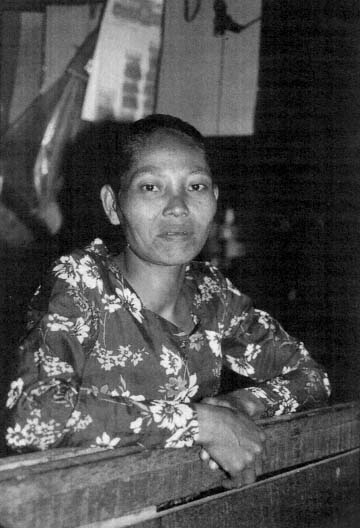
Figure 24.
Mak Zaini
knowledge, though I have seen Kak Suzaini make scathing remarks about her second husband in front of her youngest daughter (who the man fathered). Significantly, however, these diatribes were confined to the shortcomings of the second husband and were not generalized to any other men, let alone to men as a whole.
One of the major arenas in which women resist official representations of femininity (and masculinity) is the office of the Islamic magistrate (kadi ), which, as noted earlier, handles what is often referred to as "family law" (marriage and divorce, failure to provide wives and children with material support). Such resistance occurs in numerous ways, the most overt of which involves direct verbal challenging of husbands and the heaping upon them of insults and other forms of verbal abuse (calling them liars, animals, etc.). While one might assume that the magistrate's office is relatively unreceptive to such forms of resistance, this is not really the case or, in any event, is only partly true. The kadi and his staff, including especially the "women's official" (pegawai wanita )—who processes and otherwise handles most cases and endeavors to resolve them so that they do not require the kadi 's adjudication—operate with many of the same assumptions about male and female livers, temperaments, personalities, and overall "natures" as do villagers themselves. Such officials do, moreover, feel that most of the problems in marriage, and much of the "fault" in divorce, stem from men who are delinquent in their roles as husbands and fathers. Thus, while many women find the relatively formal environment of the kadi 's office initially intimidating and otherwise off-putting, once they begin talking with the magistrate's staff they tend both to overcome many of their inhibitions, and to speak and behave in other ways which indicate that they are relatively free of the linguistic and other constraints that normally bear upon women (and to a lesser degree men).
The catch of course is that women's relatively unrestrained behavior in these (and other) contexts can easily reinforce official discourses that portray them as having more "passion" and less "reason" than men. In other words, the very recounting of narratives of male irresponsibility and female virtue sometimes conveys messages which are diametrically opposed to those encoded in the "contents" of the narratives in question, and which are in any event the opposite of those intended. Phrased in broader terms, female resistance of this sort sometimes involves what Denys Turner (1983) refers to as "performative contradictions" inasmuch as it bolsters and helps reproduce the conceptual and other legitimizing structures that undergird the gendered distribution of power and prestige in the first place. The same is true of female predominance in spirit possession, which, as we have seen (chap. 4), has been interpreted by some observers as resistance to one or another form of men's control over women.
There is much more that could be said about issues of the latter sort, but I would like to proceed to a discussion of the three sets of variables
that have served to constrain the development and elaboration of oppositional discourses within the context(s) of village society and culture. One such variable (alluded to earlier) is the allocation of prestige in terms of households, which tend to be—and, in the case of the wealthy, almost invariably are—composed of men and women alike. (Prestige is also allocated with respect to lineages [and localized clans], but this is less directly relevant here.) The pooling of household resources (including labor) for the purpose of advancing or at least maintaining the prestige standing of one's household vis-à-vis other households both presupposes and promotes day-to-day economic and other cooperation between husband and wife. It also involves husband and wife conceptualizing their needs and strategies with respect to the satisfaction of subsistence concerns and the attainment of prestige—and their place(s) in the world generally—in relation to their household. Bear in mind, too, that the household is the locus of the individual's most intimate and, in many respects, most sustaining and meaningful social interactions. In sum, the primacy of the household in terms of the allocation of prestige, and with respect to economic matters (production, consumption, and exchange), social identity, and emotional sustenance works against the development and cultural realization of gender-based interest groups, and in these and other ways inhibits the (further) elaboration of oppositional discourses (though it obviously doesn't preclude their existence in the first place).
A second, related variable is the historically specific construction of personhood, social adulthood, and adult womanhood especially. In order to be a full-fledged social adult, one must enter into a legitimate marriage (with a socially approved member of the opposite sex), and bear or father (or adopt) children. For women, this involves not only being defined as a particular man's wife (or ex-wife or widow) and the mother of a particular man's children, but also, as noted earlier, experiencing a potentially extended (but in some cases very brief) period of economic dependence on (though not necessarily co-residence with) a particular man. The relational components of women's identity that focus on women's roles as wives and mothers have become highly salient over the course of the past century as a consequence of the historic restructuring of femininity that occurred as a result of state-sponsored changes of the sort that effected a realignment of the constituent elements of masculinity. In the case of femininity, the changes have entailed the historical deemphasis of women's roles as daughters, (natural and classificatory) sisters, and sisters' daughters, and, as just noted, a foregrounding of their roles as wives and mothers. The factors responsible for such shifts include the economically
and politically engendered erosion of a broadly encompassing clanship, and the weakening and contraction of the siblingship undergirding it, as well as the demise of various forms of predominantly female labor exchange associated with the agricultural cycle, which, in former times, drew heavily on women as (natural and classificatory) sisters.
Clearly relevant, too, of course, is the recent resurgence of Islam, which has been animated and sustained in no small measure by ethnic and class tensions and nationalist and transnational discourse. The doctrines of Islam (like those of Buddhism, Christianity, and the other Great Religions) focus on, and, more importantly, are interpreted locally as focusing on, women's roles as wives and mothers rather than as daughters and sisters. More to the point, Malaysia's Islamic resurgence (the dakwa movement), which is a largely urban-based, primarily middle-class phenomenon, has highlighted and endeavored to restrict women's sexuality and bodily processes, and has in these and other ways (e.g., through "pro-natalist programs" [Stivens 1987]) emphasized women's roles in biological reproduction along with their other "natural functions." Somewhat paradoxically, the involvement of young Malay women in high-tech factory work in "free trade zones" and elsewhere since the 1970s has had some of the same ideological effects as the Islamic resurgence, for, as mentioned earlier, images of factory women, aside from being exceedingly negative, center on their alleged sexual promiscuity.[9] In short, religious, economic, and attendant developments of the sort noted here have served to define women in relation to men, and as mothers, wives, and sexual (hence "passionate") beings in particular, and have thus effectively promoted official discourses on gender and simultaneously constrained the development and elaboration of oppositional discourses.[10]
A third variable which inhibits the elaboration of oppositional discourses relates to the fact that village men and women alike espouse various features of practical (as well as official) views of masculinity and femininity.[11] This may seem paradoxical and/or tautological, but the paradox and tautology, I would argue, are more apparent than real. It is in certain crucial respects much easier to conceive of and develop an oppositional discourse when those against whom it is arrayed or deployed operate with a seamless, rigid, uncompromising, thoroughly self-congratulatory and Other-despising set of assumptions about the way things—and social relations—are and should be. But this is not the case in Negeri Sembilan (or in other parts of the Peninsula), where men's and women's views of gender difference and sameness are in many respects quite similar: Men and women do, after all, operate with the same overarching framework (of
"reason" and "passion") in terms of which gender is experienced, understood, and represented; and even the most extreme contrasts between men's and women's views on gender involve little more than a structural inversion of relationships among the principal signs or signifiers of the framework. More importantly, because many men, especially elite men, espouse views of gender which are far from seamless, uncompromising, thoroughly self-congratulatory or Other-(i.e., female-) despising, they effectively preempt charges and help put to rest women's suspicions that men are trafficking in thoroughly distorting or mystifying discourses. For reasons such as these (and others noted earlier) the discourses of men help constrain the elaboration of oppositional discourses on the part of women, even though they simultaneously provide legitimate moral space for their existence in the first place. Phrased in broader and more abstract terms: Dominant ideological formations both produce and limit the forms, scope, and force of the challenges with which they must invariably contend (see Williams 1977:114; see also Willis 1977; Scott 1985).
Final Remarks
There are, finally, two other sets of issues that merit brief comment. The first relates to Ong's important observations that the sexual promiscuity and dubious morality imputed to young Malay women working in factories in the state of Selangor and elsewhere is, among other things, a register of Malays' profound moral ambivalences about the rapidly changing nature of their "lived relations to the world": most notably, their historically stepped-up involvement in and dependence on the vagaries of the global economy, the transgressions of traditional moral injunctions that such involvement and dependence necessarily entails, and the mystical and other dangers associated with such transgressions (Ong 1988, 1990a, 1990b). To the extent that female factory workers are among the most exploited members of the Malaysian work force, the denigration of such women, and the heaping upon them of blame for threatening the Malay "imagined community" (Anderson 1983), may be seen as yet another ethnographic example of the distressingly widespread ideological phenomenon known as "blaming the victim." A similar type of victim-blaming ideology infuses practical representations of masculinity in Negeri Sembilan, especially those naturalizing, dehistoricizing, and eternalizing representations which attribute to men's "innate" behavior most of the problems in marriage and much of the "fault" in divorce. Interestingly, representations which blame men (male "human nature") in blanket
terms for the dissolution of conjugal and familial bonds (and other social ills and threats to the imagined community) are not only thoroughly mute with respect to the specific kinship roles and social classes of men whose behavior (on closer [analytic] inspection) fuels such representations. They are also blind to the material and other conditions of their own (re)production. As such—and regardless of the structural or other variables responsible for their existence—they clearly help divert attention away from the broadly encompassing realities of historical change and contemporary political economy which have engendered land shortages and highly inequitable distributions of wealth, power, and prestige, and which are responsible for a situation in which, as one observer put it (with reference to the state of Kedah), "poverty itself appears to dissolve marriages" (Banks 1983:100).[12] Stated differently, while such representations foreground local cultural views of the indissoluble links between the domains of gender and kinship (and marriage), they simultaneously help bring about (but do not fully effect) a mythical sealing off of such domains from all ravages and other entailments of history and political economy. In these and other ways they serve to define the most serious threats to the imagined community as arising from within the Malay community itself (much like the recently emergent discourses on Malay factory women). This despite the fact that in a good many contexts Malays in Negeri Sembilan and elsewhere are quick to argue that the most fundamental obstacles and dangers to the social and cultural reproduction of the Malay community are posed by non-Malays—Indians and especially Chinese, who, taken together, make up roughly half of Malaysia's population—and the state strategies and policies that are responsible both for their existence in Malaysia in the first place and for their economic prosperity relative to Malays.
The second (and final) issue bears on Lévi-Strauss's insightful, often quoted (1949) remark that "Even before slavery or class domination existed, men built an approach to women that would serve one day to introduce differences among us all."[13] One need not accept this particular (androcentric) formulation of the historical primacy of gender with respect to the development of difference to appreciate that Lévi-Strauss is on to something important here (cf. Bloch 1989:136; Heng and Devan 1992; March 1984). That something is that indeterminacies, paradoxes, and contradictions in representations of gender are, at least potentially, the most profoundly subversive challenges to all ideologies of social order. Such is the case partly because gender differences are among the earliest, least conscious, and most fundamental differences internalized in all societies,
though arguably more relevant is that symbols, idioms, and entire ideologies bearing on gender are rarely if ever simply "about" gender. Because they are also "about" kinship, human nature, and sociality—as well as relations of equality/hierarchy, inclusion/exclusion, and the like—challenges to such ideologies necessarily constitute deeply unsettling threats to the most basic categories through which we experience, understand, and represent our selves, intimate (and not so intimate) others, and the universe as a whole. This is perhaps especially so when such ideologies serve to mark and legitimize class and ethnic/racial distinctions, as clearly occurs in many societies, including Negeri Sembilan. (Recall, among other things, that in Negeri Sembilan and for Malays elsewhere in the Peninsula the exercise [or absence] of restraint is an ethnic/racial marker that is heavily [albeit never explicitly] gendered inasmuch as "other races" are quickly characterized in terms of the relative lack of restraint that official discourse attributes to and defines as a key feature of [Malay] womanhood.) In such instances, challenges to ideologies bearing on gender cannot help but raise questions and doubts about the conceptual bases and legitimacy of class and ethnic/racial hierarchies and the state structures and nationalist discourses that help sustain them, though the extent to which such questions and doubts are explicitly articulated or culturally realized is of course contextually specific and otherwise highly variable.
The widely redounding and potentially limitless scope of such ideologies—to say nothing of their psychological, social, and moral force—is more than sufficient reason to strive to ensure that our descriptions and analyses of gender encompass the study of women and men alike, and that they be informed by an understanding of official representations of gender (and kinship) as well as their practical counterparts. More generally, the highly expansive scope and other features of such ideologies should serve as a clear reminder that gender systems are not intelligible as isolated phenomena, and are in fact most usefully examined in terms of theoretical frameworks which analyze gender in relation to other axes of difference and inequality as well as quotidian social process and the encompassing realities of prestige, political economy, and historical change.