
Madhu Nath's Stories in Synopsis
It has been said of at least one Indian epic—and may be true of most—that no one ever hears it for the first time. Western readers, who have not participated from childhood in the culture that produces these stories, may need a "pony." Throughout these introductory chapters I often talk about events and characters in Madhu Nath's versions of Bharthari and Gopi Chand. Therefore, as points of reference for those citations, I offer skeletal plot summaries in advance, segmented and ordered according to Madhu Nath's performance as it is translated in this book (see also figs. 4 and 5).
Bharthari's "Birth Story" (part 1) describes how his father was cursed by his own father to enter a donkey's womb. The donkey suc-
[12] Episodes for Bharthari included Pingala's sati and Bharthari's encounter with Gorakh Nath at the funeral pyre (both in part 2), as well as Bharthari's begging and Pingala's lament (part 3). For Gopi Chand most commonly cited were his mother's instructions (part 1), his begging from Patam De Rani (part 2), his troubles with the lady magicians (part 3), and his farewell to his sister (part 3).
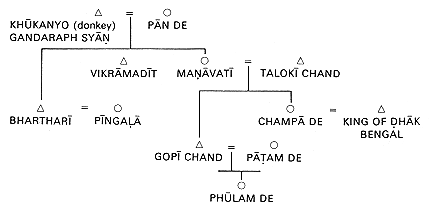
4. Family relationships in the tales of King Gopi Chand and King Bharthari.
ceeds after lengthy efforts in marrying a princess and founding a city, Dhara Nagar, where his three offspring—Bharthari, Vikramaditya, and Manavati—are born.
In part 2, Bharthari is king of Dhara Nagar and married to Queen Pingala. He rides out hunting and kills a stag, whose seven hundred fifty does, widowed, curse King Bharthari that his women will weep in the Color Palace as they do in the jungle. They then hurl themselves on the dead buck's antlers and thus commit sati .[13] Bharthari wonders if his own wife is equally devoted. He sends her a handkerchief soaked in deer's blood with the message that he is dead. Pingala knows this is a test but decides to die anyway. Bharthari has other adventures in the forest but eventually returns home to find Pingala a heap of ashes. He goes mad with remorse, until the yogi guru Gorakh Nath arrives, demonstrates the illusory nature of life and death, and finally restores Pingala to the king.
Part 3 finds Bharthari sleepless and unsatisfied. Convinced that nothing in the fluctuating world matters, he abandons his wife and renounces his throne to seek initiation from Gorakh, who sends him back to the palace to beg alms from Pingala and call her "Mother."
[13] Although the common image of a sati is of a woman who chooses to be cremated alive on her husband's funeral pyre, any style of death may be called sati if through it a female follows a beloved male.
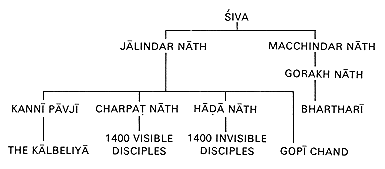
5. Nath guru-disciple lineages in the tales of King Gopi Chand and King Bharthari.
She reproaches him but gives the alms. This difficult task accomplished, Bharthari returns to Gorakh Nath's campfire.
Gopi Chand's "Birth Story" (part 1) opens with Manavati (Bharthari's sister, married into "Gaur Bengal") instructing her only son, Gopi Chand: "Be a yogi." She then reveals in a long flashback how she obtained the boon of a son from Lord Shiva although no son was written in her fate. In order not to break his promise, Shiva allows her to borrow one of the yogi Jalindar Nath's disciples, and she chooses Gopi Chand. The loan has a limit: after twelve years of ruling the kingdom, Gopi Chand must become a yogi or die. As a wandering ascetic, however, he will gain immortality. Gopi Chand, possessing eleven hundred wives and sixteen hundred slave girls, is not pleased with his mother's bargain.
In part 2 Gopi Chand tries to get rid of the guru by putting him down a well. But it is Gopi Chand who dies, and only the power of yogis saves him. Restored to his palace, he follows his mother's instructions and has his ears cut by Jalindar. The guru then sends him to beg alms from Queen Patam De, his chief wife, and to call her "Mother." Although Patam De finally fills his alms bowl, when her mother-in-law literally twists her arm, Jalindar has to rescue Gopi Chand from the palace, where he is surrounded by weeping women.
Against his mother's and guru's advice, Gopi Chand heads for Dhaka in Bengal to say goodbye to his sister, Champa De Rani (part 3). On the way he is harassed by seven lady magicians who transform him into various animals and abuse him. Jalindar sends a party of yogis to rescue him but it fails. The guru himself then accompanies
a second group, which succeeds. Gopi Chand proceeds to his sister's; she dies of grief in his arms but is brought back to life by Jalindar. Gopi Chand spends some happy time with her and then leaves alone.
In part 4 a dispute arises between,Jalindar's disciple Kanni Pavji and Gorakh Nath. Kanni Pavji tells Gorakh that his guru, Machhindar Nath, is enjoying women and lathering sons in Bengal; Gorakh tells Kanni Pavji that his guru,Jalindar, is at the bottom of a well. Gorakh goes to Bengal and rescues Machhindar, destroying his wives and sons along the way. Gorakh then brings seven species of locusts out of the well, tricks, Jalindar into giving immortality to Gopi Chand and Bharthari, and convinces him to emerge. All the great yogis then feast one another. At Gorakh Nath's "wish-feast" Kanni Pavji's disciples wish for improper foods and are degraded.