
An Introduction To The Villages And Their Settings
Gambel
Gambell, situated at the northwestern tip of St. Lawrence Island in the Bering Sea, is located at 63°38'N, 171°50'W. The island, located 40 miles south of Siberia's Chukotsky Peninsula and 200 miles west of Nome, is about 100 miles long by 20 miles wide. It is primarily basaltic and is dotted with several volcanic cones and many lakes, three of which are quite large. The area near
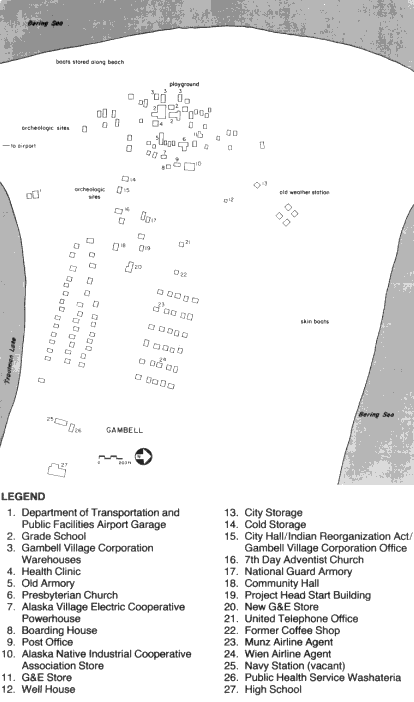
Map 2.
Gambell
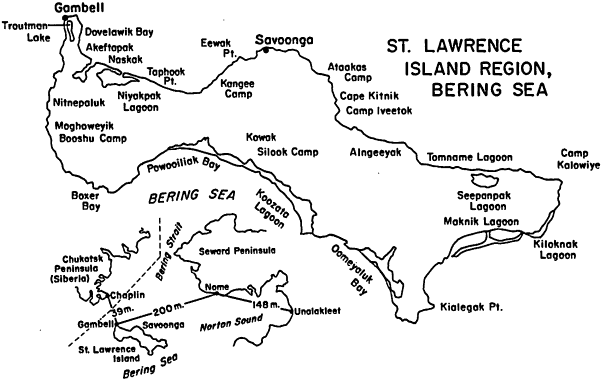
Map 3.
St. Lawrence Island Region, Bering Sea
Gambell comprises both igneous and sedimentary formations. Lagoons are frequent around the shoreline, and many short-course rivers empty into them or directly into the Bering Sea.
In 1970, just prior to ANCSA, the Gambell population was 372. It had grown to 465 by 1982 and 522 by 1989. About 15 nonnatives reside in Gambell. The 25 percent population increase in the first eleven years following ANCSA and the 12 percent population increase since 1982 represent far more rapid growth than had been experienced at Gambell since the turn of the century.
Infrastructure, Utilities, And Services
Gambell enjoys few conveniences of public infrastructure. It has few public buildings and does not have sewers, running water, or an all-weather airport. Air transport has become the major form of transportation in the Alaskan bush. To be without an all-weather airport means that transportation is limited to windows of good weather, and in a fog-enshrouded village such as Gambell, there is not a lot of good weather for flying. The village has some public conveniences, such as a community "washateria" (automatic clothes washers and a public bath) and community water pumps. Water for culinary and other household uses is hauled from community pumping sites and distributed at each house.
Gambell is electrified, although electricity is not cheap, costing 49.5 cents per kilowatt-hour in the 1980s. The state of Alaska absorbs 12 cents of each kilowatt-hour cost through an "equalization" program,[2] but even 37.5 cents per kilowatt-hour causes Gambell households to use electricity with great care. Gambell houses are heated by oil. In the early 1980s, the average household paid about $2,700 annually for heating oil. There is no timber or outcroppings of coal and very little driftwood on St. Lawrence Island, so coal or wood-burning stoves are not used.
[2] "Equalization" formulas for energy costs vary by villages and by the household needs, so all villages do not receive the same amount of assistance per kwhr from the State of Alaska.
Regularly scheduled bush flights from Nome, weather permitting, carry mail, freight, and passengers to and from Gam-bell. The almost ever-present cloud cover and recurrent nasty Bering Sea storms cause frequent flight cancellations of the small, twin-engine Cessnas and Otters that fly between Nome and Gambell. Flights, which should occur about twice a week, are often delayed for two weeks by unfavorable weather.
Most of the heavy freight to the village, such as skiffs, outboard motors, snowmachines, all-terrain cycles, building supplies, oil furnaces, and canned goods, arrives on the two annual visits (one going north and one coming south) of the BIA's ship, the North Star . The ship sets anchor offshore, and the freight is brought in on a barge. Oil is also lightered from a distributor in Norton Sound.
The state of Alaska received billions of dollars in revenues from Prudhoe Bay oil operations during the late 1970s and early 1980s. It redistributed many of these funds to projects statewide, including among the native villages. In Gambell, state and federal funds were used to construct a small community center, which houses three village organizations—the village profit corporation, the city government, and the IRA government. Federal funds were also used to construct over thirty houses for Gambell families.
Corporation And Government
Under ANCSA's mandated provisions, Gambell chartered the Sivuqaq Native Corporation (SNC) as its for-profit village corporation. It is guided by an elected Board of Directors who serve without remuneration. It also has an IRA government, which serves as its nonprofit corporation, and a city government.
The passage of ANCSA threatened St. Lawrence Island's residents because that act stripped the island of its reservation trust status. The residents feared the irretrievable loss of the island, the loss of their subsistence base, and undesired alterations to their life-styles. Rather than participate in the Bering Straits Regional Corporation (profit) and receive cash distributions and some land conveyance through ANCSA's provisions,
the St. Lawrence villagers in both Gambell and Savoonga chose to use a provision of ANCSA that allowed them to take patent-in-fee title to land (both surface and subsurface ownership). The two village corporations received title to the 1.1-million-acre island—a land allocation three and one-half times greater than would have been received if they had accepted the cash award and the accompanying more modest land award.
Gambell's IRA government constituted the village's nonprofit corporation. Its access to funds is limited to the grants, awards, and contracts that are available from the federal government, some of which are channeled through Kawerak, the regional nonprofit corporation. Many of Kawerak's leaders, including its director, are residents of the island and are, or have been, active in Gambell and Savoonga IRAs. Through Kawerak, St. Lawrence Island natives have been instrumental in guiding many regional affairs, from commissioning subsistence studies to sponsoring conferences for elders. Other St. Lawrence Islanders who are very active in village affairs have headed Eskimo organizations, such as the Eskimo Whaling Commission and the Eskimo Walrus Commission, that defend the interests of Eskimos residing in several regions.
The Gambell IRA council provides guidance and counsel concerning the stewardship of the island. It shares responsibility for the island with the Savoonga IRA.
Both St. Lawrence Island villages are second-class cities. The Gambell city council seeks state block grants and other programs, including housing, community improvements, and social services. The IRA councils and city councils of the two St. Lawrence Island villages ostensibly have different spheres of authority and are intended to be distinct. Yet the dose coordination and similarities of interests and opinions between the members of the IRA and city councils in each village create consensus without acrimony on decisions made by either group. Moreover, officials move from one council to the other, forming a pool of respected leaders. Promising young people, usually men, are drawn into the pool.
The SNC owns the island in conjunction with Savoonga's native corporation: neither can overrule the other. A sine qua non of native corporation practice in Gambell is that the Board
of Directors does not act independently and on its own counsel. Rather, the corporation is seen as a public institution, and de facto, not de jure, the SNC's Board of Directors makes crucial decisions for the village in consultation and consensus with the IRA and city leadership.
The three organizations in Gambell each have seven-member Boards of Directors, and the boards hold joint meetings one or more times annually. The importance villagers place on the IRA form of government is most apparent. Many are not comfortable with the separation of spheres of authority among economic, political, and social and health service delivery institutions. Thoughtful, traditional counsel to incorporate all of these functions is synonymous with St. Lawrence Island life: economy, polity, kinship, and counsel are embedded in one another.
Gambell residents regard the SNC as a public institution, whose interests are identical to those of the IRA. During the period of field research, several community leaders explored ways to dissolve the SNC and reconstitute all resources and power under the IRA. In this way they hoped to regain federal trust status for the island. Thus, its removal from the state's tax roll could be effected, while obviating hostile purchase of the corporation in 1991—a distinct possibility under ANCSA's original provisions. If necessary, the villagers were willing to forsake their city charters, but they did not want to lose any state benefits to which they were entitled.
SNC operates a retail store and a house that it seeks to rent to researchers, public servants, antique ivory buyers, and the occasional bird-watcher who visits the village. The store lost money throughout the 1970s and early 1980s. The obstacles to profitable development of any SNC venture are imposing. They include the long distances to and from markets, the modest amounts of cash that reach the village each year, the lack of either a resource base or adequate occupational skills among natives, and severely limited access to capital—federal, state, or private sources.
Removal of these obstacles is a prerequisite for the development of businesses that can penetrate the market at any level. Furthermore, the meager funds that make their way to the
village must be put to immediate ends, such as clothing, fuel for heating and transportation, technology to extract naturally occurring resources and to make trips safer (e.g., snow-machines, motorboats, rifles, guns, nets, ammunition, radar, sonar, radios), and supplementary foods. Thus, the multiplier potential of the cash within the village is severely limited. Local revenues are modest, and the local sales taxes authorized by the city council are used for public projects and organizations benefiting the entire village, such as providing funds to the IRA.
Schools And Education In Gambell
The Bureau of Indian Affairs operates a grade school in Gam-bell. Since the mid-1970s, a state-funded high school has accommodated the secondary grades.[3] In the past, students received their secondary educations on the mainland. Now that Gambell high school students remain at home, an unintended consequence has been that students participate in subsistence skills year-round, especially from spring through early fall when intensive extraction occurs.
Dependency And The Importance Of The Public Sector
The Gambol cash economy is heavily dependent on transfers of public funds. In 1982, there were not sufficient full-time and part-time jobs in Gambell to provide one per household. Public funds were the basis for the vast majority of those jobs. The few jobs in the private sector were themselves secondarily dependent on public funds, such as purchases by schoolteachers, travel by public servants, and purchases by welfare recipients. The majority of the full-time jobs available in the village were held by nonnatives—jobs such as teaching school, but also including waste collection and disposal. Natives have not qualified for the teaching positions, and they eschew the sole waste collection-disposal job. More than half the households in the village have no wage earners.
[3] Gambell, originally called Sivuqaq by its residents, was renamed following the death of Presbyterian missionary Verne C. Gambell in 1898.
The need for cash is pressing, and it is gained in many ways: through paid participation in the local unit of the National Guard; through public transfers of income in some form, such as energy assistance, food stamps, or Aid to Families with Dependent Children; through sales of ivory carvings excavated from old village sites; and through ivory carving and seal skin sewing. The St. Lawrence carvers are world renowned. The income from carving provides the major source of almost all household incomes, but even the modest sums from transfers and the National Guard are important to sustenance.
Christianity
The Presbyterian church is the dominant Christian denomination in the village, numbering 365 members. More recently, several families converted to Seventh Day Adventism, and that congregation now numbers 90. Six Baptists reside in the village. About half of the members of the two larger denominations regularly attend services.
The Environment
Gambell's environment is cold, moist, and fog enshrouded, with only about thirty clear days annually. Yet the wind and water currents of the Bering Sea moderate Gambell's climate in the winter and influence its relative harshness during the summer. For example, during the winter months, there are often leads (openings in the pack ice) close to the village, making it possible to hunt walrus, even though pack ice surrounds the island for about six months a year. Winter temperatures around 4°F and summer temperatures around 4l°F are in the middle of the expected ranges—very narrow ranges at that—for those seasons.
During both summer and winter, persistent winds of over 20 knots are commonplace. In combination with the low temperatures in winter months and the relatively low temperatures during summer months, the winds pose an omnipresent windchill threat to the islanders as do storms over the Bering Sea which interrupt transport.
The island vegetation is subarctic tundra comprising low
willow and birch shrub, lichens, black crowberry, cranberry, cloudberry, and spring-beauty. There are no large land mammals other than the reindeer herd that is managed by Savoonga which resides on the island year-round, but arctic foxes, tundra voles, snails, and slugs abound.
Salmon enter some of the rivers during the summers, and resident whitefish and char migrate down some of those same rivers during the spring and return during the fall. The coastal waters and lagoons are frequented by several saltwater fish species, particularly tomcod, saffron cod, blue cod, sculpin, and herring.
Seabirds and waterfowl in remarkable quantities nest during summer months on the island, while other varieties stop over in their annual migrations. Birds are hunted, and eggs are collected from nests on the cliffs of the island.
Marine mammals, especially walrus but also several species of seals and whales, inhabit nearby waters or migrate past the island. These mammals provide the most important staple of St. Lawrence Islander existence. Polar bears, which migrate south to the island during the winter months as the ice cap attaches to the island, are also hunted.
The bowhead whale is the animal most desired by Gambell residents. The bowhead has symbolic value, is preferred for its taste, and is desired as an item that can be given as a gift to relatives and friends at home, in distant villages, and in dries as far away as San Francisco and Albuquerque. It is also regulated without force of law by the International Whaling Commission (IWC) in which the U.S. government participates. An annual quota determined by the IWC is placed on the number of bowhead whales that Gambell hunters can strike (two per year, whether or not they are landed). The controversy surrounding the extraction of bowhead whales is conjoined in the native view with ANCSA, oil and gas company extractions of nonrenewable resources, state and federal arrogation of controls over naturally recurring resources, the expropriation of native land throughout Alaska, and ultimate domination of native affairs by state and federal governments.
The relative poverty of Gambell is not apparent, perhaps, from the foregoing, nor will it be apparent on reading the
thumbnail sketches of Unalakleet and Wainwright. But the differences are marked, and they will become more obvious later.
Unalakleet
Situated on a spit at the mouth of the Unalakleet River, Unalakleet is backed by the Nulato Hills and fronted by Norton Sound, the easternmost waters of the Bering Sea. The village is located at 65°52'N, 160°47'W. It is about 400 miles northwest of Anchorage and 150 miles southeast of Nome. Nome is the region's economic, transportation, and political hub.
In 1970, just prior to the passage of ANCSA, Unalakleet's population totaled 434. In 1982, it had increased by 82 percent to 790. In the 1980s, about 12 percent of the total were nonnatives, and all of the nonnative adults were employed either by state or regional institutions. The proportional increase between 1970 and 1982 was not phenomenal, as the Unalakleet population had waxed and waned over the previous 150 years.
The sheer size of the population alarms the villagers, because of the demands that are being placed on the naturally occurring resources and because of the changes that are occurring at such a rapid clip. As a secondary transportation hub with considerable infrastructure and an attractive, resource-rich setting, Unalakleet has become a preferred site for the location (and relocation) of regional public agencies.
Infrastructure, Utilities, And Services
Unalakleet is electrified and has a water system, a sewer system, and a liquid waste disposal system. Its all-weather airport, with two gravel runways, accommodated scheduled jet flights (Boeing 737) three times a week from Anchorage as well as regularly scheduled flights of smaller commercial aircraft.
Unalakleet is home base to the largest and most successful commercial bush airline in Alaska (Ryan Air) owned by a local native family. Ryan Air moved persons and freight among the villages of Norton Sound, St. Lawrence Island, and Nome from its Unalakleet and Nome bases.
Most of the 170 houses in the village were built under several
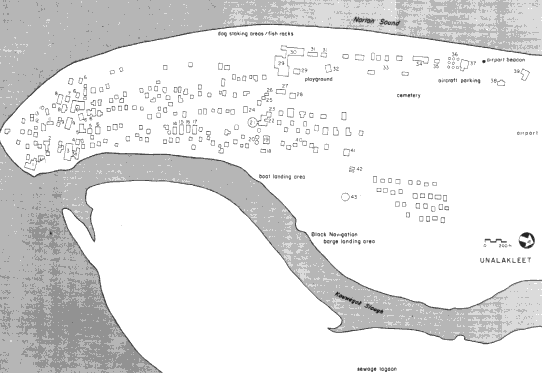
|
Map 4.
Unalakleet
IRA government, Housing and Urban Development (HUD), and state housing projects between the early 1950s and the 1970s. The newer houses, like those built earlier, are heated by wood- or oil-burning stoves.
Eeucation
The Swedish Covenant School—a twelve-grade boarding school that draws students from Unalakleet and other villages within about a 500-mile radius-and a state elementary and high school are located in town, as are the offices of the Bering Straits School District (BSSD). The influx of employees of the school district offices, relocated from Nome in 1982, accounts for 60 percent of the Unalakleet population increase since 1980 (from 632 to 790).
Public And Private Sectors Of The Local Economy
Whereas commercial trapping supplements many family incomes, as does commercial fishing, and although many gain their principal cash income from commercial fishing, it is the public sector that currently drives Unalakleet's economy. The passage of ANCSA had profound effects on the village. Unalakleet created a for-profit corporation, a nonprofit corporation, and also became a chartered second-class city.
The IRA government, which had been the village's key institution for thirty years, was reshaped as the village's nonprofit corporation, through which federal programs made available to Native Americans have been channeled and administered. The IRA government has a five-member council that controls tribal operations and works with Kawerak, Inc., in sponsoring various programs for the village and region, such as boat-budding classes. It also administers many of the federal programs that play significant roles in village affairs, such as social services.
The IRA government serves long-term native interests in the environment and also represents native culture in village affairs, particularly in dealing with persons and institutions in the
village. The IRA leaders work well with elected and appointed officials in the city government (which includes both natives and nonnatives) and in the Unalakleet Native Corporation (the village for-profit corporation). In numerous instances from the earliest to the most recent (February 1989) visits to Unalakleet, we have noted that IRA leaders provide counsel to guide the villagers over rough places and through fight situations. Their lead, although shared by city council members, was followed by heads of other institutions on all of the crucial issues that confronted the village.
The City of Unalakleet, incorporated in 1974, has a seven-member city council from which a mayor and a vice-mayor are elected. Although nonnatives recently have comprised the majority of council members, the mayor and vice-mayor are natives, and the directions taken by the council are agreed on through discussions among IRA and city leaders. The city government appears to be the surrogate for the pre-ANCSA IRA government. The cooperation and coordination of the city council and the IRA council are evident in all important decisions. The city government is not simply the reconstituted government half of the old IRA, because it provides Unalakleet with state revenue-sharing funds and access to block grants for municipal purposes. It levies taxes, provides police protection, provides fire-fighting equipment, maintains the roads, and so forth.
The shareholders of the Unalakleet Native Corporation (UNC) elect an eight-member Board of Directors, which, in turn, elects its chairman. The UNC began with 829 original native shareholders, all born prior to December 18, 1971, each with 100 shares of stock. The UNC received 100,000 acres from the Bering Straits Regional Corporation through conveyance and is scheduled to receive another 61,280 acres. The UNC, in turn, is conveying some of the acreage to shareholders. The corporation acquires funds to conduct business through the $962 million settlement award that accompanied ANCSA.
The UNC operates a grocery and dry goods store in competition with the Alaska Commercial Company's (ACC) similar operation in Unalakleet. The two also compete in snowmachine,
outboard motor, and all-terrain cycle (ATC) repairs. The UNC has created a construction contracting division and has been successful in garnering public funds for several construction projects, including buildings and roads.
The UNC has hired several managers since its creation, usually local natives, although from 1982 to 1984, the UNC manager was an enrolled member of a Nevada Indian tribe (Washo). Unalakleet's villagers regard the UNC as a public institution whose interests are identical to those of the IRA. It is not merely a shareholder corporation in their view. In a similar vein, the members of the board work closely with the IRA and the city leadership on almost all policy issues.
The Norton Sound Fishermen's Cooperative (NSFC) is presided over by the same group of native men who serve as dry, IRA, and UNC leaders. These men change positions in and among organizations, and a few drop out of public service for a year or so at a time, but the overlapping nature of personal roles in governing bodies is well established and generates real consensus among institutions.
Since enactment of ANCSA, Unalaldeet villagers have been drawn deeply into public sector dependencies. But Unalakleet natives have also increased their participation in private sectors of the market economy, principally through commercial fishing and less so through trapping and the sale of by-products from subsistence activities. Significantly, the private sector activities of native villagers are based on the harvests of naturally occurring, renewable resources. Even these items require assistance, financial in particular, from various arms of the public sector.
Recognition of the role played by the public sector can be gained from the village's job structure. In 1982, there was more than one permanent, full-time job per household in Unalakleet. About half of the jobs were held by natives. More than four out of five of all full-time jobs were in the public sector. The remainder were possible only because of public sector expenditures, such as publicly funded passengers riding in aircraft—guided and regnlated by FAA equipment and personnel and landing on federally constructed and maintained runways—to survey projects to be paid for by public sector funds.
Christianity
The Swedish Evangelical Mission church (currently, the Swedish Evangelical Covenant church) is the dominant religious influence in the village today. A Catholic priest took up residence in 1982 to accommodate several Catholic families in town.
The Environment
The Unalakleet River rises in the Kaltag Mountains about fifty miles northeast of the village. Many tributaries feed the Unalakleet, some rising in the Andreafsky Range to the south and others rising in the Debauch Mountains to the north. The Unalakleet system is separated from the Yukon River by the former and from the Shaktoolik River by the latter. The hills and mountains that are dissected by the Unalakleet system are Wooded, predominantly by alpine spruce. Willow and birch shrub, sedges, and forbs are important constituents in the wet tundra, and bilberry, cloudberry, and birch are important constituents in the moist higher tundra.
The Unalakleet River system teems with spawning salmon during the summer months and hosts sea-run char, whitefish, and grayling that enter the river to spawn and stay for eight or nine months to feast on salmon eggs and salmon grilse (fry). In addition, brown bears wade into the river and fish for migrating or spent salmon. Brown bears also pilfer salmon from the villagers' drying racks and from their set nets (bears strip nets of their fish by standing near the shore and cleaning the nets as they haul them in—paw over paw). These bears are joined by the black bears and the villagers themselves in harvesting the vast quantifies of berries and the more limited quantities of roots that mature each year.
The tundra to the north and to the south supports the caribou herd, which, although diminished from its considerable size of over a century ago, is increasing in numbers. The willows and sedges along the river system are inhabited by moose, while snowshoe hares and willow ptarmigan inhabit the moist willow
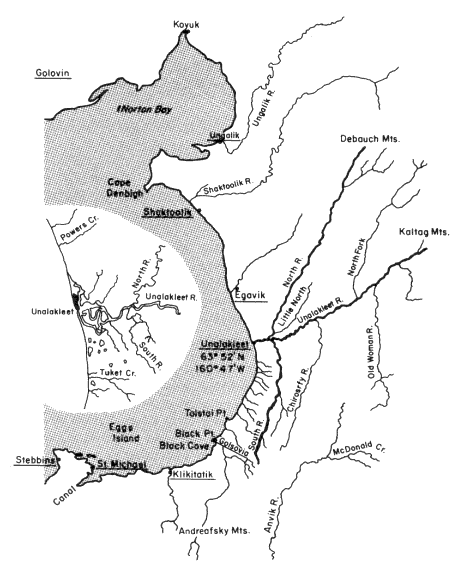
Map 5.
Eastern Norton Sound Region (Villages Underlined)
tundra nearby. Arctic hares and spruce grouse claim the higher reaches and the wooded zones.
The tidal marshes of Norton Sound support several species of invertebrates and fish, which are feasted on by migratory and nesting shorebirds, seabirds, and waterfowl. There is kelp in which fish hide and eat and spawn. Many species of sea mammals feast on the marine invertebrates and fish of the area. These resources, from the herring roe-on-kelp to the beluga whale and the whistling swan, are harvested by Unalakleet villagers, as they have been for more than twenty centuries. Except for salmon, berries, birds, and eggs, the Unalakleet environment of the early 1980s does not yield an absolute surfeit of any natural resource, but there is such a multiplicity of resources available at different times throughout the year that it is appropriate to call the place "bountiful." It is also exquisitely beautiful in all seasons, even though winter winds up to 60 knots and temperatures near -20°F are not uncommon.
Wainwright
Wainwright is located 300 miles north of the Arctic Circle on the coast of the Chukchi Sea at 70°40'N, 159°50'W. The arctic tundra bluffs on which the village sits rise twenty feet above a narrow beach. The landmass to the west narrows to a spit separating the Kuuk Lagoon from the sea. Barrow, a 3,000-resident village 90 miles to the northeast, is the center of political and economic affairs for all North Slope villages. The village of Point Lay is 100 miles to the southwest.
Wainwright was created as a permanent village site at the turn of the twentieth century. The 1970 population of Wainwright was tallied at 350. Except for a few elementary schoolteachers, a Christian minister, and a handful of state and federal employees, Wainwright was a native village. By 1982, the population had grown to 506.
It is not surprising, given the large number of projects undertaken by the North Slope Borough in Wainwright, that nonnative residents and visitors constituted a much larger percentage of all persons in Wainwright than was the case in either Unalak-
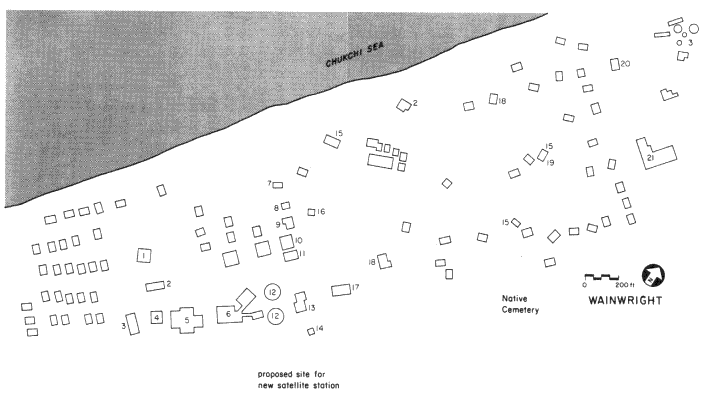
|
Map 6.
Wainwright
leet or Gambell. Nonnatives in Wainwright averaged about 110 persons in the early and mid-1980s. (The differences among the proportions of natives to nonnatives in the three study villages is marked and is accounted for by the real differences among the villages in employment opportunities.)
The Economy and Oil
Wainwright shares in the huge tax revenues collected by the NSB from Prudhoe Bay oil, participates in the federal-and state-sponsored projects that are initiated by the NSB through its successful lobbying efforts, and receives its portion of ANCSA award funds. The NSB's Capital Improvement Projects (CIPs) for Wainwright have provided the greatest sources of funds and construction activity in the village.
Federal construction programs channeled through the regional for-profit corporation, Arctic Slope Regional Corporation (ASRC), have also been formidable. Smaller projects undertaken by the village's for-profit corporation have also had real effects on the local economy and infrastructure. The opportunities for native and nonnative construction workers—both skilled and nonskilled—have been considerable but also temporary.
Infrastructure, Utilities, and Services
The large number of CIPs and federal and state construction projects initiated since 1971 have transformed Wainwright's infrastructure. Practically all natives reside in modern, electrified, centrally heated homes. There is a water system, a partial sewage system (not in the homes), a main gravel road, and several short, lighted streets. The village also has buildings for health care delivery, NSB operations, the village corporation, the city council, storage, schools (elementary and high school), and stores. Whereas the old BIA elementary school remains the focal point of community festivals and occasional visiting, the new elementary school boasts an olympic-size swimming pool, and the high school has a gymnasium large enough for all public functions. A "washateria" is available for use by anyone.
Table 1. | |||
Gambell | Unalakleet | Wainwright | |
Totat Population | 465 | 790 | 506 |
Percent Native | 97 | 88 | 78 |
Percent Nonnative | 3 | 12 | 22 |
Outside of town, a Distant Early Warning (DEW) line installation was constructed in the early 1950s. The U.S. Air Force maintains the installation and employs two local natives at the site.
Education
Until recently, high school students were sent away to Mount Edgecombe, near Sitka. This practice changed when state funds were used to construct a high school in the village. The grade school and the high school are state funded, rather than B IA funded, and both are directed by the North Slope Borough School District.
Governments and Corporations
Wainwright has a for-profit and a nonprofit corporation as well as a chartered city government. As in Gambell and Unalakleet, Wainwright organized an IRA government under provisions of the Indian Reorganization Act nearly fifty years ago. Pursuant to ANCSA, it reconstituted the IRA as the village's nonprofit corporation.
Wainwright and the North Slope region are so dominated by the North Slope Borough, through its funds, projects, and political influence, that the Wainwright IRA joined other nonprofit village corporations in the region to form the Inupiat Communities of the Arctic Slope (ICAS). The ICAS Board of Directors has representatives from each member village; thus, this IRA government is a regional institution with local representatives. Perhaps as a consequence, the ICAS and its local
members exercise much more limited local authority and pursue fewer federal grants, contracts, and awards than either the Gambell or Unalakleet IRAs. The ICAS works closely with the BIA, which still operates within the villages of Wainwright and Barrow (but not in Gambell or Unalakleet), and with the Indian Health Service of the Public Health Service.
Wainwright chartered the Olgoonik Corporation (OC) as its village for-profit corporation. The OC operates a food and dry goods store and several rental houses for temporary employees on various projects. It was also building a hotel and restaurant at the conclusion of our field research. Although the OC main-mined contacts with the ASRC, both the OC and the ASRC were dominated by the funds, activities, and leadership of the NSB.
The OC, for instance, purchased a construction company formerly owned by a nonnative resident. The company soon began to acquire millions of dollars worth of contracts from the NSB for CIPs. The millions of dollars spent by the NSB in the village have not provided a strong multiplier for local or regional industries, but they have provided vast sums to equipment and material suppliers, transporters, and construction firms. Nonnative residents tend to save and to spend their money outside the village.
Wainwright was incorporated as a second-class city in 1972 to avail itself of NSB and state revenues and programs. Its city council is composed of seven members, including a mayor and vice-mayor. By law, the city council has the authority to levy taxes, regulate public safety and morals, regulate vehicular traffic, own and manage public property, issue business permits and licenses, and enforce compliance with state law.
Yet because of the dominance of the NSB and the revenues that it redistributes, the sovereignty of the city government is very limited. Social service and health delivery programs have been appropriated by the NSB and the ICAS. Community improvement projects are NSB programs, as are public safety and fire-fighting, both of which have been ceded by the city to the borough.
The city council, in fact, operates only peripherally as the governing body of a second-class city, even though it establishes its own ordinances (so long as they do not conflict with state
law). Those ordinances are enforced by the NSB. However, the city council provides counsel and guidance, much as its IRA predecessor provided counsel and guidance and much as the predecessor of the IRA provided guidance and counsel to the villagers, that is, through suasion and nominal authority vested in traditional leaders.
Regardless of state law, and even at city council meetings attended by public safety officers who are sworn to uphold state law, recalcitrant persons have been told to leave the city, that is, the village—this without benefit of hearings or trial. Traditional wisdom, not state law, has been followed in the conduct of some village judicial affairs.
In 1982, without benefit of a single, long-term industry or other business capable of sustaining itself in the private market sector, the village of Wainwright had nearly two jobs per household. Natives held two of every three of those jobs.
The average Wainwright native household (4.1 persons) has about 1.5 employed members. Aggregating full-time and parttime employment, the contrast with Unalakleet and Gambell, where 0.6 and 0.5 person per household, respectively, are employed, demonstrates that Wainwright family members are employed at a rate about three times greater than that of either of the other two villages.
Only two Wainwright residents are employed in the off-related industries at Prudhoe Bay, and two are employed at the DEW line station. No Unalakleet or Gambell residents are employed in the oil-related industries and Prudhoe. The bulk of employment for Wainwright natives comes directly or indirectly from NSB projects, and because many of them are in construction, they are also temporary, providing perhaps twenty weeks of annual employment. But the pay rates are high, about $23.00 per hour in 1982.
Nonnatives work on construction projects, and they also comprise the professional staffs that provide consulting and other services in Wainwright through the NSB and ICAS, including health, business, law, science, education, and public safety. The nonnatives are predominantly transient.
The high employment rate in 1982, regardless of underemployment, undoubtedly made the lives of Wainwright's natives
quite comfortable. But not so comfortable that they eschewed their subsistence life-style. For example, Luton (1085) determined that heating fuel and food alone, if purchased wisely and in bulk, would consume about $16,000 per family (four persons) per year in Wainwright. That assumes that all food eaten was purchased in bulk from bush suppliers in Anchorage. Few native families in Wainwright, and fewer still in Unalakleet and Gambell, could afford such expenses in addition to clothing, subsistence technology, and subsistence trip expenses.
When the costs of clothing, technology, and extraction expenses are added to heating costs and food purchases from the local stores, even Wainwright family budgets were severely strained. The twin threats of the depletion of the Prudhoe Bay oil reserves from which NSB revenues derive and the depletion of ANCSA funds have generated persistent concern among natives.
Christianity
The Presbyterian church is the dominant sect in Wainwright. The Assembly of God, a Pentecostal religion, also has a minister and a small congregation in the village. As among the other villages in the study, the natives are devout Christians.
The Environment
The Wainwright environment, from the coast to the foothills of the Brooks Range 100 miles inland, is treeless. It is, thus, tundra, or "barren ground." In the summer, from the vantage point of the air, the expanse appears as a gray-green plain, dotted with ponds and lakes of all sizes and river systems that look like broken spiderwebs.
Precipitation is low, about 15 inches annually. Snow accounts for most of the precipitation. Winter temperatures are extremely cold, averaging about - 16§F in January. The annual mean temperature is a chilly 12§F. Pack ice, anchored to the coast and stretching for miles into the Arctic Ocean, provides the winter hunting territory for Wainwright villagers for six to eight months of each year. The Kuuk River system provides a
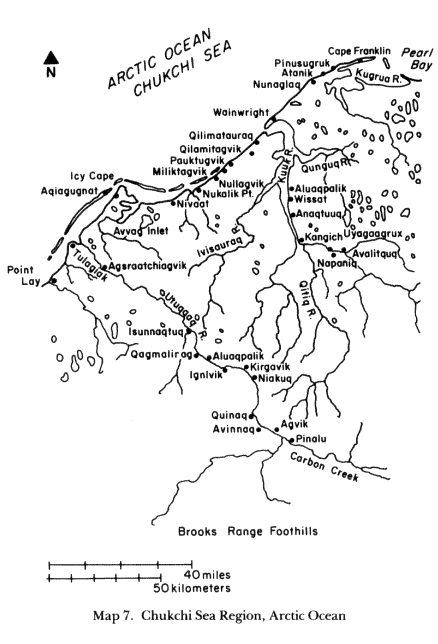
Map 7.
Chukchi Sea Region, Arctic Ocean
frozen highway for snowmachine travel to the interior during winter months and a waterway for motorboat travel during summer months.
Much of the tundra for miles around is matted with roots and stems in which low shrubs—particularly bilberry, dwarf huckleberries, and crowberry—are heavily represented. Reindeer moss grows well through this heath. In some areas, but particularly in a region southeast of Wainwright and Peard Bay, sedges and grasses grow in the marshes and near some poorly drained lakes. At climax, the tundra supports large caribou populations.
During the early 1980s, the northwestern caribou herd south of the Brooks Range was growing and expanding its range at a rapid rate, reversing the decline experienced twenty years earlier. Near Wainwright and elsewhere in the immediate vicinity, caribou were available in considerable numbers, marking a resurgence of the species in the region. In recent years, caribou have provided the most frequently eaten naturally occurring resource in villager diets.
But Wainwrighters remain adapted to marine resources as well, hunting several species of marine mammals, including seals, walrus, and whales. As among the St. Lawrence Islanders, the bowhead whale is the centerpiece of lore, symbolism, community festivals, gifting, and camaraderie, and the annual hunt of the animal provides the occasion for the renewal of crucial Eskimo values.
Polar bears frequent the Wainwright region during fall and winter, seabirds and waterfowl nest in the area from late spring to early fall, and migratory fish, including some salmon, char, and herring species, pass by the coast or spawn in the drainages throughout the territory. A few bird species, such as the ptarmigan, and marine invertebrates and fish species, such as whitefish, sculpin, grayling, burbot, rainbow smelt, and saffron cod, are available in the area year-round.
Resource Availability
A wider variety of species of plants and animals is available near Unalakleet, during more months of the year, than at either
Wainwright or Gambell, and more species are available at Wainwright than at Gambell (see Appendix C for details). St. Lawrence Island residents are very much dependent on walrus to sustain them during the hardest winter months. They cannot jump on snowmachines and hunt caribou. Jigging for fish and winter seal hunting, too, are only modestly productive.